Divorce & Money | What Every Woman Needs to Know
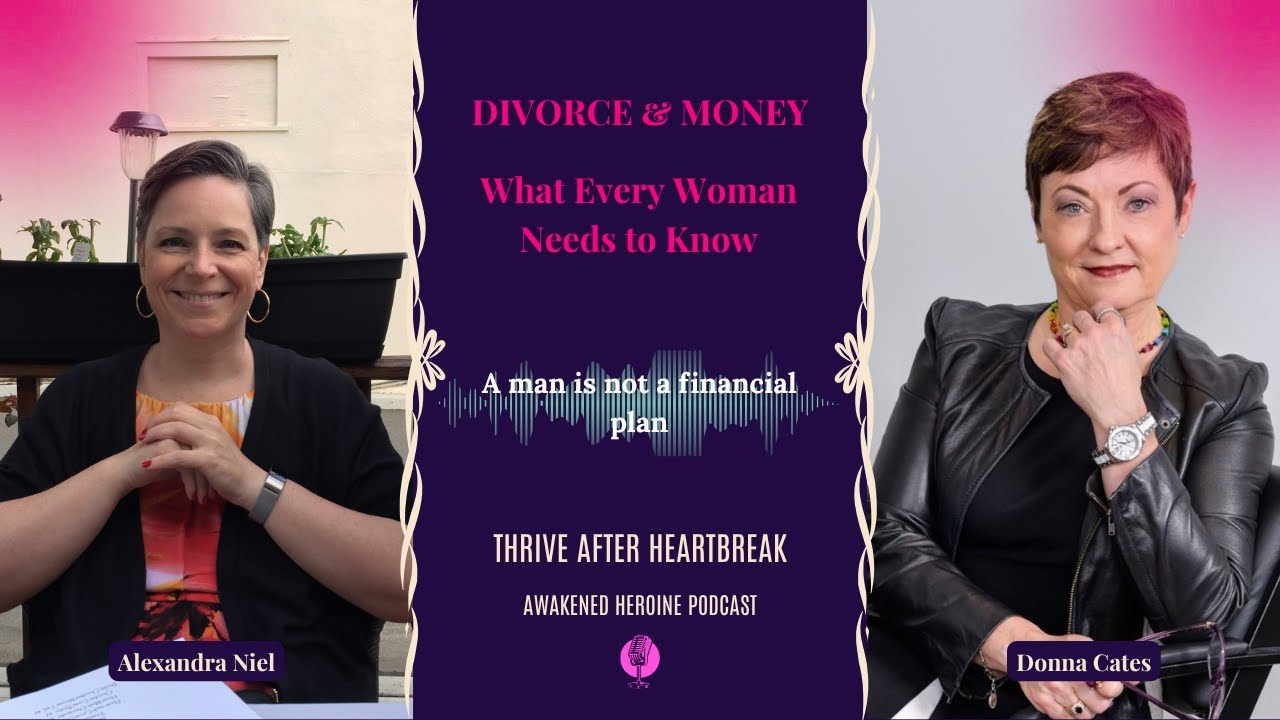
In this YouTube interview, host Alexandra Niel talks with Certified Divorce Financial Analyst and wealth manager Donna Cates about the financial challenges women face during divorce. Donna shares her 25‑year career focus on women in transition, personal divorce experience, and practical advice on negotiating asset division (e.g., alimony versus retirement), deciding whether to keep the family home, uncovering hidden household expenses, and conducting a thorough cash‑flow and budgeting analysis. They discuss the optimal order of engaging professionals—attorney, mental‑health coach, divorce financial analyst, mortgage broker, real‑estate specialist—and the importance of early financial planning. The conversation also touches on money mindset, risk tolerance, and how deep‑seated beliefs affect financial decisions. Donna highlights her extensive checklist, the value of a multidisciplinary divorce team, and promotes her anthology book Divorce Decoded: A Manifesto for Women Navigating Divorce and Beyond, which features contributions from 13 experts. Throughout, both hosts emphasize empowerment through financial education, proactive communication with spouses, and taking a seat at the financial decision‑making table.
Chapters
Hello, heroines, and happy Friday. I am so excited today. First of all, it's a gorgeous day here in New Jersey, uh, but I also have a wonderful guest, Donna. Donna, remember your last name?
Cates.
And I— what the hell?
Anyways, it's Friday.
It's Friday. I was just telling you how excited I was about my meeting, and then all of a sudden everything left my mind. But I wanted to bring Donna in because Donna and I have been chit-chatting for what, about a year now. She had me on her podcast. I wanted to bring her in because what she does is all related to finances, and when we're going through a divorce, um, there is a lot— there are a lot of things to consider. So I wanted to bring Donna in to share some of her wisdom, to also share some of her story, to not just inspire you but hopefully provide you with some information that you're going to be able to take to either your attorney or whatever, whoever it is that you're working with. So, Donna, welcome.
Thank you for having me. And I have to tell you, looking out my window here in Birmingham, Alabama, is equally as sunny and shiny and very humid. So, oh, okay.
Well, at least we don't have the humidity today. It's nice and dry, which is good. Yeah, so it is a beautiful day.
So, and I appreciate your having me on here. And, and I loved having you on my podcast as well. So thank you for the opportunity. So just if I can share just a quick minute about myself. So I have to say that in my financial planning practice, my wealth management practice, I've been doing this work for 25 years. And for the majority of that time, I I have focused on working with women in transition. So that includes widowhood, but my focus is literally with women who are divorcing, because I have found that even as smart as we are, we're running businesses, households, raising the kids and all of that, we often take a backseat when it comes to the money. And when life happens, now we're kind of like deer in the headlights. Oh my God, I don't know. I don't even know what I need to know and all. So for me, it's always interesting when I'm sharing on Facebook and all the social medias, people are going, "Well, aren't you happily married?" Yeah, I've been married for 30 years now. We're celebrating our 31st anniversary this year. So, woo! But I did have a practice run. So I do have experience, personal experience with divorce. So that's just a little bit about me and my practice.
So outside of finances, what makes you, what brings you joy?
I tell you that reading is my absolute pleasure. If I literally, I could just be put in a hole and curled up with a good book, maybe a cup of coffee, maybe a cocktail, doesn't matter. Just the good book, we're all good. But I'm somewhat of an adventurer. My husband and I, we love to travel and we try to go someplace that we've never been. At least once a year. We are— I'm a snow skier, he's a snowboarder, but we do like to ski. But hiking, you know, doing the mountain trips, the beach trips, and all of that, that's wonderful. We got a trip planned for the end of this year to Costa Rica and the Panama Canal. So, but that's our— that's, that's our goal, is we work hard so we can play hard.
And that's how it should be, right? It shouldn't be always working hard and never taking time for yourself and never taking time to actually enjoy the fruits of that labor. So, um, thank you for sharing that. I wanted to ask you this— that question's really kind of been on my mind— is because I remember going through my divorce and it, I, it impacted me in the sense that I ended up having to pay alimony for 4 years. But I paid for 4 years because then he wasn't allowed to touch any of my retirement, which today I'm like Hallelujah! Thank goodness. So what are some of the things to keep in mind, some of the pitfalls, some of the just watch-outs, uh, or just keep this in mind for women as they're going through this not-so-fun transition of exiting their marriage?
I'm happy to share, and I have to say kudos to you, Alex, because you actually made a good trade-off. And this is the thing, is what I want to say in referencing back to what you just shared with us, is that, you know, when we get ready to divorce, everything from the court system is looking at either equitable or as close to equal distribution as possible. So whatever we have, half is mine and half is his. That's the way the court system's looking at it. But what we have to remember when we're going through the divorce, you know, the day you hire an attorney, That attorney is prepping for court. That's, that's the litigation process. But the goal is for the two of you to be able to negotiate, whether it's between yourselves or your attorneys and his attorney. But it's the negotiation process that gives us the control and allows us to keep power of our personal situation versus a judge having control. But I bring back to what you just said. You elected or agreed to pay alimony for 4 years in lieu of having to give up your retirement money. So that's a huge choice. So that's kind of the thing that we need to be cognizant of, you know, when we're negotiating how we're going to divide all the things that we have, the home, the retirement assets, the bank accounts, the material stuff. We really have to say, okay, what's important to me? What are my priorities? What are my goals? What are my values? All of those things. Then we look at that laundry list of all the assets that we have and we say, okay, what does it make the most sense for me to ask for? And sometimes it may be, and I'm going to share this as an example because this is often a very large problem for women. Especially with women, women with younger children. Those women typically will say, I'm keeping the house. I absolutely do not want to disrupt my children. I don't want to move them out of their school system, the only home they've known, whatever that story is. But we're emotionally attached to that home. But we're making that emotional decision, Alex, without understanding all of the financial consequences of that. So this is a little bit of a long explanation, but it's worth going over because the first thing is, is if you've got a mortgage, it's likely in joint name. So that means that if you're keeping the home, you're going to have to refinance the mortgage in your name. Do you even qualify? Do you have enough earnings to qualify? Do you have a good enough credit score to qualify? And not only that, not only do you have to qualify for getting the mortgage refinanced, you have to be able to afford to buy your spouse out his share of the equity without using any of your joint assets. So like you, you forgo— I mean, you decided to pay alimony in lieu of giving up any retirement asset. Somebody else may say, well, I'm giving— I'm going to keep the home and I'm going to give up a part of my 401 account so I don't have to buy my spouse out. But that's the thing that I want to have people understand, is that you can negotiate those things, but it behooves you to work with a certified divorce financial analyst who can help you understand what the financial impact is going to be of any of those choices that you make.
Yeah, and I feel like going back to what you said about Often women don't have the visibility because the husband might be the primary breadwinner. He might be taking care of all of the investments and all of those things. When I went through mine, I was like, I don't care what it costs, just get me out. I was like, it was like I was paying for my freedom, right? And, and it turned out like, looking back, I am so glad that I did it that way because we didn't have children and I didn't want to be tied to him. For the rest of my life, right? So in terms of— so you talked about keeping the house, and I totally get the whole emotional attachment to the house, and in a tumultuous time, being able to provide children with stability, right? Hugely, hugely important. What else need— do they need to keep in mind? What, what are some of the, the things that you see most often that kind of like just keep coming back?
The most common thing is underestimating what it costs them to live. And in this day and age with credit cards and all of that, you know, we, we just get— we have income, we spend, we— it goes wherever it goes. But I think most women underestimate what it's costing them to live the lives that they're accustomed to. And you are doing yourself a disservice if you really don't dig down deep and identify all of your living expenses, because what it's costing you to live now is actually what's used to determine whether or not you might need alimony. Now, that doesn't mean you're going to get it, because the reality is, is you're living in a household right now, whether it's one household with two incomes or just one, now you're separating that out. You've got two households with the same amount of income. So the standard of living may change. But if you want— if you're expecting to receive any kind of extra support above child support, it's important that you know that you are truly identifying those living expenses. And I'll give you an example. Pest control guy shows up at our house last week, and I'm working, I've got a home office, and he's expecting me to stroke him a check. If you had asked me, if I had gone to an attorney and they gave me a budget list, that's the last thing I would have thought of is covering pest control. But, you know, there's more to expenses associated with a home than just the mortgage. You know, you've got repairs and HVAC and homeowners association dues, all of the things that we really have to, you buckle down and figure out where is it we're spending money. And the other thing is that the benefit of doing that exercise is if you discover that you are going to have to adjust your lifestyle post-divorce, now you can clearly see where you're spending money that doesn't align with your priorities.
And it also allows you to maybe make a different decision with regards to whether or not you keep the house, because the best option might be to sell the house, stay in the same neighborhood, right? So the kids have that stability, but maybe that house then becomes more of a burden than a support.
Absolutely. And that's the case. And I, I can tell you, the house has been the biggest issue for most of the people that I've worked over— worked with over the 25 years that I've been doing this. Because they end up keeping the house and then realizing that they can't afford it. They keep the house, and I had one situation, the woman kept the house, but she did not realize that there was no equity in the home. She did not take on any of her ex-spouse's 401 money because she was going to keep the equity in the home, but he had actually used the home equity line of credit. So when she ended up trying to refinance, she couldn't even qualify. There was no equity in the home, so she ended up having to sell it. But that— the home is typically the most complicated. But you're right, identifying those expenses really helps you make more informed choices.
So you talked about— you gave the example of the pest control. Are there other things that are kind of like hidden expenses? That you might not think of right away because you might be less involved in the finances, but that really can make a big difference?
Oh, I can think of 100 things. So think of this, like homeowners association dues. We only pay ours once a year. Some people have them, you know, where it's paid on a monthly basis. But if yours is once a year, car tags, you know, everybody's driving a car. If you've got a new vehicle, that's a big expense. If it's an older vehicle, maybe not., but it's something you got to spend money on every year. What would be other examples? Going to the gynecologist, you know, all of those doctor's appointments, you know, we may not be thinking about the expense of out-of-pocket, you know, cost. And speaking of medical costs, you know, if you're on group insurance right now, if you're on your spouse's group insurance, you're going to have to come off of it. You can stay on it for 36 months using COBRA, which means you pay the full premium price, not the half that he's been paying through his employer. So it's best for you to go ahead and look on the open market to see what would it cost you to get your own health insurance. But see, these are just things because they're not front of mind, they're built in. I mean, like we pay for our health insurance every pay period, that's not front of mind, it's just it automatically gets paid, life insurance premium payments. Yeah, I could go on forever with all of the things that we just— and that's why I've got a very extensive checklist. All of the attorneys in my area know if I've met with somebody when that person goes to the attorney because they come with a detailed budget.
So in what's kind of the order in terms of meeting with the different professionals? Because You're a financial professional. We have attorneys, we have mediators, we have all of these other professionals. When, when should people really take a look at their finances so that they're best equipped to make the best decisions?
Ideally, you would be looking at your finances the minute you start thinking about divorce. Now, if you're the one that's choosing divorce, that kind of puts you in the power seat because you've got time to plan. If divorce is being thrust upon you, now you're going to be in a little bit of catch-up mode. But I will tell you that there are several people that you want to have on your divorce team. We automatically go first to the divorce attorney, and that's not necessarily the most practical place to start, but it's not a bad thing because you do need to be represented. But if you are meeting with a divorce attorney, it behooves you to also be working with Number 1, mental health professional to take care of yourself and your kids, possibly a divorce coach that's going to help you unpack, you know, and regroup for the future, a Certified Divorce Financial Analyst like me to help you unpack and understand all of the moving pieces of your financial well-being, and also other professionals. There are real estate professionals that have divorce designations as well as mortgage brokers.. So like, if you're thinking about keeping the house, you need to be talking to that mortgage broker now before you've signed the dotted line on any decree. So there's really, you know, the best thing is being in a planning mode versus a reactionary mode. But if you find yourself in that, you know, reactionary mode, just know that there are steps. And this is one of the things that I pride myself on with my divorce community. I'm kind of, I'm known as the the connector. I'm the one that says, "Ooh, well, you haven't thought about this. You need to know." And I will actually connect people and cross-refer to the appropriate professionals wherever they are throughout the United States. So, you know, knowing that you're working with professionals that are well connected and that know how to stay in their lane. When I first started doing divorce work, I was so nervous about divorce attorneys thinking that I was trying to impact their clients' outcome. And I was, but I was trying to help them look better by helping their clients make more informed financial decisions, right? But that's what I learned, is that divorce attorneys know about assets and what happens with assets, but they're not experts in forecasting and looking at tax consequences and such. So knowing that you've got to a team of people who are looking at a specific aspect of your divorce. That's really crucial.
Yeah, I agree. I went through it. We had one attorney when I went through my divorce that dealt with both of us. And sometimes I feel like I didn't get the best deal for myself. But like I said, I was like, I just want to be done. I was done. I was like, okay, it took me forever to make the decision, but once the decision was made, I was done. Um, I want to go back to what you talked about, you know, identifying the living expenses. Is that something that you also work with, um, with women about? Because it's kind of like budgeting and things like that. Is that something you also do, or is that out of your wheelhouse?
No, absolutely. So first and foremost, I'm look— we're looking at financial planning and, and building wealth. So that you can do the things that are important to you. So ideally, when I work with a client, they come to me in a financial planning relationship. And what that allows us to do is to literally do a deep dive into all of the moving pieces of your financial well-being. So we're going to look at cash flow. What do you have coming in? What's going out? Enhance the expenses. And because I can ask somebody, and a lot of financial professionals will say, Well, how much discretionary cash flow do you have at the end of the month? I don't know, $2,000 one month, I might have $5,000 the next month or zero the next. So no, we want to dig down into the expenses and see where the money's really going. But yes, so I work with people in a comprehensive relationship so that we're not just saying, oh, you're an aggressive investor, let's put your money to work in an investment portfolio that's going to get you the best returns.
That discussion sounds familiar.
Yeah, right. So the key is, is that a lot of us don't even have any idea how aggressive we are. I will have women tell me, oh my gosh, I'm scared to lose anything. I'm conservative. Then I look at their statements and they're currently, you know, they've got 100% in the stock market. I'm going, ooh, okay, this doesn't match. But that's part of what I do with clients is help them understand what is the risk they're taking. And does the risk that they're taking align with what their priorities are? And I have to share this with you. I had a client yesterday ask me about, you know, expected returns. You know, none of us can tell you what you can expect return-wise. As a financial professional, we can give you an estimate on what you should get based on your allocation. Okay. But, but this woman was— somebody had told her that, you know, she could get a 6% annual return. I'm going, okay, number one, they shouldn't have told you that. Number 2, it really does depend on how you're invested and it depends on how much of that you're going to get to keep as well. So there are a lot of things to unpack in there, but that's, that's what I love doing. And I'm going to share with you, I'm going to be bold and share this with you. I'm all about educating women about money because a man is not a financial plan. That's my tagline. Okay. And that's not meant, you know, as a negative to men. It's meant, girls, we have to pull up our big gold britches and have a seat at the financial table.
You know, it's interesting because I grew up learning that you don't talk about religion and you don't talk about money. Right. And I think that is a mindset that's been kind of following me my whole life. And I'm working on kind of dismantling that, especially the money piece. So is part of the work that you do mindset related? And if so, how do you tackle that part when you've grown up with these ideas that maybe aren't serving you in today's day and age?
Absolutely. Well, I will tell you, I deal with money mindset every single day. So, you know, using the example of the, you know, the client that says she's conservative, but now and she's got aggressive investments, you know, that there'll be a conversation where she's going, "I'm aggressive. I'm aggressive today because the market's doing absolutely fabulous. But tomorrow, you know, the market's tanking." And she's going, "Oh my God, I gotta be conservative now." So it's kind of flip-flops. So I'm dealing with that every day. What I will tell you is that if you really, you know, because we all have embedded beliefs, We learned everything as children. All of that is deep-seated and it's in there. And it raises its ugly head or its pretty head all of the time. So if you're struggling with anything like that, I'm going to say I'm not the expert on mindset. I would refer you to a coach, a life coach that can help you unpack all of that and then figure out how to move forward. I can deal with it and tell you how it's impacting your day-to-day and helping you be more comfortable with taking on defined risk. But you're, you know, if it's really deep-seated, we want you to work with a professional that can help you untap that. Because the thing is, is as long as we have a belief, if we're thinking it, that's our reality. If we speak it out loud, We just made it even more real.
Yeah, it's very true. But it is also, like you said, it can be so deep-seated. You don't— we behave in ways that we don't even realize simply because it's part of our programming. So at some point you have to deprogram or install a new version of the software that is going to, uh, to, to serve us, to serve us more. So Um, so you had— you've now been in this 30-some, right? 30 years, 25 years, 25 years. Um, and but you said you did have a trial run, so tell us a little bit of course.
Yeah, the divorce. Yeah, 30 years. I was thinking career-wise. Yeah, 30 years married. Okay, married young. Um, and, and You know, it's in hindsight, you know, everything's 20/20. But I married young. I was in college and got married before I finished, which was a mistake because now my ex's name is on my degree, my diploma. But we don't think about that, do we? But so, so yeah, so I had a trial run. And this is the thing for me. It was It was not expected. We had been married not quite 2 years. I came home from work after having been on a trip. I think I was out of town for about 5 weeks on some training. And apparently while I was gone, the other person had an opportunity to discover they must like life better without me because I came home and a few weeks later— this is a very vulnerable story, but I'm going to share it. I was driving home on a Friday afternoon from work and, and I was late. Okay, ladies, you know what we mean. So I was late and I said, oh my God, okay, this never happens. And so I stopped and got a pregnancy test. I thought, you know, oh my God, I might be. And I'm going, oh my God, what am I— I'm not ready. Oh, all the horrible things that I was thinking. But then I got home, you know, and I'm walking in the door going, I might have some exciting news. He's going, well, I got some news too. And that's when he told me that he wanted a divorce. My world crumbled. Number one, because I thought I was pregnant. Luckily, I ended up not being pregnant. But that, you know, it was the reality because immediately for me, the things that were going through my head is, how the heck am I going to raise a kid on my own? Oh my God, how am I going to afford this house. Oh my God, I don't want to be alone. I didn't do this. I don't like this. What did I do wrong? You know, all the negative things. In hindsight, it was the best thing, but it took me a few years to see that.
Yeah. And, you know, it sucks when it happens, right? Even when you're the one who's leaving, right? Because what happens is if you're the one who wants the divorce, you've done your grieving before you ask for the divorce. If you're the one who's being, for lack of a better word, left behind, your grieving starts from that moment, right? So there's a different— it's a different grief experience for the two people that are, that are involved. And I wanted to go back because you said you were very young, and this takes us a little bit off course but not really. Do you have any advice for anyone who is— who might be watching this, who is considering getting married and stumbled upon this discussion? Anything that is important for them to know before getting into that contract?
Absolutely. And I so appreciate you referring to the marriage as a contract, because that's exactly what it is. It is a business decision and we don't treat it that way when we're getting married. So, and it sounds so negative and it's not to poo-poo on anybody's marriage parade, but it is asking you to be a responsible adult and understand what you're getting yourself into. So it's, having a great relationship is wonderful. But with that relationship comes all the baggage, and money is part of the baggage. So you need to be having a conversation, not shying away from talking about money, but understanding what do you make? What's he make? Who's going to be responsible for what? Knowing this, you know, are y'all even on the same page? Is he a spendthrift and you're the saver? You really need to have a conversation about your money, your money expectations. And if you're not on the same page, now you're going into the marriage knowing that, and you are at least better prepared because you're knowledgeable of it and you can attempt to manage it. But there are some situations where people are just so far removed from the conversation They've never talked about money, and now they find out that their new spouse has a gambling, you know, history, that there's significant debt, you know, all of the things. Anything's possible. But if you haven't had the conversation, then, you know, you're basically to blame, and you don't want to be in that situation.
So I'm thinking about a woman who is considering leaving her marriage, okay? And she's never had a discussion with her husband, or they've never really openly talked about finances. And yet you said before it's good for you to start engaging in that financial understanding before, you know, things go too far down the road, or— and so how does, how does one begin to engage in that discussion when the discussion's never actually taken place?
That's a good, good question. So if you've already spoken the D word, you know, any conversation that you have with your spouse is going to be viewed as you preparing or a potential threat. If you've not spoken the D word with your spouse yet, now you've got a little bit more room, because if y'all have never talked about money It could be as simple as you saying, oh my gosh, my friend's mother lost her husband or what, you know, some story that, you know, and now her mom knows nothing about the money stuff. And I don't want that to happen with us. You know, let's have a conversation about, you know, where's our will? What, you know, do we have life insurance? You know, let's kind of uncouch that so that we, you know, because if something happens tomorrow, I don't want to be left in the dark. You know, who do I call? I mean, if you were to meet your maker tomorrow, you know, who do I call at your company? How do I find out about your 401? All of those are legitimate questions and concerns because any of us could meet our maker tomorrow. So I think, you know, having that conversation is prudent. And you just have to pull up your big girl britches again and just say, you know, hey, I deserve, you know, this is a relationship, it's a marriage, we're both contributing, whether it's financially or not. We both contribute to the relationship, and it's only fair that we both be knowledgeable about our circumstances. So that's, that's important. Now, working with a professional like me, because some people will come to me and they go, "I don't have access to any of this information," and that's okay because I'm going to empower you by telling you all the things that you need to be gathering. So you kind of become your own private investigator. And it's a little different now than it was 10 years ago. You know, I used to get a pay stub, you know, handed to me. Now everything's done electronically. If I wanted to know what my husband's income was last month, I'm going to have to ask him to share that with me, right? Or I can look at last year's tax return and see the W-2 or the K-1s or what have you to see what his income was for last year. So, but now it's a matter of, you know, you looking and paying attention and me having that long checklist that says, do either of you have a pension? Okay, that's something we need to value. Do either of you have old 401s at previous companies that you're no longer working with? It's kind of a discovery process. So, it's a tool for you to be able to say, heck, I have no idea. But again, you can, if you don't own a business, strike that off the list. You don't need to keep looking at it again and again. If you don't own a business, scratch it off, go to the next bullet point. Ooh, yeah, I've got that. Oh no, I don't know about that. So now when you go meet with your attorney, you're going with the information that you do, but you also have the checklist of saying, here are all the things that I don't know. Help me figure this out.
Yeah, that's— thank you for sharing that because I think it's— I mean, just to hear you and putting myself in a woman's shoes who has to have that discussion, even like sitting here and it's not impacting me, but I've still got a little bit of anxiety around. That's not an easy discussion to have. So yeah, it is about gathering that courage to be able to, to have that discussion. So, um, any— what was your biggest lesson from your divorce?
My lesson— I'm going to say my divorce probably wasn't the best one for the lessons, simply because I was involved in the financial conversation. We were married less than 2 years, so So there wasn't a lot there. The lesson that I will tell you I took away is that even as distraught as I was when that was laid in my lap, the hindsight's 20/20. I did recover from it. This is the big takeaway, though. I had issues myself because I contributed to why we were getting divorced, and I had to acknowledge that. It took me a little bit of time. Because I kept attracting the same type of man. And it took a couple of relationships where I'm going, hmm, this doesn't seem right. But because I was open to seeing this, I was able to do the inner work that I needed to do for myself so that it would put me in a position that I was no longer attracting that particular type of person. And that in itself, you know, I had to own my own responsibility. And then I had to take responsibility for who I wanted to become. And knowing— and that's the thing, is there's light at the end of the, the tunnel. When you get through with divorce, life's not ending. There is the future, and that's what we're working to improve, is, you know, you being your best self going forward.
Yeah, I love that because it is true. There is— there's a reason why this is happening and you can choose to let it destroy you or you can choose to let it empower you. And it's a very different way of moving on from the experience. And I fully believe in being empowered by the things that happen in our lives. Um, and the difference is something happening for you versus something happening to you. And just that one little word difference, it makes a huge difference. So Donna, any, anything that you think is important to share that we haven't put on the table yet?
I think you've done a great job uncovering a lot that I would say takeaways are number one, don't be afraid of money. Number two, pull us back. Make yourself a seat at the financial conversation table. And if you need help with that, we can certainly help you get to a place where you're comfortable. But just allow yourself to be empowered with knowledge. And if you haven't decided on divorcing yet or not, that's okay. You're in a good space because you can do the investigation and learn the things that you might need to know that you aren't even aware that you need to to know. So getting the education, understanding the different processes, understanding what your financial reality might look like, that's all empowering because that's going to help you make more informed decisions if you choose to navigate that path.
Beautiful. Anything you want to mention about that book behind you?
Oh yes, let me do a quick share. This is a book. It's actually Divorce Decoded: A Manifesto for Women Navigating Divorce And Beyond. And what's unique about this is it's an anthology. So I'm the, the author, but we have 13 different professionals who are writing about divorce from their professional and their personal experiences. So we have everything from divorce attorneys, divorce coaches, counselors talking about the kids, real estate agents leaving the house, um, all of the things, and even recreating yourself post-divorce with style and photography. So it's a really good read and it's available on Amazon.
Very good. So throw the links in the comments, um, so that people know that, uh, that that's available. Donna, thank you so much for being here with us.
You're very welcome. It was my honor and I appreciate it.
Oh, my pleasure.









