Divorce Was Harder Than Cancer | MJ’s Bold Truth About Emotional Healing
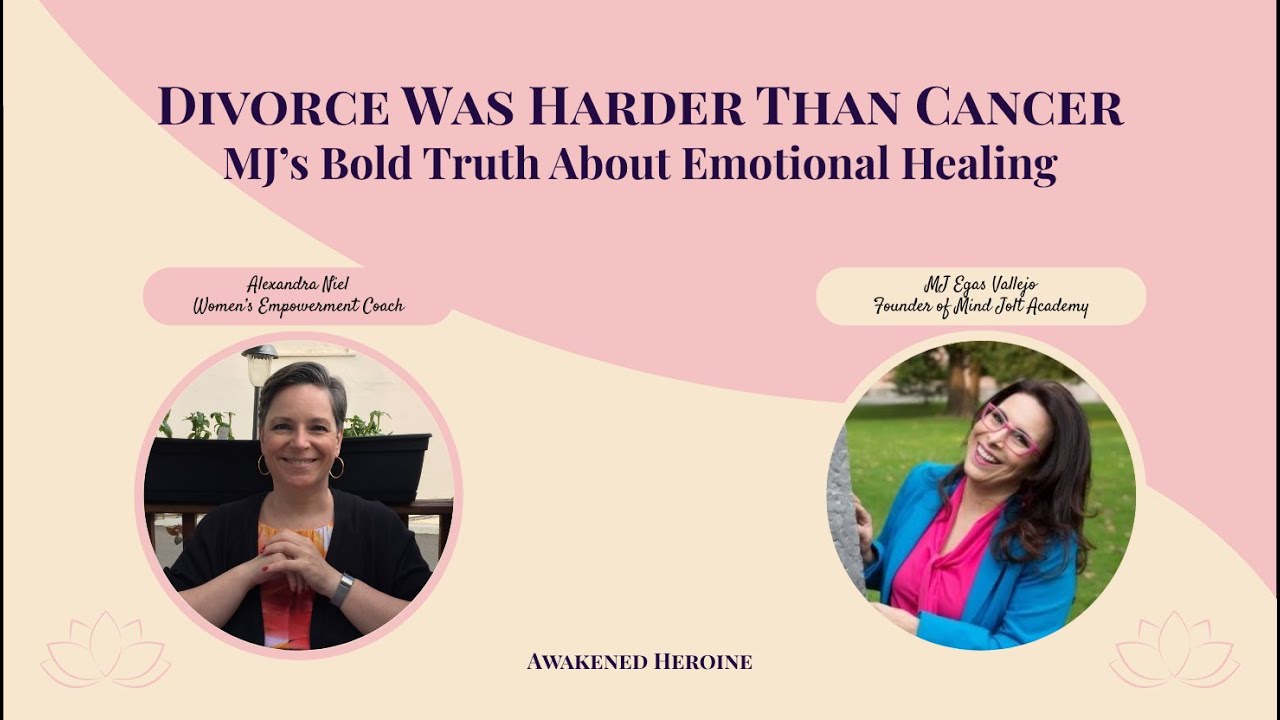
In this intimate interview, host Alexandra Niel sits down with MJ, an Ecuadorian‑Swiss high‑performance and emotional‑intelligence coach who survived two cancers—colon cancer in 2020 and an aggressive non‑Hodgkin lymphoma later—and a painful, codependent divorce. MJ explains how the illnesses forced her to confront deep‑seated trauma, leading her to study the link between psychological patterns and disease (citing Gabor Maté) and to pursue therapeutic coaching. She describes the differing physical and mental impacts of her two cancer journeys, the ways she cultivated patience, creativity (painting, choir), and self‑compassion during recovery, and how the experience opened space to heal family relationships, especially with her father, and to re‑evaluate attachment styles. MJ shares hard‑won lessons about boundaries, over‑extending to help others, and the importance of allowing support rather than controlling outcomes. The conversation expands to broader themes of emotional pain versus physical pain, the role of crisis as a “messenger” for personal growth, and practical advice for listeners—particularly women navigating divorce or toxic relationships—on recognizing unhealthy patterns, setting and enforcing boundaries, and embracing the discomfort of healing. Throughout, MJ’s tone is candid, reflective, and encouraging, offering concrete tools (therapy, gratitude practices, positive reinforcement) while emphasizing that true worth is inherent, not earned through over‑performance.
Chapters
Hello, heroines! Welcome back to our second interview today, and today I have the pleasure of bringing a dear, dear, dear, dear friend of mine, MJ, to the show. Hi, MJ!
Hey, Alex! Hey, everyone!
So MJ and I have known each other for, oh, I don't know, 10 years or so, something like that.
And she and I Wow.
So yeah, you're right, it is 10 years this year, and she's got an absolutely incredible story. She's a woman I have a lot of admiration for, a lot of love for. She's an incredible human. And so MJ, why don't you tell us a little bit about yourself and what you do?
So I'm originally Ecuadorian but been, uh, 31 years living in Switzerland. I am a high performance coach, an emotional intelligence and resiliency coach, and now I'm in the last level of therapeutic coaching, which was something that I decided to explore after my last cancer. And I say last because I had two different instances of cancer, colon cancer in 2020 and last year an aggressive non-Hodgkin lymphoma. So these two challenges have kind of made me change my purpose. With the first one, I wanted to— because I was— I had already— I mean, I feel lucky that I had so much personal development that I was able to go through that challenge in a different way. So almost enthusiastic to a lot of people. Well, you're crazy. How can you be enthusiastic about cancer? But I, I decided to like, okay, you know, this is here. How can I make it work for me? How could I go through it in a better way that is going to be helpful for me? So I asked myself that question. It's like, I cannot bypass it. I have it in front of me. What can I do? So that made me, because it worked for me and I went through that difficult challenge in a way that I felt this was something that I perceived to be happen fast, even though it wasn't fast. And then with, you know, when you raise your hand and say, hey, I want to help people with this. I don't know, the universe says, well, here's another challenge, uh, so you can learn more. So, uh, I had this, uh, different, uh, type of cancer, which, uh, was a little bit more destabilizing because it was more aggressive. So also treatments were more aggressive. And then I got really interested in, in trauma, uh, and how, uh, there's this connection between trauma and illness. So I've been going the rabbit hole because the more I read, the more I realized that there are a lot of scientific studies that correlate a specific, you know, psychological profile with cancer. And there's also, if you're interested in this, Gabor Maté wrote The Myth of Normal, which it's basically about trauma and illness. And it correlates, you know, all these emotional aspects to a lot of different illnesses, not only cancer. And the more I'm studying for this therapeutic coaching, the more I realize that we have to address these emotional aspects, you know, things from your past. And with these cancers, for me, it was very— it was an opportunity to address things that I never addressed before. So for me, that was like kind of the collateral beauty in these challenges. And I had been in a, let's call it, toxic relationship. But I believe I was co-toxic too, because you learn ways to cope that then, you know, make you attract certain people that, you know, make you feel needed, and you end up, you know, giving to no end. And doing things that, uh, you know, a lot of self-neglect in trying to help and save and rescue. So I come from that, you know, very codependent, uh, kind of trying to fix, rescue. And, you know, sometimes you cannot rescue if they don't want to be rescued. So that was actually what brought me to personal development, and that's how I met you, because I wanted to find something actually to you know, help him. But in the end, I ended up helping myself, uh, and that brought me to, you know, a lot of learning, a lot of healing. But also, you know, now that I, uh, see it in retrospect, I can see how a lot of the things that I went through is like created some illness. So the, the real challenge now is to heal all that, to heal all the, all the coping that, you know, that sometimes, uh, there is certain behaviors that get, uh, that people wear like a badge of honor thinking it's a good thing, but actually is unhealthy coping. Right? Like people pleasing, like always trying to, you know, make everyone happy and leaving your last— I don't hear you, you're muted. So that was something that really made me reflect. And then I was like, well, what else is there? And what else I haven't healed? So that brought me to have, yeah, like You know, I was like scratching the surface and I think both of the cancers, but especially the last one was like a framework, not a framework, sorry. Like a, just like a frame through which I could see maybe things that I hadn't addressed. So I started having conversations I never had. Uh, I did a lot of therapy, you know. And it's been really incredibly healing. So I believe that sometimes you have to get really sick to heal. So, so what I'm trying to help people with is when something really bad happens, not, you know, after the initial shock, not take it as like, well, why is this happening? Why me? Or whatever. But see it as a kind of a rude messenger that, you know, and sometimes because we are so concerned about why, why me, or that we forget to actually see the message. So for me, the message was that it's like all the things that I need to look at, and I'm really happy about that. I'm really thankful And sometimes I even say, you know, if I could go back and maybe choose, would I choose to have those two things again? And it's like, but I love the person that I'm becoming. So, so that's what I'm helping people with, deal better with when something really bad happens and destabilizes you and you don't know anything. What's going to happen is like, okay, if you're already going through it, Can you go through it in a way that's going to be helpful, not maladaptive? And can you use it? Can you even, you know, take advantage of it to grow, to heal? And can that pain that you're going through can become even, you know, more purpose? So that's where I am right now. That was a long answer for your question.
It's okay. You, you've— I mean, you and I have been, you know, talking for, um, for a while, and we talked through both of your, your cancer journeys. How are you— how was your second cancer journey different from your first one?
So, um, the first one, I, I think, uh, um, if we talk about like medical treatments. So the first one had more surgeries.
Okay.
And that was hard in itself, but those things for, at least for me, were less impactful than, uh, the last one where my mind was also, uh, impacted. So I, I didn't feel any difference mentally with the first one, but this second one, I was fatigued. I couldn't focus. I had brain fog. And that for me was scary because I've been always very cognitive and always kind of pride, had a lot of pride in my, uh, brain. And then you don't have even that. So that for me was very destabilizing. Uh, so I've been kind of healing, healing. It's been a year and a half since I, I was done with treatments. So it takes time. And also that brought, uh, also healing in itself because I started to being, uh, to be more compassionate, uh, for myself and being kinder and just accept because sometimes you want to like, okay, chop chop, let's get to where we were, and your body is like, no, sorry, we're still healing, you have to deal with it. So that brought more opportunity for me to be patient and to embrace other things. So I started painting, I started doing other things, I enrolled in a choir. So there was a moment where I said, okay, with that attitude, I was like, okay, I get it. I need to have patience and embrace this journey. So, uh, really embrace the unknown and say, well, you know, let's, let's see, how can I still be, uh, you know, worthy even if I'm different right now? Can I still love myself even if I'm different, even if I'm slower? Even if I forget things and drop everything. And, you know, so, so that brought, uh, some really interesting reflections.
Yeah. And you healed more than just your cancer, right? You healed— you healed your relationship with your— with your dad. You healed other kinds of—
oh yeah, for those were like things that I said, this is interesting to, to do right now. So Like I said earlier, it just brought me to say things that I never said before and to be vulnerable and to want to really do the uncomfortable work.
Yeah.
So actually, last week my dad was here for 3 weeks. Which I never spent time, quality time with him because I didn't grow up with him. And he came for my son's wedding. So I talked about a lot of things I never talked about. And I had to basically do, go back into your own narrative and kind of substitute certain things that, you know, sometimes you get this idea and sometimes it's just, you know, lack of capacity. Sometimes you have to substitute, you know, rather than malice, it's just stupidity. So I had to do that work and I had to— it was very funny because, you know, past generations, they didn't have kind of the psychoeducation we have right now and the access to information. So they were like, you know, walk it off kind of thing. And there were many moments where, I don't know, there was an instant that we were stuck in a car driving back from the hotel venue, you know, for the wedding. And he was like, oh, but I'm showing up now. Like, can you just let it go? And I was like, it's not that easy. Have you heard about attachment theory? So basically I was like kind of explaining how it's difficult to trust when, you know, you had that kind of inconsistent love. And I was like also explaining because that made me also pursue emotionally unavailable people because they felt familiar, right? So I was explaining all of these things and he was like overwhelmed with all of this, but you know, very, uh, he was overwhelmed, but he was a good So I started, you know, kind of explaining, this is how, you know, having an inconsistent father and mother in my case, it creates certain coping, right? So it's been not only healing from that side, but also kind of seeing the whole, you know, everything coming full circle, understanding why things happen, but also how you can change them and how you can, you know, even be stronger and, you know, help other people with it. One of the things that when I talk to clients or my friends, they say, wow, you can really articulate, you know, what I'm going through. It's like, it seems you know what I'm going through. It's like, yeah, because I did. Right. So it's not that I cannot say that I have healed everything, but I feel really confident about where I am in this journey. So I feel very lucky and blessed that I had this opportunity because I, you know, sometimes you get sick and you say, well, it sucked. I got sick and that's it. But I I felt that I really took it as an opportunity. And, you know, with my first cancer that I had, actually, I had the luck to actually look at my shit because I was, you know, carrying this ileostomy bag and it's transparent. And then you see your shit. So I was like, wow, this is a metaphor. It's like, what other shit I'm not looking at? And what can I do about it? So, you know, that's how it all started. It was just me at the hospital looking at my shit and saying, what other shit I haven't looked at?
You know, it's amazing to hear your story because it's really ultimately a story of healing, right? And there's so many different things that we need to heal from. In your case, it was Cancer leading into healing of other things. For others, it could be divorce, uncoupling, and having to heal from that and discovering new things about yourself so that you can heal those parts. Because like, I talk to women who say, you know, I'm always talking to the wrong guy, I always attract the wrong guy, what is wrong, you know? And, and the thing is, it goes back to what you were saying because of the— your attachment style. You attached to people that felt familiar even though it wasn't healthy. So at the end of the day, it is, and people may not realize this, but it is a choice. But you have to be aware that it is a choice.
Yeah, usually you're not, because when, when you call, you know, passion, and it's because your nervous system is triggered, you know, and they make you feel all those, you know, butterflies and everything. And most of the time that is because there is something reminding you of your history. And sometimes you are kind of, what's the word, you feel like you have to prove your worth and you start doing all of these things and, you know, and basically you leave your post. You are abandoning yourself in order to do all these things to kind of prove, uh, your worth so, so you are loved, so you are chosen. So, so that was my case. And then when I finally did like a lot of, you know, uh, almost studying, because I, in, in trying to heal, I, I went through a lot of courses and read a lot of books And then I realized, oh, here, there's a pattern. I want to save people to, you know, to prove my worth, to justify my existence. And then I said, no, I don't want to do that anymore. So I actually rewired my brain and say, I don't want to be attracted to these people. I don't need saving anybody. Uh, so then Guess what happened then? Somebody arrived that wanted to be there for me very consistently, and that was even there through both cancers. And I always joke that, you know, sometimes you are attracted to pizza and chocolate, you know, because it's exciting, but it's not good for you. So now I'm attracted to broccoli. Very good for you, but it can be, you know, sometimes It's not going to give you those incredible highs, but also it doesn't give you those incredible lows, right? So you have to actually do something that might feel counterintuitive and really teach you to be attracted to people that are good for you, that are consistent, that are calming. And I—
And that doesn't mean that they're boring.
Yeah, exactly. It's something that we, you know, we believe wrongly. But also not be attracted to those peaks, right? And listen to your nervous system because sometimes we are so uh, how, how would I say, we are so distracted with so many things, we are pursuing so many things that we don't realize we're not listening, uh, to our body. And there are a lot of people that are going to be, you know, that calming energy, and those are the good people you need to be with, not the ones that, you know, uh, throw you off your center. That you have to feel like either you have to save or to prove or to do something that is not authentically you. And that's a signal we need to pay attention to. Every time you feel like you have to be in a different way, that you cannot be yourself, that you have to hide a part of you, or that you have to perform. Yeah, like you have to perform or just kind of sacrifice things to earn love, that's bad, and it's never going to bring anything positive. It's only going to be to your detriment. So I had to learn also to be in my feminine energy, which is, you know, feeling and being vulnerable. And almost I had to really— I remember at the beginning where this guy wanted to be there for me and was offering, okay, I can do that for you. And I almost wanted to say, no, I can do it, don't worry. And that's like, no, he's like, let him do whatever he wants to do, right? And, and the more you let them, the more they want to do it. But sometimes with our independence with our, you know, trying to prove, uh, so many things, we don't allow people to be there for us. And then, then they don't feel like they can, you know, contribute to add value. So you have to allow them. So I had to— I, I saw how many times I had to bite my tongue and say, yes, would you do that for me? Thank you. And it was so hard.
I totally, I totally relate because I did that with Justin these days, right? Also, and I have to catch myself because he's always like, I can do this for you, honey. I'd like to do. And I'm like, and it's like, sometimes I have to, like you said, I have to bite my tongue and be like, yes, please. That would be awesome.
To give them directions or whatever, because that, you know, then they don't want to do it. And then, you know, I had to really let them do it in the, in the way they wanted to and just appreciate, thank you. That actually helped me. And the more you, you know, positive reinforcement, the more you say thank you, that was so helpful, that made me feel better, uh, and they, if you create positive emotions, they feel appreciated, they want to do more. So, so now I'm in a place where, uh, I, I can enjoy that. And before it was so hard, it was so difficult. I was so trained to not needing anyone. I was like a cactus, you know, didn't need any maintenance. Now I'm a fern. I want all the water and care in the world, you know.
You crack me up. But that's— it's, um, it's difficult, you know, when you're so used to being self-reliant to take a step back, to just say yes, and to just accept the gift that is, that is given. And I want to go back to what you said earlier about, you know, you joined the PD community because you wanted to help him, and you ended up helping yourself in the process. And it reminds me a lot of Justin, because he— we joined— we met in a Facebook group. And He joined the group, like, you know, coming out of his divorce, like, I need a woman with coping skills, right? And then as he was going through and, like, participating in the forum, he's like, dang, I need, like, I need to fix my own stuff, right? So sometimes that's a roundabout way also for us to deal with our own things, is because we do things to help other people And we end up helping ourselves in the process. And going back to allowing people to help us, it doesn't mean that we can't do it because we know we're capable, right? We just have to let our ego take a back seat for a minute.
Yeah. And not trying to control everything. I, I, I remember there was a very epic moment where we had forgotten some things for an event, and then we had to, you know, basically write down in some piece of paper to exchange for some drinks. And I saw that he was writing, you know, very quickly, like one drink or whatever in these pieces of paper rather than tokens. We had tokens. And I was freaking out because I was like, But I would have written that in such a beautiful way, you know, it's like, we're gonna give that to people. And I, I was like, MJ, this is why you cannot have nice things, you know, it's like, let it go, it's not important, people are gonna throw away the paper, you know, it's not about you, it's not about your image, this is not an extension of you, let it go. And I just didn't say anything because in that moment I was like, if I say anything, he's gonna feel unappreciated, and I'm gonna, you know, train him not to want to help me, which is what I did before. So I was like, no. So I saw myself and I was like, nope, nope, we're not saying anything. And that was the first moment. And then from that moment on, there were many things that I was like, oh, I would have not done it that way. And I was like, well, that's you, Neville. Now you let other people do and you don't care. But the more you let them, the more they want to help you, the more they want to do. And sometimes you have to accept that other people doing things, you know, they're going to do it their way. But then you have to choose. Do you want that thing done? Or do you want to, you know, be doing it your way and be extra tired? So I was like, no, I'm done with that. I want to be, you know, I want to have things done for me. I don't care how. And then you just learn to let things go. And that prompted me also to delegate more. And also this organization that, that I do, like before I was always, you know, controlling every event and, and then nobody wanted to help me. And now it's like I don't do anything. I just show up and people are, you know, independent and Guess what? Events keep happening. No one is complaining.
And you're less stressed.
Exactly. Now I get to enjoy it more. So I was like, wow, I've been, you know, mistakenly trying to control things because you have that thing, you know, you are perfectionist because it's about your worth. It's about like an extension of yourself. You have to prove everything and everything. I was like, no, I don't care. I don't want to prove anything anymore. I just want to be taken care of and enjoy, you know, and having— that doesn't mean that I don't do anything anymore, but, uh, I just don't do it for the wrong reasons, you know. Yeah, yeah.
So I wanna, I wanna ask you something because you had to heal from your cancers, you had to heal from your divorce. How different was the healing between, between the two?
So, so I have answered this before, and people get surprised because for me, cancer was a walk in the park. Compared to, uh, leaving that toxic relationship. So, and, and I wasn't new to divorce because my, my second was, you know, my second divorce, uh, but that was hard because for physical pain, uh, there is surgery, there is medicine, there's a lot of things they can do, painkillers. But when you have emotional pain, external There's no way of escaping it. You just have to do the work. And that can be extremely destabilizing, extremely painful. You just have to go through it. There's no shortcut for emotional pain. So for me, what I went through in that relationship and what I learned about myself, that was really hard. Compared to this. This felt easier, even though a lot of people say, oh, how can you say that? That was so much more difficult. But not really. Physical pain, there's a lot of things you can do. Emotional pain, so for anybody here going through that, know that your pain is validated, and it's hard.
Yeah, so, um, anything that we like— so before we go there, um, what was a lesson that you learned from going through your divorce that you implemented moving forward that you think might help our heroines?
So in, in my case, I, I wanted always to, to help too much, and, and that helping was coming at my expense, you know, at my mental health. Uh, so it was to my detriment, uh, because I was sacrificing who I was to to try to please the other person. So there was a moment that I didn't recognize myself anymore. I was like, this is not me, this is me trying to gain approval and love and doing all these things, trying to help, uh, somebody that didn't want to be helped at that moment. So it was a hard lesson for me to, to learn that all your help and all your good intentions it's not working. If, you know, so in order for, you know, for me to— hey, you know, people can choose whatever they want to choose. For me, in my case, you know, my ex was a little bit emotionally unstable and psychologically unstable, so that was hard. So now I just don't overextend myself. I don't leave my post So I don't abandon myself, and I learned boundaries. Was super hard for me to learn. I didn't have any. I didn't know what they were. So learning boundaries, putting boundaries, uh, enforcing the boundaries.
That's the most difficult part, is the enforcing of the boundaries.
Yeah. And, and, and it's, you know, uh, if, if I would like to shortcut that for you? Because sometimes we believe that we have to say, oh, you know, and it's not a threat, it's not an ultimatum. A boundary is what I do to take care of myself when others don't. So you say the boundaries, like if this conversation continues or this tone or, you know, this way of dealing with this is continue, then I'm going to leave the conversation. I'm going to go walk out. I'm going to go to the other room. And then you just do it. And then, of course, expect pushback because people are, you know, the only people that were profiting from you not having any boundaries, you know, are people that are not really convenient for you. So You just have to be patient, but people will— the good people will rearrange to your new boundaries. And sometimes in order— so in order to trying to please everyone, we are kind of losing ourselves. So don't be afraid of losing people, be more afraid of losing yourself. And whatever relationship is costing you your peace is way too expensive. So that was the hardest lesson for me that now I implement, you know, to any type of relationship. Anytime that I see myself going a little bit overboard, I'm like, no, that's, that's not good.
And, you know, the beautiful thing about what you just said is that if I think about the relationship that you're in now, the people that love you truly love you will respect your boundaries. They won't try to push, they won't try to force, they won't try to get their way. They won't. They'll just accept and will understand and work around them.
Have you heard that quote, uh, the right people— so, so the wrong people, you know, you, you will not be enough even at your best. And for the, for for the right people, even at your worst, uh, you're still, uh, you know, the, the best thing and worthy. And, and that I had to learn because with everything that you have to go through, uh, the more I had problems, the more he loved me, which was, uh, something very humbling. Because all this time, you know, I was trying to do all of these things, and when I had nothing to give and I was sick and I couldn't do— I couldn't even have sex for a long time, and he was like even more loving. And I was like, wow, like I really had it wrong because I've been overextending myself and exhausting myself. And then, you know, like I didn't have to do anything because I was worthy all along, right? So, so that is something that now I always say, it's like for, for the right people, even at your worst, they, they see, they, they see you, they love you, and, and you're worthy for them.
So I love that. I think it's beautiful, and I've had the same experience, so it's, um, it's nice to be able to compare notes. Um, anything that we haven't mentioned that you think would be helpful for our heroines to hear before we sign off?
On that same note, if that sounded difficult to hear, because I know that it sounded difficult for me before, like I rejected that idea, it's because you need to do some healing. If that sounded like, no, no way, I still have to do all these things, yeah, that's a sign that you need some healing.
Yeah, it's a sign to begin the journey, which is, which is actually can be difficult, but it's also can be a lot of fun. And what's on the other side of that is well worth it, right?
Everything that is worthwhile is difficult. It will be uncomfortable. I mean, otherwise, you know, it wouldn't be something worthwhile having.
It wouldn't be the treasure that it is.
Exactly. You can embrace the suck.
That's all right. MJ, I love you. Thank you so much for being here and sharing your journey.
And I hope, uh, this helps you.









