Finding Peace One Line at a Time | Ruby’s Healing Story with Zentangle
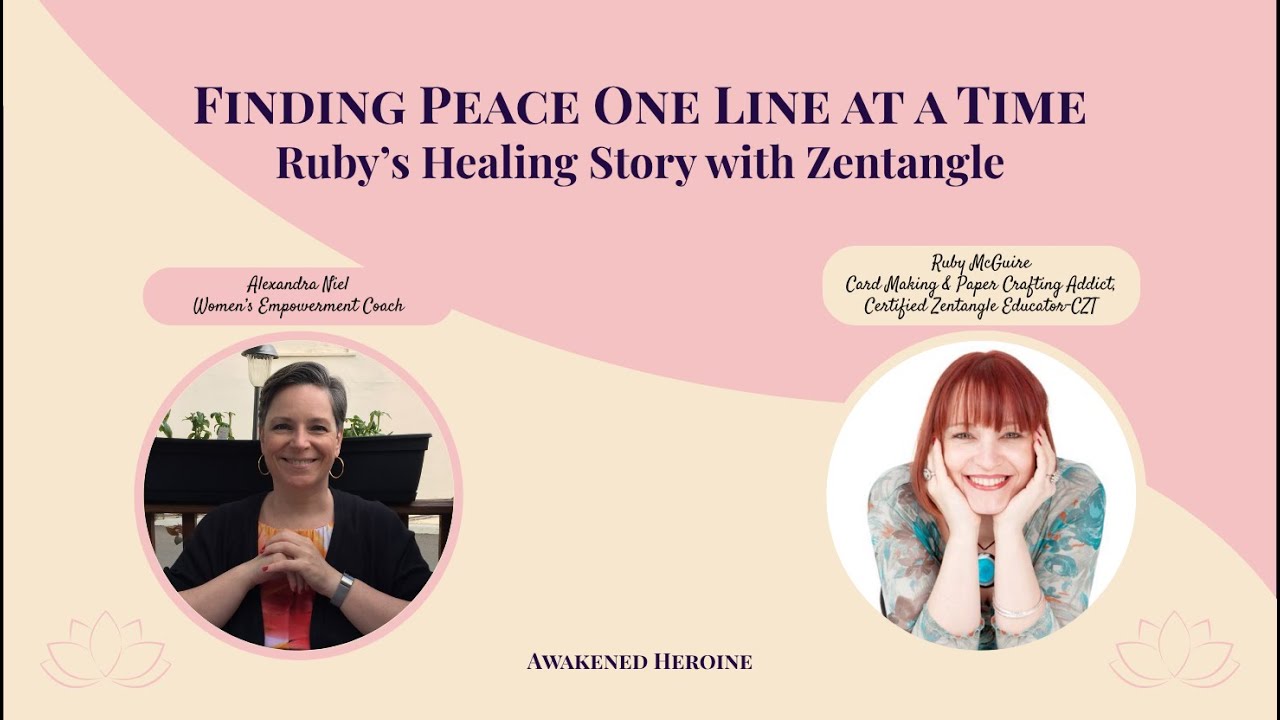
Ruby, a Certified Zentangle Teacher, shares how structured mindful drawing helped her heal from anxiety, grief, and divorce. She moved through careers in medicine and HR before finding Zentangle as a restorative practice, and now runs workshops teaching others to process emotions one line at a time.
Chapters
Hello, heroines, and welcome back for another interview. This is so exciting. I get to interview all these awesome women and a few brave men in the group. So today I want to introduce you to Ruby because Ruby does something really cool that I have never heard of. Um, and I'm also part of her group, although I have to say shame on me because I haven't participated so much, but I'm very curious. So I figured we'd start by saying welcome, Ruby. How are you?
I'm fabulous, thank you.
How are you? Good, good, thank you. And why don't we just get started with an easy softball? Tell us a little bit about who you are and what you do.
Okay, so now I do what's called Zentangle, and this is a bit that you're intrigued about. So Zentangle is basically mindful art. It originated in the States about 20— from, I think we're in the 21st year of it now. Um, and it's basically drawing structured patterns. What I'll do is I'll share some photos with you so you can share. It makes more sense when you see it rather than talk about it. And, um, it's an amazing way to get out of your head and just into a mindful place. It just takes you— takes anxiety away, takes stress It works with people with, you know, I've had clients with agoraphobia. I say clients, they're people who come along to my sessions with agoraphobia, with my, with ADHD, all sorts of different things. It's incredible. Through grief, so many things. And it's just a way of calming the mind down, and you can't focus on your thoughts when you're trying to focus on the next line of a pattern. So it's, it's really powerful. It's amazing. It's really helped me because I do get anxiety. So it's been brilliant for me as well.
And it sounds so simple and so logical at the same time because one thing that I do is, um, what's called diamond paintings. Have you heard of those?
Have, yeah.
And I can do them until I throw up because I've been so focused on my thing that everything else disappeared. So what's been your journey? Like, how did you go— how did you come to do this?
So I go, wait, if I give you a way back, I've been, um, medical receptionist, secretary, practice manager of a doctor's surgery. Then I went to be a PA. Then I went into HR. That was my biggest area. Then I was in that for 11 years. Then I became a coach and mentor running my own business. That's why I'm still in the mindset of client. I have to keep remembering it's not clients now, Ruby, it's people who come along to your sessions. So I'm not— I closed that business last year, and I've always been into things like craft things, like you were saying with Diamond Art. I haven't done it myself, but I know what you're talking about. I've been a card maker for Oh God, about 35 years, but we won't tell anybody how long that is. Um, but then I got into Zentangle about 13 years ago. Interestingly, it coincided with my business, which I find fascinating. Um, and I've got— I kind of went back to it now and again and then left it and went back to it. And then a few years ago it got back into it because of anxiety. And for me, I needed another outlet. The card making I could do without thinking because I've been doing it for so long, whereas this you can't because you are— you— there is no outcome. It's not like I know I'm going to use this stamp set. For those of you who don't know, it's like an image of a flower, for example. I'm going to do this and I'm going to use these colors and it's going to end up looking like this. So in tangle, you don't know what it's going to end up looking like because you follow the line and then you're like, oh, I wonder what would happen if I did this, and you go off in a different direction. So you don't know what the outcome is going to be, so you have to concentrate a little bit more than just—
you can't get in—
you get into a flow state, but you, you can still think when you're card making. You can't when you're doing Zentangle. So it was just a complete mind release for me, and I just love it. I cannot get enough of it. I'm like, I literally draw as much— if I'm not marketing the workshops, I'm drawing the next workshop, or I'm running the next workshop, or I'm doing— talking about something else to do with another workshop. Um, or I'm drawing for myself occasionally when there's time. Yeah.
So when do people come to you?
It's more that I advertise it locally and online, so often people will be, um, looking for something in a community environment. When they're coming to me locally, they'll be looking for something community, and also they'll be looking for something mindful, or they'll be looking for art workshops, or they'll be looking for de-stressing or mindfulness. Um, that kind of thing. And that's when they come across me.
So it's really about healing?
I think so, yeah, I would say so. And because I've got the— I mean, I've got the branding of Mindset Queen and CZT. CZT is a Certified Zentangle Teacher, but the Mindset Queen is because it links in so much to mindset. The philosophies of Zentangle are very much about slow things down, anything's possible, one stroke at a time. Not the best one because my husband, he had a stroke at the end of last year, so I don't use that anymore. I usually say one line at a time. Um, but it's, um, all of these kind of things about, you know, really noticing and gratitude and all those kind of things are built into it. So it's really beautiful practice as well if you want to slow your life down a bit, which I do a lot.
And Like, how do you get started? Is it just as easy as having a piece of paper and a pencil?
A piece of paper and a pen is how you would get started. You need to know how to do it, but you can— you have what's called online like a step out. So they show you like the first red mark, and then you copy that red mark, and then they'll show you the next step of it. So they'll take you step by step through. Or you can go to any Zentangle teacher because they're worldwide. So you can go to any Zentangle teacher and go along to one of their sessions, and they can teach you how to it, but you can do it online as well yourself. You can go and have a look for it on Google or Pinterest or whatever.
Okay, so how do you envision something like this? Because you and I were chatting a little bit before. You have gone through your own divorce just like I did. Had you had Zentangle back then? Did you have Zentangle back then?
No, I didn't. I got divorced about 23 years ago, I think.
Okay, okay. Oh yeah, and you said Zentangle 13 years, so yes, okay. So how would Zentangle have helped you back then when you were going through that transition?
I, I think for me, um, so just to give you a headline on my divorce, my divorce, my ex cheated on me, and I was very much like, that's it, you're out. There was no question about it, he was gone. Um, and I didn't have a heartbreak or anything like that. I was just, who am I now? I don't know who I am because I'm a mum now. I'm a single mum all of a sudden to a 2-year-old. It was the typical 2-year-old, you know, husband's not getting the attention he needs because you're looking after the child, that kind of scenario. The typical thing that happens. And I, um, lost my identity. And I think if I'd have had something like that to fall onto and, and just to take me out of my head, like, who am I? What do I even believe? I mean, my faith— I was a Christian back then, and then I realized, well, actually, I don't believe everything that I've been told to believe. I need to start again and, and decide what do I believe and what have other people taught me that I should believe. So I kind of went back to basics on everything and trying to understand who I was and what I wanted for my life going forward, because I just hadn't planned that at all, as we don't. Um, so it was just— it was completely life-changing. Um, I've now married my soulmate. I've got it right the second time. Um, so we've been together 20 years. And he's just perfect. I love him. He's not perfect, that's— nobody's perfect, but you know what I mean. He's perfect for me. And, um, as I say, got it right the second time. But it's— for me, if I'd had that back then, it would have got me more out of my head, I think, and just not thinking about, um, the— it was the identity thing. It's interesting because my— I, I'm very good at compartmentalizing. So I'll say, oh, we'll put that in a box, we'll deal with that later. And then like 20 years later, I think Maybe I should deal with that bereavement trauma that I've had. Maybe it's time to uncover that one now, you know. And for that, I kind of did the same thing. And my— I remember my managing director of my— when I was in HR, he said to me, we're worried about you. I said, why are you worried about me? He said, because you're handling this too well. I said, how can you handle it too well? And he said, because you're not dealing with it at all, are you? But I think maybe if I'd had a way to process emotion that was going on. I wasn't the person who was ever going to talk about it then. I would now, but I wasn't that person then. It was very much shut the doors, not talking to anybody about it. I'm fine, moving on. Um, and I even had— I think I even had— I did go to a relationship counselor, you know, the Relate. I don't know if you have that. You're in the States, are you?
Or Canada?
Where are you? States? Yeah. Um, and I remember going to this Relate. I don't know if they have them over where you are, but this, um, over in the UK we have Relate, which is like marriage counseling kind of thing. And I went and I said, I want to talk about it, but I said, I just want to get over the other side. I don't want to resolve the relationship whatsoever. I'm absolutely not interested. I just want to come out the other side and feel better. She's like, doesn't work like that. I thought, it doesn't work like that? She said, you've got to go through this. I said, no, I haven't got time for that. I've got busy job. I've got time to go through it and come out the other side. So yeah, I think if I'd had it then, it would have helped me process some of that stuff that perhaps I didn't deal with at the time. And, you know, not in words necessarily.
Yeah, yeah. And I, I hear— I listen to your story and I hear you say, you know, I busied myself in work. And I think I— well, I did that. Um, I didn't want to think about it, even though I was the one who chose to leave. I didn't want to think about it. I didn't want to really deal with it at first. And I think that'll resonate with a lot of the women in the group because I think that's something that we do because we're like, ah, I don't want to deal with this right now. I've got all of this stuff to deal with. Let me focus there. But the thing is, if we don't deal with what's here, it's difficult to effectively manage all of the other things that we have there. So it will come back and bite you on the bum, invariably. Yeah, for sure. So when— how did you come to that moment where you said, okay, I need to deal with this. Like, what was it? Was there a triggering event or was it just the passing of time that made you realize it was time?
It's usually when I don't deal with something, a friend will say, you haven't dealt with that, have you? I'm like, don't know what you're talking about. What do you mean? Well, you've got unresolved trauma, Ruby. You need to deal with this. So it's usually that. I usually will be, oh, I just carry on. I haven't got time for that right now. When, when, you know, when this happens, then I'll do it, or when that happens, then I'll do it. It's one of those kind of things. And I never used to address feelings at all, and I would see it as a weakness. I was always brought up that it was going to be, you know, you don't share your dirty laundry in public, or whatever the phrase was. Um, so it was always a weakness to talk about feelings. And I think actually going through the divorce and my managing director saying that, he said, you, you should get counseling, it's not a weakness, it's a strength. And I think that kind of chipped away in my head of, I do need to talk to somebody about this at some point. But I wouldn't say I went into it in any depth. I probably still got unresolved issues, honestly. But you know, I'm happy, so I just think, well, if it comes up and I need to deal with it another time, then I will. So there's still a bit overlapping, probably left over from it.
But let's be honest, we also can only deal with so many things at a time, right?
Absolutely.
And there's only so much healing you can do in one shot. So really, taking our time— so being vulnerable isn't a bad thing, taking our time isn't a bad thing, it's just It has to be a time that works for us and we need to find our own way in some ways.
Yeah. I think it was also very empowering time because I had to, you know, manage my full-time job and it was a high-level job, um, manage my 2-year-old. Um, so I was juggling all of it and I remember once I went away, I think she must have been 3. And I thought, I want to go to Paris. And we'd never gone abroad, my ex-husband and I had never gone. He never wanted to go on holiday. And I thought, I'm going to go to Paris, we're going to go to Paris. So I took her, and I only spoke a little bit of French. I understand a lot more French than I can still speak, um, and I can read a lot more than I can speak. I tend to get tongue-tied when I'm speaking. But when I was over there, I had to speak French because otherwise I wouldn't have been able to do anything. And it was so empowering, and I came back a different person as a result of that trip because I just thought, I can do this. If I can do this in a strange country, or strange to me country, um, and not even have the native language, I can do anything. And even now I go back, if I want a boost of confidence, I go back and think, I did that, I can do this.
You know, it's funny because my beau and I were talking today about how excited we are to go see my brother this weekend because it's like we're getting out of the house. Like, he's so focused on his business, I'm so focused on mine, that that's all we do all the time. And it's like, my God, having a change of scenery is just going to be so rejuvenating and so good. So what are, what are different ways that women can if they can't physically go somewhere or do something like, you know, taking a flight and going to a different country or whatever, or even to a different state, um, how can they begin that process of addressing, acknowledging and recognizing and addressing that there's some grief that they have to work through, or that there's some triggers or patterns that might not be supportive?
I think that the first thing is actually having the awareness, because sometimes we can just be so in that— sorry, I saw the mic go off and I thought it was me. We can be so focused on being busy that we don't take the time to be aware of what's actually happening. You know, it might be that something triggers you and you get angry, and it's like, well, checking in, well, why do I feel angry? What was that, an irrational amount of anger, or was that, you know, in alignment with what actually happened? And if it isn't in alignment with what actually happened, then there's something else going on, and it must— there must be something that I need to do to address it. Um, I think being willing to go through the emotions. I mean, that's what I've learned over the years, not necessarily to do with the divorce but other things. It's like, I don't want to deal with that, but actually it's a bit like Churchill says, is it something— didn't he say something along the lines of the best way to get through or get over problems to go through it, or something along those lines? Um, goodness me, probably kill me if you heard me misquoting so badly, but anyway, you get the gist. It's better to go through it than keep skirting around it because you're just going to keep making the same mistake and it will keep coming back to you until you actually deal with it anyway. And I think once you've got that awareness, um, and you're recognizing things that you're, um, being triggered by or that are feeling like they're unresolved, um, then you can do something about it. But unless you've got the awareness, there's You're not going to. You need to kind of almost make time, take a step back. I'm— and I say this, it's hard for me to take a step back from business and stuff like that because I love what I do, and I've always loved what I do. Whatever I do, I love what I do. So I throw myself into my work, not always just hide myself away, but because I love what I do, I choose to do the things I love. And as part of that, it's then not giving yourself enough time to think. So you, you know when things aren't right when you stop for a little while. It might be every weekend, or it might be, um, you know, you go out somewhere and all of these thoughts are coming up. It's because you've all of a sudden allowed yourself the space for them to be voiced or heard. And I think once you start to— if you can take a step back, even just for a few days or a few hours or something along those lines just to start recognizing what's really going on, um, and get the help that you need. Because, you know, I didn't, and I haven't on many occasions with many different life events. It's only now, more recently, that I've actually asked for the help that I've needed and been able to get the help that I needed. Um, but what's the other thing I was going to say to you? What else you can do. I think if you're not able to— I was lucky, I was in a good, well-paid job, um, but I know everybody couldn't go away and just have a weekend away or a few days away. But it's talk to people that you know, find something you love to do. It doesn't matter what hobby it is, something that will get you out of your head. Um, for me, I can't sit and do meditation, it's just not going to happen. My brain is a gazillion miles an hour. Apparently I've got ADHD, but I don't know, I've not even been diagnosed, but you know, my brain just can't stop that. But when I do Zentangle, peace. That's the only time I have complete peace. And there'll be something there out there for everyone. It might not be Zentangle, but it might be drawing, or it might be horse riding, or it might be, I don't know, going on a motorbike. Whatever, doesn't matter. Whatever it is that lights you up find that and, and give yourself time to do that, because when you're doing that, you're also giving your brain a bit of restful activity. So then you can tap into some of those other feelings without necessarily having to go deep into them at the time. You access a different brain part of your brain then.
Wonderful, wonderful. So I want to go back to what you said earlier, in that you found your soulmate.
Yes.
So what is different between in how you're showing up now versus how you showed up then? Because obviously you've had the experience.
Yeah, um, that's an interesting one because one of the things that used to annoy him was that I would always be learning. So I went to do my HR degree, like, I can't believe you're learning again. And it's like, but I'm not going to change because that is literally in the very heart of me. I cannot change. I'm always wanting to learn something else. Um, so how do I show up differently? I would say as a result of what happened, I'm more comfortable in my own skin because I'd been quite sheltered. I'd not been out with many boys because it was boys then. I was only 17. I was 16 when I first met him. I'd not been out with many boys then, and so I was very young. Got married when I was 20. Um, so I think if I was doing it again, I wouldn't get married until I was at least 30 because I want to do other things and, you know, have a bit of a life before, um, settling down and that kind of thing. Um, how do I show up differently? That's a really good question. Um, I think I'm very me, although I don't know whether I wasn't me then or not. I, I thought I was, but I think I'm very much more me now. Um, you know, you take me or you leave me. Some people like me, some people don't. I'm not bothered because I know that there's some people I don't like and some people that, you know, I do. So it— that's just how it is, you know. So that doesn't bother me. Um, I think we're— me and my husband are very, very open with our communication. So I think looking back, perhaps I wasn't as open because I can remember thinking we were going for our 10th anniversary meal, my ex-husband, and I remember thinking, what am I going to say to him? I was getting ready, I was like, what am I going to say to him? What we're going to talk about tonight? I've got nothing to say to him, you know. Um, whereas if that had happened with us, I'd be saying, you know, we need to get a bit more spice in our life because there's, you know, we're running out of conversation because we just know each other too well now, do you know what I mean? So, um, our way of dealing with that is we'll just move house and move town, or we'll go to Scotland from England, or, you know, let's add some more adventure in.
That's a hell of a way to get more variety in your life.
It's nice to bring in variety, but we like to do adventurous things together. So, um, and I'm not talking about jumping off a cliff or anything like that. He would, but I definitely wouldn't. He's much more adventurous than me. I'm a bit more of a home girl. But we, we're always looking for new things to do together or interesting things that we like together. And we have our separate lives as well, so I think and we're safe, separate lives, separate friends, you know what I mean? Male friends, female friends for each of us kind of thing. So it means that we've got, um, other things you can come back and then share, haven't you? Whereas I think when you're— when you've got a baby, it's very easy to be— it's all about the baby because it is. I remember reading a book once, um, I can't remember the name but I wish I could because it was the most hilarious pregnancy book I'd ever read and I would give it to anyone that fell pregnant. I say you've got to read this book, it's absolutely laugh out loud, hilarious. And I can't think who it's by, and she said, if when your baby's born, you— if somebody throws you— said, well, throw you in a line, you've got your husband and your baby going to drown, which one would you save? You will 100% save the baby. And I thought, oh, that would never happen to me. The minute, the second she was born, I was like, 100%, I just don't care about him. She is my world. I will do everything to save her, you know. So you can see why we can't compete.
Yeah, I mean, I've never had children, but, um, I can, I can see how that would be because it's the ultimate unconditional love, right?
Yeah, amazing, just amazing. But yeah, so funny because I really thought I wouldn't be like that, but I totally was.
Yeah, so Do you think, had you met your now husband back then, would you guys be a fit based on who you were back then?
Possibly. I think so, because I think there's a lot of me that hasn't changed. But I think I'd have been shy. So I met him online, on online dating, which when we met was a bit of a taboo. You didn't do that. But it was because my friend told me that she was going to set me up an online profile, and if I didn't, um, if I didn't set it up myself, she was going to do it for me. And I'm like, you're not. So I did it myself.
It's good to have friends like that.
It is good to have friends like that, because I would never have met him if it hadn't been for that. So, um, so I think there's a lot about me that's the same, but my confidence is a lot higher. Now. I had quite a lot of self-esteem issues back then. Um, I'd, I'd lost a lot of weight before we split up as well, and that didn't go down very well either. So it's interesting, but my husband's loved me all sorts of shapes. Um, I've been bigger, smaller, all sorts, doesn't matter. Um, so I don't know whether I was very, very different back then. I suppose there's some things I was. I'm much more spiritual now in a different way. So I'm more into it, like law of attraction, and I like my oracle cards and I like all of those kind of things. And whereas I was not into that at all back then, I was open to different things, but I was trying to find my way because obviously I said to you, with my background, I didn't really know what I believed. So, okay.
Okay. So anything that we haven't talked about that you think is worth mentioning? For the heroines in the group?
I think if you, if you're going through a divorce or even heartbreak, it's work on the identity bit because the identity was really so important to me. I just, I'd labeled myself with this wife and mother and there's so much more to us as women than just— and I say just, it's not just because you might be a stay-at-home mum, you know what I mean? But we're not just wife and mother. We've got— we're intelligent women. We've got loads of other interests. We might be wives and mothers, but equally there's more to us than two labels that can sum us up. So I think it's really work on that identity. And once I had worked on that, I think I started to shift a lot. And you do evolve so much, don't you, over the years. But I was— it was interesting because we had this conversation a while back and I was saying, do you think I've changed much since you first met me? And he said, no, not really, you've just evolved in different ways but not changed that much. And he hasn't either, but there's certain things— he's more confident, he's more outgoing, he's all of those things the same as I am, um, but ultimately we're still those people. Yeah, so yeah, definitely.
I think, um, so yeah, I, I agree with you in terms of like, we're not a one-trick pony. No, there's so much more to us than just the one or two labels that society likes to slap on us so, so happily. So Ruby, thank you so much for joining us.









