From Atheist to Healer | Steve McCann on Trusting Your Inner Wisdom
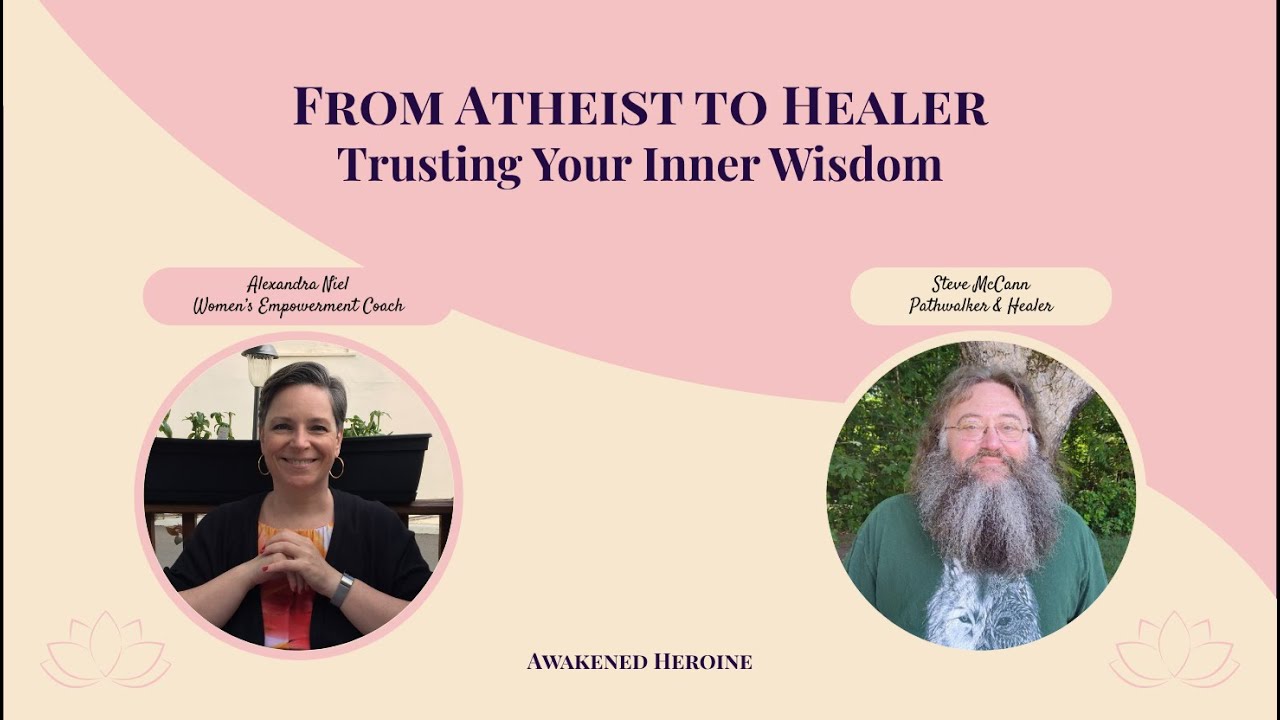
Steve McCann, a former atheist, became an intuitive healer after a 2000 dream of a Native American guide. He works with clients to help them trust their own spirit guides, whether angels or ancestors, and emphasizes that spirituality is an internal compass separate from religion.
Chapters
Hello, heroines. This is Alex. I feel like I was just here because I was just here with Claudine, and now I'm here with Stephen McCann. Stephen, how are you?
I'm doing well, thank you. And yourself?
Good, good. Thank you and welcome, welcome.
Thank you.
And so I wanted to bring Stephen because he's got a unique perspective on things, and I thought that it might help you ladies. So Steve, why don't we just get started with the basics of where are you from and what do you do?
Okay. I'm in Rochester, Minnesota. I call myself a pathwalker, which I'll explain later, but I'm also an intuitive soul guide and certified energy practitioner. So I do energy healing and stuff like that and spiritual guidance.
That's so cool. I love hearing— this is something I wish I had the gift because I would totally do it, but I don't. I like to be on the receiving end though. So how did you, uh, how'd you get started doing that? Like, what's your journey?
Uh, well, go all the way back to the way I used to be a militant atheist, and then in 2000 I actually did a heartfelt prayer for— because I was bad marriage, bad, bad career— and that night a Native American man showed up in my dreams. And then, but not only that, he showed me like 4 horses, each of a different color, running in one of the cardinal directions, which, which relates to some of the Native American stuff. I don't teach Native American stuff, but it's flavored my spirituality. At any rate, he stayed with me through Friday at, during the conscious days and unconscious, you know, I was sleeping and during the day, and I was getting mad. And when somebody else who's very metaphysical said something, I, I changed my approach. I walked up to him in my mind, of course, on Friday afternoon and went, how can I help you? With that, he smiled and gave me gifts. Like, that's what he was waiting for. And he gave me some gifts. That started me down my spiritual path. I ended up working with a shaman in Minneapolis. I'm for like Minneapolis, St. Paul region. I ended up working there, uh, with a shaman for about 12 years, delving into my gifts. Um, a little bit later on, I ended up having a thing called cough— about 2 years later, I had a thing called cough syncope. Cough so hard you'd pass out. And the doctors couldn't figure out a reason why, let alone a cure. And it turns out that it's almost like, I mean, I dropped, almost dropped my 9-month-old baby down the stairs because of it. Cause I was having, I had a bout when I was going down the stairs. And so I'm like, I'm desperate. The doctors couldn't figure it out. So like someone said, work with a hypnotist who's also an energy healer. I'm like, okay, not a problem. We did that. I did that. We found the repressed memory of somebody choking me when I was a teenager while I was asleep. So, and once that memory— that's how the memory came up for me, is inability to breathe correctly. So once we worked through that memory, I no longer had a problem with the cough syncope. So I was so impressed with the power of the mind and spirit, in this case, over the body, that I went out and became a certified hypnotherapist as well, and a Reiki master. Um, had a business for a little bit, got a divorce, ended up going back into the software industry for quite a few years, another 20 years. Um, and then now my youngest has just graduated from master's program in college, I decided to pursue this energy healing, the healing career. And so I ended up taking some classes to get the energy, quote unquote, certification as an energy practitioner, um, NLP coach, um, oh God, there's a whole bunch of things, DNA activations, you know, all bunch of things like that. And I decided to do that. Well, in the process of working with the people on the healing side, what usually was happening, and was a lot of the female clients I had, I ended up working with them from a spiritual spiritual perspective. Like, they would start talking about a dream and something they got, and I would get— I, I see things, I feel things, or I know things. So I'd hear them say the message and it bring up a reaction or an action in me, and I, I, I give it back, and we go back and forth like this until it turned out to be something, a message they needed to hear, and they needed to start incorporating or making changes in their life. And so that's why I call myself a pathwalker. I was meditating one day and went, what, what am I? And the term pathwalker came up. You know, there's pathfinders. I'm not— I help people find their path, but I walk with them on their path for a little ways to help them understand if they, if they come from a place that spiritually that is not in one of the traditional traditions or religions like myself, I'm very eclectic. I struggled and I really need like the shaman guide I had really helped me learn to incorporate this stuff, particularly coming from being an atheist. Atheist, a militant atheist. Anyway, um, so now what I do is I help people find the path that fits their soul. And I walk with them a little bit on that and get them going on their path. So like, I walk the journey with them side by side. I'm not a teacher, I'm a guide. I'm not a leader. I'm a teacher, yes, but I'm not a leader. I'm a guide. You know, that's the way I look at it. Because I end up learning from them as well. So we walk paths similar for a little bit, and then we branch off and go our respective directions. So that's what I do in that quite so short nutshell.
You know, it's funny because you say you learn from them as much as they learn from you. I find that as well in my coaching. Like, I'm always in awe of the women that I coach because I'm like, they are so freaking awesome. And it's like, okay, let's— you know, it's almost like it's a grim analogy, but, you know, like discovering a body and you have to get rid of all the dirt that's around so that you can— it's— that's how it feels, is like there's all this stuff that needs to be cleared so that the true essence of the person can come out.
Yes, I agree with that 100%. And in my case, I do it— sorry, sorry. In my case—
No, no, go ahead, go ahead.
I focus on their— the spiritual side as well as the physical. Well, for myself, doing the spiritual healing has helped my physical, mental, and emotional healing immensely as well. So I think they all— I mean, we're all integrated systems. It all ties in together. Yeah. Western medicine covers certain things and psychiatry covers certain things, but there's other parts that's missing that I'm trying to help other people find.
And not everything is everything, right? It's— there's a little bit of something— I don't even know how to say this in the right way, but everything, like you said, is, is connected and interconnected.
Yes. Yeah. So, so you might need a little bit of part A, a little bit of part C, you know, that's it. Yeah, it's a mix. And for myself, I'm, I'm realizing it's very individualistic. I work with one person and we go one path. I work with somebody else, go down a different path. Like, I have my own spiritual beliefs, but I work with people that are their path. I don't push my beliefs on them because that's not fair. I need them to find what works for their soul. And I actually get a lot of enjoyment watching that light come on in their— Yeah, exactly.
I totally get what you mean. And I want to go back actually to what you said when you were being pestered by your I guess by the guide or the elder that came.
It's Bill DeGuy. Yeah. Yeah.
Because you said, I turned around and I asked him, how can I help you? And I think that when, or would you agree that in our day-to-day life, instead of judging our triggers, our patterns, our all of that, we said, how is this serving me? Right? How is this helping me? Yes. Um, how would that, just that simple act change people's lives?
Well, as I said, for my experience, I was going at it very angry. I was like, why are you here? You know, demanding, demanding, trying to figure out what. And the simple act of trying to understand changed everything. And it made a huge change in the trajectory of my path. And I think that's the same with everywhere. And it's like, you know, not how do you help yourself, but how do you help others if you're, if you're drawn to that line of work, which I am, not everyone is, but, you know, it's still you understanding somebody else's viewpoint. The empathy helps, I think, us understand the world better and get along better. At least that's my viewpoint.
Yeah, I agree. And I think too, um, when we don't judge even ourselves and we just approach things from a place of curiosity, that changes everything. But I think we're conditioned by society to judge everything.
Yes, we are. Self-judgment. One, my harshest critic is myself. I know that. Yeah, I'm still working through that myself. But I agree with you 100%. We all are. And we all will probably will be all our life. That's just life here is a journey to learn from, you know.
So tell me a little bit, you talked briefly about when you work with somebody, you can go one way with somebody else, you can go another way with with yet another person. So how do you generally like approach healing with someone who comes to you for help?
That is a good question. Like I said, I, we started off doing things on the physical or, you know, like Reiki, Reiki energy healing type stuff. But the one that ended up coming up is like, there's always a spiritual component that seemed to be lacking. And I don't mean that in a negative sense. It just, there's a, there's a spiritual part of them that what desire to be feel, desire to be seen, desire to be explored. And so like, for example, I worked with one gal, very Christian, and I'm working with her. And like I say, I, a lot of times I refer to your spirit guides and stuff as spirit team, because it could be angels, it could be ascended masters, it could be ancestors, it could be, in my case, a lot of, a lot of animals, the Native American aspect for me, you know, but she, you know, I worked with her. And we got talking about things and it really, she had a resonance for Archangel Arch. I can't say, I can't speak now suddenly. Archangel Michael. So we started going down that track and she started looking into that more and it ended up helping her. Someone else I worked with, another woman who was Muslim, um, she was having problems with the messages she was getting. She's a lot, I've been called a reluctant shaman. I don't like the term shaman because to me that there's a connotation, medicine man, whatever. There's a connotation that I don't feel I deserve. You know, I do help people, but I, there's, there's, there's an aspect to that that I don't try to claim. But she, in her own right, was a shaman of her, her own right. And what I had to do with her is help her get custom from going from a religion, which to me is like a external mandated set of rules, to spiritual, which is an internal guidance to your creator, whatever you call that creator. And so I had to work with her on decoding the messages that they were given, that the, the, her, her spirit team gave her, understand who the spirit team was, and let her merge her religion and spirituality together and just have a discernment of when to use which. You know, if she's, she works with clients too, so she would use the spirituality a little bit more unless they happen to be very Muslim, then, you know, I mean, that's, you know, it's, it's, it's not a one-size-fits-all. So, you know, that's what I was trying to teach her too, is like, you know, Some circumstances you're gonna be on one side, sometimes the other, some, a lot of times in the middle. And that's, that's a lot what I do. What I end up doing is I talk with them and I get going, and then I, I get a feeling, I get a vision, you know, I, I'll ask questions, I'll get information, and then I'll tell them what I see, see if it resonates with them. And a lot of times what happens is I might understand, you know, I might see a purple, purple zebra. I don't know what it's supposed to mean to me, but it means something to them. Yeah. And then they bounce off and bounce that off on something else. And we kind of keep going that way and build a rapport. So we come to the place that they need to be for their safety, not safety, but for their soul.
Very cool. It's like you're, like you said, you're guiding them, you're walking the path with them. And you're holding their hand along the way, but you're, they're leading. The charge in that. They decide where it goes, right? In a way.
Yes. Yeah, they do. Like I said, that's why, that's why I don't call myself a leader. That's why I say I'm a guide, you know? Um, because there is a certain expectation that comes with leadership, and that's not my role, in my opinion. You know, my role is to do, like you said, to help guide, you know, hold their hands if they need it, have them start walking down the path, and then let them go on the path on their own. Try to teach them to be self-sufficient and how they can connect to their own spirit team.
Wow. So you talked earlier about how, you know, you kind of— your life took a different direction after your divorce and what was going on back then. What were some of the lessons that helped you to move forward from that, from your divorce?
That's a good question. That's a good question. Um, one, I grew up— well, I'll just be honest, I grew up in a very alcoholic family, so a dysfunctional family. So I went in thinking I'd never get a divorce when I got married, and hell damnation, I wasn't going to get a divorce. And, and I don't mean any disrespect to my ex-wife because I had a part to play in it as well. But the point where I was going with this is I realized shortly after, in our marriage, that this wasn't working, but I tried to make it work. I wish I would have listened to my instincts more. Granted, I got two wonderful daughters from that marriage, you know, and, you know, and everything. So that, you know, I wouldn't have had them if I hadn't done that. So, you know, there's always a bonus to things. But what I would say is listen to your instincts. You know, as I said, nothing wrong with her. We just were not compatible. And, you know, it just took time to see that. And it took me maturing and learning and the spiritual growth that I've done to help me realize, one, okay, part of the problem was I always thought I was fundamentally flawed. When I grew up, was that I was— there's something wrong with me, that I shouldn't be here. I didn't deserve to live. And the spiritual realm, the spiritual growth I've done has helped me see that everything that's happened is a lesson. May not have been a fun lesson, you know, but it's a lesson to learn from. But if you make the choice to learn from it. A lot of people don't make the choice. My dad was an abusive alcoholic. I started down that path. I made changes. I've been sober for 37 years. I made other, you know, other changes in the way I behave with people, you know, thank you, by the way. And I wouldn't have done that had I not been— well, to use your word, you had curious. Like, when I decided to stop drinking, I was curious, what can life be like without drinking? And because a small voice in my head went, you know what you need to do, you know? And, and that's the thing to me, the spiritual world, the spiritual voice is a soft whisper. It's not the loud. The loud is the rest of the world and the external dictated things in my opinion, in my, my experience. So that soft voice said, you know what you need to do. And I didn't think I'd make 3 months and now I'm 37 years, you know, so I'm, and I'm very grateful because I'd be dead if I hadn't. I was blacking out 3, 4 nights a week.
So. That's, you know, it's, I want to go back to what you said about making the choice, right? Because we may not think we have a choice, but everything is a choice. And everything being a big word, but, but no, I agree.
I mean, sometimes we— I know I like in my marriage, I didn't think I had a choice because I had these preconceptions in my head of what was acceptable, what wasn't acceptable. I didn't want to be like my father or my mother, stuff like that. And in the end, it I forced the issue with an action. And, you know, I'm grateful. I, you know, I wish it would have ended differently, be very honest, you know. Um, but it, again, it was a choice for me to learn something new about myself and about life.
Yeah. And we can choose to, like you say, for it to be a learning, or we can choose for it to consume us.
Exactly.
And it— the choice is entirely ours, how we respond to whatever is happening.
Exactly. And sometimes, like you say, we, we don't feel we have a choice. Even if you take a minute step to the right or left of the straight line you're walking on, that's a, that's a change. And, you know, that's saying the, the journey of a thousand miles starts with the first step. Mm-hmm. That's exactly what this is. You just make a little, little change and then they start and you continue to do that and, and continue to have aligned action with your goals and you'll find that you, things things will often become much better than you thought they could have been.
I've certainly experienced that in my life. And I want to go back to what you also said before, talking about intuition. For women who are very reliant on their intellect, on their brain, and who have over the years maybe stopped listening or forgotten how to listen to their intuition, How do you start tapping into that again?
Oh, that's a good question. Um, kind of tied into that, I'm, I'm, I'm kind of a rapper, a rapper, is I look at everybody has a masculine and feminine side. Yeah. And I don't mean, mean gender, I just mean there's, you know, masculine tend to be more active, energy. Yes. Tend to be more active and decisive, driven and stuff. Women tend to be more soft, intuitive, um, companionship, getting a lot, you know, communication skills are usually better. Um, You know, I'm a guy and I'll say that any, any time of the day. So, but where, where I'm going with that is I, I try to see them because I was stuck in the same place where I was stuck in the intellect because I grew up with an alcoholic father, abusive father. I was very sensitive. He didn't like that. And it took me a long time to learn that it's okay to feel sensitive, to feel things, to sense things, to know things, and to be who you truly are. That's what I work with is try to help them uncover who they truly are, not in my perspective or their parents' perspective, but in their— what feels right within their body, within their soul, within their psyche, whatever term you want to use. And, and I— that again starts with little changes. Sometimes, sometimes it can happen like through hypnosis or sessions, you can, you can hit things really fast, but then, then there's always a growth period and growing pains, you know. Or you do it in small steps. Either way, it takes Exploration, me listening, understanding, using my intuition and intelligence combined together. And that's what I would try to teach women to do. And that's what, you know, is use both of them. Because, because if you only use one side, you're missing half of what life offers us. So if you try integrating the two together and not saying one's better than the other, they're just different, but they coexist and make life— I don't want to use the word easier, but more fulfilling, I guess might be a way to say it. To me, that's my goal when I work with somebody and try to balance in the masculine and feminine aspect of them.
Yeah. And I love that you bring the masculine and feminine because I learned recently that even within masculine and feminine, you have the masculine and feminine within the feminine and the masculine and feminine within the— it's like, my God, how many layers are there to this thing? Right?
Exactly. Yes.
But to keep it like super, super simple, what is one thing that a woman can do to start tapping into that intuition again and to start trusting what they're hearing?
I always said it's one, but I'm getting two things to say with this. One is trust what's in their heart. And some people have a hard time with that. So then When I say trust is in your heart, this is the second part, is when you say something internally, you don't have to say it out loud, but internally, does it ring true? Even if it doesn't fit the facts, does it ring true for you? And I, you know, I don't mean like saying, you know, the— I'm not going in— I was gonna just go down a conspiracy theory like the Earth is flat, but I'm— I don't mean to do that. Sorry. But, um, you know, the point is, as long as they can sense internally that what they're experiencing, thinking, feeling is real and true and trust to start to trust that. That's the first step.
Okay. Yeah. And it's little things, huh? We're not talking about doing big things. It's just kind of checking in, taking a beat and checking in on what we are feeling.
Yep. And that's where the term mindfulness, I played a big part of my spirituality too. And you know, read a lot about Thich Nhat Hanh. I can never pronounce the Buddhist names correctly, but, um, he, he had a lot of stuff about mindfulness and that's what really helped me. Cuz that centering in your own self, that would be the other thing is learn to center in yourself, not external, but bring the locus of control in a sense internal center in your heart, in your soul. Whatever it is you call it, you know, and if your mind, if you are intellectual, but just the center there and to feel and experience with what's happening now without judgment, the mindfulness.
Okay, cool. So anything that we haven't talked about that you think is worth mentioning before we sign off?
Um, I, no, I mean, what I'll say is I'm always learning myself. You know, I, I say, I'm, I'm say I'm a guide. I might be in third grade, like Amos says, when you're in first grade, but you know, I'm always learning. And I think life is— we need to be curious, to use your word again. We need to be curious to continue to grow. Otherwise, you're stagnating or dying. That would be, you know, and that's what I hope to help people do is learn how to be curious, and not learn to be curious, how to explore life more.
Yeah, I mean, life is supposed to be a big adventure, right? It's not supposed to be as, uh, as dreary as, uh, We can sometimes make it.
So, yep, exactly.
All right, Steve, thank you so much for being here and for sharing your wisdom.
Thank you for the invite.
My pleasure.









