From Paralysis to Purpose | Cecily Henderson’s Journey Through Breast Implant Illness and Healing
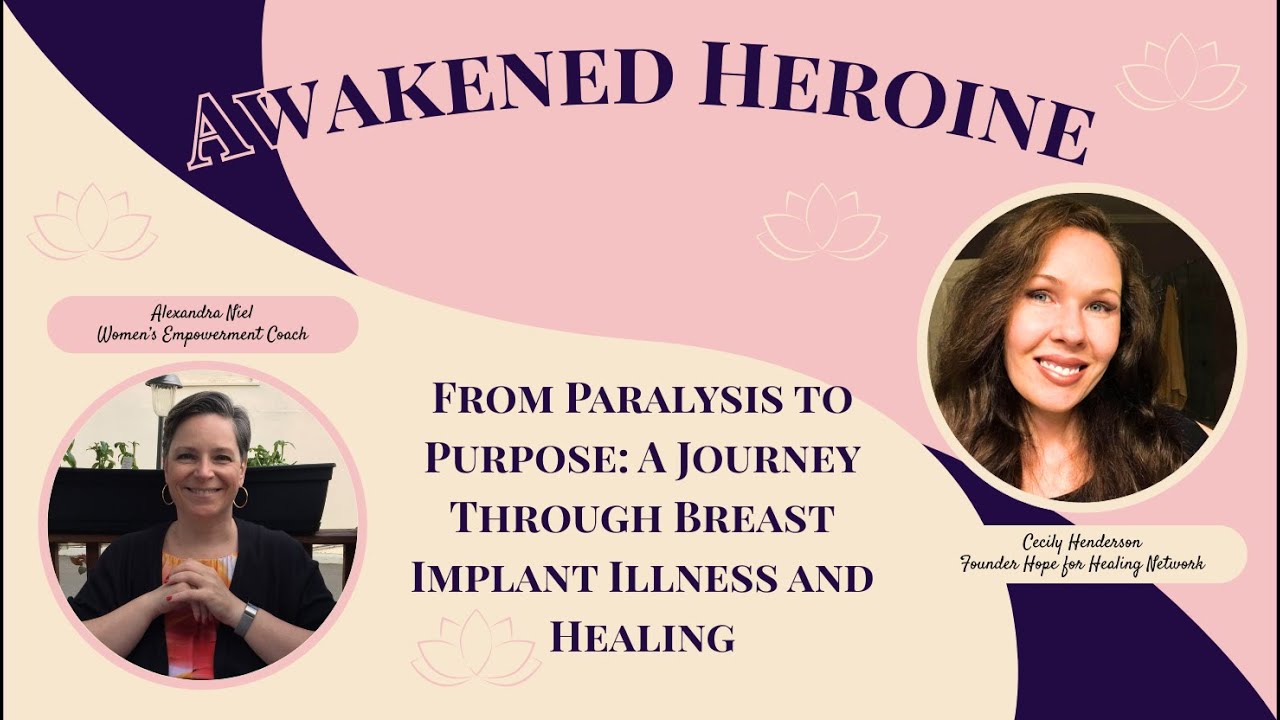
This content was created by Alexandra Niel. This content was uploaded by Alexandra Niel. This is a YouTube interview titled "From Paralysis to Purpose | Cecily Henderson’s Journey Through Breast Implant Illness and Healing" (posted 2025-05-26). It features host Alexandra Niel and guest Cecily Henderson. The conversation covers Cecily’s personal medical history (thyroid cancer, autoimmune illness, episodes of paralysis), her diagnosis and recovery related to breast implant illness, details of explant surgery and complications, and her subsequent advocacy, support groups, and holistic/healing recommendations for women. They discuss common symptoms, how to advocate with doctors, mental-health impacts, and resources for connection and care.
Chapters
Hello, heroines! I hope you are doing okay on this lovely day. Today I am so happy to bring to you the lovely Cecily Henderson. Cecily is somebody whom I met relatively recently but has absolutely captured my heart. Her mission is incredible, the work that she does is incredible, and she brings so much wisdom to the world, and I really wanted to bring her in here to share with you because I think a lot of what Cecily will share is going to resonate. You'll be able to pick up some tidbits, and plus I just want you to know her because she's just freaking awesome. So Cecily, welcome.
Thanks, Alex. Oh, that was so awesome. Thank you for the wonderful, wonderful welcome. I appreciate it. I'm so excited to be here because you, you have also touched my heart, and those people like you that are really advocating for women, that's a special place in my heart because as women, we need to stick together and we just go through so much and being able to support each other is wonderful. I agree.
I think we need to do a little bit of a better job. I think that people talk often about sisterhood, but it's one thing to talk about it, it's another thing to live it. And I really feel like You know, that's something that you live with your brands and your companies and the work that you do. And so that's another reason why I wanted to, to bring you in, because there is that need for community, I think, especially with us, with us women. So on that note, tell us a little bit about yourself, where you're from, and what it is that you do.
Oh, thank you. So my name is Cecily Henderson. I'm a certified functional medicine practitioner. I work with a lot of women online who are suffering. I ended up 20 years of being sick. That's how it got me down the functional medicine path, because I was very sick. I had cancer symptoms at 24. I was finally diagnosed with cancer about 25, and they then had surgery. Radiation at 26 years old. It came back at 30 years old. So here I was pregnant at the time with my son. I was 30 and the doctor's like, oh my gosh, you know, because I had thyroid cancer, he's like, I think it has come back. And so I had to wait till I had my son. And then 6 months later I had the surgery and I had full radiation and I had to stay away from my kids for weeks at a time. It was so awful. But you know what, here nor there, you just kind of push forward as a woman and as a wife and a mom, right, to do the best you can. And then I ended up very thin and I thought, you know, back then it was the thing to do. And I ended up getting breast implants because I had nursed, you know, I had nursed my babies. I was very saggy and everybody was telling you, hey, that's the thing and you can look normal and feel normal again. And so I did it. And unfortunately, I ended up being very sick. About a year later, I was getting arthritis symptoms. I had just weird, weird phantom symptoms. And I'd go to the doctor and they just tell me, oh, it's all in your head. You need to go see a psychiatrist. You know, it's just the mom syndrome. Yeah. How you're, you're achy and your body's hurting. And I'm like, this is really weird. And the symptoms just kept getting worse and worse. And I was more fatigued, more dry eyes, dry mouth, um, brain fog. All of that just compounded, got worse and worse. I ended up, um, having ankylosing spondylitis, which is a, an autoimmune illness. And they're like, usually it's a guy illness. We don't know why you have it, but you do. And then in 2014, the unthinkable happened and I collapsed, ended up in the emergency room and I was paralyzed. My nervous system was shutting down. They rushed me to the IMCU because they thought that I would stop breathing. And they were getting ready to intubate me. And thankfully, um, I had a very intuitive surgeon start me on some medication that helped prevent that. Um, it was immunoglobulins. They, they gave me IV immunoglobulins for 2 weeks and it slowed the progression down enough where I didn't have to be intubated. But it was very scary to leave that hospital. I was in my early— or excuse me, my late 30s, and to leave the hospital, they didn't have a walker or a wheelchair for me. And so I remember as a mom trying to get to my son, and I was climbing on my elbows, just, you know, struggling, pushing myself across the floor, trying to get to my son. And yeah, and trying to feed myself. I couldn't— I remember being really hungry for that week. And my sister came, and she flew down. She's like, I'm not going to let you starve. And she definitely— she took care of me and my son. Um, for my sweet sisters all pitched in to send her to go come with me and take care of me after I got out of the hospital because my husband was military flying, all, you know, and he was gone a lot. But it was, it was such— it was a terrible time because the doctors were just saying, well, we don't know, we have no idea. And I remember celebrating when I finally got a walker and a wheelchair because I could be mobile. And I end up being that way on and off for 7 years. I was paralyzed and didn't know, nobody knew, and just trying to live my life normally, which it's not. You know, you get into a really deep, dark depression when you go from being mobile to immobile, like in a split second. And so I just remember going through all those things— anxiety disorder, um, depression, very, very deep, dark place that I got to. And Having this manifestation or inspiration, I had this thought, this powerful thought coming to me because at one moment I thought, or at one point I thought I was going to die. My body was literally breaking down and I was having more problems breathing. I was having a lot of problems swallowing. I'm like, this is it. This is my time. I'm going to go. And this powerful thought came to me one day. Your implants are making you sick.. And I remember looking around and going, oh my gosh, what, where did this voice come from? This was so weird. I'm like, I am definitely going crazy. And so I went and talked to my doctor. I said, is there even a real thing about your breast? Something could go wrong with your breast implant. She's like, I've never heard of that. So I did more study and then I eventually I let it go. I was just kind of push, brushing it off. And I, being a practitioner, I was going to school.. And I came across a webinar and it started listing all these symptoms talking about breast implant illness. And I checked off every box and it just hit me right here, took my breath away. I'm like, oh my gosh, I know what's wrong with me. And so I, you know, I went to my doctor again. She's like, we'll do a CT scan, we'll do a mammogram. Everything came back normal. And I, again, once again, was so distraught. But then I thought, well, you know what? What, what is there to lose? And I found a surgeon who took me seriously and she's like, okay, let's get those implants out. And I said, okay. And I went on the, I went to my surgery, had butterflies, and it ended up being a 6-hour emergency procedure because my, I had a rupture on one side. It was so bad. It was like little pieces of little putty, gross sticky pieces of silicone that were broken off inside the capsule and inside my body. And she had to clean everything out very very meticulously. The other side was black. I had an infection, a slow-growing infection for 14 years. I had no idea which caused the spondylitis. And so she had to clean everything out and just basically give me a double mastectomy at the time. And thankfully, because she was intuitive and she listened to me and she prepared for emergency, she was able to take, you know, biopsies and get everything cleaned out and was very meticulous in it. And so I'm grateful for this wonderful surgeon. And, you know, went home, very difficult time recovering from surgery. Thought that, you know, went through all of the— my symptoms were still— some of my symptoms were still there. I'm still paralyzed. I'm thinking, um, you know, dearest God, did I do something wrong? Did I, did I not make the right decision? And I just kept little by little recovering better and, you know, each day getting better. And then a year later, Sorry. A year later, I was walking normal.
That's amazing. That's amazing. What, what an incredible story of resilience and perseverance and of advocating for yourself. And it just gets me so crazy when I hear doctors say, and when I hear women's stories of doctors saying, it's all in your head. Right. And it's like, who, how do you know? You know? And to be dismissed like that is just blows my mind.
Yeah. It's very frustrating because a lot of these women that they don't have a voice for themselves.
Mm-hmm.
And so I decided once I got, was healing, hey, I'm gonna get, I'm gonna be a women's health advocate. So I'm going back to school. For health education, and then eventually I want to get my PhD in clinical research so I can do more research because there is no diagnostic code for breast implant illness. So there's, there's nothing there that doctors have as a guideline if patients have breast implant illness. They just don't know what to do. They don't know what to do with you. And so women are alone. They just, they're suffering. They have all these terrible symptoms and they're being told that nothing's wrong with them. And so that's why I'm doing what I'm doing, is to advocate for them and and give them some hope and, and just be there.
So when, when you talk about symptoms, what would you say are the most common symptoms of, uh, breast implant illness?
Yeah, right now there's, um, over 120 documented symptoms, but the most— there's about 50 symptoms most common, everything from, you know, arthritis pain, joint pain, you you have dry eyes, allergies, allergy reactions to a lot of things. You have fatigue, brain fog— brain fog is a big one. Then I would say other things like rashes. Like, I got a lot of rashes, feeling like something sitting on your chest, anxiety, depression. So mental health, because silicone, what it did for me and a lot of women is it passes through the capsule because our bodies form a capsule around the breast implant. That's just what you do when there's a foreign object in your body is you form this capsule. And so it leaches through the capsule, the silicone, which yes, saline does. The saline shell will leach from that implant. So the saline shell will come out through that capsule, go into your tissues and into the brain, cause mental health disorders. It can cause inflammatory connective tissue disorders. So anything that with the inflammation, if your body's inflamed, you've been diagnosed with lupus, fibromyalgia, with, you know, any of these osteoarthritis and you have implants, it is a big possibility that your implants are causing that.
So if a woman has symptoms like that and they want to go see their doctor, what is it? What's the best way that they can advocate for themselves and that they can— is there something that they should say, something that they can say, something that will land and be heard in a different way by the doctor so that the doctor takes their explanation of the symptoms seriously as something to act on?
Yeah, that's a great question. So I would recommend— I have a nonprofit website that has a lot of information about breast implant illness. There are— there's— what I would do is I would approach my doctor, say, look, I have all these symptoms according to the FDA. So if you're in the United States, use FDA because it's on the FDA website. So that is proof right there. Okay, your doctor has to pay attention because it's on the FDA website. So give them that information. Say, look, the FDA website says that, you know, it's potential risk. There's also a cancer risk. When you have certain breast implants, and it's associated with all implants, all these symptoms are. And so I am experiencing these symptoms according to the FDA, and I would like to have more, more testing done. The test that you take is called a BMRI. It's a breast MRI. That is. And even sometimes it doesn't show everything. You could have an intact implant and still be experiencing these symptoms, unfortunately. And it's because the shell, it's called a, it's a very small leak. You can have a micro leak, very, very micro where it just doesn't show up and it is leaking out into your system, into your tissues. I interviewed one of the top silicone research doctors. He's in the Netherlands. He's been doing autopsy studies for years on women that have silicone and have, um, you know, saline breast implants. And every single autopsy he did, there was silicone that was in every tissue of the body.
That's crazy. That's crazy. Okay, so What would be— I don't know, I mean, you know, the group is, um, you know, we're here to support women coming out of transition, transitioning out of a relationship. And one of the things that we tend to sometimes do when we're in those dark moments is we don't take care of ourselves so well, right? Because we are playing movies in our head and we're, you know, rehashing, rethinking, grieving, feeling all of these emotions. What is something simple that they can do to make sure that they stay on top of their health so that their health doesn't end up becoming an additional problem on top of the, the emotional load that they're carrying.
Yeah, are you asking in relation to breast implants in general?
Because I know, I know that, you know, the breast implant illness is one of your, one of your core, um, areas of expertise, but I believe, if I'm not mistaken, health in general, right, and healing is, is something that's that you keep a close eye on.
Yeah, that's— I would, I would recommend don't, don't be alone in this. Reach out, just keep searching for those answers because, and then act on it. Because if I didn't keep searching, like I was going to school and I came across this webinar and I was continuing my education and there's lots of information out there now on breast implant illness. But keep searching and then connect with other women that are going through the same thing. You can connect with me. I'm very happy to guide you because there's— when you take out your implants, you don't want to go to a general surgeon. They, they don't have the understanding. There's a certain way. It's easy to put them in. It's really difficult to take them out the proper way. I had a girlfriend where her implants were stuck to her rib. They had literally adhere to her rib cage. She almost bled out on the table when they tried to remove her implants. And so she had to go to a special ex— it's called explant— she had to go to a special explant doctor that had the education, qualifications, and experience to remove her implants. She— he literally had to scrape that silicone off of her ribs, and that's what he did, and it saved her life. And now she's doing well and advocating for women. So you need to make sure, number one, you go to a special explant doctor who knows what they're doing. Then for those practitioners such as myself, there are practitioners out there that work with women with breast implant illness to help you because it's a very complex illness. And then as far as mental health, what you said, mental health and emotional health, just connect with women that are going through the same thing. That's wherever walks of life you are, whatever you're dealing with right now, don't be alone in this. That's the worst thing you can do. So connect with other women.
Okay. And then you— so you have the, the Holistic Professionals Network. You also have the Facebook group called Hope for Healing. Um, how else can women connect with you to learn, to learn more?
So I also have a, a breast implant illness group. It's called Breast Implant Illness, um, Trauma and Holistic Healing. So I— my group, there's a lot. There's 432 groups on Facebook dedicated to breast implant illness. Let me repeat that, 432. I know because a friend of mine, she went through and did a whole spreadsheet, and there's 432 of them. Mine specifically deals with not all— not only the holistic healing or the physical aspect, but the trauma aspect as well, because we— when we go through these things, we're being gaslighted, told that it's all in our head. We have— we are definitely traumatized. And so I try to focus on that, very positive. Uh, make sure the breast implant illness groups, if you, if you join any of them, make sure that it's uplifting. Because some, you know, you get in that victim mindset and that's really difficult. And that's another thing I would recommend any, any woman going through a difficult time, whatever group you join, make sure it helps you feel good. Because if you don't want to be in a victim group that brings you down and you get into that mode where you're complain, complain, complain, right? Yeah, exactly. You spiral down, get into a group like Alex's group, which is so incredible, so uplifting. That's going to get you out of fight or flight when you are constantly being uplifted and, and feel happy and positive. And that's what you need for your, for your whole body wellness.
Yeah, it's, it's amazing what happens when, you know, because you could have two people having the same experience, right? And one person chooses to stay in that negative kind of more victim, this is happening to me, versus somebody who chooses to be in that positive, I can overcome this, this is happening to, for me. Right, for me to be better, for me to grow, for me to whatever. It's a different energy and the outcomes can be very different.
Yeah. And you know what? And if you're a victim, you know, my heart— I've been there and I embrace you and my heart is with you. And it's okay. It's okay to feel when you're a victim. It's okay to understand that, yes, I am a victim. But you also need— I want you to feel happy. I want you to feel good. And the only way to feel good is to get out of that victim mindset. I'd rather have people heal Yes, feel your feelings. Feel those victim feelings. Get that— be upset. That's okay.
100%.
Once you deal with those feelings, move on. Move on. Be— get to the point where you're healing, because you're worth it. You're worth healing. My heart goes out to those— all those women that are suffering right now, because there's a lot of them. And the You know, I've been there. I've been in the deepest, darkest depths of literally hell. And, but you can get out of it. You can get out of it with love and support and connecting with women who are positive and lovely. And just like this wonderful group here that I'm in, and that's what I try to do as well. My Hope for Healing Network is just be uplifting and positive. So keep connecting with those women and, and you will find that healing and that hope.
Yeah. And I agree with you. I think there is, there's always that time for grieving, right? We have to feel the emotions, feel the anger, feel the frustration, feel all of those things because that's part of the healing process. But there also needs to come a point where you start to think about what's next. You— and that can only come once you've done, you know, you've taken that ball of yuck and found a way to make peace with it or release it and, and let it go. So It's dealing with that, that all those negative emotions so that you can, you know, move forward and look forward to, to the future. Because it doesn't just affect them, right? It doesn't just affect us going through these negative emotions, but it affects all the people around us, including our children, and it teaches our children how to behave, right? Exactly, because we're role modeling. So, yeah, Cecily, any last words of wisdom you would like to share with our heroines?
You know, I'm going to give your beautiful heroine group a call to action. If you feel like, you know, you are sick, or if you feel like you just can't hang in there, like you can't hold on, reach out, reach out to Alex, reach out to somebody. You know, I'm here for you. Just reach out and connect with a friend or someone that you feel comfortable with because you don't want to be alone in those moments. So that's what I would do is just reach out, act, act, and, and connect with people. Don't just sit there. And it's— you're going to feel like you want to sit there and do nothing but cry sometimes. But my call to action is actually to do— reach out and, and connect, because you're going to start feeling better the more that you connect. And, and that's the ultimate goal, right, is to get you to, to feel better.
Absolutely. And we want our heroines to be the hero of their own of their own stories, and you can't be that if, um, by being silent and by not speaking up and by not taking action. So Cecily, thank you so much for being here and for sharing your, your story.









