From Triggered to Empowered | A 12 Step Journey Back to Yourself
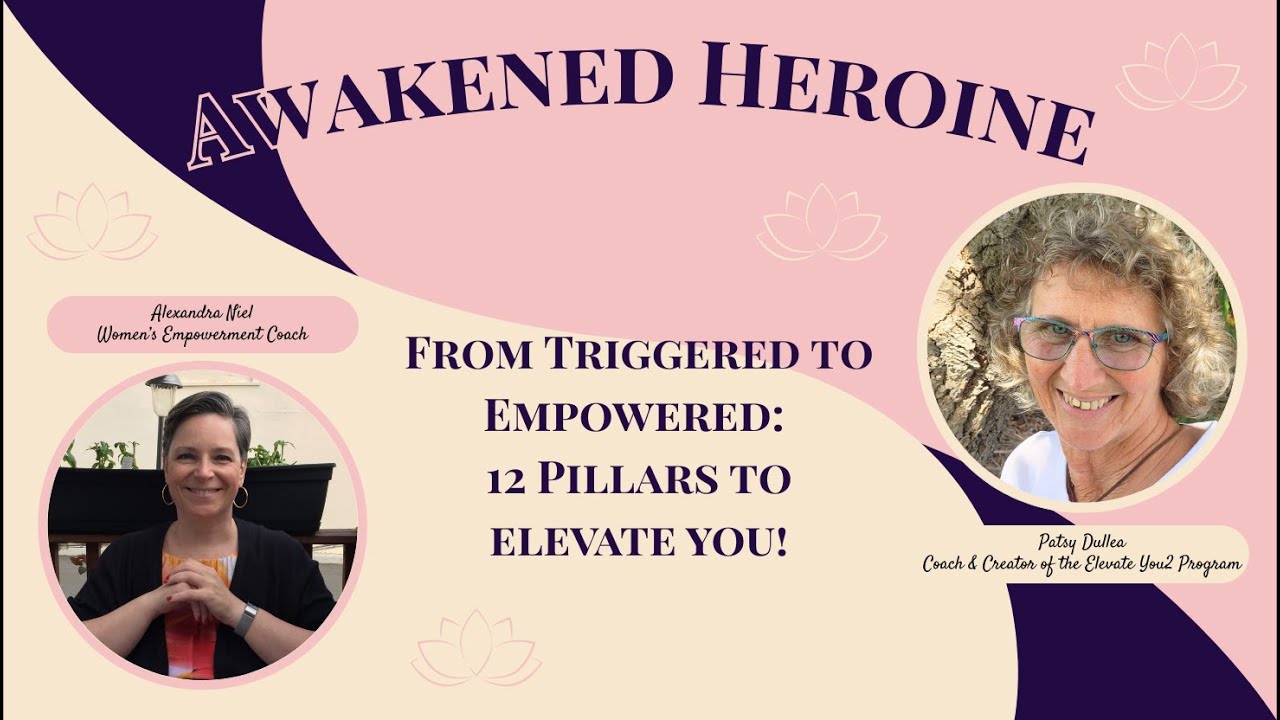
Patsy DeLay, 65, survived a toxic marriage, childhood burns, and addiction before creating the Elevate You 12 Pillar Program. She talks about leaving her marriage to protect her son, rebuilding through therapy, and learning that recognizing your ability to choose is what moves you from triggered to empowered.
Chapters
Hello ladies, welcome to the Divorced Women's Alliance. I'm so glad that I am here with Patty Delight. Patty, how are you?
I'm doing great, thank you. How are you doing, Alex?
Oh, I'm good. I'm always good. I'm always good. Um, well, so here's the deal. We were gonna go live, uh, but we're having technical difficulties. It seems like it's a recurring thing, so, um, this is recorded and not live, but that's okay because the message is still going to be awesome because it's Patty. So Patty, why don't you share a little bit about your story? Uh, let's start there. Tell us who you are.
So, well, I'm Patsy DeLay, and I am a founder of Elevate You 12 Pillar Program, which I needed to instill within myself to help me emotionally grow up and let go of triggers that kept me captive. I kept myself in my own prisoner without my awareness, without my permission, but yet I was giving myself permission to do all these things. Um, through therapy and group therapy, I was able to get to where I am today, which I'm grateful. I'm a human, I'm a work in progress, and it's all about elevating myself and going through evolution. I like evolution versus transformation because every day is different. Every, you know, you have different types of situations, and sometimes, uh, something will come up and trigger, uh, some type of traumatic situation that occurred to me as a young child And so that's why I choose to use evolution. I'm a 65-year-old woman.
Yay!
I just had my birthday. And we are—
When was your birthday?
It was April 5th. All right.
Well, happy birthday, Patsy.
Well, thank you. Yeah. So I get to live another, you know, another year around the sun, I pray. And, uh, my husband and I, we travel in our motorhome. We gave up traditional living. We've been living in our motorhome for 3 years now, and we are visiting our eldest son, which would be from my husband's first marriage. And I call him my heart son, and I have a heart daughter. I don't use the step. I don't like step. I'm not stepping up.
I never understood that.
I never understood it either, but here we go. Traditions and beliefs brought down to us, and we've just picked this stuff up, um, because it's easy. Like, we pick these phones up to use them for stuff. Um, so anyways, uh, I've been very busy learning all about Bump Global, and I am a divorced woman from a man that I loved tremendously, but it was toxic for him and toxic for me, and especially it was toxic for my child. So I really didn't leave the relationship for myself. I left it for my son. And then because I always put others before me, and what mother— well, to me, a mother puts a child, especially an infant child, or, you know, before her, keep them safe. So there was just a lot of dynamics, things that I didn't want my son to learn. And so I made the choice to leave. It was very difficult because my whole world had been wrapped around this man since I was 15 years old. And I was 29 when my son was born. So I was in my— I was 31 when, when we left. And then I met my husband today, and we've been together 32 years. Um, gonna celebrate, gonna celebrate our 32-year date anniversary this month, and then we celebrate our 28 years of being married in July. So sometimes, sometimes you have to leave a relationship to take care of you and others. Um, and it's not that, it's not that my husband today and I don't go through relationship struggles. We do. We each have our own baggage, and it's all about— I don't know if you've read Mel Robbins' Let Them book, but it's all about let them. And I learned all about surrender, you know, how a person acts or reacts or sits in their stuff. Is theirs. How I bring it into my world as I absorb it is to affect me. Why? You know, if I've done something wrong, face up, ask for help, figure out how I could respond differently to life. That's what it's all about. So that's kind of a little synopsis on what I thought I could bring to Divorced Women's Alliance. I'm not sure what questions you have for me, but here I am.
Well, first I want to honor your journey because it's— you and I have known each other for a little bit and I've heard different bits and pieces and parts of, parts of your story. But I love how— I love what you said in the very beginning, which is we have a choice, right? We choose. And I don't know if it's now or when we were talking before, and that's okay. But it's— we do, we do have a choice. It may not seem like we do, but the moment that we realize that it is a choice, then every week— and that not only is it a choice, but we have the power to change that.
Yeah, yeah, yeah.
That's, that, that's huge. That's huge, right?
Yeah, it's, you know, What stopped me from staying in the marriage as long as I did? I'm going to lose all the people that I loved. People aren't going to— people aren't going to like me for doing what I've done. All the stories I wanted to build to justify, to rationalize me staying in the situation. It's my dream. I— my mother stuck it out. This person stuck it out. I should stick it out. And Unfortunately, but fortunately, you know, I chose to leave the relationship. I chose to, to go through all the emotional grief of not having my husband in my life, losing the family that I've developed ever since I was 15. But yet I was able to raise my son without the X word. I don't use X words. I say my son's father, my son's uncle. And it was pretty cool because we all worked it out together. We all had our own baggage, but at the end we were all friends and we did what was best for what we thought at the moment was best for our son. Whenever there was difficult times, it was a three-parent decision-making on how we should support my son and things. And, um, I made sure that my son always stayed in contact with his father's family. Matter of fact, there was many times I conditioned that my husband today and I spend a lot of holidays alone because we would have the morning stuff, like for Christmas, a morning breakfast, presents, and then off my son went to his other family's, uh, holidays. I didn't— I thought that was good, but if you ask my son, he might tell you differently. But he always had the closeness with his, with his father's family, and he still has that closeness, and we all do. Matter of fact, my husband today and I, when we were in Wyoming, we were visiting my first husband's oldest brother and sister-in-law, nephew and great-niece. So, you know, these are choices. And I, you know, once I love an individual, I love an individual. So it was emotionally, you know, difficult, but I knew I had to do the right thing. Because we were both emotionally immature. We didn't know how to handle things. And I can admit that we were not just he, his issues. It's important to really take a good look at yourself.
And it's interesting that you say that because somebody asked me recently, when did you really know who you were? And I said to them, because it was that much of a demarcation line for me, is— was I did not know who I was until I got divorced. Yeah, because I had to be— to stand on my own two feet, right? For the first time not being with my parents, um, not being with my— with my former husband. And so it was— it was a completely— and even when I was alone before getting married I was, I was a kid, for crying out loud, right? So I— how, how about you? How did that kind of—
well, because, um, I want to sit this way a little bit. Because my dynamics, um, were due to alcohol and drugs and things like that, I thought he was the problem, but I didn't know that I was working up— excuse me— working up to crossing over that line of alcoholism and drugs. I did drugs just so I could drink more. So it was just like, who would have thought this active woman wanted any type of stimulant, you know? So I, you know, I didn't really recognize a lot about me until I decided that I no longer wanted to do these irrational, immature behavioral acting out. And 14 years ago is when I stepped into getting help, my therapist suggesting I go to some group counseling with other people that have like situations and learn about myself. And when I, you know, I was ready, I had the light switch on, I wanted to be awakened, I wanted to become my higher self. That was an internal desire. I was tired of beating myself up with blame and shame and remorse and picking up the bat and taking all responsibility for the mess-ups. So I was sitting in a meeting one day and I said, oh my God, when was it that I really truly loved who I was and what I did. And actually it brought me right back to high school. And so what I've been doing is implementing things that really I'm physically able to do, but really enjoyed in life. And so I started Toastmasters. I started building myself up again. I start, you know, I continued my therapy. Then I got a concussion and I had to really slow world down. And I stopped running and chasing and helping solving other people. You know, it's like, put on the cape, Patsy to the rescue. I, you know, all of that was halted. Thank you, God. And then in Bump Global, we say, thank you, Gus. So I like that too, because it's inclusive for everybody. So that's what I did. And I started building myself up from there. And I really, it was building blocks. I was tearing out what I didn't like coming out of my mouth or coming out of my actions to— what am I going to do differently? How am I going to respond to this differently? And it doesn't mean— I'm definitely not perfect. I love a phrase of saying I'm perfectly imperfect. So that's kind of how it was, and that's how it is. And I'm continuing to learn, um, through, through our, our Bump Global as a global light. Uh, I continue to learn by by connecting with other coaches and seeing what they're teaching and like, ah, well, I could definitely, you know, I'm teaching this, but this is another component that I forgot I even walked through. And so that, you know, and to be able to share it on another person's page, maybe it'll help another. And for me, that's what it's all about. I love, I'd love to be of service. I love helping people, but I put me first today. Yeah.
And I think it's, you know, back to the old analogy of putting your oxygen mask on first, right? We can't help anyone if we don't help ourselves. We can't pour from an empty cup.
I mean, there's so many different ways that you can bring a horse to the water. You can't make them drink it. Yeah, yeah, exactly.
But it's, So that's— that self-discovery is something that I don't know if I would have gone through it had I not gone through my divorce, right? And that's why it was almost like a rebirth for me, because it was like, okay, here you are, how do you want to move forward from here, right?
So yeah, well, you know, um Well, you may not know this. I shouldn't say you know. I'm trying to learn not to use those— that phrase. There was a time when fear was running me, and I was so uncomfortable that I thought of leaving my hus— my, my previous husband. I felt like I thought I was needed to divorce him. And then I had an aha awakening. Uh, he and I chose to get married in a church this time around. Both of us had gotten married by just peace. This is something about attaching my spiritual conditioning together with us that one day I stepped out of a meeting and again a light switch came on and like, oh my gosh, it's the triangle, you know, it's me, my husband, and God. And Bill and God carried me through all of my stuff. It was my turn for myself and God to help carry Bill through his struggles. And when I started to learn that I didn't need to allow another person's behavior to affect how I was feeling and how I was reacting, but I didn't learn that as a kid. I didn't have, I didn't learn that. And it's okay. I don't beat myself up for changing my life. Short of 51 years. I, I had a great life. I had a lot of fun, and I had moments that were completely miserable that I was giving so much energy to. And when I stopped giving energy to the— those negative moments and started looking at all of the gratitudes in my world, why shouldn't I be joyful? I didn't mention I was burned at 5 years old for these folks. But here I am coming into June 18th. It'll be 60 years I've been giving— been given a miracle of life. I, I— 45% of my body in 1965, second and third degree burns. I was supposed to die. I mean, they did not think I was going to live, and yet I lived, and here I am. So You know, live, learn, go through what I've gone through, and all that I've gone through, I have experienced to help another person.
I think that's the best compliment that we can pay to ourselves, and I think to our lives, is to really pay it forward and to be able to help, to help other people. So yeah, see, I just wanna— yeah, yeah, exactly, exactly. So I just want to say thank you for for sharing your stories and for, you know, sharing a little bit of who you are with us. So again, thank you. Oh, thank you.
Thank you for having me.
No, it's my pleasure. It's my pleasure. Ladies, I hope that this has served you in some way or another. If you want to connect with Patsy, I'm gonna throw her links into the comments, so feel free to do that. I know she has a group. You can also connect with her in other ways, so I'll make sure that you have access to all of that. And I guess we'll leave it at that for now. Patsy, thanks again. Ladies, thank you for watching, and talk to you soon.
Love you guys.









