From Wife to Whole | Reclaiming Identity & Soul After Divorce
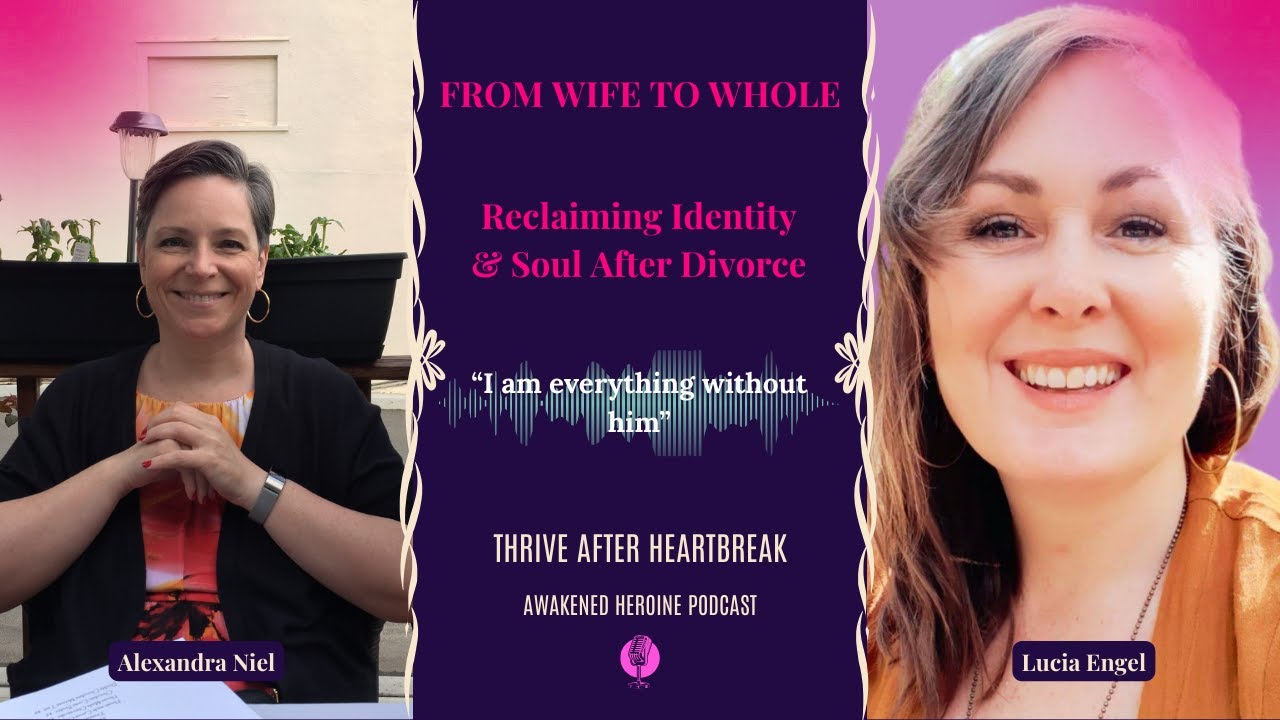
In this interview, host Alex welcomes art therapist Lucia Engel, who blends theater, music, painting, and movement to help clients process emotions non‑verbally. Lucia explains how artistic expression accesses the subconscious, using metaphors like an iceberg to illustrate hidden emotional layers and practical exercises such as drawing fear in a hand to externalize it. She introduces a software‑vs‑hardware analogy for personal change: “software” updates represent shifts in thought patterns, while “hardware” changes involve deeper identity work and confronting core beliefs. The conversation moves to the challenge many women face after a divorce when the "wife" label disappears. Lucia describes how she re‑defined herself beyond that role, emphasizing worth, soul‑level identity, and the importance of consciously choosing new relationship models (e.g., "soul partner"). She shares how her daughter, who is highly sensitive, mirrors her emotional shifts, highlighting the ripple effect of personal transformation on children. The drama triangle (bully, victim, rescuer) is presented as a filter to recognize unhelpful interaction patterns, especially in conversations with ex‑partners. Lucia offers concrete steps for post‑divorce recovery: grounding on solid emotional ground, building resilience, and using metaphors like a shipwreck to organize resources for rebuilding life. She reflects on lessons from two divorces, noting limiting beliefs (e.g., "I am nothing without him") and how the experience served as a catalyst for healing childhood wounds and becoming a more authentic leader. Throughout, the tone is conversational, supportive, and empowering, aimed at women seeking to reclaim their identity and soul after heartbreak.
Chapters
Hello, heroines, and welcome back to yet another interview. Today I am super excited to bring to us Lucia Engel, who is sitting in the Netherlands as we speak. Lucia, how are you?
Hi, I'm really good, Alex. Thank you. Hi, everybody.
So, you know, let's just get started with a really soft and easy one. Tell us who Lucia is.
Well, easy. I have a lot of layers. I have a lot of parts that all work together and make a beautiful harmony most of the days.
Yes.
Well, I'm an art therapist, so I do— I'm originally a theater therapist, but I also created things with music and with painting. How do you say that? Like just coloring, dance movements. Just, uh, yeah, so I help my clients to express themselves.
So you do it instead of like regular therapy, which is talk therapy, you do it through artistic and creative means.
Yeah. So you do use your story and your emotions, but we transform them through art.
Okay. And how did you get started doing that?
I think like just by the examples or the experiences I had in my life as a child, that I noticed that that brought me a lot of joy when we would dance together or like when I was 4, I was still like, I felt like happy. And then the more it went mental, like the, the, the lower my spark went as a child until we did like a musical. And that was so transformative for me always. So when I was allowed to, to pick my studies, like, I went totally with my intuition and what I really wanted to do, even though at that time it was not like a profession that you could make money with. But thank God that has changed now.
Yeah, no, it's good. And I love that, you know, because people think like when they think mental health and they think therapy, it's very boxy. Right? It's like you talk to somebody, but I love the fact that, um, you can also get the benefits just simply because I imagine, and correct me if I'm wrong and, and please expand on that, when you draw or when you dance, your subconscious kind of takes over, right? Tell us more about that.
Yeah. So, you know, like I always show, I also work in youth jail, for example, I show this ice. You know, like ice.
Oh, iceberg.
Iceberg. So, you know, the upper part, and then we have everything that's below. And, um, so below is really where we can change things in ourselves, connected with, with the upper part as well. But like, so the arts, they form metaphors or symbols or feelings in the body. That if we connect it with our conscious mind, it actually gives us the answer of where to go to, if that makes sense.
Yeah, no, I, I get that. And so what do you tell somebody who says to you, well, I don't know how to draw, or I don't know how to sing, or I don't know how to whatever?
Well, I say that's not important.
Okay.
Because I do explain a little bit about, for example, that, you know, like if you do, if you have a trauma, you do EMDR, it's about the eye movements, for example. So I would say, oh, you have an emotion, you're fearful, like how would that look like? So I normally put like, for example, we draw the hands and then you draw the fear in the hand. So it's like kind of like has a safe space. Oh, I've heard that before. Yeah?
Yeah.
Oh, fuck.
Anyway, sorry, go ahead. Keep going.
Yeah. So that's just one of the methods, right? Like, so it has a safe container. So you put the, the fear normally is really big, but if you put it only in the hand and then you draw as if it was in your hand, like, how would that look like? Would it have like a stripe or like a curl or would it like, uh, have, have like this kind of movement? And like almost so far everybody understood that. So it's not really about like, could you make a beautiful drawing? It's more about, are you allowed to express yourself or could you express something outside of you? Because if you can put it outside of you, it's more manageable. You know, you could put the fear there and then ask, you know, what color would the fear have? And, and because you put, you see it, it actually changes something biologically as well.
So. The changes that you are able to make are long-lasting changes. It's not like, you know, you make a decision to not eat chocolate one day and then the next day you're eating chocolate again.
Yes, exactly. No, it's, it goes into the subconscious. So it, so it, it, it like, it's like what day one and then say two, day three, day four, and it has like a longer it's implementing a little bit by bit.
So it's like a software update.
Yeah, you could say that.
Okay.
Or hardware, actually hardware as well, because it does go to your, it also has a layer to your hardware, maybe in a subconscious there is software and there's hardware. The hardware is a little bit harder. You have to be more courageous. You know, you have to have already a little experience. Experience in it, but with the right guidance, they also could change their hardware.
So tell me more about the hardware part, because I'm having a— like, I totally get the software piece, um, but I'm not— I have to admit, I'm not getting the hardware part. Because it's the container, right? Then the container doesn't change.
You mean the subconscious?
As a container, like a human, as a human, right? I mean, when you get rid of a computer, you get another computer. We don't get rid of ourselves because we've had this. So that's why I'm having a hard time with the whole hardware thing.
Okay. Well, yeah, the body stays the same. Yes. But like how you move, you know, like, uh, and the hardware is more like, uh, on identity. It's more, the hardware is more like what is really in your shadows. And like, you can feel it. It's normally before you are verbal as a child. The things that happen before is, is, is forming your hardware. But like, because it's really a felt sense, so it goes deeper and it has to be approached a little different than the software.
Okay.
So it has a lot to do with identity, you know, a lot of like, I'm not enough, like deeper painful little that we feel.
Yeah. And I love that where that the discussion's going towards identity because I think we take so much for granted how we talk about who we are, right? We say we're a wife, a mother, a businesswoman, a whatever. And I don't think we realize how much of an impact those words have in forming our identity. I know there's a, like, way more identity creation that happens as we're younger. And I guess you could, you could talk about identity as a label. For some of the women that I talk to, you know, when the wife label goes away, then they're like, now what do I do, right? So if you, if somebody came to you with this need to reinvent themselves because they've gone through, um, heartbreak, whether it's divorce or the loss of a long-term relationship. How would you guide them towards refiguring out who they are at the soul level? Because I see your community is Soul Sparks. So I wanna bring some of that in also to help women understand how important that part is.
Yeah, first I would say I relate to that because I love being a wife. I very much got my identity from the wife, and there was so much attached to it, you know, like to be the wife. So, but so on a soul level, it's more like, so how do you relate? What's your relationship to that role, right? Like for me it was, I'm worth something. So it has a lot to do with worth, even though me as Lucia, I'm, I'm a woman and my soul is, you know, it's the same as my cat. I, you know, like there's no, no question or doubt that it's existing. So, but I would label that on, on, on wife. So if I, when I got divorced, I was like, oh my gosh, part of my identity felt lost. Like I felt unsafe suddenly. So I really had to like redefine like being a woman and, and being not a wife.
Yeah.
And for me, it gave so much freedom to, uh, to understand that I put— I projected too much on the wife, that, that was— I was already that. So in the— then I turn it around, like, so what was the quality of the relationship? And then I, there was a reason why I was divorced because I didn't know how to make quality relationships. So it was very detrimental. That relationship was not beneficial for me, not for him. So I had to step back and learn those relationship skills. So I could be, you know, like for me now, the wife is more like, if I would right now I'm single, but if I would meet somebody, it's more like a soul partner. Well, like, he has a soul spark, I have a soul spark, and then we make a beautiful, you know, even maybe a fire, right?
Yeah, yeah, it's— I love that because I think that we often forget who we are when we become a wife, or, and especially when we become a mother, right? And I'm sure you've experienced that yourself. I haven't, but I've seen it through my mom's eyes in that her whole life was her kids and her husband. Like, she never did anything for herself, or never, seldom did things for herself. She always put her children first, always put her husband first. And after a while, it can be hard to recognize again who, who you are. So what would be something that a woman in that situation might want to start exploring to get back in touch with who she is without those labels?
Good question. Yes, well, I— what I've noticed in my journey is that like my daughter resonates best, and I, I'm very grateful that my daughter has autism, but also she's highly sensitive. So I noticed that as soon as I changed something in me, automatically it changed in her. So if I would improve my self-talk and I was downstairs and I had like a release, you know, like a transformation, she would come down the stairs and say, "I think I should like improve my self-talk, Mom." And she could not know that because she cannot hear it. But like, and this happened like 20 times, the same thing. I would listen. I'm like, Wow, this is what I improved. I start also like using my own projection on my daughter. For example, like she has not enough friends, for example. Then I would look at where can I improve my friendship? What does friendship mean for me? So I would work on myself and I would use that. And, uh, but sometimes also I had to then, you know, like overcome, like, oh, I, limiting beliefs like, I leave her alone or something, right? Because if I would spend time with my friendships, which probably your mom also would have, you know, like, then I'm not present for my daughter. Which each belief I would question, is it true that I'm not present for my daughter, or am I maybe more present because like I'm lifted my energy when I come home? And then, you know, how much time do I have to spend with her? So all this, yeah, so that's what I noticed, like, if you use your projection of what you want for your children, but you also have to live that, and that is like, be really courageous and look in your mirror, because a lot of times before I thought, oh, but I have a lot of friends, but then I started to investigate my friendships and I'm like, we're all avoidants. We're all just playing a certain game, but is there really like, do we have emotional connection? You know, like how, how is the quality of that relationship? Like we're all always nice to each other. We, we, we spend time together, but so there was a lot to explore there that actually was beneficial for my daughter.
That's, I love that you brought it to the level of energy because everything is energy. Right. And the fact that she was able to sense that shift in energy in you and that it triggered for her to do things in a different way. I think that's, I mean, that's the first time I think I've ever heard it explained like so with such a vivid example. And I love it. I love it. So. When— how important is it then for us to role model the way for— whether it's for our children or for the people in our community who we want to kind of, you know, elevate or where we want more for them than sometimes they see for themselves?
Yeah, I think it's essential. I think that's what a true leader does, you know, like you, you show the example. And for me, it helps to say, is this out of survival or in survival, right? Like, I use the word surviving because, like, if I make a bold step out of survival, then actually that— then I'm leading.
And if you're staying In survival, that means you're staying kind of stuck in your beliefs and in, and not really stepping out, I assume.
Yeah, in patterns, in beliefs, in fight, flight, freeze, or fawn, all that. Or in, you know, you have the drama triangle that I use a lot too, to show—
Oh, tell me more about that. I don't know that.
Oh, that's nice. Well, it's just one of the filters I use, you know, like if I feel like something's off, I just put one of the filters, the drama triangle, to see if, uh, if I'm more in the bully, in the victim, or in the rescuer, if that energy is present.
So you said it's, it's drama, not trauma.
Well, actually, it could be as well.
Yeah. Okay. Okay. So you said bully, rescuer, or victim.
Yeah.
And okay. Okay, so how— give me examples of each of those.
Well, for example, I could be a bully if my mind is in fighting mode, you know, like, so if I'm relating to a person or relating to my business or relating to, you know, my body image, or it's all about relationships, right? So what would be most beneficial as to use an example for your Having a difficult conversation with a former husband. Okay.
Yeah.
So for example, if I'm in my fight mode, then I'm in survival. So it's important in survival, biochemically, it's impossible to connect. So the conversation, if you start it, the conversation normally ends how it starts. So if I start in the bully mindset in fight mode, then probably it will not be a good conversation with my ex, right? So the bully— each archetype has— the bully is really about speaking and dare to say your boundaries, but the boundary not, and this is not what I want. It's more like, what do you do want? And speak to that. If I'm in a victim mode, I see him energetically that's what I had, like as a big person, you know, like, oh, I can't stand up for him, and, you know, he does this, when he does this, then I have no choice. But so the victim is about, I do have a choice, and what choices do I have? And then the rescuer, so I had this even 7 years after my divorce that I believed I still had to rescue him. And a rescuer is really about a coach and believing that that other person, so the ex-husband, is really capable himself to do it. And by taking certain— doing certain things for him or thinking that you know better is actually taking away of his strength and his life force to grow himself and to come up with his own answers.
Okay. Yeah. So a healthy way of interacting in a situation like this from an energetic point of view, walk us through what that looks like.
More the soul-centeredness, like, so you, you are kind of in your silence, uh, space. Where your soul spark lives. So you, in your wisdom and your higher self, or you know, your wise self, like the self that has communication skills, awareness, you start a conversation with knowing what you actually want from him, right? But it starts with you. What need do you have, and what would you like to change and speak into?
If I take a few steps back, this— it starts with us and knowing what it is that we want, what we want to stand for, who we want to— who we want to be in this new chapter.
Yeah. And yes, and in that relationship and future relationships, right? Yeah.
So So how, for somebody who's kind of in that space of, you know, they're just coming out of the shock of going through a divorce and they're starting to pick up the pieces a little bit, how, where do they go from here? Like, what's a, what's a logical or intuitively and energetically aligned first step to get to know themselves again.
Yeah, the metaphor that I often use is like you kind of have like a shipwreck, right?
Yeah.
So you're on sea and everything around you is like there's a suitcase, there's like a plank, everything broke down. So the first step would be get yourself on shore and organize, you know, what you still can use and how you want to rebuild your life. To get on solid, safe ground, especially safe, and, and regulated. Learn about your emotions, build emotional resiliency. So because sometimes you have to go back to talk to him so you don't feel again like all wobbly and blown, blown in million pieces again, and you don't fall into one of the three in the, uh, in Drama Triangle then? Well, that's more like, uh, that I use as like before I start a conversation, or sometimes when I'm in, when I'm lost, then I'm like, oh, you can also use it. Actually, now I'm in victim mode. So you can also, even in the storm, there's always the silent peace, right? So the awareness that you have access to these questions and to this information actually helps you to recenter you even though you are in the middle of a conversation.
Okay, so, you know, we've all—
you've—
I've been divorced, you've been divorced. I think if I were to, you know, if Justin and I were to go our separate ways today, even though we're not married, it would feel very much like a divorce. It would be just as emotionally painful. As, you know, as a divorce. And I carried my lessons from my previous marriage. What were some lessons for you that were things that you carried forward in your life from your divorce or divorces, I guess?
Yeah, I had two divorces. Well, my main, my shift came really in changing a limiting belief. I'm not everything without him. And then I'm like, so I looked into, I'm everything without him, and I am nothing without me. And, uh, or he's nothing without me. That also, like, yeah, I'm actually a great woman, you know, like, so Yeah, um, so I looked into these beliefs as if they were as true or more true. And when I looked into these beliefs and I, I thought, oh my gosh, I am actually, uh, everything without him. And I like, then actually an image came up from my subconscious that like when I was in this, this, this marriage, it for me it was unhealthy. It was like a toxic gray cloud covering me and my daughter. And I, you know, and it was all because I, I didn't check my emotions. I was in survival. So I didn't know how to clean up the air and like connect and stuff like that. I didn't learn yet. So, uh, your question, what was your question again?
Lessons. Lessons.
That was my, yeah, that was my biggest lesson. Like, it's not like a failure. It's just like one of my many examples that I needed, because like I'd never accepted that in my childhood, actually, my parents didn't have a happy marriage. But we didn't speak about that. There was no, you know, like in that time, everybody was doing their best, but it was unhealthy as well. And by kind of like mirror, that it came back in my life, it actually helped me to clean some emotional wounding from the past. So it was a gift. My divorce was a gift, but the, the, the stranded marriage was like what I needed to be able to be more myself, to be a better mother and, and be an example, a lead, the true leader. If I wasn't that marriage, I would just be busy with myself and fixing and surviving.
But, you know, it's, I know that there's a period of time after, especially when a divorce is something that you're on the receiving end of, right? It's a little bit different when we decide to leave versus when the other, when our partner decides to leave.
Yeah.
And I can see that because I saw it happening with my former husband, that there was a period of time where he felt very much like a victim. Right. And I think, and based on your experience, let me know if, if what you think, but I feel that we get stuck in victim mode while we're, we're grieving, right? Because we have to make peace with the situation. We have to just find a way to cope. And once we start to to come to the tail end of the grief is when we can start to think about, okay, what can my life look like now? Um, how do you feel about that?
Yeah, again, I would come back to the drama triangle, that when you are in a drama triangle, whether you are, you know, the victim or for example, I let— I decided that the marriage has to stop. So you could also say he felt like a victim, but I also felt like a victim because in my head he was the bully. He was abusive to me.
Well, I had to leave because he did ABC XYZ, right?
Yeah. Well, you know, but that doesn't need to be like still how you say it now. It's not necessarily that you were a victim. It's just like that was just what was necessary.
Yeah.
You know, but as soon as you take, if you start to go to the observer, like, this is unhealthy, I take healthy, you know, like, then he still can say, but you left me, you know, but that's not yours to, you know, he can deal with his own emotions and his own thoughts and his own process in that. You could stay a victim and, you know, like, there's this like really good advice, like, if you meet a new person and you ask about his ex, like, how he talks about her, Yeah, actually reveals a lot about like how, how he stands in life. So I try to not talk about my ex as a bad person because he's not, you know, like, so I just, he, he was a big lesson in my life and I loved him and we had a lot of drama and, and it's ending and it ended.
Yeah. And, and I, I agree with that a lot because, um, Oh, I forgot what I was going to say. I was going to say something because of what you said about, uh, yeah, what I was going to say was I know he loved me as much and in the best way that he could.
Yeah.
And that was it. And it was just not for me, not enough. And that's okay.
Yeah. Yeah.
Right?
It's not how you needed to be loved.
Yeah. Yeah, exactly. So anything that we haven't talked about yet that you think is important for our heroines to know?
Oh, I'm curious if they have any questions, if something resonated with them. I love conversations, and I'm really curious where they are at. And yeah, like, really cute. I will go and look more in your group as well, you know, what conversations you have. And I hope we can support each other, you know, like as women to empower and to learn from our lessons and not to think, oh my gosh, you know, I am— I did something wrong and that was devastating. I hope they can make it just a life lesson, like we have many life lessons.
Yeah, just with a little bit of heartbreak.
Yeah, but it— but the heartbreak is good. So, you know, like, So we can bloom again.
Yeah. Lucia, thank you so much for being here with us today.
Oh, it's my pleasure, Alex. Thank you.
Oh, my pleasure. My pleasure.









