Healing from Emotional Eating | Rewire Your Thoughts & Reclaim Your Power
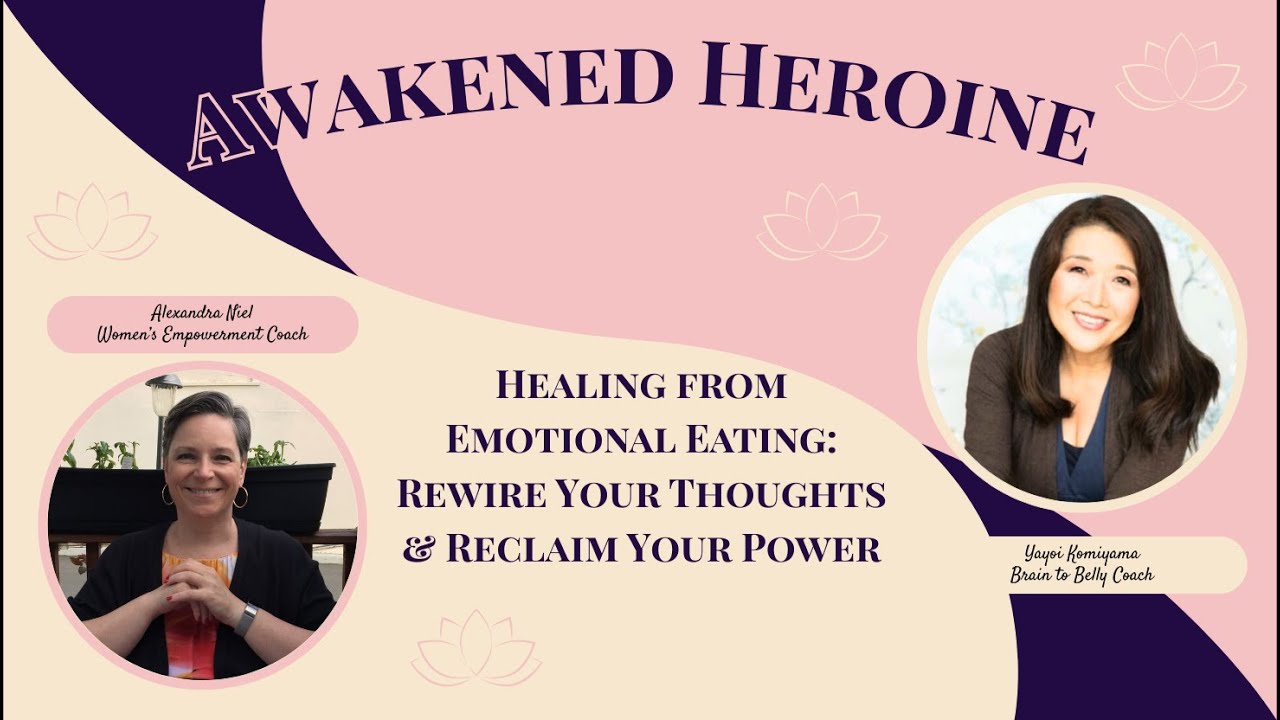
In this interview‑style YouTube episode, host Alex welcomes transformation strategist and neuro‑encoding specialist Yayoi Komiyama, founder of Brain to Belly Coaching. Yayoi shares her personal history of chronic yo‑yo dieting, emotional eating, and an exercise‑based bulimia that began in early adolescence and persisted through a painful divorce. A sprained ankle forced her to confront the disorder, leading her to therapy, self‑love work, and the development of a coaching method that links thoughts, feelings, actions, and outcomes (the "think‑feel‑do‑have" cycle). The conversation explores how suppressed emotions—especially in a Japanese cultural context—drive food‑related coping, and how conscious reframing of self‑talk (using "I am" statements) can rewire neural pathways. Yayoi offers practical tactics for becoming aware of emotional‑eating triggers, interrupting them with humor or simple gestures, and replacing them with empowering habits. She emphasizes the role of embodied power poses (e.g., Wonder Woman, a "Yes!" pose) to anchor positive self‑beliefs, and encourages listeners to craft their own signature pose. The dialogue concludes with advice for women emerging from divorce: recognize their inherent power, engage supportive communities, and allow their true essence to shine. Throughout, the tone is supportive, conversational, and uplifting, aiming to empower listeners to reclaim control over their relationship with food and self‑identity.
Chapters
Hello, heroines! This is Alex. I hope everybody is doing okay. Today I wanted to bring the lovely Yayoi Komiyama because Yayoi is, first of all, a force of nature. Um, she's learned so much over the years and she's so passionate about what she does, and her focus is really health. And we know how deeply stress and anxiety can impact our gut, and whatever's going on in our gut has an impact on the brain and vice versa. So I thought she would be a really good person to bring on board to really have a chat with you guys and tell you like what she does, how everything's connected, and we'll kind of go into all of that. But I'm going to give her a chance first before I continue to rattle on to to introduce herself. So, yayoi, welcome. Um, why don't you tell us a little bit about, you know, where you're from and what you do? Let's start there.
Okay, thank you, Alex. Thank you for having me today, and it's so good to spend time with a good friend. So, you know, it's always fun and I enjoy it. Um, so my name is yayoi Komiyama. I am a transformation strategist I'm a neuro-encoding specialist and I'm a neuro coach. So all of that, the neuro part, I'm sure you heard, is really about the brain. And I am the founder of Brain to Belly Coaching. And what it is, is I— what I do is I really help people to change their relationship with food from chaotic and messy to just peaceful and balanced. Because I was a chronic yo-yo dieter. I think I started my first diet maybe when I was like 12 or 13. And I was also somebody that had a lot of emotional eating, did a lot of that. Food became my friend when I was lonely, when I was hurt. I turned to food because they didn't talk back, they didn't hurt me, and it tasted good, right? So that's why food really became a friend of mine. And we just had this— it was a— it was probably too good of a relationship that we had. And then I would say, no, no, I don't want to see you anymore for a while. And then I would go go back to it. So it was like this— I always kind of liken it to this bad boyfriend or girlfriend that kind of strings you along and you go in and out and in and out. And it was kind of like that, kind of a messy, messy relationship. And it took me years and even going through an eating disorder, which I call, which is called an exercise bulimic, where you would binge on food and you would purge it through exercise. Because the only reason I purged it through exercise was because I couldn't throw up. I couldn't do it for some reason. I tried, but I'm just gonna be honest with you, I tried, but I just couldn't do it. So I said, you know what? Okay, then I am just gonna exercise it off. And so I would calculate how many calories I overate and then try to get on the treadmill and then go to spin class and then go to, do other things, go on the treadmill, come home, you know, do my weights and the aerobics and all of that. So it was a crazy, crazy cycle. And it took a long time to break that cycle, to break that pattern. And I think what really helped me was one day I sprained my ankle. And that was like no exercise. And I was like, "Can't throw up. Okay, what am I gonna do?" And said, "I think I really have a problem and I think it's time that I got help for it." And that was the hardest thing to do. But I started getting treatment and I started to learn how to love myself. And that's when a lot of this part started coming into play. So with Brain to Belly, we work on what you think about. And because my mentor has this phrase that he always says, "As you think, so you feel. As you feel, so you do. And as you do, so you have." And that is think, feel, do, and have. So What that means is anything you think is gonna influence the way you feel. So when I was feeling lonely, I was like, okay, I'm lonely, I want food. So I went to food, emotional loneliness, and then the action was food, right? And eating it. But that wasn't a constructive way of handling that. And so I started to learn that maybe feelings are something that I need to actually feel and talk about maybe. You know, because also growing up in Japan, it was— you kind of learn not to show your feelings. It's also a very cultural thing, and we tend not to express our feelings, express our thoughts. And I thought it was, you know, I was being a good Japanese person by not expressing how I felt. But in the long run, what that did was it I just suppressed it, and food was my way of shoving it down into my system, into my body. And of course, my body was getting bigger and bigger because it was trying to shut down all these emotions and feelings. And then I was trying to exercise it off, which was crazy. And, um, so basically that's where Brain to Belly came from, and it's really about learning How to make conscious thoughts. Your thoughts are always going to be your thoughts, but you can always make conscious thoughts so you can be aware of what you're thinking instead of saying, "Oh, I'm such a loser. I can't lose weight. I'm no good at this. I'm always going to fail at this." Instead of saying that, you know, think of it from a different perspective. Use a different frame of mind and say, hey, look, okay, in the past maybe this was the case, but now I'm doing clean slate. I'm going to start fresh. I'm going to do something different. And just putting that different thought into your brain is going to change the way you're thinking because you just broke up that bad pattern. So what we do is we interrupt that bad pattern. Right, by doing something, anything that'll interrupt the awareness, put something better instead that's going to be more empowering. Like, for instance, if I'm failing, if I think, "Oh, I'm such a failure, I'm such a failure," well, there's something called that says, "Fail is a first attempt in learning." So it means that you're learning something. Maybe I'm learning something. Maybe I should think on that a little bit. And then I'm like, oh, that feels a lot better than saying I'm such a failure. So let me look, work on that. What did I learn? What did I learn? So when you do that, you change the feeling inside. Your energies change too. Because when you, you know, make, when you say things that are negative, it's just going to bring your energy down. When you say something positive about yourself, like even if you say, I'm magnificent, I'm brilliant, I'm awesome, right? Whatever, any of those things, you feel so much better. And even if you're not feeling it, even just saying it, the vibration of those words are different. Instead of going down, they're bringing you up. So being conscious of things like that. And so with Brain to Belly, we work on your thoughts. And we work on the self-love piece a lot too, because that's where, you know, we tend to— well, I know that I used to just intentionally— I hated myself. I hated the way I looked. So I would do whatever I can to punish myself or punish my body. And it's learning to say that that's not constructive. That's not to my benefit. So how am I gonna flip that, flip that script? And it's really about rewiring these wires that got crossed and untangling those wires, basically. Yeah.
So I, I wanna come back to what you said just a little bit before about failure because yes, when we come out of a divorce, we tend to feel like failures. And there's a big difference between being a failure and having failed at something.
Yes.
Because when we are something, we make it a part of our identity. When we do something, it's just an action.
Right.
So what would be something that you would recommend To— and just to continue on that tangent, when we feel bad about ourselves, like you did, like sometimes I do, we self-medicate with food because food will never reject us. Food always loves us. So what would be something if somebody is— if one of our heroines is struggling with, you know, making choices, food choices, to soothe their pain or to soothe, you know, their anxiety.
Right.
What would be something that you would recommend to them?
Well, first I would say become aware of that, that you're taking that action to soothe. So become aware of what you're doing. And once you're aware, you can make a choice. You know, it's hard to, it's hard if you're not aware, you're just gonna automatically reach for the food. But if you start becoming aware of it, wait, am I gonna reach for the cookies because I'm feeling lonely, because I'm feeling hurt? Just that realization is going to help you to say, wait, wait, wait, wait, wait. It's like putting the brakes on the car, right? It's like saying, wait, what did I just do? And you're recognizing that pattern. So let's break it. So it could be just something as simple as, well, I'm not doing that. Or it could be something like no cookies. Or even if it's just snapping your fingers, like, I don't know, like I don't know if you watched Bewitched when you were a little girl or Genie. Yeah, you could do this, or you could do blink like Jeannie did, or whatever, but anything that's going to make you laugh and say, wait, I'm not doing it, and then cookies away, or whatever. But, you know, making that and actually taking action, some sort of action saying that you're gonna break that pattern, is gonna actually put a stop to what's here. It's gonna create Like what if this was a line of that negative thing, right? It's gonna make a cut here. So it's gonna open up this space. So what we're gonna do is put something fun in it. So it could be that laughter, like, oh, I'm gonna do, I'm gonna be like Tabitha and I'm gonna do this and that craving will go away. And then it may not go away, so you keep on doing this, but still you're gonna laugh about it and you're like, oh, okay, this, this can work, this can work. And the fact that you're becoming conscious of it, you're controlling it now, and that you can control it. So that is something that I would recommend. Now, you were talking about identity earlier, and when— yes, you know, I'm a divorcee as well, so you do feel like your identity was tied to it. You were a wife, right? I was so-and-so's wife. I was Mrs. something something, right? And it is an identity thing, but we also, like in Brain to Belly, we also work on creating newer identities. And we, I mean, even with the eating thing, we want to create a newer identity of who we are. And the new identity is not someone that wants to wallow in her chocolate chip cookies, or swim in her chocolate chip cookies and, I don't know, fudge, fudgesicles or whatever, right? You know, I want to be somebody that could say, wait, okay, those are good, maybe one or two cookies are good, but I don't need the whole sleeve, right? Thinking about that. What's my new identity? Who am I? So we work on a statement called the I Am statement and when you say, "I am," it's a big thing because your brain is listening to it. Yeah. And your brain doesn't know what's true or false. So if you keep on saying, "I am magnificent," you know, and just those vibrations of those words make you feel better. I am magnificent. And if you keep on repeating it, you're going to start believing it. Instead of saying, you know, with your voice down, "I'm such a failure. I am such a I'm such a loser. Instead of saying that, saying, you know, so I'm clearing that out, but you know, I want to say, I'm magnificent, I'm awesome, I'm brilliant, you know, I'm a winner. And you might think it's silly at first, but try it because your energy will change when you say it, even if you're just saying it half-hazardly or half half-cocked or whatever you want to call it. Yeah, if you're not fully into it, you could even— even if you're not fully into it, by saying it, it makes a difference. And start painting a picture of your new identity. Who do you want to be? What do you want?
Yeah, I love that because the other thing that goes along with what we say is how we hold ourselves.
Right?
Because just like you were saying, you know, when you talk about I am magnificent, I am these things versus I'm a loser or I'm a, or whatever, like our body language completely changes. And, you know, when it's negative, we kind of fold in on ourselves. When it's positive, we want to put it out and we want that energy to, um, yeah, to be out there.
Yep. That's something else that, you know, I teach in Brain to Belly is really about your body because when you're saying these positive phrases, I want you to really embody that. And so I don't know if you're from— well, a lot of people know Tony Robbins, and Tony's always like, you know, yes, or whatever, you know, he's got the fist going, right? And but it's really important that you find a pose that's to anchor those feelings into you. Even if it's like doing like this, you know, I'm magnificent. Like, even just doing that, or even, you know, hidden, you could just be like tapping your thighs, you know, with your— saying, I'm magnificent, right? Or even snapping your fingers. Something that's going to have you actively taking action, your physical action, as well as your brain, so that it really gets programmed into your brain that you are magnificent. And then you'll start really feeling it. And then you might really want to maybe explore to find out what makes you so magnificent.
Yeah. Yeah. Yeah. And it's— I love the whole thing that you said about Tony because it's true that I think we all should have a power pose.
Yeah.
So, you know, the pose that makes us feel like a million bucks and that actually has the power to bring you out of that funk.
Oh yeah. Right? Totally.
And what's your power pose?
It's very similar, but I have two. I have this one, which is the Wonder Woman pose, right?
Yeah. That's mine too. Yeah.
That's one of them. That's a common one. And then I have, "Yes!" Okay. That's mine because— and I do this a lot. Like, I do it a lot because I feel like I want the energy coming down into me. Yeah. You know, I want this positive energy to come into me and keep me where I am in that positive frame of mind, in that positive state. And it's an empowering state.
Yeah. So I'm actually going to throw out a challenge to you heroines out there to come up with your very own power pause— pose, not pause, pose. And, you know, let us know what your pose is. Let us know if it's a gesture, if it's a saying, if it's— what is it that really makes you feel powerful. And that really changes your state. Because I'm like you, Yo-Yo. I'm more into the kind of— it's the Wonder Woman, Superman kind of pose. And they do change how you feel.
Totally. Totally. Because like you were saying, when we're negative, we're always like this and we're closed in. Our body, our breathing is closed in. You know, I look like I'm negative here, right? Like I'm depressed or whatever. But like, if I'm going like, if I'm standing up like this, I'm taking in air like this, I'm breathing it in, I'm taking in energy. That's really powerful. Just that gesture. So even if you're feeling like crap, you know, if you're feeling like this, then I just say, do this and just see. And it could be one of those silly things, you know. Um, I don't know why I just thought of it, but it just came to mind. I don't know if you watched, um, what was that called, that movie called Legally Blonde? And they had that.
I know of it.
Yeah, okay. There's one scene when they're in the beauty salon and there's a pose that you're supposed to do with the catch guys or whatever. It's called the snap and bend. And if you snap, you go down, and then you bend like this, right? But even if it's that, even if it's just doing this, right? It's like funny, it gets you. And oh, and I just wanted to show you my Wonder Woman toy.
Oh my God, that's awesome! Where did you get that?
Oh, I bought it through Funko Pop.
Oh my God.
They have all of these, and this is one of them. I have more than one Wonder Woman, but this is the one that I have on my desk.
That's awesome. I love Wonder Woman. She's—
oh yeah, she is so cool. I loved her when she— even when she was doing the twirl thing.
Yeah, yeah, yeah. So, yayoi, any words of advice for our heroines who are on the aftermath of a divorce or the end of a long-term relationship? So that they can begin to take back their power.
Yeah. You know, what I can say from my own experience is that you are powerful and you just forgot about it. You just let it because relationships are tough. I mean, I went through a bad, you know, it wasn't a great relationship, marriage, and It really was. I felt like I lost myself. And just think, you know, maybe this is God's way of giving you time to yourself so that you can find out who you really are and what you really want. And maybe it's easier to find out who you are without any other person around to kind of, you know, distract you. Sometimes it's necessary to do that introspection and find out who you are and what you you what you are, you know. Are you a powerful woman? Are you like, are you beautiful? Because you are. And are you brilliantly shining? Yes, you are, because you are. All of us. And I believe that we all have a part of the universe in us, and we're kind of like stars, and each one of us shines brightly, and it's a brilliant shine that we all have. So just remember, you know, all of the, the pain from the divorce, all of that maybe clouded, got layered. I don't know, these clouds just got layered all over your shine, right? And we're just stripping them all off, gently taking them off, and let your true— let yourself, your essence Just shine because you are brilliant and beautiful and you are whole. You just have to remember that. And being in a community that supports you is so important. So, you know, reach out to your fellow people and supporters, people that are going to nourish you and be with them and be who you are and just shine because you are powerful. You just forget it.
Sometimes. I completely agree with you. I think there are a lot of layers, whether it's societal layers, familial layers, expected, expected, whatever, right?
Yeah.
And we forget that we're okay just being us and shining our light. So I just want to thank you so much for reinforcing that. Yayoi, I want to thank you for being here today and sharing your wisdom with our ladies.









