Healing Trauma, Loving Your Body & Finding Real Love
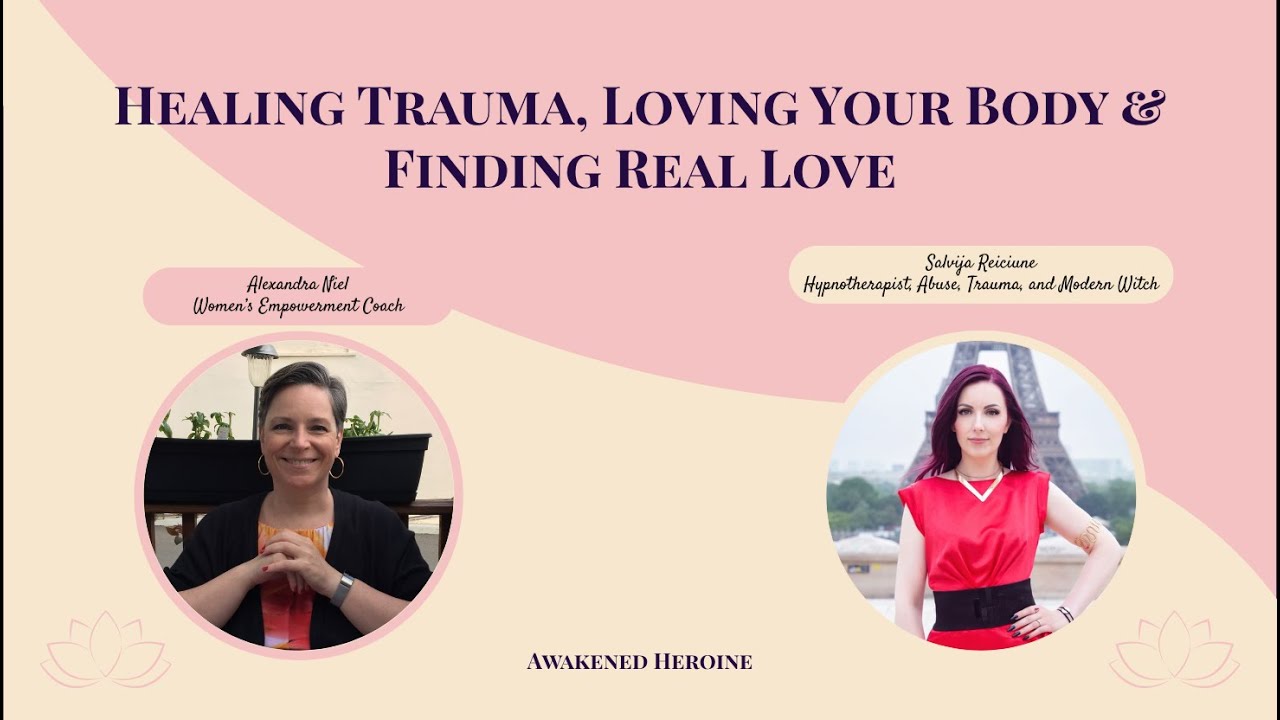
Alexandra Niel interviews Salvia Raychuna about healing from childhood and relationship abuse, the physical effects of trauma, and how to build self-love and boundaries. Salvia shares her personal story and coaching insights on leaving abusive situations and forming healthier relationships.
Chapters
Hello, heroines, and welcome once again to this interview series. This is Alex, and I am here today with the lovely Salvia Raychuna. Correct?
Incorrect?
Close. Welcome.
Oh, I'm so glad to be here. Thank you.
I'm glad that you're here too. So, um, let's get started. So I wanted to bring Salvia in because We just did a— you had a session with me recently, which I thought was actually really cool because it gave me the chance to really listen to what my body was trying to say. And so, Satya, why don't you just start by telling us where you're from and what you do?
Oh, the most hardest question of them all. So Originally, I'm from Lithuania, so there is a bit of an Eastern European situation, but I'm not going to do the accent. Sometimes it just comes out. Okay. So originally, well, now I live in UK. I did live in Spain for some time. So I love to move a lot, if that's not clear by this point. What do I do? So I am abuse, cam, and emotional trauma expert. So I basically do support people in active abuse. If they want to leave abuse, they don't know what to do and where to start. I also support people after abusive relationship or even abusive experiences, let's say at work, to rebuild the confidence, self-worth, and really, really understand what the hell they want from their life, how to read their body, how to connect with their body, because the body tells us everything. The mind acts for around loads of time. It depends how long you ignore it. People are usually really good ignoring their body at this point. And I am massive potato and caviar lover, animal lover. Anything with the potatoes. If you need to bribe me, caviar and potatoes is gonna be the way. Um, for around 6 months I'm doing pole dance and just capturing the whole journey, challenging myself, which also opened a new door of development, my sexuality, and showing my body more, and even becoming more friendlier and more kind with my body. So it's also part of me now and what do I do, because I feel it helps a lot when we get out of shitty relationship, especially if you've been body shamed, to just connect back with that essence and be just a sexy bitch.
I love everything that you just said, and it's good to know about the potatoes and caviar. I'll have to keep that in mind. So tell us a little bit about your story, because one, like, how did you get started doing what you do? So like, what's, what's kind of behind the curtain a little bit?
So it all started very randomly, but not very randomly. So I was born in abusive family, so my father was the main abuser and he was very dictatorship style. He was very rich, so clearly no rules applied. We couldn't get help, um, the worst thing we could do is contact the police. And if we would disappear, nobody would even ask the question. So that was the situation for many, many years. Clearly, we had to smile, we had to, you know, pretend to be the perfect family and pose and all of these things. So my model of relationship was that the male is dominant, abusive, and controlling, and the female is submissive. And clearly, when I started, you know, getting into relationship, this is where I ended up. With basically abusive type of men, or very emotionally neglective, unavailable. So the situation got worse and worse because clearly I was never loved child, so I wanted to be loved. And clearly what abusers are really good at— I'm not gonna say narcissist because majority of the time abusive type combines few, um, characteristics, it's not just pure narcissism. So basically, yeah, I was jumping on abusers like left and right, like If there is, you know, a bunch of good guys, I'm gonna sniff out the shitty one and jump on it. I'm just like, "Love me." So that was going for years and years and years, which didn't go well with my childhood trauma and being neglected in the relationships, which I started self-harming. I was healing myself with alcohol. I was literally doing everything and changing myself every bit of a way to fit the relationship. So basically, I was modifying myself to be lovable. But as we all know, if you have abusive type of partner, you will never fit to be good enough. So that kind of gone really, really bad. So I started developing a lot of hate towards myself. And then when I felt I'm gonna crash, in Lithuania, we didn't have any help, basically. We had psychotherapists, that's all. So I had option either pills or psychotherapist. And I was like, fuck it, let me try psychotherapists. So then I started learning. It didn't quite help me with the trauma, but it helped me educating myself because I didn't know anything about relationships, abuser types, anything. So when I started just really taking care of myself, I pushed away the relationships. I kind of stepped back, and this is where my husband came in, which by the way, I tried to get rid of for many, many weeks, and he's still stuck around. Don't know why, that was very questionable at this point. Um, so it was very weird because I was like, you either mentally messed up, another one, or you actually might be good. So I even started developing tests and all of these things to understand if he's, you know, suitable for me. And also I started to understand how messed up I was. So it's like, are we compatible? We had no dating, we had like relationship terms and conditions first of all discussed, like what do I want, what he wants. I, for example, don't want children, so we started looking the compatibility and do we match. I knew I'm not gonna stay living in Lithuania. That's another big thing that, for example, I'm not gonna stay here for any guy, like fuck off. Again, if you want to pop a baby, good luck, but I'm not gonna stay. So these were very important things for me. Again, I can't be told anything about animals, so I had very important things then like less important things. We had conversations, it was fine. Then eventually my cat decided that we're gonna have relationship because I said if my cat approves, we can continue dating. If not, then not. I can't tell you how many guys told me I'm gonna be eaten by cats. So I started embarking on healthy relationship, and then I wasn't doing this for a job, but then one day one lady, she's like, you've been through abusive but you're now in the loving relationship. How the hell did you move from this to this? And I was like, oh, you know, shared my story, and she was like, can you help me to leave? I think I'm in abusive relationship. Can you help me to leave? And then how do I get into normal ones? I was like, I don't do this for the job, but if we're doing this, are you taking the risk? Because there is a lot of risk leaving abusive relationship, and I'm not actually professional, so you understand that this is going to be a trial. It actually gone really, really well. She, I prepared her in case if anything happens. We built the whole strategy for the police. She won the court case and everything. It was just like, and she was like, oh my God, like you've done this so well. You need to do this for a job. And I was like, what are you talking about? Like, and then she recommended me to somebody, then they recommended me to somebody. And this is how it started to happen that I started specializing in active abuse because actually nobody could help people to leave the abuse successfully. And then heal from it successfully. Because majority of the time, I'm gonna call it the person who's leading the abusive relationship a victim, but they're not a victim for the whole life. They come back, and that is the biggest problem that a lot of strategies fail with it, which my one doesn't. If the person truly wants to leave, there is a stepping program, they feel taken care of, and Yeah, it's like this is how I ended up just doing things because people came to me and they said, fuck it, I want loving relationship, how do I get there? And I'm like, sit down, let's see if you can handle this.
But it's so important what you're doing, right? Because I think there's a lot of stigma and a lot of misunderstanding around abuse in that, you know, people talk about, well, it's a choice, or it's you know, they asked for whatever the case may be, right? And but nobody, nobody wants that. Nobody in their right mind wants that. And the, the— I, like in all relationship, I read something recently, or I just heard it this morning actually, um, somebody said— oh, I wrote it down, hold on a second because I gotta, I gotta go pick it up. It's A relationship problem is really a personal problem that shows up in your relationship.
Yeah, because, right, yeah, yeah, we attract basically what we lack of. Like, for example, when I was in abusive relationship, was it in my right mind? Hell no. Was I knowing my self-worth? What the fuck was that? Was I confident? Definitely not. Was I desperate that anybody loves me? Yes. Did I know what the love is for me? Absolutely not. I thought being abused, neglected, and tortured, and scrapes of attention thrown in, that was love. How messed up is that, that I was thinking these things? And when I speak with people, not even my clients— definitely I grilled them— but when I say to people, cool, you want loving relationship, what the fuck love means to you? And they're like, you're a bit aggressive. And I'm like, no, just answer the question. What love looks like. Oh, I just want to find a kind man or a woman. What kind is— for somebody, choking is kind. For some— for someone else, you know, being held in a sensitive place is kind. People don't really know what the hell they're looking for. They just like think of like ideas, what they saw in their family, what culture was telling them, what society is telling them. And that's what they find. And then they try to convince themselves to be happy with it. It's not going to work. This is where cancer, autoimmune, pains, everything comes in because your body is like, if you're not going to get us out of here, I'm going to kill us and I'm not fucking joking. So this is the whole vicious cycle. But the point is that even when people decide to leave, they're like, okay, I want to leave. There is no actual proper support that successfully helps you do that. Majority of the advice gets you 99% killed in abusive relationship.
So not a, not a great success rate.
No. And yeah, yeah, and with the course is even worse.
So I want to go back to what you said about, um, the desire to be loved and the desire to be accepted, and I feel like a lot of women will look outside for that, right? But we know that the gold is really on the inside. So how does one begin to access that, that self-love? Like, what have you seen work?
So I feel, first of all, it's very crucial to understand that you are seeking external validation, because for me, while I was seeking it, and not understanding that I'm seeking it, you know, it's very hard to do any self-development and start loving myself that I subconsciously try to seek from outside. So I'm gonna say it's like admitting the problem is the first step, which sounds like harsher than it is, but it's just like admitting that, okay, cool, so I'm seeking external validation because it's going to be like, oh, because I want to be seen. 'Okay, cool, I want to sing because...' A little bit understand your reasonings, because for me, for example, it was like, I just want to be loved for who I am. I don't want to be hurt. I don't want to be felt neglected, because for me, the worst thing was, you know, when you have an argument with somebody and they just leave the room or leave the home, and they— the silence treatment and everything. That was so bad to me that I used to have massive panic attacks. That was such a strong thing for me. And I was just like, oh, I want to be her, that nobody literally cancels me out. I want to be that person that, you know, I can say what I want to say and not to be scared I'm going to have consequences. So also understanding what do I need and what do I want was very important to me. So then I can start working with myself that, okay, I'm really dependent. If somebody wants to cancel me out and block me, I'm really sensitive to that. Okay, how can I be less sensitive to that or maybe react as less as possible? So that meant that I needed to be safe with myself. I had to work with my inner child. I had to feel confident that I can survive because for me it was equal death. So if your mind equals something to death, you lose control because your whole mind and body target is Survive, live. You have no control over that. So I was like, okay, if somebody, let's say, blocks me or splits with me, am I dead? No. Is it going to be painful? Yes. Am I gonna have grieving period? Yes. Is that normal? I guess so, yeah. So it's like just sitting with yourself, like with the child, and explaining the process, and you eventually understand that, okay, cool. Then another thing that really helped me out telling compliments to yourself. It's a massive, massive thing that especially women don't do, is telling yourself compliments daily, inside and outside. Compliment your outside and compliment your organs, um, to be really, you know, that you're beautiful, that something is really nice. I, for example, wanted to grow longer lashes. I literally complimented how sexy and long my lashes are. They're longer now and sexy. And eventually do that naked in front of the mirror, which is very difficult for women to do. And especially if you are still coming into periods, that's the thing for me. So when I reach PMS side and period, we clearly retain more water. And since I'm doing pole, I clearly notice that and I instantly go like, oh gosh, I should lose weight. And I'm like, no. No, this is the week we're being kind to myself. So I, for example, bought shorts that are a little bit more— has wider around the belly area, so it's just a little bit— it squeezes me in so I feel better. But I'm like, no, no, no, I clearly don't have that much strength to do pulse. I'm like, oh gosh, we've been practicing, what the fuck is wrong with you? You should be doing this. And I'm like, no, no. So again, really noticing these moments when you're starting to criticize yourself. Notice what time of the month it is. Maybe you're on your period. Be less critical. Switch that criticism into self-love. And also understand what self-love is to you, because if you've been in an abusive relationship, I can bet you don't know what self-love is. So compliments and being kind to myself was really, really crucial, because even if somebody tells me something nasty— like yesterday, I had a teenager flip out on me in the corner shop because he was an asshole to the checkout lady and me. And I was like, I'm sorry parents didn't love you, but it was still not a pleasant situation because he called me names. And I was like, oh, but you know, he's kind of a bit hurt, so it makes sense. But still, you know, it's not about me, it's about them. I didn't do anything. So it's really noticing your actions and thoughts and practicing self-love that is going to be the game changer. Because when you then go let's say, attract the partner that you desire. If you do practice self-love, if you understand your worth, what you're not gonna go lower of, being confident and splitting where is your behavior, where is somebody else's, is going to be so much easier for you to filter out like fish and allow for seahorse to come. That's my analogy, because there's plenty fish in the sea. Who wants A fish. Nobody wants a fish. Everybody wants a seahorse. Stop bullshitting yourself. So then you allow seahorse to come.
Seahorse as it is. That works for me. Um, I want to go back to what you said earlier too about how when you're, um, not living your— the full expression of yourself is what I heard— that it's reflected in your health. And that's how various illnesses and things like that come up. Tell, tell us more about that.
So even my examples were, so for example, while we were living with the father, clearly there was a lot of abuse and father was beating me. I used to have unexplained allergies and some of them were really, really painful. I couldn't even turn my head. So clearly my body was instantly protecting me. Doctors never could explain anything. The moment we moved away, all of these allergies disappeared. So that means your body is going to indicate. Then the next thing was that in the school, you know how in the school nobody wants you to speak up. And I was like, just shut the fuck up, just stay silent. I started losing my voice. If I didn't say what I wanted to say, I used to get voice cords inflammation and I used to lose my voice for at least a month. No sound came out. From my throat. And right now, if I'm silent not to say what I want to say, my throat starts to hurt. The moment I say it, it goes away. Then it's my body instantly does these things. If I'm, for example, not doing what I truly want to do right now, I have all sorts of signs, headache, neck pain. It instantly tells me, and I know for other people it instantly tells too. So for example, migraines is one of the big things, chronic pains. That means that people are not truly listening to themselves. They're putting themselves into the situations where they shouldn't be or trying to be happy in, and the whole body is screaming like, you need to leave. And it will make you leave either in the coffin or you will understand that you need to leave. There are two ways. So I had multiple situations like that in my life, and the whole point was I just had to listen what my body is trying to tell me.
So when you work with someone, you work on both the trauma piece and you work on the health piece. How do you connect those two things? Okay.
Usually trauma impacts health massively. To be honest, 99% of the work with even cancer patients, autoimmune patients, any of them, It's very rarely pure medical problem. It's usually trauma cause. So for example, I was working with a lady who had autoimmune. It was in joints. She couldn't move. She couldn't walk. It was so bad that doctors offered her such a harsh medication that it would have destroyed inside organs, but she could have walked for some time. And eventually she was like, oh, I don't know what to do. And I said, come to me, let's do We done a Rapid Transformational Therapy session and a bit of a coaching after, and it was all to do with her mother's trauma. So her mother was really abusive, very dismissive, very critical, very neglective, very aggressive, always made her feel like shit, guilty, not good enough, just the worst daughter in the world. And we released some of that guilt and the buildup of emotions. After 2 weeks, she came back to work. She still had a bit of a pain, but she could have worked, she could have moved, she could have taken care of the kids. And I said to her, your biggest problem is your mother. You have to figure out what you're going to do next because you can't keep exposing yourself to that abuse. And every time she used to communicate with her mother, even through the phone, the joints worsened. And we done experiment. She didn't contact the mother for a month. The joints were getting better and better and better. She, she needed no medication anymore. So the body tells us very, very clearly, and it— majority of the time it is related with trauma, or let's say we on purpose put ourselves into abuse, like, oh, it's my parent, I should be communicating with them. But yeah, if I would be communicating with my father, I would be dead for sure, because I had 2 attempts to my life, so I kind of needed to pick. For me, it was very obvious, but my one brother is staying with my father, and he has enormous health problems right now that doctors cannot even explain. He probably is on the pills every day, like 9 pills a day or something, and it's purely because he's exposing himself to abuse. If he would leave, all of these problems would go away, and I've seen that with so many people right now, and they can't believe it. They're like, I never thought that me just leaving situation is going to heal me, but that's what very often happens. Like, my mom was the same.
That's so powerful, so powerful. I want to switch gears very quickly, um, because we all have a story of either divorce or heartbreak uncoupling, whatever we want to call it, in our life. What was— what were some of your lessons from your history in your relationships that you think would help some of the heroines in the group?
I would say better learn to be happy alone than with somebody shitty who doesn't respect you. Because when I came to realization that I'd better be, you know, alone with myself than chasing somebody who really doesn't care about me and is very, very harsh towards me. Um, what else? If somebody can't bother to dedicate time for me, and you know when you sometimes have a meal or something and they're always on the phone, that's also a massive no for me. Because it's like, if, if somebody cannot give attention to you during that time, that means they're not going to be bothered to respect you later on. Um, I always, always check if the words match actions. Majority of the time, if you are dealing with shitty relationship, you will notice that actions and words do not match. So if somebody is like that in the beginning, run. Just run. Also, be crazy in the beginning. If somebody cannot handle you at worst, why would you want them to be at your best? Like, I literally, when I started dating my husband, I was very difficult. I can't even tell you how difficult I was. I was annoying. I was pissing him left and right because I needed to understand how he looks angry. Is he abusive? Is he insulting? Is he quitting instantly? You have to understand these things very, very quickly. And Cut the bullshit being nice in the beginning, being perfect. Yes, make an effort, look nice, you know, do makeup or something, but apart from that, be an asshole. Understand with whom you're dealing with, and then if the person is, you know, ticking the boxes, let's say, what do you have, you'd be like, okay, cool, so we can be compatible. It's going to be really awkward, but then, you know, when you explain the reasoning, the right person will Yeah, I get—
I can see that. I have a physical— I don't think that that would necessarily be for me, but I think showing up authentically and showing up as who we are without the filters and without trying to be perfect, because nobody's ever going to be perfect no matter what's going on. In our lives, I think that's really, for me, it's the secret sauce, is to be able to, to do that because then we're respecting ourselves. Yeah. And, you know, we also get to gauge, okay, is this my person? Because you don't, we don't want to be with the person that's not our person.
No. And the one thing also that was big for me, understanding that it's not forever, ever and after. Because you know how everybody's like, oh, it's my one person. Now when people ask to me, they're like, oh, you know, you and your husband are going to be always forever together. And I'm like, I don't know. And they're like, no, you don't say that. Maybe not. Exactly. I don't know. It's like tomorrow one of us can be hit by the bus. What the fuck I'm gonna do then? Like, simple as that. The death is going to end it. And understanding that relationship might end gives you that sort of kind of a realization. Oh, cool. So then I'm going to enjoy it now because I don't know what tomorrow holds. We don't know. And I kind of realized if you do relationship backwards, it's even better because, you know, everybody's nice and perfect and dating and glossing, and then let's see what do we want. Now flip it. What do we want? And then nice dating and glossing because you already figured out that you are compatible. Like me and my husband, we've been together, gosh, I have no clue. I never know. He knows. 8, 9 years, something like that. And we still go on the dates and everything because right now we're enjoying that glossiness, we're enjoying that compatibility. When we start—
because you've already done the hard work.
Exactly. We have no romantic story in the beginning. Even our proposal was ridiculous nonsense. I was complete asshole. And everybody's like, how he's still with you? I'm like, I don't know.
Because he saw something that you Either you couldn't see yet, or he really wanted to dig in and just make sure that— or he was very, very— how do you say— he just knew.
Probably I'm just crazy. He likes crazy.
That sounds like something else for another therapy session.
Like, we all have our craziness.
Yeah, we all do have our craziness. But Salvia, I just want to say thank you so much. For being here and for sharing your story with our ladies.









