How Becky Reversed Pre-Diabetes & Built a Holistic Wellness Business
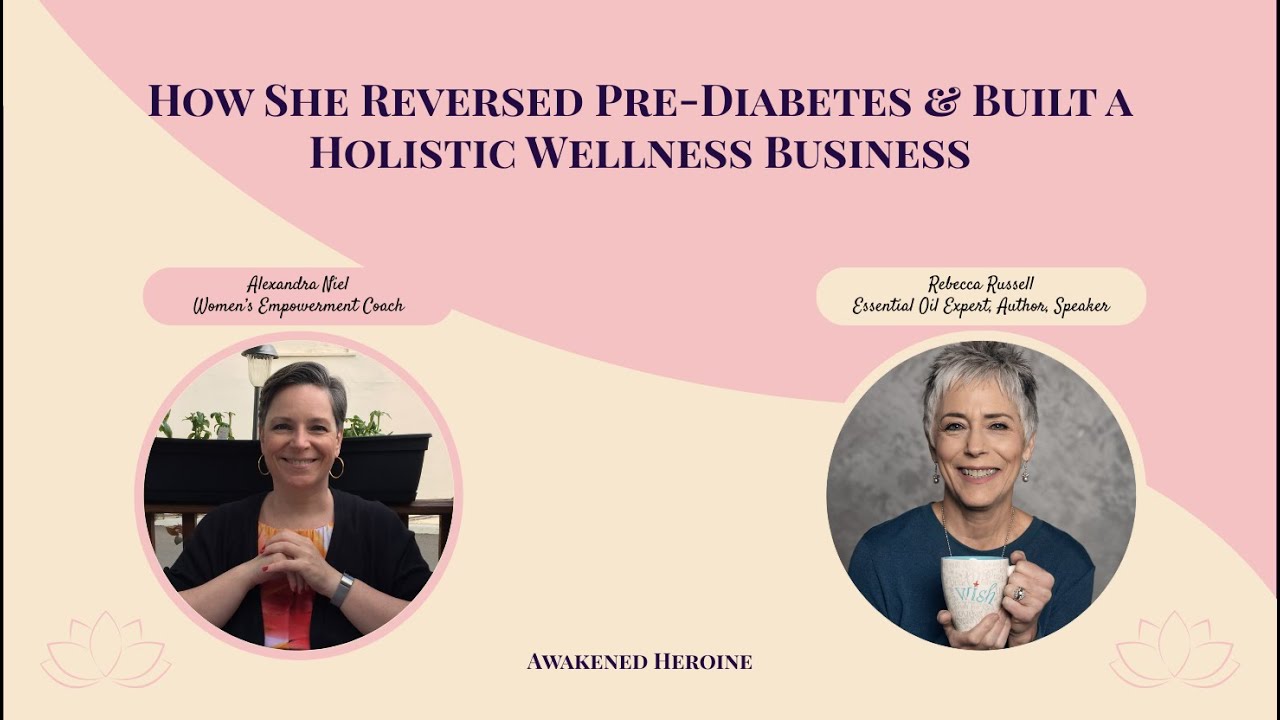
Becky Russell reversed pre-diabetes at 35 without medication by working with an Oriental medicine practitioner and shifting to holistic health. At 58 she launched a doTERRA wellness business mentoring women on sleep, stress, and digestion, using essential oils like ginger for empowerment and bergamot for self-acceptance.
Chapters
Hello, heroines! This is Alex. Happy— what are we, Tuesday? I hope everybody's doing okay. And today I have the pleasure of bringing you Becky Russell. Becky and I know each other through a wonderful networking community called Fem City. If you don't know them, little plug for Violet, uh, check them out. They're not everywhere, but they are in a lot of locations, so don't hesitate to to check them out. But meanwhile, today we're going to talk about essential oils. We're going to talk about personal development. So welcome Becky, who's an essential oil expert, author, and speaker. Becky, welcome.
Thank you. Thank you for having me.
It's a pleasure. So why don't we just get started with the basics? Tell us, you know, who you are, where you're from, and what you do.
Well, I am a, like you said, an essential oil expert, author, and speaker, and I live in Jonesboro, Tennessee, and love it here. Absolutely love it. And didn't start my business until 58, which, who does that? But I, I'm living my best life. And I think I did not know that I needed a platform for my message. And my message is how to age with the quality of life. We don't want to just get older. We want to age well. You know, being 90 is not any fun if you're sick. So I do not have good genetics. I was diagnosed at 35 as pre-diabetic, even though I wasn't your typical sedentary, overweight, food-addicted person, which my family was and is. But the genetics were pulling me in that direction. And so that's what started me on a holistic journey about health, because I saw the— what type 2 diabetes did to my family. And I'm the only one left. I'm 67. There's no one older than me left in my family, and I am determined to help as many people as I can figure it out for them because everyone's different. But there are some basic things that everyone needs to do if you want to age well. So I teach about metabolism, mindset, you know, lifestyle changes, and of course, the oils, which upgraded my health when I found them 10 years ago.
That's amazing.
And I am not even pre-diabetic now. So, I'm doing something right. So, I want to share that with others.
Yeah, I don't blame you. I think you're right. There is, you know, there's getting old and then there's aging gracefully, I guess, in a way, right? And by gracefully, I don't mean physically gracefully, but gracefully in that, like, in a wholeness kind of, kind of way, right? So, so I want to go back and dig a little bit. What kind of was your, your genesis? Like, did something happen that got you started on the journey, or was it like, did it kind of like seamlessly evolve?
Is there anything seamless? I mean, Uh, do you mean journey as far as the holistic path or owning or starting a business?
Just so you're holistically for your whole—
okay, well, that doctor's visit was— he told me I was going to die a diabetic and it was up to me when. So if I did not get on the drugs, by 40 I'd be a type 2. If I did get on the drugs, I— maybe when I'm 80. And I left there so angry that he tried to take my hope away. He wasn't looking at me as an individual. He was looking at me as the typical person who has no— that I don't want to say typical, but who he sees the most, where they are not willing to make changes. They're not willing to learn. They're not willing to grow. They're just stuck. And that's not me. Never has been me. So I was like, I threw the prescription away. He wouldn't let me leave without it. I threw it in the trash on the way out. And I thought, I'm finding a better way because I've seen the traditional path and it's not pretty. It's awful. It's so hard to watch. You're very helpless seeing your loved ones just, you know, They— the women were diagnosed in their 40s, and then you just— one medication after another. There's no coincidence there's more than one medication that you're on when you're diabetic. And then just poor quality of life from that point on because, A, they didn't know what to do to— they weren't told the correct things. And, B, they were also fighting food addiction, which I fortunately There's some with the sugar, which everyone has, but not the emotional eating and the, you know, addiction, making food like the epicenter of your life. I probably went too far the other way because I was blaming food, like, you know, for killing my family, making them sick. And so I could have easily gone the other way. And I did sort of dip my toe in there for a little while, not not on purpose, but it, it was for different reasons. I was headed that way. So my journey has really been making peace with food and understanding everything that went into all that, their decisions, their addictions. And, you know, they smoked, they were sedentary, and, you know, I didn't do those things. And then you fight with, well, then why am I pre-diabetic? I mean, I was doing all the other things that are supposed to be correct. And yet here I am. But there was no victim thing of, well, I'm doomed. No, no, no. It was like, okay, I got to figure this out. So I hooked up with a doctor of Oriental medicine, 8 minutes from my house. She taught me about the value of quality supplements and the, the reality of how obsessing over something can literally create the reality.
So I was obsessing every little symptom I thought I might have. Oh my gosh, am I diabetic now?
Oh, you know, just so, so obsessed with fear that this was going to happen to me. And she, she was just amazing.
She walked the walk. She just— it's a long story, but it's very interesting. It just was like, it wasn't even cholesterol that was causing my issue. It was a thyroid problem. And once she balanced the thyroid, the cholesterol was fine. So taking a statin, which now we know a lot about, would have covered or ignored the real problem. And so that's just another reason why the holistic path, it's, it's the only path for me and it has served me well. And I just want to share that message and make it easier for other people. I had to figure all this out myself. Now there's a wellness movement, holistic wellness movement, which is awesome. It's not just me. Yelling my truth. There's doctors who've come over to the holistic side. And so I have a— Casey Means is now, you know, head of—
what is she up to?
Be Surgeon General.
Yeah. Yeah. So this is exciting. So it— but it's wonderful to not feel alone anymore. You know that. But then, you know, That was in my, you know, mid-30s and, you know, figuring all of it out. Then I got hit with some other health issues. But when we moved here 13 years ago, I was immediately connected with the, like, the holistic people here. There's like an underground kind of thing and just so amazing. And then I found the oils that helped me get off a sleep medication and I was the easiest sell ever because I was already holistic. But, and I thought, you know, I was sort of confused for a while. Why did I feel compelled to start a business? Because at 58, I was already working full-time somewhere and I was tired and I was helping other people get their dreams. But I was too, afraid to go out on my own with the oils. And then other, other things happened that I ended up not working there anymore. And it was like I worked part-time somewhere as an admin, and it was definitely not the right fit. And we knew that, but I was just helping out. And then it was like time. And so it just— I, in that time, figuring things out, I realized that doTERRA could be a platform for me to get this message about holistic, the big message about holistic living. And so it was, no, there was no seamless thing. And I just, I was so taken with the culture of doTERRA, with the the hope of helping people prevent and reverse autoimmune diseases. And just, I've always, I never had a problem with public speaking. So that wasn't a stretch. But owning your own business, that's, I don't have that business brain. So that's why Fem City is so amazing. All those lovely women have really helped me.
So, and it turns out you actually do have that business brain. Because look at what you're doing.
I do, but it's, it's a, it's a challenge to— I'm so heart-driven. That's where I usually just want to stay.
I don't blame you. I totally get it. I totally get it. So when you work with women, how do you approach, like, what kind of, what kind of women do you work with? What do they come to you with? How do you guys work together? Tell us a little bit more about that.
It's sort of you meet people where they are. So I do have a wellness mentoring program that if you want more than just, you know, like typically if you are struggling, the things I see the most when I meet with people are sleep issues. Stress, stress, stress, stress, and digestive issues and low energy, pain issues. So those things, allergies, those are things where we can, during a wellness consultation, I can sort of, you know, figure out with some questions, you know, what, what are you dealing with, etc. And so we just go from there in that if it's— we need to figure out the root cause. That's what I love about this. Because I— perfect example, I had a guy that met, he goes, I just need something for sleep. Just give me something for sleep. And I said, well, let's, let's talk a little bit. I never send someone to the website. That, that does not serve anyone other than if you know exactly what you want, go for it. But it's— there's too much information. It's overwhelmed. And again, if you don't have someone sort of guiding you, you may miss it. So we talked a little bit and I told him just what I told you about what other people deal with. He was like, oh yeah, of course I have stress. Oh yeah. You know, I have allergies. And then the biggie, digestive. I've had issues with my digestion my whole life. And so we start talking. He tells me a little more and he started thinking and he thought, you know, if I, I think my digestive issues are what's affecting my sleep. So it like, well, light bulb went off. And that's what I live for is, you know, when they see that. And so that's— we didn't ignore the sleep issue, but we don't ignore the root cause either. And the other thing I love to help with, of course, because of my story, is if someone is on medication for autoimmune, especially type 2, we— doTERRA has a product line that is excellent to try to help with that. And then I know my tips and tricks from my journey, and I've helped someone get off the metformin and their shots. And that is the best feeling ever when they take control of their health and make those changes. And that's what I love to see.
Yeah, it's— I mean, I've experienced that, too, with my clients, and And it's amazing when they get that light bulb and it's like, ooh, yay.
Yeah.
But so when— so you work with people on the physical part. How do you work with them on the mindset? Because I've seen and I know for me, I can do everything I want here. But if my mindset is all screwed up, then I'm not going to make the progress that I want to make. It's, you know, the limiting beliefs and everything.
Right.
So how do you work around those, those things?
Well, that's where my, you know, lifetime of personal development has just is a natural overflow into that. Um, I mean, at 12 years old, I was reading like Psychology Today or something. I've been just, I'm intrigued by what makes people tick, but I think I was really exploring myself. Like, what, what, who am I kind of thing. And so I want to share with you, uh, something that I came up with when I was writing a chapter, uh, for a book, uh, with 19 other authors. Uh, a Fem City gal was the lead author in that, and The whole theme of the book was stories of hope and resilience. And when I approached the gal about being a part of it, I said, I may not fit in because I honestly have been so blessed. And I have not— I've had challenges, obviously everyone has, but the degree of trauma that a lot of the authors have had and, and come to the other side. I, I don't have that experience. And but because I was born an old soul, very empathetic, very sensitive, the, the tiny traumas or mini traumas that I've had affect me like it was big. And so I, I feel others' pain.
I—
it can vary. It can stay with me for days, months. And so I— because I only had 2,500 words, which if you're not a writer, that sounds like a lot. But if I am an author, so it's like it's torture. And I just had too much to say. So I had to figure out a way to make it concise. And so what I came up with was a formula, which is not my normal thing. I, I don't— the number thing is not me, but some divine something came down. But I came up with a formula of self-awareness comes first. So self-awareness, then you want to add self-acceptance. So if you figure out who, how you're wired, who you are, and you know what you need to be happy and fulfilled. That's, that's huge. So self-acceptance, once you have that awareness of who you are, then let's accept the quirks, the strengths and weaknesses. And with that should come self-love because we've explored all those things. And then once you have that solid base, which can take a different amount of time for whoever you are, it's good. It's not the same for everybody. Um, once you have that, then you can start looking at other people outside yourself who you want to have a better relationship with, but all you're seeing are the weaknesses, what you perceive as faults.
And a lot of times that's family members.
Or, or, you know, coworker, neighbor, whatever, and you want to have a better relationship, but all you're focused on is how they're different.
And so if once you have your base, you feel self-love, then you can start looking at other people who are different than you and why they bother you and explore how they are wired, what their strengths and weaknesses are, and there's going to be less division, less, less negativity. And once that starts happening, it's so magical. It's like you, you, you not only can have a better relationship, but you're seeing yourself through their eyes. And I saw myself from a family member's eyes, and I didn't like what I saw because I didn't really see myself as that person. And, but that's how she remembered me, saw me, and I didn't want that. So it wasn't me changing. I had already grown up and changed, but she didn't know that. So I made a point then, from that point on, to be self-deprecating because she thought I was perfect. And thought I was so smart, never messed up. And so I would make a point of sharing my goofs and silliness. And so our relationship is better because of that. I'm not faking anything. I'm just aware, and I'm wanting her to know the real me. And it's, it's wonderful when you get to that point. And once you feel that, where you're caring, you know, you've got better relationships, then you can actually look outside that. How can I serve the world? What is my purpose? But if you don't do those other things, why do you care? You know, why should I care about anyone else getting healthy if I'm not healthy and whole? It just doesn't— you might force it to happen, but it's not going to be sustainable. And so that formula, I believe, is going to end up being like a signature talk for me, because it all revolves around books.
I'm a reader.
And so if there's an issue, I, you know, in the old days, it was the library. Of course, now we have the internet and so forth. But I need to understand why things— I don't want to accept, oh, that's how it is. No, I need to understand it. So if you don't mind, I'd love to share some of those books because I think they would be helpful to anyone going through any kind of change or who might be stuck.
And so—
Go ahead. But then you can also throw the books in the comments underneath the video as well so that it'll be easier for, for the heroines to find it.
Okay, perfect. So, um, the first book that, that was life-changing for me, and you can see all the sticky notes, um, it's, it's called Personality Plus by Florence Latour, and it's been rewritten to, um, updated, and it's called Wired That Way by her daughter. Marita, but I like the old one. I like the tone better. But anyway, it's Christian-based, but you can ignore— if that's not your thing, you can ignore that piece. But it— a friend gave it to me because I was writing, and she thought it'd be helpful to flesh out characters, and it was. But it was life-changing for me. I already had self-awareness. I had the self-love pretty good, but this— or the self-acceptance. But the self-love was, I think, I didn't hate myself, but I didn't have that confidence. I didn't have the courage. I didn't, you know, it was sort of playing it safe and staying small. And when I read this book, it was life-changing. Because my personality, which is the melancholy— this talks about 4 different personality types— the melancholy is very sensitive, inward. You're up in your head a lot. Um, it— a lot of creatives are this, and you carry the weight of the world on your shoulders. And I also was born into a family of extroverts and, um, just very, uh, surface kind of people. Beautiful, wonderful people, but they didn't go deep on anything, which I was born that way. So I constantly heard, are you okay? How come you're not smiling? I can't tell if you're happy or sad. And it's like, oh my gosh, just leave me alone. I'm fine. My nose was in a book and they weren't readers. And so I was just different, so different and serious and sensitive. They didn't know what to do. It scared them. And so I had that. I had love, which I know now that should not be taken for granted. I knew I was loved, um, but I was— I didn't feel accepted as I was, and I didn't feel understood. And so I grew up thinking there was something wrong with me because I was different. And the little town I grew up in is a beautiful little town, but I didn't fit in there either. So it, it was just very hard, and So when I read this and there were people making the comments, I'm always being asked if I'm okay and why don't I smile. It's like, oh my God, I'm not the—
I'm—
I am okay. There's nothing wrong with me. There are other people like me out there.
And then I left home at 18, so I'm around people who have no preconceived ideas about me. I can just be. And That was the sort of the start of, of evolving into that. But this book was a turning point where I could embrace who I was fully, and, and have compassion for my parents and family who didn't understand, and learning what their personalities were. And, and then figuring out, oh, that's why that scares them.
Oh, that they're not, you know, they're not being necessarily mean about it.
They just are clueless about what I need. And so this book was phenomenal. And Wired That Way has the same message. You take a little quiz and so forth. And I had done the Myers-Briggs and I'd done other things. But this, this was, was the turning point for me. And they actually have one for kids. Uh, uh, that I think should be taught in school. I really do. Um, and then the, um, so this is the book that was the turning point for me with the, uh, short chapter, the 2,500 words, but it's called Uncover Your Light, um, Volume 2. And, um, these stories are amazing, uh, hope and resilience is the theme. And then my little formula is in there. And, and I was told by the author, everyone, you know, has a voice, and you absolutely belong in this book because not everyone is going to have the big traumas. But even if they do, these are tools you're recommending, these books that are going to help anyone through a lot of things. So It was— it was— I was encouraged to go ahead and do it, and I'm glad I did. But it did teach me that I have too much to say. I need more words. So that's why I'm writing my book now and on holistic wellness. And it feels so good that I get all the words.
Yeah, they're all yours.
Nobody else can— nobody else can take them from you.
Yep. And then another book I want to throw in is called Wish craft. And it's so funny, my husband— because I'm a writer, you never know, there's books on poisons and how to hide a body and, you know, all sorts of things— and he's like, what are you into now? What? Why are you reading about witchcraft? And it's like, no, it's wishcraft. So, um, but I love this book because even though I found my, um, career of writing in my mid-30s, mid to late 30s. So many women around me did not. They did not know what they wanted. And this book, I can't even remember how I found it, but this book not only helps you figure out what you might want to pursue, but then how to do it. There's an actual, like, blueprint of, okay, now that you fit— there's lessons to do to figure that out. Name 20 things that, that you love. And believe it or not, that's a little hard, 20 things. So even if it's, I love eating ice cream, it goes on the list. But 20 things, and it's getting your brain to thinking about positive things.
And then the other thing is You know, describe your perfect day if you had no money issues. You know, no, I can live anywhere I want. I don't have to worry about money. What would a perfect day look like? And we don't allow ourselves typically to dream like that. And then what brought you joy as a child? I'm the weirdo that wanted to play school the minute school was out. So I grew up thinking I was going to be a teacher or a social worker, and I ended up not even going to college. Uh, I ended up being a travel agent, traveled all over the world. That was my college, and it was amazing for this girl from a town of 4,500 people to have traveled the world. It was awesome. Uh, no money, but great perks. And, but so love to travel and read, obviously. And, but I was— it's so funny how sometimes when we grow up, we forget who we were, what brought us joy. And for me, I— deep, deep conversation, deep. I'm not one of those that does the small talk. That, that'll last about a minute with me. And then it's okay, who are you really? What do you really feel about this? What, what brings you joy? You know, we're talking on a deeper level, which annoys some people. But so anyway, deep connection is super important to me. And so this book is just really— it's old. I'm sure there's others that can help you. But it was really I think it's very helpful because it's not just helping you figure it out. It also has the blueprint for how to go about. And it stresses that if you can't make the jump right away, say you want to be— you want to— one of the examples was he wanted to own a dairy farm and he was a truck driver and it took a long time to get the funds and so forth. But in the meantime, what he was told to do was visit dairy farms, check them out, see what really is involved, you know, get some facts, but get those little pieces of joy along the way. Don't just wait to feel that until you have it all together. And I think a lot of us are all or nothing. And so I love that advice too. To just, as you're figuring it out and, and the logistics, experience that, those pieces of joy along the way. So, um, this is a book that, again, it's old, but, and there may be newer things that can be more helpful online or whatever, but this is what helped me. And I ran a, uh, goal setting, uh, club or group Uh, we met every other week in my home, and it was— and those of us that already knew we were pursuing publishing, um, we would share our goal of submitting the chapter or the book or whatever.
And then the 2 or 3 that were trying to figure out what they wanted— one was a new widow, and she had no idea who she was anymore. She had, she had spent, um, decades as a, you know, caring for the kids and then her sick husband. And she, she just had no clue. And so we were helping her figure, you know, figure that out at her pace. And so that, that was very rewarding as well.
And that's the, that's the beauty of, you know, of community. But yeah, I'm just, I'm looking at the clock and I'm just mindful of the ladies that might be watching. But any, um, any other books that you want to share, throw them in the comments. Okay, underneath. And then, um, that'll be awesome. Any final words before I release you into the wild?
Yes, oils, oils, oils. We have to talk about those. Okay, so, but that— but I had to set it up because the self-awareness, self-acceptance, self-love Those are so, so important. And the oils, there's an actual book, another book, Essential Emotions, that will explain the emotional component to every oil. There is an emotional component. So for instance, ginger is the oil of empowerment. So if you are feeling stuck and helpless, then this is an oil you might want to diffuse. Or create a roller bottle blend. Bergamot is the oil of self-acceptance. This is huge. Worthiness is at the root of most problems, challenges. So bergamot is an excellent oil to again diffuse or make a roller. Wild Orange is the oil of abundance. A lot of times when we're going through struggles, there's that scarcity mindset. And so this is one you definitely want to acknowledge. And then there are actual 6 different oils in an emotional aromatherapy collection: Forgive, Console, Peace, Passion, Cheer, and Motivate. And these oils can be sort of used throughout a grief, sort of you're going through the steps of grief, these oils can be used to help with that process. And so whatever you are dealing with, stress, sleep, digestion, it all— there's an emotional component to so many things and there is an oil for just about everything. So I would love to just, you know, share that knowledge, you know, whatever issues you have. And the other thing I want to really, really stress, there is a definite connection between your gut and brain. And if you are stressed, chronically stressed, you must pay attention to your gut health. If you are relying on comfort foods and emotional eating, foods that do not serve you, processed foods, those are the typical ones we, we crave, right? That is affecting your brain. And so your stress and anxiety are going to increase the worse your gut health is. And also, you are not going to be making those hormones, feel-good hormones like serotonin, dopamine, GABA in your gut when it's stressed. So that is another way it affects your mental health. So it's— everything's connected. And the oils can help at every level.
And it's easy.
So that is something I want to stress. It's so easy to just put a few drops in a diffuser. And, you know, have a morning routine where you're focused on positive, you know, gratitude. We can find gratitude in some way. And then I do that in the morning. And then at night, I do 3 things that brought me joy and my wins, because I want to end the evening, I want to have those bookends of positive things.
So Awesome.
I love it. I love it. Well, Becky, thank you so much for being here.









