Misdiagnosed & Misunderstood | What Women Need to Know About Menopause
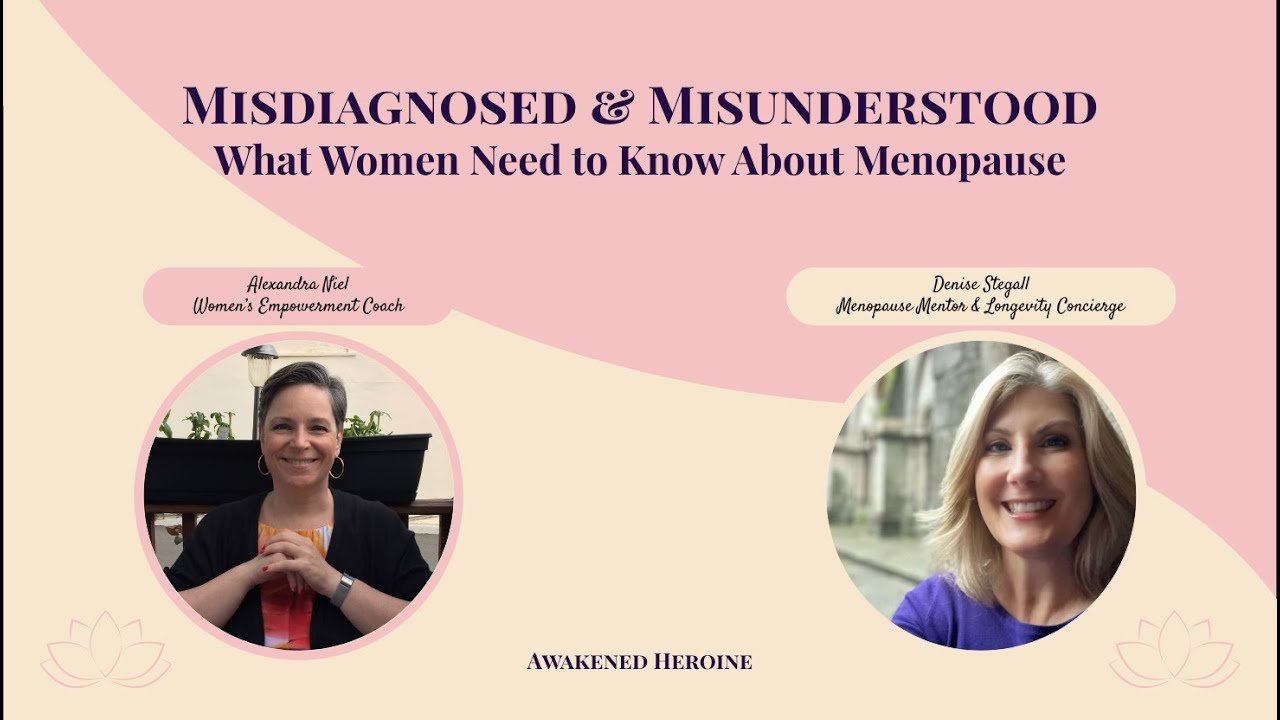
This content was created by Alexandra Niel. This content was uploaded by Alexandra Niel. This is a YouTube interview titled "Misdiagnosed & Misunderstood | What Women Need to Know About Menopause" (posted June 13, 2025). It is a conversational interview hosted by Alexandra Niel with guest Denise Siegel, a Menopause Mentor and Longevity Concierge. They discuss Denise’s personal perimenopause journey, common and less-recognized menopausal symptoms (joint pain, migraines, itchy ears, vaginal dryness, sleep/weight issues), effects of hormonal changes and long-term birth control, and Denise’s coaching approach (pillars of success: nutrition, decision-making, accountability) to help midlife women restore healthspan, reconnect with core values, and improve relationships and wellbeing.
Chapters
Hello, heroines! This is Alex. I hope everybody's doing okay today. And today I brought another guest, Denise Siegel. Why am I having a hard time saying your name? Denise Siegel.
Everybody does for some reason.
I've never had before. But anyways, to share her knowledge with us. So Denise, welcome! And why don't we get started with, uh, where are you from and what do you do?
Okay, so I grew up on Long Island in New York, and I spent most of my formative years there, though I have lived in Rochester, Minnesota for the past 22+ years. I walk too fast, talk too fast for the Midwest. Like they say, you can take the girl out of New York, but you can't take New York out of the girl. But this is home.
Cool. And tell us what, what it is you do.
Okay, so this is fun. This is— this has been a journey. So I am the Menopause Mentor and Longevity Concierge. Now with this, I am helping women in midlife to understand what's going on with menopause, perimenopause, and through the phases of menopause. But also to help them understand or discover what it is that they want to do in this next phase of life. And the important piece here, especially when we talk about longevity, is I'm talking healthspan here. What do we want to do? How are we going to live our life in this next phase in a way that we're mentally, physically, and emotionally healthy? Because we can live a long time. But if you're not healthy and you're bedridden or you're sick all the time, what's the point?
Yeah, and I mean, it's not, uh, it's not even worth it. You might as well just kick the bucket. That's going to be the case. And tell us a little bit about how we got started, because I know you and I have connected a couple of times, and the tip that you gave me, I was like, thank God, because it absolutely saved my life and my sanity. So I thank you for that. But tell us, like, what's been your journey to get to, to doing this?
So part of it is life journey. I started out about 15 years ago as a health coach. Now, I had a career well before that in something completely different, but I became a health coach and it became clear very, very early on in my health coaching career that there was so much more going on with people, specifically women, when it came to weight loss and food and emotional eating and all of those things. And so then I started to, I really started to look more into the mindset piece. What's going on there? What is the emotional piece? So I became a life coach. So I'm a health coach and a life coach. As the years went on, I started to experience what I now know as perimenopause. I was 37 years old and nobody understood what was going on with me. Doctors, you know, medical doctors, naturopaths, all of the people that I would turn to for support, they had no idea. I was 37 years old, so I wasn't menopausal, but they didn't understand at the time that I was actually perimenopausal. So I started doing a lot of research for myself because I was not feeling well. I was gaining weight. I was not sleeping. I was a cranky SOB and just— I wasn't myself exactly. And then the hot flashes came, all of those fun things. But again, because I was so young, No one understood what was going on. So there was a lot of times when I would go to a doctor or speak to a professional and they wanted to put me on, you know, a sleeping pill because I was having trouble sleeping or, you know, an anxiety pill because my moods were, you know, my moods weren't just a little erratic, but I wasn't anxious. Like, I didn't have anxiety. But they kept saying, well, we know that these, these type of medications work for these symptoms. Problem was they were focusing on symptoms instead of underlying cause. So that's really what my journey has been, is to understand the underlying causes of menopausal symptoms and struggles. And there's so many of them. You know, we talk about the hot flashes and not sleeping and the weight gain, but there's so many other symptoms and situations that actually are caused or associated with menopause.
So tell us a little bit about what those are, because I've, I've been doing a little digging myself, and I keep hearing that things like itchy ears is a sign of menopause, and it's like, like, who, who, like, how? Anyways, so tell us, what are some of those more maybe nebulous symptoms that somebody might not associate with menopause but could be related to?
Sure. I love the itchy ear thing because, like, I agree. It's like, really? One of the things that I, I had started to notice was joint discomfort, a lot more muscle aches, like not even after a workout, just I'd wake up and I'm like, oh, why am I so achy and stiff?. But I noticed my knees were— I mean, literally, I would walk up the stairs and it sounded like there was sand in them. They were just kind of— but it was just— there's nothing wrong with them. There's no bone on bone, nothing like that. I absolutely went to the doctor to check that out. But as I started reading more and more, that is another symptom of menopause. So little things. And again, everybody, everybody is different. So if there's something that you're experiencing that you've never experienced before and you're like 40 to 55, it's potentially menopause. So one of the other ones that people don't necessarily think of, especially if you've been prone to headaches in the past, what headache? Migraines. They get more intense. If you never had them before, You know, this is like, oh my God, I've got migraines. And they do want to put you on an antidepressant for those too. I know. Again, underlying cause is declining estrogen, mostly declining estrogen, but progesterone has its role as well.
Yeah, it's amazing because a few years ago I put— I was— I had an IUD put in and it was a progesterone only. I was taking the pill and I had decided because of the risk of breast cancer and everything else. I wanted that. I wanted to be done with that. And I had been okay until then because with the pill come a higher level of estrogen. As soon as that went away and I was on the progesterone only, is like my— like I felt like I landed in hell.
Yeah, because your estrogen literally, that was, was as stable as, you know, it was as stable as estrogen is in our bodies, right? All of a sudden you stop taking the pill and it fell right off. And that's something that the doctors don't really tell us about. And I agree, I was on birth control forever, it seemed. I started to notice though, oh, it was helping, but then it was also not helping in other areas. When you're on the pill for a long period of time, dryness comes very— vaginal dryness comes along with the pill. And it's like, wait a minute, this is supposed to help with— but it's just the fact that it's a synthetic medication and there are side effects to every medication, you know, even side effects to, you know, aspirin, you know, all— everything has some kind of side effect because it's, you know, we're introducing a foreign substance basically into our body.
So, um, I was going to ask you something. Um, when you work with women, how do you go about getting them to a point where, like, they start feeling like themselves again, and then they can start to think about, okay, I can— now that I'm, I'm okay, right, I feel better, I can start to think about the future and how I want to live moving forward. So tell us a little bit about what your process is with them.
So we— no matter who I'm working with, I always start with what I call the pillars of success. And they— that's basically that my— the pillars of success are eat real food, make good decisions, and be accountable. So food is first and foremost. You know, in midlife we think, oh, you know, it's, you know, we can eat the same. No, we can't eat the same. Our body does not react to the foods that we've been eating in the past in the same ways. So nutrition is— that's where we start. So we know that we're doing everything right for our body. And the better the nutrition, the better we feel just with that, you know, on, you know, and then with the added symptoms, we can kind of figure out which symptoms of menopause or but somebody is experiencing like tummy troubles, indigestion, all of those things, being able to go to the bathroom or not going to the bathroom. So much of that, yes, is part of it is related to menopause, but it's also related to diet. So when we clean up diet, those symptoms kind of get a little bit better. So then once a person is feeling good, we're working on this kind of at the same time too. We're focusing on core values. What is important to you at this stage in life? Because so often, you know, we've taken care of everybody else and everybody else's values, whether it's your spouse, your kids, your job. You know, if you're working for a company, they have values that often rub off on us because we are in these circles, right? Not necessarily a bad thing, But we get so caught up in all of that, in the busy, that we forget what our own core values are and what we actually want to do. Like, what do we even like? I asked a client this a couple of months ago. I'm like, well, what do you like to do? And she said, well, you know, whatever my husband wants to do. You know, we go out to dinner or, you know, or whatever the kids want to do. And I said, no, no, no. What do you like to do? And she really struggled to answer. And between sessions, you know, she has homework. I mean, that's, that's one of the things with coaching. Coaching is great, but I ask the good questions, the hard questions that people don't always, one, think to ask themselves, but really struggle with because this is a time where you're looking in the mirror going, all right, This is me. This is me now. Who am I? Yeah.
Yeah. And I think that's one of the things actually that I love about coaching is that we get to ask questions to people who never think about themselves or sell them things about themselves, at least in the work that you and I, in the work that you and I do. Absolutely. I love that. I love that they're like, oh, I hadn't thought about it or I hadn't looked at it that way or, you know, but getting them to reconnect with themselves is so rewarding. Yeah.
And I tell you, I, I understand it because there was a time in my life and I know you and I talked about this a little bit when I put somebody else's wants, desires, needs ahead of my own. I quit the job that I loved. I left the apartment that the best apartment ever. I loved that apartment. I had this great life. But I picked up and moved everything because it made sense for this other person, for us to be together and do all the things that we were going to do, you know, start a life together and all of that fun stuff, right? And then when I realized this wasn't the right thing, that one, he was not ready, but I realized this wasn't the right thing for me. One, I felt stupid, like really, and Really, at that point, I didn't have a job. I didn't have a place to live. Um, like I said, I felt kind of stupid, but I also like really had to really dig deep and, and go and say to myself, like, why did I do this? You know, why did I put somebody else's wants, needs, and desires ahead of my own? Because as women, that's kind of what we do. But when we get to midlife, we realize we've done that so much. All right. This is my time.
But, and I fully behind you 100%. I think that a lot of that is societal, right? A lot of that is, that's what society, and when I say society, I mean society at large, but our parents, our grandparents, our siblings, our, That's what everybody expects from us as women. And it's so easy to get lost in the shuffle because we turn our eye outward. We never turn it inward.
So now we're taking care of everything and everyone and we're starting not to feel good. We don't know why. It's not that bad yet. But what ends up happening too often is Pardon the French, my French here, which is not actually French. When the poop hits the fan, that's when we go, huh, now I need to do something. Whether it's, you know, your relationship just fell apart, your health is in the toilet. We got toilet things going on today. Sorry. Whatever it may be, you know, your emotions are all over the place. Um, that's usually when women come to me and go, okay, I need help. What do I do?
And it's, um, it's similar to what I hear is that when life feels like it's falling apart, it's like that's when, you know, we turn inward. So what would you say to— what would be your recommendation to women in general, how do you not let it get to that point of my life is falling apart? Now I've got to take a look at what's going on. How do we do that? Well, before my life is falling apart, what's going on?
Well, this is, this is interesting because this is something, you know, when we're experiencing these things, the people around us are experiencing it too, whether it's the menopausal symptoms or the doubt, whatever it may be. We need to talk about it as women. We just kind of quietly— we don't say anything. We really need to express our feelings. We need to be in a place where we can do that in a safe environment, whether that's with your, your spouse or partner or your, your boss. Whoever, even a really good friend. We need to express our feelings, but in a way that is nonjudgmental for either person and is looking for a solution rather than pointing fingers as you're the problem. This is the problem. What is— here's the situation. What are the solutions? What can we do? And to really have those conversations early, earlier than we do. I have a client who she'd been really struggling with emotional, you know, her kids were out of the house and she had always just been a mom, just been a mom, which that's pretty busy. But she now didn't have an identity and it was affecting her emotionally and mentally, but it was also affecting her relationship with her husband. And she'd kind of, she'd had it with him. And as we were going through this, she realized that he had no idea what was going on. And so he's thinking, this is all my fault, you know, or it's all her. And she's thinking, well, it's, you know, this is how I feel. They didn't have a conversation. And what ended up happening when I asked, you know, have you spoken about this to your husband? And she said, well, no, like, duh, why would I do that? And that actually brought them to counseling. And so it's really hard at this midlife stage. Do you want to— for example, this client of mine, and I have a full disclosure to talk about her. She, you know, does she want to start over, you know, be single again, date? Like, I think about that and I'm like, ooh, that's hard. But is it the right thing for her? Is it the right thing for him? Right? These are questions and it really has to be unselfish. And that's hard. That is the hard part is for it to be unselfish. Asking the questions because maybe it's not right. I mean, we know many people within the group here who've been divorced or broken relationships. And sometimes those relationships may not need to have been broken. Many of them, yes, but some of them may not have. And even the ones that were broken may have been able to be done so in a much gentler way.
Yeah, so if I had to summarize what you just said, it's basically make sure that you're right with yourself before you start to think about maybe exploding your entire world.
Yeah, exactly.
So awesome. Well, Denise, I just want to say thank you so much for being here and sharing your wisdom.









