No One’s Coming to Save You | How Iena Saved Herself After Divorce
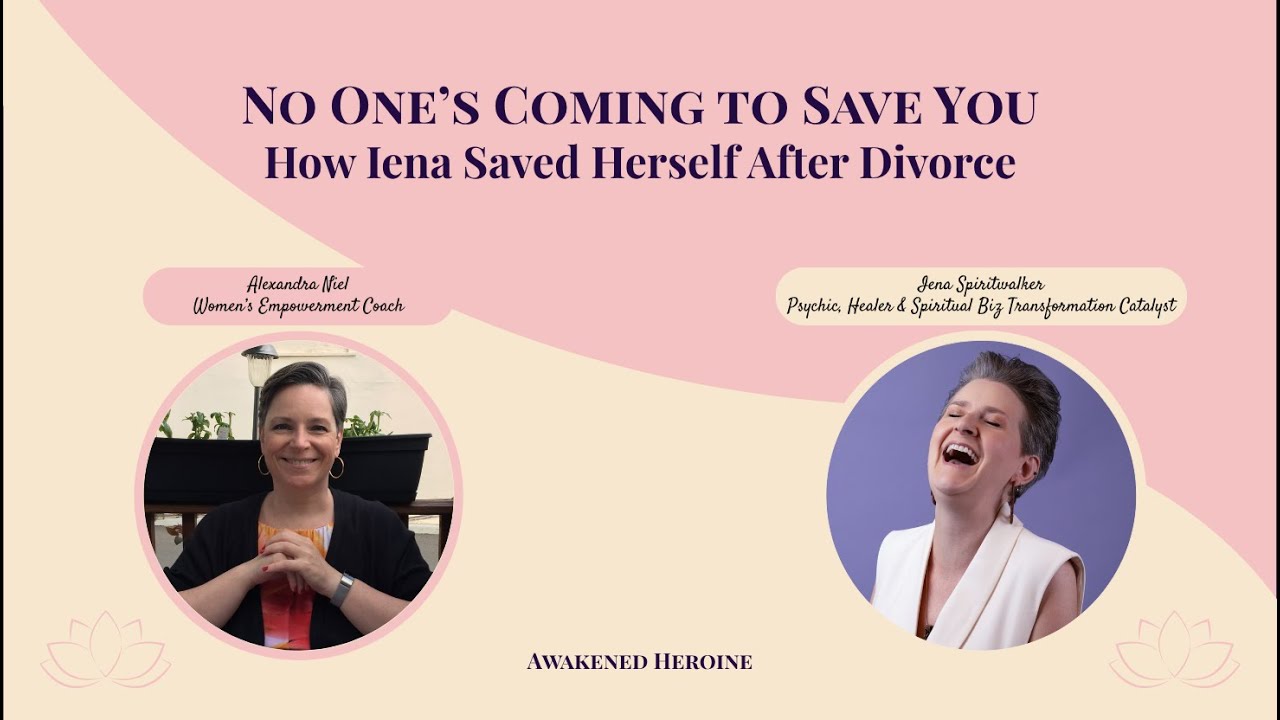
Aina, a psychic and life coach with 27 years' experience, talks about rebuilding after divorce and single parenthood. She used an energy audit to shift her work patterns and created transformational packages to scale her business while healing the martyrdom wound that kept her stuck.
Chapters
Hello, heroines, and welcome back to yet another episode of Let's Talk with Alex. Yes, I don't know, I don't have a title for this.
Is that the official name? Okay, all right, cool.
It's, it's, uh, Tea Time with Alex. How's that? It's a good title.
Okay, that's a good time.
So, um, today I just wanted to bring Aina on board because, um, she has a unique story. I think unique perspective, and I thought it would be helpful in your journey of transition to really hear somebody else's perspective who's lived it and who's now thriving. So, Aina, welcome!
Hey, I'm so glad to be here. Thank you so much, Alex.
No, my pleasure. Tell us a little bit about who you are and what you do.
Who I am? I'm an internationally known psychic and healer and life coach with 27 years experience. And in this space, it would be relevant. I help female spiritual entrepreneurs move into multi-six-figure income.
Hey, nice. That's a mouthful. No, but it's not, you know, it's— we all have kind of like our secret sauce and what we do to support the world and to support the good energy in the world and being able to support entrepreneurs is important because I think about when I got divorced, um, I never in a million years thought that I would ever own my own business. I was a corporate girl through and through. I, I joined my first company and I said, I'm gonna die here, right? I'm gonna retire from here.
Yeah.
So it's Every piece is important. Um, so in this— so how did you get started doing what you're doing? Because, um, I know some women may be looking for something to do after their divorce, or other women may already have something going that they need to kind of put on fast track. Um, right, and some may not know where to go from here. So tell us a little bit about your story.
Okay, yeah, sure. So, so when I got divorced, I was, um, I was actually a stay-at-home mom, and I had been a stay-at-home mom for 10 years. Um, I, I had an Usui Reiki certification. I was an interfaith minister.
I had—
I was doing the things, but it was a side gig because I was the mom. And that was really my primary role in the relationship. And then suddenly I was the mom, I was the dad, I was the breadwinner. I was also homeschooling both of my children at the time as well. And so things shifted for us very quickly. I found myself— we were living in Hawaii at the time— I found myself living back with friends and family in Pennsylvania. So I literally sold my car at the airport, which I found out later is a federal offense. Um, and I didn't know that. I was, you know, I, I had to pay for my kids and I to get to the— to Pennsylvania.
It was like this random rule.
It was very random, and I was just like, okay. So, um, anyway, yeah, so, and we, we each had a bag, and I had one cat with me, and we We went to Pennsylvania and then it was like, shit, you know, now what? Because I, you know, I'm like, okay, so I've been a stay-at-home mom for 10 years. Like, who's going to hire me? Like, I— and I did. Well, I went through a deep depression, as most people probably do, and literally was kind of like in freeze response for a while. And finally my family was like, you need to get off your butt and like, you know, do some stuff. So I ended up working in addition to homeschooling my kids. I had several jobs. I think I had 3 jobs, homeschooled my kids, and I also was still doing some healing stuff on the side. I started like doing sessions and teaching classes and all the things. But, you know, I got a very staunch reminder very quickly that, you know, when you work for someone else, you're never going to get paid what you're worth. And it was a scramble, and I was constantly trying to pick up more hours. And I started my own cleaning business too, because I figured if I'm working for myself, so then there's more, more stuff I'm doing to try to be the breadwinner. Because suddenly, you know, I had, um, you know, I don't know if you know how much boys eat, but you know, the children, you know, they, they needed nourishment and I wasn't squawking, you know, I wasn't mad at them for that, but it was just overwhelming for me, all the things that needed to be done. And, and at some point I was like, this is not working for me. I can't live like this. I can't, I can't work 70+ hours a week and still be present for people and be present for my kids. And there were many days that my kids would be like, hey mom, I need help, you know, with my homework after I got home from working all the jobs. And I had one eye open and I was like, I just hold it until the weekend. Just keep doing all your work and then I'll look at it on the week. I couldn't even, I could hardly function. That's no way to live. But I was, I was still in shock. I was still healing. And at some point I realized, yeah, well, we need to change this. This needs to stop. Does that answer your question, Alex?
Yeah, actually it does. And it prompts me to ask you, what was it? Was there a specific moment? Was it something happened that, that got you out of that funk and made you realize something's got to change, or was it just a natural progression of your healing?
I think it was part of a natural progression. I think, um, also I wanted better for myself and my kids, and I realized that, um, you know, despite what the Disney movies tell us, no one's coming to save us, you know, as women. You know, the white knight is not coming, and that was the last thing I was looking for. But I needed to find a new way to save myself, something that was more sustainable and more in alignment with who I am. Don't get me wrong, all the other jobs that I did, I did them well. People, you know, I had a great work ethic. However, that's not how I wanted to live my life. And it's also not the example I wanted to set for my children of like, you know, working until you're exhausted and you can hardly keep your eyes open at home and like, No. So yeah, it was, I would say, natural progression. The more I healed, the more I realized that I was worth more. I was worthy of more, and I deserve to be happy and to have a joy-filled life, including the work that I did.
So I remember when I left my marriage, uh-huh, I threw myself into my work. Like I was working crazy, crazy hours, right? And it took me a while to get out of that. So if there's somebody that's listening right now that is doing that, what would you say to get them to stop and think about what they're doing?
That is a great question. I think if you— if we take a few moments and really just put our hands on our hearts and really breathe and ask ourselves, is this really what I want? Is this really serving my highest good? And I'm not saying that paying bills aren't important. Yes, they're very important. But how can you do both? That's the real question. And I think a lot of us in society have been taught that it has to be either or. And there are ways to fit both sides of the coin, as they say.
Yeah, and I agree with you. I think that, you know, we're also conditioned, especially as women, to always give, give, give, do, do, do for others, right? Because that's what we do. But yeah, and that's what's expected. But then somewhere we like lose our sense of self.
Yes.
And you've got to get that back.
I love that you brought that up too, because that really calls to what's called the martyrdom wound. And a lot of women are in that, and it means that their sense of service, quote unquote service, is tied up and wrapped in around them sacrificing, overgiving, undercharging if you're an entrepreneur. And really putting yourself on the back burner essentially is all, you know, when it's all said and done, I'm going to help everyone else but I'm dying inside. I'm going to help everyone else but I've gotten 5 hours sleep in the last 2 weeks. Do you know what I'm saying? That's the martyrdom wound, and that's, that's part of the healing that's required when we go through this transition.
I had never heard of it referred to that way, but it makes complete sense when I hear you talk about it. Because like, I've seen other Facebook groups where there's a lot of that victim kind of mentality.
Sure.
Um, and it's part of the healing, right? So I don't want to crap on that either because it is part of our healing process and everything, right? But I agree with you, there comes a point where you got to be like, okay, this is where the rubber meets the road. This is like, I can't continue like this. Um, no way. So if somebody's at that point of saying, okay, I can't continue like this, but I don't know what to do—
yeah, yeah—
what, what would you, what would you recommend?
Well, I mean, I would start by doing something I just call an energy audit, and it really is what literally are you spending your time doing How is it benefiting you and your family, if at all? And how can you shift it? So, so for example, for me, I— my— with my energy audit, like, I was doing all these jobs and then I was, you know, homeschooling the kids. I didn't want to give that up, but you have to write everything out. Like, what am I spending my time on and where is this going for me? How does this feel in my body? And you could also do like a star rating, kind of like you're, you're rating stuff on Amazon, like a 1 to 5. Like, how much is this feeding your soul, 1 through 5? And when you start writing things out, it might be quite surprising, um, what you're doing and how you may be spinning your wheels and not even thinking about it. Because at some point, we just, we have like blinders on. I need another job, I need to do this thing, I have to go over here, I have to do this. And for me, for example, when I was like, "Okay, I really need to get my business going," I was doing things that weren't, you know, really beneficial to me financially, energetically. I had a few membership groups that I hadn't started charging anyone to be a member yet because I wanted to get the group going first before I actually charged people. I was running two of those. Free every week, every week. Um, and, uh, what else was I doing? I was like, why am I doing that? So there, there are a lot of things like that. I was, um, teaching classes in a physical location. This was kind of before Zoom was really a thing. It was 15 years ago. Um, so, and I was renting, so I was putting money out to rent these rooms, and I may or may not make my money back. You know, it was just like, and I'm spending time away. Another thing that I did was I went to psychic fairs every weekend. Now my kids were old enough to like take care of themselves at that point. I think they were maybe 11 and 9 or 12 and 10, I can't remember. But at some time I was doing psychic fairs every weekend, like hours away. And so that I could provide and get things going. I was like, well, you know, that really sucks. I don't like doing that. Like, but I was thinking like, this is what I was supposed to do because of the business that I'm in. I was thinking those were really my only options. So I really had to think outside of the box.
Yeah, and I feel like we get in ruts, right? And once we're in that rut, coming out of that is— can be very, very difficult. But I love what you said about it's kind of like pause and take your foot off the gas just so that you can Because it almost feels like the image that just came to my mind was you're driving around and you're lost, but you're like full speed on the accelerator, but you don't know where you're going. So you're like on the road to nowhere, basically.
Yeah, that's a trauma response. And that, that's, um, when our nervous system is really in overdrive. Um, and it is literally like, I think Joe Dispenza said before, it's like having one foot on the gas and one foot on the brakes.
Yeah.
And it can be— life can be like that. As you said, Alex. Yes.
The foot on the gas is all of the external stuff that we're doing, and the foot on the brake is all of the internal stuff that we should be addressing so that we can really put all of our efforts in the gas pedal. Right.
It can also be like, you know, I want to really scream right now, but I'm in the middle of a meeting or I'm doing my job, so I have to be quiet. I have to sit in my seat. I I have to punch in, I have to punch out. And it's just sort of this, we're kind of trying to conform to societal rules, but it doesn't allow a space for us to heal ourselves. So that foot on the brake can also be us like, no, don't do it, don't do it, don't do it. But I have to go, I have to go, I got stuff to do. So yeah, mm-hmm, absolutely.
Yeah, it's amazing the, the limitations and the, the impact of labels, right? And all of the shoulds that we have and all the shoulds that we should, should be doing, right?
Yes.
Um, yes, I want to go back to what you talked about just before about role modeling because you talked about this is not what I wanted to teach my kids.
Yes.
So, um, How, how did you then shift from, you know, I'm basically working myself into the ground, to after your energy audit? What, like, how did you shift things so that you can, you could start to shift not only how you showed up for yourself, but you could then establish a better role model for your kids?
I love that. So what I did was with my energetic audit, when I sort of identified the things that, you know, didn't feel like they were in alignment for me, or that I wanted to shift or let go, or I was thinking, why the hell have I been doing this for this long? Then of course the next step to that is, okay, so what do I want to do? How do I want this to be? So learning what you don't want is great, but you need to move forward and figure out what that is. So for me, and I'm sure for many women, um, my divorce was very messy, very ugly. Lots of lawyers, lots of arguments, lots of stuff. We don't need to get into that. I'm sure everyone's got their own stories. Um, but I, you know, it required a lot of healing on my part, a lot of healing. And I knew healers, and I, you know, I, I went to healers, I went to therapists, I, I did, you know, acupuncture, all the things. I did all the things. And what I found was that I was starting to attract women who were, um, wanting to heal from trauma like me. Right? So I started attracting people who needed the medicine or the knowledge that I had just accumulated for myself and had gone through at that point. So what I started doing was, I, you know, I was like, wait a second, I, I think there's something to this. I, I think, you know, so in the beginning I started doing packages. So I, I, my first course I think was an 8-week course And it was for women who had trauma and needed to turn that into peace and empowerment. And I folded in my energy work and I folded in neurohacking and I folded in food, you know, how food can nourish you. And I folded in all the stuff that I had been using for myself, made this beautiful, unique package. I actually had 2 therapists go through the course, which I thought was so freaking cool. And I love that because not only were people really, really touched by it, but at that point I knew there's something to this. So, so it's a transformational offer versus a session creates a deeper impact on others. It helps others transform. And that's really what I wanted in my life. I wanted to make a big difference. I wanted to really help people. And that's when I got started. And I've, you know, as I grow, then my packages change, my focus changes, which is totally fine. And so, but that was my first. And, and that's where I was like, ooh, I like this. And I feel like that really, and, and I know it's, I think when we go beyond the societal norms, meaning being a single mother working 70 hours a week and doing all the things, and saying, you know what, I'm just going to do my own thing. I'm just going to work for myself. I'm going to follow my dreams. As far as our children go, it, it's a great mirror for them that it's okay to do scary stuff. So long as I go for it.
Yeah, and it kind of flies in the face of, you know, what we hear, like, you got to go to college and you got to do all these things. And it's like, well, maybe not, because not everybody's destined to go to college. Not everybody's destined to become a plumber. Right. So there's got to be— there is something for everyone and we each have to find what that's going to be.
Right, right. Yeah. And that takes journaling too. I mean, I can, I can walk your audience through an exercise if you like, but it just— you have to sit down with your notebook journal and find some quiet time for yourself and really tap into what are my desires, what are my skills? You know, who do I want to help? How's this all look like in one big— you know, if you're an entrepreneur, that would be. But, um, or what do I want in my life? If I, if I do work for someone, what is it that I really want to do? Because ultimately, you know, we are spiritual beings in a meat sack, and we are hardwired for service and love until we learn otherwise. Yes, exactly. And you know, it's often those moments, like, like a really tough divorce, that, um, rip the rug out from under you and really make you see things through a different lens and can be such an amazing blessing. Like, I'm, I'm so grateful for it. It sucked. It was really hard. It was awful, um, all the things, um, but I don't think In fact, I know I wouldn't be doing what I'm doing now if I was still in that relationship.
Yeah, we wouldn't be the people that we are if we hadn't gone through that, through that time, for sure. For sure.
Absolutely.
So what would you say was your biggest lesson from your divorce?
I would say the biggest lesson that I learned for myself, for my divorce, is— was really how strong I am. Excuse me, how resilient I am. Um, because I had— and I think a lot of women do this, again, this is a martyrdom thing— but I had, um, willingly given up a lot of myself to be the wife and to be the mother. And so I had poured myself into this mold that I thought I should be. And when that mold was shattered, I didn't know who I was. I didn't know where I fit in. I didn't know what to do. And when those things come crashing down, oh my goodness, shit gets real fast.
And it's, it's a major identity crisis, right? Because we've attached who we are to this one thing. And it could be to a couple of different things, right? Or, right, we might be attached to us as a wife, and that's the label, and that's what we embody. That goes away, okay, I am now career woman, right? Because that's an easy label to wear. And who we are without all of these things really becomes the foundation for who we can become moving forward.
I love that. And I, I've, I've seen a psycho— I don't remember the name, I wish I did— a psychologist was given a talk once and he was talking about the dangers of those labels. Like, I am a mother, for example. So then what happens when the child goes to college? Then there's like a major identity crisis, empty nester, you don't know what to do, you don't know who you are. Same thing, I am a wife. When that's gone, who am I? And it's, it's really, as you said, boils down to who are you at the foundation. And, and for me I'm a divine being in a meat sack, and I'm here to serve, and I'm here to love. Um, and it's— when we find that, it changes everything.
And it's so much broader, right? Like, it's kind of— it's almost like limitless, because then you can let your imagination run free and decide, okay, so who do I want to be if I don't have to worry about all these things?
Yeah, I love that you said that. Yeah. And, and I had a friend who She was my teacher and also became my friend, and she was doing healings on me regularly. And, um, you know, there were many, many times I was in her living room just crying and crying and crying, and she said, you know, Aina, you can do anything you want now. You can do anything you want. And, and I was like, that's what's so fucking scary. I don't know what to do. Like, who am I? What do I do? And, and she— to her it was very simple. To me, I was like I don't even know where to start.
The image that just popped in my head was, you know, when you go to a restaurant that has like 15 pages of choices and you're like, I—
Yes.
I don't know. I can't pick.
And there's no pictures. Like, you can't even— Yeah.
You know, but when you get a menu that's like 5 different things, it's a lot easier. And in a way, that's what the labels help us to do is they keep us restricted to that little menu where there are so many more pages to the menu.
Yes, yes. And so it takes some healing just to even be in that space where you can read that menu. It, it takes a lot of healing, um, you know. And it's not a race and it's not a compare, you know. Everybody has their own time frame for this stuff, um. I mean, I, I would say there are some things that it took me probably 8 years to really clear. And it's been 15 years, and every once in a while something will come up and I'll be like, wow, there's a deeper layer. Because healing is like an onion, you know, there's always like different layers. And, um, there will be times where I think that box is checked, good, moving on. Nope, there it is again. Okay, yeah. So it's important for us to really, um, take that lens and look back on ourselves too, because, you know, we are We're our own responsibility. Like I said, nobody's coming to save us.
For sure. So anything that you think is important for our heroines to know that we haven't talked about yet before we sign off?
I would just encourage your, um, your group to really stay true to yourself. And if you don't know who that is, that's where you need to start. The healing needs to begin with you just clearing that for sure and recognizing who it is that you are to your core, as you said. Um, and everything else begins to— the more healing you do, the more clear things become. And you get like little, little breadcrumbs start forming in front of you and you go, okay, I'm gonna, I'm gonna follow that. And then, then something else like, oh, okay, yes, like But, um, yeah, start with yourself because again with the martyrdom stuff, I think it's very common for us to fix everybody else and deal with everybody else. And a lot of women that I work with, that's kind of like their theme, you know, they're, they're like falling apart, but they, you know, they, they run a rescue out of their home and they, you know, volunteer at the elderly care center and they, they work this full-time job and— but, you know, they're falling apart physically, mentally, and emotionally but they don't, they don't see the contradiction between that. Because the truth is, no matter who you want to serve, no matter who you want to help, no matter how you want to volunteer or spend your time and be of service, if you're not helping and healing yourself first— as they say in the, um, in the airplanes, you know, put the oxygen mask on yourself so you can help other people— because you're not worth shit if you're not healthy, if you're not conscious. So working, you start from yourself and you can help others along the way in a bigger way.
Very true. Aina, thank you so much for spending this time with us. It was a pleasure having you.









