Rediscover Yourself Through Travel
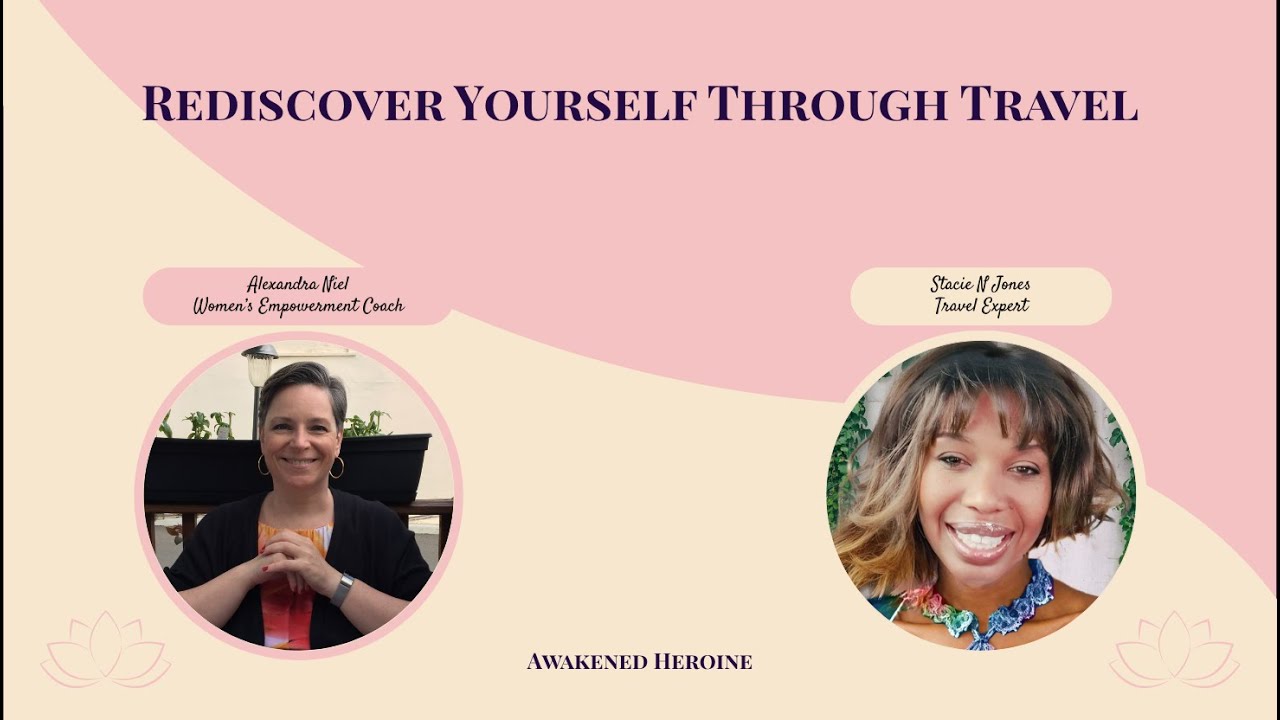
This content was created by Alexandra Niel. This content was uploaded by Alexandra Niel. This is a YouTube conversation titled "Rediscover Yourself Through Travel" (created 2025-06-16) featuring host Alexandra Niel interviewing travel expert Stacey Jones. The discussion covers using travel to rediscover and reclaim oneself after separation or divorce, Stacey's stroke and recovery and how that led her into the travel business, coping with perfectionism, solo and group travel options for women, and messages of empowerment and community.
Chapters
Hello, heroines! This is Alex back again and here with the lovely Stacey Jones. And Stacey is a travel expert, and I thought for you guys and for us who either might be looking forward to traveling a little bit after either separation or divorce, or, you know, using travel as a way to rediscover ourselves, I wanted to bring Stacy, and just to be able to talk about that. And so Stacy, why don't you tell us where you're from and, um, yeah, how did you get started doing what you're doing?
Well, um, I'm actually, um, I'm from Rockville, Maryland. That's where I grew up. But currently I'm in Cincinnati, Ohio, getting ready to become a second-time grandma. So I'm here for the next year or so, make sure my grandson gets that first good year started. Um, so I'm so excited about that. Um, but I got started in the travel industry kind of by default. Um, I suffered a stroke 3 and a half years ago, or about 3, a little over 3 years ago. And prior to, I was in the insurance industry and did a whole lot of multi— multitasking scheduled like 250 Zoom calls a day from time— 4 different time zones all over the U.S. And I woke up, um, on a Thursday morning being told I had suffered an ischemic stroke where I actually— part of my brain had died. And at 49, yeah, that— your expression is exactly what my face looked like when I opened my eyes. I went to bed working, scheduling interviews for the next day, and then I woke up and I was in the hospital being told this. So my life as I knew it ceased to exist. Um, as you know, um, Alex, I'm a recovering perfectionist, so that did not sit well with me at all. Um, pretty much I cursed out my neurologist because I could not recall the word pen. He had asked me what he was holding. I said, I don't know, I need my coffee, I'm being told I had a stroke, so give me a minute. 45 minutes later, he asked me again, and that's when I proceeded to cuss him out and tell him to leave. So that's how perfectionists work. I was not happy. Um, my life I, I, I, I didn't know what I was gonna do. So, but like most perfectionists, we don't sweat, not at all. Part of my brain's dead. I'm good, I got this, I got this. Oh, okay, am I all right? Do I look okay? All right, I, I know I can't use the bathroom by myself yet, but other than that, I'm good. Um, and I just started scrambling trying to figure out how I was going to provide for my family. So I had— I can't really write. Even though my stroke affected my left side, my right side wasn't affected, but I don't know how it works. My penmanship looked like crap. Um, the keys on my laptop just looked like they were floating around like alphabet soup. Um, emails, they made sense but they didn't make sense. So yeah, I'm faced with— I gotta find something, something that can deal with me going to therapy 4 times a week. I can't multitask, cannot chew gum and walk at the same time even today, even though I try, um, and that I can make the same amount of income. And then the hours aren't going to be traditional remote hours, they're going to be overnight because you're in therapy pretty much 4 times a day, 4 times a week, and or, you know, you can work on weekends. Good luck finding a job that matches those things. Uh, well, a lot of prayer. I, um, kind of muddled through this, and over the next 6 months, I found an opportunity to invest into a travel business where I'm my own boss. I work the hours I want to work. I can work from anywhere in the world. Travel perks are insanely awesome. So of course that was a good sway, um, but also it allows me to make the same amount of income that I was making prior to. So I fell into this by necessity. And then only until last August of 2024 did I realize, okay, I suffered one stroke in 2022, two more in 2023, and then it finally hit me the next following year. Okay, God, this is why you've given me a God do-over, not once, not twice, but three times. It's because what I'm doing I can help others not have any regret, you know, um, live for today because you might wake up tomorrow and not be able to see, walk, talk, or even cease to exist. So it just kind of fell on me like one of those aha. And I was in the middle of the Caribbean on a cruise and somebody said to me, I'm sorry you had a stroke. And I just looked at him and I said, you know what, I'm not, because guess what? Had I not had the stroke, I wouldn't be cruising around in the Caribbean for 2 weeks as if I have no care in the world. And so that's my passion, to help others have less regret.
And I love that because I think that's one thing, right, is that we feel like we— there are so many things we need to do, right? So many things we have to do. That those things come first and then we come last.
Yeah.
And we never do, we never do for ourselves. But I want to go back to what you said earlier about being a recovering perfectionist. I know that resonates with many in, in the group. So what, what's working for you in that recovery process? And then we'll talk about the travel piece.
Um, I— because of what has happened to me as far as having a stroke, I think that that was the catalyst to make me focus on trying to recover from being a perfectionist, because I woke up on the April 15th and realized that I can't control everything. My life's not going to be perfect. And I'm sorry, it just hits me.
Um, okay.
And as much as women, we want things to be nice and neat and pretty, I was not nice and neat and pretty that next morning. So you got to deal with life on life's terms, brother, and I, you know, I don't know, I just, I didn't realize that, that control of always having things so perfect, my emails just nice and neat and, you know, and I was very systematic and they all went out at 10 and I had my follow-up at 2 and yeah, that went out because I just couldn't do it.
Yeah.
So what happens when you can't be perfect? You have to surrender to it. And life has kind of forced me to succumb to not being perfect, um, extending myself grace, um, and knowing even in my imperfection, I am perfect.
You are perfectly who you are, which is exactly what the world needs. And I think that's where we sometimes— our wires get crossed, because when we try to be perfect, we're actually trying to make other people happy, right? I think that's, I think that's one part. I think the other part is trying to be perfect is a coping mechanism for us because by being perfect we know that we can control situations and things so that life goes more smoothly. So I love the idea of surrender because it takes so much pressure off.
Oh my gosh, it does. I was sharing this with Sandra Kellogg when I had a conversation with her, and I'm just like, yeah, I never thought, like they say, have no control is more freeing than having a lot of control, because I guess it's an oxymoron or whatever you want to call that in grammar, but it is. I feel so less stress, um, and that's why every time I have a conversation or introduce myself, I try to put it out there because it is something I work at every day. I'm a recovering perfectionist, to remind myself if I have this conversation with you and I stutter, um, or I get lost because of my stroke and all this other stuff, that it's okay, it's okay. People can see me being human, you know. Um, so I don't know, it's, it's exciting. It's exciting. Scary at first, but when you get into it, then you're like, woo-hoo!
I can't imagine, because it gives us— when we surrender that control and that need for connection, it gives us the ability to just show up and just be.
Yes.
And not be in a box. Yeah, just be, right? Yeah. So tell us, so why, why is travel so important in general? In general?
In general, I think it, it really For me, and I can only speak for myself, I feel I fell in love with travel. I'll just start from the— I fell in love with travel when I was 5 years old. I went to Disney and fell in love instantly with— I don't know what they call them nowadays because I'm not politically correct, but flight attendants back then. This is when you could smoke on airplanes, people. Yeah, dating myself, but Um, but I thought it was so romantic. I mean, you could wake up in Paris one day and New York the next. I'm like, oh my gosh, what the life! Then I hit the beach and I'm like, yeah, this is so what I want to be. But you just feel so— when I was standing out on the beach, I mean, I remember this like it was yesterday. I'm 50-something now. Like, I was just one with the ocean and with the earth and I felt lightweight. I don't know, healed. And you don't— there's no healing that needs to be done, I don't believe, at 5. I didn't experience anything. I don't think— maybe it was just healing my soul, maybe just that energy, that oneness. I don't know, whatever, whatever it is. But I was like, gosh, this is where I want to be. And I feel every time I've traveled— and my happy place is being on an airplane. I love flying above the clouds. Um, that I just feel like the world— there's endless possibility.
Yeah.
And I— that's the only way I can describe it when I travel. And I don't even care if I'm going on a road trip. I just feel like, yeah, the world's in my oyster, you know. I— it's just that whatever you want to accomplish, you can— it can be done. And I feel that feeling really heightens in me when I travel. And I could be just going on a road trip or a stay vacation at a ritzy-pretty hotel I gotta check out in the next state. Fine, great, woohoo. But that's how— what it makes me feel like.
Yeah, and, and I agree with you. I think it's— I love it. I've traveled all my life, um, and I just, I feel like there's something very freeing when we're able to, to do that. So I want to dive a little deeper into the question of why is travel important and ask you, why is travel important specifically for women who are coming out of a divorce or a long-term relationship? Why do you— what do you think is going on there?
Um, I think you don't feel so trapped, and that would be what I think it would offer women that are coming out of relation— long-term relationships and rediscovering themselves. It gives you a chance to breathe and pick out the croissant that you want to eat, not your partner, but the one you want to eat, the one you always pass up because you want to get their croissant first. And I only say that because I have been there and I have done that, um, personally. Um, I was in a marriage for 25 years and, um, we are moving in separate directions, so we are no longer under the same roof, and I'll just leave it at that. And that is very different because I get up and I say, what do I want for breakfast? It all starts, you know, and all of those things sometimes that women let go when they're in relationships, whether— I don't know if it's the fault, I don't know, I don't know the science behind that psychology, but sometimes we kind of forego us for or you forego the me for the we, and then it becomes them. So yeah, I don't know, I think travel kind of forces you to think about me. Where do I want to go? What do I want to enjoy? You know, I was just looking at this morning, I want to go to this candlelight music thing that they do in Cincinnati. They do like a classical thing and it's all done by candlelight. And it just seems like the coolest thing. I don't think I'd ever would have done that with my partner. I mean, he'd say, okay, have a good time, but so then you forego it because you want to do something together. So I'm like excited to go because I don't have to worry about the, okay, go by yourself. So I mean, I don't know. So I think that that would, would be something that, um, your members might want to think about if you really want to reconnect with yourself and rediscover who you are and what you want and what makes you happy, I think solo travel is certainly the place to be. And even if you don't do it by yourself and you do it with another, uh, a group— I've done group travel for 12 ladies back in November. They just went on like a weekend cruise, and I got them an excellent, really great group rate. It was very affordable, and they had an absolute blast. And as soon as they got back, they're like, okay, well, we want to do it again next year. And I'm like, Okay, well, you just got back today. They said, yeah, I know, but these are the destinations. And it was just, I guess it's going to be an annual thing for them now. So I don't know. I just, I think it just would be invaluable.
There are two things about what you said that I love. One is about using travel to rediscover who you are because, you know, when we're, and I don't think it's science what you said about, you know, putting ourselves last. I think it's conditioning. I think it's societal conditioning. You know, it's— I think it's— we hear it from our parents, we hear it from our leaders, is, you know, women put other people first, right? So there's that being able to reconnect with yourself. But I think the other piece is— oh, you were just— the way that you said it, I was like, I want to make the point, or I want to ask, and now I completely forgot. Anyway, it'll come back to me. It doesn't, it doesn't matter. I think it is about, you know, being able to reconnect with ourselves, but also learning to put ourselves first because we have to do that if we're going to be in relationships. You know, we have to be able to put ourselves first. And the other thing, which I remember now, is the power of community, right? And doing things with, with other women, especially when we come out of long-term relationships. It's, you know, knowing that you have a group and a community you can rely on.
Well, maybe I'll put together a group cruise for your community.
Oh, that sounds good.
Yeah, so you all can get a great, great group rate. I mean, that's the advantages of going through a travel agent. I mean, I could do a group rate. It could be, you know, 5 cabins. I think the minimum 8 cabins. So whatever, double, single, whatever, put together a cheap, cheap, cheap, cheap, cheap rate and everybody come and I do all the planning. I just need names and you know, dates. And I don't know, maybe we could do that because even for you, I know that these women groups, um, people that might want to join. So a lot of times as travel agents, we kind of— we have the ability to go ahead and do like a group cruise booking for later on in the date, and then you have people sign up and the deposits can be as low as $50. I mean, then you got a whole year to pay on it, you know? So yeah, so maybe we can do that.
We'll have to float that out to the group and see where it goes. But I think for me, traveling is essential. But just before we wrap up, is there anything that you think it's important for heroines to know that we haven't touched on yet?
That you can do more than you think you can. Um, I think, um, I want to leave your members with, and, uh, yeah, to hold on to that. You know, when you think that you can't, you were built for this, or else you wouldn't have— your eyes wouldn't open today. That's all I can say. And I think for, for any of your, your members in the group, that that's, that's why they're here today, because they can.
That's right, they're like the little engine that could.
Yes, yes.
So Stacy, I just want to say thank you so much for being here with us today and for sharing your wisdom. Much appreciated.
Yes.









