Rewriting the Rules of Marriage | Divorce, Identity & Doing It Your Way
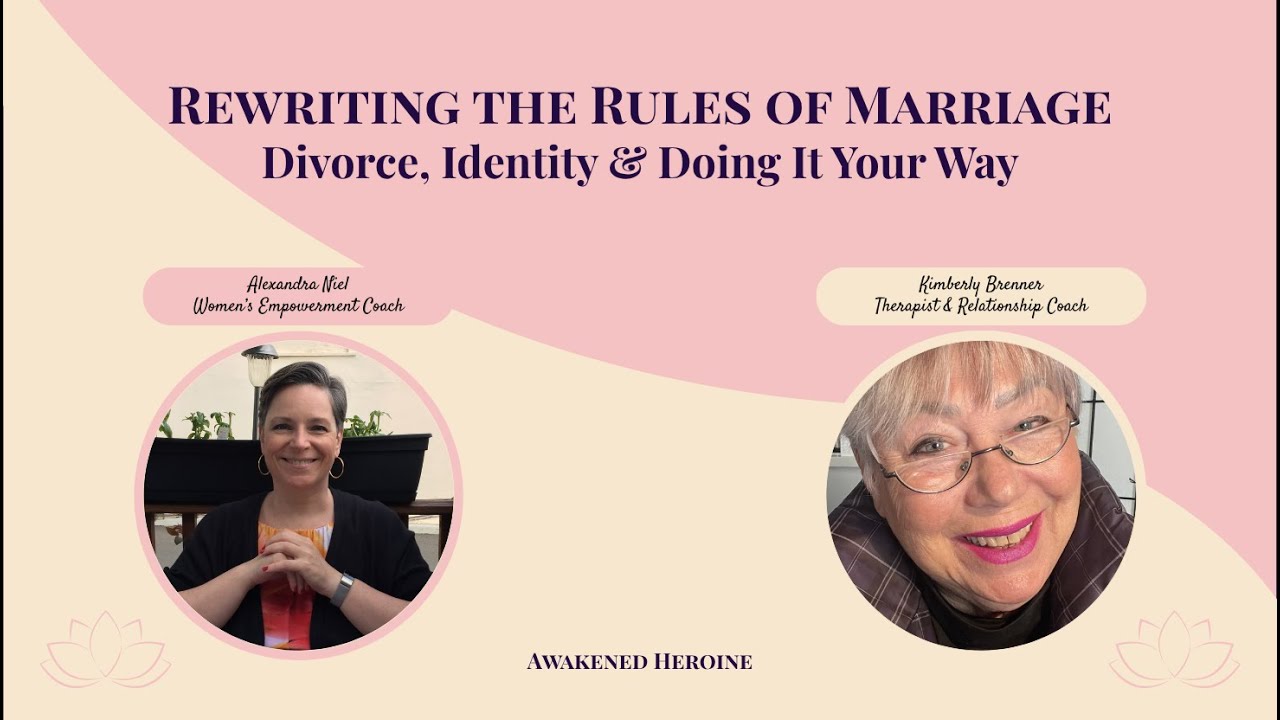
This content was created by Alexandra Niel. This content was uploaded by Alexandra Niel. This is a YouTube interview-style conversation titled "Rewriting the Rules of Marriage | Divorce, Identity & Doing It Your Way" (posted 2025-08-01). Host Alexandra Niel interviews Kimberly (a licensed clinical social worker, author of the Gutsy Wives series) about relationships, divorce, identity, communication, and practical tools for deciding whether to stay or leave a marriage—topics covered include problem diagnosis (7 Whys), solution-focused approaches, communication tone and directional mantras, expectations and labels, red flags, repair in long-term relationships, and personal lessons from Kimberly’s divorce and reconciliation. The transcript appears to be from a live or recorded conversational episode (YouTube) and includes coaching/advice context and references to resources (a workbook titled "101 Red Flags Every Gutsy Woman Needs to Know").
Chapters
Hello, heroines, and welcome back. Today I'm so excited. I think we're going to have a really juicy, juicy interview. So Kimberly and I were talking just before, and so I'm excited to— I don't know what's coming, but I'm excited about what's coming. So welcome, Kimberly.
Thanks, Alex. Glad to be here.
And I'm glad to have—
I'm really pleased to be able to talk to women about relationships, maybe with themselves, with their partner, recognizing when it's time to walk away, or it's, you know, kind of figuring out how to make it work and at some point realizing it ain't gonna work. Yeah. And so, um, but I— it, it was my story too.
Yeah. Yeah. And actually, I'm glad that you mentioned, um, whether or not to walk away because I ran a poll in, I think it was in June. And the first or the main answer was, I'm trying to figure out what to do, basically. So I'm excited that that actually might be a part of the conversation.
I want to point out something. Everything is a decision, right? Everything is a decision. And if we looked at What problem am I trying to solve? Then it shapes our decision. So often we get married to solve the problem of, I want to be loved, and we get married. Or I don't want to be alone, and we get married.
Or I don't want to— society tells me that I need to be married, so we get married.
That's another decision. So the problem is I don't want society to think that I'm— oh, I remember people used to think I was a lesbian because I wasn't married for a particular part of my life. And it was like, that's crazy.
People think I'm a lesbian because I have short hair.
Right. I mean, labeling is just nuts.
Oh, yeah.
Yeah.
Yeah.
But label apparently is that's how we figure things out. And you know, in a relationship that happens too, and other people put labels on us, we're trying to figure things out. And oftentimes when we're married and our husband starts putting labels on us, or society puts labels on us, what we end up doing is we're trying to figure us out. And I know that's what you're trying to do helping women, because now they're labeled as divorced.
Yeah, right.
And the world sees them as divorced, and it's like, well, wait a second, rather than assume somebody's label on you, figure out who you are. And oftentimes we need a guide, so you're guiding them to do that because they can't see themselves.
Yeah, agreed. And I would add also that not only do we You know, is it a label that is being— that we're embodying or that we're trying to embody? But it's also that, that what you were just saying, that lack of direction and trying to figure out, you know, where, where do we want to go? And it's all of the emotions that are attached with what that label is, right? It's that box that we then feel we have to fit in because that's the label that we've been— that's been slapped on our, our shoulder.
So the idea of what's the problem I'm trying to solve will dictate what my decision is going to be. However, what if we did not identify the problem correctly? Then the solution never resolves the problem. And we just continue with the problem, and, and then we end up defeated, like, there must be something wrong with me, I'm not happy, I don't have the life I want, because they haven't really identified the problem. And so often I find that the problem is out there. People are like, out there, so we try to control out there or change out there. And I think Einstein— I think it was Einstein, and I'm paraphrasing— where it's like, you can't solve the problem with the thinking that created the problem. So if I did create the problem I'm in, it's going to be hard for me to identify the problem. So that's sometimes how— why we do hire coaches, or we do hire therapists to come and help us pull apart, well, what Why? So the question is, why is that a problem? So I'm unhappy with my marriage. Okay, why is that a problem? I'm unhappy with my job. Okay, why is that a problem? And keep asking that question, why is that a problem, until you finally get to— you can't answer that anymore. You nailed it. The least common denominator. That's the real problem.
So there's like so much to unpack and we've like barely even started. Before we continue, why don't you tell us who Kimberly is?
Oh, okay. All right. You know, though, you're talking labels. Okay.
Who—
how do I put this? So what I want to do, my mission is to give the next generation an advantage, either be happily married or happily divorced. So that's my stand. I have watched— I'm a therapist, I'm a licensed clinical social worker, and I've worked with children whose parents were divorced. And then I worked with couples to help them figure out what to do. I've written several books on the idea of the Gutsy Wives series to help women get gutsy in their relationships. Because oftentimes the relationship isn't working because the, the— and this is not about blaming women, Alex, it's— it really isn't, because sometimes I'll hear it that way. It really is having the woman be her own person in the marriage. And, and oftentimes she doesn't have to leave the marriage in order to find herself. If she finds herself, then she decides whether or not the marriage is a healthy one for her. That's the key. So you don't have to, uh, perhaps give up the security of the marriage in order to, quote, find yourself. So find yourself and then decide whether or not this person that you're turning your life over to is wanting to do the same for you. And if they're not, you can say, thank you very much, I appreciate this, but I'm going to move on. Okay. Um, and that's, you know, that's not a codependent kind of relation. It's, it's, it's a— you're co-creating with someone. You know, when I was married, I used to ask my husband every month, do you feel loved by me? Do you feel loved by me? And there were months we'd said no, and I'd go, okay, I'll fix it, I'll fix it. But every time— I was married to a man and not a boy— so every time I did make him feel loved, he always gave me 150% more. Because men, men, not boys, are responsive. I wrote an article, Men Don't Cheat, Boys Do. So that distinction of a boy versus a man, and women need to know if they're married to a man or a boy. If they're married to a boy, they're going to treat them like they're— I'm your mother. And that's not, that's not really good. But a boy says, I love you because you make me feel good, and as long as I feel good, I'll be with you, so you better do what I want you to do. A man says, I love you because I want to take care of you, provide for you, give you the best life you can. So it really is important. And for us women, we need to be women and not girls. Girls are selfish. Girls are demanding. Girls are, if you don't do what I want you to do, I'm going to make your life miserable. A woman is clear boundaries. I know who I am. Let's talk. Let's work things out. And if need be, I can walk away. It—
I love that you make that distinction between men and boys and women and girls, because when I look at the relationship I'm in today versus the relationship I was in when I was married, I was definitely a girl when I was married. Hell, I didn't even know myself in— when I first got married. My development, my personal development journey didn't start until after I went through my divorce because I was like, I'm not doing that. And that's when I started to learn more about, about me. So having that distinction and knowing kind of where you are in the You know, in the girl-woman continuum, because it's a process, right? You don't go from girl to woman overnight. You just, you grow into, you grow into that. And I want to go back to what you said about identifying the problem correctly, because you're right. If we don't have the right diagnosis, just like in medicine, we're not going to get the right treatment. So how, how do you go about doing that? How, how do you identify what the root cause of the problem is? Is it the 7 Whys questions or is there another way of doing that?
No, I like the 7 Whys questions. I really do. A lot of coaches are utilizing that. So, for example, Um, most— first of all, 70% of divorces are filed by women, and they hold the dissatisfaction in the marriage. So the question is, or the statement might be, why are you divorcing your husband? I'm unhappy. Why are you unhappy? But the question is not a why, but why is it a problem? Why is it a problem for you that you're unhappy? And is— and will divorcing your husband solve that problem? And most women will say yes. They'll say, yes, I'll get rid of the jerk and I'll be happy. Okay, but what happens when they get rid of the jerk?
They're still not happy.
Still not happy. And the research shows that out of the 70%, 5 years later, the question of, are you happy now? 70% of them said no. So the solution to be happy of divorcing your partner or divorcing the marriage, getting rid of this person, wasn't the correct solution to the problem. So what is the problem? I'm unhappy. Okay, why is that a problem? It's, it's, it's a problem because I don't like this feeling. Okay, you don't like this feeling, so why is that a problem? So what, you don't like this feeling? Do you think you'll always feel this way? But what can you do to make that happen? So I'm studying solution-focused therapy, and what's interesting, solution-focused therapy does not look at what's your problem. They look at your resources and the solution to, uh, how to have what you want. So the answer would be, or the, the question might be, so what is your best hope? The best hope is I'd be happy in my marriage, or I'd be happy with this husband, or I would be happy with my life. Okay, and so what difference would that make for you if you were? What difference would it make if you were happy in this relationship? Well, my life would be better. I would be more productive. Uh, I would probably lose the pounds that I put on because I'm overeating. Um, I'd get out of the house more, whatever it may be. But what if we could do all of those things and our external environment never changes?
Because it's all an inside job anyways, right?
Right. So the outcome is, you know, what's your best hope? To be happy in my relationship. It doesn't mean that they have to make you happy. You find a way to do it, and then you decide whether or not it's a healthy marriage. And that's what a woman does. The girl overreacts. I'm unhappy. I've got rid— I've got to get rid of him. The woman says, let me get happy and decide whether or not he's healthy. I need to get healthy first. Take full responsibility for my emotions instead of saying, I need you to stop yelling at me so I feel better. I need you to make more money so I feel better. I need you to come home at a decent hour so I feel better. I need you to stop drinking so I feel better. And when we try to control another person, we stay the girl.
Yeah. And it's, you know, I, I'm listening to what you're saying and I'm thinking I was definitely a girl. I did. I didn't even know how to communicate my needs to my partner. Right. And that's, for me, one of the cornerstones. And I know in the different interactions that you and I have had, we often talk about communication and we talk about, you know, because how else are you going to make your needs heard if you don't talk about them?
So the key about that, because women will tell me all the time, I tell him, I tell him, I tell him what I want. He's not getting it. Okay, that, that indicates that there's something wrong with him. And they rarely stop to think, maybe I'm not communicating in a way that they could hear it. So what I focus on is the vibration of your voice. So I have this free 5-day audio, it's called How to Have a More Responsive Husband. And, and one of the days I talk about the voice, how you sound. Now, I'm sure you've heard people go, oh, you, you've got an attitude. Oh, she's got an attitude, right? Or stop complaining, or whatever, right? So here's how it works. You use what I call directional mantra. So I created something called directional mantras, and you might say, calm I am, relaxed I am. Okay. And when you do that, you become it. You become calm, you become relaxed. And when you speak, the vibration of the words is delivered on that kind of like carpet. And calm and relaxed. But if you're frustrated with your partner and your vibration is frustration and you communicate, the words carry the frustration and the partner feels it like a tuning fork. And then they respond back frustrated. And this reminds us of childhood when our parents would get frustrated with us. As a child, we thought, I did something wrong, they don't love me, and I'm bad. So when we're frustrated with our partner, which is inevitable, we will be frustrated, okay? But when we communicate through that vibration, the reaction our partner is, they become this little boy again, feeling like they're being judged and scolded by their mommy. Exactly. And they don't like it. And so they defend themselves. And now we have a fight.
And tensions escalate and voices get louder. And the more— and the louder they get, the less they hear.
Totally. Totally. So it just— so if we can't at the moment go, "Calm I am. Relaxed I am," and then speak, The opposite would be let them know what you're feeling to start with. I'm really frustrated with you right now, so when I'm talking to you, you're going to hear how frustrated I am. And now they're listening for they're frustrated rather than feeling it.
So it's almost like a, um, a warning flare.
Yes, yeah, yeah, yeah, yeah. Because we have something called listening for. Okay, listening for I'm in trouble versus listening for my spouse is frustrated. That's why we introduce people, by the way. You know, if you're going to go on stage and you're being introduced and they tell you, oh, you do this and you have these books and you have this podcast and you have whatever it may be, people listen to you differently. Than if you walk on stage and nobody knows who you are.
It establishes kind of that baseline and that foundation so that it starts building the relationship with, with the person.
Yes. Yeah, yeah. Which reminds me, one of the things that if girls or women are going on their first date, I tell them, here's how you know not to take a second one. You ask the guy, who do they admire and why?
Huh.
What they're going to tell you is the kind of values that they want to see in a woman. And if you're not it, don't take a second date. So if their values are, I admire my mom, she worked 3 jobs, she took care of the kids, she— and you're over there going, heck no. I, I want vacations. I want to stay home with my babies. Don't take a second date, because the more we, quote, date and learn about the guy— like, I want to know more about the guy— we fall in love with the person we share ourselves with. This is critical. So the more we share our, our problems, our visions in life with somebody, the more fond feelings we get. And we think those fond feelings are love, and we bypass the red flags. So get the red flag up front and say, thank you very much, this was a lovely date. No, thank you. And to be very— and very upfront about it. It's like, we're not a fit. Well, how do you know? Because nobody wants to be rejected, so the guy's going to get defensive. Well, how do you know? You say, oh, wink wink, it's a woman's intuition, honey. I'm saving you the trouble. I'm saving you a lot of money by dating me.
I love it. I love it. I think that's so awesome because it's true. Like, you go on dates and then you start to see flowers and you hear the angel singing and you hear the harp playing in the background, and you think, oh my God, this is my person. And then you get married and all of that stuff kind of falls off. And then you wake up one day and you're like, who the hell are you?
You know, I've worked with couples that live together for years, years, I'm telling you, years. And then they get married and in 6 months they want a divorce.
Okay, can I just tell you, like, I've seen so many people do that, which is why my honey and I are probably never getting married, because we've been together enough and things are working, and why mess with what's working? But I have a theory, and I want to hear what you think.
Okay.
And my theory is that while you're living together, you're still almost like in a almost a discovery phase, but it's like there's a lack of quote-unquote certainty in a way, in some ways, because you haven't made it official. And the moment you get that piece of paper, people stop trying and they've stopped showing up for each other. That's my belief. I could be completely wrong. I'd love to know what you think about that.
It's mine too. So I want you to think of somebody is working at Amazon, okay? And then it's a brand new job and they're getting to know the job and they're getting to know Amazon and they, you know, know how it works and whatever, and they're doing a great job. And, and the manager goes, wow, you're doing such a great job, I'm going to promote you. Now you're going to be the director. It's a different mindset, isn't it?
Yeah.
Okay, so now you're not, you're not going out with all of those guys that you hung out with at level 1, and they're going to look at you and go, oh, look at you, you're, you're a manager now, you think you're all that and a bag of chips. Okay, our titles change expectations. When it goes from boyfriend, girlfriend, lover, significant other titles to my wife, my husband, that label changes the expectations. And nobody ever talks to them about what are the expectations of a wife and what are the expectations of a husband and what I think you expect from me and what you are really expecting from me. They don't talk about that. So that subtle shift of label changing changes the mindset of the dynamic. Well, you never used to do that. You used to open the door for me all the time because as a boyfriend, that's what I did. When I'm a husband, I'm the king of the house, and husbands don't have to do that. So you are slightly correct in what you're seeing, but this is why it's happening. It—
I hadn't thought about it in the context of labels, but hearing you say it, it makes perfect sense because it's true. Expectations are, are going to be different. Yep.
So, and then what happens is when the expectation is not met— and most of them are never talked about— when an expectation is not met, the result is I'm mad. So every time you get mad, every time you get mad, there was an expectation that wasn't met. So now we never have to get mad at another person. We all have to look at, well, what was my expectation and did I clearly communicate it? And how come I didn't get it?
Okay. I think just having that point of reflection.
Yeah.
Right. Instead of sitting with the emotion and sitting with the anger or sitting with whatever, just to be able to take that step back and say, okay, what's actually there? Is hugely helpful.
And now you can communicate. Now you can talk about it reasonably because it's not about the other person. It's about, I didn't get what I wanted or what I was hoping to get. Let's find out if we can make that happen.
Yeah. Okay.
You know, um, I used to teach communication to corporations and of course I teach communication to, uh, couples. So personal communication versus corporate communication or military communication, they're different. They're really different because at home, this is, this is your partner, right? At work, supervisors, it's a different level of communicating. Corporations are spending millions of dollars training their people how to communicate. And we don't do that in marriages. And I think that marriages are more important than our jobs. I mean, granted, our jobs are important, don't get me wrong, but we don't go to bed with our jobs.
Some people do.
Well, that'd be pretty lonely, let me tell you.
So that, that all brings me back to something you said earlier about I created the problem that I'm in. Yeah. So take us through that a little bit more in terms of the, the, a bit like the conditions that make us create these problems and how do we avoid— is a big word— but how do we, how can we do things in a different way?
Um, so I hear a lot of, I'm not happy.
Okay.
That to me is a very powerless statement. I'm not very powerful because I don't know how to make myself happy. So this whole movement about empowering women is not about, you know, uh-huh, powering, you know. It is really is about I have the resources and my own identity that I can make myself happy regardless of circumstances.
So it's self-reliance.
Yes, yes. And you know, it's interesting because they teach resiliency to the, to the military on the military base. Resiliency, to be your own person, is what they teach, not only to the soldiers, because they need each soldier to be resilient and work with the team. They teach the wives or the spouses of the soldiers the resiliency to handle whatever comes your way, that self-reliance to know that no matter what, I'll deal with it, I'll handle it. I love Byron Katie's book loving what is. Loving what is instead of complaining about what is. And I tell, I tell this jokingly, all women always complain all the time, that's why they're not powerful. When we as women complain about something, that complaint says we have no power to change it within ourself, and we try to control this in order to fix this, and that never works.
So how do you switch out of complaint into empowerment in the way that we're talking about it?
Why is this a problem for me?
Okay.
Because I want to learn from somebody else. How come it's not a problem for you that cars cut you off, and it's such a problem for me? I just want to kill them. What do you—
so that's the magic question.
So what do you tell yourself? How are you being? How are you thinking? And this is what's happening in the coaching world where they're saying, here's the mind of a millionaire, millionaire mindset, money mindset, creating this mindset that allows you to make the money, creating the mindset that allows you to have joy in your life. And I talk about the mindset of being married. And most people don't have a mindset to be married. And yet we want to have a partner, but we don't have a mindset, what it takes to be married. And some people would never have that, and then they shouldn't be married, and that's fine. It doesn't mean that they shouldn't be in a relationship. And I've worked with plenty of people that did not have a married mindset but wanted a relationship. So we had to get very clear about the parameters of what this relationship's gonna look like. Excluding the marriage. That's fine. Goldie Hawn did it very successfully. Exactly. But it's between two people and the expectations, and it's not about avoiding something. We're avoiding marriage. No, no, no. It's about what am I creating. This is what works for me. This is what brings me happiness. I'm not running away from marriage. I'm running towards what works for me by my definition.
And I think the interesting thing is that society tells us that unless you're married, you're not creating together. Because it's a stigma about still living together or being partners that like you haven't like arrived, like there's some kind of magical something that happens when you get married?
So, um, there's the listening of society, and then there's the real— and then there's the reality. Okay, the reality is that, um, this is my husband, I'm his wife, and there's no paper trail that says that.
And that's— and because it's— it brings to mind what you said before, because it's a mindset, and a piece of paper isn't going to give you that.
That is correct. Which is why, you know, there was a time in the '50s that the whole idea of a woman going to work and providing for herself was unheard of, you know, and I lived through the— I lived through that women's liberation movement and through the change. And I remember going to the bank and I was getting ready to work with Mary Kay back then, and I needed $3,000 to pay for the kits to start the business. And I went to the bank. I had $3,000 in cash, and I went to the bank and I said, here's $3,000. Put it in whatever savings account and loan me $3,000 because I wanted to build up credit. They said, we can't do that without your husband's signature. And, and I remember that, how upset I was that I didn't have my own identity, that my identity was tied into I'm somebody's wife. And I think this is what fueled that movement back then, is we— not that we wanted to be equal and, and be a fireman like you're a fireman, per se. We wanted our own identity. We wanted to know who we are. And Alex, I'm sad to say, it is 70 years later and women don't have Women have not given themselves their own identity.
Yeah.
And so now it's kind of like they leave their marriage to acquire an identity. But that's what I fought for back in the '70s, that I did not have to leave my marriage to know who I am. I needed to know who I am and teach my husband how to love me, love me for who I am.
I—
we would have a favorite phrase. If I would mess up and be mad at him, I go, 'Could you love me anyway?' And if he messed up, I'd say, 'I'm gonna love you anyway.' And then it'd be over. We'd let it go, let it go, because that's what it means to be a woman, just to let it go. And the key is it's all about love and acceptance. And if I can't love and accept myself, how the heck am I going to love and accept somebody else?
Yeah, very true, because we can't see in others what we see and what we don't see in ourselves.
I don't know if I answered your question about, uh, you know, how do we know and identify What is the problem? Okay. Because, you know, if you put 10 different coaches and line them up and they have 10 different, uh, points of view, they're going to give you 10 different reasons as to where the problem is coming from. Okay. Um, but what if we stopped looking at and looking for what the problem is? What if we stopped doing that and said, what is my heart's desire? What do I really want out of life? And what difference would that make for me? And we build on that. We build on that. What if we did not have to think of us as broken? That somehow we have to fix it. What if we would look at our life and say— and I have two phrases for this: I wanted to do that, and I wanted that to happen. So no matter what, I wanted to do that. No shame in it. I don't know why I wanted to do it, but I did it. And I own it. So I wanted to do it, no regret, and I wanted that to happen. I'm not a victim. I don't live as a victim, and I don't live in regret. I wanted to do that. I wanted that to happen.
And that can be difficult, right, to fully take ownership of what happens in our life, then we're holding on to regret and we're holding on to being a victim. Agreed.
Okay, but ironically enough, when I have a woman repeat it over and over again, all of a sudden her brain starts— or spirit, I don't know— gives her answers like, I did want that. All of a sudden she goes, I did want that to happen. I did. Oh my God.
Like, you know, because it's another way of getting to the why, why, why, why, why, right?
Yeah, exactly. You know, so I, so I use this analogy. I run a red light. Oh, I wanted to do that. Because what's our alternative? Oh my God.
Oh my God.
Oh my God.
Right.
And then you get a ticket. I wanted that to happen. Because the alternative is, oh, And then we spend hours complaining about, I got a ticket and I got to go and I got to do this and I got to pay. Get over it. You wanted that to happen.
It fills a need somewhere.
It does, it does. Yeah, I mean, the, the police officer might be cute, or you go down to the station and you got to pay and you meet the perfect person in your life. You never know.
You never know.
You never know where it's going to lead.
So I want to ask you, and you might need to share a little bit about your personal divorce story, but like, what was a lesson for you that was important, um, from your divorce that I think is important also for our heroines to hear?
Right, so I got married in 1972. On our third date, I asked this man, I'm gonna marry you. I told him, I didn't ask, I'm gonna marry you. He says okay, and, um, I did. It was instant, instant, instant. And over 18 years, I became unhappy. I was unhappy because I felt, um, in hindsight, not only was I being a girl, but in hindsight, I was pretending. I was in the corporate world and I was pretending. I was pretending to be tough. I was pretending I had a, I had to battle it out with the guys. And I was unhappy about it because I wasn't being me. I wasn't, I didn't take the time to discover what I wanted. I was living a life of what I thought was expected of me. Well, Steve and I— that was my husband's name— Steve and I had this agreement when we first got married that if either one of us was unhappy, we would put one shoe out the door, which would indicate there's a problem and we needed to talk about it. Well, I put one shoe out the door. We went to counseling, and this counseling just let us fight, fight, fight, fight. We got nowhere. So after 3 sessions of this, We looked at each other, my husband and I, and said, well, if she can't help us, nobody can. So that's when I put two shoes out the door, which meant it was over. And we went to a lawyer, one lawyer between the two of us. And the lawyer says, you guys seem to like each other. Oh, we do. So why did you go to counseling? We said, that was terrible. By the way, when I think about that, I, you know, as a therapist and marriage therapist myself, it's like, I will not let my couples fight like that. No way.
I was gonna say, I was thinking as you were telling the story, that probably shaped how she deals with her clients.
Yes, absolutely, absolutely. I was on the other end of the stick. Uh, I know what it felt like, uh, to not get help and to let us just fight. So, so Steve and I divorced amicably. We really did. And, um, so now it's like, I'm gonna go find my happiness, right? And of course, I blame Steve for not making me happy in the marriage. And all the guys that I dated, at some point— I'm embarrassed to say this, Alex— at some point says, I'm not going to put up with your shit. I mean, really, I was a B, capital B. I was such a girl, had to be my way or the highway. Okay, I was looking for somebody to fulfill me, which put too much of a burden on another person, and they were not interested in it. And, and here's the, the story that changed everything for me. I am sitting next to a man on an airplane. His wife passed away. He says, I've been married for 55 years. And I go, wow, that's a long time to be married. 'Did you ever want to divorce her?' And he goes, 'Oh, you know, divorce was never an option, but I hated her guts and I wanted her dead. And I slept in the garage and we didn't talk to each other, but because divorce wasn't an option, we had to figure it out.' This happened 5 times in our marriage. Now I'm over here thinking Holy crap, 5 times! If my clients— once, okay, they'll forgive it. Second time, they're calling a divorce lawyer and calling it a pattern. This guy went through it 5 times. But then I'm like, okay, 5 times, 55 years, that's not too bad. And then he went on to say, you know, every time this happened and we figured it out, we got better as a couple. And he says, you know, life always hands you problems, and isn't it nice to know that the person you're with won't bail on you? When he said that, I got this horrible feeling, and I called myself the P-word, you know, what usually men call themselves, that I bailed, that I didn't stay to figure it out. That it was like, I'm unhappy, I'm gonna go find my happiness, and that's it. And I realized— and then he went on to say, thank God she died on a good year. And I thought, he probably used a lot of humor in repairing. Okay, so that's the other thing that shaped how I do is I help couples repair. It's not enough just to say I'm sorry and move on. I really want them to repair something, really sew it up that it doesn't rip again, to figure out, to learn from what just happened, and to grow from it. So when I— I swear to God, God must have put that angel next to me on that plane. Because why would he open up like that to me? Seriously, that was pretty personal. And, and so, so one night, like a late, late, late, late night, I call Steve up. I'm in— living in Atlanta, Georgia. He's in El Paso, Texas. And I call him up and I said, it's not over. After 7 years of being divorced, It's not over. His response— and I— it didn't matter what his response was. I had to say it. And I realized through those 7 years of men telling me, I can't put up with your crap, I began to realize it was me. And so when I called Steve up, I took the stand of being a woman. I'm going to say what I needed to say regardless of what he was going to say. It didn't matter. It didn't matter. So I told him, I says, it's not over. And his response was, you're right, it's not. What do you want to do about it? And the next thing I said was, I'll be there in 2 weeks. And I packed my car with whatever I could fit, told my roommate, I'll either be back or I'll tell you where to send my stuff. And I drove 2 days from Atlanta to El Paso with whatever I could fit my Mazda at the time. And I got there and I looked at him and I says, we're going to figure this out. And he goes, okay. And I tell women, if your husband is coachable, you don't throw him back in the dating pool. Yeah, he's coachable. And so that's what we did. We figured it out. And a couple— about a month later, I called my roommate. I says, the movers are going to be there at such a day. Show them where my stuff was, pack everything. And that's how I got the rest of my stuff back in El Paso. And I never left. And he passed away about 4 years ago. And it was great. It was great. I know.
I love it. I think it's, it's so inspiring to hear that because you hear so many stories of— and I look at my, my honey, he's been unfortunately in a battle with his former wife for years and years and years and years. And to hear that contrasted with your story of hope and love. And I just think it's so nice when there's so much of the other uglier stuff out there.
You know, is it really ugly?
I think the way people behave is ugly. Yes.
Yeah. And, and I'm sure you've heard the phrase, he's such an a-hole, right?
Yeah.
Okay. And women, I don't know what you would call a woman that acts like that, but people who act ugly, I tell people they're not okay.
Yeah.
They're not okay. And so if somebody is acting ugly, rather than to get upset with them, you look at them and say, I get it. You're not okay. What do you need to be okay? Because it's not about me. I don't have to get defensive because you got ugly on me. I don't have to get butthurt because you got ugly on me. I don't have to be challenged because you got ugly on me. It's all you. It's like, I get it, you're not okay. And they'll say, you're right, I'm not okay. Say, I get it, but I'm not the one who didn't make you okay.
Yeah. And I fully hear what you're, what you're saying. I think the other person has to be willing to engage in that discussion and recognize that they are not okay.
Yeah. And, and if they're not, you say bye.
That's it. And that's it.
I'm not engaging. I'm not engaging anymore. And I've had to do that with people in my life. I'm not engaging any, but that's a woman. I don't have to be liked. Yeah, girls have to be liked. So if I, if I want to let your listeners leave with something, make sure that you're a girl. Alex, can I give a plug?
Yeah, yeah, absolutely.
Good. Yeah, so I I don't know if you'll be able to see this because of the screen. Let's see, I'll hold it here.
Ah, what does it say? 101 Red Flags Every Gutsy Woman Needs to Know. Aha. Okay.
So it's a workbook. So each page is a red flag and on the other side you get to do the workbook. So this, this last week.
So when— congratulations.
So when women tell me, you know, where were you when, or how come I didn't recognize these red flags, and then what I do is I teach communication so that the woman can turn the red flag into a white one and have a relationship that works. If not, say bye.
Yeah. So you know what, um, you're gonna have the opportunity once, um, once we get off the live, throw any information you want people to know about in the comments below and, you know, how people can find you, how they can reach out to you if they want to. Yeah, so that'll make it easy for everyone. Kimberly, I just want to say thank you so much. This was so much fun. Yeah, you and I need to talk more. Okay.









