Stop Shrinking, Start Speaking | How to Own Your Voice After a Toxic Relationship
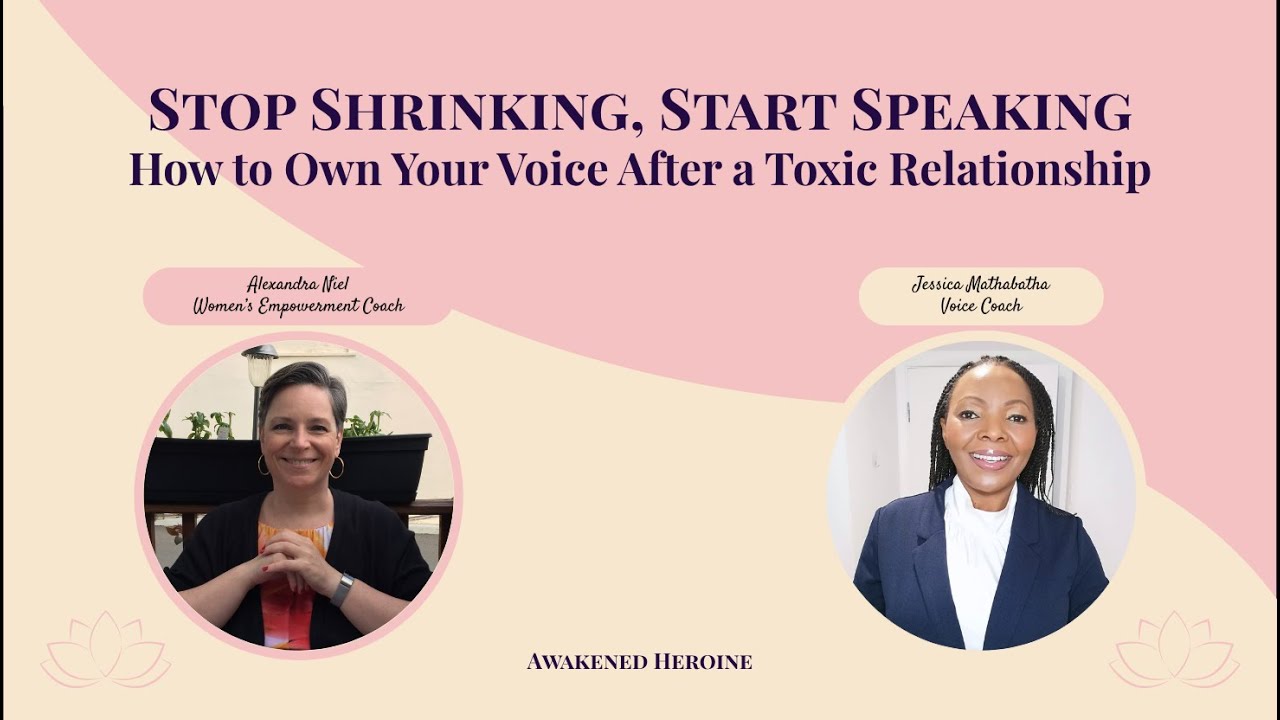
Voice coach Jessica Matapata explains how people leaving toxic relationships can reclaim their voice. She teaches that "no" is a complete sentence and shares a technique called "carefrontation" for expressing feelings without blame. Owning your truth and letting others decide how to respond is key to healthier relationships.
Chapters
Hello, heroines! This is Alex. Welcome back. Today I have the pleasure of bringing on board and bringing to you the lovely, the one, the only Jessica Matapata. Jessica, how are you?
Hi, Alex. I am doing great, thank you, and thank you for having me on your platform.
Oh, my pleasure. So I wanted to bring Jessica on board because she talks about really kind of rediscovering your voice. And I think for you and the group, I thought that would be a really good thing to talk about because we can sometimes feel like when we are in a relationship, we might not have a voice. And rediscovering that when we come out of the other side of a divorce or a separation or some kind of uncoupling It can be a journey. So I wanted to bring Jessica to really be able to talk about that. So Jessica, tell us a little bit about who you are and what you do, because I don't know whether or not I butchered that.
Right. I am a voice coach and a certified speech and language pathologist. I work, I do a lot of work around communication, around mastering your voice, around Owning your voice, because what you've just mentioned there is so important. Um, a lot of my clients, a lot of the people that I see, have in a way, whether it's in a relationship, whether it's in a personal relationship, or whether it's in their businesses, some of them hold back because they don't feel their story matters. They don't feel whatever that their opinion is is valid. And as a result, they spend quite a lot of time in relationships or in a workplace where they are unhappy because they hold back so much. And it destroys the relationship because when it destroys the relationship with yourself, because when you're sitting there every time kicking over, should have this, I could have said this, oh, why did they do this to me? Oh damn, why did I keep quiet about that? You know, and that's the first thing that does is it really takes away that confidence in you. And when you lose that confidence in yourself, then you will lose confidence in communicating with other people. Because when you're not true to yourself, there is no way that you will be true to other people. Your relationship with other people will be really based on something that is not solid. So it's really important to own our voices and really stand in our truth because what's in our heart matters. And then you have to allow the listener or the person that you are with to decide on what they do with your truth. As long as it is presented in a way that is respectful, the way that honours you and honours the other person. Then the other, you know, you're the person that you're communicating with, or, you know, your partner, spouse will decide on what do they do with that truth. Is it something that they want to hear? And once they've had that, what, what are their next steps?
So I'm going to come back to all of that because there's so much to unpack in there. But I'm curious and I want to hear, like, how did you get started doing this? Like, what's your, what's your story? What's your path?
I, I multiple— there's two paths. First, the first part was I was one of those people who was really awkward and odd about owning my voice. I would— I'm going to say, oh, people please, I'd never really stood up and uttered and stood up in my truth and say, right, I don't want like that, I do not want that, or this is what I think. Because I always felt that I needed to blend in. And then every time anybody says, even with friends, I was like, oh yeah, yeah, yeah, oh absolutely, oh yeah, you're right, absolutely, I totally, totally agree. I was that person who would just, oh yeah, absolutely, and deep down I'd be thinking, oh no, I don't want that, you know. And that was destroying me inside because I would get— I would agree to things that I did not want to do and then do them. And then after that, kick myself and going, I don't want to do this. Oh, I'll just kind of really be hiding. I would agree to something and then not go and like, oh no, oh no, I'm not feeling well. Oh, my tummy, this— make excuses when I actually could have just given the truth and allow that person to make a decision based on my truth. So that was me in the workplace with friends, and I took that even with my like intimate personal relationships because I was that person. I was, I was that really nice, you know, partner, girlfriend who was, oh, oh yes darling, oh absolutely, oh yes my love. You know, I was just that person who was always so understanding, and I used to pride myself as, I'm really flexible, I'm so understanding. And what I was hiding there was that I wasn't, I wasn't speaking my truth and allowed people to make decisions for me, and I'll just go with that. And even when I hated it I'll just, oh yes, darling, oh, as long as you're whatever, you know, I'm, I'm really flexible, you know, I'm really cool with it.
So I just want you to know you are not alone because I've been down that path as well, and I just want to honor you for how far you've come because look at you, you're on camera talking to however many people, and that's freaking awesome.
Thank you, really appreciate that. It's just taken years of training.
Yeah, I can, I can imagine, because I know it's taken me quite a while too, and there's still times where I have to catch myself.
So absolutely, because there's times where I have to kind of really say, right, like moments where people will say something and I would go back into the old self where I would like, oh, not say, and then I'll snap out of it, go, no, you don't agree with this, say so, as long as it's respectful. But you have to speak your truth. People need to know what you think. And you know, it's like people, it's a— people need to make decisions based on what you say. Speak your truth and you'll never have to lie again.
And what I love about that is it reminds me of the quote that I've heard that says, um, you are not responsible for other people's people's emotions, right? All we can be responsible for is how we show up in our authenticity. And, you know, and we can show up in kindness and still say no, or still do the things that are meaningful for us without it, you know, without being mean or rude or anything like that. But it's up to the people in front of us, like you said, to decide what they do with the connection. But that's not on us.
Absolutely. And you know, one of the other things that for me liberated me, the day when I made peace with that— no is a complete sentence. I do not have to dress it up in any other way. If I say no, that's just how it is. It's a complete sentence. That liberated me. And I say that to a lot of my clients. No, it's a whole and complete sentence. You say no, full stop. That's it. No, period. That's it. No explanation.
We— and we don't see— I think that we feel like we need to explain, like we need to provide a reason why. Maybe because we think it's going to help them feel better, maybe because it's going to help us feel better. Whatever the reason, the point is no is no, period.
Yeah, no is no. And that I say to like my clients, and whether they like leaders in the workplace and are just taking on a lot of load, this, that, and the other, they always say, oh yes, I'll do that. Oh yeah. And then end up taking on too much and burn— burning out. I'm like, listen, no is a complete sentence. Just, you have to train the people senior to you to understand that no is no, and it's no. There's no— you don't have to be aggressive about it. Just say no, and that's it. If they would like an explanation, that's when you give an explanation. But if they're not asking for an explanation, Leave it as that, period.
I totally agree with you. So I want to go back to what you said before because you talked about shrinking back and losing your voice. And when you work with somebody who is not in the habit of voicing their opinions and their desires and their needs, How do you then start to get them to feel more confident about the fact that their voice does matter, that they deserve to speak out loud what they want? How does, how does that work?
A lot of the time people don't say no or don't own their voice because of the trauma that they've gone through or because of their limiting beliefs. There's always something in there, in their mind, in the something that they're telling themselves, or they've got a history of being growing up being told, oh, shush, what do you know? Like as a child. And there's usually something, some kind of trauma, some history behind. And so a lot of the time what we do is that's what we kind of unpack. What is— where did this all start? And then once that is healed, we open that and heal that. And once that is healed, then, you know, the person is usually open and free to step into their new self. And it's, it's a whole process. I say— I always say to my clients that you have to unlearn so that you can relearn. And that is not a straightforward road.
And I love what you just said about unlearning, because sometimes I feel like, you know, it's like somebody who's got— how can I say this? Like, people sometimes feel like the more you do, the better, right? But sometimes it's as important to take things away as it is to add things when you want to grow, when you want to, you know, when you're on this journey of rediscovery or whatever the case may be. But I love that you talk about unlearning because those are the things that we have to remove so we can make room for the new stuff. To come in.
Absolutely, because most of us, by the time we get to the age that we are, there's been layers and layers. We've got a layer of protection, we have a layer of defense, we have a layer of this— there's just so many layers that we have. And so what we need to do is shed those layers. I don't have anything to protect, I don't have anything to defend, I don't have anything that I have to argue. So all those layers need to go, and then you get to the, you know, your real you where you stand in your truth. I don't have to be defending anything. I don't have to be protecting anything. This is just my truth, and that's where I stand. And once you are in that place where you're not hiding and having to protect and defend and all sorts of things, then that's where you find your liberation, and that's where your voice comes. And you'll say things without— you will be able to express yourself without worrying about, oh, what are they going to say? If you say it with, you know, with respect, then it's no longer in your hands. Your soul, your responsibilities— be respectful, honor the other person, and that's about it.
So I'm thinking about the heroines in the group who might be going through a divorce or a separation or something, and they approach things and they are starting to rediscover their voice, or they're wanting to share things with their partners, but that's not always well received. And we talked before about, you know, let them decide what they do with your truth. Right? But when you're facing somebody who's not reacting well and certainly not responding to what you're offering, how do you— what would be a way that they can manage that so they can stay authentic to themselves, but also then them not reacting to the reaction in a way.
Yeah, I think, I think what, what, what sometimes what we do, which I've done that before, is that when we're having difficult conversation— my mentor Lisa Nichols calls it carefrontation, so I, I've taken, I've borrowed that word from her— it's carefrontation, where we standing in our truth and having those difficult conversations What most of us do, we sit there and say, darling, when you know what you do is you do this, you do that. And once you start saying to somebody, you do this, you're hurting me, you are this, then the first reaction, which is a natural normal reaction, is to defend and protect. That's when people say, 'How dare you say this? You can't say this about—' You know that, and then everything just kind of really falls into chaos. But when you take it back to yourself and say something to the line of, 'When such and such happens, this is how I feel. This is how it makes me feel.' 'And what I would really love is for you to do such and such,' or, you know, 'To help me move forward,' or, 'To help me manage this better is if, you know, we can do 1, 2, 3,' instead of turning it and say, 'You do this, you do that, you hurting me, you this, you that.' And because that, that's a normal reaction, people will defend themselves.
It's about diffusing the situation before the situation actually happens, right? Absolutely. Because we're coming at it from a place of, this is what I feel, and it's not saying you, right, the big you. It's more like, okay, I own that this is how I feel. How do we fix this? Absolutely, absolutely.
It's, it's, it's just how you— you're not even bringing them in. It's how I feel. And that— it's not like— it's not long as saying to the other person, you are in the wrong, but it's saying, this is how I— I'm owning my feeling and I'm owning my emotion. And so let's, let's kind of work around this. So that we can, like, the goal or the outcome is a different emotion.
Yeah, I can, uh, I can totally, that totally agrees with how I see, um, how I see the world. So, um, what's been, because we all have, um, a story or two or more of heartbreak in our life, whether it's dissolution of a marriage or the end of a long-term relationship. Um, and there are always lessons. I, I noticed after I went through my divorce that there was a gift in there, and I had a choice to either take the gift and run or ignore the gift that was there. So what were some of your lessons from, you know, past heartbreaks, let's say, that you've carried forward into who you are today and how you interact with, with partners?
I remember when I think I was in my 20s, I, yes, I was in my 20s, and it was a late, you know, when you're that young, sometimes you think, oh, That's the one. And you know, I had met my— that's the one. And at that point, I just— I was blindsided by love and everything else. And what I did not see was that, that intense level of coercion and abuse. It wasn't physical, but there was that, you know, those like, you know comments here and there, which happened a lot more often than desired. And now looking back, I see that actually that was such— when I was in it, I didn't see it as an abusive relationship, but when I came out of it, I'm like, oh, actually there was a lot of coercion there. There was a lot of, you know, emotional abuse, blackmailing, and all that kind of things. And What I learned from that relationship and what I allowed that person to do was that I, I, I, I, I look back now and think, you know what, to an extent I allowed them to do that because I didn't really challenge it when it was happening. I didn't like some of it And I would look at myself and think, oh, maybe I was wrong. I blame myself a lot. And now I look, I'm thinking, I wasn't in the wrong. He was just very controlling. And I look at that now thinking, you know what, I am— in a way, I can look back and be angry about it, but I choose not to be angry, but look at anything, right? It has just now taught me to just stay in my truth, stay in my truth. And if there's anything in the slightest that I do not like, we have to sit down and talk about it. And if we can't come to a resolution that we're both happy with, then it's not going to work. So now I put everything out there. We have to talk about things.
Up front. Yeah, I think it's important too because like you were saying before, we don't want to lose ourselves, right? And when we don't speak up, we don't own our voice, right? That's what happens is that little by little we start to shrink and we start to, you know, play small and we start to defer to the other person. And that, like, and when you come out of a relationship after you've had whatever epiphany, or if it's been, even if it's been forced upon you, it's like, okay, well, now who am I, right? Like, we really tend to lose ourselves, or it's possible to really lose yourself in a relationship. So I love what you said about just owning your truth and speaking it into existence.
Oh, absolutely. Because I think during that, like, and when I was in that relationship, there were so many things that I was actually ignoring. The red flags, they were as big as the mountain, but I was choosing to, to ignore and not really talk about it with friends. I'll be with friends and I'll be talking, oh, it's so rosy rosy, everything is And then, but there are massive red flags, huge, that I chose to ignore. Like, looking back now, I was like, they were there, the red flags were there, but I chose to ignore them because I was just blindsided. I thought, oh, that— oh, my relationship is so fun. No, it wasn't. It wasn't. I was seeing everything with rose-tinted glasses because I wanted things to be in a certain way. And they were not. They were going the opposite.
Yeah. And I completely relate to what you're saying because I know in my marriage I thought that to be a good partner meant to not voice disagreements, right? That everything had to be like— everything had to be okay and I had to smooth everything over. You know, all of those things. And that's like, when you, when you think about it, because I, I was fearful of how he would react and that maybe that would break us up, right? And what broke us up was the fact that I didn't speak up, right? So not owning my voice is actually what broke their relationship.
Yeah. And when we get to that point where we're not owning a voice and we're like, right, you come out of there with so much rage sometimes because there's been like— there's a trail of things that shouldn't have happened that we allowed to happen. And you look at that and thinking, oh God, only if I'd said something, this wouldn't have done, I wouldn't have lost this, I wouldn't have gotten this level of debt, I wouldn't have this, that, that, and the other. And we are like, you know, I mean, we sometimes we do what we do based on what we know at that time. And what we knew at that time was that this is the right way to do things. And we didn't openly talk to other people to actually see and realize, or to admit and accept that that was wrong. We were not looking at things the right way. But, you know, that's what we knew at that point, and that's what we did.
It's, you know, we learn along the way, and, you know, we learn when something goes sideways. When everything's going well, there's much less chance of us learning than when something goes, you know, when something blows up. So, anything else that you think is important to share that we haven't talked about yet?
I mean, we've talked about most things, but one thing that I always say, which I've already mentioned, is so important for us to, you know, in order to have our joy, our happiness, the first person that we have to honor is ourselves. We have to stay in our truth. We have to make sure that everything that we do is in alignment with what we value, with what is going to, um, which, which is maybe around our passion, what we love, what we enjoy, and what we value the most. And when we do that, then in like the next person that we're in a relationship, or the person that we're relating at that moment, that relationship will be a lot easier because communication will be at the forefront. And one thing, when we have an open discussion about things. And if we do that in a respectful way, then it just makes relationships so much easier and so much better, you know, because there's so many people out there who either say things that they regret in, oh, I was angry, or they don't say things in moments where they should have said, oh, I could have, should have, and that, you know, they— by that time it's too late. So just make sure that we say whatever that we need to say at that time in a respectful and way that honors ourselves.
Fully agree, because I look at how different my relationship is now. That was one of my biggest learnings, was learning to speak up for myself and also knowing what I, what I wanted and knowing who I was, right? When you have all of that, you bring a different level of engagement to a relationship, I feel. So, Jessica, thank you so much for being here today.
Oh, thank you so much, Alex. I really, really appreciate this moment. Um, it's been really grateful— it's been really great to be here. I, I, yeah, I do appreciate that.
Thank you, thank you. And we've loved having you.









