Take Your Power Back After Divorce | One Intuitive Step at a Time
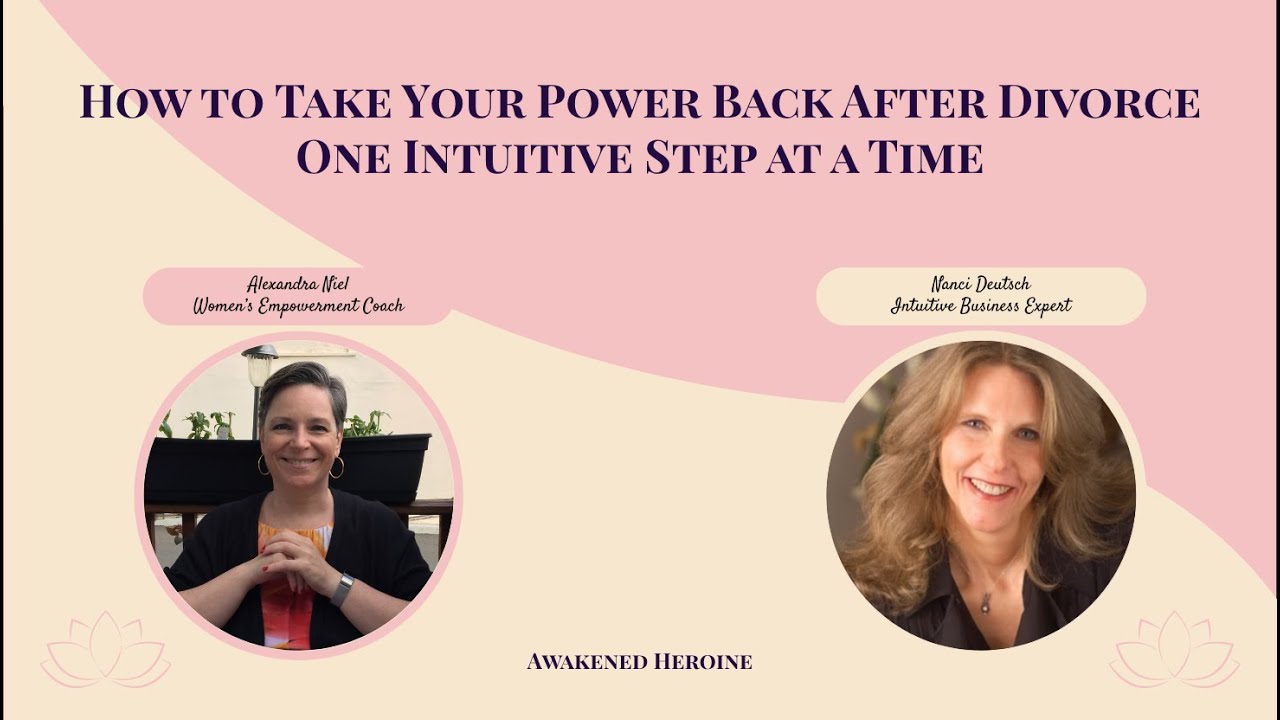
Alexandra Niel interviews Nancy Deutsch, a clinical social worker and hypnotherapist, on reclaiming power after divorce. Deutsch shares her own divorce story and walks through using intuition to spot codependency patterns, set boundaries, and untangle from manipulation. She offers concrete steps like clearing limiting beliefs and building a support team.
Chapters
Hello, heroines, and welcome back to another wonderful interview. Today I am bringing you Nancy Deutsch. Nancy and I have known each other for a little bit, and I wanted to bring her in because, um, I think she can provide a different perspective on what to do, especially coming out of a divorce, if you have some financial choices to make. Whether that is reentering the workforce or going into business for yourself or whatever, because of how she approaches things. I think that can be enlightening for many of you. So Nancy, how are you?
I'm great. Thank you for having me on your, your, for this conversation.
I know I have to give this thing a name.
I keep talking about it, but I haven't given it a name yet. I don't know what to call it.
So, you know what, let's just get started easy. Why don't you tell us who Nancy is?
Sure. Thank you. So I am actually a licensed clinical social worker for over 30 years and a certified hypnotherapist, and I'm an intuitive business expert. So I combine my counseling, my coaching, and my intuitive abilities. But when I'm talking about intuition, I'm talking about it from the, the psychological perspective, because being a holistic psychotherapist is so much a part of who I am and where I've been. And so, but I also have been divorced myself, and so I can come, and I've had many, many women clients that have been going through a divorce or have been divorced that I have worked through with the— through the years as well. So I come from many perspectives when it comes to divorce.
So how did you make that journey? Kind of tell us a little bit about your story.
Sure.
How did you get to do what you do now?
Okay, so, um, my divorce was many, many years ago, and— but I, I'm the kind of person that have always been into, um, personal development. I, I, at that point, I would call myself— I've always been holistic, body, mind, emotion, spirit. I've always been beyond. And I thought my husband that I married, he, he said the right things, and And then he— what happened was I wanted to keep growing personally and spiritually, and he didn't want to go there with me.
And you got bait and switched.
Yeah, yeah, he didn't want to go there with me. He was afraid, and he was much into his ego. And, and that's, you know, but here's the thing. What I realized is that it was a really powerful, important experience for me, and I will share with you that it was his name I kept, Deutsch, after the divorce, because intuitively I was being guided to keep the name. So, so it— so there were many reasons. It taught me important lessons. And I, when I got to— when I got divorced, um, I was really— I had really gone from my parents' home into my husband's home. So, and, and I was also graduating from social work school, so that kind of gives you a hint how long ago it was. But obviously getting divorced leaves this huge impression on your life. It's, it's something that— it's an experience that you will, all of you will look back and you say, the most important thing I support you is What did you— what have you learned? What have you learned from this experience? How can you grow from— instead of blaming and shaming the other person, it's about learning to take responsibility. What was your part in it? What was their part? Now, my part was I was naive, you know, and I didn't see red flags. And, um, I was codependent, major codependent. And for those of you who may not know what codependent is, I really— like I said, I went from my my parents' home into my husband's home. So I was depending on him. So that's my divorce story. And then I, I was also graduating from social work school, and, and it was— so I was young, I was definitely young. And I also feel that what happens very often, because I've seen this with many of my clients, is that that as, as you get older and you grow older and you learn and you have personal growth, either A, your paths, you just— it just doesn't work anymore because you want to go one way, they want to go the other. I've had clients where there was a lot of control and manipulation, and, and they needed to leave for their mental health and sometimes even safety, and emotional safety, physical safety. Um, anyway, so what happened was, as I started growing psychologically, really on every level, personally and professionally, and getting more and more into holistic, holistic work, I— one of the things, and this was part of that codependency where I was looking for everyone else to make the decisions for me instead of me making the decisions. I didn't trust myself. I had all the da-da-da-da-da, the doubts, the all of that. And then what happened was I, I was through my personal spiritual growth. I had an aha moment. I was sitting in my living room drinking my tea in the morning, and I like to take that morning time. Morning is a really important time. And all of a sudden I was like, oh my gosh, like, I need to be making those decisions coming from that intuitive, that inner wise part of me that knows the answers. And then I started like tuning into myself for the answers coming from that deeper, wiser part of me, and much better than depending on others outside of you. So, and then I started teaching it, and I started working with my clients, and I developed a whole system called The Intuition Advantage based on that. So that, I mean, I, I know that was a long, but I was trying to put it into a nutshell.
No, that's okay, because there's a lot that we can unpack in there. So first, I'm curious, how has keeping the name of your former husband— how has that helped you in what you're doing today?
So it was— it's really interesting. When I was getting divorced and I, you know, I didn't even know. So I was probably— I was listening to myself even back then, but I wasn't owning it. I wasn't aware because intuitively I was really being guided very clearly to keep his name and not my maiden name. And it felt— what I was being guided was that the way that I am, because I always had a vision of serving and making a bigger difference on this planet. And the way that my soul wanted to come out was through become Deutsch, was being Nancy Deutsch. And as I shared with you, I even, I changed Nancy from a Y to an I. And that is how I've needed to appear in the world out there. So that's kind of what happened.
It's interesting that, you know, that intuition guided you so, so strongly. And you also— another question I want to ask you, actually, listening to your story, is did you know yourself when you got married?
You know, it's, it's really, really funny because I knew myself to a certain degree in the sense that I was spiritual and holistic even before I got married. And I remember saying to him when we were dating, he— I said to him, I said, I'm into visualization. Because at the— I don't know if you know the book Shakti Gawain's, um, She had a book years— this is in the '80s— and, um, and, um, creative visualization. And I'm like, I'm into that visualization stuff, and is that something you're into? And he's like, yeah, yeah, sure, sure, you know. And, you know, he was so— and, and through our marriage, it was like I was going into like spiritual We would have couple friends, and me and the woman would, would go off and do our spiritual things, and him and them. And so it was just really interesting. Like, you— I was still me then before I got married, but the way that I didn't realize was that I didn't get how codependent I was, how dependent, how scared. I mean, I was terrified of being on my own and making those decisions and, and, and being financially independent and all of those pieces. So there was a big dependency, and that's where my immaturity really was showing up.
And it's— I listened to what you're saying and I recognized myself in your story as well. And it's— I want— I go back to what you were saying in that, you know, this divorce is an opportunity for— it's a choice, right? We can choose to let it define us in a positive way, or we can choose to let it define us in a negative way, right? We can choose to live with the shame and the guilt and all of that, which is all a construct, right? There's like nothing there to be, to feel guilty or be ashamed about. Or we can choose to say, okay, what was I supposed to learn from this? Just like any other experience in our life, it is there to be a lesson.
Yes. So huge, huge lessons. Listen, I, I believe relationships are our greatest teachers, and those that are most difficult and most challenging can be our greatest. Teachers, even if our ego does not like it, but our soul's like, oh yeah.
But it's like, you know, I— if I, if I equate it to being in a corporate job, yeah, and you have a big project and the project goes smoothly to completion, is there any learning there? No. It's when you take a project and it goes all kinds of sideways Yes. And at the end you're like, okay, how can we— what can we do better? Right? Relationships are the same thing.
Yes. Yes. Big time.
So what were some of your biggest learnings from that time, from your divorce?
So the biggest learning that I received was really, you know, it was because what I realized is, and this is really important, when we come together, and this is a psychological— okay, okay, because I'm coming from my therapist background. When you, when you come together in a relationship, and it doesn't only mean partnership spouses, it could be friendships, it could be anybody in your life. There are unmet needs that you subconsciously— all right, I'll do my quick Psych 101 just so that we're all on the same page. You have your conscious mind, which is those of you tuning in and listening to us. Congratulations, conscious mind of yours, because it empowers you to make those empowered decisions. Your subconscious mind is from the moment that you were conceived to present time, that has recorded every moment that you have been alive. And your subconscious mind, those— the way that you were treated growing up from your parents, no matter how good or bad or somewhere in between they were, there are unmet needs, unmet, uh, uh, things that you are looking for subconsciously. And then I talk about the superconscious mind, which is our higher aspects of self, your what I call your higher self, that wise, unconditionally loving part of you and your soul, this core energy essence of who you are. And then you have your angels, guides, and universal forces of God, higher power, whatever you choose to call it. And, and so what happens is that for me I really needed to get, um, deeper into my own being. Like, I was so, um, I, I was dependent on my mother growing up, who was— ended up— my ex-husband was a combo of my mother and my father. And that very often happens, that your partner or spouse or friend or whatever, they're those unmet needs. And that's why, um, it's really important to become aware of what those subconscious patterns are so that you don't have to keep continuing them. So I was learning those subconscious patterns from that experience so that I wouldn't be making the same mistakes in relationships again and again. And if you don't learn, you will continue to repeat the pattern over and over. So people who are like in their second, third, and fourth marriage and they're like, why am I still doing that? It's because they haven't gotten the lesson. They haven't healed their subconscious patterning. And I support you all to do your clearing.
And it's, it's so funny to hear you say that because I, I know I wasn't aware until I started digging right after the divorce. I was like, okay, I am never doing that again, right?
What do I need?
What do I need to do? But when you're in the midst of things, it can be hard to have those moments of awareness. So for Somebody who hasn't yet, or who doesn't yet understand that awareness is that first step, and yes, might not be familiar with the fact that they, you know, when we pay attention, right?
Yes.
So how, how do you get started on that journey of becoming aware?
You, you The Come Aware, it's first of all, those of you who are listening to this right now, you're— there may be seeds planted, or you're open, or you're willing to be on the journey. So congratulations, you. So it's really about— I would say the best word that I can— that's in the lingo now is mindfulness. Because when you start becoming mindful, mindful of what you're thinking, mindful of how you're feeling, you're gaining awareness.
And would you say mindfulness equals paying attention?
Yes.
Okay.
So, so, um, it's, it's when you Like, for example, a lot of the things that I teach— I have a TV show and a podcast also, so I'm always talking about a lot of this stuff on my TV show and podcast. When you— like, right now I'm talking a lot about anger and dealing with anger and how to have those conversations and all of those things. So I can put the link to that in afterwards. As well. Um, so it's, it's becoming aware of what you're thinking and asking yourself, like even let's say anger or hurt or pain, is what, what's going on for me right now? What's getting triggered? It's asking yourself the questions and, and taking time to feel. And I also say to feel— you, in order to heal, you need to feel. But you also want to make sure that you're feeling without hurting yourself, someone else, or the environment, because you don't want to be acting out. And especially in divorce situations, it's really, really— and when you have kids I mean, whether you have kids or not, but especially when there's kids. I mean, it's really important to be aware of how you are because your kids are watching everything that's going on and they are like sponges. And so you want to make sure that you're handling yourself. And the more aware you are and the more you're asking those questions— and it's also about taking time for yourself. And allowing yourself to take that time to give yourself that alone time so that you can do your inner work.
Okay.
And also, of course, it's reaching out to, to coaches that can help you, like you, um, Alex, who help people through divorces and, and that kind of thing, or going or reaching out for therapists. Because if you're stuck in trauma then you want a therapist, a counselor that can help you move through it.
No doubt. Thank you for that. And I want to go back to— you were talking about before manipulation and control and being in relationships where that dynamic plays out.
Yes.
For somebody who's either experienced that or continues to experience that even though they are separated. How does one disentangle from that, from the control and manipulation?
Well, the first thing is, is the awareness that it's happening, number one. Number two is it's not getting hooked in, because a lot of times if someone's guilting you, then you need to say, I refuse, I am not going to be guilted. Like, they're trying to manipulate and control me through the guilt, or, um, or if there's— they're using money, or they're using some other kind of— like, how are they manipulating and controlling? And what I really want to support all of you is to think about how can you take your power back? Like, what do you need to do to take your power back and not get hooked in to that control and manipulation.
And that is going to be different for everyone because everybody's circumstances—
exactly, exactly.
But what have you seen? How have you seen some women take their power back?
Okay, so, um, I mean, with me, for example, as I started As I started getting more aware and more feeling more empowered, my brand is Inspired and Empowered Living, and I'm all about inspiring and empowering people, especially women, to feel and to gain, take back their power. So it's about becoming aware of the patterns and then saying no. Like, one of the biggest things is people manipulate and control. Like, oh, can you do this and can you do that? And if you're a people pleaser and you don't say no, you will be controlled and manipulated and get burnt out if you don't. So learning to say no— right up— what?
They'll gobble you right up.
Exactly, exactly. So it's taking your power back is learning to say no, standing up for yourself. Really, like, setting your boundaries, that's huge. Huge.
Yeah. And it's easier said than done when you're not practiced. Yes.
And that's why you need to practice. And that's also why you need support.
Yeah.
Because I don't think any of us— like, I will tell you that through the years I've had therapists, I've had coaches, I've had healers. I really believe we need a team. We need a team of people that are going to help us through to get to the other side and move through. And I really believe, like, I'm all about coaching. Um, if, if, if you're a woman, like, for me, my expertise is now helping women to grow their business. So if there's a woman out there that you're wanting to start your business or grow a business or and, and you're really wanting to learn more about how to do that, that's my expertise now. And I know, Alex, yours is helping them through the divorce process. So you want to reach out for that support.
Yeah, agreed, agreed. So as we're coming to a close, anything that you think is important for our heroines to know that we haven't talked about yet? Any final thoughts?
There's so many pieces. Like, I could probably just go— I love to talk, can you tell? We could go on and on. So there's so many pieces, and a lot of times I invite, I invite people to ask questions. They can tag me, um, because it's your Facebook group, but I guess if they tag me, I can answer questions. So if there's anything that's coming up, I guess also, um, intuitively, let's talk into Intuition, which I didn't really get because I was very psychological. See, there's a psychological orientation. Um, intuitively, it's, it's really helping in order to really tune into your intuition. It's being able to have that awareness. Awareness is huge. And then you've got to clear the limiting beliefs and the emotions because those limiting beliefs and emotions will block you from being able to get accurate answers. And, and so it's really important to do your work. And intuition gets blocked. Like, you can't— if you're feeling really angry at someone you're separated from or getting a divorce from and you need to make a decision, I am going to support you that you do your work to work through what needs to be worked through in order to get into the place where you can then be able to make that decision.
And that's the difference between reacting and responding.
Bingo. Yeah. You know, I'm thinking I also have a meditation that I do to help with a P— or a PDF that helps people take it through the process. I mean, that, that it's, it's clearing, making that connection to that sort more of your inner self, and then making that intuitive decision. So I wasn't planning on it, but I'm— as we're talking, I'm like, well, maybe that's something your women can use.
That's up to you. I think definitely it would serve the women in the group. So Nancy, I just want to say thank you so much for being here and for sharing your wisdom.









