The Legacies We Leave: Dr. Marcelle Crinean
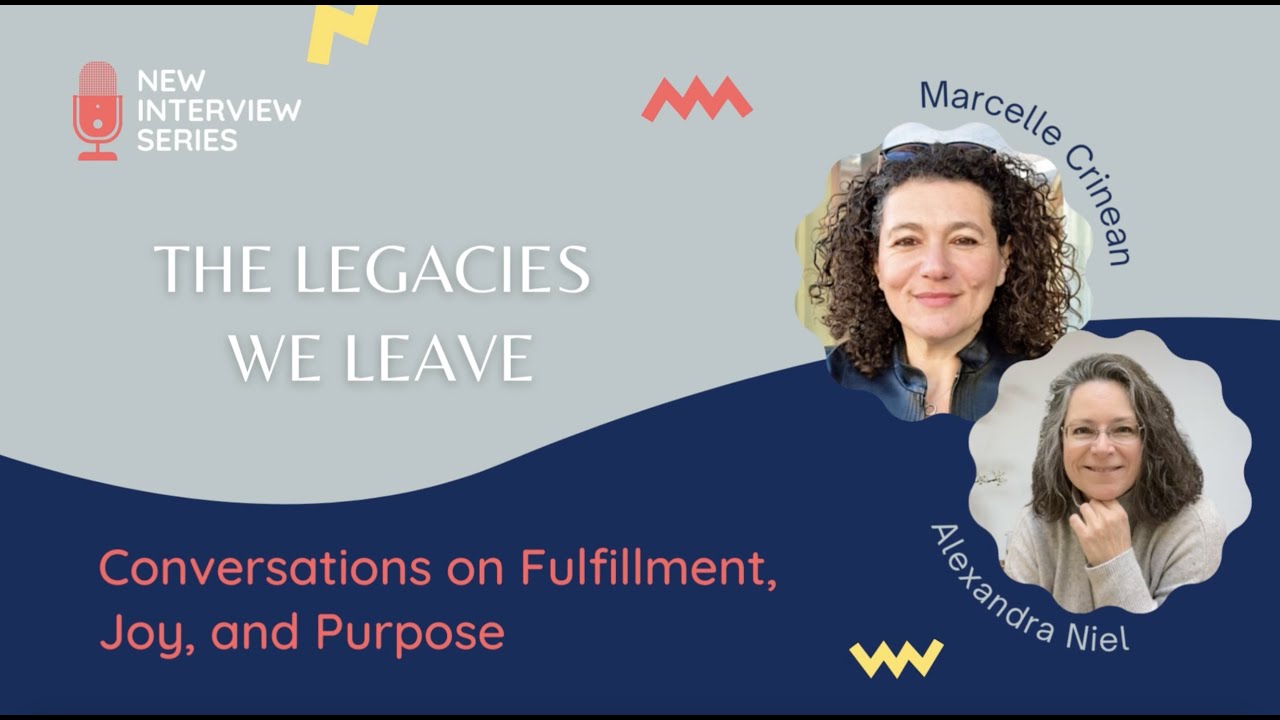
Dr. Marcelle Krynian left a 20-year corporate career after a health scare to become a clinical psychotherapist and coach. She talks about the inner critic and imposter syndrome that hold high-achieving women back, and how reframing self-talk can shift them. Legacy, she says, isn't what you inherit but the impact you leave on others.
Chapters
Hello and welcome to The Legacies We Leave, conversations on fulfillment, joy, and purpose. Today I have the pleasure of having my friend and fellow coach Marcel Krynian with us. So Marcel is a clinical psychotherapist and certified high performance coach who helps driven, successful business leaders to consistently perform at their highest level and accelerate extraordinary success in all areas of their work and life while ensuring they effectively navigate the mental challenges of stressful, fast-paced, high-pressure environments. Having previously worked in the corporate world for almost two decades and holding several senior positions, including Senior Director of Global Product Management for a $6.2 billion multinational data analytics company and VP of Product Management for a leading customer engagement software company, Marcel has a particular interest in working with women executives who have a track record of success but are limited by their loud inner critic who stops them from achieving their full potential and becoming the confident, inspiring leaders they know they can be. Simply put, Marcel's mission is to significantly impact the lives of those she works with and help them perform at their best and go further than they have ever before without sacrificing what matters most. Marcelle, welcome.
Thank you for having me.
Oh, so excited to have you here with us.
So excited to be here.
Good, good, good. So let's just jump right in and get started. So why don't you tell us a little bit about your entrepreneurial journey, how you transitioned from your more traditional career to where you are now? And why did you decide to start your own business?
That, that word entrepreneurial always gets me because it's never how I think of myself. Um, so I guess I have had a traditional career, as you just read out, um, but I haven't really necessarily thought of it as traditional. Um, kind of underlying it, my whole ethos for life is you should enjoy your life. You get one chance, you need to make the most of it and live it. And I got that because my father died when he was 49 and I was 18, and he was too young, right? He was far too young. And I think even when I was 18, I was like, that's not right, right? I'm— that can't be me. I don't want to have got to that age and where was my life, right? So, so it's always been on my mind that my life has to be enjoyable. So I picked a career that I loved, and I can honestly say I always enjoyed my career. There wasn't really a part of it that I didn't enjoy because I consciously made the decision every day to go to work. Um, but I guess around somewhere around my mid to late 40s I had a health scare, and I think I heard one of your previous guests call her illness a gift, right? The gift of illness. And I think in the back of my mind, I'd always wanted to just do something different, right? I'd studied psychology at university in the '90s. I had a massive interest in mindset, how our brain impacts our quality of life, how language impacts our quality of life. And I'd always wanted to do something along that line, but I never quite had the confidence. I didn't want to give up the career and the money and the benefits that went with the career. But when I got ill, uh, I kind of had no choice. I had to give up my work, and, um, and that's kind of how I got started, really. Um, that gave me the courage to go, do you know what, let's just let's just see, let's just see what happens, let's see where it goes. And kind of 8 years later, this is where I am.
You know, I listen to what you talk about. I didn't want to give up the salary and the benefits and the this and the that. And I think that's something that keeps so many people stuck, right? Because it's not just the salary, it's the benefits, it's You know, stock options depending on how far up in the company you are. It's all of these things. I call them the golden handcuffs. I'm sure I'm not the only one, but it, it's really hard to break away from, you know, from all of that. So what was it for you that really made that shift?
So I, I kind of thought them other people are making a good living doing what I want to do, so there has to be a way of doing it. And could I imagine my life, um, not doing it, if you know what I mean? So it's, um, so I kind of thought, this is— there has to be another way of making money, and I don't think I would like my life if I have to do what I'm doing now because there's no other way. Like, there has to be another way. Um, so I think I just trusted that if somebody else could do it, why couldn't I? Uh, like, it has to be possible, right? That whole kind of, you know, Roger Bannister ran the first 4-minute mile, and he was the first guy because nobody thought it could be done. And then once everybody realized it was possible, like, he, he held on to his record for like nanoseconds. So I think, you know, I've seen the possibility. I saw it was possible. I saw other people being successful doing something that they loved, and I couldn't see why I couldn't do it as well.
I think that's critical because oftentimes we get, you know, we're stuck in our box.
Yeah.
And what I've heard women say is, I don't know what I would do, or I don't know what my purpose is, and other things like that. But it's like, sometimes if we just take a step back, that's one way of figuring out, okay, maybe there is another way, and maybe there is something else that I can do. In your case, and in Lorna's case, it was more you had that incidence that forced you Essentially to take a second look and say, okay, if I don't do this, yeah, what can I do?
Yep. And, and I think that's a, that's a good thing. You know, I don't know my purpose, I don't know what I would do. And I mean, neither did I, right? I just knew that I just— it's kind of how do you eat the elephant, right? One bite at a time. So I just picked something and went with it and and I've learned over the years that if I don't succeed at something or I fail at something, it's not the end of the world. We just try again. And so I didn't have that fear of failure. I just went with what felt right at the time, and I had no idea where it was going to go. I didn't know what my purpose was. I didn't know really where it was going to go. I could I could never have predicted 8 years ago this is where I would be, not in a million years. And nobody does, right? We don't have a crystal ball. Nobody can predict what tomorrow is going to be like, let alone 8 years, 10 years. But we think we have to have it all figured out before we take the first step. And we don't have to have it all figured out. We just have to have the courage to take the first step. And if we happen to be going in the wrong direction, then we just navigate somewhere different, right? It's not like we have to fix our journey and we can never take a detour or we can never change our destination. So, and I think that's a mistake that as humans we make a lot. We kind of go, well, I've made my decision now, I'm going to stick by it. And it's like, but why? That's like the dumbest thing. If it doesn't work, then then change it, right? Don't, don't do it. Even computers update their decision with new information. So yeah, I, I started on what I thought was a very exciting journey and just decided to let it take me where, where it did.
And that's the difference. You talk about it from a point of view of curiosity and excitement.
Yes.
Whereas other people look at it from the point of view of fear and scarcity.
Yeah.
And that makes a very big difference because the lens that you look through has a huge impact on the actions that you take.
It does. And I still had the mortgage and I, you know, I still had all of those things, but I, I just, I just knew there was, there had to be a different way. Like I couldn't, I couldn't be working till I was 65 or 70 years old. For the man. It just— that's not— that wouldn't have given me my whole purpose, which is to enjoy life. Yeah. So there had to be a different way.
And I think too, the people think this, that purpose has to be this big gigantic thing. Yeah, it really doesn't. It's very simple. Like you said, I'm here for a very short amount of time. I want to enjoy my life. While I'm here? What's the best way to do that? And things change all the time, and what was right at one point in our life isn't necessarily right for the next part of our lives. So we have to also have that flexibility and that openness to say, you know what, that was right then, it's not right now, so what else can I do?
Yeah, I think so. I think it's like that question, you know, what do I want to be when I grow up? And it's like, well, maybe I'm not grown up yet, right? Because I still don't really know what I want to be or who I want to be. And you're right, it's just constantly evolving. You know, I wanted to be a maths teacher when I was 10, you know. So why is what I wanted at 10 acceptable to change, but what I wanted at 30 isn't acceptable to change? Who said?
Well, you did have responsibilities when you were 10. Now you have responsibilities.
Oh no, don't tell me that! It's true, but you know, you're right, we do, we do have responsibilities, and, um, that can change the lens through which we see things, but I don't think that responsibilities have to be something that stops you from living.
It doesn't have to be a crutch or a yoke. Use it as something to fuel going in a different direction instead of using it as a, as a quote-unquote excuse for staying in a job where you're miserable, for example.
And I think we often, when we make decisions, we do things because we think we have to or we should, right? And that makes us feel like we're not in control of the decision because it's almost like an external pressure on us. And we have to really kind of go, well, hold on a second. I don't, I don't have to do that. I could make different choices. You know, I could live in a field and in a tent for the rest of my life and have no mortgage, right? You could. I could, right? Do I want to? Not particularly. So I choose something different, but that's my choice. And I think we often discount choices because they're so unappealing or obviously not what I would choose that we forget that what we're doing is still a choice. So the job I chose, the career I chose, is still a choice, um, and I could choose to live somewhere cheaper, right? Or I could choose to, um, I mean, I'm oversimplifying and I don't mean to because obviously, you know, we have rents to pay, we have mortgages to pay, we have bills to pay. But within that remit, you've then got a lot of options of what job do you do, what career do you choose, um, And yeah, I, I think we often forget that it's a choice. It doesn't feel like a choice. I absolutely get that. It doesn't feel like a choice. And, you know, in today's market, we don't always have that, that luxury of too many choices. But at the end of the day, it's important to remember that you are making a choice. Okay, because some, because some people choose not to go to work, right? Some people choose to not do that job. So what are they choosing instead? So it does all really come down to choice. And even if it doesn't, even if that's your only choice, if you think about it as a choice, it feels less pressured, less stressful.
And it's also the difference between approaching your life from a victim mentality where this is all happening to me versus taking 100% responsibility for your life, right? Because we can always— it doesn't mean that we're responsible for all, necessarily all of the things, especially some of the negative things. If somebody's been assaulted or, you know, fire in the house, whatever the case may be, but we can always choose how we look at that situation and what we can— going back to the gift, right? What is the gift in here? What is the good thing that can come out of this so that I don't stay focused on woe is me and I'm a victim of my circumstances? Because a lot of times our decisions and our choices bring on the things that happen. In our lives.
They can do. And I think, but I think we, we always, I mean, we never have control over the things that happen to us. Nope. Ever. Okay. And yes, uh, you know, kind of a lot of things that happen to me too, right? Uh, and a lot of things happen to all of us. And it is, it's then our choice. Do we, how do we use that experience? Do do we allow it to define us and the rest of our life, or do we find a way to overcome it and make it a superpower, make it a strength? Um, but yes, we can't, we can't change anything that happens to us. The only thing that we can ever control is how we think about it and then what we do about it. Yeah, but those two things are always in our control.
Yeah, it's about changing the story around it.
It is. And yeah, it is about change. It's about changing the narrative. It's about, um, kind of going, do you know what, I accept it's happened, but it doesn't have to define me.
Or I choose how it will define me. Yes, positively or negatively.
Totally. Yeah.
Yeah. So what would you say I mean, you touched on it before. What would you say is your sense of purpose in life? How did you kind of discover that and how do you strive to fulfill that every day?
So really, my purpose is driven by ensuring I live my life like I live it. I choose it consciously every day in the way I want to live my life. And that kind of came because my father died. When I was 18, he was 49, and I just thought that was far too young. And I remember it so clearly, and I remember going to work thinking, right, this, like, this, I have to enjoy every moment. I don't know when it's going to be my time. Not in a morbid way, more in a— because none of us know when it's going to be our time, right? I don't know when the last day is going to be. And it's, it is that whole kind of, you know, that question of when you're on your deathbed, you know, no regrets. Yeah, exactly, no regrets. So I try to live my life with no regrets, uh, and that means, you know, not hurting other people, um, but also not hurting me, um, and living my life in the way that aligns with the best of who I am and the best of who I want to be. Um, so it's been with me for a really long time, you know, for nearly 40 years that's been my purpose. Um, so it's kind of running through my DNA now. Um, and sometimes I lose sight of that, right? Sometimes I forget. Sometimes I wake up and, and, you know, I forget what's important. And then I remind myself my friends are important. I, you know, I value my friends hugely and my job for 20 years meant that I didn't get to see my friends as much as I wanted to. Um, and, and now, I mean, I've moved home 3 times in the last 3 years, um, and so I'm not as close to my friends as, like, geographically, so I don't get to see them as much as I would like to. Um, but it's about making conscious decisions, really. The, the way I choose to, to live my life that way is making conscious decisions about being happy. And that's not to say that I don't every now and again throw myself a self-pity party, right? Because I do. And no one else is invited. It's a self-pity party for one, and I will choose the snacks and the drinks. It's all my party, and I'll cry if I want to. But I will put boundaries around it, and I will go, right, this is not, this is not forever, this is just tonight, and at 11 PM it stops. Like, music goes off, curfew's done, we're done, and I move on. Um, so I, I will allow myself— sometimes we just need to indulge the misery, right? Sometimes we just need to. Um, I'm— I wouldn't say, you know, like, I'm a, a little miss positive all the time in a false way. I would just say I'm I'm a realist, right? I balance the narrative, the story that my brain tries to tell me. I balance it with facts, um, and I always try to see both sides, not just the positive side, because that can be just as annoying as seeing the negative side. Um, but I just try to—
just as detrimental.
It really can, because it's just another story, right? Um, and also feels very inauthentic when you come across somebody like that as well. Um, so yes, but I try not to do that. I do try to be very balanced. Um, but yeah, I, I try to live my life in a way that if I look back on it, I go, do you know what, yeah, no regrets.
It sounds like you are— so you talk about living consciously, which to me means you're living every day with intention. Yes, you show up because you know how you want to show up, you know who you want to be, you know how you want to interact with the people in your life and around you. I also see that a lot of people just show up, and it happens to me, huh, show up without that intention. They just show up in life like Kramer walking into the, you know, into Seinfeld's apartment. You know how he does where he opens the door and he's like, "Ta-da!" And I don't, but I can see what you mean.
We don't get that in the UK.
So he— and I've never watched the show, but that's the one scene that I can see in my mind's eye. But the people sometimes just like show up and expect things to go the way that they want it to go. But there is a certain element of how we show up that makes it happen the way that we want it to happen. It doesn't just, by and large, happen by chance.
By chance. Exactly right. And I think, and I think that's the key. So do I always show up intentionally? Of course I don't, right? Some days I just kind of daze my way through the day and then get to the end of the day and go, where did that go? Like, what did I do? What did I eat? Did I work? How did I waste my time? I do all of those things, but at the end of the day, then I can't be angry or cross or disappointed that it didn't turn out how I wanted it to because I didn't do anything to make it different. Yeah. So I think that's the difference. Do I, do I sometimes not show up intentionally? Yes, of course.
Well, we're not robots. We're human.
I was going to say, I'm not a robot. I'm human. I'm not a number. But, but what I don't do is, is that whole, well, it should have gone like this and it should have gone like that. And that person didn't do this and this person— I don't, I don't play the blame game and I don't judge because, well, I didn't. It's, I guess it's a little bit like people who want to lose weight but then sit and eat all the donuts and then get on the scales the next week and go, but I'm like, I gained weight. And I'm like, yeah, but you you didn't do anything to change that, right? Like if, if you did lose weight, that would have just been by chance. And, and like, it's not like you can't expect the same result next week. Yeah. So, so yeah, I try to, you know, I'm, I'm not a saint. I'm not a robot. I don't always show up as my best version, as I'm sure my my partner would attest to, but I do try to check in with myself on a regular basis and check that I'm still doing what I want to do, that I'm still happy with who I am, that I'm doing the best job I can for my clients, and that I'm not unintentionally wasting the time that I have here.
And it's incredibly— when you play that blame game, it's incredibly disempowering, right? Because it just says, I have no control over everything, when we know that's not true. We, we talked about it before, we can make choices, we can make decisions, we can live by certain standards that will stack the deck on our side so that our life goes in the direction that we want it to go in.
Yeah, so, and if you, and if you can't, then, then somebody will know how to and can teach you. Yeah, because I think often people get stuck because they go, well, I don't know how to do that. Um, and it's like, well, most people don't know how to do that. They have to learn, right? These are skills. We're not, we're not, they don't teach this at school along with like math and home economics, right? So they are skills, but a lot of people will be able to teach you how to, how to adopt these skills. Because I think a lot of people get stuck in the how. They don't move forward because they're, well, I don't know how to do that. And so my question is, but do you even know what you want yet? Like, don't get stuck about— don't get stuck in the how until you know the what. And then you can identify the who and they'll teach you how.
And then— but before you can do all that, you need to figure out why you're doing it. Because your why is what's going to drive you and that's what's going to push you and it's what's going to keep you going when things get tough because invariably things will get hard. But when you have that bigger vision that's pulling you, it makes it easier to stay on track.
It does. It does. Yeah. So I don't think many people sit— I mean, I certainly didn't until, you know, in the last decade of my years, actually sat down and thought, why, why am I doing what I do? Why is it so important to me? Um, and I— you're right, I would probably go on that, right? I'm going to do this and I'm going to do that. So I'd focus on the what because I'm practical and I like to keep moving.
And, um, tick the box.
Yeah, exactly. Tick the box. Tick the box towards perfection. Okay, tick the progress box. Um, without really necessarily even knowing why I was doing it or what direction I was going in. So quite often I would hit a you know, a dead end and have to retrace a bit. Yeah, but I guess that comes with age and experience, doesn't it really? Maybe not age, but experience as in how many times you do the thing. I was just quite old before I started doing the thing. So yes, age, age plays a part in my journey, but I'm sure there's much younger people who learned the lesson a lot earlier than I did.
Oh yeah, yeah. So how has your understanding of legacy and purpose evolved, or has it, over the course of your life? And how do you, if you do, um, see it continuing to change in the future?
That's a really good question. So not that the others weren't good questions, um, but legacy is one of those words that I struggle with a little bit. And I think, I think what used to— so for me, a legacy was something that you left your children, right? Like a legacy and a will. Um, and as I got older and I didn't have children, I was like, well, what's my legacy? Like, what's, what, what's my legacy? Who, who's going to remember me when I'm, when I'm dead, right? And I think once you take ego out of that, um, then I realized actually my legacy is my purpose, which is I mean, they're very interconnected in that it's not about me. It's about— I mean, I want to know that when I died, I made a difference. And it doesn't have to be about me. It doesn't have to be my name. But I just want to know that the collective, if you like, has benefited somehow from my little short visits on this earth. And so that's now how I see legacy. It's not like, you know, the, the old photos and the dishes that I leave in my will. It's the, it's, yeah, it's what did I do when I was here? What difference did I make? Or did I just take up somebody else's oxygen? Because I don't want that to be me. So I think about legacy like that now. So I'm, I mean, Who knows if my definition will change in the future, um, but right now that feels okay. Yeah, that feels congruent with who I am right now and, and where I want to be going. Um, I, I can't say whether it will change in the future, but it, but right, right now that feels okay.
It's about the impact that we want to make, right?
Yes.
It's about knowing that, like you said, while I was here, I impacted people in a positive way. I tried to make their life better. I gave of myself so that they could have what they wanted.
Yeah, I think if you have a— if you are able to— and, and this doesn't have to be in a way that I'm, you know, it's not selfless in a way. It's not like I'm damaging myself by, by giving to somebody else.
It's—
and I mean, it's completely not selfless, right? Because it makes me feel better if I can help somebody. So I get something too, right? So that's not selfless. Like, I'm not only doing it for them, I'm doing it because it makes me feel better and not worse, right? If it made me feel worse, I probably wouldn't do it, right? So I'm still getting good, goodness, good, good hormones, happy hormones because I'm helping somebody else. But I feel like if you have— this is, this is going to sound so fluffy and, you know, you know, I'm not one of those people, right? But it's like if you have a gift, if you are able to help somebody improve their life in some way, I— who are you to not do that?
I think, yeah, you owe it to them to show up and, and, and to share.
And to me, but I owe it to me because if I don't do that, then I would feel bad about myself. Mm-hmm. If you know what I mean? Like, I'd go, well, it's even like, you know, helping a little old lady across the road who can't help. It's like, well, if I ignore her and I leave her at that side of the road, what does that say about me? Yeah. Okay. So in a way, it is still about my ego. It is still about me. Um, because, but I don't want to be the person who leaves the little old lady standing on the side of the road and she has to wait for somebody else to, to walk her across because it's no harm to me.
Yeah.
To just help her. So, um, so yeah, I, yeah, I, I think that's, that's my definition right now. It feels okay.
It's very similar, if not almost identical, to my definition. Yay!
What's your definition?
No, it's, it's the same thing. It's really to— when I left my corporate gig, I left because I didn't want what I was doing to be my only legacy. I wanted to make, to do something that was going to make a bigger difference.
Yeah.
And not just pushing papers, making phone calls, going to see a client, doing things that when you— when I looked at it, the— at the 10,000-foot view, I was like, it's not bringing me what I need to fill my soul.
Yeah.
And that's when it was like, okay, time to go.
Yeah, we're done. And I think that's it for me. It was the making money for the man. I'm like, I don't understand why I'm spending my whole days just making money for people who already have loads of money and actually don't seem very happy about it. And that was it. So I just couldn't see the point anymore. And I think that's it. It's like, what's, what's the point? And I think that's in fact, that's probably my question. It's like, what's the point? Like, what's the point of doing this? And if there isn't one, so it goes back to your why. If there isn't one, why are you doing it? Yeah. What's the point? So yeah, I agree with you, it's the same thing, same thing.
Well, the point is, you know, money, and I gotta keep a roof over my head, and you know, it's all kinds of different things, but they're really just rationalizations. And when I say that, I don't mean that because you and I left our corporate gig that it's the right thing for everyone, but what I do believe is that when we approach things in a different way, when we change how we look at something. You were talking, we were talking about before, victim versus, you know, empowered point of view. It changes the ball game. So you don't have to be in a job and be miserable. You can be in that same job and by changing how you look at it, how you interact with that job is completely different.
Agreed.
Agreed.
Because I did, I used to be that person on a Monday morning going, oh, it's Monday, right?
Oh, you— for you it was Monday. For me it was Sunday night with the headaches.
Oh, really? Because, yeah, so you all started earlier.
I'm starting a little bit earlier.
Yeah, no, like dreading the Monday morning, right? So it would be Monday morning and I— and then I— and then I would reset and go, but, but you picked this job, you like this job, you know, think of all the positives of this job. And even if you don't like the job, think about the money, think about the benefits, think about the positives that that it's giving you, right? There's always something, even if it's just, it's keeping a roof over my head for right now, right? So it's got, it's got a benefit, right? Um, but yeah, I think I still, I think, you know, I think a lot of people have that Monday morning thing, don't they? Or the Sunday night thing. And you have to be really careful that Sunday doesn't— it's that, you know, that creeping day of death, right? Where suddenly then it's Saturday night and before you know it Friday's just, well, it's just 2 days to Monday, you know, it's, it's that. So it just, you know, yeah, but at some point you have to draw a line.
Yeah, yeah, no, I hear you.
But you're right, I think how you think about, I mean, how you think about anything becomes your truth.
Yeah.
So you can choose to go to each day, you can choose to go to your job every day miserable, or you can choose to go to your job every day happy. Yeah, that's your choice.
Totally.
Um, that is in your control. Um, so maybe you don't like it. Well, we all do things we don't like, right? We have— there are things we do that we, that we have to do that we don't like, particularly like, like washing up. Like, I hate washing up and ironing. In fact, ironing is not something I have to do, and I never do it. Um, but you know, there are things we have to do well, fuck it up, right? They're things that actually improve our life. Um, so yeah, but I could just enjoy the washing up and go, well, do you know what, I love having clean cups.
There you go. I like a nice sink.
Me too.
So there you go.
There's your— Exactly right, you see? So how you choose to look at the thing changes how you see the thing. Yeah.
Totally. Yeah. So what's the biggest struggle that you're comfortable sharing, um, that you've experienced? How did you get past it, and what did you learn and grow? How did you grow from the experience?
How many, how many hours do you have?
Just pick one.
I know. Yeah, I'm gonna— I'm just, I'm trying to think of one. Um, so there's been so many, to be honest, and I think The difficulty I have with that question is I don't necessarily see things as struggles.
Okay, so let me ask it to you this way. What's, um, what's the biggest lesson you've learned on your journey?
So, okay, so those are— now I have two different answers, so I'm going to answer the first one first, which is I think The struggle that I had that lasted the longest was when I worked in the corporate world because I hadn't necessarily learned all the mindset stuff yet. And that was when I, as I got promoted, I really struggled with confidence in myself. You know, it was like part of me was like, I really deserve this. Like I've worked really hard, I really deserve this. And the other part of me was kind of going, you can't do this. They should have picked somebody else. Like, you're not as good as he is. Like, he should have got the job, right? And, and I struggled with that for a really long time, actually. And I think as I learned how to have more confidence in myself and ignore that little inner critic voice, sooner, then I, I mean, I might not even have left the corporate world, right? I might have got over my illness and gone back. But I, I think it, it did kind of ruin some of my enjoyment because there was always that little voice, that little voice of doom and dread that I couldn't quite silence. And I think now that I've learned more about it, it doesn't bother me really anymore. So it came up again like 8 years ago when I trained as a therapist and then when I trained as a high performance coach, you know, the little voice that goes, who, like, who's going to be able to take you? Who are you? You know, everyone, everyone else is way more successful. You can't do this like you're no good at this, right? So the same voice, it just, it haunts you. In whatever guise it takes. But I'm much faster now at silencing it. And I do that through kind of, as I talked about before, that balanced thinking of, well, hold on a second, that's one side of this story that my brain is telling me. Where's, where's the evidence that I can do this? Where's the evidence that I am successful? Where's the evidence that says this is why they promoted you? Where's the evidence that says, hold on a second, you've worked with hundreds of clients who all had like hundreds of success stories? Like, you know, you know you're making a difference. So stop with the, stop with the noise, right? So I've got much better and much quicker at silencing that voice.
And do you have like a trigger that says, oh, wait a minute, or is it just basically paying attention to your self-talk and realizing you're speaking negatively and then making that shift?
So it's the second one, but that's because pretty much all the work I do with my clients is about making them more aware of the language in their heads. So I know for many, many people it's about noticing, you know, getting in your body and feeling your body more, but I'm not that person. I'm the thought, language, nerdy person, right? Because my doctorate was in how our brain processes language, um, and how that can cause an effect to our quality of life. So language is my thing, um, and of course thought is just inner language. So I teach all my clients— well, not all of them, but the ones who come to me for mindset work or imposter syndrome type stuff, I will teach them the— to spot language patterns that might be threatening their well-being, their confidence, their sense of worth, their sense of value, whatever it might be. So I'm so aware of those patterns that if I use one myself, um, which of course I will, right? Um, because again, not a robot. Um, then I notice it really quickly. Um, and I've been practicing this stuff. I mean, I, I first learned this stuff 31 years ago. I mean, it's a long time. So I, so I'm, I'm, I'm aware of it. So I'm aware when I use it. And, um, I teach my clients how to reframe those thoughts. So I'm pretty good at reframing, like catching them fast and just, and just like throwing the ball back, um, and then just, just letting it go. Um, like I used to teach mindfulness, so I'm, I'm really good at kind of noticing thoughts but just noticing them just as a stream of noise, and I don't have to hang on to the thoughts at all. I can just let them go. Then they're just thoughts, right? Thoughts aren't real. Um, so that little voice, that's not real, still just a thought. So I, so I guess that's my lesson. The, the biggest lesson I've learned is how to develop more inner confidence and trust in myself. Yeah. By ignoring or reframing or rewriting the narrative of the thoughts that my brain gives me, the ones that kind of live in my— that have lived in my head for far too long. And, you know, they live there now. It's not like I can get them out, but they're getting quieter and quieter and they're kind of almost filed in, you know, in the bottom of a filing cabinet gathering dust that doesn't really get opened very often. But occasionally somebody will go nosing in there and open the file and blow the dust off. And catch me by surprise. But yeah, I know, I know what to do when it comes.
Yeah, it boils down to what I've heard, and I can't remember who said it. I'm sure more than one person has said it, but you can't believe everything you think.
Correct. In fact, you can't believe anything you think. Like, it's just, they're just thoughts, right? Your brain constantly tells you stories. Don't believe the stories your brain tells you. Basically, yeah, get curious. And it goes back to that thing you said at the beginning, right? Get curious. Kind of go, that's an interesting story. Is it— is it— is that fact? In fact, that's always the first question. How true is that thought on a scale of 1 to 10? How true is it? How factually correct is that thing? And more often than not, that thing is not factually correct. Okay, and, and kind of, this is kind of what I say to my clients. It's like, there are certain things that, you know, like I have 5 fingers on my hand, right? That's a fact. Or 4. And then somebody going, no, you don't, you have 4 fingers and a thumb, right? So there's always different ways of say, of seeing things. I don't, yeah, but you know, I have 4 fingers and a thumb on my left hand. That's a fact, right? You can't argue with it. So it's not a story, but the fact that, you know, oh, my hand is— oh, my hand, my hand just twitches. Does it or does it not, right? It's like, well, does anyone else notice it? Like, how would everyone else perceive it? Um, so yeah, I think you're right. You can't believe everything your brain tells you, for sure you can't.
So, um, I'm just trying to be conscious of the time. So what would you tell a woman who is struggling to find her purpose?
Stop struggling. Like, you don't need to know it, right? It doesn't— no, who said you have to know your purpose right now? Just one, one bite of the elephant at a time. Just take a step towards something that feels like it's aligned with what you want right now. And who you want to be and what your values are and what makes you happy. And you, you may be on the path to your purpose, or your purpose may find you, or maybe you'll never know it.
Maybe.
And maybe it will change from year to year. So I think don't struggle. I, I think we get hung up on that, you know, that, that it that question, what's my purpose? Um, and I think just, just be, just, it'll find you, you'll find it. Just keep moving towards happiness.
I think the more we move forward and try to align with the things that make us happy and that make us come alive and make us feel joyful, the more we get closer to figuring out what our purpose is, because our purpose is never going to be something that doesn't feel good. It's never going to be something that leaves us feeling depleted or unhappy, or insert whatever negative emotion you want in there. It's always going to be something that makes you feel fulfilled, that makes you come alive. So I love the idea of, I don't need to figure out my purpose. I just need to keep doing more of the things that make me happy because that will get me to my purpose.
Yeah. And I think it's that whole, you know, life is a journey, not a destination. So for me, purpose is, I mean, then once you found it, then what? Yeah. Like, what, why is it so important? What, what, what comes after it? Okay. I found it. Now what?
Now what? What do you do with that?
Yeah, so I think it doesn't matter. Just, yeah, just keep, just keep being happy. Just intentionally choose happiness. You'll end up somewhere.
Yeah, oh, very true, very true. So things don't always go the way we want them to go. Life often likes to throw us curveballs from time to time. So how do you stay motivated and inspired when life does go sideways?
I just remember what I have control over, which is what I, how I think and what I do. Like, that's it. It will always throw curveballs. And I think my, my core belief used to be I'm useless, right? That was my core belief. And now my core belief is I can deal with anything.
That's a good core belief to have.
It's taken me a while, but I honestly think I can because it goes back to that. I'm, I'm a small pin in a very large world, and I can't believe that life is giving me something that no one else has ever experienced before. So somebody else made it. Why? Why can't I? Yeah. You know, it's not— I'm not special. I'm just going through something that many, many other people have been through. So we'll all be okay.
It makes me—
I think that's it.
It makes me think of what Brandon always said, which is, um, trust in your ability to figure things out, because at the end of the day, that's what it is, right? Yeah, we have to have that certainty that no matter what comes our way, we will be able to figure it out, because how many examples do we have in our life so far of situations that fell on our lap that we had no idea what, how to manage them, what to do with them, how to deal with them.
Yeah.
And we did. Yeah. So we figure it out.
We do. As we go. Or it becomes like that really important piece of paper that lives on your desk for 3 years and then you realize it wasn't that important after all. One of the two, right?
Yeah. No, totally, totally. So, all right, so are you, um, how can people find you? Are you— do you have anything going on right now, any upcoming webinars, master classes, whatever? Or just tell us how people can find you.
I'm kind of like that guest that goes on a chat show and goes, I don't have a book to sell. Yeah, no, I have no nothing, like, no, there's no promotions. Um, I just, I, I I work with clients typically one-on-one, um, sometimes through businesses, sometimes not through businesses. They find me, uh, all by themselves, usually by somebody that's referred them to me. Um, I do work with teams, uh, in corporations, but all of my details are on my website, um, which is just www.drmarcellekrinian.com. So D-R-M-A-R-C-E-L-L-E Dr. Marcelle Krynian. Dr. Marcelle Krynian.com.
I'll put it in the—
no forward slashes. Yeah, just Dr. Marcelle Krynian.com. That's it. And thank you.
Anywhere on social media?
Oh, good question. So I'm on LinkedIn. You can find me on LinkedIn as Dr. Marcelle Krynian. That's my page. I am on Instagram @DrMarcelleKrynian. And I'm not really on Facebook. So Instagram, LinkedIn, website. That's it, really. Yeah.
So last one, and I think we've already covered it, but I will ask it anyways. What does living a purposeful life mean to you?
So I think it means living it on purpose and with purpose.
Okay.
So on purpose as in intentionally and with purpose means with or aligned to where I want to be, right? Be happy, align with my values, align with the best of who I want to be and who I am right now. So that's what it means to me. On purpose, with purpose.
Nice. Love it. All right, Marcelle, it has been a pleasure. I just want to thank you for taking the time. I'm so glad that we could have this short discussion.
You know, nothing is short with me. Did we go really over? I'm so sorry.
No, it's all good. And let's, let's stay in touch and we'll talk soon.
Great. Thank you. Thanks very much for having me. Thanks.
My pleasure.
Thanks. Bye.









