Kevin Hines Story : Surviving Suicide and Learning to Thrive
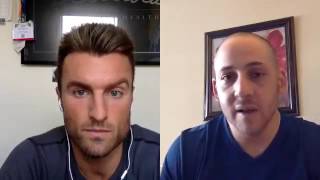
Interview between Andy Hnilo and Kevin Hines about Hines’s life: his traumatic infancy, adoption, development of bipolar disorder at 17, his 2000 suicide attempt from the Golden Gate Bridge and survival, and his recovery and advocacy work. Hines describes lived experience with auditory hallucinations and instant regret upon jumping, daily tools he uses to stay well (breathing: 4-7-8 sets, exercise, sleep, nutrition), his public speaking and documentary project Suicide the Ripple Effect, and provides resources and contact info.
Questions this video answers
Filmed in 2004 and released in 2006.
September 2000.
Approximately 220 ft (25 stories) at about 75 miles per hour; survival rate historically ~1% (36 survivors mentioned over 80 years).
'4-7-8' breathing: inhale 4 sec (nose), hold 7 sec, exhale 8 sec (pursed lips); three sets of 20 breaths, three times per day (three sets of 20 reps, repeated three times daily).
Cracked Not: Surviving and Thriving After a Suicide Attempt.
Chapters
Again, thank you so much for joining me on this. It's. I, you know, I want to say, when did the Bridge come out?
The film was filmed in 2004. It came out in 2006.
Okay. Because I know I didn't just see it, you know, because I messaged you January 1, 2016. I had actually. I had driven around. I was like a designated driver that night. So I just, like, I would pick people up and take them to their destination. And so I got home and I guess I watched the bridge at 12:30 in the morning. After. After. Yeah, but it was. It was perfect. I didn't, you know, I guess I wanted to set the tone for my year just of gratitude and appreciation and just perspective, you know, I mean, like yourself, I, you know, I, you know, been through some. Been through some situation myself that touch on. But, man, it's just like, that's how I wanted to start my year, apparently. I wish I could go back because I messaged you right after I saw that. And I just, you know, Facebook, the beauty of social media is just like, you can kind of get in touch with anybody, man. And so I just. I fired off a message, said, love the story, man. I forget exactly what I said, you know, just. But just. This is so cool, months later that we're chatting, man, because I shed many, many a tear over that story. I don't want it. You know, it's just. It really, really hit home and to me for many reasons. And so this is. I'm truly grateful for this and want to thank you for taking the time. I know you're a busy dude, so I, yeah, saw. You know, whatever. It's just. This is. This is. It's an honor for me. So, yeah, I. Clear. I'll clear out the schedule when we can. So I just. Yeah, so it's.
I was.
I'm from Palo Alto, and if you'd like to just kind of introduce yourself and tell the audience about your story, that'd be great, because I briefly touched on it. But just take it from where you'd like and let people know who Kevin Hines is.
Kevin Hines, born and raised in San Francisco. 34 years living there until last year, moved to Atlanta. And I, you know, if we go back to the very beginning, I had a very traumatic infancy. I'm adopted. My birth name wasn't Kevin Hines, it was Giovanni. And my birth parents really had it rough. They had been diagnosed separately, the two of them, with manic depression. Of course, we today call that bipolar disorder, the very same brain disease. I would be genetically predisposed to twice, right? And the disease I would develop in my brain at 17. But if you look back in those days, in the very beginning, you know, my birth parents, I certainly believe that they loved me. And my brother Jordache, I certainly believe that they were madly in love with one another. But what they couldn't do was take care of us. They were not well enough to do so because. Because they had that brain disorder. They coped in the 1980s with hardcore drugs and alcohol. They coped with substance use disorder. And it's often misunderstood substance use disorder as something to blame someone on who has it, someone with alcoholism or substance use disorder, doing drugs or living with that behavioral health challenge. And I don't blame people who go through that. Even though my birth parents did and neglected me and my brother because of it, they would leave, he and I unattended in seedy motels while they went to score drugs. And it wasn't because they didn't love us. It was because how can two people take care of two infants if they can barely take care of themselves? Well, one fateful day, one seedy motel clerk made his most unseaty decision. As I say in all my speeches when I recount this story, he called the police. He heard our screams and cries one too many times. He knew we were being neglected one too many times, and he called the police. And the police come in with Child Protective Services and they swoop us up and they take us into protective custody. Now, the idea here, Andy, was that me and my brother would be adopted together, but we both got bronchitis and he died. And you know, that was the very beginning of my life. It was fraught with trauma, non stop trauma and neglect. Well, my birth parents weren't going to give up. They fought in court for me for the better part of two years against Patrick and Deborah Hines. Now, you know, we met as I am Kevin Hines, Pat and Debbie Hines adopted me and made me their son. And they are my mom and dad. But I look at it like I have two moms and two dads, two who passed away because of their brain, and two who love me dearly to this day. And I love equally, and I'm very lucky. Unlike my birth brother Jordache. You know, we were supposed to be adopted together. As I said, he got bronchitis, I got bronchitis, he died, right? So he disappears, he's gone. And. And I bounced around from home to home until Pat and Debbie picked me and decided to make me their son. And give me a world, a life that every kid would dream of. A privileged life. You see, Patrick and Deborah Hines worked very, very hard and they wanted to give their kids they could have natural born children. They didn't. They had me, my brother and my sister, all from three different families into one. We were a real melting pot of a family. My sister's white, I'm mixed, my brother's black, and Pat and Debbie are Irish and German. So when people saw us, like walking down the street, they absolutely were very confused. But we didn't care. We didn't care. We were a family in love. And I grew up in that household. And it was amazing. Until Andy. It wasn't until at 17, out of nowhere, this bipolar disorder hits me, this manic depression. And I start becoming extremely paranoid. And I don't mean in a sense that generally general paranoia. I mean, like I thought that everyone around me, everywhere I went, no matter who you were, what language you spoke, you were out to get me, trying to hurt me or trying to kill me. And because I thought that I was physically out of control, I was in such a great amount of fear, perpetuated constant fear, that people started to think I was on drugs. In my high school. I wasn't on drugs. I was just in a lot of mental pain. I really call it brain pain, going through what I go through. Because first of all, mental is a negative connotation of a word. And when we say mental illness, I don't agree with that term. Whereas I used to. Illnesses and D are temporary and can be cured, and diseases are chronic, derived from the brain and can affect you for the rest of your life. I live with a brain disease that if I don't take care of it, will dictate the rest of my life. So, yes, I live with bipolar disorder. I fight it every day. If I don't fight it, I'm right back into a psychiatric ward. I've been in seven in 11 years between 2000 and 2011, up until the year 2000. In September of the year 2000, it all came crashing down in a big way. I started becoming suicidal, Andy. I started thinking that I didn't belong here. I started feeling that I was useless and had no value, that I had to die. But I want to make something really clear. I never wanted to take my life, want, have to. I thought I had to. Hearing auditory hallucinations in my head, voices in my head that were not that of my conscience, a third party voice in my head telling me what I had to do. And That I was useless and that what I was about to do was absolutely inevitable, that I had no choice. And it took me to the Golden Gate Bridge, and it took me to leap over an attempt that, you know, 1% of people have survived in 80 years. That's 36 people of the over 2,000 that have died there.
I. Go ahead. I mean, I know you said the most powerful thing to me in your article in the film, everything. The most powerful thing to me is the minute that you left the railing, you felt an instant regret. Do you want to touch on that?
Yeah, that's really important, Andy, because it's not just something I felt. At the millisecond that my hands left that rail, I felt an instant regret for my actions, A feeling that, what.
Have I just done?
I don't want to die. God, please save me. Those are the thoughts that went through my mind in the four seconds that I fell 220ft. That's 25 stories at 75 miles an hour. So in that moment, recognizing that I had just made the greatest mistake of my life, but that I thought it was too late because I had never heard of anybody surviving this kind of fall. Well, of the 36 people that have survived that fall, and of the remaining who live today, many have died of natural causes. It's been 80 years since the bridge's opening. 19 of the remaining alive today, which is the majority of those who remain alive today who have attempted that and lived. 19 of them have come forward to say they had that very same instant regret from their action. Now, if you were to look across the span of time at suicides around the world and suicide attempts, you would find that a great many, a massive number of people who have survived their attempts at whatever means they use, have had a very similar instant regret from their actions upon thinking they were going to die and that it was all over. Okay, so what that tells us is that there is a separation between the thought and the attempt of suicide. When someone thinks it, plans it, perpetuates it in their mind. Then when someone attempts it and thinks it's too late. Often around the world, people have recounted who have survived those attempts. I wish I didn't do it.
Oh, man.
Now, that's something we can all learn from Andy. That's something we can all recognize as a human feeling that you feel like you have to die. Even the people who say they want to die by suicide, they're in so much brain pain, they're hurting so bad inside from whatever situation, disease or battle that's going on in their head. However impulsive or however long they've been thinking about it doesn't matter. All of these people have come forward to say instant regret. And they're so glad they're alive today. Separation from the thought and the actual act. Now, the other thing that's important to recognize is that people get into suicidal ideations. They get into this pattern and they get into this place of such great pain. And that's the common denominator. It's the pain. Pain. They end this pattern of pain and they believe they have to die, so they attempt, right? But if we just could recognize and be self aware enough like I have become today to say my thoughts do not have to become my actions. My thoughts are my thoughts. Andy if all of our thoughts became our actions, we'd all be in a world of trouble. What about every time you're growing up and your mom's taking you to high school in the morning or grade school and someone cuts her off and she says, I'm going to kill that guy. If she did that, she'd be in jail. Our thoughts can be separated from our actions if we can determine that they are separate in the first place. Today. Andy I live with chronic suicidal thoughts, but I'm never going to die by suicide because I separate it every time I say, no, I am not defined by my suicide attempt in the year 2000. I am not defined by the word suicide. And I take the sensationalism out of the word and replace it with education. And I say that now I know that when I have those thoughts, the first thing I do is go walk to my wife and say, honey, I need your help. And those are the three words. Men, women and children. People all across the world who battle these suicidal pains and thoughts need to say. And he has three words. I need help. I need help. I've got a friend in Australia, Patty Lawson, who founded an organization called Three words I need help for just this case. He thought it suicide. He neared an attempt. He survived. And now he goes around the country, in Australia and even the world and talks about his story using those three words that are so key, so important. If we don't ask, we can't get it right. Andy Right.
So powerful. I think the tough. There are two things that stick out to me right now. I'll just touch on since we just left. I need help. It's like the big thing with not only addicts but disease in general is you hear this common thought of, well, they have to do it themselves. They have to overcome it themselves. And, like, I just. I disagree with that. I completely. I mean, I just. It has always bothered me ever since I was a little kid. I mean, life is just. Life is just so precious to me. And the thought that someone thought that the only option was just to end it, they were in that much pain to end it. Ever since I've been, you know, ever since I can remember from living across the street from Palo Alto High School, where they have the train tracks, and there were some suicides. You know, it's just like we lived really literally across the street, and they became more and more common in a town called Palo Alto, where it's just. There's so much pressure to succeed in education and so many poor, you know, kids. You know, that's it. You read about it. It's becoming more and more common. But I think, you know, there's. That. I know that there's something that can be done. And just, like, it's okay to want to get help. It's a luxury to want to go to get help and to be able to talk to someone. I mean, it's. But it's like, it's so common that you're hearing, you know, the addict, the disease, you know, they got it. They got to want to do it themselves. Hey, you need. Everyone needs help. Everyone does. And so that's. I'm really glad you said that. That's very powerful out there. To anybody listening out there, I mean, running, doing the thing, my life, I have to talk to someone. My outlet is my family and my friends, beautiful people. I'm very grateful for that. I understand a lot of people don't have that, and believe me, I appreciate the heck out of that. I just got off the phone with my mom a couple hours ago, so I try to wake her up every morning, but it's something that's just part of my routine. And then to touch back on what you said earlier, which was just. Which was extremely powerful, is if you can. That 19 out of the 36, which is clearly a majority. I just, you know, if you do. If you. You obviously know how many suicides there are, you can only imagine the percentage of the people that just at that moment felt that regret and aren't lucky, aren't fortunate enough to still be here. That's what really crushes me. And, I mean, that's where people like yourself are just. I mean, not only are you changing people's lives daily, I mean, I can't wait to hear about what you're doing for that but it's just the message of being. Look, it's your brain telling you something that you really don't want to do. And yeah, so thank you for sharing that.
Of course, I agree with you when you talked about that idea, that notion that they can't get well until they want to, until they're ready and all that. It's not that simple. It's more about how the people around them are reacting. Are you reacting with judgment? Are you putting, putting them down or saying, are you blaming them for their psychological problems that they have no control over? If they have a disease called bipolar disorder or schizophrenia and you're telling them to get over it, move on, snap out of it, and pull themselves up by their bootstraps, how do you think that makes someone feel who has no control over what they're going through and no control over how their brain's reacting to chemistry that's misaligning, misfiring and misconnecting inside of it? And I think what we need to recognize is we can't make change without them and they can't make change without us. If we don't all work together tirelessly to better each other's brain and behavioral health, we're going to all be in a world of hurt. And I always say in my speeches, Andy, I say a line that I think is very important. And you don't have to have faith to believe in this line, although it's a faith based line. The saying goes, if we are nothing else on this planet, we are our brothers and sisters keepers. And I believe that whether you believe in God or higher power or not, I certainly do. That's my prerogative. Never pushing that on anybody. I do believe that saying transcends faith into general livelihood and existence. And if we are going to be here on this planet, it is not to better ourselves financially or become some great individual or to make it for just us. We are here. And if we are doing well on this planet, our sole purpose should be to give back to those in need and give back to those around us. And I believe that whether we know them from Adam, whether we like them or whether we love them, we are here to give back to people in need in some way, shape or form. That is our collective purpose. I've always believed that since I was 4 years old. I can remember walking over to my neighbor's house at four years old and he's mowing a lawn with one of those giant lawn mowers. And I walk up and of course he has to stop so we can take off his headphones. And he says, kevin, what's going on? And I would look up to him. I said, hey, you know, I can do that if you want me to. At 4.
Wow.
He goes, really? So you're going to do this? And he goes, do you know how to operate a John Deere? And I said, I don't even know what that is. And he said, well, that's what this machine is. And Kevin, you're four. That's not going to happen.
Probably taller than you, right?
Well, man, you know what? To just try to help, that's just me. And when I attempted to take my life survived. I knew very soon thereafter that this was my purpose. They say, Andy, that there are two most important days of your life are the day you're born, the day you find out why. I believe that too. I believe this is why I was born to try to help someone who is suicidal. Anyone who is suicidal, stay here.
That's beautiful, man. I mean, I can absolutely relate to that. Just as far as the excitement of helping others, fulfilling just the feeling you get from it. I just, you know, recently, it's just how I am. I'm personally not motivated by money. I've never got goosebumps through a paycheck. I've gotten goosebumps through a compliment that I received from a stranger. And also I've got goosebumps through giving a stranger a genuine compliment. You know, kindness, helping others, being of service. And I mean, that's what makes my hair race. That's what gives me chills. That's. That's absolutely what ignites me. And I mean, because being of service, helping others, man, helping others feel better about themselves like that is. That's it for me. I mean, that is what I. That's. That's what, that's what makes. I mean, that's. That's what. Yeah, that's what I'm here for. And it's beautiful to hear that from you as well. Personally. My. My story, I was in an accident and I created a product with never an intention to have a business, but just that helped to accelerate the healing of my injuries and my scarring and my abrasions. But that little did I know that formula that I was making for myself is now helping others like yourself around the world just feel better about what they see in the mirror. And then boom, that kick starts that energy to hopefully building that personal momentum towards just believing in that self belief, whatever it is, just little increments, however big, however small. But man, just. Just letting somebody. Just acknowledging somebody. Like you said, you're walking on the bridge and the one lady asked you to take a picture and she has no idea what you're going through. I mean, that crushed me. I mean, it's just. Can you hold a picture while you're just going through this storm right now? Or can you take a picture and you're just like, man, nobody cares. And then, boom, that's what. So, I mean, as hard as it is, it's beautiful to hear that. It's beautiful that you're here and you're changing people's outlook that are in the same situation as yours. So, I mean, if you.
What do you.
Would you mind telling us is what. What are you up to now?
What are you.
What are you doing for. For that I understand you're speaking. Is it internationally? Is it.
What are you.
What are you up to?
So I travel the globe today telling my story. You know, I. People like to give titles to people like me, but I just call myself a storyteller, author and advocate. And I share a message of hope. And it's been proven through some studies, scientific studies, that stories of hope and recovery actually have the transformative power to help people who are suicidal choose life that we know. And I knew that before I even read about that study. So I knew that when I was giving this message and people were coming to me saying, I'm going to stay because of this message of hope. Now, Andy, that's not because of me or my story. That's because story in itself has the power to help people heal. We do these Hope Help Heals tours all over the country and the globe. I do them with various different speakers in their various fields of suicide prevention, brain and behavioral health, anxiety and stress disorder prevention. All of these different folks who do all these different things and share all of these different messages. The common theme is hope and recovery. I live in recovery today through a simple tool guide of 10 steps that help me stay here. 10 tools like educating myself as to my disease, bipolar disorder, so I can fight it. Eating healthy foods most days so I can stay my brain healthy. Exercising most days, 26 minutes a day, because it leads to 12 hours of better brain health, better mood. If I do it twice a day, 26 minutes of rigorous exercise twice a day, 24 hours of better mood. I know you know that you exercise all the time. It's awesome. It helps us heal, it helps us move forward. Right? If you're physically capable, get to moving, because it's going to help Your brain, body, and mind and everything in between. And so doing that is very important. I do things like utilize coping strategies and coping mechanisms such as music therapy, art therapy, breathing therapy. All of these tools help me stay stable mentally. So I do them every day. I utilize a tool, a breathing technique called, which is so simple and so transformative and helpful for people. Four, seven, eight. You might know it. Inhale through your nose for four seconds. Hold your breath for seven seconds, release for eight seconds. Why? Andy, this scientifically has been proven to lower blood pressure, lower heart rate, lower a panic attack, lower anxiety, lower an adrenaline rush, and over a great deal of time and effort, this breathing technique can help lower your blood sugar.
I'm fascinated with this stuff. I love the science of breathing. So breathe in through your nose, hold for seven, breathe out through eight through your mouth or out of your nose.
So in through your nose for four, hold for seven, release through pursed lips, through your mouth for eight seconds.
Okay.
Like a whistle, but no sound. This has the power over time. I do it every time I need to calm down in life, which is a lot of times, because I have a manic disorder. So every time I get paranoid or delusional or stressed out. Listen. Human beings have forgotten the art of breathing. We have forgotten that by breathing we can control the body. And so people, when they're stressed out or they're angry or they're rageful, they forget to breathe.
They.
They hold their breath, they shorten their breath. So by implementing this tool into your daily life, you're inevitably changing your daily life and being more calm on a regular basis. I do three times, 20 breaths a day. Three times a day. And I do it every time before I speak or before I have to do an interview of some kind or before I talk to you. I do it all the time. Helps me heal.
So you do the three, the four, seven, eight. You do that three times a day, or do you do 320. What's a 20?
Imagine like, you're doing sets and reps of weights. So I do three sets of 20 breaths three times a day. 20 reps. Really helps me stay calm, stay cool, stay collected is the best of my ability.
Okay, so for those 20, though, do you have any specific. In through the nose, out through the mouth. Sorry for all the questions. I love this stuff.
This is important that we clarify. So it's just doing the four, seven, eight. Three sets of 20 reps a day. Yeah.
Wow. Oh, man. Oh, okay. Got you.
Yeah. Really implement it into your daily life, and then you do it whenever you're stressed, anxious, nervous, paranoid, panicked, having hallucination, Bring yourself back to a center, bring yourself back to a calm and move forward. That's the idea.
I love that.
Tools in my pocketbook. The other thing, one of the really important things that people are missing so much of in this life. Sleep. We're not sleeping right. We're drinking copious amounts of caffeine, myself included. But today I don't drink caffeine past 2:30 in the afternoon. Why? Because caffeine has a seven and a half hour half life and that's only the half life. If you're drinking caffeine past 2:30 in the afternoon, you're damaging your sleep that night, the next night and the following night.
Oh, okay.
To know these things, all of these things can help people stabilize their brain health. This is what I work with people on every single day. And you know what, Andy, the funniest thing about this is everyone goes, really? I can do these things and I can feel better. Like why aren't our general practitioners talking to us about this stuff all the time?
Oh man, I don't even want to get started on that. It's so frustrating to me. I mean the good thing is there are starting, there's starting to become a larger range of holistic physicians and doctors that do believe in the route of using things like breathing techniques and anti inflammatory herbs, foods, diet, nutrition, I mean blood tests, I mean the technology these days is fascinating with what we can counteract through exercise, nutrition, positive thoughts, self talk. I mean I do it all. I mean I'm no saint myself mentally. I was an absolute little bit of a mess in high school, but that's okay. I embrace it. I embrace who I am. I saw a counselor for my anxiety and I just, I dealt with it that way. I just needed to talk and athletics took over. I did some things that kind of just made me feel good about myself and then that really just. But it's work though that I'm happy to do because I'm lucky to be here. And, and my thing is more routine as you stated, exercise, nutrition, connection with people that I love to set the tone first thing in the morning. Who else would I rather talk to than my mom? But I mean I do it. It's part of my work that I do that I love and that I'm fortunate to be able to do. So that's really cool. So do you have any. Now you mentioned nutrition. Now are there certain things that you cut out that you noticed because they had this thing called the grain brain and how it disrupts cognitive function and brain cloud, brain fog. But clarity is what I love being locked in. What do you do for that? Have you noticed any improvements to certain foods?
When I reduced the amount of sugar that I was intaking. When I learned that sugar is considered a Class 3 poison. There's nothing good that comes from sugar. Now I couldn't cut it out entirely, but I'm working on that as we speak. The input of many, many more vegetables a day is crucial to my well being. I mean simple things. And the reduction of white bread's flourish. Wheat, these things that you were talking about that fog the brain, those are the things that I changed or am in the process of changing. And it's going very well. And I'm seeing a definite visible physical and mental betterment from doing those things. Those are three simple things that any human being can do. Who's overusing and over putting that in their bodies. When I started to see that I saw a weight reduction. Almost immediately I saw a lift of the brain fog and the fatigue and the lethargy feeling I was having because I was having too much of those things. I think it's pretty clear.
Absolutely. Yeah. I even cut out fruit to a certain extent. Now I don't know, I'll do a little dark cherry and blueberry after a workout to just help even out my blood sugar levels because I'm a little depleted. And truthful, like you, I love like a good coconut cherry protein shake, man, that's like my go to. But I'll do it at night. Dark cherry has a nice little sedative effect to it. And I sleep as you said, sleep is so important. I have a couple amino acids that I like to include and a little tonic that I make before bed. But yeah, it's just, it's putting in the work and knowing the consistent feel of well being that you're going to get by doing that. Just recognizing the certain things that you know, don't bring anything to us besides a little instant satisfaction. I mean come on, cheesecake in Chicago every now and then or New York, wherever it may be. It's something that I do but I keep to a minimum. I'm a 95. 5 guy, so 95%. I eat pristine. Intermittent fasting. It's all work because I love if we put the work in, the results most likely are going to come. We stay consistent with that. We have a consistent energy and it's all about bringing that towards others. That's our contribution to Society. I really believe that.
When you do that and you see the results physically, mentally, behaviorally, you're going to be grateful that you did it in the first place. And you're going to appreciate that you took so much good care of your person that you're able to do more for others in that, because you have more time, more energy, and more ability to give back than you did before, which is. Which is crucial. One of the things I wanted to tell you about, just if we could talk about it briefly, get a film coming up. It's my first documentary. It was absolutely inspired by the film you saw, the Bridge by Eric Steele, working very hard on it every day. It should be done by spring of next year. It's a film called Suicide the Ripple Effect. And everybody, when they read that title, they think, oh, it's about the ripple effect of the devastating account of suicide and how it affects people. And yes, in part it is. And by definition, suicide leaves a massive ripple effect that goes on across the span of time to everybody that looks lives on that love that person, or even the people who knew someone who loved that person, who learns about their paternal grandfather or paternal grandmother that died by suicide from depression. And this film is, moreover, really about the positive and beautiful ripple effects of stories of hope and the transformative power they have to help people heal, find recovery and stay alive. That's what the film is really about. You follow my journey in public speaking across the last 16 years throughout the film. And we follow my journey in meeting some of the most amazing, gifted and kind and giving people this world has to offer. A lot of young, hip cats who are doing great work in suicide prevention all over the world in this film. The film will show we will be in six countries in this film by the time it's done, working with people in the field who are giving their all to help save or try to help save lives. I'm a person, Andy, who doesn't believe that you can help save a life physically unless you move someone out of the way of train, right? But you can help give a spark in someone's mind who is suicidal to say, maybe, maybe that doesn't have to be the option I take. Maybe the option I take is to say those three words inspired by my buddy Patty, I need help. And then to follow through with those three words by saying, yes, I have suicidal thoughts and I have a plan and I need to talk to someone right now or I'm going to be in trouble. You see, Andy, I know people can do that because as I told you, I live with chronic thoughts of suicide. But the first thing I do is ask for help, whereas I used to. The first thing I would do is. Would go harm myself. And today I'm so self aware with my brain disease that no matter the situation, no matter the suicidality and how strong it is, how much pain I'm in, when I get those thoughts, I go straight to someone who loves me. Your wife makes sure that I'm safe that day, no matter what. And that's my wife or my father. And I've got a personal support network of people. I call them my personal protectors. And they've got my back as much as I've got theirs. But they know my signs, symptoms and triggers, and they know my doctor's information so that when they see something in me that I am not being loud about or not asking help for, they go, hey, Kev, I'm noticing that this symptom is happening and you're not saying anything. What's going on?
Okay.
That way, Andy, even if I get in that rare moment when I'm not self aware, I've got four people that see me and know what to do, know who to call, and know how to get me to a safe place at that very moment so I can stay alive.
Okay?
And so building network for yourself, for every person, is crucial because what do we all have to take care of, Andy? Our brain health. And if we don't take care of our brain health, frankly, we don't have health at all. Right, Right.
I'm curious. I don't know if this is the best analogy, but I have a friend in the major leagues. He's become his own hitting coach. When he's at the plate, he's got it down to a science where he's going. Okay. He's a little out in front and needs to stay back. Now, have you developed the tools or learned the tools over time to where you can be your own coach? If that's not. Are there any tips that you can do? Just quick triggers, maybe three tips that you can kind of just give someone out there that maybe, you know, if they notice certain things going on, Just maybe a quick little, or, I don't know, quick. A checklist. You kind of be your own little, you know, counselors.
Absolutely. Okay. So if you are wondering, if you're out there and you're wondering, do I have clinical depression or a form of it, you need to ask yourself, have you been on any kind of high alert or could you call it a manic Episode for the better part of the last two weeks. Congruently next to that. Have you been on a depressive low? Have you been more than sad for the last two and a half weeks? Have you been such in a deep rut that you start asking yourself and saying to yourself, I'm useless, I'm not worthy, I don't belong here? That kind of inner dialogue suggests that you might be suicidal or becoming suicidal. Are you an individual who has just given away all of your personal belongings, your prized possessions to people that don't deserve them? For example, Andy, before I was suicidal, before I even see said in my head that I'm thinking of suicide the first time. The first thing I did was give away all my prized possessions to those who I just decided to. I gave away all my CD collection back when CDs were cool to a guy I barely knew, who was a friend of a friend. I gave away my comic book collection to my little brother. First of all, he creases comic books. That was irrational in the first place. But I gave away all my trophies to my buddies. And they looked at me and they're like, Kevin, we don't want these. But that was all before the first in my mind inclination of suicidal thought came forward. It was in my subconscious. I was giving away everything. I was tying up loose ends. Those are signs. Are you not sleeping and not eating? On the opposite of that, Are you eating too much and sleeping too much? These are signs that you are potentially in a dangerous place. Look for these things within yourself. Are you experiencing events or situations that people are saying are delusional? And is more than one person saying that? Are you living in a distorted reality and you just can't see it yet? These are all important things to take note of when you're going through this kind of battle, depression or even psychosis that you're not aware of yet? These are the ways you can look at yourself from afar, step out of yourself and go, wow, I did all those things, doing all those things. Boy, I think I need help. These are the kind of tools I would say to look for. Because these are the things that all occurred to me before my attempt that I never told anyone, Andy, never told anyone.
Just kind of let it pent, you know, build up inside.
Worse. Yeah. And it got so bad I was hearing voices in my head telling me I had to die. But that voice in my head, I didn't go and tell my father. He was in my head, this third party person that I didn't recognize as anybody. I ever knew or loved. And that's what I needed to do. I needed to tell my dad. The voice in my head was telling me I had to kill myself because it would have saved me from going. Going over that rail and it would save me from breaking my back and nearly dying. And my point to everyone that's listening, that's watching your show, is that you deserve to be here. Suicide is not the option. It should never be the solution to any problem. It only causes more problems and leaves such damage in its wake and leaves people who are in pain for ever because they lost you and they loved you and you couldn't see it. But I am telling you, they love you and they need you here and they need you to stand up. My father used to say. He used to say, kevin, you are drowning in two feet of water. All you must do is stand. And I have stood up now for the last 16 years fighting this disease. And that's why I need. That's why I'll never die by suicide. Giving these thoughts because I know how to ask for help and how to beg people to get me to safety. Because I deserve to be here just like you.
Yes, you do, man. I don't. That's beautiful. And it's so true. And it's just. It's. You know, I could see that just pouring out from right here, brother, you know, that's. Man, I got goosebumps right now. Thank you. Doesn't even really begin to start. I just, you know, this was. You never know. You're gonna help with just the words and your story, you know, story, stories stay. You mentioned that earlier. And it's something people can repeat, hopefully as accurate as possible, but it's something that sticks. A story that affects you. Personal reflection, it touches people, hopefully, you know, depending on the story. But I mean, it's just. I know we all have a story. I'm so interested in what everyone is going through. I mean, the mind has always just been such a trip to me because I've battled little things here and there since I was early teenager. And I've understood, like, how powerful our mind can be and our actions and self talk. I've done that since I was very young. So I'm always just interested in whether it's sports psychology, whether it's going back, I don't know, and getting a psychology degree. This is. Man, come on. I mean, goosebumps. This is connection. This is something that is so important to me and it's. Who knows, down the road, it's been on My mind and maybe I'll just keep throwing her. If there's anything that, that we can do, you know, to assist others, man, I'm all for it. And I just, I really. It's tough to follow up what you just said with anything because it's just. I want to like, let it digest and I'll probably rewind that and just listen to it later on. I mean, you know, I really just, I just have to say thank you for sharing your story with all of us and if there's any. Where can people contact you. What is your website? This Suicide the Ripple Effect. I just have one quick question. Did you have footage from all the. You said 16 years. Did you have anything that you got on tape fresh after the incident? So have you been filming and collecting files and media and audio for 16 years?
Probably the better part of the last 10 years. Okay. It was probably after that that I started collecting footage and files, but some of that I lost. But I have, I have the majority that came after the last. After the first five years and then the last 10 years. I have footage from those parts. Yeah.
And then, then just another quote. Do you plan on writing. Have you written a book? Do you plan on writing one? I'm sure you've been asked this a thousand times.
No, no, I did. I did. I wrote a book called Cracked Not Surviving and Thriving After a Suicide Attempt. The film can be found in its stages right now@suicidetherippleffect.com and that's E, F, F E C T. At the end there. We can be, you know, go right down there on Facebook, like us on Facebook at Suicide the Ripple Effect on Facebook. And you can reach me anytime. Suicide the ripple effect, gmail.com and I'm absolutely.
I don't care. I'm getting LASIK on Friday. So I mean I really. I don't care if I have to come in there half blind, I gotta come see you. Talk on, on. I believe it's Wednesday, Tuesday in UCLA.
UCLA on Tuesday the 13th?
Is that.
It's the 13th.
Okay. Yeah. So, man. Yeah, I would. Yeah, I gotta come see at least just give you a high five, brother man. Cuz I just really, I appreciate your time. This is something that is. It's been on my mind and I would check back here and there and just kind of like just. I've been following you and what's been going on. And ironically someone recently just posted something that was on buzzfeed a year ago, but you know how those things work on Facebook and they Go. You know, And I was like, no way. How does this get clicked on it. I was like, you know what?
Boom, I got it.
And I just kind of had to message you, even if it was just a thanks, but that's all. I just keep that positive energy and just letting people know that, hey, you never know who you're going to affect. And you affected me in a great way. And, man, I have so many people reach out to me that know of your story, and they're so stoked to hear this. And you exceeded my expectations. And I just don't want to, like, it's a perfect meal. I don't want to touch it anymore. You know what I mean? Like, it's, it's. This is a lot of. I don't want to say a lot of this is very powerful. And I just appreciate your time, brother. And let's be in contact about Tuesday. And also, just, just if you have any, any other ways of contacting you that you'd like to let the following know. We're going to include all of this in our show notes. And, and, yeah, so I really appreciate your time, Kevin. And yeah. Any parting thoughts to the audience or if not, man, it's just, it's been a pleasure.
Thank you, Andy, for having me, first of all. And to anyone out there who's watching right now who's in a lot of pain and maybe even having some suicidal crisis, please, please go to the Crisis Text Line, 741741. Text to them what you're going through or what someone you love is going through who might need help right now. And if you don't want to text and you want to make a phone call, please call the National Suicide prevention lifeline. That's 1800-273825-51800-273-8755. Text and you can, you can. Once you call that number, you can press one for active duty military service men or women or veterans. And if you want to text instead of write Instead of call741. 741. We want you to stay here. All right, Andy. Thank you, man.
Thank you, man. So glad you're still here, brother. I'll talk to you soon. Thanks again, man.
More from Andy
☀️ A quick message from Andy: One of our biggest sales of the year is happening NOW!