10 Mistakes Store Owners Make and How to Avoid Them - Part One | Product Growth Lab Podcast - Ep 1
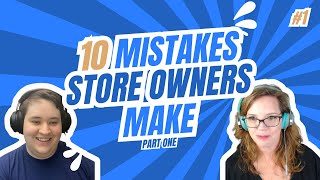
Andrew, Sabaanda George, and Melissa Biggill cover five common mistakes new e-commerce founders make: unclear target audiences, overcomplicating product lines, poor website design, and skimping on photography and copy. They show how AI tools and smartphone cameras can fix these problems cheaply.
Chapters
Hello and welcome to the Product Growth Lab podcast with Sabaanda George and Melissa Biggill. This is the podcast for creative product-based business owners who want to grow their businesses without overwhelm or massive investment. Each episode, we explore actionable strategies, real-life stories, and insights from business owners and experts who know what it takes to succeed. Whether you're just starting out or looking to scale, we're here to help you grow your business on your own terms. Subscribe and join us each week as we dive into practical advice and inspiring stories to fuel your growth journey. This is the Product Growth Lab. Let's get started. Okay. Hello everybody and welcome to our very first podcast.
This is gonna be fun. We're starting out with like the best content possible here, something that everyone can relate to. And I want everyone keeping a scorecard today, 'cause what are we doing, Andrew?
Today we are discussing the 10 most common mistakes that new e-commerce store owners make and how you can avoid them.
So we definitely want, this is like a feedback heavy one. Let us know how many of these mistakes you also made, or if you somehow managed to leap across and avoid these mistakes, because if you did, You're a genius and we want to talk to you.
And if you know these upfront, you're so much less likely to make them. And that'll just infinitely increase your success because everyone who starts off without some sort of advice or coach or something always makes these mistakes. And I'm sure you'll probably make some of them anyway. I think you're going to need to, to have success. We're trying to make that easy as soon as possible, avoid as many of those mistakes. As we possibly can. I'm sure we've made just about every one of these here.
Probably. Multiple times. Just because you make these mistakes doesn't mean you're a failure, and you might be succeeding in spite of some of these mistakes.
The first mistake we come up with is not knowing your target audience. It's so crucial to know who you're selling to. It makes marketing your business so much easier. It makes coming up with new product ideas so much easier. When you have this one person or group of people in your head and you go, okay, I want to make this thing, will they like it? And knowing them deeply enough where you can go, okay, yes they would or no they wouldn't, does make it so much easier. But I think it can take months or years to get there, at least from what I've seen in myself and just everyone else we talk to.
Everyone too. So let's see, Andrew, what's a way like this mistake has happened in your life?
I started off with no clear idea. It was just, oh, I know how to make these things. Let's go ahead and make them.
Andrew does embroidery products.
Yeah, all personalized stuff, and I do a range of stuff. It's the thing with gifts, the gifts aren't necessarily all for the same person, but it should be the same person that's buying them. So that's where you can kind of expand your target market a little bit there. I started off, my first range of items were kitchen stuff. There was aprons, oven gloves, all that kind of stuff. And so that just kind of happened to be the target market I started off with. And then it came time to create new products. And I spent a bunch of time and a bunch of money listening to people, and I was like, okay, this is what's trending, this is the colors you need to do, and then went along with this whole thing. And it's the worst sales thing I've ever done. Instead of listening to my own instincts, I talk to my customers a lot because it's gifts and people want really specific stuff. I'll get a lot of messaging back and forth with people, so I get to know them quite a bit. And instead of listening to people and thinking about what they'd like, I was like, okay, let's look at the trends. And I'm not saying that's not important at all, but I went too far down that. And some of that stuff, I think it's all sold, sold once. And like everything else, I sold like 100 times. So it really was a bad idea.
I did that in my jewelry world with incorporating leather products. Like, oh, these are trendy. I see them all over the place. They got really high margins, everything else. Meanwhile, I didn't know anything about working in leather, but it's gonna be easy. Of course I'll do it. Here's all the supplies I think I'm gonna need. And not only were the products horrible to make, my people didn't like them. It totally 100% missed the mark. And I got a drawer full of other shit that I wanna burn.
So if someone was coming along and saying, okay, I want to avoid this, what do you think you tell 'em to do?
They wanna avoid— pick someone. It doesn't— so much time we like in product, especially in the areas that we have been, and let us know if you can— easiest way to mix to miss this one is pick a market and then figure out what product that market likes. A lot of the people that we've dealt with and us ourselves, they're like, I like making this product because we come from a maker world, and now I'm gonna find someone who wants to buy this kind of product. And so that makes it so much harder. But I would say just don't try to agonize at finding the perfect person. Just pick a person and then go all in on what that person, that market would really, really like, and you're going to have such an easier time dealing with it. What do you think of that, Andrew?
I think that's really good idea. What I've normally said to people is pick someone and make those digital products for them, and then you'll realize that there is a group of people who end up buying these products. They're not going to be the ones that you thought they were, but those people end up becoming your target market. You can do like polls and stuff on Facebook and Instagram or through email and kind of ask some questions and just through chatting through a little bit, you get to know them better. And as you go, okay, Actually, this person is a little bit different than who I thought they were, but they are. And another really good thing to do is to find a way to chat that out. One thing I did a while ago was I opened up Descript and I just recorded myself talking. I spoke about things I thought I knew. I spoke about specific customers by name, said all these things about them that I knew. And then I took that transcript, copied it into ChatGPT and was like, okay, turn this into a person.. And it did. And I've used that document whenever I'm coming up with something or I need to use a prompt in ChatGPT and it helps for it to know, uh, your target customer. I can just copy and paste that in. So having that document somewhere, that will make running your business infinitely easier.
And that right there is such a great example of using AI in how AI is intended to be. It's not a replacement for you. It's going to find the patterns that sometimes we can't figure out because we're so close to it. So if you're someone new and you're trying to pick, you're trying to avoid this pitfall. So I'm gonna assume if you don't have a business, you're breaking into a new one and you don't wanna do this and you're like, I can't create a fake person. I'm not a fiction writer. I don't know anybody like this who would be my target market. 'Cause there's all the I can'ts that come up in the beginning. I would say pick a lifestyle niche and then dive deep from there. So like if you're in the outdoor space, like I wanna do products for hikers. Who like bamboo socks and only do like crunchy granola things. Or that is not a market I would ever sell to, personally. They would buy the right crunchy granola things, but not one I would sell to. But pick like a— go for a lifestyle niche, or like, I'm gonna work for— and do— someone I met recently, like, crocheted dolls, but they're all like This is a terrible example. Don't copy this example. They're like, have you seen any fandom characters? And they're for people who collect things and I'm gonna sell them outside of Hot Topic where people who collect these kinds of things naturally go to shop. But it's going in with a specific idea of something about their life. And you can then, as you start getting customers, you can do what Andrew just did and talked about and really go diving deep in once you have them. But give yourself a really concrete place to, to start. Start by picking a lifestyle.
I know it's a long one, but just one last thing I thought of is don't worry too much about, okay, if I pick this person, I'm locked in forever and I can't ever change, and that no one else who doesn't fit into this specific market— if you're like, okay, my market is Jessica and she's 25 to 34 and she's a she— that a 54-year-old man named Jeff isn't going to buy your stuff. You're always going to get some people outside your market who do that. I actually, this is another weird example, but I was on Instagram and I got this ad for, they're like these big mouse mats, but like the size of your desk. I'm like, okay, I have a massive desk, this would be nice. But then they had like dogs and stuff and I was like, okay, I like these. Clicked on their site, it is all clothing and accessories for furry people. And I'm like, ooh, this isn't something I would start out buying. I do like this mouse mat and I would probably buy the hoodie. So, like, totally the wrong market. That's— I don't— not quite sure how I got that attitude, but I was still buying the stuff. So you're always going to get some people. So don't worry that you're locked into someone and then no one outside that will ever purchase from you.
Love that story. That was great.
Yeah, it's not the target market thing is wrong. It's the— they're in the US and I don't want to pay international shipping. That's the problem. Delicious. Okay, so the second mistake that we see people making is overcomplicating their product offerings. You end up with these really complicated products, you end up with too many products you can't fit in your home anymore, because most of our people are home businesses, and there's just piles of boxes. It's important to simplify that down a little bit.
And what that's like, that could be you offer too large a variety of products for what you have storage and capacity for. And it could be one that I fall into all the time. You offer too many variations on a single product. Since I'm in jewelry, like, oh, you can get it, the necklace in this size or this size, this bracelet in these 4 sizes. And by the way, since there are 12 birthstones, I'm going to have 14 different colors and get this thing in. So overwhelming, not only to me keeping inventory, but to my customers trying to buy. There's too many options. People get decision fatigue and then instead of choosing, you're like, I'm gonna give everything so they can get perfectly what they want. They don't know what they want. Give them 3 options. That's much easier than giving them 14, um, options. The variations are obstacles.
Yeah, I'm super guilty of that. I have things and they come in too many colors and people always pick the one in the full. They have no imagination. Because I'm embroidering like all the personalization and names and things on, I have thread colors and it's like, I want to give options cuz not everyone's gonna want blue, someone's gonna want yellow, someone's gonna want orange. The most popular one is gonna be the one in the photo. They're gonna choose the product color that's in the photo and they're gonna choose the thread color that's in the photo cuz they can't imagine it, they can't see it. And yeah, and I, I know there's one product, it's a bestseller, so I'm too scared to change anything. But I have it in royal blue or navy and black, and they're like all the same color. One's bluer than the other, but like they don't—
Do you want blue, blue-black, or black?
Yeah, I was actually like, 'cause I was ordering clothes from my supplier, I was like, 'I need a black one.' And it's like, 'We have black, pitch black, dark black, coal black.' I'm like, 'What is the difference?' All you have is these silly little color block buttons to choose from. And they're all black. I'm like, whatever one is black, I'm going to vote. Why are these all options? And it leads to that kind of decision fatigue and go, you know what? I'm not going to bother. I'm not going to argue this.
I'll go to the other listing or the other website that just has black instead of 5 different kinds of— I just overcomplicate products. I know we want it to be—
Yeah. It— decision paralysis for your customers and inventory issues for you. Trying to keep a stock of all these different colors is expensive and it takes up a ton of room. It really benefits no one. I know you're doing it because you think, oh, people need all these options, you want to give them choice, but there's no real positives of it.
The only people in the world who are okay having a gazillion different variations of things or a gazillion different products on their sites are ones who either have someone else fulfilling them or it's print on demand. Where it doesn't matter if like 19 out of your 20 designs don't sell. It's all digital and then someone else is making the one that sells anyway. But if you're like a home-based business like we are, do not do it. Don't do it. Don't do it. Don't do it.
Yeah. You know how many people sell on Amazon start being like, okay, you're gonna have to pay us up to keep storing this stuff that isn't selling, or we can just throw it out.
So But don't you have to pay to have it returned to you?
Yeah. They're like, you can pay for it to be returned to you, or we can just burn it. And no one wants to see that happen to their products. You're like, it's, it's lighting money on fire. Literally. So the way around this is to focus on a core set of products. Don't worry about having too much variations. Focus on what sells. And sometimes it's having a bit of a customer base and you can survey them a little bit. Although people tend to not do what they say they'll do. So, take that kind of feedback with a grain of salt. They'll be like, "Okay, I can't decide between pitch black and jet black. Here are some images, vote for one," and just kind of go with it and know that it doesn't really matter. People who want black are just going to choose the black one.
Yeah.
They're just going to go, "Black." Okay, so—
And if you think the color combination is ugly, That's the one that's going to sell.
Oh yeah. Always the worst one. People will do lazy things. They'll, I'm too lazy to like, the, like this, you'll be able to choose the same from the same thread options on my site. And too lazy to set up every single listing so it excludes the same color as the item. And sometimes people will be like, okay, I've ordered a red apron, I want it to be red writing on it. And I'm like, what is the point in that? You cannot see it. It's kind of bumpy and shiny there, but I'm gonna like email the people and be like, are you sure? Yeah, you'll all do weird stuff. And it's like, okay, we're gonna buy this in orange and now like jeans. Yeah. And yeah.
To me, orange and green, I can do that.
Yeah, I've had some weird, like, some weird things. I get special requests. How about I don't pass judgment on Oh my gosh, the way it is, as long as they're paying me, I'm happy to do what they want on it.
As long as they enjoy the product when they get it, all good.
Yeah. So number 3 is ignoring your website user experience. This is such a massive one. One that we kind of have to beat people over the head with a little bit.
Mm-hmm.
People want to do like the, I want to make it pretty and I want to customize every single color and all these platforms, things like Shopify, it's like I can change every single element. And I'm going to, and suddenly it's just this big rainbow of colors. You can't read the text, the images are hidden, like it starts to get a little bit crazy.
It's like a rainbow threw up on the page.
Yeah. And this applies in English as well, like people who think, I'm gonna take this Canva template that someone freshly designed, I'm gonna change every color and font until it's hideous. Don't do it. Stick to what Drew Pearson has done. And I'm not trying to put anyone down, but especially on websites, simple and clean is what makes you look back. Look at any successful site. They aren't too busy. Amazon can be a bit busy, but it's, it's still, it's white. There's text. It's fairly clean-ish. It's starting to get a bit messy as you go down the page, but it's like the white product photo, the white background, a white website. Black text and like a colorful background.
I like one accent color.
Yeah. Do not go overboard.
That doesn't hurt your eyeballs. Yeah.
And it, it makes it difficult for a lot of people. A lot of people have vision issues and things, or there's specific requirements that it's too complicated for us to go into here, but like the ADA stuff, like you have to make your website accessible to all different kinds of people. And when you have this bright pink writing with like yellow letters, stuff, it just, it gives me a headache. I think you have these low-res products with like, people do all sorts of stuff.
It's in the background, very busy backgrounds.
Yeah. Winter scene and burlap and, and, and ribbon and leaves.
Node. You need all together. All together.
Yeah. Yeah. A white background photo. They're difficult. They're a total nightmare and I will never master them as long as I live, but they, they work really well. Are just something simple. A nice kind of clean background. I like to buy the white backdrops and stuff and like there's always, there's call for like more lifestyle images and just the plain black photos, but of course photos are the Photos is probably a topic of its own, but website experience, making sure that you have this clean website, it's easy to navigate, you don't stuff it full of these large images that means it takes 10 minutes to load. Google will never show you anywhere if you don't make that site load in the first couple of seconds. Difficult layouts, being hard to find buttons. There's like so many different things that go into user experience on a site and The easiest way to do this without paying someone more money than you probably have is to stick to the theme. Yep. Okay, I want to swap out the logo in the corner, customize the text. Maybe I want the buttons to be in black, I want it to be blue. Small things like that are okay, but do not go changing everything because it's only going to hurt.
The other thing to remember is like the people who did those Canva templates, people who made those like Shopify themes or website themes, They are designed to convert how they are. They're designed for you to literally swap the logo and go. So don't make it harder on yourself. Like, I feel like that's one of the areas that some people like, it's a procrastination point because I'm going to get it perfect. Focus on the photos, not on the website. Or not on the template, not editing the template, editing the photos.
Yeah, and it stops people launching their stuff. They spend too much time trying to do all the stuff that's going to make their website convert less. And it also delays 6 months. We see all the time people who are like, I want to get everything perfect first. And it's just not worth it. Get the things out there, launch, kind of like build their rocket on the way up, as they say.
Yeah.
Do the tweaks, do the changes. I think it's kind of a scarcity thing. Like if I don't sell to this customer the first time, they'll never come back and I'll never find another one. There's billions of people out there that access your site, so We'll always find some new people if we need to.
We'll find more people. Okay. I think we beat that one to death, so should we move on to mistake number 4?
Yeah, so our 4th mistake is not investing in quality product images and descriptions. This is a big one. Product photos are the most important part of someone buying your products. Infinitely more people are going to look at your product photos than look at your description, especially if you're on a like a Google Shopping search, or they're just, they're on your site, they are on the search page or like the product category or something, they see a list of photos and the names and the price. They don't see your description until they click into it. So your product photos are so much more important. And obviously, again, good descriptions is important, but they both go hand in hand. But product photos is the one I would say you need to focus on first. And both these things are difficult, but there are more and more tools since I got started. The things like Canva and like being able to use Photoshop on your phone instead of it being this expensive monthly fee. And obviously AI is coming along and some of these tools are starting to get somewhere where they're usable. Uh, not like a year or two ago though, and where it's do not touch, it's like they exist, but ooh. These are not good, but we're starting to get there. And a lot of these things are becoming much more, um, accessible and easy to use and producing results that you can go ahead and use.
Like, I don't know about you, when I started, I had a Canon point-and-shoot camera that I had to go on and to look at them now, the photos were so low resolution. They were so bad, all those old photos. But now everyone carries one of these in their hands, in their pocket. You have a cell phone, your cell phone's gonna take amazing photos. And honest to God, you can go on YouTube and be like DIY photos with whatever your phone model is for product photos, and you're gonna get more than enough tips and tools to get you started. If you can't afford a photographer, which totally understand, been there, done that, hired photographers, got mediocre results back. But just, you can do it on your phone. Just do the simple white background. That's all you need.
Yeah, there's so much advice and tools out there, and I know when I got started, I was using a DSLR. I bought a lens for it. Oh my God. I bought Photoshop, and I still could not use any of them.
I was so glad I'm not bound and locked into Photoshop anymore.
No, moving over to my phone and like Canva and like the photo software I'm still learning to use here, my photos are infinitely better than myself. They're still not fancy professional photos, but they're super simple. And there's other ways out there to take— They're good. As much as I'd love to improve them, I'm getting sales without having done it. So it's not that important. Also, don't have terrible photos. Have decent photos, but don't think that they need to be these professional photos. There's a scale. I have done a few times where I swap product in return for photos, and I've gotten a mixed bag there, but I still use all those photos. They're good enough and they get sales. So even if I'm like, okay, I can be a bit nitpicky with these things, they're fine. They get sales. Do not— it's another thing— don't let that hold you up. And we're kind of focused on photos there, but the other thing is descriptions. And again, that is another thing that AI has made so much easier. Whether you're using something like ChatGPT or Claude or Gemini, or if you're on Shopify, it has that Magic AI stuff built in.
Great.
You can use it to get started. I am kind of nitpicky as well, and I will sit and edit and change things, and I like to focus on SEO, so sometimes you need to get your keywords in there in a way that ChatGPT and these AI tools haven't done for you. But having that starting point to work with makes it so much easier and faster. There's people also talk about the duplicate content stuff, and I was like, okay, but I'm listed on Amazon and Etsy and my site, and it's like, okay, change this enough, make this more Amazon sounding, make this more Etsy sounding. And that stuff I can work with cuz it's using me and what I've said already to write that.
Yep. You're the nitpicky and fussy, whereas I, if it's going on Shopify, if it's going on a funnel page, it, it gets the full AI walkthrough. If it's going on Shopify, it is literally 3 bullet point description things about my product. And then whatever their AI says, I read through it, didn't lie, good, sent, and done. People are not gonna be scrolling through it, they're looking for sizing information, they're not going in there to be enchanted.
Yeah, but having a real good decent description and using those tools to make it easier is really gonna help you a lot. And there'll be people who say, "I need it all." And there'll be people who, even though you have put in every single detail, will still send you an email. It's like, "What size is this? And what material is this?" And like, I'll go and I'll copy and paste it from the page so I don't have all this stuff memorized. Like, you could have done that and saved both of us this email. But it just shows that people aren't always doing this. So that's the thing to focus on. So I know we spoke about covering our 10 biggest mistakes, but I think we're going to have to split this into a two-parter. So come along and join us in our next episode when we'll cover the other top 5 mistakes that we see people making in their product-based businesses.
And make sure, like I said, let us know of these first 5, how many Done. You've heard from us. We've done like all of them. So are you a top fiver here or be like, haha, I skipped a couple. I didn't fight with that one.
Thanks for tuning in to the Product Growth Lab podcast. We hope you found today's episode insightful and inspiring. If you enjoyed the show, be sure to subscribe and leave us a review. It helps us reach more creative entrepreneurs just like you. Stay connected and keep experimenting. Follow us on your favorite podcast platform and don't forget to join our community for more resources, tips, and support. Until next time, keep growing and creating. This is Product Growth Lab signing off.
More from Andrew

Prune your email list #handmadeseller #emailmarketing #businesstipsforsmallbusinessowners

90% of your sales will come from 10% of your efforts #handmadeseller #podcast #marketingstrategy

Streamline your business expenses #etsyseller #handmadeseller #ecommercesuccess #marketingstrategy

It's time for your mid year business check-in #podcast #handmadeseller #marketingchannel #podcasts

Focus on what makes you happy and makes you money #ecommercebusiness #ecommercesuccess

Focus on your top performers #handmadeseller #handmadeclothingbrand #etsyseller #handmadeseller

What do you need to look at to review your goals for 2025? #handmadeseller #ecommercebusiness

You need to know your numbers #handmadeseller #etsyseller #handmadebusiness #handmadeclothingbrand