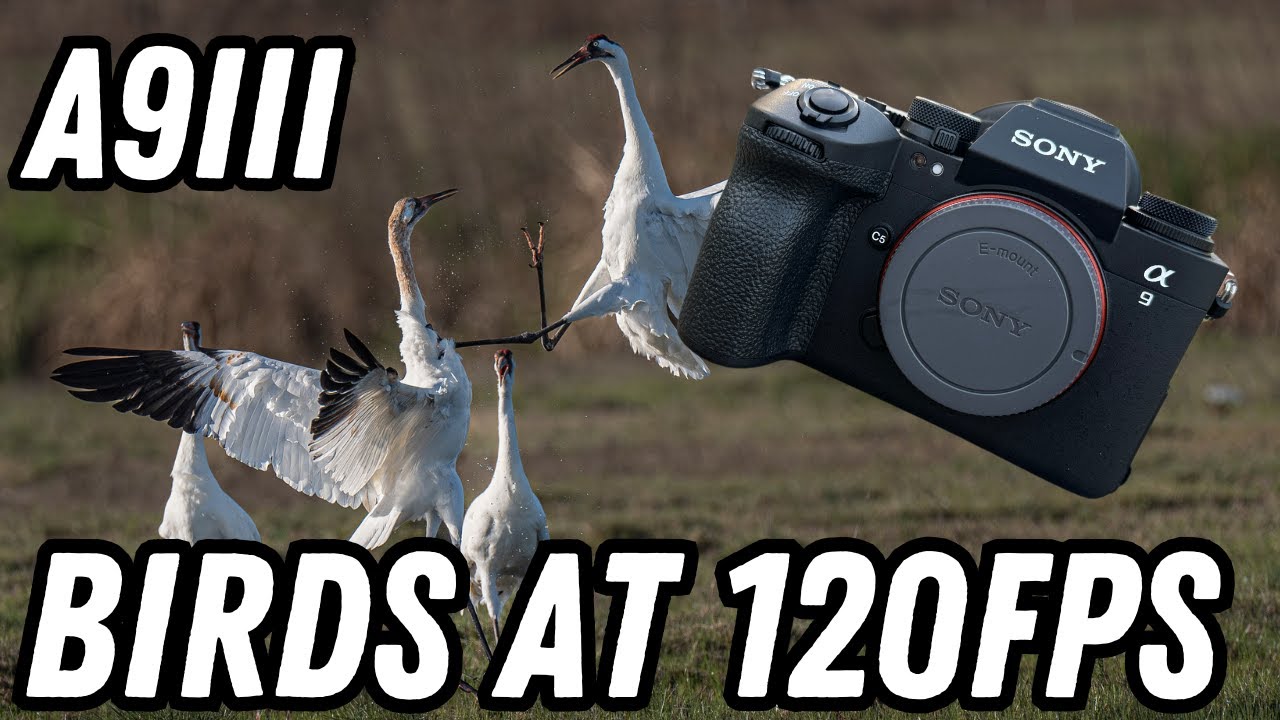
Sony A9 Mark III tested on Texas birds with a 200-600mm lens. The autofocus tracks fast-moving subjects in low light, and a new button toggles between 120 fps and 5 fps. The grip is bigger than the A1, and the flip-out screen works in the field.
Chapters
All right, who is ready for the unboxing of the A9 Mark III? All right, so you know what, forget this, let's just go shoot. Alpha. So it is a little busy here at the fish cleaning table, but I wanted to let you guys know what I plan on doing. I'm going to hook up the Sony 200-600 lens, and I'm going to hook up my external recording monitor, and I will share the tracking with you on this next segment, so stay tuned. Let's check out this tracking. All right, so got the external monitor hooked up and got used to having to look through the monitor instead of the viewfinder, and the birds finally decided to cooperate. But I, I believe that the tracking works really good on this camera. As you can see, especially when the birds are flying around like this and you have people walking in front, it stays on the bird. Followed this little guy walking, but then it picked up on the other eye. But these birds flying and people walking in front was pretty good in my opinion. Got some really killer shots of seagulls. Alright, so we are off to another location. This one is probably the most popular one here in Corpus Christi area. Alright, so here we are pulling up to one of the bird spots here in Port Aransas, and as usual, it is packed. So we'll park over here in the overflow parking. Springtime birding here in South Texas is Yeah. We got a lot of them. They come through here when they're going— right now they're gonna be going back south. Not to mention we have all of our usual residents who live here year-round, and then we got a bunch of them that winter down here. that are getting ready to head out for the winter, like the whooping cranes. All right, so let's go walk this boardwalk and see what we can find. All right, so here we are at the boardwalk, and I'm just kind of zipping through here. Looks like we might have a pretty good chance of seeing something today. Lots of things reported. So this boardwalk was rebuilt after Harvey. Hurricane Harvey, that is. It took the other one out completely. Now we got a couple miles. Here's a roseate spoonbill. They're so gorgeous. And our local alligator. His name is Boots. He feasts on wild pigs. All right, so here's some more tracking. You need to take into consideration that this is a really cloudy day and my lighting was Horrible this day, but even though we had low light, we still got some really good shots. Here's some shovelers coming flying right at me. I got to go back another day when the lighting is better because I think these photos would have just turned out amazing if I would have had good lighting. They turned out pretty good even though we had Bad lighting. That A1 is pretty darn sharp. Oh, and that lens that I'm using is the 200-600 Sony f/6.3, and it does a really good job. I'm not real sure if that lens is capable of 120 frames per second, but if anything, I'm probably getting at least 60 frames per second. So this little video clip was taken with my iPhone on the ferry as I crossed over. Got some dolphins to come visit. Heading off to another bird location, and I was hoping the sun would come out, but it just kept getting foggier. Alright, so we just pulled up to one of my favorite bird spots just outside Corpus Christi. We are gonna get out and take the A9 III, and we're gonna take it out and we're going to mostly take images with the A9. Get out of the truck here. We're gonna go over here and get set up on one of these bird platforms and see what kind of Bird footage we can get. Get some beautiful bird footage. That's my goal. All right, let's go. All right, so we made it to the other side of the bridge and we got a little bit of sunlight. That's a neotropical cormorant. Here we got a little willet down in the water stretching. Got a little sunlight on him. That's really nice. Notice that it catches all the little droplets of water. This little guy's stretching. That's an American Avet. So I was using the Sony 200-600 lens while I was doing this review, but I'm not 100% sure if that lens is capable of 120 frames per second because the Updates for the lenses have not been released yet. Oh, watch this. This is killer here. He catches a stick and then he drops it. See that? Isn't that a killer shot there? Guess he decided that stick doesn't taste very good. So that's a common turn in those photos. They're a real challenge to photograph. They're so switchbacky, and you notice the Oh, here's another one of my favorite birds. Of course, they're all my favorite. That would be a white morph reddish egret. They're the funnest to watch fish, but he wasn't interested in having any part of me that night. Some little American abbots walking by, and here we got a great blue heron hiding in the bushes. These next 2 clips are videos that I put together out of, uh, each one contains just under 200 pictures, and I stitched them together to create a time-lapse that simulates a video since this camera does shoot at 120 frames per second. Each one of those clips, I took the picture with the A9 III and the, the 600mm 100mm lens f/4. So I was shooting at 120 frames per second and 120 frames pre-capture. So let's take a look at those. Okay, so let's go over a couple things on this camera. First, I want to mention that they added this C5 button in the front right there, and I actually have that button set through custom functions, um, to actually slow the camera down. So I shoot it at basically full throttle, 120 frames per second, and 120 frames Pre-capture, because I love speed. And then if I have a bird just sitting still, I just push this button, it toggles it down to 5 frames, 5 frames per second, and then when I push it again, I resume back to 120 frames per second. And if I ever get tired of speed, then I'll dial it down a notch or two, but right now I'm really enjoying the speed. And the other thing that it has is the little flippy straight screen that flips out, flips around. It's a really nice screen. I hope it comes out on all cameras from this day forward. And then they also added this little asterisk right here on the top dial. Where you dial in your selected drive speed, high speed, high speed plus single frame, high speed, medium, low, timer, and bracketing. So when you have it set on the asterisk, you can now change it through a custom function or through a custom button, or you can change it through the menu screen on the back of your And the other main thing that they changed is the grip. The grip is bigger now than the A1. So here's the A1. The A1 grip is definitely smaller. Now that I've been shooting this for the past 2 weeks now, I really like this new grip. It fits your hand so much better now. So that's really the only 2 things, I mean the only specs that I'm really going to talk about in this video. I'll do another video later on. I'll go through all of the menu functions and how I have my menu set up, but I need to go through that menu and make sure I got it set up the way that I want it set up before I share it with y'all. And I'll also do a video comparison of the A9 III versus the Sony A1 as well. So look for those videos in the future. Meanwhile, watch this video right here, and I'll catch you on the next video. Have a great one! Bye!