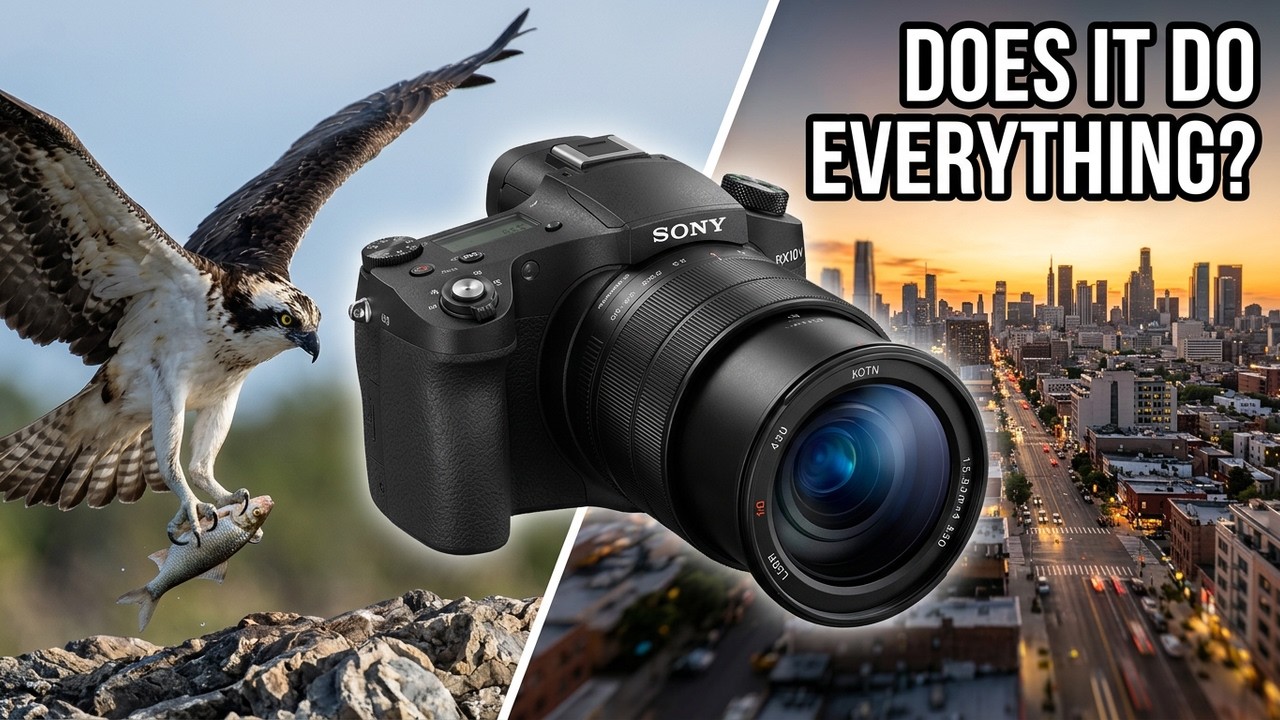
In this video, Angie Birmingham (Jeff and Angie Photography) provides a comprehensive hands‑on review of the Sony RX10 IV bridge camera, which she tested for a month thanks to a loan from B&H Photo. She begins by outlining the camera’s core specifications—a 1‑inch sensor, 24‑600 mm f/2.8‑f/4 zoom lens, 20 MP stills, 4K video, and an advanced A9‑derived autofocus system—while placing it in context with other sensor formats (full‑frame, APS‑C, Four‑Thirds, 2/3) and explaining the resulting crop factors. She then lists the camera’s main pros (versatile super‑telephoto lens, strong image/video quality, solid viewfinder, tilting touchscreen, low‑ISO performance, fast AF) and cons (high price relative to rivals, larger size, bulk). The bulk of the video showcases a wide array of sample images and video captured at various focal lengths, especially 600 mm, with detailed exposure metadata (shutter speed, ISO, aperture). Subjects include wildlife, portraits, beach scenes, and an airplane, demonstrating the camera’s ability to focus and produce clean images even hand‑held at long focal lengths. Angie walks through her post‑processing workflow, emphasizing the use of DxO PureRAW 3 for noise reduction and lens correction before exporting 16‑bit TIFFs to her editing suite (primarily Luminar, but also compatible with Lightroom or Photoshop). She concludes by asking viewers to decide if the RX10 IV’s performance justifies its $1,600 price tag, noting that while it excels in many areas, the cost and size may deter some users.
Chapters
Hello and welcome to another episode of Jeff and Angie Photography WTF Stop. Hope you've been out and clicking your shutter because I have been. I've been using this Sony RX10 IV for the past month thanks to B&H Photo. They sent it to me so I could do a review, so I'm going to give you my honest opinion on whether or not This camera is worth $1,600. It is a 1-inch sensor, and its focal length is equal to 24mm to 600mm at aperture f/2.8 to f/4. Yes, that's 600mm at f/4. You heard me right. So this is a point-and-shoot. It's also referred to as a bridge camera. So stay tuned. Let's take this out and go see what we can photograph and see how well it does. Stay tuned. Hello and welcome back. So today we are going to be reviewing the Sony RX10 IV. It does have the 1-inch sensor. It was announced in September of 2017. Was released in October of '17. And at the time of release, it was, uh, manufacturer's suggested retail was $1,698, and still to this day, it still sells for $1,698. With it being a bridge camera, or a point-and-shoot as other people call it, it really has no competition as far as the camera goes. It's— I've been shooting with it now for about a month, and it's actually not a bad camera considering that it's a point-and-shoot. But you'll see the images, and I'll let you make your decision. But I think that the images turn out pretty good. All right, so you ask yourself, what does 1-inch sensor mean? So basically, in the world of digital photography, you have the full-frame sensor, the APS-C sensor, the 4/3 sensor, the 1-inch sensor, and then a 2/3 sensor. So we'll go over each of these. So first up, we have the full-frame sensor, which is equal to 35mm film, and there is absolutely no crop on this. So if you have a 200mm lens on your camera, your lens will be 200mm. Next up, we've got the APS-C, and on Canon, that is a 1.6 crop, which makes your 200mm lens 320mm. And on your Sony and Nikon, it's a 1.5 So that makes it a 300mm lens. So Olympus and Panasonic fall in the Four Thirds category, and they are a 2.0 crop, which makes your 200mm lens a 400mm lens. And these cameras are typically fairly small along with the lenses. Okay, so here we have the 1-inch sensor, which is what the RX 10 Mark IV is. Sony and Nikon both make cameras with the 1-inch sensor on it. They're both 2.7x crop sensors, so that means that your 18mm lens is now a 24mm lens, and then at the far distance, the 220mm is now Okay, so the 2/3 crop sensor is typically in your PowerShots and other compact cameras. That's what crop factor is. So let's go ahead and jump on over to the pros and cons of this camera. All right, so some of the pros that I really liked about this camera was the lens, the 24-600. At f/2.4-4 zoom lens. It had great images and video quality. It's got a nice viewfinder and a touchscreen that tilts. It performed well in low ISO, and it has an advanced autofocus system that was borrowed from the Alpha A9, the first version. And it also captures 4K video, which is beautiful. You'll see later in this video, along with 20-megapixel still images, JPEG or RAW, at 24 frames per second max. That's if all the conditions are perfect. The cons on this camera were that it was a little Pricey compared to the rivals. Panasonic Luminix was probably the closest at $900, but you were limited to 480mm at 4.5 f-stop, same 20 megapixels. And this camera also is the largest in the class, but it still weighs in at less than 3 pounds. So overall, it's an nice compact camera. It's just a little bulky, but it feels really good in your hand cuz you have something to hold on to. Okay, so let's jump into some images, take a look at them, and see what you think, along with a little bit of video. All right, so let's jump into some images. All right, so here we've got Bailey. I was sitting across the room at her. This was taken at 600mm, shutter 1/40th of a second, f/4, and ISO 800. Turned out really nice considering it was taken at 600mm. And this one here was also taken at 600mm to exaggerate the size of the sun as it was setting at 1/40th 1/320th of a second, ISO 160, and f/8 was my aperture. Notice the little bird in the sun. And here we've got speed. I did the same, 600mm at f/4, 1/100th of a second, and the ISO on this image believe it or not, is 4,000. It turned out really well. So before I edit any of my images, I run them through a program called DxO PureRAW 3. This here is Speedy's original image, and I'm going to take you through the steps on how to do the DxO PureRAW right now. When I go to edit my images, The first thing I do is I run every single one that I'm going to edit through DxO PureRAW 3. And the reason I do that is because it reduces the noise and it also does all of the lens corrections, um, before you even start editing. And then it will put it in as a TIFF and it will send it to your editing program. Here, let me show you. All right, so here are the images and here is Little Speedy right here. All you do is right-click on the image. This is in Mac. Go down here to Open in PureRAW 3. Bring it up. So here we've got Little Speed over here on the screen. We just hit Process Now. And we're going to tell it either Deep Prime or Deep Prime XD. Most of my images I just use Deep Prime. Then you can go in here and choose your settings, and I like to output it as a TIFF 16-bit. And then you also can tell it where to put your file and tell it what to rename it and then tell it to export it to Luminar, don't export it, Lightroom, Photoshop, whatever your editing program is of choice. And I use Luminar, so that would be my choice. Now I hit start processing, and this image is taking a whopping couple seconds. So here we go. Here is the original, and that is a couple clicks of the button, and it does an incredible job of removing noise. And here he is, shows up over here in Luminar, and then you can go in and edit him from there. And if you go down below, you can catch the link and you can get a free 30-day trial using my link there at DxO. All right, so here's a couple late night photos right before the sunset. This one is at 1/800th of a second, 800 ISO, and f/4. And this one here is of a kayaker After the sun had already gone down, 1/125th of a second, ISO 500 at f/4. All right, so here is Bailey. We're going to do a couple outside portraits. Here is a dog at 1600, 100 ISO, f/4 at 190mm. So this is a static dog just standing there looking at me portrait. So let's jump into the next one. And here is my grandson. Shutter speed 1/800th of a second, ISO 320, f/4 at 240mm. I wanted to get a nice close-up of his face. And here we have Bailey running straight at me. The camera did a very good job of catching her at 1/2000th of a second, 100 ISO, f/3.5 at 85mm. And here we have a little sanderling running along the beach. I love the reflections that day. This was at 1/2000th, 200 ISO, f/4 at 430mm. This guy came in and landed on this post and hung out with us the entire time. This one I cropped at 50%. The shutter speed was 1/1000th of a second. ISO was 100. f/4 at 600mm. This blue heron looks quite tattered after the tropical storm that came through Corpus Christi. That's why we were down at the beach. The next few pictures, like these sunglasses, are a few things that the ocean washed up to shore. So this was taken at 1/2000th of a second, ISO 160, f/4 at 115mm. I wanted to get as close as I could to the subject and have as much as possible in focus around the subject, but I wanted to blur the beach out. In this subject, the 2 little shells, I wanted to focus on the bubbles around the shell and see how close I could get to focus, and I was probably a about a foot from the shells. This was shutter speed 1/2000th of a second, ISO 160, f/4, and I was at 600mm for my close-up. So this one here was also a close-up. I was maybe 2 feet at the most away. I did 1/500th of a second, ISO 100, and f/11 at 88mm because I wanted as the ocean to be in focus with this picture. And here comes my ride. It's time to go home. These are my 2 friends, Lisa and Sheridan. This was shutter speed 1/2000th of a second, ISO 160, f/4 at 220mm. All right, so the next few pictures here are of animals Trying to get to focus going through bushes or trees. This was the little dove in my yard. Shutter 1/500th of a second, 100 ISO, and it did a really good job of catching her through the tree. And same here, this little squirrel. It did a really good job of catching focus on him. 1/500th of a second, ISO 1000. f/4 at 600mm. I think the focus did a great job trying to find animals in the bushes and trees. And here is a young axis doe. 1/1600th of a second shutter speed, ISO 250, f/4, and I think I was at 600mm on this shot as well. It did a really good job catching her through the fence. And here I've got some backyard pictures again. This is a little squirrel that I feed pecans every day, shelled pecans. Shutter speed 1/500th of a second, ISO 400, f/4, and that was at 600mm as well. And here we have A dove hanging out at my pond. Shutter speed 1/250th of a second, ISO 200, and f/4, and this too was at 600mm. So this video was taken at 600mm. I was hand-holding, and you can see where she would go out of focus and then It would quickly gain focus again, and it's actually pretty steady considering I was at 600mm handholding. And last but not least, I have an airplane shot, a crop duster out in the fields. 1/1600th of a second, ISO 100, f/4. At 600mm, and it was taken in the middle of the day. That's why you got a little bit of heat waves on that plane. So I hope you enjoyed my video. Don't forget to like and subscribe, and we'll see you next time.