We're LIVE Birding on the Coast & in the Desert! Join Us!
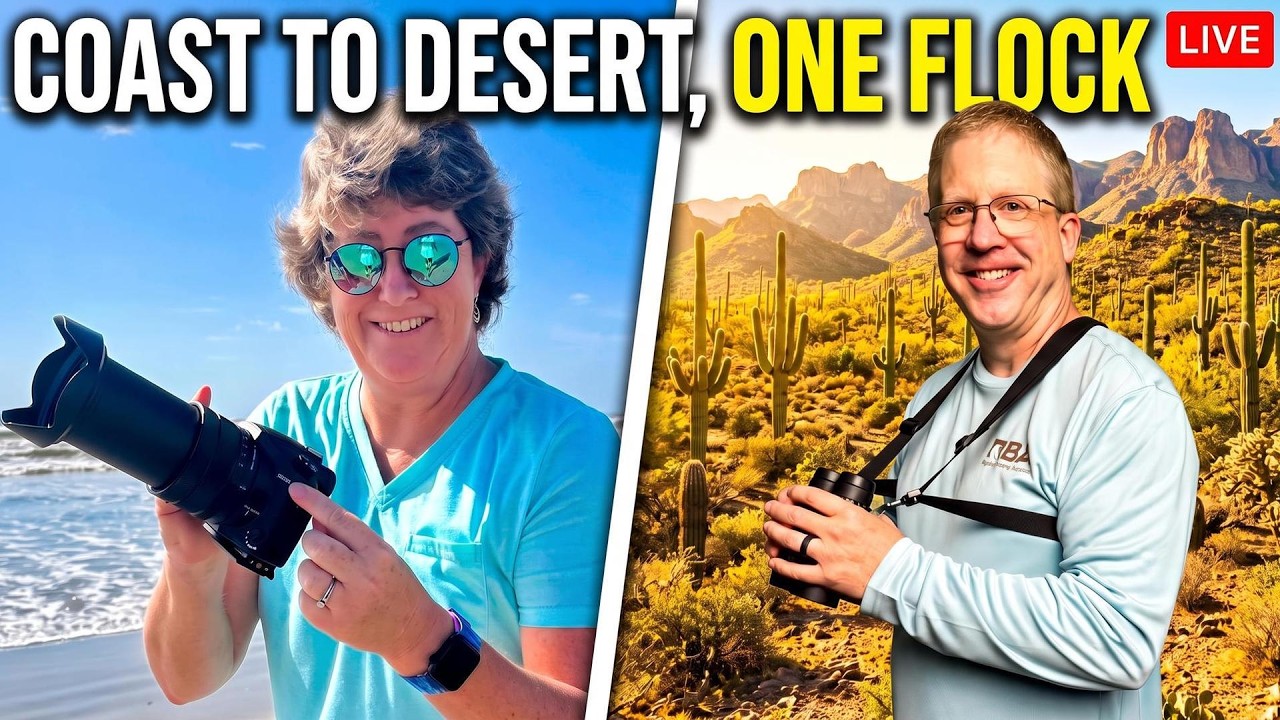
In this 2026 live‑stream, Angie Birmingham (Jeff & Angie Photography) hosts a two‑location birding session from the Leonabelle Turnbull Birding Center on the Texas Gulf Coast and the Sonoran Desert near Tucson, Arizona. Guests include local birding expert Chris from the Port Aransas Nature Preserve and Joe, founder of Raven Birding Apparel (RBA), joining remotely. The broadcast blends real‑time bird observations (spoonbills, egrets, skimmers, frigatebirds, warblers, hummingbirds, and desert species such as Black‑throated Sparrow, Purple Martin, and various warblers), migration updates for both regions, and a deep discussion of field gear. Angie showcases a Sony RX10 Mark V, Sony Alpha 1 with a 200‑600 mm lens, Vizio “smart” binoculars that tag GPS locations, Leica binoculars, and a Kowa TSN‑99A scope. Joe presents RBA’s UPF 50+ sun‑protective apparel, explaining its permanent UV‑blocking fibers, PureTech cooling‑wick technology, M‑Shield antimicrobial zinc treatment, dye‑sublimation graphics, and related accessories (gloves, gaiters, caps). He shares his personal motivation—surviving multiple melanomas—and the brand’s focus on birders who spend long hours in the sun. The hosts also announce Jeff & Angie Photography as official RBA ambassadors, field‑test the apparel, and interact with live chat (moderated by Diane) while navigating technical hiccups. The stream ends with birding tips, a reminder to stay courteous, and a promotion of upcoming live sessions.
Chapters
Hi, and welcome to the channel. Today is a little different, so please be patient with me. This is my first live rodeo. I have my mom today, Diane, monitoring the comments, and we will answer them as they come in. So I am here at Leona Turnbull Birding Center in Port Aransas, Texas. It's a very important birding location along the migration highway. And I have actually a special guest, Chris, and he is from Port Aransas Nature Preserve. So he's going to tell us a little bit about Leonabelle and the Port Aransas area.
Hello, my name is Chris. I'm a local here in Port Aransas. I've lived here for about 10 years. I started birding here in Port Aransas. This is where I picked up my spark bird, the White-faced Ibis. We've got a lot of birds coming through Port Aransas, specifically throughout migration, Spring and fall. A bunch of warblers. We've picked up rarities like flame-colored tanagers, black-whiskered vireo, Lucy's warbler, red-breasted nuthatch. Tons and tons of birds coming through Port A. Right now, we did have one recently on our jetty, which is just down the street from Leonabelle. So tons of birds in Port Aransas that you really can't get anywhere else. Our proximity to Mexico is what allows us to have such varieties here. So if you're ever in the area, make sure to stop by. We've got tons of trails. We make sure to keep it clean for you, and I hope you have a good time on this live. Thanks for having me.
Thanks, Chris. That was awesome. Yeah, so, so on the other side of the screen, right over here, we have Joe, who is from RBA, which is Raven Birding Apparel, and he is out in southeast Arizona. He is— are you in the desert or where are you at today?
Oh, Angie, I am out in the middle of the Sonoran Desert. I'm at Star Pass Trailhead, which is just west of Tucson, right in the middle of that Sonoran Desert ecosystem. And Oh yeah, it's gorgeous. We actually have some clouds here, as you can see, and it was sprinkling a little bit earlier. So, you know, we are in the monsoon season here in Southeast Arizona. So there are some periods where we do get some pretty heavy rainfall. And, you know, it's great to be back in the desert. I actually lived out here in Arizona from 2008 to 2013. And just fell in love with that desert ecosystem. And it's one of my favorite places to bird because all of the, the animals here, not just the birds, but all the animals, all the plants, everything here is just so adapted to its environment because these things have to deal with intense heat during the day, cold Uh-oh, I lost him.
But you still have him? Yeah, but that's just the Before you lost him.
Excellent. Okay, top messages. I can't click them on. They should show up here, right?
Well, to my right here. So that was really cool. So it's super, super great to be back in the desert and. Some of the things that I've seen this morning so far from a bird perspective, it hasn't been super birdy, but a Black-throated Sparrow, Verdon White-winged Dove, Purple Martin flying over. And as you can see in the background, there are a lot of saguaro cactuses or cacti, and the Purple Martins will actually use cavities in the So they don't— oh, mourning dove.
So they don't, they don't use—
I mean, they probably do use houses here, but, you know, they will use natural cavities out here in the Sonoran Desert and the saguaros. So it's really neat. So thank you. Back to you.
Hey, thanks, Joe. Wow, I wish I was there with you. How's the temperature there? Pretty hot?
Well, right now it's actually quite pleasant. It might be 80 right now, and of course it's dry, dry heat. So it's actually very pleasant right now. Now this afternoon it'll be 100, 102, but at least it's not that sweltering humidity like we have down in South Florida where I live.
Yeah, that's where I'm at right now. I got In the car when I got here, it said 85, and I'm sure it's probably really close to 90 right about now with a lot of humidity. And let me tell you, this shirt, this is really keeping me cool. I really am enjoying this shirt.
It is awesome.
I think your claim to reduces the temperature is 100% right. So anyways, so. A little bit of history about Leonabelle. It's named after the Bird Lady of Port Aransas. She recorded 401 bird species in her lifetime, and this place is basically her legacy. And the boardwalk is built over wetlands, and this is a really good place to come for birding in the spring because it is the place to be for all the stopovers off the Gulf of Mexico. So anyways, let's, let's talk a little bit about gear because everybody wants to know what we're out here with, right?
Sure.
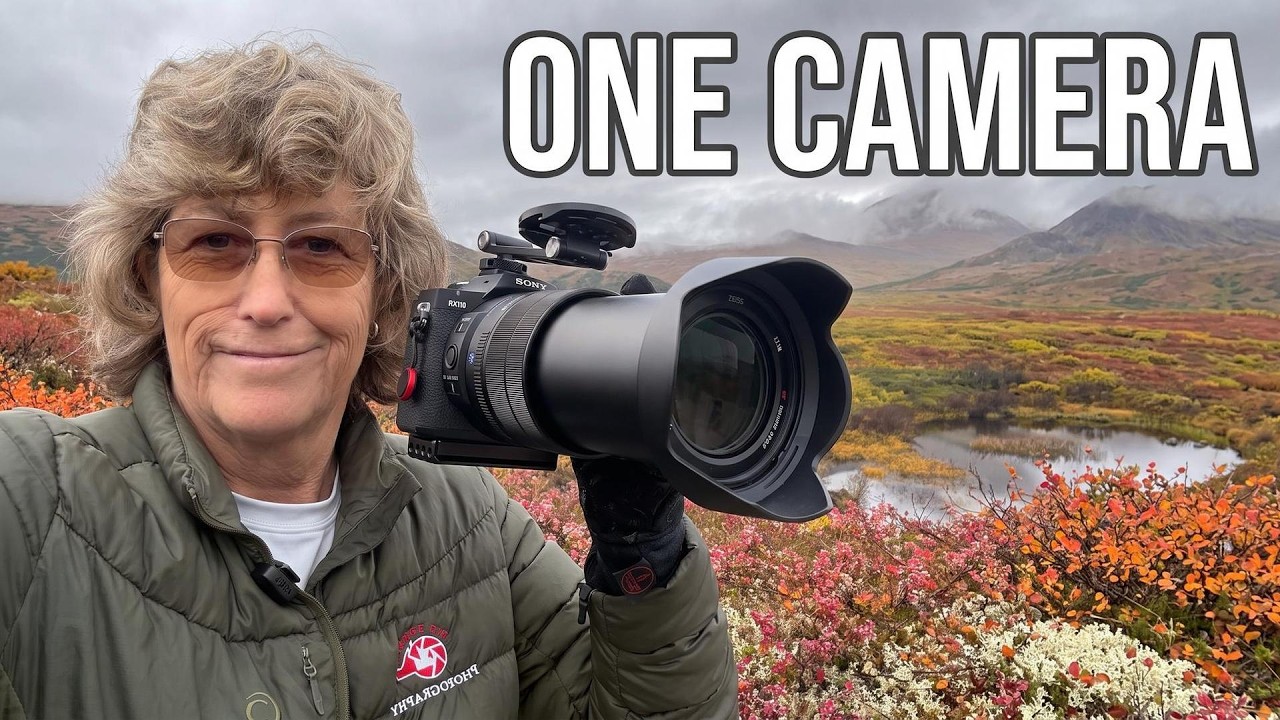
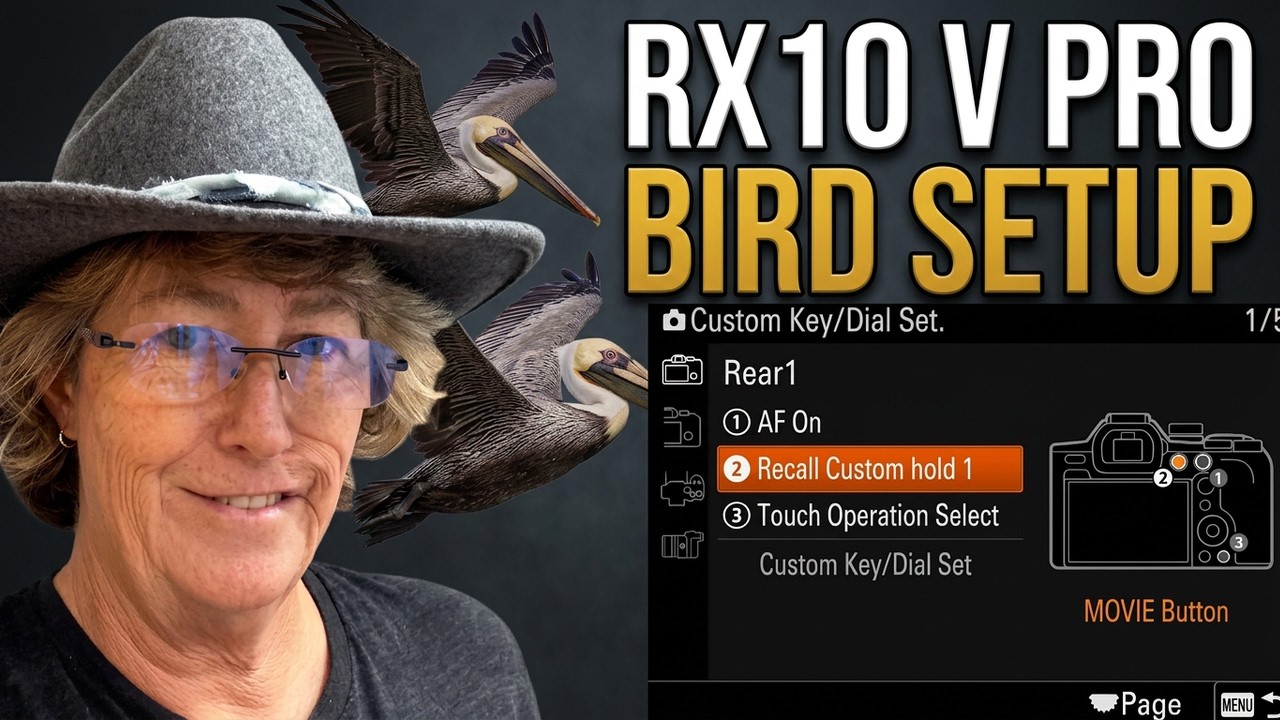
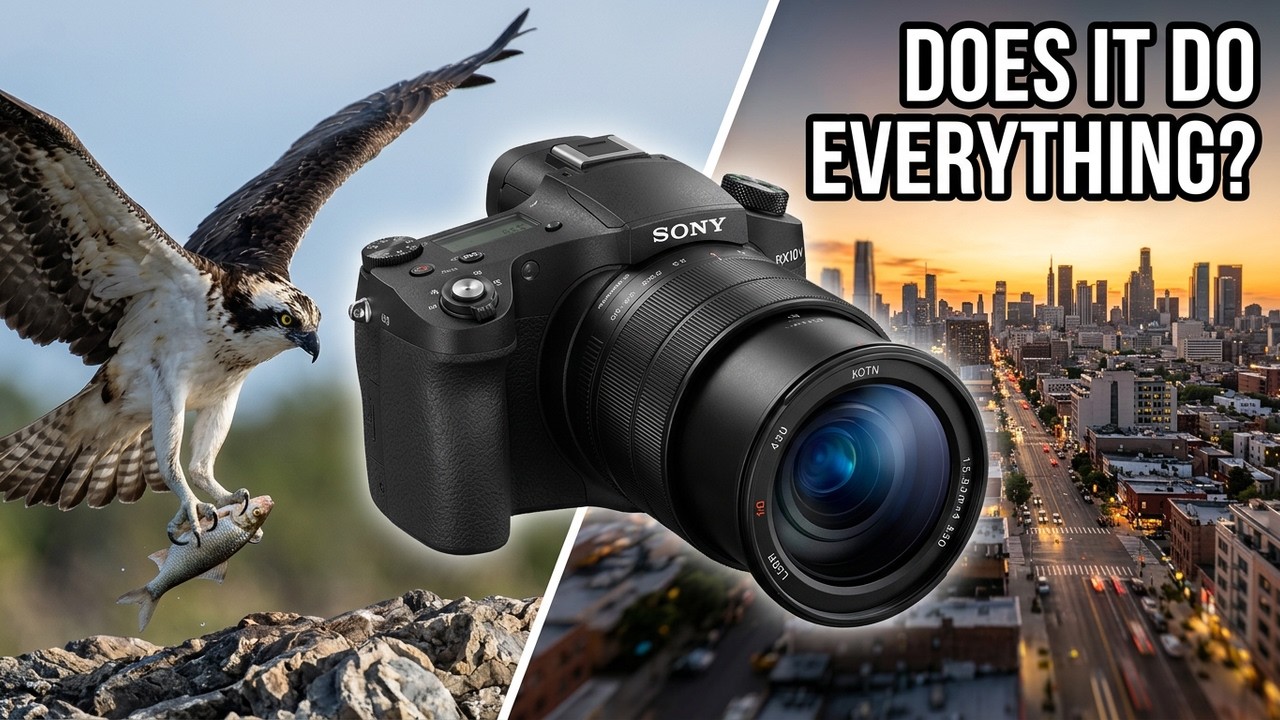
All right. So today I am— I brought the Sony RX10 Mark V with me. And let me tell you, I just got this in from B&H, and the camera, it— the body is built like the A1, but it doesn't have a detachable lens, and it goes to 600 at f/4. That's just amazing. And the photos, they're pretty darn good. I'll be doing a full review on the video later, but— And then I've also brought along My AX Vizio Saworskis to do bird ID in case I get one out here that I don't recognize. So what do you got today, Joe?
Well, first I'd like to ask a question about the Vizio. So how does that work? Do you just look at something and it— is it connected to the internet? How does that work?
No, it actually grabs your GPS location And then you choose the bird on there, and you look at it through the binoculars, and then you hit this little dot here, and the little little circle will go over the bird, and it will tell you what the bird is. And then the more lines that are around the circle is how sure it is of the species. So if you get a full circle, it's pretty pretty sure it's a Spoonbill out there.
Wow.
And then the thing that I love about these binoculars, though, is that you can switch here to like a target with an arrow. And if somebody doesn't see something, I can put the binoculars up, hit that shutter button, and it will pin mark that GPS location. And I hand them over to the next person. And the arrow inside actually points them to the location.
Oh my God.
Yeah.
Oh my God.
That is a really cool feature on these binoculars. It really helps with a lot like wild— like wildlife, because birds typically don't stick around long enough to tag them and then hand it off.
Right, right. Yep, absolutely. Well, it's interesting that you brought the Sony RX10, the new version, of course, the Mark V.
Yeah.
Because when, when I finally went to doing photography from birding, I've been birding for over 30 years. And during that journey, you know, I did a lot of digiscoping, like even way back in the day with an old Nikon Coolpix 995 and some homemade adapters and And all of that. And, uh, it just gradually wanted to do a little bit more, a little bit more. And so when I went into, you know, photography, photography, I started with the RX10 Mark IV.
Oh yeah.
And yeah, and that, that was a phenomenal camera. And I used it for 5 years and really started honing my skills in because, as you said, the, the body is Just like a regular DSLR or mirrorless camera body. It has all the same functions. All the buttons are in the same place, the little knobs, programming buttons, all of that. But you don't have the, you know, the big lenses to deal with.
Right.
And you get good, good magnification with that crop sensor to get you to equivalent 600mm. But then, you know, after the 5 years honing my skills with that, I finally decided I needed to to bump up to the new mirrorless technology. And so I am using the Sony Alpha 1. This is the— I guess there's a Mark II out now, but this, this is the original A1 with the Sony 200-600mm telephoto lens.
That's a great setup.
Oh, it's phenomenal. It's pretty easy to travel with because, you know, once you take the lens hood off, of course, it makes it smaller. And you can just fit it into a, into a bag and, and travel with it. Easy to carry around. And so, yeah, I've really been enjoying this A1 for especially bird photography and especially birds in flight, you know, any kind of movement. The tracking ability in this camera is— Oh, yes, it's mind-boggling.
It is. It is. But you know what? The new tracking in this R5 is— I mean, it's not as good, but boy, it's like 1,000 times better than the old Mark IV.
Oh, oh, wow. Okay.
Yeah.
Yeah.
That was my first response when I, when I brought it out and shot my first bird with it. I was like, oh, wow.
They really improved that tracking and it was already really good. It was. So yeah, no, that's, that's great. That's great. And then also too, for my regular birding, I have a 22-year-old pair of Leica Ultravids.
Oh yeah.
8x42s. And these have served me very, very well. They're still going strong and, you know, great glass there. And then from the scope perspective, I finally upgraded my 25-year-old old Gray Ghost Swarovski, you know, the old full gray scope.
Oh yeah.
Oh, it, it did really, really well, served me well for all those years. And but things have just come a lot further with the glass technology and so on. Did a lot of research and Settled on the, the Kowa TSN-99A. And so this is a 99mm objective. So this thing's bringing in a lot of light. And it is, it is an amazing, amazing scope. And it's really good for digiscoping as well. I do a lot of, a lot of digiscoping with this too and get some phenomenal photographs and, and videos. I'm starting to do—
Yeah.
More videos now too. So, so those are the the main piece.
Cool.
So what do you got there on the table in front of you? Is that some of your new gloves you got?
Okay. He'll be back.
So I'm filming chat.
I saw was that it says pop messages on it.
No, there's 5 people watching. All right, let's see. Where's Joe? He's lost in the desert somewhere. Well, oh. There he is.
Can you hear me now?
Yep, I can hear you and see you now.
Okay, that's good. Yeah, I don't know what the situation is. I have full 5G, but— and I'm on top of a hill here, so I don't know. Technology is what it is.
Oh yeah, it is what it is.
Yep.
That's the problem with going live on location, but that's all right. So—
Yeah, so you had some— you were mentioning something that I missed, so.
Oh yeah, what are the— you got some new gloves there I see in front of you.
I, I do have some new gloves, but would you like me to talk about the, the company as a whole and then get into the, the shirts and gloves and gaiters? Yeah, let's go ahead and do that.
Yeah, let's do that.
Okay.
Yeah.
All right, awesome. Yeah, so, uh, I—
Well, I guess we should, we should probably announce that, uh, that, uh, Jeff and Angie Photography is now official of ambassador for you and your products, which we're proud to be.
Yeah, thank you very much. How did that come about? If you wanted— if you want to explain that first, and then I can go into the company.
Um, so I, I literally one day I was scrolling the internet and I was at the Berdias Festival and I was like, what's the name of that shirt company that I, I couldn't go see because the booth was so busy? And I was like, oh, I know, I know, I know. And I looked him up and I sent him an email. And he was in— you were in Panama burning.
Yes.
And I was on my way to British Columbia to go photograph eagles. So when we got back, we caught up. But, but yeah, I had planned on going to Arizona to do this live thing with him. But I recently had a foot surgery. So traveling 14 hours with my foot down wasn't probably a very good idea. So we've came up with this idea for a live broadcast in 2 different locations. So hopefully everybody enjoys it. So let's, let's check out your products and let's hear the science behind these shirts that are so cool.
All right, excellent. Well, yeah, kind of a short version of the history is I was diagnosed with malignant melanoma for the first time in 1997. So, you know, almost 30 years ago, and Then it happened again in 1998, and then 2000, and then 2006. And so now, fortunately, everything's fine. Everything was treatable. Obviously, I'm still here. If it weren't, unfortunately, I wouldn't be standing here having this conversation with everyone.
Right. Thank God.
But since then, yeah, since then, sun protection has been Really, really important to me. You know, the UV radiation just does all kinds of things with your skin and your body and your physiology. And, you know, as I was out birding and so on, trying to keep myself covered up, you know, because obviously a physical barrier, i.e., clothing, is better than a chemical barrier. Like sunscreen. I mean, sunscreen works and all of that, but you can't beat an actual physical layer of protection on your skin.
Yeah.
And one of the issues that I ran into, and, and I got really, really frustrated because a lot of the sun protection clothing that's out there is very inconsistent. I mean, yes, it works. It does keep the sun off of your skin. But I just got real frustrated with sizing issues, quality issues, just real inconsistent product from, from one, you know, one month to the next, even, even within the same brand.
Yes.
And so I'm like, there has got to be a, a better way to do this. And then B, I realized that the whole sun protection industry has completely ignored us burners.
Oh, definitely.
Darn it.
Well, I think we lost him.
Come on back, Joe.
Come on, Joe. Where'd you go?
It's getting interesting.
I know. I wonder if he's got any chupacabras. Oh no, there he is.
Here I am. Sorry about that.
That's all right. That's all right.
All right, so let's see, where was I? Yeah.
They're ignoring us birders.
Yeah, yeah, completely ignoring us birders. And you know, it's something that people need to be aware of since we're outside all the time. In the sun, and the sun actually just came out and it's right in my face. And I'll tip my hat back down. But, but yeah, so when I retired from my regular work, I started thinking about, okay, how, how can we provide a better quality product and also make birders aware of the dangers of UV radiation? and provide a good product that will help them in the field. And so that's where all of that developed. And, you know, the, the core of the business is the SunShirt. And right now I'm wearing the newest one, and I'm going to turn around here and you can see the new Canyon Canopy design.
Oh, nice.
Yeah, so it has 5 birds on it that, that one would look for here in Southeast Arizona. And the, the artist did a phenomenal job with those species, and we make sure that the, the illustrations are fully accurate and to scale and just a really nice piece of artwork. And I'm going to be working with more and more artists over time and developing artist series of designs for the shirts.
Oh, nice.
But yeah, so that, you know, it's going to continue to expand in terms of the designs that are being offered on the shirts themselves. But designs aside, let's talk a little bit about the actual technology behind the shirts themselves. They are all UV or SPF 50+, sorry, and which is the highest one can have on a garment. That's the highest UPF rating. Sunscreen can go higher, but garments are limited at 50+. And so these are 50+, and it's not something that can wear out or wash out. It's actually built right into the fibers of the, of the material itself.
Okay.
So that's permanent protection with the shirts. They're also moisture-wicking, so they, they pull moisture away from your body, and what that does is help keep keep you cool when it's hot out, as you mentioned earlier. But the other side benefit to this is they also— that also will keep you warm when it's cooler out.
Mm-hmm.
So you can wear these as base layers and then, you know, put more layers on top, and this will actually keep your body at a good temperature because it's wicking the moisture away from your skin. And another thing that you mentioned, you mentioned the cooling factor, and there is something called the PureTech Cool Wicking Technology in the fibers. And when the shirts are wet, and same thing with the gaiters too, because the neck gaiters are made of the same material, when, when these are wet, they will actually cool to 70 degrees.
Wow.
And that's verified with temperature guns and everything. Now, your body obviously won't Won't go to 70 degrees, but yeah, the shirt will, will cool down, you know, like one of those cooling towels.
Yeah, I can definitely feel it when the wind whips through it. It's like, wow, it feels like cool wind.
It is.
Yeah, it's really— and it's actually happening here too. It's slightly humid because of the rain, and I'm feeling this breeze that's happening, the cooling going on.
Yeah. They're great. I'm in love with them.
Come on.
I think I cut out.
There you are.
You're back.
Okay.
So yeah, and there is one more piece of tech in the shirts I'd like to talk about briefly. And that is the M-Shield antimicrobial component. And what this is, is a zinc-based technology that prevents or inhibits bacterial growth. And so when you don't have bacterial growth, you don't get the dreaded polyester stank, and nobody wants the polyester stank.
No, definitely not.
Yeah, so if you've ever had one of the Yeah. One of the cheap polyester sun shirts and things. They're, they're awful. They, they reek.
I've thrown away a bunch of them.
Yep.
Yeah.
These don't do that. You can, you can actually wear these shirts multiple days and they're not funky. So now ultimately you have to wash them, but yeah, you can wear them repeatedly. And you know, when you're on birding trips or photography trips, Sometimes you can't take a lot of luggage with you. So this is something, a garment that you can take and wear multiple times on a trip.
They're lightweight too, so they hardly count at all towards your weight.
Exactly. Yeah, they fold up real small. They're very lightweight. And with that too— go ahead.
They don't wrinkle either. I mean, I had mine folded in the closet and I pulled it out and shook it out and there was, it flattened out real nicely. I didn't do anything to it. That's my kind of, that's my kind of stuff.
Oh yeah. Low, low maintenance or no maintenance is my, yeah. That's, I like that too. And that's the same with washing. I've had folks ask about, you know, how to care for the clothes. Chuck it in the washer.
Yeah.
Dry it. Totally fine. Doesn't matter temperature. Doesn't, you know, that it doesn't matter. Yeah, I typically do cold water wash and, but, you know, dry it normally, no problem at all. And the other thing too is the— any— all of the imprinting is done with what's called dye sublimation.
Uh-huh.
So the ink is actually fused into the fibers of the fabric. So none of this is sitting on top of the garment. It's actually in the garment itself, so it's not going to come off. It won't peel, it won't anything, and it doesn't create a big hot spot. Like if, if you had this shirt with this design on it, um, done through a normal direct-to-film printing method or something to that effect, that's going to be like a big piece of plastic sitting on your back.
Oh yeah, make you sweat. That's definitely—
Oh yeah, it's Yeah, so everything here is dye sublimation. So all of the functionality of the shirt is still intact, even with the design. So, so yeah. And then, you know, obviously this is the core. I mentioned before, we have neck gaiters as well.
Yeah.
So these, I actually prefer these over hoodies, you know, because we do offer hoodies as well. In the sun shirts. And some people like that, other people don't. I'm not a hoodie person, but that's okay because I'll wear a cap. And this is an RBA cap.
Yeah.
And a neck gaiter. And that'll keep my whole face, ears, neck, and all of that, you know, covered up and protected.
All right.
And then you mentioned the new gloves and these just arrived.
Yeah, I just got mine in the mail. Yeah, I, I'm going to use those dual, dual purpose fishing and photography.
Yeah.
Oh yeah. No, they, they're absolutely— yeah, it's a, it's a nice stretchy spandex and polyester material and UPF 50+, like, like all of, all of my products. And we did the— I call this genuine Faux suede.
Oh yeah, nice.
So nice. We got this art, you know, the, these synthetic suede material here to provide grip. So when you're out in the field, if you get wet, you can still grip binoculars, you can still hold a camera. It just gives you a little bit extra grip because otherwise this would be kind of slippery if, right, if you didn't have that. So yeah, I was thinking of both Yeah.
All right. Well, let's jump back in to do some bird talk. So here on the Gulf Coast, we're already starting to see some, some migration starting. We've got Let's see, 2 days ago, I know that there was some Northern Pintails that were pushing through and some Dunlins. Got some Common Yellowthroats too. Oh, and Wood Storks. They're, they're starting to show up as well. So it's kind of the sign that the seasons are starting to change. Fall migration here isn't nearly as urgent as spring. Spring migration, it's like you got a bird, you gotta go. Here it's like, oh, I'll get there eventually. But we still got the Painted Buntings here. They're probably going to pack their bags and leave here pretty soon. The juveniles are looking pretty good and pretty healthy. So, but so what are you hoping to see this week while you're there in— Well, in Arizona on that, what is it, the Arizona Birding Festival?
Yeah, the Southeast Arizona Birding Festival. And what was nice is I actually got to spend a couple of days before today over in the Chiricahua Mountains, which is somewhere I haven't been in a long time.
Oh, nice.
And so it was great to go over there and spend a couple of days, you know, birding in those areas. And yes, definitely migration is starting to occur.
Yeah.
Things, you know, and August is a really neat time in Southeast Arizona because a lot's happening at once. Yeah. First of all, all of the nesting species are still here right now. So, or Copper-tailed Trogon, I almost called it the old name, Elegant Trogon, Copper-tailed Trogon, Sulphur-bellied Flycatcher.
Oh, nice. Is that a lifer for you?
No, no. Yeah, it was— yeah, I saw my first trogon in 1997.
Okay.
Down here in southeast Arizona.
Yep.
But, but yeah, so those are all still around, which is nice. But there are also migrants now coming through from the northwest, such as MacGillivray's Warbler, Hermit Warbler, Townsend's Warbler, Green-tailed Towhee. Yeah, things like that. They're, they're now starting to move through southeast Arizona heading south.
Oh, cool. The other thing on their way here.
Yeah, well, yeah, yeah, they'll, they'll, some of them will come go east and head over there toward Texas for sure.
Absolutely.
And yeah, another thing with, with August is rarities tend to show up here in southeast Arizona at this time as well. In fact, there's a Tufted Flycatcher over in the Chiricahuas that people are seeing. I missed it, but other people are seeing it. So that's a really good bird for here. There was an Eared Quetzal over there for a couple of days last week. I looked for it, but nope, nobody has heard it or seen it in several days. So, so there are rarities around. And then finally, the hummingbirds are probably at their peak.
Oh, nice.
And so you have all of the nesting species, which there are a lot of, and all the juveniles are out now and feeding up and so on. But we're also, as part of the migration, the Rufous hummingbirds and Calliope hummingbirds are now coming through as well. So, so it's like a big smorgasbord of, of birds here in Southeast Arizona. And this is a really great time to be here. It is warmer because it's summer, but, you know, the birds are fantastic this time of the year.
Yeah.
Yeah. Right now I'm sitting here and I'm looking at, I don't know, probably a half dozen Rosiettes Spoonbills. Tons of skimmers. They're coming and going. Oh, here comes another roseate. I don't know how many egrets. Oh my gosh, I'm covered up in egrets. We had a fight breaking out here a little bit earlier while you were talking about the coverage on the shirts. I was like, oh, I need my camera. But we got a couple pelicans out there. The brown pelicans.
Yeah, that's a bit unusual. They don't normally have—
No, no, usually the white ones will show up in the winter, but not the brown ones. They're not usually here.
Don't like fresh water.
Yeah.
Yep. But yeah, this is, uh, it's a good day at Leon. Of course, then we have the neotropic cormorants hanging out. But yeah, so it's a, it's a good day in South Texas. Oh, and we have a magnificent frigatebird flying above us. Look at that. Nice. Looks like a juvenile. A magnificent frigatebird.
Females also have the white breast.
Oh, do they? Okay, get my binoculars and get, get some eyes on him.
And what's the oddest thing about the frigatebirds?
Uh, their name.
They get their name from following Uh, old sailing ships, frigates.
Oh, do they?
Yeah.
I would venture to say that's probably a mature female. Oh, and she just pooped.
Making room.
Yep, making room.
Yep. Their feathers are not waterproof. If they get in the water, they drown.
Really? I didn't know that.
Now, they can't take off from the water either.
It's been 3 or 4 months out over the ocean.
That's just crazy.
It is a pelagic bird and its feathers are not waterproof.
That's insane.
I know, that's what I said. Weirdest thing about frigatebirds.
That's a really cool fact. I'm gonna have to share that.
Yeah, and they cannot take off from land or water either. They can't lift themselves off. So they always, when they're landed, they're always in a tree or something like that, or a You know, tower out in the ocean or whatever. Yeah, if they, if they get on the ground or the water, that's it.
Yeah, yeah, that's, that's pretty cool. Oh, I see there you're a Master Naturalist.
Yes, ma'am.
Awesome. What's your favorite thing about Leonabelle?
Yeah, I mean, that's like saying which bird is that? Which bird do I like? You realize this is a White morphed red-eared peacock down here.
Yes. Yeah, I saw him earlier.
Okay.
Yep. There was also a juvenile, uh, tricolor here earlier too.
Yeah, there's a tricolor standing on the boardwalk over there. There's a pretty stock tricolor out here. Yep.
Yep. We got lots of birds here. Can they hear you? Yeah, they can hear me. Yep.
So anyhow, um, you haven't seen the least bit of a fly, have you?
Uh, no. Not yet. Not yet. I'm sure he's here though. Well, so anyways—
There aren't any Least Bitterns right here.
No, no, definitely not there in Arizona. Definitely.
Yeah. Yeah.
So, all right. Well, so if you are at the Southeast Arizona Birding Festival, stop by the booth and see Joe and say hi and pick up some of his amazing shirts. And thank you, Joe, for sharing your wonderful apparel. And Jeff and I are really proud to be ambassadors for your products and looking forward to working alongside you. Oh, and I didn't show you guys the new shirt, the Feathers and F-Stops. Let's see here. How can I do that?
Oh, hmm.
I don't have a way to shoot. Well, there'll be a link down below to the new shirts that'll be on RBA website, and it's Feathers and F-Stops. That's our community on school, and we love to do live monthly broadcasts and sometimes more. We talk birds, birds, birds, and more birds and photography.
And photography.
Yep.
Yep. And I tried to post a bird daily tip, something to look for. Let's see, 2 days ago was watch for heat shimmers. Day before was— what was the one day before? I don't remember. But last Tonight was, um, when you see a beautiful bird with iridescent feathers and you don't get it in the viewfinder, move with your feet because it all has to do with the angle of the shot. So you can't bring it out post if you don't capture it in the camera. So anyways, I'd like to thank you. Thanks for coming. And as always, remember, don't be a Karen and keep on clicking.
Bye.
See you later, Joe. I'll talk to you later.
Thank you.
All right, thank you very much. All right.
Bye-bye.
Bye-bye.