🎙️ EP04: Market Roundup with Inma Martinez — Christmas Comes Early | InvestHer Podcast
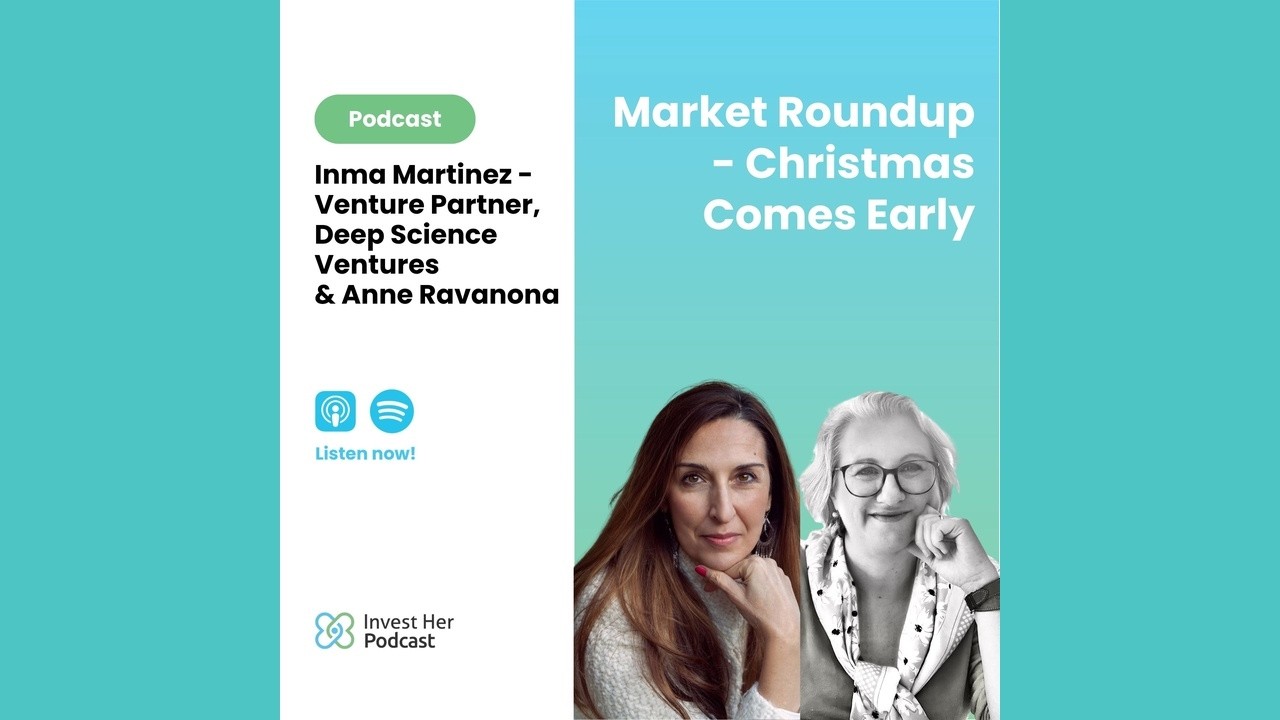
In this episode of the InvestHer Market Roundup, host Anne Ravanona (CEO of GlobalInvestHer) and guest Inma Martinez (venture partner at Deep Science Ventures) discuss the rapidly evolving European startup funding ecosystem. They begin by celebrating the newly launched Borski Fund, a €21 million vehicle dedicated to female founders in the Netherlands, and explain its historic naming after 19th‑century Dutch investor Johanna Borski. The conversation then shifts to a wave of large European VC fundraises (Northzone, EQT, and others) that are dramatically larger than the regional average, and to the unprecedented move of US‑based venture firms opening European offices. They analyse why US VCs are now looking for pan‑European, high‑growth opportunities and how this changes the expectations placed on European founders. The EU’s VentureEU programme is unpacked: six public‑private funds pooling €2.1 billion to back smaller VCs, with the aim of scaling European capital supply. The hosts provide a practical fundraising playbook – from understanding equity vs. debt instruments, building pre‑money valuations that incorporate book value, intangibles, and founder credibility, to tailoring pitches for US versus European investors. They also discuss market realities such as the unicorn gap, recent stress signals from high‑profile companies like Uber and Airbnb, and the broader bubble‑burst narrative. The episode concludes with three key take‑aways: (1) Europe now has sizable capital pools that will fund multiple growth rounds; (2) US investors will demand pan‑European product roadmaps and bottom‑line earnings; (3) founders must master valuation, execution, and continuous investor dialogue to capture the coming funding wave.
Chapters
So welcome back to another episode, episode 1 of our market roundup with Inma Martínez and myself, Anne Ravanona. We're delighted to have you back, and in this episode we're going to tell you about the next European fund for female founders, And lots of great news about the big money coming to Europe and what you need to do to get your hands on the money from European and US VCs in Europe. So listen up, lots of great value bombs coming in this episode. Enjoy! So welcome everybody, uh, I am— okay, let's start again. So hi everybody from Paris, welcome to Market Roundup, the new podcast by Global Investor that covers the money markets and the economic news affecting innovation funding, startups, capital requirements. My name is Anne Ravanona, and I'm CEO of GlobalInvestHer.
And I'm Inma Martinez, venture partner at Deep Science Ventures, an innovation institute for applied sciences that funds and backs young scientists disrupting industries. Hello from London.
And you learn more about Inma on our previous Market Roundup episode, episode 2, on Apple Podcasts and GlobalInvestHer podcast. Episode 0 when it comes to Market Roundup. So before we get started, Inma, let's, let's see, have you got any shoutouts to mention? What should we know?
Well, big shoutouts and congratulations to the Borski Fund, the Borski Fund in the Netherlands, which is a truly special fund because it just raised €21 million to invest on female founders. Hooray, hooray, hooray, hooray. So who's behind this fund is quite interesting. It's all the brainchild of Simon Grummelshuis, the founder of The Next Women, which is a network that was created about, you know, 10, 12 years, 13 years ago across the Netherlands and the UK and London. And it was a really nice get-together for female founders female startup founders to meet up, to listen to other founders and get inspired. And what Simone and her team have done is to really push the envelope in the Netherlands. Basically, they have made the 3 largest banks, ABN AMRO, ING, and Rabobank, to commit each of them with €5 million to the fund. They then continued to pass around the hat and went into, you know, the Van Lanschot, which is a private bank and asset management company. And then again, contribute to the fund. And then they went for family offices, private investors. Basically, the whole of the investment community in the Netherlands has put money into this. It's a huge win and huge congratulations to Simon and the team. And, you know, Dutch founders, lucky you people. You know, you now have the nation and the money behind you.
And I think what's brilliant is, as you said, they have brought the whole funding ecosystem together. That's what's interesting. That's what makes this very, very special. Big shout out to you, Sibonne. You're amazing. We met many years ago, but I love what you're doing. So, okay, Inma, where does the name come from, this Borski? Where does that come from?
So this is really interesting. So obviously, you know, they named the fund after a lady, Johanna Borski.
Hmm.
But, you know, I'm a detective, you know. So you go into the website of the fund, who is Johanna Borski? And it says she was a Dutch female investor who in the early 1800s, you know, invested not only in the Bank of the Netherlands, but also saved from bankruptcy the Netherlands Trading Society, which if you're familiar with the West Indies Company, you know, the British side, This was like the Dutch version of that. You know, when Holland and Britain had the Indies, you know, there was this massive trading company that was shipping all the goods—
Merchant Bank.
Merchant Bank. Well, apparently in the 1840s, you know, it was about to go bankrupt, and who came in to save it with a super package was Mrs. Borski. But when you imagine this lady, It's not that she was, you know, imagine this is a lady in the early 1800s and all of a sudden she's like, what, Mrs. Moneybags? Where does that thing come from? Well, she was married to a very successful merchant and investor himself. And they had 5 children. It was a very prolific family. And she and her husband were very kind of visionary at the time because They had and owned big houses where they used to throw amazing parties. But these were not like dancing parties. These were parties where intellectuals, bankers, and people—
Yeah, the intellectual salons of the day.
Yeah, like Napoleon and Josephine used to go there.
Wow.
Imagine that. So when the husband passed, This lady looked around and saw herself a widow, 5 children, and a massive business that the husband had left. And rather than hiding into a corner and like, oh my God, she went and said, right, roll up her sleeves. And imagine what people would have said of her, like, what is she doing? You know, she then did the business of a man. She jumped on her husband's chair and put the helmet on and said, okay, I'm not going to let my husband's business die. I'm going to drive it. And then what nobody expected is that she was going to do it so well and so boldly. So that is the nature of her, that she rose up to the occasion. You know, when life throws at you horrible things, imagine your husband passes and it leaves you all alone. she then rose above, you know, all expectations. So big admiration for Mrs. Borski, Johanna. And what a lovely name for a fund to invest in women, don't you think?
I love it. And you have just introduced me to another amazing feminist that I didn't know. And I think it's so important that we rekindle their memory and to show, because they have been— she has been Honestly written out of history. Inma, I didn't know about her until you've mentioned it, because you did the digging. And I'm so glad that Simone chose that name. And obviously it's a good— I think it's a clever use of that. And I think it's a good lesson for future fund creators and fund managers, is to buy into a legacy that's already there. It's very clever on her part to do that, and also obviously to buy into the national pride. And that's how she was able to say it's all these Dutch stakeholders who are coming in and that we're going to make this a part of national pride. And I think that's very clever on their side. So long live the Borski Fund. Hats off to Johanna, and I'm so glad that she existed and she rolled up her sleeves. I love the way you painted that picture and, and just dove in after, you know, inheriting the money. And again, a great role model for future women, as we know there's going to be trillions and trillions of dollars being transferred of wealth, particularly in the US, in the next year. And, you know, to all those women who would be thinking of philanthropy as the main way of using that— ladies, come contact Inma and myself and the other people. I'm deadly serious because we can help you to invest in the biggest opportunity in the world, which are women entrepreneurs. And we are like creating incredible businesses and making more money than the guys. So come see us. There you go. I just threw that on you, Enma. You didn't know I was gonna say we're launching a fund, but there you go.
I just love how politically incorrect we are in this podcast. You said it, like, we're better than the guys. Ooh my God, the stakes are high.
We're just getting started, guys. So just watch out. So thank you, Johanna.
Who said that women don't like to compete?
Oh yeah.
They haven't met us.
They haven't met us.
They haven't met us.
They haven't met us. Okay, so right, let's get into this month's topic, which I have to say, it sounds like music to my ears. More funding for European startups, more chances for entrepreneurs to get the money they need. Tell us more!
Well, it's kind of like the big money bonanza. You know, like we all pray and we all say, okay, I must achieve these, you know, these big huna prayers and the mantras that would be, let me be strong. And, you know, many entrepreneurs is like, please God, help me raise €1.5 million, yeah?
Yeah.
And oh my God, the floods, the gates of heavens have opened. You know when the universe gives you more than you are praying for? This is exactly what happened in the last couple of weeks. So there's 2 events colliding. This is like double Mercury instead of retrograde, prograde. So on the one hand, almost simultaneously, 3 of the biggest venture capital firms in Europe raised hundreds of millions of euros, which this is one element that we will cover, we will discuss now.
Yeah.
400 million, 500 million funds. This is completely unprecedented. The average size of a European venture fund is about €56 million.
Yeah.
So imagine our shock when we were reading the news, like, you know, 400 and 500, what's going on?
Yeah.
And then on the other side, the thing that we never thought would happen after 20 years of European entrepreneurs wanting American VC money, The American VCs of pedigree are opening up European offices. Woohoo!
They've copped on.
And this has had like a funny moment in Twitter because you had people like Fred de Stan, you know, like one of the wisest and most active VC guys in Europe, saying things like, the Americans are coming to eat the European lunch. There will be blood. Like, wow, is this thing a horrible thing? And then, you know, the way I see it is like, yes, bring more money!
Exactly! It's what we've been saying for donkey's years. Like, we need bigger money bags in Europe so that our European startups, when they're scaling up, instead of knocking on the doors of the Americans in the US and having to flip their companies and all that IP and that expertise going over to the States and building up their stockpile of incredible innovation advance. Let's keep it in Europe. And I'm so glad to hear you share this with us. And like you, I'm doing the rain dance here.
Yes, big Mexican wave, European style. It is a big deal. I'll tell you why. Because if you just look at the numbers, just 2016, you know, just like 3 years ago. According to the EU public figures, in 2016, venture capitalists invested about €6.5 billion in the EU compared to €39.4 billion in the US. I'm going to say the same thing, but in a more like English for my mother kind of sentence.
Yes, I like it.
What that means is that European startups received only $6.5 billion of investment versus US startups received $39.4 billion.
Yeah.
And of course you can say, yeah, but the US market is a 300 million people market and Europe— well, we have the same size if you compare both nations, you know. So it's literally always the US pours funding into their own innovation and this has Many explanations, you know.
Mm-hmm.
On the— the first one is, in the US, the funds are 3 times the size—
Yeah.
Than the ones we have in Europe, right? And the effect of having tiny, tiny funds made the European VCs completely inadequate to really scale up to the growth needs of their portfolio companies.
Yeah.
Even if you were gonna be like the biggest hot investment out there in the market, you had to go to the US to get the money that you needed for the runway because you could not find it in Europe.
Yep.
And that is what has happened to things like Spotify, SoundCloud. But what happened is that you would be suffering in silence in Europe doing A rounds and B rounds. And only if you were still alive and still attractive, you would then get American money for the Series C. Yeah, yeah, these guys were like, oh, Series C. Oh, and by the way, for the US market, otherwise we don't care.
Hold on a second, Inma. For some reason the, um, the sound went wonky when you were just saying that last sentence. And yes, thank you for the hair because that is making a noise, but you were just saying Repeat the thing. So the Europeans were doing A and B and only— so say that.
Okay, okay, let me just— I'm gonna close maybe my emails in case things are happening. So, and what would happen is that the lack of sizable funds in Europe would force European startups to kind of try to grow within Series A and B being done in Europe, where there was the only money available to you, and then hope that the C round would come from the US, which again came with predetermined requirements. Like you have to have a US expansion, et cetera, et cetera, et cetera. I mean, in the old days, in some cases they would say, you need to move the management to the US.
Yeah.
I remember when I was told, you know, I was like, why don't American VCs invest in Europe? They said, do you see these guys jumping on a plane and coming to Europe? That's it.
That was, I mean, There's no longer that excuse.
Exactly.
With video and everything, come on. And all the environmental footprint and so on, that is rubbish. We don't want to hear that anymore.
Exactly. So, and then, you know, why— this is like the chicken and the egg. So why didn't the VCs in Europe have more money? Because they were not able to attract the super big asset management companies to put money into them. You know, it's just chicken and egg. And then thirdly, you know, the European unicorns, meaning companies that reach a valuation over $1 billion, the number of unicorns that we were able to produce in Europe was like next to nothing compared to the US.
Yeah.
I mean, in 2017, you know, there were— Europe had 26 unicorns and then there were like about 109 in the US and 59 in China.
Yeah.
But, you know, life is funny as life passes on. And this is exactly what is now making the US money come to Europe because the whole unicorn fiasco has exploded. And what investors in the US are looking for are companies with less capitalization, more efficient. Remember we were talking about being efficient as a company in terms of your funding?
Yeah.
And then more truthful business models that are aimed to actually make money someday, which is the typical European mentality. You know, one of the big criticisms that European VCs used to be challenged with was that, oh, European VCs, they're not risk— they're risk-averse.
Dares.
More like private equity, And what does that mean? Okay, well, private equity is zero risk. Private equity comes when a company is already a market leader, huge sales, it's international. And that's when they put the money because they want to exit really quickly.
Yeah.
And VCs in Europe were asking you questions like you were already a full-fledged SME.
Yeah.
Where's the risk in that? And so now the tables are turning and we're finding that the European startups were always challenged, now is their advantage. We are more conscientious about how we spend the money, how much money we raise, you know, building real models that are aimed to actually create net income. And finally in the US, because the whole unicorn party has exploded in their faces like a bad nightmare.
Mm-hmm.
Now they're coming to Europe to actually see, okay, what is it that these people have to offer? So we're gonna be living the most exciting next 18 months that the European venture capital scene has ever imagined, because people are gonna get funded and they're gonna be able to choose which money they want.
Yeah, I love it. So there's a reversal— there's a few things that come to mind when you say that. Number one, it's like the The myth of Silicon Valley is really starting to lose its shine, number one. And what about the European— we have to find a new term for this, Inma. I think we need to find a new— it's like instead of Silicon Valley, it's like the Euro— I don't know what we can say. It's— Ah, we have to find a term. We will find a term. But basically We are now seeing that it's not all rubbish what we've been doing in Europe. And it's so interesting because when you were talking about the different unicorns and so on, and I was just laughing because I was looking, I started writing down some of the big European successful ones. And so many of them start with the letter S. It's like Stripe, Skype, Spotify. I was just going, what is this with the S?
Wow.
So maybe we're gonna—
Scandinavian.
Yeah, exactly. S for Scandi. Indeed, indeed.
But we gotta find out what's funny also. You know what's funny? Okay, so the most active venture funds in Europe, obviously they are British funds.
Yes.
But the Scandinavian funds, these Vikings, you know, the spirit of Erik the Red is rising because North Zone Ventures, for example, which is a tier 1 venture capital, super active from Sweden, they have raised €500 million, but not just to invest in European startups. If you look at their press release, it's, and also in East Coast of US. The Vikings are jumping from Greenland into the Boston area. It's like, I love them. I love them to bits. It's just extraordinary. And the other venture fund that raised a huge— I think it's $400 million— again, EQT, another Swedish fund. I mean, it's really extraordinary. The Scandinavia, these are small nations, 9 million people in Sweden, you know, like the size and the hunger to invest and create startups is It's unprecedented.
It's the pioneering spirit. I love the way you say it's the Viking spirit. It's— or the Danish, they say the Viking because they pronounce the W like a V, like a W. So it's the Viking spirit. So this Viking spirit is, is, is, is absolutely part of that pioneering spirit. And it's so funny because we're— for all of you out there, we're actually recording this podcast on Thanksgiving. So I think it's great that we're talking about the pioneering spirit coming out later.
But yes, you know, I do think— Turkey, we're gonna, we're gonna eat pølse, meatballs. And what do you eat in Denmark?
Oh, I can't remember. Their national dish has got meatballs in it as well with this kind of puree, so, and beetroot or something. But the thing is that, you know, I was, as you were saying these things, Inma, I was kind of saying, right, if it's Silicon Valley, I think that we should call it Europe Rising. This is the Europe rising movement because Europe is rising. It's rising up. And I think that we're going to stand up for ourselves and realize, yes, we are very culturally diverse. So where we were saying in the past that having a homogeneous culture and funding culture and so on and size of market in the US and in China— let's go both sides of the pond— is what's made them very powerful because it's easy to do business in those markets. And Europe has always been tagged as difficult and complex because of our very different national cultures and ways of doing business. And I think that with the internet, with Bitcoin— or not Bitcoin, blockchain— with the internet, with blockchain, and all the new innovations that are here, those national cultures are still strong, but they're not as divisive, let's say, in the business and the funding world as before. And I think that now Europe is rising and we're realizing that we have got to come together to fund our startups and to keep the innovation in Europe and to kind of get back on the playing field. The US would not exist without Europe, okay? That's a fact. They wouldn't be there. And we love you, America, but it's a fact, okay? And I think that Europe is really good at looking at our history and thinking that it's all in the past, our glory days. But I think that our glory days are rising again. And in the same way that Asia is very much rising at the moment, I think that Europe is rising too. So I've given it a term. It's the Europe Rising. That's what it is.
The phoenix. The phoenix from the ashes.
The phoenix. It is.
I think it—
European phoenix. I like that even better.
I think it is also European pride, you know. Yeah, it is. We're so low-key and we just let the Americans, you know, jump and jump around and be arrogant and be like, we are the champions. And we're like, fine, fine, just give me another pint.
I love it.
Give us a pub. Give us a pub and we're happy.
Yeah.
But it's the spirit of inventiveness. I mean, you think about where does the innovation of the new technologies come from? Well, you know, the WhatsApp founders were Russians.
Yeah.
Spotify, Swedish. Skype, Danish and Estonian.
And Nikola Tesla. I mean, let's not forget him. I mean, I know there's all the buzz Edison, but hey, you know, Tesla actually was behind a hell of a lot of those patents and innovations, okay? And that's a fact. So it's— I think—
I think it's going to be interesting to see what's gonna happen when Series A and B in Europe are bigger.
Yes.
I think it's gonna be really exciting if you really fuel money, proper money, to very good ideas. in the hands of European founders. What can we do? What limits, what skies are we going to reach? And I think it's going to be high. Exactly.
Because when we put the fund— let's unravel that bit— because when you put the money behind worthy endeavors and behind real pioneering, that builds the confidence of not only the entrepreneurs but the whole ecosystem around them, all the suppliers, the governments, and so on. Oh, okay, yeah, this is actually a good thing. And then Europe suddenly says, okay, we gotta get in on this. So tell us a bit more about this new injection in Europe of capital, Inma. I know you've lots to share on that.
Yeah, well, I, you know, I always like to know who are the limited partners of venture funds.
Yeah, who puts the money in?
Who puts the money into the funds? that venture capital firm has. And funny enough, in Europe, a big, big investor in companies is the European Union money.
Yeah.
And about a year ago, so now look at the timing, exactly around April 2018, the EU released a huge statement and announcement which was Okay, funding SMEs in Europe and startups is really poor and more funding is needed.
Mm-hmm.
So the EU, meaning the single market, is going to create 6 massive investment vehicles that are going to pour into 6 of the most reputable asset management companies that we have here in Europe. And we're gonna pour this money into them so that they in turn invest in venture capital firms' funds. This is where all this ton of money is coming. Money, like I explained, money does not evaporate. Money—
Money follows the money.
Money is always flowing.
It is.
It's sitting somewhere. Funny that we say evaporate because the only thing that evaporates are valuations.
I love it.
Which are not based on money. They're based on pie in the sky. But money is sitting always somewhere, is invested always in some place. Money's always flowing. So the EU has decided to allocate the single market funding, part of the funds, into creating these venture funds.
Yeah.
The Venture EU. And how will it work? Well, you know, they put together like a total of €410 million, you know, into private investors. So the 6 Venture EU funds will raise up to €2.1 billion of public and private investment. So that means that these 6 Venture EU funds will invest around 25% of the target into smaller VCs. So this is what has happened. The money that these VCs have raised now, part of that I bet you comes from these because where the money went, it went to companies like Axon Partners, Aberdeen Standard Investment, Isomer Capital, LGT, Lombard Odier Asset Management, literally asset management companies, professional asset management companies.
Exactly, which is what you'd expect. I mean, they have to be completely accountable, the EU, for the money and where it goes and track trace and everything. everything and needs to be done properly. So you'd expect them to be putting it into money vehicles where they know it's gonna be managed correctly and therefore, you know, who will push it into the, into the validated, tested VC funds.
Exactly. So we— Europe is typically a market that has a lot of contributions from its government. It's not so much private and private and private. It's like the governments have a conscience as to like they need to be behind the innovation and the enterprise of their own markets. So yeah, it's gonna be— what I think that the step now is, okay, how does a European founder learn to deal with American VCs?
Has anyone ever met investors?
Yes, tell us.
Let's break it down for the lessons to be learned. What do you need to do if you're a European startup looking for money and you need to approach an American VC who's suddenly coming to Europe?
So, okay, so let's just, let's just make the list of what is it that people think of American VCs. Well, they're very pushy. Yeah, they're very aggressive dealmakers. You know, they take very bold early bets. You know, when it's like a guy and his mate with a little plan in a beer mat, on the back of a beer mat, boom, $1 million. You know?
Yeah.
You and I always talk, often talk about, you know, remember that entrepreneur we met? They raised $1 million. Like, really? Like, in a week? This is like surreal for us in Europe. And it's because in America, the typical VC mentality is like, bam, here's a ton of money, which creates Good and bad situations, you know. Let's not forget the founders of Instagram. Initially, Kevin was going around with an app about finding bars that will serve you bourbon whiskey, and he managed to raise half a million dollars for that. I mean, this is like, Jesus, I want to be in America.
Yeah, that famous dog walking app last year or something that raised They got something like $300 million, and it just made me actually sick because who needs another dog walking app? I mean, I prefer that to go into health tech, med tech, you know, all the green companies who are doing new energy, top innovation in space like in your recent book. And just a little mini plug there, Ilma, because you've just come out with an amazing book. But it has to be feeding into proper innovation, you know, rather than—
Well, so it is a market Remember, this is the retail of the world. The Walmarts, the Amazon, the Americans are big into retail. So when you go with a consumer proposition, they always want you to target huge markets because they are used to the sheer volume of the opportunity.
Yes.
Why, if you were a French entrepreneur or you were like a Spanish, markets of about 45 million people, This is like peanuts to them. They're like, no, we can't invest in a Spanish retail business because, you know, what market is that? This is nothing. This is like the state of Texas on that side.
Yeah, of course.
So one of the things that's gonna happen is if you are B2C, having American money is gonna force you to address Europe as a whole. They are used to huge volume and also big bold moves.
Yeah.
You're not gonna go to them and say, we're gonna start first in Europe, in Spain. No, no, no, no, no, no, no. Go bam! And that's something you need to consider if you are a B2B.
Well, hold on, sorry to interrupt you there, Inma, but let's pull that apart a tiny bit because if you're saying that they're gonna force you to look across Europe as a whole, I understand it from the market perspective, yet Even though I'm saying, you know, we need to kind of blur a couple of the cultural lines, as I said earlier, the fact is that, you know, doing business, there will be some legislation hurdles maybe that be different, or VAT, or different hurdles that means that going in and going for several markets at once with the language barrier, you may have to change all of your, you know, your content and your communications into a new language, etc. You know how it's also I think we need to do a bit of education. I like the way you say the the the money is turning, turning the the power is turning. So now in in the next eighteen months, startups are going to be able to choose where they want to take the money from. Okay, and it's a bit like the flipping of the real real estate markets where it goes from a buyer to a seller market and vice versa. And in this instance, I think this is where the Europeans can also teach. about, as you said earlier, not being so aggressive to go for the whole lot and like choose how to segment in a more intelligent way or to scale in a more intelligent way. It's not all rush, rush, rush.
Let me just do something right. So the way I'll explain to you how a venture capital Plans their investments. Yeah.
Yeah.
When you raise a fund, normally the life of the fund is about 5 years.
Yeah.
Meaning, if you raise $400 million, you need to invest an average of about $80 million a year.
Yeah.
Maybe more aggressive at the beginning. And then you leave the last 2 years to actually go for other rounds for the ones that are doing well in the portfolio.
Yeah.
And still have some money for them. But that means that the investors will be able to open up and spread their array of investments and also their allowance for risk.
Yes.
Because, you know, you never know how something is gonna be run until you're actually in it, seeing it functioning.
Yes.
So it's gonna lower the aversion to risk. And it's going to increase the number of companies that they invest every year in.
Yeah.
Now, being a European entrepreneur, because all this money is coming into the market expecting a lot from you, you're gonna have to perform at a higher level of scalability and growth. You know, you cannot just say, I'm gonna start in Athens and and if in the next 18 months I do well, there is no time for the wicked.
Hmm.
You will be pressed to actually present pan-European scale-up businesses that can respond to the need to actually demonstrate that your business can become international and global. So that is the handicap. You're gonna be in front of a ton of money, But also you're gonna have to learn how to then launch yourself, propel yourself into the market internationally much, much faster.
Hmm.
10, 15 years ago, what investors, risk-averse investors wanted was, let's cut our losses short. Let's make them into the number one in Germany.
Exactly.
And then once they prove the business model in their local market, either A, they get acquired by someone expanding like crazy, Which is what happened to Ricardo.de, which was bought by Amazon. It was like the Amazon of Germany. And many, many other companies that all of a sudden, you know, the entrepreneurs only operated in the single market in Germany or in France or in Spain, and then they got acquired and bingo.
Yeah.
Had to build international businesses. This is typical of Southern Europe.
Yeah.
Or Spain. And now because the American money is coming in, It's like, fine, show me, show me what you can do. Here is the money that we have. They will demand an international mind. They will demand a pan-European approach to rolling out very, very quickly. And to be fair, from the regulatory point of view, thank God for the EU because we have all of that sorted out because we're a single market.
Yes.
The ones that are gonna have a pandemonium are British companies out of the EU.
Yes.
Wanting to now roll out into France, into Italy, into Germany. Oh my God, what are we going to do with the VAT? What are we going to do with non-double taxation? They will not be able to be that attractive. These are things that, you know, start thinking about them because they will come into play.
I think that's very insightful, and I think that we will definitely be having more talks about Brexit impact in the coming weeks and months. I think that's definitely going to be on the agenda. So you've said how European companies need to adjust to this American capital coming in. What would you say, how else should companies get ready for For looking for money, because there's 2 different philosophies when it comes to VC funds: the American funds and the US ones. So tell us a bit more. Can you break down each of those very briefly so that our listeners can say, okay, right, so if I'm a European startup and I want to get European money, and this is how I'm going to need to approach the European funds, and if I'm going to approach the American ones, like you've just said, that's been very clear. What else do I need to know? So can you break that down for us?
So if you want US money, you're gonna have to have a very bold and global and pan-European approach to your business. Yeah, that's what they like. Yeah. If you want European money, you will gain the knowledge and the understanding of Europe from European investors.
Yeah.
Yeah. This is their market. They are as German or as British or as Swedish as you. So they will understand it.
Yeah.
Some of them now have sizable funds. Thank God for that. Congratulations to Balderton, to North Zone, to EQT. MMC Ventures in the UK has another $100 million fund. This is really exciting. And these are proactive, very active, and very knowledgeable investors. I love them all. Fantastic people in each one of them and very good portfolios. So you will be able to have mature conversations. You will be able to say, look, it will be easy for me to tell you that I need €2 million, but if you were to ask me what I really would like to have for my vision, I'd like to have €3 million. And now you can have that conversation.
Yeah.
Before, most people were like, the bare minimum, the bare minimum, because I don't want to dilute that much Because when you go raise money, remember, there is a pre-money valuation. Like, up to what value you have grown the business so far. And from there, we're gonna create your post-money valuation, meaning when I give you the money, this is what you're worth right now.
Yeah.
But you have to work so hard to create asset value that you don't want to dilute like crazy In your Series A. You don't want to dilute everybody and yourself for a Series B. So you need to claim a sector multiple that is high enough to— for you in the future to still fundraise with proper adjusted valuations to motivate everyone.
So put that into plain English for my mother, because now you've gone into, into jargon.
It's a target. So let's imagine that you build a company and you run it for 2 years.
Yeah.
And okay, what is hot right now? Well, of course Netflix and Amazon, and it looks like the digital film and streaming and all these platforms. Yeah, this is the hot, hot place where everybody wants to get into. Okay. And data, data, artificial intelligence, all these platforms.
Yes.
So if you raise £2 million and you have raised previously £500,000, your value by the book, by the book is, well, £500,000, which is the money that you raised, plus any contracts or any revenues that you have managed to achieve through your customer sales or whatever. So basically it's very poor.
Yeah.
book level, you're like under a million.
Mm-hmm.
But of course, you're entering a really hot, sexy sector that is growing at a 3 times multiple. So you have to be bold to say, look, I'm not selling candy or ice cream on the high street. I am in the multimedia platform AI biz. So you then assign yourself a valuation that is very, very, very close to that at least $1.5 million pre-money. So then somebody gives you the 2, and then eventually post-money, you're $5 million worth. This is how it works. This is like the 1, 2, 3, 4 of the assumptions as to the value of something. The value of something is a combination of its real money in the bank and its potential.
Yeah.
And its potential.
Yeah.
So any customer relationship, any partnership you have, like we have a partnership with Dell Technologies, you know, the big partners of McLaren and Callaway Golf. And, you know, so they are also supporting us in our expansion. Well, that has value. That has value because you are achieving things without having to spend money. You're achieving things thanks to the partnership you have with these big players. So that has to be worth something. You know, the famous worth something. Oh, You manage to create a reputable, trusted brand in the market that you can value financially in your balance sheet. So that is not money, banknotes and coins in your bank account, but it has a financial value. It's worth something. So you build that, your value, also the value of the people.
Mm-hmm.
When you say, who are the founders in this startup? And you say, look, I am an AI computer science major and I'm— and my partner did this and that. So you see that the background of the founders is stellar, stellar. Well, that obviously adds value to the valuation of the company.
Yeah.
So the world of investing is a world in which you appreciate the assets You know, the people, what they have built, the brand, the client relationships. And then you look into what is really money, money, like sales, revenue, and money raised so far. And it's a combination of the two.
And in the money raised so far, it's equity only or debt?
It's both? Um, no, debt doesn't count.
I'm asking the questions that, you know, some of our listeners may ask.
Well, I had a meeting today with the CEO of a really, really cool company in the post-production film industry.
Yeah.
They've been operating for 8 years, and I said to him, no, no, no, no, no, no, no, you've been running for 8 years. You do motion pictures that are like Rogue One and the new Cats. and all the Star Wars. Go to a bank, go to your bank and say that you need credit finance facilities. And he looked at me and says, I'm sorry, I'm gonna get my notebook out and I'm gonna write what you just said. And it's because most entrepreneurs are people that are not bankers. They—
Yeah.
Accountants don't even say, why don't you go and get some— like, it's an overdraft. It's basically to manage your cash flow.
Yeah.
If you enter into a huge contract and you need to hire a bunch of people to deliver this project for the client, you need to pay a lot of salaries.
Yeah.
And the client is going to pay you in 30, 60, 90 days. So you have a gap in your cash and you need a credit finance facility. So you don't release equity. It's not debt. Yeah, overdraft.
Yeah.
And, and it's mechanisms like these that entrepreneurs have to become knowledgeable about.
I love it. And thank you, because that's a super practical, practical lesson that we had. We did say we wanted to be able to include that type of practical lessons in our podcast. So I think that's great. So let's recap Ben, this is like what we've learned on this episode. If you had to say the top 3 takeaways, what would they be in math?
The big takeaways would be talk to investors that have knowledge of your sector.
Yeah.
Because your business And don't be misled by, oh, but this VC already invested in our competitors. Well, are they really competitors? Maybe go to the next VC that don't have someone like you, but have conversations. You know, the money— raising money is about having discussions with people as to the value and the potential of a company.
Hmm.
And when you talk to the right people, person, then the interest rises, and then the discussion continues and continues and continues. It's discussions. As a CEO, you need to be able to have conversations with investors on a weekly basis.
Yeah.
You know, touching base. Are you guys looking into our sector? You should, because this and this is happening. You know, investors are always wanting, like, what am I doing with this ton of money? I need to invest I need to invest it. And investors like to invest in people.
Yes.
If you are a great entrepreneur, you have vision, you have commitment, you're smart, you, you put your, your efforts towards building value, everyone wants to work with you. Everyone would love to invest in your company. And you know what's gonna happen? Even if you come to them with kind of like a Some flaws in the model, they will help you get the model right. They'll say, listen, Inma, and it has happened to me as an entrepreneur. I remember we were told, no, no, don't do this. Why don't you do that? Go B2B, do this thing. And we were like, you know what, they're right, we should do that. And so it's a conversation. And then know your value, know your worthiness. Learn how to present your company in a financial way. You know, read about how can you value intangibles. You know, it's just, you know, if you want to raise money and be professional, put the efforts towards knowing how to present your company in financial terms.
So where could you send our listeners to, to find out a little more about that, about the valuation? What would be a good resource in your, in your mind to, to be able to do that, to put a value on the intangibles?
Well, I'll put together some links. You know, there's information that either comes from universities or even, you know, Medium. Medium is a place where very smart people write super interesting articles. I bet you someone has written not one, but there are you know, a handful of articles like how to really build up and present your pre-money valuation to an investor. I bet you there is one of those.
Yeah.
And I remember I used to read those things when I was, you know, when I learned that the way you raise money in startups is not how you raise money in the moguls' world. I was like, I need to get my skills around this stuff. How am I going to build the book value and all these things? And I read and also I asked friends, like, do you do this? Do you do that? No, no, no, just mention this. Or like, how do you value the human capital? Stuff like that.
I think that's really good advice. Yeah, to go to Medium, ask friends.
What works the most is not that you have a vision, it's that you tell them exactly the execution so that it doesn't look like you do it magically. Nobody likes magic.
Yeah.
Nobody wants to know the trick. Show me the trick. How do you guys do it? Okay, we do it like this. We partnership with this distributor and then we have this distributor and then, okay, I can see that thing happening now. It's not like a pie in the sky. So when you present your business, don't forget to explain exactly how you execute. I mean, fair enough, you say we're building this thing for this kind of market and this is the opportunity. Great opportunity. Explain how you execute. Everybody loves to know how you're going to do that, like in the mechanics.
Hmm.
Because then that shows that you are realistic, that you know exactly how to operate in a market, you know, factually. Otherwise, everything seems like, you know, like a big pie in the sky. Oh, we're gonna build it. Okay, tell me how you're gonna build it. You know, tell me how this thing is going to materialize. Be specific. And, you know, pay— one of the most important things is hire the best people you can. The people will make you successful.
Yeah.
This is where the money has to go.
Yeah.
Don't come along with some middle-of-the-range kind of team and then ask to be allowed to spend half a million pounds in marketing. For God's sakes, no. You know, just, just build the strongest team that you can that allows you to execute. It's all about execution or building the asset. You know, if you're in beta, you want to— you want a proper product, etc.
Yeah.
It's about the realism of really making it happened for real. Yeah, not in a business plan. And execution is, is where everybody gets lost in the woods.
Yes.
Being consistently good every single day and making less and less and less mistakes and having more and more successes is what breaks or makes companies. Yes.
Well, I think that's perfect.
We didn't talk about Uber.
Oh yes, okay.
So, okay, I will cut out my paper.
I just said, yeah, tell me. All right, so given all that you've just told us about why these USA venture clubs are coming to Europe, why they're migrating, tell us about Uber.
Okay, we promised, remember we promised our fans we would talk about Uber?
Yes, we did.
By George and England, yes we are. Uber is now lost in the woods of despair because this week London withdrew their license to operate in the city, in this big city, and also other cities in the UK are thinking and considering to withdraw the license for Uber. Manchester is one of those.
Yeah.
So in addition to, as I predicted, the bonanza of selling Uber shares in the market post-lockup agreement.
Yes.
Which has made Kalanick, the former CEO, a very rich man. But hey, we knew that.
Yeah.
The company stock is down. And one of the nicest things that happened, which also we predicted in the previous podcast, is that this has put the entire investor community in the US on alert and kind of like realization. Like, we cannot back companies that don't make money anymore.
Yeah.
And the knock-on effect has been, for example, Airbnb.
Yeah.
Airbnb has lost You know, in the first quarter, it lost like about double of the previous quarter. Like, they're losing value because their investors are beginning to see the gaps and the holes in their business models, in their profitability. You know, so this is what is also prompting these American VCs to come to Europe. You know, the fact that the valuations, the increased and unrealistic valuations of some of their superstar companies are beginning to melt like ice cream in the sun.
Is this, is this the beginning of the bubble burst?
Well, it's already bursting in the US.
Well, that's what I mean. Like, can we just name a spade a spade and just say the bubble is bursting? There's no more question, is it coming or whatever. It's bursting. So now—
Well, I like more like the ice cream melting.
Oh, okay.
It's happening slowly and quietly. Very slowly, quarter on quarter. I mean, the dot-com was a bomb. That was an explosion because within days the whole NASDAQ went to hell.
Yeah.
This is slowly. Slowly, and now it's Airbnb, and then it's Uber, and then it's the WeWork, and then it's gonna be the next one. And it's like a little virus, you know, that is beginning to touch the weakness of each model.
Yes.
And destroy it. So it's kind of like ice cream melting in your hand on a sunny day. Oh my goodness, what am I doing with this? Do I still hold it? It's melting.
I love that analogy. I love that analogy, and I think we're gonna use that definitely moving forward because it's time that we name this spade a spade, as you say. So the ice cream is melting, and that means that there's going to be more opportunity for the real companies to shine, the real value makers to shine. And I think that's where we're going to bring a lot of value, to kind of point out the holes in the system and then say, hey, this is where we should be looking moving forward.
Exactly. So just Just to give you the sentence, and I really, really like, you know, some of the headlines that I've been reading.
Mm-hmm.
It's the trigger for the drop is that the investors are not, not that they are withdrawing from investing in big tech ideas or big plans for disruptions, is that they really want to invest in companies That make earnings.
Yes.
Show me the money.
Exactly.
Bottom line earnings, uh, EPS, earnings per share, you know, kind of like the same rule that measures the grown-up companies.
Yeah.
Big tech ideas don't deliver earnings. It just doesn't cut it anymore.
Yeah, I love it. So I think That's one of the key lessons. So you have given us so many nuggets of wisdom today on this market roundup. And I think that, you know, if we need to summarize, give us the key summary, because I think it's good to kind of close off this lesson with the headlines of what you think are the key important things. You've said earlier on, what are the key kind of things that people need to retain? So what would be your overall summary of this episode?
Well, the overall summary would be finally we're going to have at our disposal in Europe big funds that will be able to support you with further rounds in your growth. If you need to scale up big, they'll come along with you rather than being stuck in a corner and say, listen, the next round we need to go out there in the markets and race with somebody else because we cannot lead this round, which is a that thing. That is going to also create a new mentality in the European entrepreneur, because if the American investors come to Europe, they will expect that you have a pan-European product roadmap.
Yeah.
You cannot be king for a day in your market and then say, and then I'm gonna roll it in the next month. No, no, no. You're gonna have to have a pan-European vision for your B2C or your B2B. It's that demanding, but this is what the money will ask you. And then obviously the unicorn land unfortunately will be shrinking because the basis of those $1 billion plus valuations were very, very much based on paradigms that have now been demonstrated as illusionary, basically. You know, it's not about big disruption for disruption's sake. Investors will be looking for companies that create bottom-line earnings, just like any other mature business. You need to bring earnings per share for your investors, especially if you have aims for an exit or in the markets or being attractive for an acquisition. So those are the 3 takeaways.
I love it. And I would round off by saying it's Europe— the European phoenix is rising. We're ready now. So I would encourage all our startups listening in on this podcast, listening on our market roundup, get ready, start getting ready. Listen to Inma's advice to have those early conversations, to have continuing conversations, to adjust the story. And now you know what the European And the US funds will be looking for. So get ready, get out there, start fishing, and get in early because you're absolutely right. These big beautiful funds that are now created, they need to spend their money and they're going to be doing it in the first 2 years of their fund. So it's basically the next kind of, I'd say, maybe 24 months, as you said, 18 to 24 months. It's the time to get in. So if you thought you were having a quiet Christmas, start using the quiet time or the the supposedly quiet time to get ready. That's what I would say in my, in my final words. Well, how about you, Inma? What would be your final words?
Drink lots of champagne this Christmas.
Yes!
That's my advice. Kick up your heels, you know, you've worked really hard, and take our advice and plan 2020 with a nice glass of Absolutely, and you're going to catch Inma and myself for another market roundup early next year.
So we'll be kicking off the new year with a bang, won't we, Inma, with lots of insights. So join us for our next market roundup, which will be hitting the podcast probably the first week of January. That's our plan. So you're going to open up the new year with our, our take on what's going to happen in 2020, looking back, looking forward, and just Just kicking ass generally, Inma. What can you say?
Absolutely. Be the best.
Yes. So to all of you who are still there, get ready for Christmas. Have a good rest and get ready. Get ready for 2020 because it's going to be rocket fuel. So thank you all for listening with us and thank you so much, Inma, for sharing your wonderful insights. We will have the links to the resources you said in the show notes and we See you soon.
See you soon.
Thank you for listening to InvestHer Podcast. Don't miss more great funding tips and insights by subscribing to the podcast on Apple or your favorite podcast host. And while you're there, I'd love you to rate and review the show. We'd love to hear from you. So if you'd like to send in some questions, interact with our guests, or suggest other great people we should feature, join our community on the Click InvestHer Group, or send us a message with a screenshot of your favorite episode on Instagram @GlobalInvestHer. I'm Anne Ravanona and look forward to having you with us again for our next episode. Let's put the fun into funding and get more women entrepreneurs funded.
More from Anne



🎙️ EP69: Get Off the Fence: Renate Crollini's Startup Blueprint | InvestHer Podcast

🎙️ EP68: Radical Truth: Robert Rubinstein Exposes the Impact Investing Illusion | InvestHer Podcast



🎙️ EP66: Global Sisterhood — Carine de Meyere on Trade Missions | InvestHer Podcast



🎙️ EP65: Capital With a Conscience: Pierre Norman Rolin on Investing in Women… | InvestHer Podcast

🎙️ EP64: Dream Bigger: Nikki Barua on Building an AI-Native Company Without… | InvestHer Podcast