🎙️ EP06: Disrupting HealthTech Supply Chains in Emerging Markets — How Vivian… | InvestHer Podcast
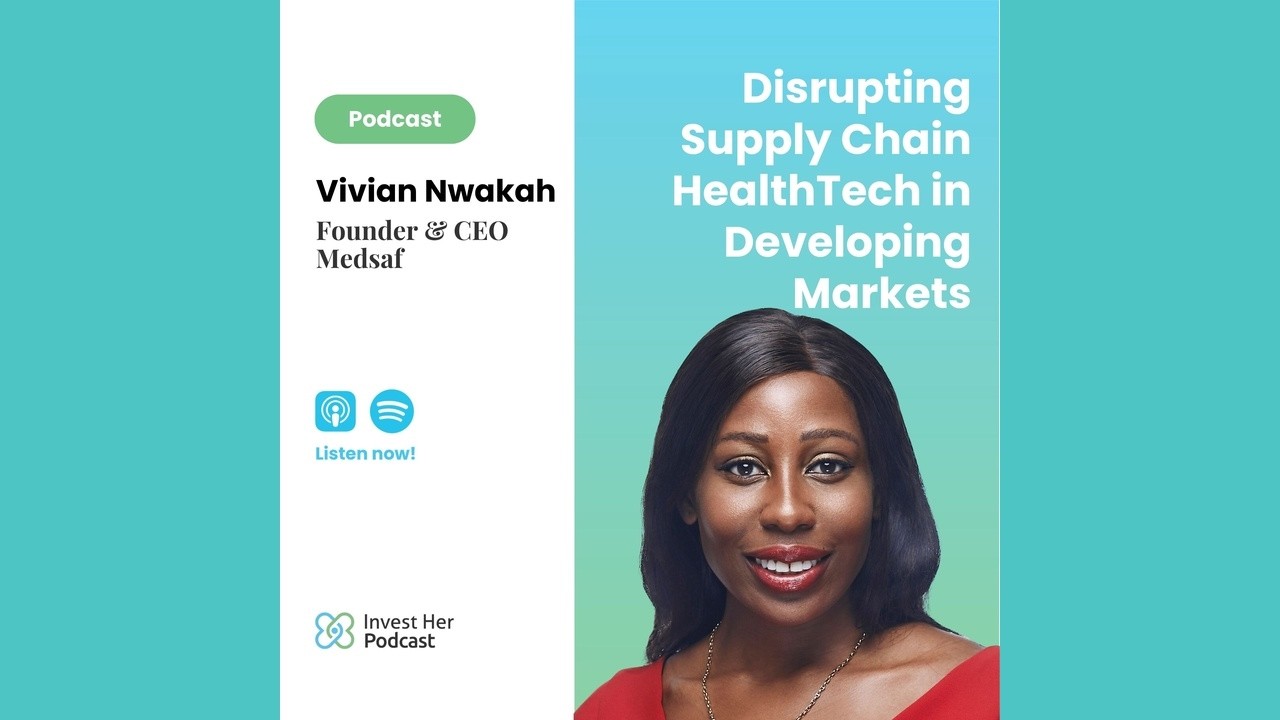
Vivian Nwaka moved to Nigeria after a friend died from a fake malaria pill and founded MedSaf, a platform connecting drug manufacturers with hospitals and pharmacies to stop counterfeit medicines. She bootstrapped with personal savings, raised $1.4M, and is now raising $3.5M to scale across West Africa.
Chapters
Welcome to this latest episode from Investor Podcast, and I can't wait for you to hear this one featuring an incredible female founder, Vivian Nwaka, from Medsaf. Now, Vivian has created an incredible medtech startup based in Nigeria that is solving a super important problem about how can you get high-quality, real medicine to you, to the hospitals and the clinics that look after you. So learn— in this episode, you're going to learn more about why she set up MedSaf, why was this such an important problem for her to solve, and how big a problem it is, who she serves, how she does it, and what were her key challenges on the funding journey so far, because she's already raised a significant amount of money and is on her next round. So she's going to share her key tips with you female founders on what you need to do to get funded, and also she has some key messages for you, the investor, On, you know, things that need to change in the funding environment. Enjoy this episode with Vivian. She is absolutely amazing, and I can't wait to hear what you think about it. So don't forget to rate and review this episode and check the show notes to have links to all the resources that we share on the episode. So enjoy! InvestHer Podcast is for you, the female founder who has a product, a service, or a message that you believe in and need to get funded, or for you, the investor who wants to learn more about the huge untapped investment opportunity that gives you a higher return— women entrepreneurs. My name is Anne Ravanona. I'm an entrepreneur, TEDx speaker, and women's advocate, and I'm passionate about helping women entrepreneurs get funded. In each episode, we'll take a behind-the-scenes look into real-world funding tactics and strategies to help you get the funding you need faster. Let's put the fun into funding. Thanks for spending some time with me today. Now let's get started. So welcome everybody. I am delighted to have with me today the amazing Vivian Nawaka, who's founder and CEO of MedSaf. Vivian, welcome. It's great to have you with us.
Thank you so much for the opportunity. This is exciting, so thank you.
Oh, we love hearing about you, hearing how you're growing, especially as you're doing something so, so important. So let's tell the listeners a little bit about yourself. Who are you? And then give us one fun fact about you. So tell us a bit about you first.
Okay, well, I was born and raised in the US and grew up in the Chicago suburbs, the North Shore. I went to school, stayed most of my life in the US. And never thought I would work or live outside of the United States. But I'm a very curious person. So my first job was in— was working in the mortgage industry for Wells Fargo. Worked for Wells Fargo until the market crashed. And that just opened my eyes that I needed to look large, you know, I need to look much more broader than the United States. And I needed to expand my skills. So, you know, one of the first things I did that really just opened my eyes to the fact that I could probably do a lot more is I volunteered to work on a political campaign, and I ended up becoming the campaign manager. So that was a great experience of raising money, getting funding and backing from the Democratic National Committee and AFSCME, Chicago Teachers Union. And really getting close to winning that election. So that taught me a lot. And from there, I realized that I could probably be an entrepreneur. And when the opportunity to help start home healthcare agencies in Illinois and Indiana came up, then I took it. And so that was my kind of exit from corporate world into entrepreneurship. And I would say a fun fact about— well, so I'm a very curious person and You know, I think that's what's kind of guided me along my experience, through all of my experiences over the years, is just my curiosity and just willingness and always, I just always want to learn more. So one of the fun things that I've done in my life is there was a point where I just backpacked. So I solo backpacked across Europe, South America, Asia. I had a blog as well, and I would blog about my travels, and I was analyzing cultural differences, society, and just funny experiences that would happen to me along the way through all of my journeys. So that's, that's something a little bit about me.
Oh, that's awesome. I didn't know about that. I'm so glad that you shared that. That's really cool. And I mean, I think it's a perfect demonstration of your curiosity and willing to learn. And the other thing I think that we could add to your fabulous list of talents is like sharing that learning with others because, you know, people could go backpacking around the world. Very few people will do— okay, there are more people who do the blogging experience, but what I love is hearing from you is that, yeah, you put it out there as well. You wanted to share it. You were really interested in the cultural side. So that's awesome, awesome, awesome. I like that fun fact. Right. Now I want to get into the nitty-gritty about you and your current entrepreneurial journey. Can you tell us a little bit about— well, tell us about MedSaf and why you set it up?
Yes, absolutely. So MedSaf is a one-stop shop for healthcare stakeholders to purchase, manage, and track medications in complicated supply chains.
Mm-hmm.
So this is for the hospitals, the pharmacies, the NGOs, governments, insurance companies to know, to have a better feeling of quality, that quality control is much more controlled in the distribution of medications that end up being dispensed to patients. So we don't dispense directly to patients, but we're looking to increase access of medications, affordability, and quality of medications in supply chains. And this is a problem in emerging markets. So it's something that, you know, Americans or Europeans might take for granted, but can be life-threatening in countries like Nigeria. So I landed in Nigeria 6 years ago and have been here ever since. And I think in my second month, I realized one of my friends died from taking a fake malaria pill.
Wow.
So that opened up my eyes to this idea that in markets like Nigeria, you can't necessarily trust the supply. That, you know, that there's— that there might be fake or substandard medications in the system that can end up hurting people. And when I would talk about my friend's death, almost everybody that I would meet would know somebody who had a similar story. And so I just thought, that's not fair. That doesn't make sense that, you know, you've got a country with 170 million people and everybody's just resigned to the fact that you might go to the pharmacy and the medication that you take might not be real. And that didn't seem fair to me. And so I got really curious about looking into it.
Amazing. And I mean, I say amazing because what I love about how you say it, it's how many entrepreneurs start their journey. And me too, like you, I saw something that really outraged me, which was the funding gap for female founders. And when I learned it was $1.7 trillion, I was like, I cannot stand that. I want to help close it. But listening to you, what I love is that you said like, you were in the US and then you went to Nigeria, and because you were profoundly touched by this personally, you know, somebody, a personal friend died from this. I mean, I think that is just horrendous. And the fact that you could see more people being affected by bad quality or fake medicine and that you decided to do something about it, it's just incredible. So you mentioned in your introduction, you said that you serve Hospitals, pharmacies, governments, NGOs. Tell us a little bit more about how you serve them.
Yeah.
How it works, how MedSaf works, how the platform works.
Yeah, so MedSaf is a double-ended supply chain platform. So it means that a hospital or pharmacy can go online and they can purchase and manage their medication on that platform. And a supplier can connect to that platform and then receive orders from these hospitals and pharmacies and understand their usage patterns so that they can order in advance and meet the customer's needs in real time.
Hmm.
So it's about connecting good suppliers who have great quality control practices in place, supported by MedZapf and MedZapf partners, And connecting them to hospitals and pharmacies that have committed to dispensing quality medications and use them as that platform.
So listening to you there, I mean, it sounds— you obviously have made it sound very simple in that you have simplified that process and you have built that connection. But how did you go about it, Vivian? Tell us a little bit more, because obviously you saw a need You said, right, I need to connect these 2 stakeholders, these 2 groups of stakeholders. So how did you go about building this amazing supply chain quality platform?
Yeah, so the first thing I did is, you know, I thought, okay, well, Nigeria or countries like Nigeria, they probably just don't have good medications. And so I just made that assumption and I would call the manufacturers and I would tell them I'm calling from Nigeria, they would hang up the phone. Then I would call them back and say, I'm calling from Chicago, and would they distribute— would they allow me to distribute, purchase medications and ship it to Nigeria? And they would tell a lot of stories just about how hard it was to set up in Nigeria, how hard it was to trust, the trust factor being a big issue.
Mm-hmm.
The distribution and the infrastructure not supporting, not being cost-effective for them to invest resources in. And then that's why they weren't there. Right? And so I realized that they have a pain point, which is a lack of transparency, a lack of data, and a lack of a trusted supply chain.
Mm-hmm.
Then I went to— of course, I knew the patient story. And of course, that was how I started. So I knew that You know, people do question whether or not their medications are real. I knew that wealthier people, if they have the chance, they can go, you know, on a plane and fill— and they were filling up their suitcases with medications.
Wow.
So they have a pain point here that's almost similar. It's a lack of trust in the system and a lack of transparency in the supply chain. It's almost the same issue that the manufacturers had. So then I went to the hospitals and pharmacies and I looked at and I talked to them. So the first real big act that we did for MedZack was we surveyed over 100 hospitals in Lagos.
Mm-hmm.
So we knocked on their doors, we brought cupcakes and said, can you please fill out this 7-pager questionnaire? And so basically we found that they have also many, many pain points. And so it was about finding, okay, well, what are their pain points? How can we solve their pain points? And realizing that in the chain, it's the hospitals and pharmacies that have the less investment going to them.
Hmm.
Right? Majority of the hospitals and pharmacies are single owners. They're small businesses and they're serving their communities and they need support and they just don't have any support. And not even banking ability to get loans or anything like that.
Wow.
And so we realized is that if we could focus on the hospitals and pharmacies and focus on building a platform and processes that really make their lives easier, then we can make it easier for them to control. We can make it easier to control the medications that are being given to them. through our supplier network and start to increase quality medications that are being sold by our hospitals and pharmacies that align with us. And so we focused 100% on the hospitals and the pharmacies. So we knew that the— we focus on what are their needs and how can we innovate around giving them what they need and being even better. Over time. And so that's how we started MedSeth, when we realized that we had enough information from the hospitals to give them a good service. And so that's, that's when we launched the company.
And so, I mean, listening to you, it sounds a bit like a marketplace, but it's not a marketplace, but it has the elements of meaning you've got 2 ends to it and you need to focus on working on both ends simultaneously for it to work, because without your your suppliers and without your clients, meaning the hospitals and the pharmacies, there isn't— there is not that connecting factor, which is Medsafe. So how did you balance building up both ends of the supply chain? Because that must have been a bit of a challenge at the beginning to focus.
Well, absolutely. So, and it was funny because when I first started the company, I said this has to be a platform where hospitals and pharmacies can purchase and manage their medications. And it has to have this dual function. And I remember investors, potential investors telling me, yo, you're doing too much. But you have to do both in order for this to work.
Yeah.
Because the future, you know, the whole, the real value add of MedsApp is the data and the transparency and the controls put in place of the medications going through the system. And so you can't do that unless you have both sides. built up. So what we realized that we had to do, which I think was our first big shocker, is that we realized that we had to become a distributor ourselves.
Hmm.
And so that's how we were able to then build the relationships with the suppliers as well as the major manufacturers by being the best distributor that we possibly could be. using our customer-focused approach to gain market share in one of the craziest and largest cities in the world, Lagos. And so we were here. So we said, okay, we've got to do it here. And so that's what we did. That's when we launched, January of 2017. Wow.
Because you hear, I keep saying wow, because it's, it's, It's really impressive what you have achieved, what you and your team has achieved, Vivian, because you spotted the need, you saw this complex need on both ends of the supply chain. You said, okay, I know now who I need to serve, meaning the hospitals and the pharmacies. I know their pain points. I know the suppliers kind of, they have a pain point, they want to get in on this, but there's no trust. So I'm going to be the trustworthy partner first. And I'm going to be, if you will, the customer on the supplier side of things first to test how our systems, our control systems, actually work. And then once we've proven that, then to be able to go and get more on board and then create those quality checks so that we can sell those services into the hospitals. Would that be an understanding, a fair understanding of what you've just said?
Yeah.
So, I mean, that's, that's so, so impressive. So tell me, on this funding journey, on this journey so far, Vivian, how have you funded MedSaf? Can you now come into— now that we know more about you and MedSaf, tell us a bit more about how you've funded the company so far to get to this stage, and what are your plans?
Yeah, well, when I first started, it was my paychecks and my savings.
Mm-hmm.
And so I pulled from my campaigning days and got a group of people to agree to volunteer their time on MedZapp, to be honest with you. So I didn't actually have enough money to really start the company. I just used relationships and just creativity to try to make it easier for people to help in small doses to get it up and running.
Yeah.
Right? So if you know a hospital, introduce us so that we can go and speak to them. Or if you want to come in and work on this as a— work on this project, we need this done. You know, so that's how we, at the very initial stages before we actually officially launched, that's how we were able to kind of get all of our surveys going and, you know, start to understand who the players were. And to craft all of the original documentation and all the original framework for Medsaf. So when that was done, then I was able to go to investors and say, hey, this is a functioning company that you should invest in.
Mm-hmm.
And so that was where the angel investors came in. And so, you know, I would— I didn't go to family and friends.
Mm-hmm.
Because, because I wanted to get people who have done something not similar, or maybe similar, but who have exceeded or excelled in an area, whether it be in Africa or in the US, that could be great guidance and just people to call as we go through this journey, you know. So I picked people in some of the biggest e-commerce companies in Nigeria, in Africa, some of Silicon Valley investors, some oil and gas lawyers, you know. So I picked just a kind of a wide range of people who, you know, have had experience raising a lot of money, building and working in large companies, and, you know, creating big impact where they're at. So that's what I focused on.
And so how many investors did you have in the group? Obviously, I'm not asking names, but how many investors and how much did you raise at that point with that angel round?
Yeah, so we had about, I'd say, 12 or 13, and we raised $320,000 at that point.
Thousand dollars or—
Dollars. Yeah. Yeah. So we were— so that's how much we raised then. Then we got a bit more traction. We're able to use that money to accelerate more. And then we were able to raise additional funding. And so in total to date, we've raised $1.4 million.
Amazing.
But I will definitely say that the first—
those first checks were the hardest So tell us more, because I think that's the most valuable information that I would love you to share with our listeners and share particularly with the female founders and to the investors listening so that they can hear what it's really like on the ground. So tell us about that particular phase of getting those very first checks. What was that like?
Yeah, well, because my strategy wasn't to go to family and friends. I had to really get people just to buy into this vision and buy in that I could pull it off. Um, and so what that meant is just getting told no a lot of times.
Yeah.
And just being really consistent with people. So for example, one of our investors, um, he built the largest, um, tech company in Africa at the time. Um, they had raised at the time, they had raised the most money of anybody.
Wow.
In the, in the tech scene, and I remember I would go to him with the deck, he would say, nope, this isn't gonna work. So I'd go back, I'd go again, I'd tweak something, and then he would give me all these reasons why it's not gonna work. I would go back, I would refine my pitch, and I realized that I just really used him to just get my pitch going and to really just understand, you know, what was it that someone like him would need to know or hear in order to say, oh, this is great.
Yep.
And then after many months of doing this, so just calling him for meetings like every month just to ask, show him, here's our progress, here's our progress, here's how we are. After many, many months, he finally said, okay, I'll invest. I'll give you X amount. And that was actually a surprise to me because I thought he was— I thought the whole time he was just not interested, even though I just kept trying. And so what that made me realize is that, you know, the persistence— persistence, sales, you know, persistence, you know, it's just getting him to believe in it and showing him that I'm not giving up.
Yes.
I think that was it because I I don't believe that it was just that 50,000th time that I had pitched him that he then decided. I think he knew earlier, but he wanted to see if I would keep going.
Yeah.
Because the idea is very hard and we're trying to build something super complex. And so the lesson for the angel investors is to be persistent and then not be afraid to get feedback. And so one of the other earlier things that I did is I would just have meetings with all types of people and I would pitch them the idea of Medsaf.
Yeah.
And I think especially in the African context, there's this idea that you should not tell— and actually it's not an African context because I was just on LinkedIn recently and I saw someone in New York was in stealth mode healthcare startup.
Yep.
And it's just like, okay, you know, I didn't do that. I didn't have the luxury of being stealth mode. Right? I had to let everybody know what I was doing because I needed to raise money, but I also needed to get people to join me. You know, so I needed to be very open and that was the strategy that I took.
Yeah.
And the reality is, is that, you know, I think people are scared that someone's going to steal your idea, but it has to— this is not a company that you just hear someone say and then you say, oh, I'm going to invest my life into this.
Yes.
You know, you've got to have some drive from somewhere else to keep you going because this is a very hard company. Yeah. You know, so, um, you know, so I wasn't afraid that someone was going to steal the idea cause I already knew how hard it was, how hard the company would be to start. I already knew that. And I already knew the strategy that I would have to overcome some of those hurdles, um, that the average person would have.
Yeah.
And so that was already in my mind. And so it was always just talk to as many people as possible to refine my pitch of this company.
And like, coming back to your early investor man, let's call him that, how many months then would you say it took you to get him to say, yes, I'm going to invest, that you have to show that persistence?
It had to have been— so July, so he invested in July, we launched in January, so it had to have been like at least 8 or 9 months.
Right, that's persistence, that's great, and that's helpful. I think that's really, really a great illustration. And then how was it different then? Maybe what type of investors did you look for for the next part of that round to fill it out to $1.4 million? What type What type of investors were they from there on in?
Yeah, so this is a good one because I think the traditional route is to say you've got to find a VC. Yeah, you know, and I knew at that space that, remember, we're building double-ended supply chain. It's complicated. It's not straightforward. So we needed, in order to make it straightforward, we needed to build up both sides. And so It took time. So if you look at our revenue from 2017 compared to, you know, today, I mean, it's miles apart. And that's because we needed, you know, there were iterations of development around this concept. And so that doesn't bode well, I think, with the typical VC crowd, right?
Yes.
They're just saying, okay, well, what's the growth? you know, is it fit for market fit? You know, they're looking for all these things that you sometimes when you're building a company like this, you need another step before you get there and you know what that step is, but you need funding to get there and you have to get someone still to invest in you almost like they invested in you at the, at the angel round.
Yeah.
It's still, it's still that same type of, you know, It's— that's still that same type of pitch. Like, look, the numbers aren't going to tell you where this opportunity is at that point. And so a family office was— family office as well as previous investors invested to make the next million.
Right. And that's very helpful to share because I think a lot of first-time founders sometimes they don't think of family offices. As you say, there's this myth and aura around VC firms, and I think they are great, they do fill a need at the moment. The reality is we know it's much harder for women to access that type of funding. And I think that when it comes to the relationship building and so on, if you can— I mean, you're absolutely right, the next stage is always to go tap on the shoulders of your existing investors and say, Hey, now look, I've shown you these milestones. Are you in for this next round of it? Are you in for the next stage? And for how much? And then the other thing is to say, right, to kind of expand into the family office. How did you find the family office? Was it through a contact that you already had, or had you spotted them in advance?
It was through the network of our team. So they had found Us, actually. So we weren't— I knew that I needed to meet family offices, so I just obsessively talked about it. I would just tell everybody, I need to find a family office, I need to find a family office. So that's kind of— that's weird, but that's what happened.
You asked the universe. You asked the universe, and the universe said yes. I love that.
pitching to VCs and I kept pitching to like institutional investors and I just kept realizing that at that stage we were way too early. But the great story is that even just today I just had a meeting with one of those institutional investors that has already committed to being in this round.
Yay!
Because basically the relationship was built last year when I was trying to raise for You know, this bridge round, and they've seen that we've continued to grow, and that they saw that that money helped accelerate us and continue to prove that we're on the right track. So it wasn't a bad thing to go out to the VCs and build the relationship early.
Yes, and I think that's a really good tip to female founders is, you know, build that relationship early. You know, it is a question of building it up over time. You're not the first, you won't be the last who has successfully raised money who said that to me. So I would really highlight to our listeners, that's a very key strategy when you are looking in the early stage of your seed, your bridge round, before you're thinking of going for Series A. Now, because you're currently fundraising, tell us now just quickly how much you're looking for and when you're closing, because I think to the investors who are listening, they're probably going to be very interested. Since they've heard more about you and the progress you've made already with what you've raised. So just tell us a bit about your ask, your round, so that we can get the message out there.
Yeah, so we're raising $3.5 million to scale further into Nigeria, but then also into other countries such as Senegal and Ivory Coast. And we are also building up our corporate office and continuously refining our technology so that it's even better for scale. So that's what we're raising for.
I love it. And okay, listeners, particularly to our female founders, you hear what she did, how she said it? I'm just gonna rephrase what you said because it was exactly what we need to do. You said, I'm looking for $3.5 million round. I'm gonna scale in Nigeria, Senegal, and Ivory Coast. And I'm gonna use that money to build up the corporate office, to get the hires I need in there, and to, you know, rework, refine our tech so that it's better scalable. That's the type of language that, you know, you need to get out there. I just love to grab that nugget of wisdom you shared, Vivian.
I didn't even realize.
You see, you're just doing it naturally, which is just fantastic. That's exactly the way to do it. You're like, if I had a magic formula, I would say this is what you need to do. And Vivian, you just demonstrated it beautifully, so thank you.
Okay.
So, okay, now let's hone in on to the key tips section. What would be your key tips to female founders who are looking for funding and how to jump over those hurdles? You've mentioned persistence, you've mentioned building relationships early, you've mentioned taking the feedback, you've mentioned refining the pitch, and you've mentioned Being clear on who you target at the right— at each phase. Anything else you want to add to those?
I would just definitely just say get ready for a lot of rejection. You know, I think the benefit that I have is I've been basically working in sales since I was 16. So You know, I'm used to hearing no, but you need to— you're going to hear no, and you've got to figure out the ways to kind of self-motivate yourself to continue to, you know, protect yourself and just keep going forward.
Yeah.
So I think that's the biggest thing. And also, you're not going to get that from people around you or outside you. I can't tell you how many people told me that Meds App would never get off the ground.
Yeah.
That were close to me, you know, when I was starting the company. So, you know, I had to pull everything from within myself. So for that reason, you know, just making sure that your reasons for doing this are very clear, of starting your business are very clear. You know, if you want to be rich, if that's the reason you start a company, entrepreneurship is not the way to go.
Yeah.
Right. You can get a job on Wall Street and move up the ranks, you can make way more money faster than starting a startup, right? So I feel like there are— so you just have to make sure that your motivations are clear. So that's what I would add to that.
I love it, Vivian. So, okay, so what do you do to help, you know, keep yourself on track and handle those rejections? Because, okay, you've said I have a thick skin because I've been doing sales since I was 16, but you have to reach deep inside of yourself to keep going. And I think that will resonate with so many women entrepreneurs and entrepreneurs, full stop. How, like, what do you do to help yourself to get into the right space to handle the rejection and keep going?
Well, actually, that's like such a perfect point because, you know, even, you know, I've been on this roadshow across Europe, all these places, just recently, just getting back, and I was so tired.
Mm-hmm.
And, you know, I go into the office and the team is excited. There have been new developments, new ways of doing things, you know, improvements, and everybody is excited about what they're doing. So I'm gathering energy and refreshing myself from the team that's actually directly impacted by the success of MedZapf.
Yeah.
As well as the customers, you know, so being able to hear from the customers and talk to them and have them remind me why what we're doing is beneficial. And then of course having a chance to talk with you, you know, it's, it's all of these, you know, little moments where you can, you know, just get another perspective about what you're doing that reinforces why you're on the right path.
Yeah.
So that you don't, get sucked into self-doubt or worry, you know, or discouragement.
I love it. I love it. And are there any things like mindfulness, meditation, other things that you do, any strategies that you do to look after your energy and look after yourself on that front?
Well, that's interesting. Last year I did get into meditation, which was, you know, really kind of groundbreaking for me. So I have absolutely started a meditation journey. I haven't gotten into yoga yet. I just don't have the time, I think, to go to a studio. But definitely meditation is something. And to be honest, I'll be honest with you, like, I have lately— I have gotten back into reality TV as my guilty pleasure.
Yeah.
And I'm not ashamed to say it at this point. So sometimes it's just like your mind has to completely I can completely disconnect without like ever thinking about— like without thinking about it. So yes, I've watched Lock— you know, Life After Lockup, and I'm not ashamed to say that.
Yay! High five, girl! I swear it's the same thing. And I mean, okay, my guilty pleasures— I love Queer Eye, which is just awesome. You should watch it. It's like 5 gay guys who are incredible who just go and kind of Do a makeover, a life makeover of a person, a very deserving person.
Really?
One week.
I need them to come to me.
You should honestly go look them up on Netflix. They are awesome. They are so wonderful, each of them. One of them redoes your house, like your living space. One redoes your wardrobe. One redoes your hair. One redoes your psyche, like, you know, and it's just— they are— and one helps you to cook and eat better. So that's one of my guilty pleasures. The other one, which is kind of showing my anger I loved watching The Queen, you know, which is the series on Netflix.
The Crown? The Crown, yes.
Not The Queen, The Crown. Thank you. I just finished watching the last series and I'm like, oh yeah. And then I love all the medical doctor stuff because I'm a kind of frustrated doctor. I think when I was younger I wanted to be a doctor. Now I'm very glad I'm not a doctor, but I still love to watch all the, you know, surgery stuff like Grey's Anatomy.
Yeah, exactly. Here's the reality, all this kind of TV totally got me. Yes. Definitely, definitely. You know, just resign to that. You can't be on 100%, otherwise you're just gonna burn out. And I've gone through burnout before.
Yeah.
And it's just not pretty.
I agree.
Yeah.
Me too, me too. And it's not a t-shirt I want to get again or wish on anybody. So, you know, I think we need to learn.
Exactly.
We need to learn from them. So what would be your key messages to investors? Vivian?
Yeah, I mean, look, I think the biggest thing, especially as it pertains to women, is, you know, we're not going to look and feel like the average, you know, Silicon Valley bro. So there's gotta be a way to open your mind. And I mean, I think one thing I don't— I wonder about you know, the average investor is, is why go for the herd theory? You know, if one person is investing in something like this, well, everybody's got to get into that. You know, why not look for the, you know, the diamonds in the rough or the, you know, the, the next frontier so that you can be in on it?
Yeah.
You know, when I started MedZapf in 2017, nobody was talking about health tech. Or investing. I mean, they just were not in the African space. I couldn't find anybody that was interested in— people would say, oh, we're just not interested in that. And I'm saying, you're not interested in your health?
Yeah.
This is the only thing that's consistent other than, you know, this is the only— one of the only industries that's consistent. It doesn't matter what happens to the country. Yeah. You know, so, but now everyone's talking about health. It's trendy. You know, and so what about all those people that could have had the chance to invest in MedZapp before or a healthcare company before? Where were they? They were chasing the other, you know, trendy things. So I wish—
Yeah.
I would like to see more investors that are thinking outside of the box. And then also just realizing that not all the great entrepreneurs are going to look like Mark Zuckerberg or act like, you know, Mark Zuckerberg. Right.
Exactly. And I would say, like, that is so, so true. And it would be my key message as well to the investors who are listening. The research I shared in episode 1 of our podcast is like Boston Consulting Group recently did some research, and they said that investing in female founders could add $5 trillion to the global economy, which would be the equivalent of 6% of global GDP. Now, who wouldn't want to be part of that growth story, you know? And so that's why I would completely reiterate and support everything you're saying, Vivian, on that. We need to have a more open mind and listen to the outliers. Vivian is an outlier. I'm an outlier. I was working on funding female founders since 2013, before it became a hot topic, which it is now.
Yeah, it's so hot right now.
You know, it's so hot right now, thank God. But I mean, when I started, people were like, what? Why women? You know, all this kind of rubbish. And I'm like, yeah, you just wait and see why. You know, we're the biggest opportunity in the world. So let's wrap this up because I want people to know, how can they— how can our listeners contact you if, you know, there's some Great opportunities in MedZapf that not just investing but also in hiring. I know that you said that you'll be hiring. So how can people reach you, Vivian? What's the best way?
Yeah, you can reach me by email at vivian@medzapf.com. That's the best way. Or you can reach out to me personally on LinkedIn, Vivian Nawaka, or MedZapf's LinkedIn page and Those are the— that's the second best way to get them.
Perfect. And my last question, which is a really tough one. How can we put fun into funding? How can we put more fun or fun back into the funding game?
Vivian? Just release the money and then that will be more fun, I guess. I love it! I don't know. I don't know. Shorten due diligence time.
Yeah, yeah.
Maybe, you know, make the average 3 months, not 9 months.
Yes, yeah.
Those are ways to make it fun. If it's quicker, then it's definitely fun.
I agree with you, and they're good. 2 great tips. You heard it straight from Vivian. Just release the money and shorten due diligence time. I love it. Thank you so, so much for being with us today, Vivienne, and thank you for telling us the very impressive Medsafe story. I know we're going to hear and see amazing things from you and your team moving forward. So I would encourage all our listeners who know anybody in Nigeria, any hospitals, any pharmacies, or people in the supply chain that you think should be part of the Medsafe journey, send them Vivian's way. Investors, call out to you. She is raising her round, $3.5 million, closing in February. Go reach out to her. You have her email. You've heard more about her story. And this is a hot, hot, hot startup to invest in. And it's scale-up, like, you're ready to scale big time. So, and I mean it, I've met you several times, Vivian. We've had the pleasure of meeting each other and doing a webinar together with AXA. And I've seen your growth. It's phenomenal even in the past few months since we did that. And so I know that you are going to break those boundaries and we'll be seeing you, hey, one day Times Top 100. I would not be surprised.
Oh, don't be complimented.
I'm dying to see you there. So thank you so much for being with us. Everybody, please read the show notes for this episode because I will be putting in the links to Vivian that she mentioned, her LinkedIn, Obviously their website and her email so you can contact her. And, you know, the key things, the key beautiful nuggets that you've heard from her on this, on this podcast. So thank you so much, Vivian, and keep, keep going, keep doing what you're doing. We need you in this ecosystem. Thank you.
Oh, thank you. And thank you for promoting women. And this is something that is just really, really necessary. So thanks for raising the vibration. The volume on the fact that women deserve to be funded as well.
I love the way you say it, the vibration and the volume. I love— thank you, that's a wonderful way of saying it. I'm gonna steal that from you. Thank you.
Thank you. Bye-bye.
Thank you for listening to InvestHer Podcast. Don't miss more great funding tips and insights by subscribing to the podcast on Apple or your favorite podcast And while you're there, I'd love you to rate and review the show. We'd love to hear from you. So if you'd like to send in some questions, interact with our guests, or suggest other great people we should feature, join our community on the Flick InvestHer group. Or send us a message on investherpodcast.com. Want more great resources for female founders about funding? Check out our InvestHer Academy at academy.investherpodcast.com. Academy.globalinvestor.com. I'm Anne Ravanona and look forward to having you with us again for our next episode. Let's put the fun into funding and get more women entrepreneurs funded.
More from Anne



🎙️ EP69: Get Off the Fence: Renate Crollini's Startup Blueprint | InvestHer Podcast

🎙️ EP68: Radical Truth: Robert Rubinstein Exposes the Impact Investing Illusion | InvestHer Podcast



🎙️ EP66: Global Sisterhood — Carine de Meyere on Trade Missions | InvestHer Podcast



🎙️ EP65: Capital With a Conscience: Pierre Norman Rolin on Investing in Women… | InvestHer Podcast

🎙️ EP64: Dream Bigger: Nikki Barua on Building an AI-Native Company Without… | InvestHer Podcast