🎙️ EP07: How To Advance Gender Equality in Venture Capital, with Siri Chilazi | InvestHer Podcast
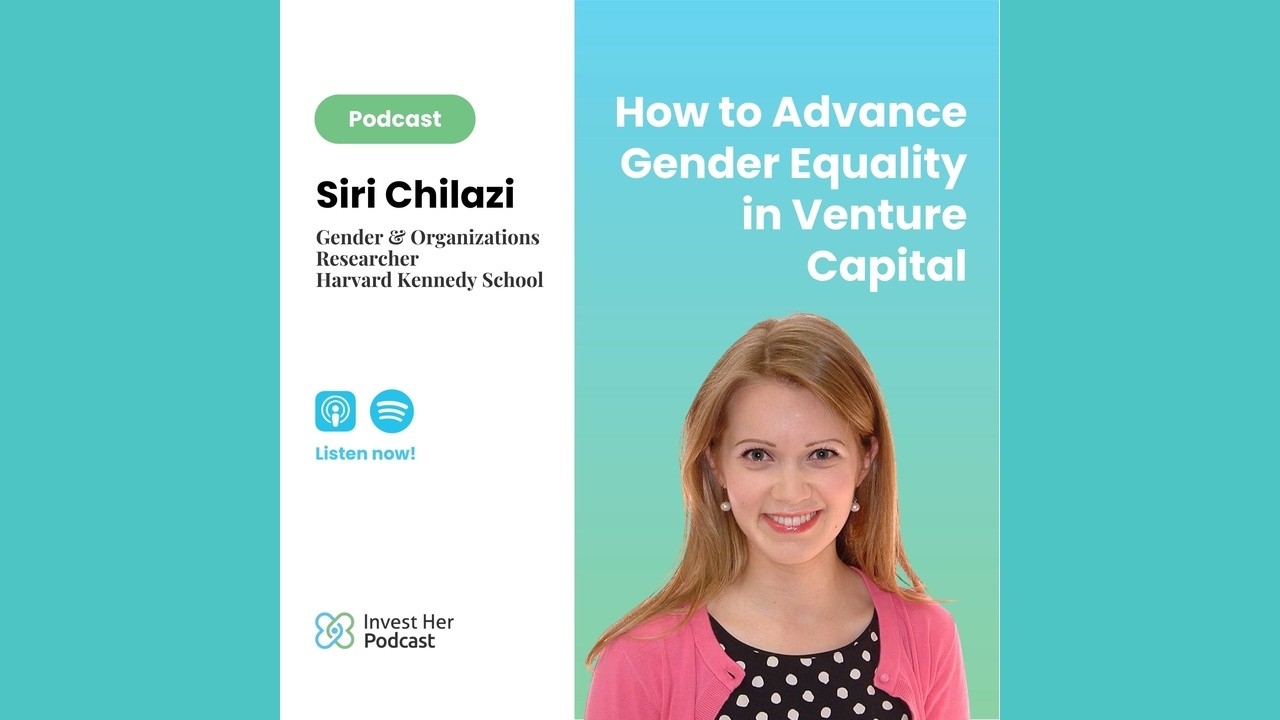
In episode 7 of the InvestHer Podcast, host Anne Ravanona interviews Siri Chilazi, a gender‑and‑organisation researcher at Harvard Kennedy School, to discuss Harvard‑backed behavioral‑science research on gender inequality in venture capital (VC). The conversation begins with personal stories that illustrate the systemic bias women face in business, then presents stark statistics: only about 11 % of VC partners are women and just 2.3 % of VC funding goes to all‑female founding teams. Chilazi explains that prior interventions have focused on individual behaviour, but bias is embedded in the industry’s structures, processes, and social norms. The research identified four categories of barriers for women VCs (industry‑wide cultural factors, organisational HR gaps, interpersonal dynamics, and individual attitudes) and similar systemic obstacles for female founders (network access, perception biases, pitch framing). The study combined a literature review, 21 in‑depth VC interviews (partnered with the New England Venture Capital Association), and AI‑driven analysis of over half a million online VC‑entrepreneur conversations (via Culture Intel). Findings include experimental evidence that identical pitch decks receive more funding when narrated by a male voice, and that male founders are asked promotion‑oriented questions while female founders receive prevention‑oriented questions, leading to a five‑fold funding gap. Based on these insights, the episode offers evidence‑based, actionable recommendations: for VC firms – implement structured, bias‑free hiring processes, bundled hiring, data‑driven tracking of opportunities, and equitable assignment of mentorship, board seats, and speaking slots; for female founders – adopt a promotion‑frame in answers, signal traditionally masculine entrepreneurial traits, and adjust pitch style while acknowledging that systemic change, not individual adaptation, is the ultimate goal. The hosts stress collective responsibility, encourage education through the research report and executive summary, and invite listeners to connect via LinkedIn and InvestHer resources. The episode ends with a hopeful call to put “fun into funding” by highlighting successful women VCs and founders.
Chapters
Investor Podcast is for you, the female founder who has a product, a service, or a message that you believe in and need to get funded. Or for you, the investor who wants to learn more about the huge untapped investment opportunity that gives you a higher return— women entrepreneurs. My name is Anne Ravanona. I'm an entrepreneur, TEDx speaker, and women's advocate, and I'm passionate about helping women entrepreneurs get funded. In each episode, we'll take a behind-the-scenes look into real-world funding tactics and strategies to help you get the funding you need faster. Let's put the fun into funding. Thanks for spending some time with me today. Now let's get started. Welcome to episode 7. In today's episode, I'm delighted to be joined by Siri Chilazi, Gender and Organisation Researcher at Harvard Kennedy School. She's a recognised expert in advancing women and promoting gender equality in organisations. Frequently collaborates with both startups and Fortune 500 companies on this topic and is an awesome woman. I can't wait for you to meet her now. In this episode, you're going to learn about the latest research from Harvard about advancing gender equality in venture capital. She's going to share the key findings from her research and her specific practical tips for VC firms on how to increase the number of female venture partners and invest in more female founders, As well as her key tips to women entrepreneurs on the funding trail. If you ever thought research was boring, this episode is about to prove you wrong. You'll love this lively conversation and learn key facts and evidence that may even open your mind as to how we, we can change the funding industry together and have more fun along the way. Enjoy! So welcome everybody, I'm delighted to have today with me Siri Chilazi. Now Siri, we met only recently at the Women's Forum in Paris and I I'm so glad we did.
Likewise. I know it was such a fortuitous connection, and I'm just absolutely delighted to be able to join you today, Anne.
Oh my goodness. So I want everybody to know who you are, so let's kick off this, this episode with you telling us a bit about yourself and one fun fact about you. I'd love to get that in right at the very beginning.
So my life's work is to advance gender equality in the workplace. And I do that by studying, doing academic research on ways in which organizations can more effectively advance gender equality in their ranks. But I also do that by making sure that the insights that we generate in academia and all this knowledge that we produce actually reaches the people on the front lines. So it's coming on to doing podcasts like this, presenting at conferences, talking directly to companies, helping educate their senior leaders, their HR leadership teams, their diversity and inclusion professionals about about what the evidence says about what will work to better diversify and make more inclusive workplaces.
Amazing. And so how long have you been with Harvard Kennedy School? And what brought you onto this path to become a researcher, and specifically in gender equality?
Yeah, I've been affiliated with Harvard— goodness— for more than 13 years now. So it's been quite a while. I've been in my current role for about 2 and a half years. And I have to tell you, growing up and even through college, through university, I would have always called myself a feminist, but I just hadn't personally experienced any major gender inequities in my life. So these issues weren't top of mind for me on a daily basis. When it really hit me was in my very first job out of university at 22, starting in a large multinational consulting firm.
Yeah.
And that's when for the first time I started looking around and saying, well, wait a second, you know, it's, it's 50/50 women and men at my level, at the entry level. And as I look up, less than 10% of the partners are women. They're essentially all white men. And I saw guys getting promoted faster, even when sometimes I felt like, you know, maybe the woman that could have also been promoted was even more qualified based on my own work experiences with her, and instead a guy was promoted. I was definitely paid less than my male colleague, which I raised as an issue, and it wasn't appropriately addressed. And so all of— I basically had my first personal experiences of all of these gender inequities that research has documented in the workplace for a very long time. And this was also the time when, you know, in 2012, 2013, Sheryl Sandberg published her book Lean In, and there were a lot of other articles that came out, at least here in the US, around this topic. And I felt like the societal conversation around gender equality started picking up in a way that I certainly hadn't seen seen it pick up in my lifetime. And that was the impetus for me to really reassess my own career trajectory and ask myself, well, is this something that one could make a career out of? And if so, what would that even look like? I didn't know anyone who worked on these issues as their full-time professional career, but I feel incredibly fortunate that I've sort of been able to chart a path to do that because this really is what gets me out of bed every morning.
Oh, amazing. And I'm so aligned with you on everything that you're saying. I'm the same. It gets me out of it, and it's actually because, like you, I experienced all different forms of gender inequality through lack of promotions, to bosses taking credit for my work, through being illegally fired after I had my first child, through unfortunately experiencing sexual harassment from, you know, bosses.
Yeah.
The whole lot. And I knew that all of this was down to the fact that I was a woman in business. And, you know, that's also what enraged me. And I think it's when I learned about the $1.7 trillion funding gap, that just was the it for me. I said, right, because I was like, like you, I said, how can I work in this? What can I do? I had plus 24 years behind me, so I was like, okay, but now I really want to give the rest of my life to gender equality. And I'm so glad I did. And I'm so glad you're with me because otherwise I wouldn't have met you and we wouldn't be talking about this. Well, thank you.
And I'm also so glad about the work that you're doing. And I mean, it was truly a meeting of the minds when we met at the Global Women's Forum in Paris, because it just turns out that we are doing work on exactly the same topics coming from 2 different angles, which is of course exactly what we need. Because I'm a big believer whenever we're trying to make change on something as complex as gender equality in society, no one can do it alone.
Thank you.
There's all kinds of different actors that are part of the problem and that therefore also have to be part of the solution. And so everyone has to come at it from their own Doing whatever they can within their sphere of influence to push this, push this forward.
I love the way you say that because it's so true, because we cannot change the system by ourselves. But before we go into your incredible research and more in-depthly, can you give us one fun fact about you? Because I always like to start off—
Yes, I did forget that. I realized just now. Well, as passionate I am about As I am about advancing gender equality, I'm also very passionate about health and wellness and fitness. So my fun fact is I've actually been for the last over 13 years now a fitness instructor. That's my sort of second career. And people sometimes ask me, well, how do you find time to do all this? It must take so long to prepare for classes and all of that. And it does, but it in many ways is what gives me the energy and the time to do all the other work that I do. It just gives me so much joy and energy to be able to share fitness and health and wellness with other people. So I teach classes here in Boston and Cambridge, Massachusetts in the United States where I'm based, and I also train other instructors around the United States.
Amazing! Oh my god, I wish, I wish you were here in Paris. You need to do some of this virtually. I'd love you to do that. Hey, there could be another side business for you.
You never know.
Yeah, indeed. So I'd like you to tell us more about Why you did the piece of research that you've done. Tell us about the research first of all, and the big why, and then we're gonna deep— we're gonna dig deeper into it because I loved it. I think it's monumental, and that's why I said I'm so glad that we met because I know we can help each other to help make your research work on the ground. So first of all, tell us a bit about what this research is and why you started it.
Yeah, so our research focuses on how can we promote gender equality in the venture capital ecosystem, both from the standpoint of getting more women into venture capital as investors, but also increasing the amount and the share of venture funding that goes to female entrepreneurs. I think of it as being the 2 sides of the table. You have the venture capitalists on one side and then the female entrepreneurs on the other side.
Yeah.
And what really brought us to this work was really a couple of things. The first is that the numbers don't lie, and the numbers tell a very clear story of just how extremely unequal this ecosystem is today. So in the United States, only about 11% of venture capitalists are women. Global figures are very similar.
Yeah.
And last year in 2018, in the US, 2.3% of venture capital funding went to all-female founders, meaning either a solo female founder or founding teams that had only women on them. And then another 10% or so of venture capital funding went to mixed-gender gender founding teams with at least one woman on them. Stated a different way, about 88% of VC funding goes to men exclusively. That's a staggering number. And in fact, those numbers, if you compare them to all other industries, you see that venture capital is one of the most male-dominated of all the industries in the world and in the country.
Wow.
So that was one of our first motivations, is this is an area where change is desperately needed and where there's a huge amount of upside because we're starting from such a low base. The second reason why my team and I— and I did this work jointly with my colleagues Iris Bannett and Anisha Asundi at the Women in Public Policy Program at Harvard Kennedy School, where we all are based— is we take a behavioral science approach to this question of how to advance gender equality. What that means is that You know, decades of behavioral science research tells us that individual brains and minds are— they are biased. We all know that unconscious bias exists, but that bias is really difficult to take out from individual brains.
Mm-hmm.
But the real insight that behavioral design gives us into this work is that bias exists not only in individual people, but it also exists in the systems and the processes and the structures that we humans have created. for ourselves, for doing our work. And it turns out that these systems and processes are much easier to debias than our individual brains. And what we saw in examining the venture capital industry, we saw right away that the traditional conversation around how to increase gender equality in this field has been almost entirely focused on the individual level.
Yeah.
So people have documented the numbers. Oh, the situation is so bad. There's bias, there's sexual harassment, This is terrible. What should we do about it? Well, male VCs should do a better job of diversifying their networks and actively seeking out female funders to take meetings with. And on the flip side, female entrepreneurs and female VCs should just act as role models for other women so that we can get more women into the industry.
Yeah.
Now, that's good advice. And if people were doing that, we would have seen a lot more progress than we have in the last, call it 20 or 30 years. But part of the reason why those approaches haven't been as effective as we might have hoped is precisely because they're targeting individuals.
Wow.
We're asking all these individual people to essentially overcome their very powerful unconscious biases and somehow magically start behaving differently than they have historically. That's a tall order for anybody. And so we saw a huge opportunity to redirect the conversation in venture capital from the individual level to a more organizational and systemic level and offer some evidence-based practical solutions and recommendations and interventions that VC firms, individual investors, and kind of bigger bodies like National Venture Capital Association or other of those types of industry bodies could take to move the needle faster and in a bigger way.
That's awesome, and I think for me the 2 key things that come out of what you've just said are that it's evidence-based recommendations and that the focus is going industry-wide, systemically, organizationally, and not to the individual because that's just too slow. And you're right, because otherwise, like, we know what needs to change and we've known what needs to change for many, many years, but as you say, We're human and humans hate change, certainly on the individual level, and unless it's forced upon us and we can't do anything about it, even then we still resist.
Exactly.
So, you know, I think that that's very important, that the way that you're approaching this is that it's evidence-based. Also because, like, we need to be realistic. The VCs who are investing money professionally to make a higher return are doing it based on, you know, yeah, evidence that can be biased, we understand that, but basically they care about the numbers. They care about the science, they care about proof, and so coming at this with an evidence-based behavioral way, but that it doesn't put too much onus on the individual, rather than all of us as a collective also, so that we can, you know, collectively as a group influence each other, and the pressure is not on any one individual. And I think that will change then, you know.
Exactly.
The dynamics change.
Absolutely. And actually, one of the big insights from behavioral science research, again, is the power of social norms and the power of collective action.
Yeah.
So we humans naturally, we want to be part of the herd. We want to kind of belong to a bigger tribe. We want to be seen doing what is socially acceptable to do, and we don't want to be the odd one out doing something different than everyone else is doing. And at the moment, there's not really a huge social norm in the venture capital ecosystem around trying to be as fair and objective, as unbiased as possible, because the norm is more so around just doing what we've always done because it seems to work well enough.
Yeah.
And so one of the things we're trying to do by sharing this research and by essentially empowering everyone within this ecosystem with more data and with more facts about what's really going on is to start building this movement Toward change and shifting the social norms toward making diversity and inclusivity and toward making fairness and more objectivity in the process the thing that everyone wants to be doing.
Yes, and yeah, coming back to first values, you know, to the first fundamental values of society, of fairness and so on. So I think that's, that's really important. So tell us a little bit more before we get into the ins and outs of the actual findings. Tell us a bit more about how you carried out that research and what challenges, if any, you may have faced when you were doing it.
We did 3 different things. The first is we dove into all of the existing literature on gender equality in venture capital and in venture funding. And when I say literature, I mean both academic research and studies that have been published, but also just articles from the popular press, from newspapers, magazines, the internet. And that was step one, to understand really what do we know today already about what's going on. That allowed us to develop some hypotheses about what we thought were the key issues and also where we thought the biggest opportunities for change and progress would be.
Right.
We then partnered with the New England Venture Capital Association here in the US to conduct 21 one-on-one interviews with VCs in depth that allowed us to test those hypotheses and sort of get additional color around the things that we had already essentially read about and heard about. And there's some great quotes in our research report from those interviews.
Mm-hmm.
And then as a third piece, we partnered with another organization called Culture Intel. They are a female-founded startup based in New York, and they have a proprietary software AI algorithm that allows them to turn unstructured data, essentially qualitative data and text into structured insights. So Culture Intel helped us mine and analyze over half a million conversations that venture capitalists and entrepreneurs were having online about the process of fundraising, and they allowed us essentially to listen to these people in their own unfiltered voice talking about their experiences and gain some additional insights specifically into that interaction between entrepreneurs and VCs. And then we put that all together into a big research report.
Amazing. And I think what I love about it is, is that you're, you know, you're taking the qualitative information and making sense out of it, but in a very scientific way, and using the tools of the trade that we now have at our fingertips, which is awesome, and working directly with the VCs as well, which In and of itself is also part of education, isn't it? Because even having those conversations actually helps tilt the conversation into a different direction in the future.
100%. And that was actually one of the things that was personally most surprising for me, both in conducting this research, but also now as we're getting it out there and socializing it with the ecosystem and with the VCs, is just how much knowledge there is out there that hasn't actually seeped into the consciousness of venture capitalists.
Yeah.
So there's a lot of studies that are, you know, 5 years old, 7, 10 years old, that have been not only written up in academic journals, but even written up in places like the New York Times or Harvard Business Review that are more— not as academically oriented outlets. And yet VCs who are doing this work on a daily basis, and in some cases even kind of acting as the face of the diversity inclusion movement in the industry, they've never heard of these studies. I had a conversation with a male venture capitalist, a very senior one, who is one of the people who's frequently quoted in the media as someone who's really promoting gender inclusion and diversity. And he said to me he doesn't believe that VCs would ever be biased against female entrepreneurs when they're coming in to pitch. And I had to tell him, if I may disagree, here's 3 studies that, you know, prove that. For example. I mean, there's many more than 3, but I just cited 3. And I said, here's 3 examples of how randomized controlled trials have proven that there's a massive amount of bias against female founders. And I quickly summarized those 3 studies, and then there was silence at the end of the line for a couple moments, and he said, hmm, well, I haven't seen those studies. I guess I'll have to take a look. You know, and I thought to, you know, I thought to myself, wow, what an educational effort we have here in front of us that we need to do.
I hear you. It's the same thing happened to me when I was moderating a podcast with several VCs, European and American VCs, last year. And one of the VCs was from Italy. And, you know, in our prep conversation before, we were discussing different things. Of course, I brought up the, the point about bias against female founders, and she says, well, I've been doing this and medtech funding for 20-something years, and I've never seen any bias, negative bias, towards female founders. And that's when I did the same thing. I explained the research, and then I sent her the links. And to give her due, the next time we spoke, which was on the podcast, she recognized. She says, yes, I didn't know this information. Now I know, and I'm going to be more careful. And I realized therefore that maybe because I'm working in the medtech industry where, you know, you need to have medical degrees and so on, and it's very research-heavy, that maybe the bias is less because of that, and therefore I just didn't see it. And she very graciously, you know, explained that, and I was really happy to hear that. But yeah, again, it's— there is a huge amount of education to do, and that's why your research is so important. So take us in, take us behind the scenes. What are the key So, let's start with the key findings that you found in general, if you can, and then let's look into, you know, what the different ecosystem partners can do to increase gender diversity. Let's start with your general overall findings.
So, let's start with the venture capital side of the table, so women as VCs. We find that there's 4 different types of factors that prevent us from reaching full gender equality among venture capitalists. There are what we call industry-wide or cultural factors that relate to how the industry is fundamentally structured. This is things like the fact that the VC industry is historically male-dominated.
Yeah.
So if it's already dominated by men, people who are entering now evaluating whether this is an industry that they would like to join, well, it's gonna seem much more attractive to men than to women because they see themselves represented there and they see people like themselves succeeding. Another big factor that pertains to the industry as a whole is the fact that work is so relationship-based and networks are so crucial in getting these deals done.
Yeah.
And when the majority of the people in the industry today are men, those networks are also male-dominated. So if you're a woman or if you're a person of color, because all of us humans have a tendency to naturally gravitate towards people who are alike, ourselves, it's really hard to break into those networks to get access to jobs, to get access to deal flow, and to get access to generally just opportunities for success.
Yeah.
Another factor that I'll highlight, which is somewhat specific to VC, is that because the industry overall is relatively small and tight-knit, but also because individual VC firms tend to be very, very small, the way people get into this industry and the way they learn how to be an investor is essentially an apprenticeship model.
Yeah.
So there's a lot of luck involved in finding someone more senior than you who kind of sees themselves, a younger version of themselves in you, takes you under their wing, mentors you, coaches you, brings you along to meetings, introduces you to the right people, and over time shows you the ropes of how to be successful in this industry. There's no formal onboarding programs. There's no training courses. There's no degree that will prepare you specifically to become an excellent VC. And so again, we come back to this thing where, where the industry today is male-dominated. For anyone who's not a white man, it's really hard to find those coaches, sponsors, mentors, sage older advisors who are willing to open up the path of success for you.
Hmm.
So those are fundamental structural factors pertaining to the industry and I'm not gonna lie, many of those are difficult to change in the short term, right? Those are just fundamentally part of how the industry works, and it doesn't mean that it's impossible to change, but that'll certainly take a lot of time.
Hmm.
But fortunately, there are also other factors that are a little bit easier to change in the short term. The next set of barriers that we encountered are at the organizational level, so at the level of individual VC firms. And here what we see is that most VC firms tend not to have any formalized processes around HR or talent management, you know, hiring, performance evaluations, promotions, determining pay, things like that. We also see that again as an industry-wide cultural thing, diversity and inclusion is not a priority.
Yeah.
In other industries like big tech, for example, there's actually a lot of resources, a lot of staffing power put behind diversity and inclusion these days. That is not the case in VC. And in general, processes at the organizational level are very ad hoc and very unstructured.
Yeah.
And research tells us that that lack of structure and formality often is a breeding ground for bias, because when we don't have processes, when we don't have systems, we end up making decisions based on gut instinct, essentially. And that's where bias comes in. The third set of barriers are the interpersonal ones. And so this is when people are interacting with each other, how they're behaving, whether those behaviors are inclusive or not. And of course, we find a lot of evidence about gender bias, about sexual harassment, which create an environment where women don't feel welcome. First of all, they don't feel like they belong, but they are also not able to do their best work and to bring all their skills to bear. Because, you know, if you're being sexually harassed, I mean, that's incredibly disturbing. That's a huge psychological tax. You're just simply not able to focus on the work in a way that a comparable man who doesn't have to deal with harassment would be able to.
Mm-hmm.
And then the fourth set of barriers that we found, this is really about people's individual attitudes and beliefs. We find that on average, male VCs tend to live in more traditional life arrangements. than men in the population as a whole. What I mean by that is partially perhaps because they make so much money, most male billionaires have a stay-at-home spouse who takes care of the home and takes care of the children, which we would describe as a traditional arrangement. And that of course shapes their view about women's position in society and what they should be doing, whether they should be working or not. We also find that there's a strong belief in venture capital in meritocracy and a very strong view that this industry truly is a meritocratic environment where the cream rises to the top and the people who deserve to get the top spots and to be successful get them. And by extension, or by contrast, if someone doesn't make it to the top, it's because they don't have what it takes. It's essentially their fault. So there's a lack of recognition and appreciation of all the ways in which the playing field is tilted, all the ways in which the playing field systematically favors white men and disadvantages everyone else.
Yeah. Wow. They're so enlightening. And I'm so glad that you're sharing those views— not views, those findings from the research so clearly. And so then, so you've talked on the VC side. So what were your findings then on the women as entrepreneurs raising money side?
Yes, this is another one where I wish I had better news to share, but the evidence really is, I would say, overwhelming about the types of biases that female entrepreneurs have to contend with. I'll give you just a handful of examples. We know that women have access to fewer networks, both for capital but also for advice on how to build their companies. There was a study done among MBAs that showed that that female founders are viewed as less capable as male founders. And in a hypothetical IPO scenario, those female founders' IPOs were rated as less attractive investments than identical IPOs by male founders.
Incredible.
We know that in a study where the same pitch deck had either a male voice or female voice narrating A voiceover, not only was the male-narrated pitch funded 68% of the time, but it was also rated as more fact-based, logical, and persuasive than an identical pitch just narrated with a female voice. This is as, you know, close to essentially pure gender bias as we can demonstrate.
Incredible.
Based on a field study, so of data from the real world, this was based on the TechCrunch Disrupt startup competition in New York.
Yep.
Researchers from Columbia Business School found that female and male entrepreneurs were asked different types of questions. Male entrepreneurs who were pitching in this competition tended to be asked what they called promotion-oriented questions that invited conversation about potential for gain. and future opportunities and upside. It's questions like, how do you plan to monetize this? Or what major milestones are you targeting for this year?
Mm-hmm.
Female founders, by contrast, were asked prevention-oriented questions. And these were questions that focused on potential for losses, threats, and how to safeguard against those threats. So questions like, how long will it take you to break even? or how predictable are your cash flows? And it turns out that subconsciously we humans tend to answer a question in the same orientation that it is proposed.
Hmm.
So the male founders ended up talking about upside and the proverbial hockey stick and all these great things that could happen in the future, whereas the female founders were inadvertently dragged into this conversation about the potential for losses and threats and all the bad things that could happen. And in this competition, or in this dataset, it was actually from 2010 to 2016 in this competition, so quite a large number of startups. They saw that on average, male-led startups raised 5 times more money than female-led startups. And in this dataset, that gap was entirely explained by the different line of questioning.
Wow.
So there's a lot.
There's a lot. There's a lot. And I know there are other studies out there as well that also say that, you know, that show the women-led startups have a higher return investment, higher profits, and so on than male-led tech startups. It's a lot. And I think that's why it's so important to keep on sharing the data, because otherwise, you know, people say, oh no, you just give me, you know, you're just a super feminist and you just want me to believe that you're right. I'm like, well, no, actually this is empirical, as you said, research carried out.
So, and that is one of the— I think the power of sharing this data is that it really backs up what female VCs and entrepreneurs have been saying for years already. But what they've been saying, of course, is anecdotal because it's based on their own experience and, you know, the handful of people that they know. And what we're now able to show is that it's not just anecdotal examples, but this has really been backed up by both research in the laboratory, randomized controlled trials, but also, you know, when we looked at those half a million conversations online, we see exactly the same dynamics playing out there. And of course, with that sample size, you can say this is not just anecdotal examples, but this is really endemic dynamics.
Endemic and systemic.
Exactly.
Yes.
Yes.
And so what would you say surprised you most about your research, about the results, and what didn't surprise you? Because that's always interesting.
What didn't surprise me was essentially all the biases and all the barriers that we found, because they have been so well documented in other fields, in other contexts, you know, large company contexts, team contexts. And so when that sense, VC is no different than society at large, you know, no different from any organization. What surprised me— well, I already mentioned one thing, which is the fact that there's a low level of awareness of all of these sort of dynamics and of the hard data that exists. I think that's the biggest thing.
And it really is a big one because I see it on the faces of the male investors that I speak to, and when I tell them the data, they look at me like very blankly. And the other way I do it is very simply to say, okay, so do you— you know, what do you think about gender bias in the pitching and all that? Oh, I'm gender-neutral, and so on. Okay, great. So I say— I ask them, so what percentage of your portfolio companies are women-led?
Exactly.
They can't answer, number one. And then I'd say, even, okay, well, if you don't remember the companies, what about on average the number of female founders you'd see over the year of the 2,000 pitches or people that you'd meet? Again, they can't answer the question. There was one investor I asked and he was like, oh, I'm gender-neutral. And I said, okay. He says, I have a portfolio of 12 companies that I invest in, great I said, so how many of them are women-led? And then he went super quiet because not one of them was, and he had never realized it.
Exactly.
And that's where it's like, it's like to say, okay, so we've got to point out the facts and do it in a very elegant way. And I think that's what we're doing here on this podcast. It's not about chastising, pointing the fingers at, you know, particularly at VCs in the industry. Let's say, okay, the system is a bit sick, let's say it that way, and we can fix this if we all do it together and if we all see the benefits of doing it for the industry and for society at large.
Yeah, and that's a really important point which I'm glad you brought up, and I want to reinforce it again, which is this really is not about pointing fingers because we all have unconscious bias, women and men alike. And most importantly, that bias is unconscious, meaning we're not doing this on purpose.
On purpose.
This is just the way our brains work. So, you know, all of the male VCs and entrepreneurs that we spoke with are actively, consciously saying, we want this to be more gender diverse, we want it to be more gender equal, we want it to be a level playing field. They're not tilting it on purpose, but nonetheless the playing field is tilted. And so now it's about shifting the conversation from the problems to the solutions and everybody taking an active role in bringing about some of those solutions and actually achieving greater equality.
Which is a beautiful segue into what your key proposals are. What are your pragmatic actions and proposals from your research for both groups, for VCs and then for women who want to get into VC, and then for female founders looking for funding. So let's go into that, because I love that— that's the real meat of this as well, to kind of say, okay, we've looked at the problems and we know them. Now, what are potential solutions to help us change this ecosystem for the better?
And I'll start again with the venture firms. So I mentioned earlier that our big insight going into this this was moving from individual-level solutions to organizational or systemic solutions. And we see that VC firms as entities, as organizations, are in the kind of in the key spot here to make a big difference, both in terms of bringing more women into VC, into their own ranks, but also making sure that the funding they disburse gives all entrepreneurs an equal shot at success. So what can VC firms do? Our first recommendation is to institute more structure into the hiring process, both for their own firms, but also to encourage them— or for VC firms to encourage all their portfolio companies—
Yes.
To institute more structure when they are hiring their staff. So this includes things like creating, writing down formal job descriptions whenever there's a position open. So that you don't just go off the top of your head, oh, I know John. I think John would be great. Let's just, let's just get John to come over.
Right.
It's no, let's first think about what are the responsibilities of this role. Let's write them all down. Let's make sure that the language that we're using to write these things down is not gendered. There's software available where you can copy and paste in a piece of text and it'll tell you if you're using excessively gendered words, because we know that job descriptions with a lot of masculine-coded words, for example, will attract more men Exactly. And vice versa. And then running a proper recruitment process where you actually distribute that job description or job advertisement and give people an opportunity to apply. It's also things like predetermining evaluation criteria. We have great research studies that show that if we just see candidates without having a sense of the criteria, we're always gonna pick the person who fits the pattern for that job, the person who's most stereotypical for the job. But we can prevent that if we actually decide on our criteria in advance and use those criteria to guide our decision-making.
Yeah.
It's things like implementing structured interviews so that we ask all of our candidates the same set of questions in the same order so that we can actually compare their answers in an apples-to-apples fashion. And then one last thought I'll offer is this idea of bundled hiring, or hiring multiple people at the same time. Research shows that when we make decisions jointly, multiple decisions at the same time, our brains not only are less biased in that evaluation, but more diversity emerges in those decisions.
Yes.
So, you know, instead of hiring one person in January and one in May and one in September, It would actually be better to recruit for all 3 of those open positions at one time in, say, June.
Right.
So that's the whole first set of recommendations around instituting more rigor and structure into hiring. The second big piece for VC firms to think about is how they distribute opportunities and support for success. This is things like mentors and sponsors, It's also what projects people are assigned to, who gets board seats or board observer seats. If there's an opportunity for someone to represent the firm at a conference or at a gathering, who do you send, right? And we know that women simply do not have the same access to these types of developmental opportunities, or I call them opportunities to shine, as men do.
Yes.
The good news is that this stuff can all be tracked. You know, you can actually make a list of, you know, who represented our VC firm at conferences in 2019, or how many boards does John sit on versus Jane. And so we can both track, collect the data to allow us to see what's going on today. And to the extent that there are any gaps, the data will tell us exactly where those gaps are and will enable us to close them.
That is awesome. And they're very— what I love about your recommendations, they're so practical. I mean, everybody can do this and they can get their hands on your research and they can follow your checklist, but also, you know, work with others who are used to implementing these type of processes internally. As you say, it's like it's new processes that are, you know, it's actually going to bring the structure that will help eliminate some of that unconscious bias, because once we all have the same methodology of using— that we're all using the same methodology for the hiring and the developmental side of things, that can make a huge, huge difference. And so what about for the— what were your suggestions then, your recommendations for founders, for female founders who are looking for funding?
We have a few, but I'm gonna be completely honest. What we see is that the root of the problem and the real issues are not with female founders. In other words, they're not doing anything wrong.
Yeah.
They are founding great companies. They are doing a great job pitching, but they are doing it on— in an environment, in a context, on a playing field that's fundamentally designed to disadvantage them. And it makes me very sad to say this, but I think it's important for women to know this.
Yes.
So that when they, you know, try to raise funding and it's just not yielding the same results as it might be for their male counterparts, that female founders don't internalize that and say, oh, there must be something wrong with me, because it's not you, it's the system. And our view, based on all the evidence, is that we have the most chance of making progress if VC firms are the ones that make changes rather than individual female entrepreneurs. But that said, let me give a couple of evidence-based suggestions. One relates to that study that I just shared earlier about the types of questions that female and male founders get asked and the fact that they differ. One thing that female founders can do is be very conscious about always answering questions in a promotion-oriented frame regardless of how they're posed. So if a VC asks you a question about how you're gonna protect your revenues, answer that question by talking about how you're going to grow them and the potential for upside and expansion, rather than kind of buying into the, the negative prevention frame that the question was posed in.
Yeah.
That's something that female founders can do and can Yes. Another evidence-based suggestion is to try to signal fit with traditionally entrepreneurial traits. And what I mean by that is the definition of entrepreneurship is fundamentally male in our culture. And so things or traits like aggression and dominance and creativity and risk-taking, that's what we all of us culturally associate with entrepreneurship. And those are also traits that we culturally associate with men and masculinity.
Yes.
So I'm not asking female founders to be anything that they're not, because that's the last thing I would ever recommend. But in framing their own story, in framing the story of their company, I would encourage female entrepreneurs to think about how they can connect with with some of those qualities that are seen as part of being entrepreneurial or part of being a successful entrepreneur and how you might be able to provide examples of times when you've taken risks in the past or taken a leap or overcome adversity. Because whether we like it or not, that is still today what venture capitalists are looking for and what they're listening for.
Amazing. I think that's again very practical advice and very doable. And what I love about what you're saying is that you're not asking, and nobody's asking women entrepreneurs, that they have to change or become men. I think that's super important, or have male behaviors.
Yes.
What we're saying is frame the way you position your stories in such a way that it will be more receivable by the men. And this is something that actually we touch on in our online course called Own the Moment, and it's about how to pitch to male investors using gender awareness. And we bring in the neuroscience that explains where these gender differences and tendencies come from and how it, you know, permeates in the pitch. And we are also very clear not to point fingers and also to say, you know, this is not about you, female founder, having to become a man. So, you know, there are certain practical things you can do to frame your information, your pitch, to frame how you answer things. So not only in the content but also in the form, as in making shorter sentences and, you know, giving points 1, 2, 3 in a very clear, short, succinct way, because men think linear, in a linear fashion, versus women in a more web-like fashion. So there's loads of great things that are very practical, and I love you know, that you're very clear in saying, okay, answer the questions in a promotion frame and also always signal and reframe it. Again, reframing traditional entrepreneurial traits and show, give your examples, because the thing is very often female founders, we don't like to brag about ourselves, you know, we don't like to say we did this, we did that, we just kind of overlook it, whereas the guy would be like screaming it from the rooftops.
Exactly.
Same project, So I think it's just like take a feather out of the male entrepreneurs' caps that you see pitching to say, hmm, I like the way he said that, sounded really good, and maybe I need to kind of reframe how I tell this part of my founder story slash this part of how I tell our company investment opportunity in the pitch. So it's about reframing the communication styles really, and the content obviously is In how you answer in a promotion way. That's super important.
Exactly. And I would highlight that this is— I view all of these recommendations, these types of solutions, as being a transitional strategy, meaning they are ways to navigate the world as it is today, which is very imperfect. If we make the systemic changes that we need to make and get to a world that is fundamentally more fair, these types of recommendations for entrepreneurs will no longer be needed because they can pitch in whatever way they, they choose to, right? And we have a variety of styles of pitching, all of which are going to be valued by VCs. But we're not there yet. And so in the meantime, for female entrepreneurs right now today who are looking for funding, in an imperfect world, this is something that can help them I love it.
And I mean, I'm just looking at the other questions that I had lined up for you, and you've basically answered them all really very well in advance, particularly around— I think I like this framework because I ask all our guests, and I want you to kind of sum up from all the key learnings from your research and from your recommendations, what needs to change in the funding world for women entrepreneurs? What are the key What are the 3 things that need to change? Let's— oh, it's always good to summarize because we've heard this. Let's summarize them.
Yes, the biggest thing that needs to change is VC firms should change the pitching process and the funding process to implement and institute more structure, making sure that they are asking female and male founders the same questions in the same order, developing a evaluation criteria that they apply consistently across the board. There's a whole lot of other little details that we didn't even get into yet about, you know, once the entrepreneurs leave and it's the VCs in the room that are now making a decision, how does that conversation unfold? What are some small strategies that we can put in there to make sure that there's less bias that creeps in? For example, by having each person write down a short evaluation independently first—
Yeah.
Before they start the group discussion. discussions so that that group doesn't succumb to groupthink. But a lot of those dynamics are in the hands of VCs, and it's really about making small tweaks to the existing processes that they use to make those processes more fair and more objective. I love it.
That's bite-sized, that's doable. I love the way you say make the small tweaks to the existing processes. You're not like saying reinvent the wheel. You're already doing this stuff. But make some small tweaks and it can be much more effective, and, and you're going to see better deals that way.
That's right.
That's what it is about. Mm-hmm.
That's right.
And then what would you say, any key final messages to the female founders and to the investors overall?
My final message? Oh, that's a, that's a big one.
It sounds very final, doesn't it?
But you know, I do, I do. Number one, educate yourself a little bit more about the barriers and about the solutions. One such way is to read our research, but also, especially if you are a male entrepreneur or male founder, talk to your female counterparts.
Yeah.
Or your people of color counterparts if you're white, because it's hard to It's hard to know what you've never seen or been exposed to.
Exactly.
You know, the people who are affected by these biases, who suffer the consequences of them every day, will tell you exactly what it feels like and what the biases are. Whether it's educating yourself from research or educating yourself through the firsthand experiences of others, that's really key. And then do something today yourself. If you are the leader of a firm, of a VC firm, you are in a position of tremendous power to, you know, really change processes and make bigger changes in how your firm operates. But even if you are a junior individual VC or entrepreneur, there's probably something, some one simple thing that you can do starting today to make the world a little bit more gender equal. Maybe as a VC it is actively going outside of your current networks and starting to take meetings with female founders. If you're a female founder, maybe you can mentor a younger or newer up-and-coming female founder and share whatever wisdom and insights you have based on your own experiences about how to navigate this playing field. But all of us can do something.
Exactly. And so what's super important here is how can the listeners contact you, Siri? What's the best way to get in touch with you? How can people get in touch with you after this?
I'm on LinkedIn, so I encourage you to connect with me there and message me. I'm happy to share my email one-on-one. And we're going to also share with you the website where all of this research is available, both the full report, which I admit is very long, but we also have a short pithy executive summary as well as actionable takeaways for VC firms, individual venture capitalists, and entrepreneurs.
Which are absolutely awesome, by the way, everybody who's listening in. I've read them all, I've gone through it with a fine-tooth comb, and I've loved every word written. And each time, not only do you get, you know, the synopsis, do you get the key findings and the key recommendations, you always get links to the research that backs each piece up, the evidence is there, and I think that's super, super important. Siri, you and the team have done an incredible job on this research. I mean, I really want to congratulate, congratulate you and to say thank you for doing it, because we really, really need it. It's timely, and I think that 2020 is going to be a very important breakout year when it comes to the funding industry and to female founders. I think that, you know, things are going to change. I just have a feeling in my bones And of course, you and I, we work every day towards making that happen and helping, you know, influence others to make the changes on a systemic level, as we're saying.
Exactly.
But thank you so much. And how, how can we put the fun into funding? We've talked about the barriers, how to overcome them, and the practical things. How can we make it more fun?
Well, I think one thing that you do such a great job of, Anne, is highlighting successful examples of female funders and amazing new companies that are being founded, that are getting funded, and that are making a difference in the world. It applies at the level of startups, but it also applies at the level of individuals.
Yes.
I think the more we can see examples of female entrepreneurs and female VCs doing incredible work, succeeding, and changing the world, That also helps all of us to have confidence that things are moving forward and that we can also follow in their footsteps and there's a path to success. So I think the biggest way to put the fun in funding is just to keep highlighting and highlight even more all the positive examples of success.
Amazing. Thank you so much, Siri. It's been such a pleasure. The time has flown by and I just I don't want this conversation to end. I know you and I are going to continue after this, but I, you know, thank you so much for sharing in such an elegant and eloquent manner your research, which is so thorough. And huge thanks to you and the whole team. Big shout out to Iris, who I interviewed many years ago for my blog at the time, and I'm going to republish her interview on the Trailblazing Women blog because she's so awesome. And to Your other colleagues who I haven't had the pleasure of reading yet, but I hope so in the future. So thank you so much on behalf of our listeners for everything you do, for sharing with us the fruit of your amazing research. And I know that we're going to be talking, and hey, it'll be amazing to have you in a future episode. Maybe next year we're going to say, look what's happened in the year since we've spoken. Look what's happened. Let's do it. Let's do that. Let's take a date already. Make a date together, Siri.
That would be terrific. And thank you, Anne, for having me. It's been a real pleasure. And to all the listeners, thank you for tuning in. And thank you for the groundbreaking work that you are doing on the front lines. Onwards and upwards.
Onwards and upwards. I love it. High five to all our VCs, all our funders, and all our founders. Thanks for doing everything you do and bringing innovation into the world. Thanks very much, everybody. See you next time. Thank you for listening to InvestHer Podcast. Don't miss more great funding tips and insights by subscribing to the podcast on Apple or your favorite podcast host. And while you're there, I'd love you to rate and review the show. We'd love to hear from you. So if you'd like to send in some questions, interact with our guests, or suggest other great people we should feature, join our community on the Flick InvestHer group, or send us a message on investherpodcast.com. Want more great resources for female founders about funding? Check out our InvestHer Academy at academy.globalinvesther.com. I'm Anne Ravanona and look forward to having you with us again for our next episode. Let's put the fun into funding and get more women entrepreneurs funded.
More from Anne



🎙️ EP69: Get Off the Fence: Renate Crollini's Startup Blueprint | InvestHer Podcast

🎙️ EP68: Radical Truth: Robert Rubinstein Exposes the Impact Investing Illusion | InvestHer Podcast



🎙️ EP66: Global Sisterhood — Carine de Meyere on Trade Missions | InvestHer Podcast



🎙️ EP65: Capital With a Conscience: Pierre Norman Rolin on Investing in Women… | InvestHer Podcast

🎙️ EP64: Dream Bigger: Nikki Barua on Building an AI-Native Company Without… | InvestHer Podcast