🎙️ EP11: How to Raise Capital in the U.S., Especially During COVID-19 with Ed… | InvestHer Podcast
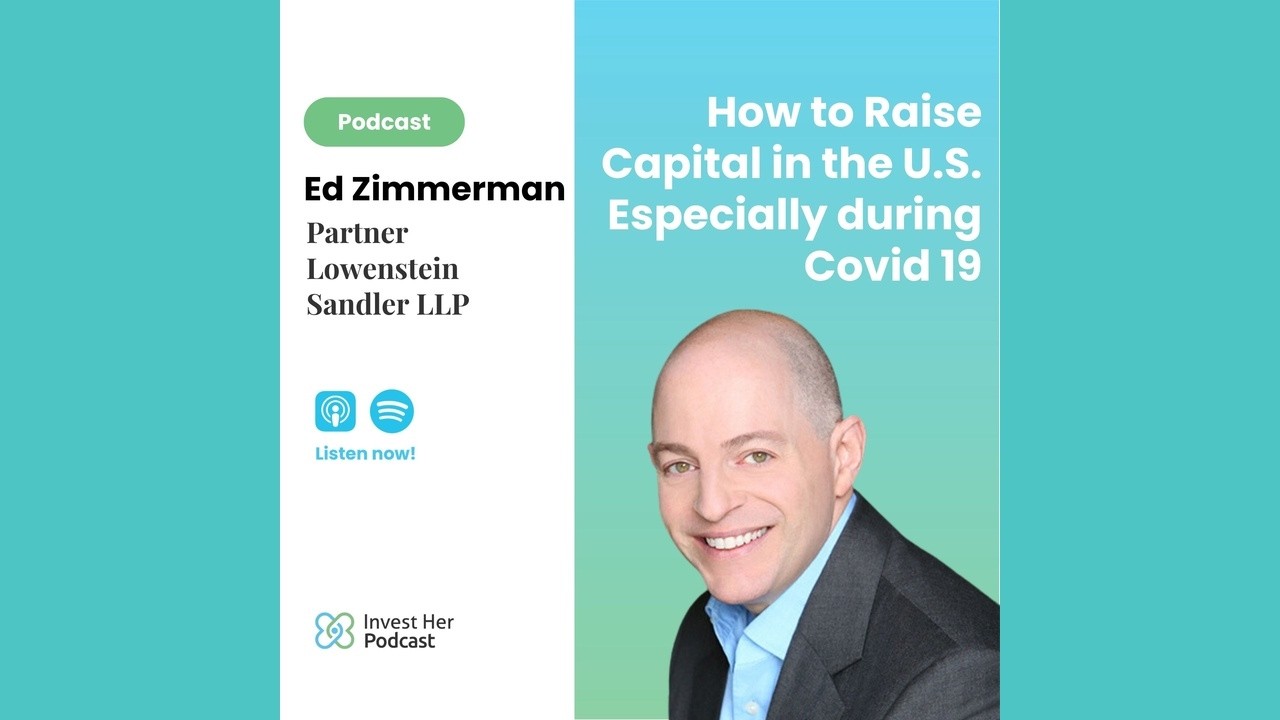
In this episode of the InvestHer Podcast, host Anne Ravanona interviews Ed Zimmerman, a veteran venture lawyer at Lowenstein Sandler, prolific angel investor, Columbia Business School professor, and founder of the VentureCrush event series. The conversation begins with Ed’s extensive background—30 years representing tech companies, over 500 venture deals a year, involvement in more than 150 angel investments, and a commitment to feminist investing. They discuss the origins and evolution of VentureCrush and how it is moving online amid the pandemic. The core of the interview focuses on how COVID‑19 is reshaping the fundraising landscape: VCs are still deploying capital but are more selective, emphasizing portfolio management and longer negotiations; angels face a “denominator problem” as public market losses make illiquid venture stakes relatively larger. Ed shares observations about New York’s resilience and recent deal activity. He reflects on his track record supporting under‑represented founders, noting that he has invested in roughly 130 companies, with a conscious bias toward women and Black founders, and describes his gender‑bias pledge and efforts to diversify his network. Practical advice for female founders includes leveraging existing relationships, crafting focused warm introductions, using government incentives, emphasizing capital efficiency, and building a strong LinkedIn/content presence. Ed also outlines systemic changes needed: broaden recruiting beyond elite schools, increase diversity of thought, accommodate working parents, and encourage deal‑sharing among like‑minded angels. Finally, he recommends resources such as AllRaise, Ada Ventures/Diversity VC, Sista, and emphasizes the value of content over events for visibility. The episode closes with contact information and a call to “put the fun into funding.”
Chapters
This is it, the very first podcast episode with a male investor. Yay, we've done it! I am so glad to introduce you this week to Ed Zimmerman, who is a venture lawyer, a partner at Lowenstein Sandler based in New York. Why did I invite Ed to come? Not only is he an incredible feminist, he is a venture lawyer who's actually doing the deals in New York as we speak during this COVID crisis. He's also an angel investor in over 150 startups. He is an LP in over 75 funds. He is a professor at Columbia Business School on venture capital and angel investing. I mean, what else do you need? He also writes for Forbes, Wall Street Journal, all of this, and he organizes an incredible event called VentureCrush. Wow, wow, wow. You need to hear from Ed, and on this episode, you're going to learn from him what is his take on venture funding and angel funding at the moment in New York and in the US, what you need to know to be able to navigate this COVID crisis, any trends that he's seeing that can be helpful for you to know, and what female founders and investors can learn from this situation. I really enjoyed talking to Ed, and I hope you enjoy listening to him too. Investor Podcast is for you, the female founder who has a product, a service, or a message that you believe in and need to get funded. Or for you, the investor, who wants to learn more about the huge untapped investment opportunity that gives you a higher return— women entrepreneurs. My name is Anne Ravanona. I'm an entrepreneur, TEDx speaker, and women's advocate, and I'm passionate about helping women entrepreneurs get funded. In each episode, we'll take a behind-the-scenes look into real-world funding tactics and strategies To help you get the funding you need faster. Let's put the fun into funding. Thanks for spending some time with me today. Now let's get started. Welcome today, everybody. Welcome to this latest episode from The Investor Podcast. And I'm absolutely delighted to have with me today Ed Zimmerman calling live from New York. How are you, Ed?
Great, thank you. I appreciate the invitation and the opportunity to chat with you.
Well, I'm so thrilled because you're the first male investor, male funding expert that we have on the podcast, and I couldn't have chosen and asked for a better advocate for female founders for funding in these funky times, let's say, than yourself, Ed.
Well, that's— that is overly kind of you, and I appreciate the opportunity to go where no man has gone before.
I love it. Ooh, we're already starting off on a roll. I love it. Fantastic. Well, for the listeners who don't know who you are now, I know there's some people who don't yet, Can you tell us a bit about who you are, you know, Ed, and what it is that you do before we start?
Sure, and I'm aware that most people don't know who I am. So first and foremost, I'm a lawyer at Lowenstein Sandler where I've been representing tech companies and their investors for almost 30 years. I was a summer associate there in 1991. I started the tech group there with my partner Anthony Pergola in 1998. And we close more than 500 venture and growth and even seed rounds a year, which according to the Wall Street Journal makes us among the 5 most active investors— 5 most active law firms in venture in America.
Amazing.
And I'm based in New York and I've been teaching venture capital and angel investing in the MBA program at Columbia for just over 15 years. I also do some writing, both for The Wall Street Journal, where I serve on the panel of experts and have about 80 columns, mostly on the blog pages where only my mom can find them, and also in Forbes, where I have about 40 or so and am continuing to write there. Then I guess, Doing some angel investing, and we started an event series called VentureCrush, which we started years and years ago. So that's the quick skinny.
And it's a— I mean, listen, listeners, isn't that an incredible profile? I mean, if anybody can tell you and give you the best top-notch advice when it comes to fundraising, I think Ed is your man. And I say that really sincerely. And I mean, it's obvious, even if you didn't tell us all of your experience, I already know that from having seen you in action at VentureCrush in San Francisco and in Paris. And for those who don't know VentureCrush, tell us a little bit more about it, and then I'm dying to know how you're going to get around the fact that we can't meet physically for that at the moment.
Yes, me too. So VentureCrush is an event series we started as an effort to bring investors and entrepreneurs originally together We hosted the first one in our Lowenstein Sandler office in March of 2000, and it was unfortunately on the day the stock market melted. And so all of our guests started looking at their BlackBerrys and Palm Pilots. It was soon after the Palm became internet-enabled, and we finally asked what was going on and were told the stock market has crashed. So So we've been running them for a long time, but now they also include musicians and winemakers and professors and writers, but it's mostly about the tech, you know, the tech world. And we have interviews and panels and often venture investors, founders, but a number of times we've had astronauts and musicians and, you know, other people who are less sort of traditional I love it.
And I've had the pleasure of, as I said, being at VentureCrush in San Francisco about 2 years ago and also in Paris. And just to, you know, to our listeners, Ed, you are an incredible researcher. I mean, you have a wealth of information, but when you interview somebody at VentureCrush, you know them inside out. It's absolutely amazing. I remember Aileen Lee from Cowboy Ventures, when you were interviewing her and asking her loads of stuff, and she's like, How do you know that? How do you know that? And we were just laughing because you're so prolific in the depth of your research, which is amazing because it makes for very high-quality, impactful conversations. And we get to the nugget of the wisdom very quickly with you, which I love.
That's kind of you. I often cheat by selecting people I've known for years, as I have with Aileen. So that does help. But yeah, I do like to dig in. I love whether it's for clients or looking at a legal issue or for VentureCrush or for wine or music or politics, I love going down a rabbit hole and getting lost in it and reading and researching and analyzing. And I think that's how I ended up in this day job.
Amazing. So tell us one fun fact about you that people may or may not know, Ed.
Gosh, I may have more footnotes on my bar application than any other lawyer in my firm, according to our general counsel years ago.
That's funny.
You know, I got into a little bit of trouble a couple of times before for becoming a lawyer. And I say a little bit, I mean truly a little bit, but things like there's a question about whether you were ever fired for cause. And I was at the age of 16 fired for insubordination at the kosher deli across the street from the projects in Brooklyn that I worked at.
Yeah.
You know, I had a couple of things like that. Like that. And my wife recently told me that she was worried I wouldn't be able to hold a job when we, when we got married. But I've been at Lowenstein for almost 30 years, so she's a little less nervous about that now.
I love it. And it just shows that you're, you're an entrepreneur at heart, Ed. I mean, you support entrepreneurs in everything you do every day, and you're just very entrepreneurial yourself. That's— I mean, that to me sounds like an entrepreneur. Like, we don't like to stick by all the rules. Like, Apart from the, of course, the real, you know, safety major rules. But, you know, to be entrepreneurial, you have to be thinking outside of the box. And I know that you definitely do. So it just shows you had precursor symptoms, let's say, or signs of it earlier on.
Sure. And I notice in the background that you have a pillow on your couch that says feminist.
Yes.
And I love it. And I'm also just going to pan down So that you can see that I'm wearing my RBG shirt today.
And look, I mean, just speaking of the amazing lady, I'm just reaching over here for our listeners so they can hear me. I'm reaching over to my pinboard and guess what I have on it? I have a picture of RBG calendar that I have from last year. So there you go. She's definitely an icon. So All right, now tell us a bit more about what's gonna happen with VentureCrush then. Are you gonna go online or do you know yet for the next few editions this year?
We have, we do have one lined up for May that I believe we will do online and invite people to. We also, I was just asked to, I guess at the very start of quarantining here in New York, I had been asked to moderate a panel for a, for a Women in Business event by a coalition that was put together. It was the French government, the Canadian government, and the Economic Club of New York.
Yep.
And we ended up doing the panel by phone just among the panelists, and we will do a write-up of that, I hope, next week. So that'll be produced as written content. We may release an audio, although man, that audio is not going to be good.
But you know who would be good for it? For pilots. My husband happens to be a pilot, and unfortunately he's grounded at the moment like most pilots, but they have an amazing knack and ear because they listen to on the radio, you know, all the time. So like, he sometimes listens to BBC longwave or something on the radio in the car, I'm like, and you just hear all this static. I said, how can you listen to that? And he says, oh, it's just like I'm in the cockpit. So you're gonna save us from those cockpit whizzings, aren't you?
Exactly, exactly.
And Ed, listen, tell us about your other passion, which is wine, because wow, are you an incredible expert. Tell us a little bit more about that passion.
Well, that's very generous of you as well. Yeah, I didn't grow up around good wine or good food, but in 1991 I had an inexpensive glass of Puligny-Montrachet, which is a village in Burgundy, and it's a Chardonnay, and it wowed me. And so down the rabbit hole I went, researching and reading and making lists, and then over time meeting people, and I have fallen in love with wine and have spent a bunch of time in Europe and in California. both working harvest, and one sort of amusing quick anecdote is I actually in 2009, I worked harvest in Châteauneuf-du-Pape for my friends, the Ferreau family, Laurence Ferreau at Domaine de Pégot.
Wow.
And I was working on a deal in New York where I was representing investors who were putting $100 million into a A growth company that was pre-revenue called Twitter.
Wow.
And the deal, you know, I'm working harvest in France, the deal leaks in the press, every detail of our deal the press got right.
Wow.
And so we had a call where our client said, we are in exclusivity, but like, we're gonna lose this deal. We have to get it closed right away because a topping bid will come in over the transom. And so we literally, I working in, I was working in Châteauneuf, One of my partners was working in our Palo Alto office and one of my associates was working in our New York office. And because of those 3 locations, we literally worked 24 hours a day in shifts to get the deal closed. And the lawyer on the other side, who's a great guy, said to me, I don't know how you people did it. And I did not tell him that I was picking grapes for about 7 hours a day and then talking to him on either side of that. But yeah, it was kind of fun.
It must have given you the extra energy, can we say that? You were getting the great energy from the retinol or whatever it is that we have, amazing properties inside the grapes, to do one of the deals of the century. That's amazing.
Yeah, well, every time Laurence saw me working in the vines, she would just come by and scream in French, don't let him cut his fingers off, don't let him cut his fingers off, because she knew that I was not a gifted field worker.
And so before we kind of get into the heart of this podcast, I would love you to share, Ed, your experience in funding female founders, because you are an incredible feminist. You have been supporting women entrepreneurs for many, many years. Can you please tell us, like, the number of female founders you have invested in and, you know, what you do to support them? Because I want people to know what a great guy you are.
That's kind of you. So You know, one of the things that came to me in the discussion that I had with the panelists for the French and Canadian Economic Club event was that all of these organizations like AllRaise and Diversity VC, they are great at tracking numbers.
Hmm.
And as an angel investor, I am terrible at tracking numbers. So I've invested in about 130 companies. I've had about 30 exits, and I'm also an investor in several dozen venture funds, personally an LP. And all of this started by— as a result of my relationships after I paid off my student loans. So, um, so I had been a lawyer for 15 years when I started angel investing. And I have definitely had a bias toward investing in underrepresented managers because— or underrepresented founders because I believe that it's the nexus of doing good and doing well. But I haven't counted I've tried to count from time to time, and I know that at one point one of my founders came to me and said that there was— they had just gotten pressed because I believe they were the 32nd female-led— sorry, they were the 32nd Black female founders to get more than $1 million of venture capital.
Mm-hmm.
And I knew that I had invested in at least one other of the 31 companies that had preceded them. And I found that a depressing number because that was within the last 4 years or so.
Yeah.
And it's remarkable to think about the paucity of venture funding flowing to, for instance, Black women.
Yeah.
And I think the intersectionality is a really important point of that. I'm not sure how to track the intersectionality effectively in my own portfolio as an angel. But I've done a couple of things to optimize, like I've put the word out that I am interested. I've let people know about a number of the companies and funds that I've backed.
Mm-hmm.
And I've taken numerous steps to diversify my own network and avoid the sort of calcification of a network of people who look like me, earn like me, live like me, and are my age or my contemporaries. And I think that has been very helpful and it pays all sorts of dividends non-financially as well and helps shape my worldview. And I've got some really, really rewarding personal relationships as a result of that. And then of course we have the gender bias pledge that I published in the Wall Street Journal's Accelerators page about 6 years ago, Gender Bias in Tech. That was the result of actually a statement I made at one of our VentureCrush— on stage at one of our VentureCrush events to Aileen Lee, which is part of how I cheated, is, you know, I interview people I know, having just said that I don't want to calcify my social network. And that was that I wouldn't do events that weren't gender diverse. I wouldn't do panels that weren't gender diverse. I wouldn't go to business dinners that weren't gender diverse. And I should have gone further. I should have said that they also had to be diverse in a number of other ways. And while I've not published or articulated that as something to which I want to be held accountable, Hmm. I have tried to do that. And so One of the things that I prize about our VentureCrush events and about my portfolio is that you will see the diversity that is— that we talk about at those events and on stage at those events.
Amazing. I mean, thank you for everything that you've been doing, Ed, because we need more. We need more investors like you. We need more male investors like you. to be showing the way. And out of all of those investments that you've made, both directly as an angel and as an LP in funds, do you— like, you said you don't track, you know, go into loads of detail, but have you been able to see if there was any difference in your portfolio returns for the female-led companies versus the male-led companies you fund? I bet you knew I was gonna ask you that.
Yeah, yeah. So, so 3 of the companies that I'll mention that I invested in are Flatiron Health, AppNexus, and Yext. I'll throw in a 4th company called TapAd. All of those companies were very meaningful returns. In most of those companies, I invested 3 times. All of those companies were run by men. All of them were run by white men.
Hmm.
And also, all of those companies were investments I made prior to 2011, maybe prior to 2010. And so I believe that the more diverse components of my portfolio will need some time to catch up to, to some of those outcomes.
Mm-hmm.
And, and then there's also the interesting overlay of, with a couple of those companies because of the era in which I was Investing, and because those were New York-based companies, all 4 of those, um, the pre-money on my 3rd investment into 2 of those companies, my 3rd investment was about $25 million.
Wow.
Right. And so for the last— for most of the last, let's call it 7, 8 years, there's no such thing as a 3rd round of financing. for a hot company at 25 pre. Yeah, and that really has an impact on your returns.
Mm-hmm, I hear you. So, okay, let's dive into this. I really want to pick your brain as to what's happening now, Ed. Let's go for this. So how do you think this COVID-19 situation is going to impact fundraising now?
So I published this article in Forbes a week ago that crystallized a number of dozens of interviews I conducted with venture investors around the globe, most of whom had been investors for 20 years or more, and I think all of whom had been investors during the '08 crisis.
Mm-hmm. Yeah.
And the— there were a couple of different takeaways. One takeaway was that people were likely to continue deploying capital, and obviously virtualization is different today than it was in '08, but people were gonna focus a little more on their own portfolio and they were going to raise the bar on new investments that weren't already in pipeline.
Yeah.
And a number of people said to me, hard for me to invest in someone I haven't physically met in person, as great as a Zoom call or WebEx might be. And I think— so that's one ramification. One thing that I've also been seeing and that we've been talking about is For the last decade, we've had a market that's either been up or the same.
Hmm.
And so it's very easy to tell you what market terms are when they haven't changed materially for half a dozen or 10 years.
Hmm.
We are watching people recalibrate. We're getting questions as lawyers that we generally don't get. We're seeing people explore what market might be and how the market has changed. We're seeing people behave well and behave in a thoughtful way. But we're also seeing people saying there's opportunity and I can be humane and responsible and act with integrity. And sometimes people saying there's opportunity and I have capital and other people don't. And so it'll be interesting to see how that plays out, but we're definitely in a period of recalibration. And that means that negotiations and understanding what's a fair deal and what's not are much cloudier and they're taking longer. So that's definitely something that we're watching.
And would you say that Your perspective with regard to, like, how would you say that the VCs in New York are reacting? Because I know in your article you talked to VCs all over the world, I think Singapore, there's a lot of Asia and other parts of the world. How do you think specifically that the VCs in New York are reacting, if you had to do a subset?
So New York, you know, other people got experienced a dip in 2001, but New York has a special relationship with what happened to the market in 2001. And I, I say that because on the morning of September 11th, I was heading to the World Trade Center for a meeting, and I saw the second plane hit the tower. Oh my God. And so I do have a special relationship and lost friends that day. So I think that it is very different from, from that. I think that there is a, there is a resilience. I think that New York is aware that people are looking at us as the epicenter of the American version of the pandemic.
Yep.
We are closing deals.
Mm-hmm.
And yesterday— sorry, on Sunday, we signed a brand new growth round for a New York-based company that is gonna be more than doubling its valuation, which is pretty great. We are in the process of negotiating numerous other Growth rounds. We just closed an up-round venture financing yesterday. We sent out documents in an M&A deal last night. So things are still moving.
Mm-hmm.
My question is really how many people— and a number of people are saying this to me— they're announcing publicly that they're open for for new deals and eager to invest in new deals. And they're saying privately, you know, the next couple of weeks I really want to be focused on my portfolio. So I'm setting up meetings and calls, but they're for a couple weeks out. And I think people do need time to literally take inventory and understand how their portfolios are doing.
Yeah.
I think that we're going to see venture funds themselves raise less capital this year, and that will have knock-on effects in '21, '22, '23.
Yeah. And like, how— and then, so you've talked from the VC side of things. From the angel investing side of things, are you— what signs of change are you seeing in that sphere, if any?
Not this Friday, not this past Friday, but the prior, my wife and I made an initial angel investment into a company that we had committed to about a week and a half earlier.
Hmm.
That company was originally oversubscribed, and I believe that when we funded, Actually, I guess we funded last Monday. I believe that when we funded, it was not oversubscribed. And I know that in 9/11 and in 2008, we saw angels and strategic investors and hedge fund investors really pull back.
Hmm.
And, you know, venture investors are paid a management fee on the capital they manage. They have to deploy it.
Yeah.
There was a cash overhang after 2000, and people were racing to deploy dollars sort of at the end of that period so that they could continue to get their management fees and because they thought that there were good investments out there. I, you know, angels don't have to deploy And angels are subjected as well to the denominator problem, which is something I wrote about in that Forbes article from last Monday. The denominator problem is my public stock portfolio or mutual fund portfolio has now declined 30%.
Mm-hmm.
Therefore, I'm suddenly overallocated in illiquid assets, and my illiquid assets have maybe depreciated or declined even more than that. But I don't know because they don't mark to market in any way that can give me a good sense of that, particularly if I'm an angel and not sitting in boardrooms.
Hmm. So what would you say has surprised you, therefore, if you're looking at the current funding situation? What surprised you and what hasn't surprised you if you had to look big picture?
Yeah, in 2001 and 2008, things ground to a screeching halt.
Hmm.
And there was plenty of time to be anxious and to worry.
Hmm.
Right now we are working really hard, and we as lawyers are working really hard, and that's because people are still transacting and people are still getting lots of advice. And I don't know if that— if there's a delayed reaction to this because there were things in pipeline and because we're seeing people financially shore up their existing portfolio companies with bridge rounds and extra cash infusion transactions. And maybe the sort of aftershock comes a month from now when pipeline deals start slowing down. But one difference is the long hours that we've been putting in on these deals. And that's— I know that that is a transaction lawyer's perspective, but it does feel very different than 2000, 2001, 2008.
And I think that's, that's a very comforting thing because you are frontline. You are absolutely frontline, like you're a first responder when it comes to the capital markets and to making sure that the money is still being, you know, injected into really good growth companies. So I think that that's really wonderful to hear directly from you about that. And so what do you think should female founders do to raise money in this current climate, Ed? And I'm putting focus on female.
Yeah. So look, I think obviously working your existing relationships first and foremost is going to be important as people do pull in a little bit.
Mm-hmm.
I do think that it makes sense to continue to do outreach, but with a level of sensitivity. So the The cold emails are going to be a bit more challenging, and I think taking the time to make them focused and not to just sort of blanket the market with them is going to be helpful. There are obviously also a lot of female-centric networking groups, and I don't know how easy it is to leverage those when you can't really meet in person. But I would encourage people to also work, to also work that network. And then, you know, getting as many warm intros. And I have, you know, warm intros are problematic because they do reinforce the existing networks that—
Mm-hmm.
that perpetuate inequity. But I think if you have access to that, you're gonna need— you know, now is a time that you really need to use it. There are also government incentives available. I'm most familiar obviously with those in the States.
Yeah.
And some of those incentives do also provide for female-led businesses, and I would certainly be availing myself of those if possible.
Good advice. And what would you say would be the key don'ts, apart from the point that you made about, you know, do not be cold— cold emailing the way you normally would, be more conscious about how you approach things? Any other don'ts that, you know, female founders really should not be doing now?
Yeah, so there obviously there's a focus on unit economics and there is a focus on getting a little closer to profitability or breakeven if you can to stretch things out. So I would try to both optimize tactically and strategically in the business itself for nearing breakeven, even if that means significantly slowing growth. And I would also optimize for that in how I presented the company.
Mm-hmm.
One of the criticisms that male investors in particular have leveled against female founders, and, and it is not a fair criticism, is that they are less Yep. And that they do tend to build companies that are more capital efficient. Well, lean the hell into that.
Yeah.
Now is the time to have a capital efficient company. And now is the time to establish that level of discipline and getting proxy I love that.
So big picture thinking, what needs to change in the funding ecosystem moving forward, Ed?
Well, I do love Richard Kirby's article about where did you go to school, and it's really— it's short, it's data-driven, and it's not necessarily gender-focused, but I think that we really look for people who look like us and we should be doing the opposite. And I think that the talent pool has just changed dramatically.
Yep.
And there is a real opportunity as you think about building things back after what we hope will be a V curve to think about building things back by basing it on diversity as well. So that instead of thinking about recruiting from the 3 schools that you— or people with backgrounds who went to the 3 schools or 6 schools that half of all venture investors attended, for instance. Pick a much more diverse set of schools. And I don't mean go to the next 20 most prestigious schools. I mean, A much more diverse set of schools. You can rebuild with real gender and other diversity, diversity of thought, diversity of age, diversity of background, people who've lived in other countries.
Yeah.
You can also use the opportunity that we've now created for ourselves because everyone who has kids has kids in the background on all of their calls.
Exactly.
Use that as an opportunity to think about how you can on-ramp and blend in working moms. And when I say working moms, I don't— it's not that I'm stereotyping that moms are the primary caregiver, but moms are the primary caregivers. No matter how far feminism has come and no matter how enlightened a partner is, predominantly both childcare and care of other family members, and particularly for underestimated founders, there is often another family member that someone is taking care of.
Yeah.
That has historically fallen to women, and that persists. So think about making sure that there are great ways of including those folks in the workforce, maybe in a way that you weren't before because you thought that everyone needed to be at the office 7 days a week or whatever. So I think those are some things to think about.
Love it. So what are you doing differently then when it comes to, you know, investing in this climate for yourself as an angel?
I wish I knew. I really do. I mean, look, I think that it's important to stick by your word, right?
Mm-hmm.
I think that understanding what the capital needs of companies that you've invested in will look like is important. And I also think that there will be real opportunities. We represented a venture investor in a deal that closed last night that I haven't talked about in California. That deal was a telehealth deal. They started that deal long before the pandemic, and it happens to be female investor and female founder.
Mm-hmm.
I think that's— there are all sorts of interesting opportunities, but I also think the market shift itself will change access to deals and profitability of companies and pricing. And I've been shifting geographic focus as well.
Yeah.
I think underestimated founders is also analogous to underestimated geographies, and particularly in geographies where venture capital has undercovered the territory and where those founders can't now get on a plane and go to New York, London, San Francisco.
Yeah.
So I think those are things that I'll be thinking about, as well as just looking at the macro trends that result from sociological shifts in how we operate after the pandemic.
And what would you say would be your favourite fundraising resources for founders? Where should— where should the female founders be looking just to find out about funding in general and what's happening in the market?
I do think that AllRaise does a great job of trying to facilitate that for female founders.
Mm-hmm.
I also believe that AllRaise is a US-centric group. I know that Chek Warner at Ada Ventures, in which I am an investor, into which I am an advisor, in London through her efforts with Diversity VC. She's done great stuff. In France, where you're located, you have Sista.
Yeah.
And my friend Tatiana Jama has done a great job with that organization. I think those are some, some great resources. I think following you on Twitter is a good thing to do.
Thank you.
And I do, I do also think that female founders have— now is, is a good time to be doing content rather than event marketing. And I think that LinkedIn is a good source of, of that. And so sharing things there and making sure that you're You know, that you're polished on LinkedIn by ensuring that you're connected to the people that you're supposed to know. You know, maybe there's an opportunity to catch up on, on some of that as well. But, but writing and writing up case studies and showing provable results on things, I think, is something of value right now.
Love it. So last questions. How can our listeners connect with you, Ed? What's your preferred platform for people to get to you?
So I'm active on Twitter and LinkedIn and by email. I'm active in a couple of other places online, but I think Twitter, LinkedIn, and email are the best ways to reach me. pretty easy to find my email, and my Twitter is @EdGrapeNutZimm, Z-I-M-M, which is complicated and not the handle I would have chosen had I joined Twitter in the last, I don't know, half dozen years instead of earlier than that. But it's— but it is what it is.
It's cool. And so last question, how can we put more fun Into funding, Ed?
Hmm. That's a good question, and I don't know that— I don't know that I have an answer in a world in which we can't physically be together. I guess you could do some sort of Zoom call for everyone who wired to just to just spend 15 minutes with a virtual glass of wine together.
Yeah.
But I, in all seriousness, I do think that for those of us who are backing underrepresented founders, particularly but not exclusively women, I think that bringing us together and bringing each other into deals Hmm. It often— it happens where one investor cajoles you or introduces you to a founder, but I, I think if 2 or 3 get together, and if I know, for instance, that I've invested in at least 2 dozen female-led companies, just to say, for instance, if we could really start to say, you know, I'm an angel, There are these other angels who have also invested in whatever the number is, 15, 20, 10 female-led companies. I'd love to see small clusters of deal sharing among those groups because we're going to need more hands around the table to write those checks as we did in '08.
Yeah.
And we're going to have to switch from an environment where people were crowded out of deals to an environment where people bring each other, drag each other into those deals. And particularly for underrepresented founders raising first-time or second-time money, I think that's important. And it would be fun to make sure that folks who are investing in those kinds of companies bring other like-minded people in.
Love it. What a better— no better way to end our podcast today, Ed. Thank you for that amazing advice. Thank you for sharing your expertise, your experience, and yeah, your strong feminist, as in equal opportunity, streak, and your very strong ethics towards funding underrepresented founders and diverse founders. Thank you, Ed, for everything you do.
Thank you.
Keep on rocking that system over there. Keep those deals flowing. Keep it— keep the juice flowing. The Ed, you know, the Ed Grape-Nut Zim financial juice flowing into the deals. And we look forward to maybe touching base with you in a few months when all this is over and say, now let's look back and say, this is what you said, what has actually happened and how things move forward. You know, maybe at the end of this year we could touch base and, and see how it's going then.
Well, thank you so much for having me and for everything that you do and for all of the positive efforts that you've been making for years. I really appreciate it. I respect you and I wish you good health and safety and prosperity during this challenging period for everyone. So thanks so much.
Thank you.
Take care. Take care.
Bye-bye. Thank you for listening to InvestHer Podcast. Don't miss more great funding tips and insights by subscribing to the podcast on Apple or your favorite podcast host. And while you're there, I'd love you to rate and review the show. We'd love to hear from you. So if you'd like to send in some questions, interact with our guests, or suggest other great people we should feature, join our community on the Flick InvestHer group. Or send us a message on investherpodcast.com. more great resources for female founders about funding? Check out our InvestHer Academy at academy.globalinvesther.com. I'm Anne Ravanona and look forward to having you with us again for our next episode. Let's put the fun into funding and get more women entrepreneurs funded.
More from Anne



🎙️ EP69: Get Off the Fence: Renate Crollini's Startup Blueprint | InvestHer Podcast

🎙️ EP68: Radical Truth: Robert Rubinstein Exposes the Impact Investing Illusion | InvestHer Podcast



🎙️ EP66: Global Sisterhood — Carine de Meyere on Trade Missions | InvestHer Podcast



🎙️ EP65: Capital With a Conscience: Pierre Norman Rolin on Investing in Women… | InvestHer Podcast

🎙️ EP64: Dream Bigger: Nikki Barua on Building an AI-Native Company Without… | InvestHer Podcast