🎙️ EP14: Meet the VC — Live Podcast with Bedy Yang, Managing Partner & Global… | InvestHer Podcast
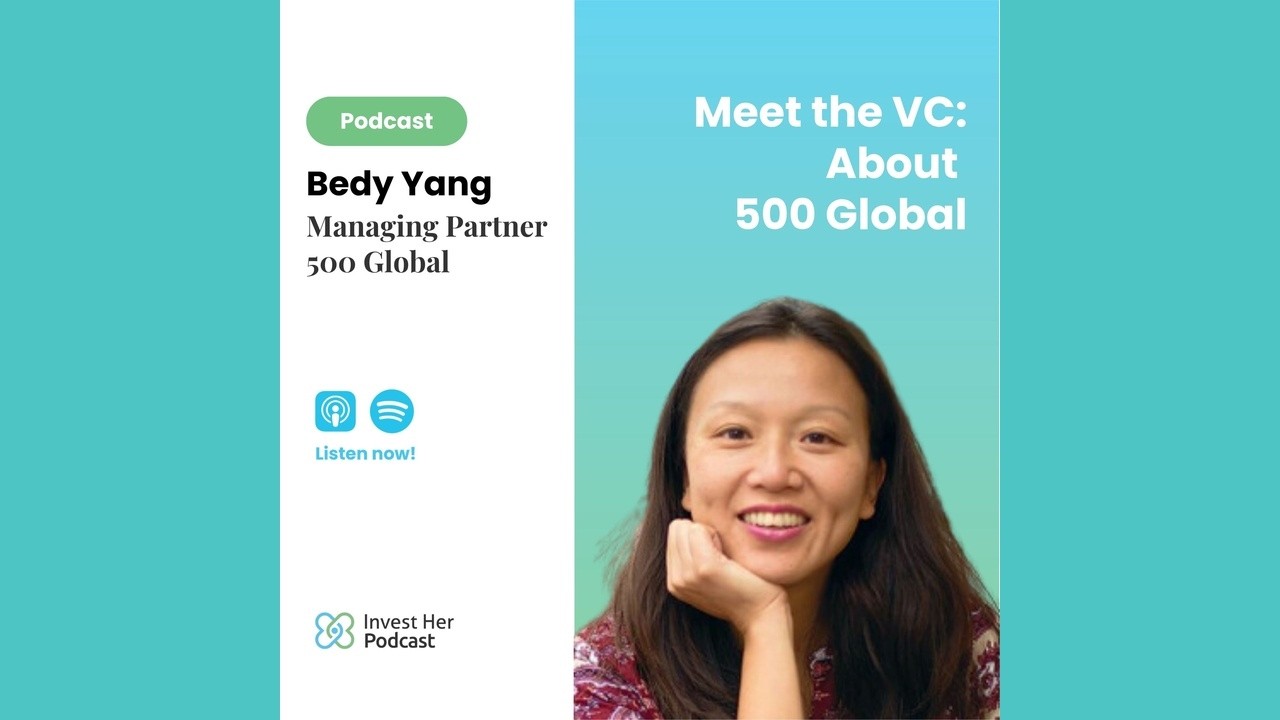
In this live episode of the InvestHer Podcast, host Anne Ravanona interviews Bedy (Bedi) Yang, Managing Partner Global at 500 Startups. The conversation covers Bedy’s multicultural background and her role as a “translator/connector” for under‑represented founders, the global scope of 500 Startups (over 20 funds, 2,000‑2,500 portfolio companies across 70+ countries) and its acceleration programs. They discuss concrete initiatives to increase funding for women and diverse founders – from tracking pipeline percentages (30% of applicants are women, aiming for 40‑50% in batches) to creating women‑focused syndicates, the VC Unlocked education partnership with Stanford, Berkeley and INSEAD, and a list of 1,000+ women investors. Bedy shares data on gender representation (20‑25% of the overall portfolio, higher share among unicorns) and explains how 500 is trying to embed more women investors at the senior level. The impact of COVID‑19 on fundraising is examined: institutional capital remains active while angel wealth shrank, leading to more digital acceleration, virtual demo days, and a permanent online investor community. Practical fundraising advice is offered – join digital networks, personalize outreach, master a 3‑minute pitch, be data‑driven, and treat feedback as a blessing. Resources such as AngelList, the Global InvestHer community, and 500’s investor list are highlighted. The episode ends with a call for systemic change (regional seed/Series‑A funds, fund‑of‑funds) and a reminder for founders to care for their mental health.
Chapters
Welcome back, everybody. In this episode, I'm so, so happy to introduce you to Bedi Yang, who is Managing Partner Global at 500 Startups based in San Francisco. She is an absolute powerhouse when it comes to investing, and she knows so much about the investing space and the funding space that I absolutely wanted her to have us back here on this I had the luxury of interviewing her a couple of years ago for the Huffington Post as a trailblazing woman VC, and she's gone on to do more and more incredible things, including creating a specific program to help more women and diverse founders—
people, sorry—
become VCs. So in this episode, you won't want to miss it. This is a fantastic one because we recorded it as a live podcast with live questions from the audience throughout the podcast and towards the end. And And so that makes it very special. You will get to watch the actual video if you want as well on our YouTube channel. And don't forget to check out our episode notes because we put in there links to fantastic resources that she gave us, including a very big list of investors. So if you want to get incredible funding nuggets of wisdom, listen up. Investor Podcast is for you, the female founder who has a product, a service, or a message that you believe in and need to get funded. Or for you, the investor, who wants to learn more about the huge untapped investment opportunity that gives you a higher return— women entrepreneurs. My name is Anne Ravanona. I'm an entrepreneur, TEDx speaker, and women's advocate, and I'm passionate about helping women entrepreneurs get funded. In each episode, we'll take a behind-the-scenes look into real-world funding tactics and strategies To help you get the funding you need faster. Let's put the fun into funding. Thanks for spending some time with me today. Now let's get started.
Great, so welcome everybody. I am totally thrilled to welcome you all to episode 14 of our podcast, and it's a live podcast again, this time with the incredible— and I mean incredible because she is, you are, Benjie— Benjie Yang from 500 Startups. She's a managing partner there, and she's in charge of the global—
global, I mean, what, what a cool title already, Benjie.
I mean, Magic Park Global. I love that. So do you want to say hi and tell us maybe one fun fact about yourself before we, before we start off? Hi, Anne.
It's a pleasure to be here today with everyone and in this podcast. Beiji, my name, and the fun fact about my name is when you read it sort of spelled out like a B-E-J-I, you might say it's a beejai or a beedi or a Betty, or any of those depending on which country you're coming from. But Betty is a pronunciation from Brazil. So when, like, if you speak Portuguese, especially the Brazilian Portuguese, you would know all the D and the G has the same sound. So although I look very Asian and I'm based in the US in Silicon Valley, I am Chinese-Brazilian. So that's one of the interesting I love it.
And I mean, that's what's cool because you surprise everybody. You can— you surprise everybody, and I love that. And not only— just for all our listeners and for everybody who's tuning in live, you know, Bedi will surprise you with her intelligence and her brio. And that's why I wanted her to be here to share her funding knowledge with us all, because she— you've been in the front line, Bedi, for many, many years. Do you want to tell us a little bit about yourself, your background, how you got into funding and 500 Startups? Give us a bit of a warm-up. For those who don't know— who doesn't know 500 Startups? But yeah, there's some. Off you go.
Yeah, happy to do that. So a little bit about who I am. I feel I am a translator/connector. So a lot of my background, like my parents are immigrants, and then they first went to Brazil, and then I later came to the Bay Area. It's how do we, as an outsider, as an underdog, really tap into the networks that tends to be very closed network, not because they want to be, it's just that very often those dots are not connected. So a little bit of my role is to find this really good platforms that, or build these platforms that we could really make those connections a lot better and a lot easier. So most of my career started with either working on strategy that are related to distribution and go-to-market to underserved communities. I have also like started a business and joined as a partner in like selling handicrafts in the indigenous communities, for instance, in the Amazon.
And then—
Wow.
My most recent sort of well-known job that a lot of people reach out to me is at 500 Startups. So we are a seed accelerator program that we run, but we also run funds, or many funds actually. We have over 20 funds that we have been investing across the world. We have invested in over 70 countries. And a little bit about our portfolio is we have 2,000, almost 2,500 companies in that portfolio. So that gave us a lot of breadth into everything that's happening around the world. And the fund started in 2010, and I joined in the early days. So, a few months after the fund started, I've learned that the fund was quite interested to take many of the entrepreneurs to go to different parts of the world, and I offered to say, why don't you come to Brazil and see what's happening? So, in May 2011, we took this over 40 amazing founders and entrepreneurs to Latin America, and in that same trip, 500 Startups decided to show many of the startups to the founding partner at the time, and the fund decided to invest in 4 of the companies that I ended up presenting. And then they— that sort of made the path to my investor journey because they ultimately felt that I had a good sense of what a global fund such as 500 Startups would be looking at in an international company, in a sense, in a startup. So that was in the very early days in 2011, and then I started a little bit the journey first curating and selecting companies in different parts of the world. Mm-hmm. So for instance, like the first Brazilian deal, the first Africa deal, the first European deals, all 500 started learning like, how do we invest that? Because you have the local legislation, the legal terms are different, the founders very often might or might not know how to pitch. So that goes back a little bit about the translation into the language, into the network. that I mentioned. And then in the later part of my journey at 500 as a managing partner, then I started looking at— I know that the programs that we run, which is acceleration program in the Bay Area, has created a lot of impact. So we've been taking these programs in different parts of the world. Mm-hmm. So we have taken that— so I was very close, for instance, in the Mexico operation. That was one of the first that we ran. And then later on, like the most recent one, like end of last year, we did one, for instance, like in partnership with the UNDP for impact entrepreneurs, for instance, like Indonesia. So it ranges from a program that we might run in Silicon Valley all the way to Asia. And most recently, we launched our Georgia program that is not the state of Georgia, but the country of Georgia.
Country.
Because there's so much talent in the ex-Soviet, like Europe, Eastern Europe component. So we started really tapping into deeper and deeper where talent is. a little bit about our mission, and because I think most of the companies will live by the culture and the mission that they have. So 500's mission is to really identify where the talents— identify the most talented entrepreneurs and invest in them and help them scale. And at the same time, we really believe that we have an important role to play in the ecosystem. Not that we will build those ecosystems, but like the fact that we have already built such a broad network around the world, we believe that we can be catalyzing and contributing to a lot of the different markets that we've been investing in.
Amazing. And tell us, I want to just share with all our listeners and those of you who are with us live, if you— not if, when you have a burning question for Betsy, please just type it in the chat box and we will absolutely ask it. I'm going to keep going through my list of questions for her, but we absolutely want to take your questions live. So I just wanted to say that. So, Benjie, tell us a little bit more about what you're doing so far, what you've done so far to help female founders get funded, because I know you've been extremely active in that. And when you and I first met, my goodness, you know when we met? We met, I think it was 2014 or 2013 at Web Summit. Dave introduced us. I went up to Dave and I said— I went behind, it was such a funny story. This is about hustle, guys, okay? I went backstage I got— I sneaked in, I sneaked in backstage and I got— I was waiting outside the speaker area and I knew that Dave McClure, he was in there, who's one of the founders of 500 Startups. And so he was there and I got one of the girls there and I said, listen, see that guy over there with the glasses and the t-shirt on? I want to talk to him. Can you bring him over to me? And she did. So she brought him over to me and I just said, Dave, love what you do. What are you doing for female founders? He says, hold on a second, you've got to talk to Betsy. And he introduced me to you. And then we met up again, Betsy, at, um, Do you remember in Miami at the, um, the IEDB, uh, we, um—
We exchanged.
We exchanged, yes. We exchanged.
The Network for Women Founders, yeah.
Yeah, and then in Paris again. So we've been kind of meeting, and I also had the pleasure for all of you to— if you want to learn more about Betsy as well, I did a great Huffington Post interview of her as a leader, as a woman investor, um, a few years ago, and it's in our blog. So have a look at that. And guess what, Betsy? Your interview is the one that's most read. I just have to tell you that. I wanted to keep it here to tell you.
That's nice!
Yeah, you're the one who's most read, so there you go. So tell us a little bit more, coming back to my question, what have you been doing so far to help female founders? Because I know you've been very active on that front.
Yeah, since 500 is a fund and also we run the acceleration program, I think very often the most impactful component is just by doing and investing in the founders. It's been quite interesting, like, an entire set of 500 journey. We have invested in over 500 startups with either women CEO or women co-founders in that network. And that is, I think, a relative, like, high number, although, like, when you look at the entire portfolio size, that's still, like, around 25%, somewhere between 20-25% of the entire portfolio that we have.
Yeah.
When you look at— just looking a little bit at the data— when you look at the companies that are at unicorn status, which means that companies are valued over $1 billion, actually that percentage is much higher.
Mm-hmm.
So, like, if you look at that, there is some sort of mismatch. Like, we should be investing in more women founders throughout. And, like, internally, we look in, like, many ways that are trying to solve in a systemic way. So on one hand, we always look at bringing more women investors into the 500 Family because there was this really interesting article on New York Times that says, like, to increase the diversity in the industry, you want women to be deploying those checks. So like having women investors on the table, they have a seat on the table, they will take decisions to people like them because they might be in the network or understand businesses. that are within their sort of understanding, right? So I think first thing we often look at is like within 500, can we bring senior team members? And we're pretty lucky. Like today, our CEO, she is a woman. And I think that starts from the very, very top. And then I'm one of the managing partners looking at all the investments, all our global Program. So we constantly, not in like one single activity that we feel like our job is done, we constantly think like, what are the things that we can continue to do that can be a sort of systemic, or how can we measure through the data? So for instance, when we look at our acceleration program, we finished our batch 26 because they are done by batch. So one thing that we've been doing is collecting a list of pipeline. A lot of people say, like, oh, we don't wanna invest in women, or we don't wanna invest in this underrepresented group, because we don't have the pipeline, right?
Mm-hmm.
So we wanted to, like, start understanding then, what are the data, what are the people that then apply to the program? So in the 2000— sorry, in the batch 26, which just happened just recently, the data— I'm just looking at that graph. The data show us, for the female founders, around 30% of the applicants We had like 3,000 respondents, right? So about 3,000 companies normally apply to every batch. So it's like a highly, highly competitive class. Normally we select only the top 1%. So the proportion, like if you wanted to keep that parata, it should be 30% of that. And I think internally we sort of kept that. So most of our batch, or recent batch, especially with acceleration, that you can like really take that— more aggressive approach in investing. So we've been having always somewhere between 25% to 40% of every batch having that, and then sort of accumulates over time. So I think I mentioned a little bit around investing in founders directly, and then it is commitment for us to— can we find networks that we do more outreach? So more female and women entrepreneurs would then apply for programs? And then can we also make the commitment to at least mentors or interview so that we make sure that it should be in the same percentage or even higher, right?
Yes.
So I think on one hand, it's like, how do we move from being 30% to 50%? So how do we increase that volume? And then the second is, then how do we help that sort of bridge that gap so that, like, should be an acceptance. We don't have a ratio that we have, like, a quota that we do internally, but, like, ultimately, I think that creates a little bit of the engine internally that we often discuss. And then we have a lot of general, like, resources and webinars, and I can send you things. I saw someone ask, like, do you have a list of women investors? I have actually a list of over 1,000 Investors that you can put later on in the podcast notes.
Show notes, yeah.
And the show notes. And I think there is more and more resources being put together that it's easier to access them. And actually, it's not something that 500 put together, but 500 is often included. So we end up gathering and knowing some of those resources that founders can use. So that's first thing. First is how can we use the cash That we collect from our LPs, make a very sort of sound decision from a return perspective. At the same time, like, how do we build systemic sort of changes that would change the ratio just by us doing it?
Yeah.
And then hopefully other people would sort of follow suit. The second thing that we do that I think can be very transformational is, what if it's not only within our fund? What if we also open the 500 platform to many other investors. So 2015, I started this first program in partnership with Stanford Center for Professional Development. We have a program today, it's called VC Unlocked. So the idea is, how do we unlock the thinking and the capital? Because the restriction is never the capital, it's the way of thinking and the access of that mindset to deploy to more innovation into the startup, right?
Yeah.
So we started building these programs first with Stanford, and later on we built a partnership with Berkeley, and most recently with INSEAD, to really then open source a lot of things that we've learned, and I think most importantly, build this network of investors. And I remember really vividly when I launched a program for the first time, That was the first time, like, I'm not an operator, so it's a bit like we're launching and then we don't know whether people are gonna be interested, they're gonna want to do it. And I remember the application had only like one woman, she was Black, LGBT, and—
Harlan Hamilton!
Yes, that's Harlan! That caught me, it's like, why don't we have more people like her, or like them, applying to the programs, right? So I felt really strongly at that time, and I said I wanted to then run a scholarship, and then start tapping into many, many, many, many, many networks to build this first, first, first class. So a lot of, I think, that's more like maybe philosophical. I think a lot about diversity, It's like one of my colleagues once mentioned, I thought that was like a really interesting way of thinking about it, is let's say if you start with like a class of 50 people and you have only one person into that, and then you want to get to like half, like the 25 people into that 50-people class, you have such a big debt and it's really difficult to catch up on the debt.
Yeah.
But if you start on 25 or you start on like 10 people, then the catch-up of that debt is a lot easier.
Yeah.
So the first formation of the VCNLog alumni class was so critical, because later on, people who look up, for instance, to Arlan, then they were also applying. And then in that same class, we actually introduced 2 women GPs that later on built out This really, really amazing fund called SoGal Ventures.
Yes.
And they are— and they have been deploying like checks for over— the last time that I caught up, it was like over 50 checks. And it's really amazing then to see like this program or this network, how much if someone can raise $10,000, $20,000, and if they are deploying to another $50,000, it's such a catalyzing momentum that can be done. So a lot of our effort, and my effort, has been, as we think about 10 programs of acceleration run around the world, how do we build data and training and team so that we can do direct funding and we can do that direct impact? But maybe that number limits to, I don't know, 5,000 founders, 10,000 founders, 20,000 founders. But then if we think about the the rest of the ecosystem, if we have more general partners, more investors, more women investors, whichever underrepresented groups are represented and have a seat at the table, then I think it starts really transforming in maybe moving from like 7% to 10% to 15% to 25% to like 50%, right? And I think it's moving towards that direction.
And you're absolutely right. I mean, the whole access to funding for female founders and diverse founders, it's such an issue. It hasn't changed in over 30 years. I mean, that women only still get 2.8% of total VC is just unacceptable. And that, like, when it's mixed teams, what, it's about 11-12%? And it's something that, you know, I hold very dear as well, in that I'm starting a campaign called 1 Million InvestHERs, um, Bedi, and I'll be talking to you about this.
Yeah.
And it's about how do we rally together the ecosystem players, the governments, and, you know, the funders as well towards— to help fund female founders. And so, InvestHer— I call it InvestHer, there's 2 definitions of it, because when I did my TED Talk on it in 2015, the definition of invest means to put your time, your money, your resources into something worthwhile and expect a positive result. That's actually the definition of the word invest. Okay? And then people have— we always think of the word invest as to put, you know, your time and resources in to expect money, but it's actually to expect a positive result. And for me, the top of the investor pyramid is the woman entrepreneur who's investing her time and energy to help solve a key problem for a community, for a group of people. And then the other 2 groups at the end is the funders. So these are the investors, people like you, 500 Startups, who actually put the money in. You are investing in her, so you're an investor with your money and your mentoring. And the other cohort, they— the other group are the corporates, the, the women entrepreneur networks, all of those people coming together. So that is something that we're launching very, very soon, and I'm kind of starting to spread the word now. And I'll be coming back to you, Benji, about that because we, we need to bring everybody together under one, under one kind of, um, Well, we're all in the same— we're all on the same mission to get more diverse, great talented diverse founders funded and getting access to capital.
No, I love it. It's very similar how actually we look at just the overall landscape. The founders is always in the middle and everyone around the founders are like supporters or sort of service providers. And in addition to the funders and the capital available, for instance, we have also like members that work very, very closely with the universities. Like I mentioned, the UNDP, the program in Georgia, actually, it was with the government and the World Bank sort of working together. And we have also really strong initiatives working with the corporates because they could be a corporate that would be buying services of the startups, and that would increase the value immediately.
Yes.
down the line, they can be acquiring those companies so that it creates sort of liquidity and exit.
Yeah.
Very often with a venture, that's really important. And the corporates, last year, the CVC has had a really important participation in the entire venture community. I believe it was somewhere between 20% and 30% of the entire pool of capital came from the corporate in the CVC space. So it's really important that they are like practicing investments that are like founder-friendly, that they wouldn't like destroy the ecosystem throughout. So like that participation and the aggregation, like you mentioned, of the ecosystem of the multiple players is super, super important.
It's vital. And we have a question from Eric. So Eric Edapka, and he's asking, do you have a specific fund for women? Which is a great question. And he says he owns a woman-only incubator accelerator Including women, and he wants to know, do you partner— are you interested in engaging originators, especially in Nigeria, Africa, to assist you to bring very high-potential founders? Of course she is, Eric, aren't you? I bet you. So take those 2 different parts. So do you have a fund specifically for women? Let's take that question first.
Yeah, so that's a great question. Like, internally we have discussed so much on whether we set up dedicated funding associated with that. We eventually— because we launched this family of funds, and normally the family of funds in the first generation was like regional, and then we sort of tested a little bit of like different verticals. So with like F500, because we're building a model that not a lot of people have like tried before, this sort of global platform, we tend to be like very open-minded to to see like, how do we think about it? So today, like, we have like shifted a little bit our thinking throughout, and I'll talk about a bit of the history of that. So just to give it like a specific example is AngelList. I don't know if you're familiar with AngelList.
Yeah.
So AngelList is this platform that connects investors and entrepreneurs, and if you have not heard of it, I would highly recommend you join the network, sign up for it. use that to look at who is interested in women founders, who's interested in Nigerian founders, because it is this open network that you can join. So on AngelList, when they launched, they actually launched this many years ago, actually. I was the one submitting within 500 syndicates and funds.
Yeah.
So one thing that I actually spent some time thinking is, like, what if we launch a women's syndicate, and then we have a 500 syndicate? And maybe that would be like really good. So the ultimate thing that I concluded, and it's personal, that's not 500, it's way better to have a base, let's say, of like 100,000 investors, and then you constantly, in 50% of the time, put women founders, Nigerian founders in front of this large network. Interesting.
Yeah.
But then you have this very clear framework that you want to increase that equality, than to say, oh, maybe there's only like 200 or like 50 people that are highly interested in this niche, but then you're trying to recruit that niche into that specificity. So we ended up launching both. We haven't been like really active because it's difficult for us to be like very active on AngelList when we have our like many day-to-day things, and we We tried to do a lot of connections directly. But my conclusion at that time, when the market hasn't really— like, there's not critical mass enough at that time. It was like, I think I want to say it was at least 3 years ago.
Yeah.
So there wasn't a critical mass, then it's very difficult to have dedicated funding for that. And then it's always like, oh, I'm only putting this because it's a women fund. No, like, you're putting like really great We want the best platform that is available, right?
Mm-hmm.
So that's about like 3 years ago. I think right now the density for interest, like the volume has increased for interest of that. I think this might be a new moment for us to reimagine. Maybe if we build like a fund or a syndicate or anything around that, then the interest wouldn't be like only like 200 people. Maybe then it will be equivalent to having like I mentioned, like 1,000 people that would be interested, then it's relevant, it's big, and then we could deploy that. So up to this point, we haven't done this dedicated vehicle, but that's something just like really recently we've been starting to reimagine. And I think timing-wise and just the global movement around bringing more diversity more global. Like, when we started, people were like, why would you do global? All the Silicon Valley funds would just go in the corner to invest in the companies. Now, it's almost us, like, why wouldn't you go global? Why wouldn't you think about a founder that can come from anywhere? So just in general, 500 Startups is extremely interested. And your question, whether we're interested in finding continuous sort of networks and people that we can collaborate on the deal flow, whether it's like suggesting that we invest, or after we invest, you co-invest, or we have also many like great investors that invest in our funds and let us deploy the capital. So there's definitely many forms of partnership that we look for, and it is really core and dear to the 500 culture and team. on the diversity, right? Like, one of the 5 core values we have is like the diversity component.
And I'm just checking because there's another new message here. So Susan wants to know, she says, what's your minimal criteria for women founders to be viewed as viable candidates? And is it different for the male? That's my add-on, but okay. What do you think? What's your minimal criteria for women founders?
Yeah, so we don't build a separate criteria. What I think can't go unnoticed is our intrinsic bias. So I've done a lot of investments and I also participate. There's this really, really great network, if you have also not heard of, called Endeavor. It's a nonprofit. And they do great mentorship for founders. And I'm part of like some— every year I take like one program, like one, because I do the international selection panel, and I make a commitment to like help participate in one to select. I know every time I read a profile of a founder, like they have to like still do well, but I intrinsically want them to succeed.
Yeah.
And it's so interesting because It's like it's in your guts, and whatever they say, you're just interpreting within that, right? Like first your emotion comes, then you rationalize on top of it. And I think it's very difficult to not have bias altogether. Yeah, absolutely. We try to train ourselves, and we talk about it. So I think we don't have, for instance, like when you ask like the questions criteria of like how we select companies, we have like something around gender or something around underrepresented groups. Like there's nothing around that, but I think Each investor that is selecting a deal, they have this bias of whether it's an industry they like, this would never work. And for better or worse, we're very, very often wrong about those preconceptions that we have throughout. So maybe just to respond a little more general, in a generic way, like what companies are accepted to 500, and—
Yeah.
What can be like, milestone or like metrics. So the San Francisco program has become really, really competitive. And of course with that, it's always looking at what is the top 1%, right?
Yeah.
So it's always in comparative terms. So today, like for instance, Batch 26, we have like 3,000 respondents. We only selected like 30 companies. So we try to do a few things. We try to look at, are we looking at several industries that we think is important. So for instance, like fintech always tends to be like some companies coming in from the States. We really like SaaS businesses, marketplaces. So there's a little bit of like, okay, what is the composition of the class?
Mm-hmm.
And then depending on what you're working on, it's a little bit more competitive than the others. So for instance, if you are in fintech, It tends to be really capital intensive, and very often, like, the founders, when they join, they might or might not have the product that is ready. So a lot of the traction, quote unquote, is around the founding team. The founding team maybe had experience in the fintech or in the financial service industry. They have a deep understanding into a certain channel.
Mm-hmm.
So we are looking at components around that, and it tends to be a little bit earlier. Stages. If you are going into marketplaces, normally you are measuring by gross merchandise volume, what we call the GMV, right? So it's like how much is transacted. So the expectation then is a little bit higher because that's not your revenue. And we want to make sure whatever marketplace you're building has some early adoption to it. So I would say for marketplaces, SaaS businesses, Because it's so easy to build a business like that, we like to see some early customer that really likes your product. It doesn't have to be gigantic, but in your niche market, they need to really like it. It needs to be really engaging. And then when we're running the acceleration program, we're specialized in growth marketing. So we want to ensure that we can help you on growth.
Yeah.
So if you feel like, oh, maybe all your help It's around introducing to CEOs in like Europe. Maybe that's— we are not the best partner that can help you accelerate in the next X amount of months.
Yeah.
So another criteria that we use is, can we believe we can bring value in these 4 months? That's why it's called acceleration program. And then other values that we often look at is related fundraising, but that's We already sort of built a network. Our partners spend a lot of time with the founders to raise downstream capital. But I think what you might be asking is, how do you get that first check? Because we tend to be the first check ever, sometimes before the family and friends. We might be your first, first check ever. It has happened multiple times among our portfolio.
And so now I want us to zoom out a little bit, and if you can tell us What is your take on how COVID-19 is impacting fundraising right now? I mean, this has really impacted the whole world, and we want the Bedgy take on this because you've got a very global view. Can you give us like your take on what you're seeing happening in Silicon Valley and then maybe globally because you've got both lenses?
Yeah, so I think the way to look at COVID and funding, it's maybe like categorize the funding in 2 types of funding. One funding that is more of like an institution or official, I don't know how you want to call it, or like a fund, they have a mandate. Another is a little bit of a tourist fund.
Tourist funding.
So what happens is, for instance, if you are raising Potentially with a group of angels. Past 3 months, it wasn't only the COVID A lot of the people who have their net worth, they have their net worth in public markets. And all of a sudden, all their money has decreased like 30% or 40%, depending if they're in travel. It's just like half of the wealth is gone.
Yeah.
So in their mind, it's like, okay, I used to own, I don't know, $1 million. Now I own $500K, do I want to take and realize a loss and then put it into this startup? I think that's a very, very difficult mindset for people to go over.
Yeah.
Because they might think, okay, this might come back, but it's like, is there a risk for me to wait? Normally there's not this urgency for them to take action, right? But they are seeing every day they go online. I talk to my angel investors, like, I don't want to go online, I go online, I go crazy. So I think there is a little bit of like, if you don't have a capital that is dedicated from early stages of fund, then you would go into fluctuation of other asset classes, and then it will have influence. So I have no question that it's harder to raise money right now because there's just like, people are not wanting to move the capital around.
Mm-hmm.
The institutionalized capital, for instance, like 500 raises money from limited partners. We have around $600 million under management. Our mandate is for 10 years. Like the COVID time, if anything, it's creating better valuation, better deal flow. So if you see 2008 crisis, that has created way more innovation.
Yeah.
So it has created— Being able to have institutionalized capital and invest during crisis is actually— I don't want to call it fortunate because COVID is definitely not fortunate.
Yeah, yeah.
But it is an opportunity for investments altogether. So 500 has not slowed down in investments, but it has become more competitive to get capital because there are more founders to do that. And now we are Chris, trying to manage, like, do we increase allocation? How do we look at the next 3 years, which is normally the time that we are deploying that cash? So that's—
Yeah, one point, just linked to that as well, because I've heard— I've asked that question to other investors about this particular kind of time and how— and context, and what they've been saying to me as well, and that they— what they see is that, you know, current VCs are reinjecting— they're re— you know, they're reinjecting funds into their current portfolios just to keep You know, to keep them healthy cash flow-wise and to make sure that they can ride the COVID if they've been severely impacted. So that also means that there's less money to go towards new startups as well. And I think, what do you think about that as well?
No, that's absolutely correct. I've seen and I heard also the same thing. We write the 500 investment thesis often is to write that first check. We have some capital for follow-on, but majority is in to the first check, right?
Yeah.
So, and then all of the companies, or most, I would say majority of the companies raise other investor money. So we are only like 5%, 6%, 7% of their entire pool of capital. And they normally know we don't write a lot of follow-ons. At least we don't lead the follow-on round, like a Series A or a Series B. So for us, maybe the case is a little bit different because we are, seeding what's happening in this, like we call it like vintage, right? Let's call like 2020 like a vintage. Like we are seeding that first check. So it has a little bit less impact. I would say when we look at internal follow-ons, we have seen, because normally you have 2 categories of companies, right? Like one that the COVID has created a lot of growth. So maybe their funding hasn't been enough to capture that growth. Or they're like, oh my God, I'm dying, I didn't plan for the crisis. So what we've done a little bit is, for instance, like some companies are doing tremendously well because of COVID We have done some follow-on, but those are looking at where a lot of the opportunities are because we're seeing That result. So when we have the thesis, because the follow-ons are relative, like the first checks are the majority of at least the first few funds, the first 4 funds, so the follow-ons are more limited. And then when we do, we do it already to like the small amount of companies that we do. So right now we've been writing, for instance, like the recent ones that we've done has been mostly— We've seen a lot of growth in education tech and health tech that has been really, really interesting in that rise. But I think overall, it's harder to raise money because there is less capital in the market.
Yeah.
And then also sometimes for a little later stage funds, one thing that I heard that was interesting, it's not that it's difficult to make a deal over Zoom, because I think Zoom, it's funny because we do all the meetings and all the investment over Zoom. It's like, I don't know what's difficult. But very often what they say can be difficult is getting the founders, the partners buy in. So you are looking at 2 levels of difficulty. One is connecting and having enough information with the founders over the digital platform.
Yeah.
And then the second can be like, okay, I normally have like my partners meetings, and then I need to build material, and then go back and forth. All of this, plus people are trying to adjust personally to COVID, It's like making that process a lot harder.
Long process.
And longer as well, right?
Yeah, and I mean, I think that's so true, and I think it's important to— it's super important to remind people of how investors have to adjust to this. Like, you know what? I think a lot of founders kind of see investors as the big bad wolves, you know, sometimes, because they may not have a great experience with some investors, therefore it's like all investors are like, they wanna do me, They don't want to kill my valuation. But I do think, you know, there is some of that going around. And I do think it's important for founders to remember where the investor is coming from. And you've kind of very clearly said that, like, you know, angels, their net worth has definitely gone down. So they're not going to be as quick to invest in more high-risk— what they see as high-risk, you know, asset class in investing in startups if they haven't already done it. Just to recap what you said, and I think that's very, very true. Just for those who don't know what your typical check size is, Becky, what is it at 500 Startups?
Yeah, so we write $150,000, and then it's normally 7% of your— somewhere between 5% to 7%, we've been ranging a little bit— of your company.
And how are you doing that? I mean, how are you working now? Because I was curious, how are you doing this? Because do you have founders physically? You can't at the moment given COVID. So how are you managing the actual cohorts and the new batches?
Yeah, that's a big adjustment. So we caught— it's really interesting. We caught the beginning of COVID that was like in the US. I know there are many people from many parts of the world, so maybe if you're listening from China, you caught COVID in a very different time.
Earlier.
In the Bay Area, it was sometime late February, early March, and when the first case came to Santa Clara, we decided to shut down the office. And the reason for that, a lot of people were like, why would you do that? Most conferences were still going on. You're being too conservative. I want to go back to the office. But we thought, because normally 50% of our class is international, so I don't know if a co-founder just went to China for sourcing and then they stopped in London and then they went to Brazil and then they came back. We're like, let's be ultra-conservative because we have a pool of founders and mentors and team staff that is constantly traveling.
Yeah.
So we ended up taking that decision very early on to not allow people to come back. Then we had to adjust to go digital. So between February and April, which was a little bit towards the end of that— of our acceleration program, we already had to go digital as a reaction. And then we've been running programs around the world. Those programs all went digital sort of immediately. But then the second thing we also decided was to take our batch 27, which is the batch that right now we're recruiting for, To go digital, because we could say, okay, maybe September things come back, maybe October things come back. So I think there is one component that we are trying to bring a little bit to the team, to the founders, is there's so much uncertainty.
Mm-hmm.
So why don't we give some certainties? So if you know that it's going to be digital, everyone's going to plan around that, and everyone's going to find great content and good ways to run a digital. If we don't know, Then you have this all wasted time on waiting.
Yeah.
So we decided very early days also to say, okay, it doesn't matter what happens, batch 27 before the end of the year will be digital. And then we've been spending a lot of time and also resources in digitalizing our service. So that means not only like using Zoom, or like we use a lot of Slack for the Slack communities, but also investing in learning management systems so that everything that we record, everything we think through, has a full digital experience.
Yeah.
And then like build that out so that if the world, or when the world decides to have some digital component, that entire time and resource, it's like well spent. So we decided to put people, money, time into full, full, full digitalization. And now that's the process that we've been going through and learning and working throughout. And we have then, for instance, like we use a lot for communities too, like Slack. So for instance, we have the founders community within Slack, and then we also built— it was a little bit of a heritage that we weren't planning. So the Batch 26, when they pitch to the investors, we had— normally we have like 700 investors join, but in the online community, we have like 1,200 investors sort of joining that virtual pitch. Virtual Demo Day, and we were able to facilitate a lot of the conversation that if you wouldn't be online, it's very difficult because online you can build special group interests.
Yes.
So right after the Demo Day, all the investors say, oh my God, this community is amazing, can you keep it? So we decided just to keep the investor community. And like right now, one thing that we do is constantly show deal flow, right? Because sometimes they say, okay, during this time there's no serendipity, so I don't know, I don't go to events and I meet founders. So we're trying to build that serendipity and the special purpose interest within the investor network that we built. We didn't plan to build that network out, although people joined, they already closed, and they were wanting to invest in many of the 500 families. So we've been like constantly now looking at that, like how do we build better community through the platforms that are existing, and we are constantly looking at like, are there better ways For us to think about content, community, and the discipline around the acceleration program.
Yeah, because— and that's it. Like, we're all having to adjust. We're all having to adjust.
We're all—
like, me too. Like, we're taking— like, we already had our stuff online, but we're just moving it in a bigger way. And, you know, with the online courses and so on. So it's— I think it's going to be a good thing because we're— during COVID everybody's having to adjust, and we're all going to get more used to doing online training. online learning and to learning groups online versus face-to-face. And I do think it's going to make a big impact as well on the travel. I mean, travel, we miss that. Of course we do. You are a huge traveler. So am I, less than you, but I do travel a lot. And I have a pilot husband and he's really suffering. He hasn't flown since March.
Oh!
He's going bananas. That's just to say it here. He's like, we have a beautiful garden, we have a beautiful house, but he's— and the golf has just opened in France, so he's like going golfing, but he's going mad. He needs to fly. He's like, look at it, I look at one or two planes in the sky saying, one day I'll be back up there. But Susan, she wants to know, so she says COVID has effectively— sorry, COVID has affected education K-26 dramatically, and as the lead online faculty of a globally accredited university in USA for practitioners in education, we are perfectly positioned for scaling our online teaching model and advancing K-12 online learning communities. We teach educators, However, we cannot keep up with the need without obtaining the funding for scale. Are funders interested in the potential for ROI on educational endeavors?
Yes, I think the direct answer is now there's a lot of interest in education tech. I think also you go through cycles, and it's really interesting to see how much funding goes into some of the sectors. I think the education tech had gone through in sometimes with a little bit less capital because there's a lot of questioning around business model because you could potentially watch YouTube videos. I'm not saying it's the case on the content that you are providing for the university or the private that you mentioned, but like at the end of the day, people can learn from YouTube on like their own self-paced So there's just a little bit of overflow of that information. How you charge can be very difficult, and many of the exits were taking a little bit longer. But I definitely feel like now— and we haven't been writing a lot of follow-ons, but we've written like 4 follow-ons, and they were all in the education tech space. And I was just talking to Christine about that. It's interesting because you see a little bit of pattern, and it's not only us because— Yeah. We have so many companies, so we're seeing what's happening in the portfolio across the world. So for instance, like one was in Latin America for the Spanish-speaking for like holders, another was like in India, another one was in the US. So it's just like really interesting to see that it's not only in the US. I actually think there is going to be— with the COVID I think that's one of the sectors and industries that people need to see how you change. And just like I was I don't think people are trying to change temporary. Like, once you have really engaging online virtual content, people would want to continue to do that. I still think that it's going to be online, offline blended activities, but there's— I don't think there's ever back to like non-digital component. And I think a lot of investors are thinking that way. Are looking like this is one of the areas alongside with health and fintech that people are spending a lot of time, especially during COVID So health, edtech, and fintech are booming.
For all of you who are there, you know, take note, take note. So let's dive now in this last part of the podcast and webinar. Can you give us the juicy tips? This is the juicy tips section, building on the juicy tips you've given so far. So what should female founders do to raise money in this current climate? Have you any specific advice for the female founders?
I think the first is find ways to tap into different networks. There are more and more new groups of networks that are fully digital. And so I think that's one way, right? Because we used to like maybe go to a conference, and I have made many investments like after I met someone at the conference. And I don't do that anymore. I haven't been going to one single conference. Like, I'm either like joining online and I leave, I turn off my Zoom or Teams. So I think the first is how do you first try to— and people need spaces for those communities, and those communities are very informal. They started to be sort of building. So I think on one hand, it's try to see if you can start joining some of the communities. It can be around women founders, it can be around certain topics that you are very excited about. I think there's a lot of special— for instance, Our Zoom group for investors, they ask, like, for them right now it's just for investors, but they tend to be really interested in specific topics, right? So I think the special interest groups for topics that are online can be helpful, and start joining those.
I think that's one tip, because I think those communities are going And if I could say one point just to that, to shout out to everybody who's listening, at Global InvestHer, we have relaunched our investor community. So we have an awesome new platform that is super cool, which is really focused on women entrepreneurs and funding. It's global, and it's much easier now to get into the special interests. Like, we actually break down the content, the cool resources for different things— for pitching, for learning about investors, all of that stuff is It's kind of broken down in a much easier digestible format. So I will, you know, just put it in the show notes, but you can check it out. It's called community.globalinvesther.com. So check it out on your website. Back to you, Webby. That was my little ad. I couldn't not do that, Benji.
But I think it makes sense, right? And I think it's like you are launching and redesigning this. Many people are doing that. You will want to manage how much time you are spending in to that, but I think everyone is trying to reimagine online community right now.
Yeah.
So that's one area to tap into. The second area is maybe people before, the investors might be willing to take less cold calls. I know some investors are worried about their deal flow because they haven't seen the same volume. So if you do more reach out and do more targeted Outreach, you might get more response. And I think a lot of what Anne was saying is like continue working on the hustle. And during digital time, your effort, like you want to make it very personalized, but your effort actually is much, much smaller.
Yes.
Like you don't have to fly to somewhere to talk to someone, and people are more open to do so. So build a little bit of your, or continue building your hustle machine to continue to do that. outreach to the investors. And because of COVID I think a lot of people, like, had to imagine new ways of working, so therefore they might be more open to do so. I think the third tip is you might get a meeting, and your meeting might be 15 minutes. Your meeting might be 5 minutes because the Zoom doesn't connect.
Yeah.
Or yours doesn't connect. So sometimes when you're pitching, You have this very specific way to pitch that you need like a full hour, or maybe you need like half an hour, but you might not have half an hour, and the first 20 minutes you totally didn't catch their attention to that, right? So a lot of times we talk about, for instance, when we train our founders, we train them to do 3 minutes. Like, if in 3 minutes you can't have any investor double-click on anything, then you haven't been able to tell your story. A lot of the fundraising is storytelling. Sometimes it seems like this founder has amazing metrics, but they haven't been telling the story, so no one knows, right? So a little bit about the storytelling and pitching. One thing especially that you have to go so much on the digital is being able to capture the pitch attention Likely, like practice, like what is it in 5 minutes? What is it in 15 minutes? What is it in half an hour? What is it in an hour? And assuming that maybe you only have that 5 minutes with the investor, you want that to create enough impact that you can have other meetings throughout. So that's just something that you can sort of practice, and I would encourage practicing because I joined a lot of meetings for a long time. Sometimes for whatever reason it's 15 minutes and I felt like I didn't really understand what the founder was trying to do.
Yeah, very good, very good tips. I think that, like, just to recap, and I was recapping them there, so, you know, find different ways to tap into your networks and that's it, because we should always be networking as business owners anyway, but I think things are changing slightly, so just tap into those networks in a new way where we would have been doing it at at events. We gotta do it different ways. Number 2, you were saying, you know, that investors may be a bit more open to— you know, they're still looking for deal flow, so they'd be opening to— they would be maybe more open to hearing from you. But still do your homework. And that's what you've really said, Betsy, and I think that's important. Make sure that you do your homework on the investor, what they've currently invested in, what they've done in the past, what their area of interest is. Read their blogs. I mean, Betsy, she's very visible out there.
You're amazing.
Thank you. Everywhere, and you share your knowledge so freely, which is amazing. So, you know, check what they're doing, check the latest from the fund, or what if they're an angel, just, you know, what they're up to. Do your homework and personalize your approach, because I know somebody asked how to reach you, and we'll get to that now. And number 3, number 3 is learn how to pitch in 3 minutes. Get your pitch nailed, get your story nailed. You got to pique the interest straight away, and that's it. Like, you gotta have that hook and get people to hook them in so that they will want to hear more. Because it's true, because if you're in the middle of— if you have the 3-minute pitch nailed super fast, you know, and you get cut off mid-Zoom, well, at least that investor will say, okay, I want to hear more from you, you know. So what would you say to founders on how the key don'ts What the key don'ts are, Betty, if we kind of build on that now.
Key don'ts. I think most of the founders have multiple chances to interact with the investors. My suggestion, when I mentioned like every 30 seconds or 5 minutes, it's crucial. But also, sometimes people are thinking like, if I get completely wrong on something, Like, I would never be able to see that investor again. It's most of the time, that's not true. Most of the time, people, as an investor, as the way that investors think, we are trying to build a line. So I meet you first time, I meet you second time, I'm trying to see if you have that improvement.
Yeah.
So when we're investing early stage, we're trying to make this graph, whether like these 5 points in the next year that we have together, you'll be tracing this up to the right. I think the things that tend to turn me off a little bit, it's like not like down, down, it turns me off a little bit, is like founders that don't really have a good grasp of their numbers. So I'm an investor of 2,000 companies. So in no way I should know better your company or your industry. So, and then sometimes founders are like really lost, or maybe like, I don't really know the number. And then the worst— so first it's like know your numbers, and then if you don't, and then you say you're gonna follow up in like 2 days, you absolutely should send a note. You can say, okay, I don't know about that right now, and I can sort of dive a little bit deeper because we have like new numbers coming in. And then in 2 days, like send something that is comprehensive, right? Yeah. So I would say those are like the 2 things But if you get it right, actually, they are really positive because then the investors would say, okay, this founder or founding team, it's really accountable. Like, they say they're going to do something, they're going to hit it. And they also know their market, they know their numbers, they know where they're heading to.
Yeah.
So I think it's a little bit of the flip side of that coin. And I would say those are the two things that it's quite important. And for instance, like, when I spend time with the founders, I wouldn't say like, oh my god, it's a waste of time. But I think it's mostly like, am I seeing progression? And if I'm seeing like a lot of progression, then like normally you get that traction of fundraising as well, right? Because sometimes it's not only the traction of the companies, the traction with your fundraising cycle.
Yeah, so that's, that's, that's really important. And I think it's cool. And how can— what tips would you What would you say to founders on how to deal with investor feedback? Because I think— I know that often female founders may take it very personally when it isn't. So what tips would you give to female founders, particularly on that topic, about how to handle feedback from investors?
I think feedback, it's a blessing. So I got a lot of feedback. I get feedback from my team members. I get feedback from my investors. I think it's a blessing. I don't think— I think what's— that's a personal view. I think it's not where you are, it's how you are evolving. And startups are all about evolvement, right? Like, you're not born ready.
Yeah.
It's whether you evolve or not. I think investors are not always right, or the mentors are not always right. So I would take whatever feedback. I think it's a blessing. The worst is they don't give you feedback. They go quiet. So if you are lucky enough, and that's always how I feel, if I'm lucky enough that someone gives me feedback, then I'm trying to say, okay, I get it. How do I improve? And maybe I disagree, which also I think it's okay with that feedback because I think the market is going to grow by having more networks versus more revenue. And that's also okay for you to have that conviction, right? So I think when you're taking feedback is have certain conviction of what the direction that you're heading. I see a lot of like whiplash from founders, like getting feedback from investors and mentors, and then they don't really know what to do. And the best founders I've always seen are the founders that know the direction Build a vision, know what they wanted to do, and then they create the arguments and the data and everything around that.
Wonderful advice, wonderful advice. So now, what needs to change in the funding game, Betsy? What needs to change all around? What's your take on this?
So much. I love the—
okay, where do I start? Where do I start? Okay.
So I think Silicon Valley has very good funding around venture, but I think outside of Silicon Valley, and then of course, like now New York, it's much better. And many places in China and London, I think, has gotten a lot better.
And France now, we're getting better.
And France as well, I've seen really good numbers around the venture coming in. But I think it's quite important for Each of the markets or each of the countries start having a little more healthier venture institutionalized money, and it can be like, maybe, I don't know if that's healthy, but maybe like 10 to 20 seed funds, and then like 5 to 10 Series A funds, like 5 Series B funds, and then you have those stage financing that the founders could go to. through that. If you have only one single investor, or the investors are not there for the long journey, then you have to be lucky, right? That's not building to the systemic component.
Yeah.
So very often when I talk to governments, it's like, can you build a fund of funds? Because then you should be thinking on this entire industry that you can create an architecture of that. But I think in many of the places, it's not there. So the only thing I feel So, like, I can try to do is how do we unlock what we've seen in the Valley and then take a lot of knowledge and people to different parts of the world. And that's one thing, but I think a lot of it is that change of the mindset and then allocation of institutionalized capital. Because sometimes people might be doing a really good job, but they can't deploy too much money. Then also money talks, so it creates a lot less impact.
And so what are your favorite resources for founders? Where would you point them? In what direction? Yeah, for funding, funding resources.
On funding resources, yeah, so at 500, we have many sort of resources. If you would like follow like what we're doing in our mailing list or the website, we always have like different components on funding. For instance, you can watch all the pitches Sometimes I learn by watching how other people do it. If I watch something, like if I see 2,000 people pitch, maybe I can also learn how to pitch, right? So there's a lot of resources just around Y Combinator. Another one around funding I mentioned, AngelList, is a quite good one because you have this network. Maybe they don't have— it's a little bit heavily concentrated in the US, Europe, and India. So maybe if you're in Latin America or Africa or some other geographies, You might have to find other sort of connecting platforms. And then I know also like more and more NGO groups are trying to be a little more connected, so that can be like not only one NGO group, like a network of NGO groups that could be like good resources altogether.
Yeah, and I will put a link as well in the show notes to our list of resources. We have a part which is literally All the investor databases, all the stuff that we have found, the angel networks that you can go from around the world, the ones that we've found. And if you know one that we need to add, do it. And, and Benji, I will get back to you. I would, as we said, you mentioned you do have a list of 1,000 investors or whatever that, yeah, you have access to that, that you want to share. That'd be awesome. And how can our listeners connect with you? What's the best way to reach out to you?
I'm always available on the social media. That's a very, very good way for us to be connected, whether it's on LinkedIn or on Twitter. I'm there.
Perfect. And I'll be putting those in the show notes, everybody. And I love this question: how can we put more fun into funding, Benjie? What can we do to make it more fun, this whole process? It's sort of hard, you know.
Yeah, it's a Good question. We always internally say, have fun and get shit done.
I like that. I like it.
I think it's a mindset of the fun component. I think it's taking— one thing I would talk about fundraising is that it's a full-time job. So, like, normally it's the job of a CEO of a startup, and the CEO is also running the companies while they're trying to raise that Right. So I think some people like fundraising, some people like closing, some people are dealmakers, and some people don't. So I think first is like understanding a little bit of your sort of strengths and what you like doing. At the end of the day, fundraising needs to come from the founding team, especially if you're in the early stages. It's hard to outsource.
Yeah.
And then I would say to make it more fun is like for many other things, try to see if you're a team, like tell your team this is a full-time job, we're dedicated, Can other people pick up things during this time so that you are not trying to juggle like 10,000 things at the same time, right?
Yeah, yeah. Excellent. All right, and any last message that you want to share with our listeners, Veggie, today, from just from your global perspective, and just a message to all those founders who are gonna go out there and still looking for funding and knocking on those doors?
Yeah, so one thing I didn't talk about, but I think it's It's very present for all the founders. It's a psychological component. I know it's already really difficult. And on your team, everyone is going crazy during COVID for whatever reason, maybe family, maybe whatever component. So first, I have a lot of empathy and respect and understanding on the really, really, really difficult time that you're going through. we are going through, and the difficult is not because we can't fundraise, the difficult is because it's really uncertain.
Yeah.
And it's difficult because everyone is like in their unrest sort of situation. So my thinking is like, as you join like this global community, for instance, like when it's building, I think those would help us ease out a little bit. all the psychological weight that we have. And for CEOs or for founding partners, we don't really have people to go to. But I think ultimately, it's take care of your health, take care of your brain. Startups, you can always rebuild, you can always go to new places, but be good to yourself.
It's such good advice. It's such good advice. And I think we really, really need to hear it because You know, I think founders are under a lot of pressure, so are investors as well, but I think particularly founders are under a lot of pressure at the moment, whether it's financial or other, because the sales are not coming in, or managing the stress of their team and their own stress because it's on their shoulders.
Yeah.
So I think that's so true, but like, to take care of yourselves and look after yourselves, allow yourself a break. I mean, this morning I was like whizzing around and I just had to stop and say, Anne, slow down. I mean, there's no need to run all the time, and we can't. I mean, we just can't. I mean, no matter how much you want to get done, we all have 24 hours, okay? We all have 24 hours, and there'll be some days when we will get more done than others, and that's okay. Isn't that right, Betsy?
It's okay.
So do you have time for one or two more questions, or do we need to wrap up for you? I'm just conscious of the time because we're nearly 10 minutes over.
Yeah, I need to jump off because I'm 10 minutes late. I'm really sorry.
All right, listen, thank you so Thank you so much, and I really, really appreciate it. Thank you so much, Betsy, and thank you to everybody who's been with us today. You'll catch the, the recording of the podcast. We'll let you go, Betsy. Bye-bye, run! And I really appreciate it so much for your great advice.
Yes, it's a pleasure. Thank you, everyone.
Bye. Bye.
Thank you for listening to InvestHer Podcast. Don't miss more great funding tips and insights by subscribing to the podcast on Apple Or your favorite podcast host, and while you're there, I'd love you to rate and review the show. We'd love to hear from you.
So if you'd like to send in some questions, interact with our guests, or suggest other great people we should feature, join our community on the Flick Invest Her group, or send us a message on investherpodcast.com.
Want more great resources for female founders about funding? Check out our invest. GlobalInvestHer Academy at academy.globalinvesther.com. I'm Anne Ravanona and look forward to having you with us again for our next episode. Let's put the fun into funding and get more women entrepreneurs funded.
More from Anne



🎙️ EP69: Get Off the Fence: Renate Crollini's Startup Blueprint | InvestHer Podcast

🎙️ EP68: Radical Truth: Robert Rubinstein Exposes the Impact Investing Illusion | InvestHer Podcast



🎙️ EP66: Global Sisterhood — Carine de Meyere on Trade Missions | InvestHer Podcast



🎙️ EP65: Capital With a Conscience: Pierre Norman Rolin on Investing in Women… | InvestHer Podcast

🎙️ EP64: Dream Bigger: Nikki Barua on Building an AI-Native Company Without… | InvestHer Podcast