🎙️ EP18: Radical Generosity Funding Diverse Female Founders with Vicky… | InvestHer Podcast
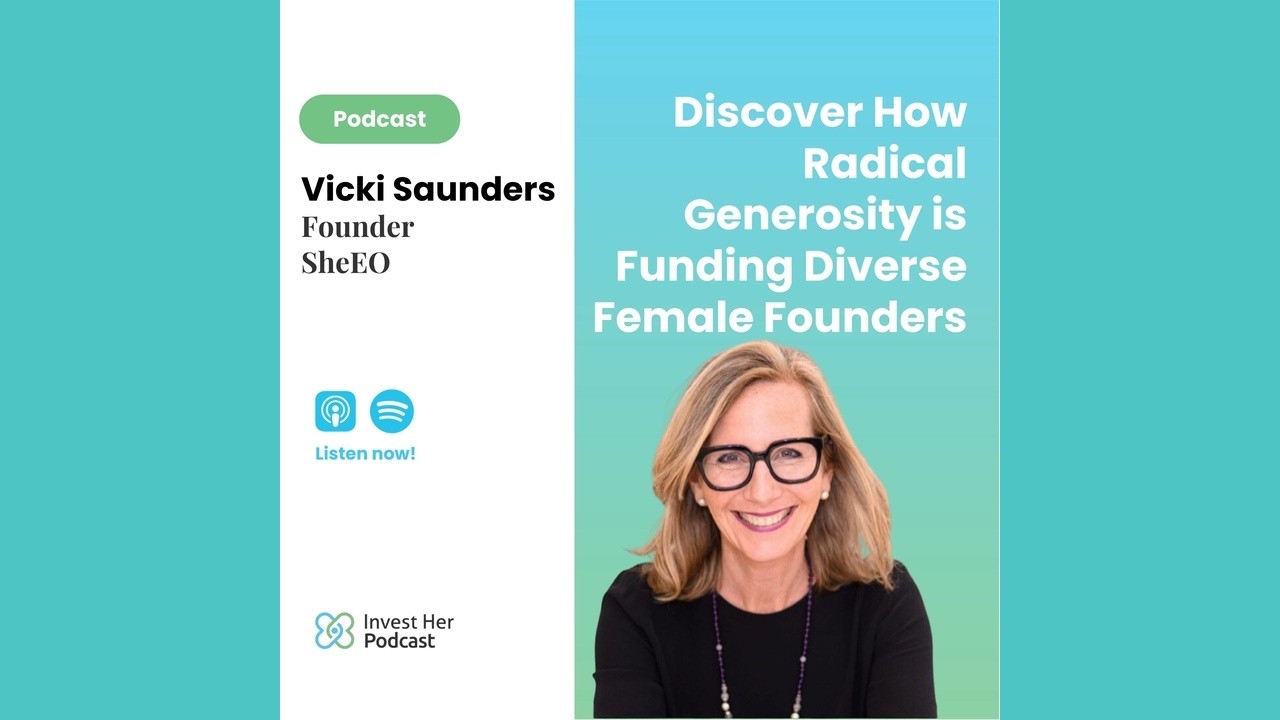
In this InvestHer Podcast episode, host Anne Ravanona interviews Vicki Saunders, founder and CEO of SheEO, a global community that funds women‑led ventures tackling the United Nations Sustainable Development Goals through a novel 0 % interest loan model. Vicki explains how SheEO was created to replace broken, male‑centric funding systems with a grassroots, democratic ecosystem where hundreds of women (activators) each contribute roughly $1,100 per year, pool the capital, and vote online to allocate loans to vetted ventures. The loans are interest‑free, have a five‑year repayment term, and are recycled, achieving a global repayment rate of about 95 %. SheEO currently operates in five countries (Canada, USA, Australia, New Zealand, UK) with many more in the pipeline. The conversation delves into the importance of equity: in the most recent application round, 42.7 % of US applicants were Black, Indigenous, or women of color, with similar figures in Canada and the UK. Vicki describes how SheEO built trust with under‑represented founders through consistent communication, weekly check‑ins, and a “words after action” philosophy. The pandemic’s onset is recounted as a catalyst for deeper community ties, with rapid triaging of ventures and mutual support. Vicki shares personal anecdotes—from growing up on a strawberry farm to learning to receive help—and outlines core advice for female founders: cultivate genuine relationships before needing capital, join peer‑to‑peer networks, practice giving before receiving, and leverage a focused network (“ask for five people”). She also critiques the prevailing self‑interest‑driven economic model, advocating for a gift‑economy mindset and a shift from monetizing every interaction to community‑based support. The episode concludes with practical tips on networking, crowdfunding, bootstrapping, and the “energy‑for‑impact” decision framework, encouraging founders to assess the effort required versus the potential change they can create.
Chapters
Welcome to this latest episode of InvestHer Podcast. Today, I am interviewing Vicki Saunders, who is the founder and CEO of SheEO, which is a global community of radically generous women supporting women-led ventures working on the world's to-do list. So why should you listen to Vicki Saunders? Well, she's an entrepreneur, an award-winning mentor, advisor to the next generation of changemakers, and leading advocate for entrepreneurship in as a way of creating positive transformation in the world. She has co-founded and run ventures in Europe, Toronto, and Silicon Valley, and taken a company public on the Toronto Stock Exchange. Why is she interesting? Because she has created this new system called Radical Generosity that allows women investors to invest in female founders around the world. And I'm so excited for you to hear from her because she's got so much to share. Enjoy this next episode. InvestHer Podcast is for you, the female founder who has a product, a service, or a message that you believe in and need to get funded. Or for you, the investor who wants to learn more about the huge untapped investment opportunity that gives you a higher return— women entrepreneurs. My name is Anne Ravanona. I'm an entrepreneur, TEDx speaker, and women's advocate, and I'm passionate about helping women entrepreneurs get funded. In each episode, we'll take a behind-the-scenes look into real-world funding tactics and strategies to help you get the funding you need faster. Let's put the fun into funding. Thanks for spending some time with me today. Now let's get started. Well, we're going to get right into this because I want to make sure we get as much as we can out of you in the hour that we have together, so that we get you off to where you need to be for your next engagement. So first of all, thanks so much for being with us here on our live podcast. It's a pleasure to have you with us. And, you know, I'm really excited because I want to help introduce to the people who don't know about SheEO and don't know who you are. I really want them to get to know you because you're an amazing advocate for women entrepreneurs and investor in women entrepreneurs and creating radical generosity to make it happen. So can we just kind of kick off with you saying a little bit about yourself and why you set up SheEO, what it is? Let's start Okay, sure.
Well, hi everybody, and thank you very much for having me today, Anne. So I'm an entrepreneur. I've been an entrepreneur my whole life. I love looking at the world, seeing things that don't feel right to me and wanting to go fix it, do something about it. So I've started dozens of initiatives and several companies, taken a company public, been an entrepreneur in Europe, Canada, and the US. So big scope, always doing strong social impact. Huge focus on technology, love tech as a way of creating scale. And so that's a little bit about me in the background. I'm Canadian. SheEO started in Canada 5 years ago. And the problem that we sort of set out to solve was, how do you get money and funding into the hands of women innovators around the world?
Mm-hm.
And the focus is not just women-led ventures, but women-led ventures who are working on what we call the world's to-do list. So focused on the United Nations Sustainability Goals, the top priorities we have on the planet.
Hmm.
I think with this sort of consecutive series of crises that are all kind of like coming at us one after the next globally, it's all hands on deck to make sure that our capital and resources are going towards those who are actually helping us to create a new world and a better world that works for all. So there's a rough focus for us. And then the SheEO model itself comes from a, a friend of mine said, you must have seen every bug in the system, like a sort of software term. And I'm like, oh yeah, like everything that just didn't work for me. I was like, here's the list, there's a ton of things. And most of our systems and structures are really not designed for us or by us. They were designed for a different time, different place, and definitely there weren't women at the table creating the rules for all of the things that we have out there. So as I sort of stepped back and thought, how would you actually go about creating an ecosystem of support for women entrepreneurs? For me, it was, um, the biggest challenge is like getting out of your own mind of this is the way to do things, the way that we have it. So we are radically rethought. If you were starting over again, whole new playing field, not trying to level the playing field, literally create a whole new one.
Nice.
Um, I think it's pretty tough to change existing systems, so we're like actually creating a new one. So totally systemic, grassroots, you know, from the bottom up. So the way that it works is hundreds of women in each country that we're in come together, contribute the equivalent of $1,100, $92 a month, £71 a month. That money is pooled together with the hundreds of other women who contribute that capital. And then we have entrepreneurs apply, woman-led, majority woman-owned. revenue generating, somewhere in the $50,000 to $2 million in revenue, £40,000 to £1.5 million in the UK.
Yeah.
And so they have recurring revenue and an ability to pay back a loan, because this is a loan, it's not a grant, it's not equity.
Yeah.
0% interest loan that they get from this fund, they pay it back over 5 years into the fund, and then it's loaned out again. And so we treat this capital as— we have a high success rate. It's different in each country, but globally the average is 95%. So 95% of this money, and hopefully that number gets even higher, is paid back, loaned out again, paid back, loaned out again. And so it's this perpetual fund that we're building in every country. And it's a model that we hope to scale to as many countries as possible around the world. We're in 5 countries right now. We have 70 in the pipeline. And, you know, like everything about it is different. We don't have an expert panel deciding who gets funded. Everybody goes online and votes. Super democratic. Trust the intuition of hundreds of women instead of an expert panel.
Yes.
And on and on.
I love it. I love it. I mean, I think it sounds like a dream come true. And that's what I love the way you said, look, we just— I love that. For me, the image that comes to mind when you describe how you created SheEO and that came to be is like, you just looked at the piece of paper and said, this is the map, but you just crunched it all up and threw it in the bin and said, right, let's start all over again. And if we could recreate the whole system the way it should be, this is how we do it. And I like the fact that it's a 0% loan as well, because there's a lot of self-regulation that goes into it, isn't there? Because we do know that, you know, around the world, women are fantastic at paying back loans. That is one thing that does set us apart from the men. And so I think it's a very clever model. to help move things forward. And so tell us the 5 countries that you already are present. I know there's USA, Canada, and Australia.
New Zealand.
New Zealand, yes.
And the UK.
Okay. So yeah, those are the 5, and then lots of others in the pipeline that are interested in this model. And we've been expanding by sort of following the energy. Who are the people that don't stop emailing us? They're like, come to my country, come to my country. Did I mention come to my country? And then they get all their friends to email. And when we feel like there's this sort of, you know, tidal wave going in that direction, we go to that region.
And I love the way you said follow the energy because I do see your posts on LinkedIn. So for all of you who are kind of on LinkedIn, do follow, follow Vicki, see what she does, because you see these fabulous Zoom pictures of all these incredible activators in different parts of the world. You say, wow, that was a high pitch, that was a super cool energized call. And it's, it's great because We need to see that. It's lovely to see that solidarity, the female talent coming together. And I love the way you say also kind of make use of the collective intelligence. You know, it's not just a small group of experts who make the decisions as to where the funding goes to or where the loans go to. There's a collective intelligence. Can you tell us a little bit more about how that works?
Sure. Yeah, I mean, I think one of the things that we've done in the world right now, we have a I mean, you and I are sort of the same vintage. You know, the narrative has really changed over the past 30 years. Before, we had a different kind of definition of business. It wasn't like win the whole market, take over everything, bet it all on red, one kind of success, which is go big or go home.
Mm-hmm.
You know, that's become the norm and a narrative. And basically, like, all these entrepreneurs that I meet are all thinking they have to raise money before they do something, which is crazy. You know, 98% of businesses, 98% of our economies are small and medium-sized businesses that get customers and bootstrap their way to success. That's the normal way. Yes, getting venture capital is for 0.001% of the population. But that's— if you only keep putting that on the COVID of magazines, that's what everyone thinks they need. It's crazy.
Totally. I absolutely— and I'm so glad that you kind of point the finger on that and put the finger on that because it's true. There's this whole glorified male model of entrepreneurship. That is, you know, the COVID of— an exercise I like to do when I'm with, you know, if I'm doing public speaking or if I'm with a group of mixed— a mixed group of people, I say, okay, give me the names of 3 male entrepreneurs, famous entrepreneurs. Boom, they're all, you know, Richard Branson, Elon Musk, Jeff Bezos, blah blah blah, all those. And then I say, okay, give me the names of 3 great female entrepreneurs? And I just get blank stares. People can't do it. And this is because, again, you know, it's not only— I think we need to take back the way of doing things, but also the narrative and to showcase the great women who are doing great things. And that I think is super, super important. And one way I love to kind of start off our conversations, and we've kind of gone around this a little bit, but I'd like you to share one fun fact about you, Vicki, 'cause I know you're a super serious businesswoman, and I mean that in the nicest possible way, okay? But there has to be— there's a fun fact that people don't know about you, and I'd love you to share that with us.
Oh yeah, I mean, like, a lot of weird things. So I grew up on a strawberry farm outside of Ottawa with a family full of boys. I was the oldest, only girl, and then 3 younger brothers.
Yep.
And so farm girl, hard work. We were the slave labor for the farm as kids. Which is great. And it was a very entrepreneurial kind of vibe and family that I grew up in. We didn't talk about entrepreneurs at the time. I was just filling out this thing this morning and someone said, you know, was entrepreneur a narrative when you were growing up? And I'm like, not at all. No one had that word. It was like, you go get a job, you know, and even just business people versus entrepreneur, that distinction wasn't really there. It's a whole kind of new thing.
Yeah.
So it wasn't cool to be an entrepreneur, that's for sure. But I grew up in this environment where we had this strawberry farm, and then we did like all these other crazy things. And now it's called saundersfarm.com. It's this entertainment farm that wins these tourism awards all the time in Ontario. And it's like really revamped what a farm can be in the modern age, if it's not doing food. And it's, we would dream at the dinner table every night. It's like, okay, what are we going to build tomorrow? And will people come for that? And we'd try something and see what happened. And so there was this iteration that I learned, and Total comfort with failure. Uh, we would try things. If it didn't work, you go do the next thing. It was never like, oh my God, you know. And we didn't go spend a ton of money on anything because we had no money. So we'd try something and see what's next. So, uh, when I look back now, I definitely have to write a book about how my parents taught me everything I know about what I'm doing. You know, it's cool.
And I identify with you so much because I'm the eldest of 6 children. So, um, myself 4 boys. So for 13 years before my, my, my sister was born, I was alone with 4 boys. So I get that. When you were saying that, I'm like, I understand that kind of man. And I have a sign you won't see here, it's at the back of my computer, and it's funny. I had to buy it because it says bossy because everybody called me a big boss because I had to be bossy. You had to be bossy, which we know nowadays that just means being a leader, okay? We know that. But I had to— you had to be bossy to survive. But what I do love is, um, I'm loving the way that very early on, you— there was this all this creative energy, this iteration, this idea ideation, but also putting it into action. It's not just like, oh, let's have loads of like brainstorming.
It's like, okay, how can we put it into action?
And then also how— I love the point that you're saying about getting comfortable with failure, because I think they're very important things for us as well to share with female founders. So tell us a little bit more. I know that when we were talking, and just for our listeners who are with us live and for those who are listening back, we are organizing our first Boost Her Biz virtual summit, which is happening next week, and Vicki's going to be one of our speakers. And I know that when you and I were talking, Vicki, I said to you, like, okay, so how many kind of Black female founders would you say have you supported through SheEO. I mean, the figure is quite astounding. So I think it's great to share that because not enough funding entities or tools do that. So please share some of that information.
Yeah.
Yeah. I mean, I think so this real focus on equity and building equitable systems through diversity is extremely important at SheEO. And from the very beginning when we started this, you can't build the new world with like the same rulers at the top. You know, we really need to rethink this. And so we've been paying attention to this for about 5 or 6 years now. And we're really, we're building this organization at the speed of trust. You know, when you look like me and you say you care about these things, it can be triggering for people because, hello, I've seen white women before. Thank you very much. You know, you, you say these words, but you don't really like invite me into your club.
Yep.
And we're a very well-resourced community. So it's been something that takes a bit of time to build.
Yeah.
That trust people, you know, we are very careful not to, uh, storytell what we're doing. Like, we don't put out, you know, when the racial reckoning was happening, we didn't send out a reading list. We talked about what we did after we did something. So it's always words after action at SheEO. We're very careful about that. And so, uh, so for example, this year we've just closed our application round for ventures in Canada, the US, and the UK, and we had a record number of Black women entrepreneurs apply in the US. 24% of our applicants were Black women entrepreneurs, which is amazing.
Phenomenal.
Yeah. So in the US, it was 42.7% of applicants were Black, Indigenous, or women of color. In Canada, it was 38.9%. In the UK, it was 28%. So we noticed, and that's our first year.
Yeah. And why did— okay, so how did you build that trust? Because that's the key thing. And I love the way you're saying, like, it's actions before words and we did it before we— So how did you build that trust in particular with Black female founders? Because I think that is key and without triggering. And I really love the way you're framing this in the correct way. And listeners, listen to how Vicki is saying this and framing it. It's very important that we learn the right language around equity. Over to you.
Yeah, well, and I think it's, you know, people have certain experiences in their life. And so, again, our actions don't often match up with our words in the world, so people want to see it over and over until they, you know, they know that it's true. And so part of the thing that we've done is that we have, on average— we were just doing the numbers for this a couple days ago— but on average, our cohorts are at least 40% women of color.
Right.
And hope, you know, that's growing. It ranges anywhere from 40% to 80% each year. So we've been funding Black, Indigenous, and women of color for 5 years. And so we have those stories.
Yeah.
And so that's part of the thing too, which is somebody gets funded, they go, yes, this community feels good to me.
Yeah.
People go, okay, maybe it's an anomaly that happened once. And then the next year, same thing happens. And they're like, okay, maybe there's something going on here. 3 years, 4 years, 5 years, they're like, okay, this organization is committed. And then they start, you know, it has to come from people who've had the experience. We can't— organizations can't talk about themselves.
Exactly.
And, you know, it's very important to just go like, we are an organization that does blah blah, no thank you. It's way better when, you know, the community say my experience is X. Yes. And so it's really about what people say about you. So we've got a GERD the work, showing up. We're doing racial justice working groups across our community. We're really evolving our language all the time. I was listening to a podcast this morning with one of my favorite social justice goddesses. She calls herself a social justice doula. Her name is Lutzi Segu. I have a podcast that I did with her a few weeks ago.
Yeah.
And Lutzi's now like— I talked to her, I don't know, 3 weeks ago, and she said, don't do umbrella terms. Don't say BIPOC. say Black Indigenous people of color or women of color. And then I, uh, and I said to her, okay, but didn't like 3 weeks ago, weren't you saying something a little different? And she started laughing. She goes, yep, it's evolving quickly. I'm like, okay. So this morning I was listening to her Instagram Live from yesterday and she's like, don't use it anymore. And I'm like, oh, don't use people of color. So, and that's her point of view.
Yeah.
And there are other points of view and lots and lots of different communities really, we're all struggling with language, wording. Is it feeling inclusive or not? Are we sharing embodied experiences or not? Are these just words? Is it lived experience? Like, so I have personally been on a deep journey of— With lots of different people, especially Indigenous women entrepreneurs over the last few years. Just learning how to show up differently and what language doesn't work and what language does work. And we are a community of 6,000+ women ranging in age from 11 to 96. Oh my God, everybody has a different opinion.
Yeah.
And, you know, like, we, we come out with, you know, gender non-binary language to not just say women anymore, and we're deconstructing our logo that you can see behind Yes. She is— we'll put cut and start it. Just there's— and so as we go through these things, you know, we are sometimes too far ahead in certain markets with this language. And so in one of our countries, we said, you know, cisgendered, gender non-binary, etc. I had, you know, like a big phrase of who is included and welcome into this community because you have to list everything.
Yeah.
And then we had people apply go, can women apply? Are women allowed to apply? Like, yeah, that's what cisgendered means. Like, oh, I didn't know what that meant.
Well, and I'm glad you're saying—
I mean, there's a lot of—
ah, I don't know.
It's hard and it's evolving. Did we lose you?
Yes, I lost you for one second, but I got the gist of what you were saying, which is like, you know, yet it's true that it's hard and it's it is evolving. I know as well that now, for example, with LGBTQ+, that's what I'm just saying, LGBTQ+, because somebody told me that now there are 22 different levels of identification and sexual orientation preferences. I'm like, oh my God, I'm completely lost. But you want to make sure that you use the right terms because you have to do it. And Actually, you may laugh at this, Vicki, but I'm like you. I'm on my journey to be as anti-racist as possible. And of course, we all believe that we are, but then we'll say something that triggers and we don't realize it, and it's not our intention, but it is a microaggression. There's one— to all our listeners out here, there's one Netflix that I watched which is called Dear White People. Now, it's the It is a series about Black people in Ivy League college in the US, but it's very, very well done because they are educating us white people as to, you know, how they live their lives on a daily basis and how, how race, you know, race filters through absolutely everything. Even when you have some of the characters on that, uh, who are white and trying desperately to fit in and trying to be inclusive, etc. There's always something that goes wrong. And so I just, I think it's a very important message that you're giving, Vicki, which is like, you know, we're all on this continuous learning journey and things are shifting and it's a good thing. I mean, goodness, could you imagine we couldn't have this conversation, let alone 10 years ago? Okay, so it's great. I think it's going in the right direction. So now I'm curious, how would you say How would you say COVID-19 has been impacting funding and everything at SheEO? Because I think that's an important thing to ask.
Yeah, it's been a year. It's been super challenging. So we had a really interesting start to all of this. So on the 9th and 10th of March, we had our global summit, our first global summit, which was amazing. We had 800 women show up at this event. And then the next day, the pandemic was announced. So we had the prime minister in the room, and then boom, pandemic. So that was— it was a really crazy experience. And for all of us, obviously.
Yeah.
And then that following Monday, when we knew that things were going to be really rough, we had a global call. So we have 73 ventures in our global portfolio at the moment. And so we had all the ventures on a call. And we did a very quick triaging, red, yellow, or green. How are you doing? What's going on? Are you in a world of pain? Are you cautious? Are you okay? at the moment. And so everybody came together, and it was also still— we were all kind of like, oh my God, is this going to be 3 weeks? Is this like— what's happening here? How long is this going to take? So we had people come on the call, and they were very stressed. Like, they had lost 95% of their revenue, boom, in a day.
Wow.
And all kinds of— so we had a woman who hired people that were at risk of homelessness to do laundry for local restaurants in the social enterprise structure. And she was like, I can't lay off all these people. Oh my God, like, what am I going to do? And she was in tears. And one of the ventures said, what do you need? What do you need right now? And she said, well, I just, I need a month to like think through this. And here's what my payroll is. And so one of the ventures said, no problem. It's on its way to you right now. I'm loaning you that money. And it was just this like moment where everybody sort of stopped. And we talk a lot about SheEO, that we have everything that we need. to support one another. We have everything we need in this network, we just need to ask.
Yeah.
And when that moment occurred, there was just this sort of chills through the whole community online. And, and then we made a pact as a group that nobody would go down during this time. How do we share our— share staff, share resources, get on calls to support one another? What do we need? Um, and so it was like, since then we've been doing weekly calls And triaging consistently to see how people are doing and making sure our resources are going to the right places. And then we started to storytell this a little bit in Activators. The women who contribute capital in our group were like, uh, us too.
Yeah.
Like, how about us?
Yeah.
And so we started to do weekly calls the week after in every country. So we've been doing 30-something— I don't know what we're up to now, 38 weeks or whatever—
of calls.
5 calls a week in each country, plus venture calls, plus lots of other ancillary things as we notice issues around racial justice, et cetera. So it's been, in many ways, we're, as I mentioned earlier, like a pretty well-resourced community. We have a lot of people who are here contributing capital and a lot of social capital that they have in abundance to those who need it, who are working on the critical priorities that we have in front of us. So we're not only helping our ventures, but we're helping each other. And it has been a catalytic event globally for us because, you know, a crisis can like really call people to action.
Yes.
And so in the past where everyone was too busy to like, and we were doing events online or offline, now it's come to the call, super easy, changing the times. All the time, and you can join different country calls if you want to. We go on trips to see each other, so like Canada travels to New Zealand and the UK travels to the UK— to the US. So we've been getting in deeper relationship with each other and really starting to understand the depth of the connections that we have in this community and how many resources we have to share with each other. And so the sort of standard question now on calls is like, how can I help? What do you need? And we get into small breakout groups and we're supporting one another. So We call this whole thing radical generosity, and that's the spirit that we show up with, and we practice it not only with each other but with ourselves, because it's a tough time to be a woman entrepreneur. It's a tough time to be a woman, period. Anyone is having a tough time, but like, if you're at home with kids and trying to manage everything, it is a complete nightmare right now. And so this is not a time to be alone and isolated. It's a time to be in relationship, stepping in to support one another and to practice asking because some people have more capacity than others right now. And it's— this is the community that we need in the world. And so I'm— in many ways, COVID has created deeper connections across our SheEO community than we had before.
Oh, I just have to go, amen, amen. And not, not in a religious sense, but of like, I applaud it and I think it's absolutely fantastic.
Because—
and you've said so many important things there. One of them that really stuck out to me, and you see me writing furiously for those who can see me, you know, I love the way you say it's important to practice asking, what do you need? What do you need? What do you need? And I think it's particularly difficult for women. We've been conditioned in society and education and so on not to ask, to be strong, to be perfect, to just carry the world on our shoulders. Like in China, they say that women hold up half the sky. It is one of their proverbs, and it literally is the case. So I love the way you're saying that. I love the way that you demonstrate how you have shifted, pivoted, completely morphed to help each other, both in the activator community, but also in the venture community. And I think that's a wonderful message that is very timely for everybody who's listening live and who'll be listening back to this, because we need so much more of that. And you're so right to To point out, you know, that women are having to deal with so much. We are so often the, the caregivers, so we're looking after the children, and if the kids can't go to school, it's a nightmare. And if they're very young kids, it's a nightmare, and you're trying to keep yourself afloat and the family as well. You may also have dependent elders or other people. You may get sick yourself, and there's just so much, and just the stress and uncertainty that's out there, it's really heavy. You know, in France we're in our second full-on lockdown and it's tough. In the first one I got COVID and I was sick for about 3 weeks, but I mean, I got the whole losing the sense of smell and all that business literally from one day to the next, and it still hasn't come back 100%, and this is like from March to November. But the point is that like every— the weird thing about this virus is we don't know how it's going to hit us. It's indiscriminate.
In a way, it's, I think, a very timely reminder to all of us that we have to care for each other, you know, because, you know, everybody's circumstances are different, everybody's competencies and resources are different, but what's important is our humanity. At the end of the day, it's about our humanity and about caring for each other. And, you know, I was on a call earlier today, um, somebody reached out to me and they were in distress and they said, Anne, I'm going through a really tough time, and when we were having that call, you know, she just reached out, she needed an ear, she was about to explode, and I said, why didn't you call me earlier? You know, like she'd been holding on to this for months and I was like, I want you to take off this backpack, throw it on the floor now, and like, you know, it just— because What I hear you doing, and we do this as well on our weekly calls in InvestHer community, it's like, sometimes you just— people need the space to vent. They've been through a tough experience or they've had a nasty conversation with a really nasty investor or some, you know, they didn't get the funding that they were expecting. All these different disappointments and things that happen. And often it's just so important just to have a an empathetic ear and then to put that hand out and say, what do you need? And I think that's a very important message that you're saying, very important, Vikki. It really resonates really deeply with me with what you're saying. And so what would you say, like, let's get down to the kind of the key tips now for those female founders that you're already helping and for those who are listening in. What should female founders do if they have— if they need to raise money Not VC, because we're not talking about that, but if they need to get funding to keep going, what should they be doing now? Any key tips, dos and don'ts?
I just really think that the core of everything is relationships. And so, you know, you're getting into a deep relationship with whoever that investor is, so you need to make sure that your values align.
Yeah.
And you have to build the relationship in order to create You know, to get the access of capital. So for me, it's like, how are you putting yourselves— how are you putting yourself into relationship with others who may care about what you're doing on an ongoing basis? And obviously, before you need it, like this fire drill of like, I need to raise in the next 30 days is like, nobody's jumping for you. Your fire drill is not my fire drill.
Yep.
And so you really do have to plan in advance and get into relationship with people. who care about the kinds of things that you're working on.
Yeah.
So that would be like my number one thing. The other piece is, if you're an entrepreneur who's out there feeling kind of isolated and alone and not in a relationship with other entrepreneurs, that's a key thing. Get in a peer-to-peer setting, find the others to help you, to get advice on what they've done, those who've gone a little bit before you. I think these are really critical things. And it's, you know, this giving and receiving. I have spent a lifetime giving before receiving, and I have, as I often sort of joke about, you know, 20,000 people on LinkedIn who all owe me a favor.
I like the way you say that.
And so, right, and so, you know, this is, this is part of the thing, part of the reason why, you know, I've built my network by being very clear on what I'm good at.
Yeah.
And finding people who are better at things than I am in different areas so that I can actually have a bigger impact in the world.
Yeah.
And so this concept of giving and receiving is very core to everything we're doing at SheEO as well.
Yeah.
And so reaching out, you know, like you can tell people that are takers first and they just—
Oh yeah.
Like we have organ rejection with those people in our community. And so it's like practicing that, the giving first and then And then the other big part of this is, you talked about asking for help.
Yes.
This is a really big challenge for a lot of us, but the deeper thing underneath that is receiving. Like, you have to be willing to receive support.
Yes.
I'm pretty sure there are a lot of people out there, I can just speak for myself, who are like, no, no, no, I got this, I'm good, I can figure it out.
Guilty.
Okay, right. And I was at a— I was in Colorado a few years ago, With a woman who is an activator in our community who's become a dear friend. And we went into— we had some lunch and a couple glasses of wine, and then we went next door and she's like, oh, I'm gonna buy some shoes. And I'm like, not really a shoe person or a shopper. But I walked in and she goes, get yourself something. And I'm like, I'm not gonna get— I don't need— I don't need anything. She's like, get yourself something. I am buying you something from this store. Get something. And so I walked around and I'm like, no, no, no, I'm good, I'm good, I'm good. And she walked over and she grabbed my arms and she said, receive! And like shook me. And I will never forget that because it wasn't about the shoes. It wasn't about the shoes. It wasn't about a purse. It was about I wasn't receiving from all of these people around me who wanted me to receive. And this is the work that I've been doing as a leader at SheEO is I keep talking about asking and giving and la la la. And I sucked at it for so long. And I'm now— when people say yeah, I'm like, oh, thank you. Yes, of course. Thank you. I will take that. I appreciate it. And it makes me feel happier, number one. And number two, the biggest thing is it has shifted my scarcity mindset into an abundance mindset such that I just really truly believe— these are not just words for me, these are in my body— we have everything we need. I have everything I need to create the kind of change I need in the world. in community with others. And when you start to get that, the possibilities just open up. Everything feels easier. It's amazing. And it's been a painful, painful journey getting here. Like, there's just so much deconditioning. It is a complete lie that we live in scarcity and we don't have enough. There's enough of absolutely everything on the planet. We're just badly organized and we need to redistribute.
I absolutely love that. I love— I want to pause to let that sink in for everybody, what you've just said. It is so, so important. We do have everything we need. We are very, very blessed. And I love what you've said, the story about how to receive. I find that very hard to do. I think it's like, you know, but really, and, and, and like, as you're saying all this, I literally had the hairs going up on my arms going, Anne, this is the message you really need to be hearing. Vicki needed to tell this to you and awaken this up in you today. And, and that's so cool. Now I want to invite— we have Laura and Colleen who are live with us as well. I know Jill was there, she's gone, but maybe because I talked too much. I was getting so engrossed in you, Vicki. I want to kind of make sure— Laura, Colleen, if you've got a question, put it in the chat box so that I can ask So that we can ask Vicki, or I can unmute you just because it's good. There's not too many on live, which is really, really good, so we can actually ask it. I think you've been saying so many important questions. So now, you talked about earlier about— as they're working on their question, you talked about, you know, we need to rewrite this ecosystem, we need to recreate this playing field. So what do you think needs to change now? What does this new playing field Look like, the one that you're creating and the one that you envisage in the future?
Yeah, so I think that the underlying operating system, uh, within which we work is a big thing. So for me, this is like being radically generous with each other and recognizing this is the value system we want underneath it, as opposed to greed and self-interest. Yeah, it's over. Goodbye, self-interest is done. Uh, that no longer serves us. 1776, Adam Smith, You know, that has just got to go. Self-interest is bogus. It's not true. And it's— what it's done is it's just— it's not the human experience. We are meant to be in community. We are meant to support one another. It nourishes us to give to each other and to receive.
Yes.
And, you know, getting to more of a bit of a gift economy as part of this. We have learned to monetize literally everything. I mean, 25 years ago, You could, you know, kids would come home from school, their, you know, their parents weren't there or whatever, they go to the neighbors, they'd find their way around, everyone would take care. Now we've monetized like right up to childcare. Every single thing has been monetized. And it, and it needs to go back to this, like, we're just contributing, you know, someone brings you tomatoes, your neighbor brings you tomatoes and you want to pay them. I mean, like, what are we doing? It is crazy. So shifting what this like how the economy serves us, not how we serve the economy. That's a big thing. Like, basically, we're all modern-day slaves working for the 5 billionaires, trillionaires that they're about to become.
Yes.
And the model just has to go away. And so we're in palliative care moment for an old system that just needs to, you know, be blessedly gone. And we're on our way to the new world. You know, there's no sense like burning down the house is being burnt down by enough people already, but like gently goes the old, thank you very much for how it's done, and now what do we want to build together? And so the big challenge of the moment is how do we imagine a different future?
Yeah.
Because we've been very conditioned to think this is the way you do things.
Yes.
And you have to get out of the way of thinking that. And so like I practice this thing, uh, it's— this is what it's like in my head every day. That's hard. What if it wasn't? We don't have enough money. What if we did? That's how it's done. What if it wasn't? Like constantly flipping everything around.
Yes.
And that's a big challenge, like building our imagination when we have been trained away from that into this reductionist thinking, numbers, impact, prove everything before you start it. That's just no future for us.
I love it.
I love it.
Oh my gosh, Vicki, I knew you were inspirational because I saw you many, many, many, many, many, many years ago in Dublin, but It's been so long and it's so nice. It's like you're giving us an injection of like positivity radical generosity vaccine, which is wonderful. And it's like prevention and cure, which I'm really loving. Laura was asking, she wanted to know, how did your background help you create SheEO?
Well, you know, I think it's one of these things that happens as you get older and hopefully wiser. is that you— I mean, now I can draw that sort of red thread through my whole life and realize all those like super different weird things that were like a jagged path on the way here. I do not have a sort of normal path. Literally everything I've done led me to this point.
Yeah.
So it's kind of a hard one to answer because I've had literally every kind of capital there is, taken a company public, grants, loans, debt, equity, the whole shebang. So I've, I've had an experience of like that funding piece. I have also been pretty much ahead of the curve most of my life, you know, kind of living out there in the future. And so way back when I was getting started, I wanted to do good and make money at the same time. And that was considered ridiculous.
Mm-hmm.
I have— so many people were like, Vicki, that's not what you do. You make money, then you give it away. I'm like, I can't do that. It's not me. It has to be all interconnected. And so I often joke that I was like the original millennial, you know, like way back there, I was thinking about this for a long time and now things have caught up. It took me a very, very long time to find my people.
Yeah.
I have thought so differently than those around me for so long that, and, you know, my parents, I love my parents. My parents would always be like, We can't explain what our daughter does. We have no idea what she does. Like, because I've always been doing things that were like process innovation. So rethinking things, doing things differently, creating these new models and new experiments, and they don't fit into a sentence like Airbnb for cats.
Yeah.
So it's always been like a real challenge on that front. So, you know, and I also, it took me an awfully long time to believe in myself because I didn't have a lot of people around me who were like, that sounds really cool. People were mostly like, that sounds really strange what you're talking about. That's not how we do things.
Yeah.
And I just, it took me a long time to go, excuse me, but have you looked at the world you've created? It's pretty brutal. So why don't we just try mine for a little while? But it like literally wasn't until I was 50 that I was like, you're all wrong. I'm gonna go do my thing.
Yeah.
So the pain of building up my confidence along the way the listening to all those other crappy voices that told me every single thing that was wrong with me.
Thank you very much.
Got that list. Um, didn't ask for it, but I've got it in my body that I've been like trying to get rid of for many years. So I understand, uh, that journey. I've been shoulder to shoulder with entrepreneurs as an entrepreneur my whole life. So I really get all the pain points that female entrepreneurs and women entrepreneurs face.
Right.
And, uh, so I think it helps me to design a better future. There's this great book called The Messy Middle by Scott Belsky who talks about how if you're not shoulder to shoulder with the people that you have a design solution for, you're usually off by like 30%.
Yeah.
And I see that all the time. I see all kinds of people who aren't entrepreneurs going to create things for women entrepreneurs. I'm like, yeah, that's totally not a thing what you're doing over there.
Yeah.
So, so I think, uh, almost everything in my background has helped. And then I, you know, haven't been that kind to myself over the years. I've really beaten myself up a lot about things. And so I, I know that that's a natural tendency. I know that we're like really conditioned to psych ourselves out. So in our, in our process for entrepreneurs, uh, applying to SheEO, we do a lot of nudging and loving We talk about loving people into SheEO. So we do information calls and then we nudge you when you've started and say, we're cheering you on. Do you need help? Can we help? And we get a lot of feedback through that process that this is really different. Like, wow, you guys have already helped me so much and I'm just applying.
Yeah.
And so, because I know that like we would have such a big drop-off if we didn't do stuff like that, I imagine people had this same kind of approach that I did, right? Like, we've been told a million times what's wrong with us, and this is a place where we're going to talk about what's right with you.
Exactly. And, and that— and it's, it's about creating the safe space, isn't it, really, for, for, for people to feel safe? And it's like, um, Laura is saying, thank you so much for sharing this, really touched me and confirmed my alternative way of thinking. And Laura, one of our members, she, she's you are very, very lateral thinker or outside-of-the-box thinker, Laura, so I know that. And she's working so hard and there's so many— it's like with so many of us, we keep plodding along and you don't get the signs, you don't get the recognition for a long time, but you need to sit comfortably with that and say— and just to believe in yourself and know that it's going to come. It doesn't always happen when we want to, you know, it's It's a really tricky thing and I love it. Thank you for sharing about the messy middle. There's also a very good book actually called The Multipliers. I don't know if you've heard that by Liz Wasserman, I think her name is. I see it on my sofa over there and it's like helping leaders to understand what it means to be a multiplier leader versus a diminisher leader and that is like that you could have somebody in CEO who, when they're working with you, you will help multiply them because they will give you their all because of the energy and so on that you— and the space that you create for them to feel good and to be able to give their best. And then put that against somebody who's not side by side, if to take your analogy, and who basically puts them down or just does not create the right environment for you to give your best. And so you're only going to give it 40% or of what you could really do because you just don't feel valued by that other person. So I think it's super important. So you've talked about in our last few minutes here, you've said, okay, VC, nah, not interested, okay, which is true because it's just not the reality for the majority of women-owned businesses. So what would they be apart from SheEO? Of course, of course, big shout out, big ad for SheEO. If you Now you know about it, you've heard from Vicki, you know how amazing she is, so go check them out. I did share the last call, and when you do your calls, you just ping them to me. I'm always sharing them out and we will always share them. So become a venture and become an activator if you do have some capital there that you could spare, $1,100, you know, definitely invest in this, in radical generosity. So All that's a long way to say, what are your favorite fundraising resources apart from SheEO out there that you would recommend to women entrepreneurs?
Yeah, well, I mean, for me, it's like your network, right? So everything is relationship-based. And so the way that I've built my network over time, this is one of my favorite hacks, which is when you meet someone that you just have that like instant soul connection with and you're like, Oh, soul sister, love this person. Then I always ask that person, who are the 5 people like you that I don't already know?
Oh, I love that.
And then that person opens up their network because it's, I mean, I deeply despise networking, hate it. I like, the second I walk into those rooms full of people, thank God we don't have to do it right now, COVID, but I'm just like, can I leave yet? I just hate, I can't stand it 'cause I've never had a good one-liner. I've never had the corporate title that everyone wants to talk to you. Like, ugh, it's been so hard. And so that has been a good hack for me. And then it doesn't, you don't have to walk the whole room. You find like the one awesome person and they tell you the 5 and then you're like, good, I'm done. That's it. Those are my 5 people. So it's mostly been that. I'm a big fan, obviously, of crowdfunding. I think it's a great way of testing out your product, seeing if there's a product market fit. I do, I do like that way because you get more than just the money from crowdfunding. You get this community of people that are marketers that can support you and talk about what you're doing. So a big, big fan of that.
Yes.
I also just have like collected a group of amazing people over the years who are really good at finding money, grants, government programs, all those kinds of things that don't require a ton of paperwork. I hate paperwork. I don't like filling out forms. So, but again, like, my favorite thing is just bootstrapping. Go get the customers. If you can't get a customer, you're done. If you can't get people to follow you, it's not going to happen. So if you're not that person, then find the person to be your sidekick.
Yes.
Help with that.
But you have to be able to, like, connect with people and be able to work on your language to really create that engagement. So Like those, those would be my number one things. And yeah, I mean, given the opportunity for any— the freest form for me is like bootstrapping and getting your own customers. That's where you're freest to do things your way. The second you have all those outside sources, there's someone else telling you, making you fit into structures which then sort of hamper.
Yeah. And I totally agree with you. It's something that's quite interesting. For a long time, I always felt that because I am Like you supporting women entrepreneurs to get funded and so on, people would all say to me, well, hold on, why haven't you raised millions and why haven't you done this? Like, I'm like, but I don't want to do that VC stuff. I want to be in control of what I'm doing and I don't want to have to follow, be pushed into, into a path that I won't agree with and I don't want to do that. So like, I'm gonna do it the slower way, but it's gonna be my way.
And that's, yeah, the on your own terms is a huge thing. And it's exactly there, no matter, like, it is, if you think that there's free money out there, it is not true. There are rules attached to every single piece of capital that's out there. And so the only way that you can really do it your way is to bootstrap.
Exactly. So I wanna open it up again to Colleen and Laura. If you wanna ask, I'd love to unmute you if you wanna unmute yourselves to interact with Vicki while we have a few minutes left, because we've got 10 minutes left, and I'd love that if you're up to it. So Laura's up for it. Okay, Laura, off you go. You can put your video on if you wish. If you don't, it's fine too, but you're unmuted.
Thank you. Hello.
Hi.
Well, thank you so much, Vicki, for this inspiring story and also sharing about your background, because That was really— I always feel like a weird duck in the pond, and especially because I have an e-learning company and I create content for teachers, so I help them raise their digital skills. So it's a world that is mainly male, and they never expect a woman there, and they don't— they less expect a woman who is under the 35. So for me, it has been quite challenging in the past, past months to make my statement. And especially now, the US just had to elect a new president, but we have to elect a new government in March. So everybody here in the Netherlands is starting to profile themselves in education. And I was wondering, what advice would you give when it comes to the bigger picture. So you said it's first about doing good and then raising money, and that's exactly how I feel. But I cannot shut myself up when I see people trying to take that education segment as they know it and just use it at a political end. And I was really wondering what advice you could give me in that sense, in How far I should raise my voice or not raise my voice.
So I have this framing for every decision that I make, which is energy for impact. So how much energy is it going to take versus the impact that's going to come out the other side? And I, you know, do those quick calculations in my head all the time. You know, sometimes I'm just like, look, that's an uphill battle. It's an old structure. It's the other person's journey. It's not, do I really need to say anything about it? Question mark. But I'm also here to transform systems. So I find myself continuously getting sucked into the old world to have these conversations. And I'm like, I can't believe I just did that again. Because of course, I'm like, oh, maybe there's an opportunity. Maybe this is the moment. And then you get in that thing. You're like, I literally just spent 2 weeks, you know, on that thing, which I shouldn't have done. have to learn my lesson, but it's, it's because I do want to shift systems. And so sometimes you have to engage, other times you don't, and you don't know when. This is the big challenge that we face. But yeah, I think this honing your own, your own understanding of your intuition and what is your work versus what is other people's work, I think is also very important. There are lots of things in the world that I think are extremely important, but they're just not my thing.
Yes.
I know what my stuff is. I'm like, focused on my stuff. I have an amazing board chair who every once in a while I start bitching about like someone's done something blah blah blah and she's like, play the long game, play the long game, keep looking ahead, put the blinders on, don't think about it. You know, as I see people go from trend to trend to trend throwing money at things and not really trying to create change, which is why we're sort of stuck after years and years of putting billions of dollars into problems and they're just bigger. But again, I think that's a muscle to build yourself.
Yeah.
Thank you very much.
I love that.
Laura, I'm going to mute you for a second just to let Colleen ask her question because she's a great question. Colleen, you're unmuted. And thanks for that. I love your wisdom. I just, I want to capture what you said, Vicki. Energy for impact. Great, great message. Colleen, over to you. Go ahead.
Yes. Good morning from Winnipeg.
Hi.
Thanks, Vicki. I appreciate it. It's a fantastic presentation. You are speaking my Lean Architect language of we must change. So I do have a startup. It's been taking a long time because I am trying to do everything on my own terms, and that even takes longer. So I don't want to fall into— I just want to find that one investor that believes in what I'm doing and believes in me. And it is difficult. I mean, just finding investors is a manual process and a 98% time waste. That would change too. I do have— so as a Lean Architect, I'm designing while the world is in crisis due to greed, number one. Number two is the failed processes accepted as status quo.
Mm-hmm.
And so I'm starting with recycle. It's completely failed. It's never worked after 50 years. So I have a startup called Save Our Planet Refillery. We're transforming distribution with new infrastructure and AI technology to remove packaging. And so it is gaining tons of attention because of COVID now, because I am the most disruptive to supply chain. Removing packaging will save everyone 20%, and starting with suppliers, going to consumers, then industries, and then to cities when we get rid of a program that's never worked. So it's disrupting. It's I call it lean disruption because I'm creating an efficiency for the for the planet by transforming all industries to. To remove packaging. And it's easy enough to do. We have a working model here in Winnipeg with water, a 24/7 self-serve water refilling station. And when I walked in, I went, wow, what a great business, runs all by itself. I want one. And why do we stop at water? And so it was to design a new system that uses the least amount of resources that we can use to refill laundry soap and dish detergent and shampoo and body wash. And it has, it has been— I've got quite the startup story, I have to admit. It's been 3 years of research and design and learning and education, and then I started, okay, now I'm ready, I think I've got a business here, only to sit down and wait till you find the right investor for that type of disruption. And I always dreamed I'd have women investors, which was a which was because women understand it more than men. I, you know, in the beginning, I started— I was able to segment out old men because old men did not see any change coming that way.
Mm-hmm.
So it was trying. I had to go through this whole process of what do they want to hear? But then I could see that the old men would never change. That was just like, dealing with a brick wall. So the moment I walk in, and if it's all old men, I just leave the room because it's not even worth the energy to try and convince them. But women, majority of the local women— the beauty of me is the network I have. It's 4 soccer leagues, and I have women investors from the soccer leagues into the business, and people that I worked with at IBM have invested in the business. So it's It's, it's good. It taught me a lot. I'm so out of my comfort zone when it came to asking for money and doing things. It was when you mentioned it, it was just like, oh, I lived that.
I—
it's awful. I, it was like, I'd rather, I'd rather do dishes and clean the bathrooms than go ask for money.
Yeah.
But I don't know. It's, it's come a long way. I was just at Arctic 15 and promoted that one, and that was very successful for me because it was from the Baltics and Nordics, and they're super interested in what I'm doing. And I had 30 one-on-ones with investors, one of the best, uh, networking sessions I've ever had, really. And that took a long time to get to because I learned— had to learn what to say.
Hmm.
It was just like, nobody wants to change the world. They don't want to change. And they don't want any money to, to use up front. And it was just like, well, if you're gonna pay Waste Management $863 billion a year, trust me, it'll be an acquisition by them because when they realize what I'm doing, it's gonna reduce their profits big time. And it's a super—
So I, I'd just like to pause you there because I'd like you to react to what you're saying, Colleen.
So, um, Yeah, because I know that—
I know she's got mega advice at the tip of her tongue, and she also needs to leave in a couple of minutes, and I want to make sure she leaves on time. So sorry to, to cut you across, but I want to make sure she answers you and gives you some advice.
Well, yeah, I was actually wondering, is there a specific question that you have around that? Like, I understand you've got an innovation.
Yeah, well, with SheEO, are they into VCs or more angel?
What type of— We're debt binding. So you need to have recurring revenue to pay back a 0% interest loan. So we're debt capital. And so you can apply on our website. You can see all the questions that we ask. We do this once a year. And so have a look at sheeo.world. It's S-H-E-E-O dot world. We love Winnipeg and excited to check out. What's the name of your business?
Save Our Planet Refillery or Stop Planet Refillery.
Great. Okay, thank you. Thank you.
Thank you. Good luck with it. Yes, thank you very much. I appreciate it.
Thank you, Colleen. And I think that's important because, you know, it was great that you were giving us some— you were giving us some context. But again, what Colleen has— she's basically given you a live example of exactly what you were saying a few minutes earlier, Vicki, isn't she? About like, you know, How do you get around the— how do you play the long game? How do you get around the dinosaurs? You can see this path, you can see the future, and you want to shape the future, and the other people are just not on the train. They're literally standing on the—
on the—
they're standing at the train station and they're not going to get on that train. And so it's like, okay, how can we find— I think what I understood from Colleen's question is she's still trying to figure out how does she find the right people to get on the train with her and And to realize, you know, that it's really hard to find the right investor, which we all know. If you'd give maybe one nugget around that, you've talked about relationships and so on, what would you say?
Yeah, I mean, it's the same always. It's right, like, I understand that this is finding a needle in a haystack, always. I've had the same experience myself. And so part of our journey is to, you know, try and get a sense of the values relation that you're looking for as soon as possible. And if you've got anyone who is even close to that, then asking them for their 5 people.
Yeah.
So that you don't waste time going one by one, which can be— it can really be deflating over time. It's a super hard thing.
I think that's really, really good advice for you, Colleen. I really do. Because you look for the right people with the right values, right? That's basically super important what Vicki's just said. So find one person that you have a good value fit and ask them for their 5 people and then build it from there. And you will, you will have a great story to come back and tell us. So Vicki, as we round this up because we're already out of time, I just want to say thank you so much for being with us today. It's been an absolute pleasure. My God, I wish it could go on forever, but thank you so much. You've shared a fantastic, um, the whole mindset, your philosophy around SheEO, and we love it and we applaud you. And please everybody, when the next call's out, you'll see me sharing it on LinkedIn. Go follow, um, SheEO World everywhere. Follow Vicki on LinkedIn and you'll see the calls. And, and become an activator if you can. Thank you so much, my dear. Off you go to great things. Take care.
Bye.
Bye.
Thank you for listening to InvestHer Podcast. Don't miss more great funding tips and insights by subscribing to the podcast on Apple or your favorite podcast host. And while you're there, I'd love you to rate and review the show. We'd love to hear from you. So if you'd like to send in some questions, interact with our guests, or suggest other great people we should feature, join our community on the Flick InvestHer group or send us a message on Instagram.
Thank you. investherpodcast.com.
Want more great resources for female founders about funding? Check out our InvestHer Academy at academy.globalinvesther.com. I'm Anne Ravanona and look forward to having you with us again for our next episode. Let's put the fun into funding and get more women entrepreneurs funded.
More from Anne



🎙️ EP69: Get Off the Fence: Renate Crollini's Startup Blueprint | InvestHer Podcast

🎙️ EP68: Radical Truth: Robert Rubinstein Exposes the Impact Investing Illusion | InvestHer Podcast



🎙️ EP66: Global Sisterhood — Carine de Meyere on Trade Missions | InvestHer Podcast



🎙️ EP65: Capital With a Conscience: Pierre Norman Rolin on Investing in Women… | InvestHer Podcast

🎙️ EP64: Dream Bigger: Nikki Barua on Building an AI-Native Company Without… | InvestHer Podcast