🎙️ EP20: Pushing for Diversity in Venture Capital with Mac Conwell II,… | InvestHer Podcast
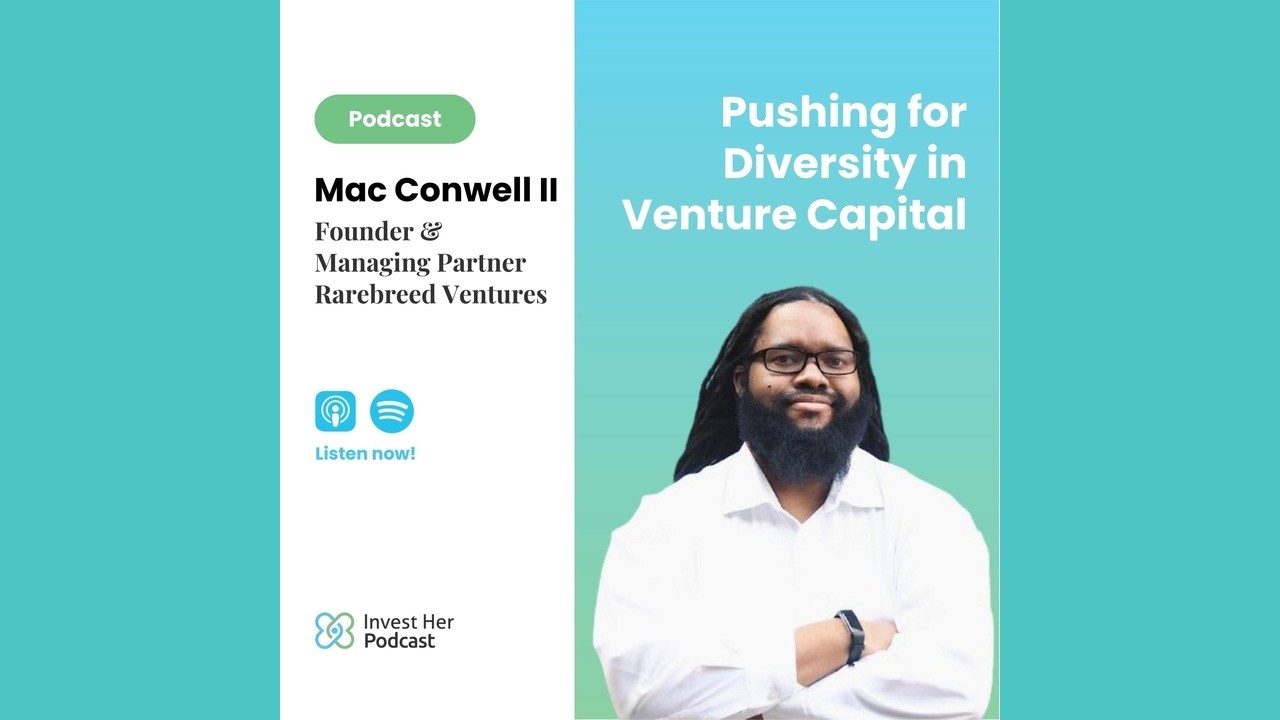
In this InvestHer Podcast episode, host Anne Ravanona interviews Mac Conwell II, founding partner of Rare Breed VC, a pre‑seed/seed fund focused on under‑represented founders outside major tech hubs. Mac shares his unconventional journey from software engineer and two‑time founder to a state investment role and ultimately to launching his own fund, driven by personal experiences with systemic injustice. He explains Rare Breed’s mission, investment thesis (geography, ticket size $100‑$250k, sub‑$10M post‑money valuations, industry‑agnostic except life sciences), and the cultural competency needed to evaluate niche consumer products. The conversation covers common fundraising misconceptions, practical advice on timing, traction, networking, cold outreach, financial projections, and the importance of clear use‑of‑funds. Mac discusses the growing relevance of ESG, the power‑law dynamics of venture returns, and the need for more diverse check‑writers. He offers specific guidance for female and minority founders, emphasizing resilience, avoiding personalizing rejections, and leveraging networks. Finally, he outlines how founders can reach him (Twitter) and reflects on the harsh reality that fundraising isn’t fun but can be rewarding with the right mindset.
Chapters
Welcome to this week's funding conversation on InvestHer Podcast. I am so excited for you to listen to this episode 20, because this week we talked to Mac Conwell II, who is the founding partner at Rarebreed VC in the US. So they invest in early-stage pre-seed startups. So you really want to hear from him. And this was a really cool conversation because we got to learn how Mac became a VC, what's important to him when he's you know, choosing which startups to fund and how investors should really invest according to culture. Learn what that means in this episode. Investor Podcast is for you, the female founder who has a product, a service, or a message that you believe in and need to get funded. Or for you, the investor who wants to learn more about the huge untapped investment opportunity that gives you a higher return women entrepreneurs. My name is Anne Ravanona. I'm an entrepreneur, TEDx speaker, and women's advocate, and I'm passionate about helping women entrepreneurs get funded. In each episode, we'll take a behind-the-scenes look into real-world funding tactics and strategies to help you get the funding you need faster. Let's put the fun into funding. Thanks for spending some time with me today. Now let's get started. Welcome, everybody. I'm Anne Ravanona. I'm your host of this funding conversation today with Mac Conwell II. Mac, we're so happy to have you with us. Thank you so much for joining us. And just to let everybody know, how is this going to roll? Okay, today, really, the reason why we've called this a funding conversation is we really want to have a chat with Mac. We want to demystify funding, number one, He's going to tell us all about Rare Breed VC, about his fund, so that you know if you're a right fit, how do you need to approach him. And we have loads of great questions that you've sent us in advance. So I'm going to— Mac, get ready. I'm going to be fielding you lots of great questions from our audience. And really what I want to do is I'll have a couple of questions to get us started with Mac. And after that, I'm going to start asking the questions you sent in in advance. And for those of you who haven't sent in a question, you've got a chance to do it now. Please put it in the chat box because I'm going to follow it there. Rosalind and Q&A, we're going to, we're going to follow it there. So send in your questions there. So let's get started. Mac, just so you know, we have people calling in from all over the world. Of course, lots from the US, your wonderful stomping ground, and also from Singapore, from India, from the UK, from Ireland. Sweden. Who else am I seeing? South Africa, we don't want to miss this. Ghana and Canada. That's just off the top of the list. How exciting is this?
This is really exciting. Thank you, everybody, for joining. Hopefully I make it worth everybody's time.
I'm pretty sure of that. So let's get started in a nice fun way, Mac. Can you tell us one fun fact about yourself before we get into the serious fun of the funding part? So tell us a fun fact about you that maybe we wouldn't know.
I do my best to listen to 50 books a year.
Wow, 50!
I'm really big on audiobooks, and my goal is to try to get to 50 every year. COVID's made it difficult because I do my most listening when I'm in transit, so not having a commute's kind of put a damper on that. But now I'm trying to find time in my day to just listen. One thing, like, if you listen to a lot of successful people over time, one thing that comes up over and over and over again is this idea of reading books. I'm not the best reader. So for me, audiobooks are awesome. And so now, you know, it's something that I've been pushing for over the last, I would say, like 4 years.
That is so awesome because, and you know, we all have different learning styles. And as I say, you're obviously very auditory, but it's practical because you can still be walking and doing your commute, as you say, and listening and learning.
I think—
and I love your key message as we open up our funding conversation about the importance of learning and being curious and keeping moving forward. So let's jump in. Could you tell— let's start by your story, Mac. How did you become a VC? Because, you know, a lot of people wonder. It's like a super cool job, and people kind of want to know what are the roads or the paths to become a VC. So what's your story?
My story is a lot of work and a lot of luck and some unfortunate things along the way. So for me, so I was a software engineer, I was a government contractor, ended up having a good buddy of mine who was really obsessed with being the Black Mark Zuckerberg, right?
Mm-hmm.
And like trying to get us, the rest of us engaged in that. And so started building Then me and a few of my friends started our first company and we didn't know anything. Like, we didn't know what a startup was. We didn't know what a VC was, you know, anything. It's like 2010. So it's not as many resources back then anyway. And went through this journey. I had 2 startups. The first one was an exit. The second one, not so much. So I got to see, you know, both sides of the coin. And then I ended up My second company didn't work out, right? And so experiencing a failed company is a really difficult thing. Went through a very tough time with that and ended up just having to get a job. Ended up working at a marketing firm. And granted, it was like a manager-level position. I was supposed to be the head of internal products. Ended up just running a team of developers. But it was an okay job. It was a cool job. But crazy enough, that organization ended up getting— like, after being there for a year, they got a client that I didn't agree with ethically.
Mm-hmm.
And so it prompted me to quit, right? It was a hard decision. I didn't have any plans, but I was just like, hey, I just can't do this. I gotta go. And so I quit on a Friday, and the very next Monday, I got this email from the Investment Authority of the State of Maryland saying they were hiring. Um, now I don't have a finance background and I'm a college dropout. Like, I dropped out of school because I had a security clearance. Northrop Grumman told me come work, and so I went to go make the money. Um, so there was nothing that really said that I should be a VC or be an investor outside of the fact that I did have this experience as an entrepreneur, and I did have a really strong brand as somebody who had helped other startups in the local ecosystem. So I just, I reached out to somebody who I knew that worked there at the organization to see, like, did they think I actually have a shot? Like, was it worth my time? And as soon as, you know, the guy was actually an advisor of mine, and as soon as he said yes, I was like, cool. So I applied. And so I ended up breaking into venture, applying for a job that came through in my email inbox. Not the most common way you see people break into venture at all. It just so happens that it was a state organization and they follow all these state regulations. And so they had to do an open search and I was the candidate they chose. Granted, here's the other interesting thing about my career and pathway, right? So I'll say this, right? 'Cause there's 2 parallels to me breaking into venture and then starting my own firm. So when I left my marketing firm, Maryland. The reason was the week Philando Castile got shot and killed in his car for legally having a firearm by a police officer was the same week that organization started soliciting a contract from the National Rifle Association, which has had a history of not supporting Black gun owners. So that led me to quit that job, which led me to then apply for my job working for the investment arm of the state, which also happened to be during a period of time where they were trying to figure out how to invest in more Black-led companies.
Hmm.
Right. And so there's this moment of time of all these circumstances around Black people and investing in Black people that led me to get a job there. And when they hired me, they told me I wasn't qualified for the job I applied for. So They created a junior position to give me opportunity to come on staff. The parallel there is when I started my fund Rare Breed, um, I— there was a founder I wanted to back and was trying to figure out a way to do it. And I had an advisor of mine say, hey, don't just try to back this one founder, go start a fund. And I'm like, it's COVID, don't really want to do that. He said, you should do that. And so he pushes me. to go start a fund, but then this is in June of 2020. So this is right after George Floyd.
Yeah.
And so after seeing what happened with George Floyd, there's now all this conversation about investing in Black-led companies and diverse-led companies. And so now when I go to raise my fund, it's during this period of time. And so, you know, at Rare Breed, we're in the process of raising a $10 million fund. We've raised $7 million to date. every institutional investor who's invested in our fund is invested out of a diversity initiative.
Yeah.
So if those diversity initiatives don't exist, I don't know if I'm able to raise this fund. But the only reason those diversity initiatives exist is because, again, there was a Black man who was killed by a police officer. So my story and my career adventure is very much so tied to that, which is an interesting way to think about it.
You know, and I love your story. Paige is saying she loves the story, and Catherine thinks it's so great to hear the story, and it is because you give me goosebumps listening to you, Mac. You know, it's kind of weird how such wrong situations can turn— there's some good that come out of them, and also I just love how it's I suppose I would say it sounds like your story has a bit of a windy road to VC, a bit like a lot of female and other, you know, different people get who are like underrepresented groups, supposedly underrepresented. We tend to have these kind of winding roads and winding paths. And what I love is, okay, let's pull it apart there. You still are a 2-time founder. Okay, and okay, the college dropout, it's just nice because in the sense of, you know, it's a super smart guy, like, and people say, well, you know, it's nice to have a Black man to say, I was a college dropout too, and look at me, and I've created my own fun, instead of having the white zooks in the hoodie. So I'm happy actually to hear that. It's good to kind of even out the balance, if you will. And then I just said, what I love though listening to you is like you're saying, yes, I had one exit, one failure, so I felt it on the other side. I had to go and get a job, and this is how I did it. it and there was an opportunity, I seized it. And I loved also, I love also how you were saying, you know, they didn't think I was qualified for the job and so therefore I started off in a junior position. And look at you now, so much like not long after, look at you now with your own fund. Like, can we all just say a high five, give him some love in there? You've got the little— I don't know if you have the emotion thingies in this. We don't. I think it's only on the other ones, but people are saying You know, um, is saying, all things work together for the good. Um, thank you for sharing, Mac, you know, and, and that's it, you get it. So that's very reassuring for our viewers and listening listeners. Now, so many of them who are founders, and many of them are founders of color, you've got the t-shirt, and, um, unfortunately horrific circumstances have made change, to forced change faster than before, and we can only just, you know, heave a sigh and say, wow, how and why did it have to come to that? And at least say, okay, that there's something good that's going to come out on the other side. That's all. And I also love the fact, Mac, that you stuck true to your values, that when Philandra was murdered, and we're going to use the word, when that happened, and then, you know, you had a client that was diametrically opposed to your values, you basically said no. And I, you know, that gives me goosebumps because that's important. I think we all have to stand up for that. So thank you for sharing that. So now tell us the story of Rare Breed. So how did you go on to start Rare Breed? And then we're going to get into what to look for And all of that good stuff.
Yeah. So Rare Breed came out of frustration. You know, my goal was to get this job with the state and use that as a way to propel myself in the venture, right? You know, it was a state position, so I'm not making a lot of money like most VCs, not even most VCs. I'm not gonna say that, but, you know, not making a lot of money like some VCs are. And, you know, it's a chance for me to break in, build up track record, and You know, get a job at a bigger firm, make some real money, you know, get to do the sexy VC thing.
Hmm.
But along the way, I met this founder who was a Black woman in Baltimore who had this amazing idea. And I wanted to support her, help her, made introductions, did all the good stuff. Even while I was working for the investment arm of the state of Maryland, I led an initiative to create a pre-seed fund for women and minority-led companies. Basically trying to institutionalize the friends and family round, 'cause that's one of the big hurdles for, you know, underrepresented founders. And even then, having put that together and running that program, I still couldn't get her funded because she was so early. It was a hardware product, it's all these things. And I looked up one day and I'll never forget this. So my friend Brian Brackeen from Lightship Capital invited me to come speak at this as part of— they do the NewMe Accelerator. And so we're like at this lake house in Ohio and I'm talking to all these entrepreneurs and teaching them how to pitch and like this really intensive, like one-week startup bootcamp kind of thing. And one of the days I'm there, like the third day I'm there, I get a call from this founder and she's all excited. And she goes on to tell me that, you know, she had become a surrogate mother to raise the money to start building her prototype. And I was like devastated. Like, I truly believe in what this woman's building. I see the opportunity. There's money to be made. Nobody else is seeing it, but she's gonna get there. And here we are 3 years later and She's now like literally selling her body to get the money to start building a prototype. And it's not enough money to do what she needs to do. And that was the moment I recognized that I couldn't think of a fund that could work that and made that investment.
Hmm.
And I just had to— had this moment of like, okay, well then I have to do that. And so that starts me on the journey of trying to understand and see what it looks like to raise a fund. And also, you know, I can acknowledge that this also like, To the core of who I am, I'm an entrepreneur first, right? Like, I'm a builder. I like to build stuff. So like, starting a venture fund is very in line with the kind of craziness that I'm all about. It wasn't my plan, you know? You know, I may— like, I've had thoughts about it, like maybe at some point in my career I'd do it, but that experience forced me to really start really diving deep into it. And then last June, um, shortly after the murder of George Floyd, I had these thoughts I had to get out my head. And so I, I wrote this Medium post and then I just started tweeting more. And like, I'd always done okay on Twitter, but like whenever I would tweet, I would get a bunch of entrepreneurs come at me. I would get overwhelmed and I'd stop. But for whatever reason, I decided to keep doing it. And I met this one founder, Roberto, based outta Dallas, Texas, running a company called RoboAmp. He had revenue, he had customers, he had this really large channel partnership with a consulting firm, something I had never seen an early-stage company have. And he was raising a small amount of money on a really low valuation, and it didn't make sense that he was raising so little and giving up so much of his company, but it's because he was a Latin founder in Dallas, Texas. And so when I started to try and raise some money specifically for his company, Because I couldn't, I couldn't make an investment because I worked for the state of Maryland. So like, you know, I started talking to other investors, trying to funnel money his way. One of my advisors said, Mac, I don't want to invest in this company. I want to invest in every company that you find. So here's some money, go raise a fund. And I'm like, I don't want to do that right now. Like I've been, at this point I had been talking about it. I started to put materials together. I'd gone through some trainings and some fellowships. I went through, uh, uh, uh, VC Unlocked through 500 Startups at Stanford. You know, I'm, I'm, I'm learning and I'm making connections, but I'm like, I'm not ready for that. You know, I thought 2020 I was going to raise it, then COVID happened, so I took a step back. It's like, we can figure that stuff out later. I still don't really have the money to go do this. And he's like, no, it's never the right time and it's never the wrong time, so go do it. So then that pushed me so that like Like, like, like a baby bird, I got pushed out the nest. It's like, go fly. And so that kind of forced me to really double down and start, you know, working through that. So that's how Rare Breed comes to be.
I love it. I love that story, Mark. And I mean, again, I love the way you frame it by saying, hey, I'm above all, I'm a builder. And this opportunity kept slapping me in the face and I was ignoring it. And I didn't want to hear from it. And no matter how much I tried to push it away, it kept looking for me. And I love the way you say, you know, there's no right time at the, you know, and, and sometimes I think that we feel we have to have all the qualifications, tick all the boxes, and so on. To be honest, how many of the white guys who created funds had courses, da da da da da da, all the training behind them as VC? Like, Honestly. So I just applaud you. And again, to hear that story of that female founder who had to become a surrogate mother to fund her MVP, to fund her product, is just appalling. And that's why we need Rarebreeds. That's why we need the pre-seed money. So when you were saying there weren't— you didn't find any other kind of pre-seed companies who could, you know, fund that type of underrepresented founder. Has that changed now since you've set up Rare Breed? Are you seeing a change or not?
Slowly, you're starting to see little changes, but I will say like her situation is really unique because she's building a product in an industry that hasn't had innovation in a really long time. There isn't any There's no competitors there. Like, there's nothing there other than just what we do today.
Mm-hmm.
And so you really have to have a visionary outlook of what the company she could build. And so investing in, like, pre-product, pre-revenue is generally just really hard, right? And there's never gonna be a lot of investors who'll do that, but you need to be able to be flexible enough that when you see something like that, you build it because The company she's building is only gonna come from somebody like her.
Yeah.
Somebody from her community. Right. I'll give an example of another company, cuz you know, I'm, I'm being cryptic about this one company cuz she's in stealth. Hopefully her website will launch next week. Fingers crossed. But another founder I'm the first investor in is a company called Rebundle. It's a company based outta St. Louis. The founder's name is Sierra Mae. And what they create is plant-based biodegradable braiding hair. So synthetic hair that's plant-based, made out of plants. The reason she's building that company is because she had gotten braids and got synthetic hair put in and it irritated her scalp really, really badly. Right. And it can lead to all these other problems because the plastic that these women are putting in their hair is basically PVC. So the same pipes you use to run your water system is— that's, that's the plastic these women are putting in their hair. The person who's going to create a solution for that is probably the same person as a consumer.
Yeah.
Or very closely tied to a consumer. So not every venture firm is going to have the competency, the cultural competency to see that and see the true vision of what they're looking to build going forward, or even the value, right? That was one of the big things with Entrepreneur Became a Surrogate was like, people didn't see the value in what she was building. But like, if you talk to people in her industry, in her community, They got it right away. Whenever I would tell them the idea, I see people's eyes pop out their heads. They're like, I've never thought of that. But then to see her speak to VCs and be like, well, who needs that? This is a true disconnect.
Yeah. Yeah.
And it's a disconnect that you have to want to bridge. And it's— and to be honest, right, it's hard to bridge that disconnect at times, right? Like, it can be hard to understand, you know, if a woman's pitching to me about a product to help with you know, menopausal issues, I'm not going to understand that very intimately, right? It's real easy for me as a guy to be like, well, you know, women have menopause for forever. Do they really need a gadget to help with that? That would be really idiotic on my part to say, right? But I understand how people get to the point to say those types of things, and that's why diversity in venture capital is so important. Right? Those cultural competencies make a difference, especially when we're talking about consumer products.
So, okay, so now let's get into the nitty-gritty because everybody's on the edge of their seats and they want to know, so what type of funders— sorry, founders do you invest in? So what is your sweet spot and your ticket size? Let's get down to it.
Yeah, so we invest in companies primarily outside of the major tech hubs, so outside of Silicon Valley, New York, and Massachusetts. We'll still invest in those areas opportunistically. We also invest broadly in North America, South America, and Europe, right? Our target ticket size is $250,000, but we invest in the range. Our standard range is from $100,000 to $250,000, but what we try to get to is $250,000. We do pre-seed to seed, so anything sub-$10 million post-money valuation is our sweet spot. We'll go as high as 20 and 25, maybe even a little larger for the right companies, but sub-10 is really where we like to be. And we're industry agnostic. We don't do life sciences because I don't have a PhD. If you got a therapeutic or a bunch of sciences, it's going to go over my head. Can't evaluate that, but happy to do just about anything else. But the 2 things we care about is, um, if it's a software company, we like to see a clearly repeatable or unique customer acquisition strategy.
Mm-hmm.
Don't have to have a lot of customers, but kind of need to know how you get your customers to have a unique way to bring in those customers. And then we also like physical products, typically in consumer markets that have lacked innovation for 10 or more years. So again, think like Rebundle.
Love it. Okay, so this is where I'm going to jump into some of the questions that are linked to what your answers there. So Jackie from Ireland wants to know what tips you have for a non-US company who wants to raise in the US. She's Irish, B2C. And like, what tips, like, if you're a foreign company trying to raise in the US, like, you've already said you do invest in Europe, so that's good, you look this side. But if somebody's from Europe looking over, any tips?
You wanna do your research. So you wanna find out what US-based funds do invest in Europe or in your area, right? So you wanna start there. You also want to work with your— not— I guess this was the consulate.
Yeah.
So you want to work with your consulate because many of them have a person on staff who's like a leader of innovation, whose job is to help make connections with businesses where you are to companies or potential funders here in the US.
Yeah, right.
And so, and then, and a lot of funds who invest, um, internationally have those relationships, right? So you, so you want to, so you want to, to go towards that. Um, and then the extreme option is incorporating Delaware and run your company out of the US while living where you are in Europe. That's also an option too. But it really is starting off, starting off doing the initial research of finding the funds That actually in the US will make investments there.
Yeah.
And then it's really about building your network to get in front of those people. And that's, that's a crappy answer because like networking and getting to VCs can be really difficult. Um, but that is still the reality of the industry. Now, some of those VCs may take cold emails. Like I take cold emails, I'll take cold DMs. Um, other folks do as well. I will say though, keep this in mind. I do take cold emails and cold DMs. That does not mean I'm going to read every email and every DM.
Yeah.
I try to read as many as I can. I don't get to as many as I want to, right? Like, there's only so many hours in the day. But, you know, you, you want to make sure you outline, you know, who are the funds that invest broadly, and then start working through your network or start working to network to those individuals. LinkedIn is a great way to start mapping out those networks. If you see these folks are speaking at a conference or speaking somewhere, go, be present. A quick tip, if you're ever at a conference and you're going to see a panel of somebody you're trying to get in front of, there's usually a point at the end of any conversation where they start asking the audience for questions.
Mm-hmm.
Always offer to ask a question. You want to ask a thoughtful question, but the thing about that is, But at the end of the event, everybody always walks up to you with their business card in your hand and wants to give you the business card. Well, if you're somebody who asked a question that was meaningful, they'll actually remember you when you go to hand them your card, and you have a better shot of them returning your email than just being one of the random people who walk up. Quick tip.
That, guys and ladies, is an amazing tip, and honestly, I can wholeheartedly agree. From— I'm not a shy person, and when I go to— I do a lot of speaking myself, and when I have somebody I want to talk to, that's my tactic. Mac, you've just given away my tactic, and I've done it. I was, I was at Dublin Tech Summit, or I can't remember which, so I was at a tech event and there was talk about climate, and the former President of Ireland, who's now Mary Robinson, who now has her own foundation on climate change, she was the speaker. She had her book. I had bought the book I had the book ready for her to sign, and when the questions— I was the first hand up. I asked a meaningful question, of course, relative to what she had said. And when it was finished, I had slinked— I slunk my way around the back to the speaker's desk and had the book, and I said, Mary, can I have a— I'd love, you know— She remembered me immediately because of the question. Got a signature on my book that's on my shelf there of my former president, as I'm Irish, as you can hear. And it works. So that's a cool tip for everybody. Robin wants to know, how do you know when you should look for funding? It's a really good question.
So there's a lot of different answers to this, right? I'll give you the answer of when it's the easiest to raise money. The easiest time to raise money is when you don't need it. When you have a company that's doing well, that's making money, that are getting customers, gaining traction, doing all the things you want to do, and you're going to keep moving forward with or without any infusion of capital, that's the perfect time to raise capital. Because always remember that fundraising— so a lot of entrepreneurs fall in this trap of thinking that you need to get funding to help you get started. Professional investors like myself, we're typically not looking to invest to help you get started. We do that every now and then, it happens. But generally speaking, what we do is we give you money to help you grow.
Yeah.
So venture capital, really the investment you get is just a tool for growth. Yeah, right. Because as you build your company, you can only grow by whatever profits you make. So if you have a company and you're doing $300,000 in revenue and you made $50,000 in profit, you can only grow by that $50,000 in profit.
Mm-hmm.
Now that— then you have the option to think through, okay, I can grow by this $50,000, but if I gave up some equity and got half a million, how much faster could I grow? And so Really, venture capital is a tool to speed up the timeline to growth, to grow larger faster. Every founder's got to make their own decision for that, right?
Yeah. Um, so, so, okay, so I want to build on those things because there's a couple of loads of questions here. So Sabina from manufacturing in the US, she wants to know, what's your funding criteria to small minority businesses with no history of income? You kind of answered it there. I just want to make sure we've covered that base. So if, if you have your minority business with no income yet, is it too early to go to you?
It's not too early, but it can be really difficult, right? Because understand from an investment, from an investor standpoint, right? So this is the thing I think a lot of entrepreneurs don't understand, how investors think about the world. And so when we think about the world, when we're looking at investment, Yes, you can come to me and be pre-revenue, no history of revenue, and have a really great idea. But keep in mind, any given quarter— so in a 3-month time span, on the low end, I'm going to see 500 companies.
Yeah.
That's on the low end. If I add in my team members altogether, we'll see 750 companies together. Of those 750, we'll invest in 0 to 5. Generally speaking, right? And so when you pitch to an investor, you're not just pitching how great your idea is and how much better you are than your competitors in your industry. You're also pitching against all the other companies I'm going to see over that given time span.
Yeah.
So if you show me an amazing company but you're pre-revenue and I already got 2 other companies I recently met who were doing $500,000 in annual revenue, it's really hard for me as an investor to make the argument that I'm going to invest in the company with no money versus the company already making half a million. Now, there are times I can make that argument, and there are times I have made that argument, right? So it's not impossible, but it is a much— it is a much harder thing to do. And you're going to say, hey, Mac, I've seen these You know, founders come out of— these white guys come out of Stanford and raise a bunch of money without a product or revenue, right? No, that's, that's a fair point. But here's the problem with that. You want to compare your business to their business. They didn't raise money because of their business or their idea. When 9 times out of 10, if you see somebody raise money pre-product or pre-revenue, has nothing to do with the product of the business. It has everything to do with their network.
Exactly, exactly. I had this conversation yesterday in our member chat, um, in the Inside the Investor Community, exactly to that point. Um, Ashima is saying that it's super important to keep in mind what VC, you know, funding can unlock. Do you— so does Rarebreed have revenue thresholds that you look for? Because— and that links into another question around traction, like what kind of traction are you looking for Pre-seed? So what are your revenue thresholds and traction?
No thresholds. Like, we've, we've invested in pre-revenue, pre-product companies, and we've invested in companies doing millions, doing multi-millions of revenue, right? So I've gone from zero to like, I think like close to $20 million in revenue, right? And everything in between. So I don't have a threshold. Rare Breed didn't have a threshold. Um, what I would say though, Because founders always ask me, like, what's the traction you're looking for?
Yes.
And my answer always makes them mad because it's like the most honest thing I can ever give you. And the answer is more, because I can't give you a traction number that, that matters. Because I could tell you, hey, you get $10,000 in monthly recurring revenue, you've made it. But then think about what I just said about I'm going to see 750 companies over a 3-month time span. So you may hit that mark of like, hey, Mac, you said if I got the $10,000 monthly recurring revenue, I'd be ready. I'd be like, you know what, you're right, but I just met a company 2 hours ago that's doing $25 million— about $25,000 in revenue. And so like, even no matter how much I like you as a person, I think how great you are as a founder, I then still have to go through all the business case and make the judgment there. And if I see a business that's, let's say, all things created equal, I'm probably going to go with the business that's slightly further along, right? Not all the time, right? There's always a whole bunch of other, uh, you know, variables, you know, the team, um, the size of the market, um, the, the defensibility of it. Like, there's, you know, How quickly you've been able to gain traction. There's all these other pieces of nuance that go to it. And that's why the answer is always more, because the more you have, the, the better it's going to be, right?
Mm-hmm.
It's, it's, there is no, like, like if I give you a number, you come to me with that number. Like there is no hard and fast rule with all of this, which is why you hear VCs say, hey, we do pre-revenue, pre-product. And then when you meet them, they say they don't really do it. Well, they say that because every now and then there'll be an exception. And so the things that they say publicly, outwardly, make sure they cover all the exceptions for when they happen. But generally speaking, very few VCs actually do that often.
Yeah. So I have a really good question from Robbie in Gainesville, US. And their question is, what's one misconception about fundraising you see over and over again that you'd like to clear up?
Uh, that piece about, um, raising money super early and comparing yourself to founders who can raise pre-product, pre-revenue, and comparing yourself like, hey, I do have traction, but that founder out of Stanford with no traction doing the same thing got a whole bunch more money. Well, it's because he had a network where those people were willing to give him that money.
Yeah.
And we're not doing it based off of the business case, which is like one of the biggest misconceptions I see time and time and time again. And it becomes really frustrating for founders. And I understand, you know why? Because I had to deal with it too.
Yeah.
When I learned it, I got really upset. But me being upset didn't change anything. Nobody was gonna give me money because I was upset about it. And so I had to figure out how to get traction. And how to get traction without money was hard, but I had to get creative. So for my first company, the way we got our first couple hundred customers was I just tweeted at people. I literally would just cold tweet people every day.
Wow.
That's how we got our first couple hundred customers, right? I'm like, there was nothing like particularly innovative about it. It was just what I figured out to do to start getting customers. And once I started getting customers, as we started making money, like my conversations with investors started changing because I was using— when we first went out to raise money, we made this mistake that I see time and time again as well.
Hmm.
We were raising money because we didn't have customers. So we figured we needed the money to spend for marketing. And really what we were doing was we were raising money to solve a problem we didn't know how to solve.
Hmm.
The problem with that is if you get money to solve a problem that you don't know how to solve, you're gonna end up wasting that money, trying a bunch of things to figure out what works. Well, if you never figure out what works, then what happened? What did we accomplish? So very often founders are trying to raise money to figure out solutions to problems they haven't figured out. But fundamentally, it's so much better if you figure out the solution upfront, then you know exactly what you're going to use the money for.
Yeah.
Which is far more in line for, for what VCs give, you know, make investments for. If you come to me and show me exactly how you're going to use the money, how that money turns into dollars, we got a winner.
Yeah.
Like, remember, as a VC, what you do is you show me a black box and I'll understand some pieces of the box. I'll understand some circuits there and some cogs and everything, but mostly it's a black box and you put a quarter in and dollar comes out. If you could do that, I got money for you. If you show me, you know, pieces of a black box, And you still got to put it all together. But theoretically, if I put a quarter in, a dollar is going to come out. All right, well, put it together. Show me a dollar come out.
I love it. Ashima is asking, um, they're saying this all makes sense. I do wonder what resources are there for founders who don't have the ability to bootstrap or quit their jobs to build. Uh, feels like there's a barrier to entrepreneurship if you don't happen to have that security Security blanket while those with the network can raise millions before taking those risks?
There is no good answer for it. There is no answer for that. You just do it. Like, when I started my first company, I didn't have the safety net.
Yeah.
And I don't know if that was the smartest thing in the world to do, but I don't get here if I don't do that. Um, if you don't have the ability to bootstrap, well, you got the ability to start. Like, it doesn't take a lot of money, generally speaking. Depending on what you're building to get started. Right. The ability to go to LaunchRock. So, you know, LaunchRock is a, is a, is a, is a site where you can build simple websites to start generating interest of saying like, hey, I got an— I got something coming soon, sign up. And then start, you know, building up a signup list to show interest in what you're building.
Yep.
You could do that for less than $100. And if you know me as a VC, if you told me, hey, Mac, I got, I got this really amazing idea. Been, been working on building a community around it. And right now I have signups for, let's say, 40,000 people who are all really interested. Well, we can have a real conversation. You've proven that there's true interest in what you're building. You don't have to spend a lot of money to do that. You gotta get creative. You may have to spend a lot of time. It may not be easy, but it's definitely doable, right?
Yeah.
Um, it's real easy to try and, and hold money as the barrier. And yes, having money helps, don't get me wrong, but it's, it's not the end-all be-all barrier, right? Like, you do have to get creative and it can be harder, but You can make it happen, right? And so, you know, it's not, it's not the greatest answers in the world to hear, but it's the most honest answer I can give you.
Why you not?
You can't bootstrap. You can find a way to get a, you could, you could find a way to save $100, $150, get a LaunchRock account or get a Squarespace account, build a simple website and start funneling people to sign up to see if you can get interest. And as you get interest and build up thought leadership about it, people will start becoming more interested. And then you start to build up your community, and now you can start having conversations about money, or you end up meeting somebody along the way who wants to help you do this and help you build it. And so now you got a co-founder who's building it, right? Like, those things don't necessarily cost money. They cost time and a lot of time and a lot of effort.
Yeah.
But it can be done.
Yeah, I love it. And I think it's, it's so uplifting to hear you say that, Mac, because yeah, I mean, you're totally right. And you've, you've created, you've set up 2 businesses and a fund, so you know how much time and effort goes into everything. And as you say, you can start from scratch. So thank you for making that accessible to everybody. Um, so Kim wants to know, when making financial projections, which details are Pre-seed companies expected or not expected to include? So if you're pre-seed, what are you supposed to put in your financial projections?
If you're pre-seed, and even if you're seed, and even if you're Series A, and even if you're Series B, your goal is to put in projections that show that— that show that you are building a business that can that can lead to ventureable returns. So that means that you have a company that potentially over the next 5 to 10 years can be worth $1 billion, right? So what that means is, as you put your projections, you're going to show that your company is going to start to grow and have explosive growth over a 3 to 5 year time span. So when you do a financial projections, you're gonna do 3 to 5 years.
Mm-hmm.
And you wanna be able to show that they, that your company has the potential, or that you're, you're thinking about your company in a way that you're gonna have explosive growth, not just the growth that you could facilitate today, but bigger growth over time. But it's going to be tied to specific assumptions, right? So if we say like in year 1, we're going to do $250,000, in year 2, we're going to do $1.5 million, and in year 3, we're gonna do $5 million. And then I'm going to say, well, what do you see as the big jumps there? You're going to be like, well, year 1, we're actually only going to be in operation and selling product for 6 months. We're going to be learning our audience, building out our marketing capacities, what have you. Year 2, we would have raised our pre-seed round of $500,000 that would allow us to do X, Y, and Z, make these hires and hit these key metrics. And those key metrics going into year 3, will lead us to raise our Series A of $2.5 million to execute on the strategy, right? And so there are some key assumptions in there. Or, um, in year 3, we're going to add in these 2 additional product lines, or add in an enterprise or B2B feature that's going to open up a new line of business. So you're going to want to show financial projections that show growth that's— that can be fairly explosive, but tied to some, um, some assumptions that you're making about the business that's tied to some, um, that's tied back to some kind of fact base, right? You're going to be making these hypotheses, you know, these fact-based, you know, guesses about how you're going to go about it. And really, the purpose of the financial projection isn't for you to show me your perfect financials and show me that you understand money, and for me to say that's how much money you're going to make. The real purpose of your financial projections is to show me how you're thinking about building your company. Because if you show me financial projections where in year 3 you're doing $800,000 in revenue, well, that's not interesting to me as a VC.
Right.
Right? That's not going to generate the returns that we're looking for. And that just means fundamentally you're thinking about building a different kind of company, and that's fine. It's perfectly fine. There's nothing wrong with that, but that's just not going to be a 5th venture. Right. And, and I know that from your financial projections, or it could be your financial projections. When I see it, I just know, oh, you're being way too conservative. Let's have a conversation. And that's when you get a chance to tell me like, no, that's how I want to grow my business. Well, that's how you want to grow your business.
Fine.
I'm not a good partner for you if that's how you want to grow your business. Or we can have a conversation that you'd be like, well, I was just trying to be conservative. And then we can have— and that's a very different tenor, very different conversation. But that financial projection is what leads to that conversation, right? It helps me understand the way you're thinking about growing your business.
So Ashima said she was, you know, thank you, and it was very helpful and motivational, your answer. And their question is like, they're under the impression that Pre-seed equals pre-revenue, but with some promising indicators of traction. That's their impression. Does that definition vary by fund?
You could ask 50 fund managers what early stage, seed, or pre-seed mean, and you would get 50 different answers.
Yep.
So there is no great solid answer on pre-seed outside of pre-seed typically, and the way I think about it, when you're raising $500,000 or less, right? Or like anything less than a million, right? People consider pre-seed, but that's a really wide range from pre-revenue to, you know, $100,000 in monthly recurring revenue, right? Like I've seen companies making a million dollars a year raising pre-seed rounds.
Yeah.
Like, like, like it happens. Um, so pre-seed doesn't necessarily mean pre-revenue unless that venture firm or investor specifically says that. So don't make that assumption.
I love that. That's a very, very important message that you just said. So Jim, who is one of your Twitter followers, and he's been dying to ask you a question. Jim, I haven't been ignoring you. It's just I've been kind of trying to get it in the flow of questions to Mac in our conversation. So he wants to know, um, your— what your VC firms and investor networks think about new areas of ESG accelerator platform that's bringing in more ESG-driven communities, brands, and SMEs to the platform? So ESG, for those who don't know, is environmental, social, governments— sorry, environmental, social, and governance. So basically, his question is, what about— what do you think about these new— this new areas of ESG accelerator platform?
So we're, we're seeing more and more funds talk about ESG. It's very much a topic of conversation, and we're going to see dollars be allocated in that direction. What I would say though is even when we talk about ESG, we're still talking about companies that have the ability to generate venture returns, right?
Yeah.
So investors aren't going to make investments just for the sake of it being ESG. Right? They may have ESG targets, which means they're going to target companies that fit into the ESG profile, right? But it doesn't mean they're going to make the investment purely because of that, right? It'll be one of the things, one of their criteria. Um, but that is a growing thing in the venture space, and it's still something that's only going to get larger over time. Um, when we start talking about the Uh, the medium-sized businesses, um, and the micro, small, and medium enterprises, that's a different story, right? Very often those companies still don't fit within the venture, the traditional venture model, because we are at the end of the day unicorn hunting. And people are going to say, well, Mac, why are you unicorn hunting? Like, there's so many other companies out here. Well, here's the thing. Generally speaking, as an investor, I get paid back in one of two ways. As a venture investor, a company goes public or gets acquired. Those are generally the only two ways I get my money back. There's some nuances there, there's secondaries and things, but generally speaking, that's a really, really high bar, number one. So every company I invest in has to have the potential in my mind to go public or get acquired. That's number one. Number 2, I'm only looking for companies that have the potential to get acquired or go public and have the potential to do that at a billion-dollar valuation or higher. And even now, you know, funds are starting to look at much larger outcomes of like $5 billion valuations or higher, right?
Mm-hmm.
And you're gonna say, well, Mac, like that, that shuts out so many other businesses. Why would you do that? Well, here's the problem. Something called the power law. So generally speaking, most businesses are going to fail.
Yep.
The most likely outcome of any business is that it's going to fail, first and foremost. So knowing that most businesses will never raise venture funding, and for most VC funds, of the companies they invest in, 70 to 75— actually 70 to 80% of the companies they invest in. So the vast majority of the portfolios that investors invest in Are never going to return capital. So that means that 20 to 25% of companies that do have to outperform so much to make up for all the ones that didn't.
Yeah.
And those numbers don't change whether you're going for companies that do billion-dollar valuations or just small businesses making a million dollars a year. The, the numbers of the chances of them getting to that point We're still about relatively the same, right? So there's no advantage from a financial standpoint of investing in the smaller businesses, but that's only from a traditional venture standpoint.
And I think that's so important for all of our founders who are pre-seed, pre-revenue, early stage, just early stage, and are thinking about going for funding and say, yeah, yeah, I want to go for pre-seed. You've got to understand what Mac is saying is absolutely vital. You've got to understand what it means to go for VC, and they have to give huge returns back to their LPs, to their limited partners, the people who invest in the funds, and to make money themselves. So you've got to be a company that can give them that return. So if you're not, and if you don't want to be, that's fine. And thank you for saying that, Mac, because not every company is going to be that, and particularly a lot of female-founded companies, you know, may not be in that category yet. simply because they self-opt out. It's not that they can't do it, but because the environment is not conducive to helping them get that money and support. So I think it's very important to realize that VC is really for the high-growth companies that are going to give a big exit. So you've got to know, is that what your journey is going to be? Otherwise, you need to look at other sources of funding. And like, I love Max's beginning of the story, he was working for the state of Maryland, Maryland. And so there will be different types of sources of funding to get you the money that you need. You need to know that for your stage. So this is kind of a good way to come into our final stretch here, Mac. And so a lot of people want to know, how is the best way to approach you? You've said, yep, DM me. You can DM me. You can cold tweet me. Other ways you like— you have a form on your website. So anyways, you wanna— how do you want all these people to come to you? There you go.
Reach out to me on Twitter. I put it in the chat. Twitter @MacConwell, M-A-C-C-O-N-W-E-L-L. That's the best way to get to me. We did have a form up. We took it down because we're not making any new investments at the moment. So, you know, we're focused on our own fundraise. You know, I got a fundraise too, which is, A process. But the easiest, but the best and easiest way to get to me is through Twitter.
It's through Twitter. That's cool. Okay. What specific advice would you have for female founders who are raising funding at the moment? So female founders in general and underrepresented founders in particular, female founders in particular.
Know that the road's gonna be hard. Know that there are biases. There, there are gonna be investors with biases. Know that, you know, sexism and racism are a thing. Most investors aren't that way, but there, there, there, there's enough for it to be a thing.
Mm-hmm.
And also know that nobody owes you anything. Right? You still got to put in the work. You still got to show the fundamentals of having a good business. It's not enough to say, forget all you VCs, you don't invest in, you know, people of color, you don't invest in women. Fair. But if you come to us with a business that's worth investing in, we'll find you the money, right? It's amazing how Misogynistic investors get out of their own way when they meet a founder who's making a whole bunch of money.
Oh, I love it. It's so true.
When things are going right, somehow these folks find a way to get out of their own way to make stuff happen. And so just remember that, right? Don't, don't become bitter by the process. in the industry, because it is— the industry is what it is. The process is what it is.
Yeah.
Know that there are people out there working to change it, but as long as you're going to go this route, you're still going to need to do some of the traditional things. Go build your network, go to the events, get comfortable being uncomfortable. I can't tell you how weird it was the first time I went to a networking event not knowing what networking was, where I'm the only Black guy surrounded by a bunch of older white men drinking IPAs. I don't even know what IPA is at the time. And I'm just there.
I don't know what an IPA is now.
They're just like specialty beers that are actually pretty nasty. And like, what do I do? And what I did was I grabbed one of the beers and I started talking about my business. Because what I found out was at the end of the day, the commonality that everybody in that room shared was We all love business. We all love talking about our businesses. We all love learning. We all love learning about new things. Um, and, but that was a hurdle I had to get over. I had to be comfortable knowing like, hey, I'm gonna go into these rooms and I'm gonna be around people who don't look like me and don't do this. But once you get in, you will find allies. You will find people who care. You will find help. Right. Doesn't happen right away. It takes time.
Yeah.
And as long as you're open to receiving that help and you're open to being uncomfortable and you're open to diving in, there's opportunity there. It's not gonna be fun. It's not gonna be easy. There are gonna be additional barriers, but that doesn't mean anybody owes you anything. And it may mean you have to work a little harder. But when you get there, you can make it that much easier for the next person behind you, right?
Oh, I love it, I love it, I love it. And actually, Amaka is saying such an amazing conversation. She says, thank you for being so real and so practical. She said, this, this conversation is such a blessing to me, a female founder of color, and to all of us as a community. Thank you. Keep leading the charge. Representation matters. Thank you, Macca. She's one of our members of the community. And yeah, and I want to build on what you're saying, Macca. It's so true, you know, you got to get in there. You will be uncomfortable because the world of funding has been made by white men for white men up until now. The good news is we have Macca and many others. Julianne, who's on this call as well, Julianne Zimmerman from Re-Inventure Capital. Ourselves at Global Investor, there are allies. We are there. It's— and you will find the tribe. The more you talk to people about your business, um, and say, this is what I'm looking for, and ask, ask, ask, network, ask, the more you'll find your allies in the tribe. So any key— any key don'ts for our founders who are looking for funding? The things they must not do?
Don't use passive language when you're pitching. Don't say I think, don't say I'm about, right? Be confident, say what you're going to do. Something I see with underrepresented founders all the time. I would say understand that you have the ability to do this. And getting used to nos is hard, but a no does not mean that you're not capable. It does not mean it's a good idea. And most times when somebody tells you no in this industry, it's really not right now. It's not really a no, it's a not right now. And don't take that personally. 2 things.
Hmm.
If you email somebody, they don't email you back, it's not personal. If somebody says no or not right now, it's not personal. Don't take those things personal. Make sure even in situations like that, continue to follow up, continue to share information, continue to let them know what you're doing. Great example, because like people tend to take those things personally and harbor really bad feelings around that. But I'll tell you, you know, one of my advisors, um, a gentleman who sold the company to PayPal for a billion dollars years ago, really well-off gentleman, met me when I had my first company, did not invest in my first company, was a mentor of mine for my second company, did not invest in my second company. He watched me grow over time and You know, I didn't take it personally. You know, he didn't think it was the right business, but he liked me as a person. So friend— we were friendly. And then came time for my fund. He did put money into my fund, and then he sponsored me to go through a fellowship program that I couldn't afford. That was a relationship that's 8 years in the making, right? It'd been real easy for me to be bitter And stopped talking to him when he said no to funding my business when I first met him 8 years ago. But I saw value and I wanted to stay in touch, and he later became a mentor, he later became advisor, he later became a friend. Now he's a sponsor. It's not personal in this industry.
Oh, thank you for saying that, Mac, because I have spoken to hundreds and hundreds of female founders in particular and underrepresented female founders. And it is certainly a tendency that I see, is that they tend to take things very personally. And that's why it's important. I say to them, don't take it personally. I learned it because I've spoken to so many investors and had these conversations, and they've said, make sure you don't take it personally. It's sometimes really hard not to do, though, when you're getting that door shoved in your face consistently, consistently. So I think it's so important for you to remind us never to take it personally. And I would add, always go back to your why. Why have you built your business? Why is this important? Why do you want to serve the people that you want to serve? Come back to your why when it gets really hard and just know that, that, you know, that no, as you say, it's just not now. And hopefully they'll be biting their hands in the future when you're, you know, going to your IPO or making your exit. Oh my God, I passed by on them. Oh my God, how did I do that? So we're going to be wrapping up now. I want to ask you just one or two last questions because we're 4 minutes into the hour. So one of our attendees is saying, so while you're not raising currently from your own fund, would you still help other founders find funding and ideas you feel you'd like to invest in later? So basically, You're— the doors are closed at the moment, they're on pause at the moment because you're finishing your own raise. So this founder wants to know, like, how can you still help the founders who are going to come to you? And I suppose they're also asking, when is the door going to open? That you don't know, but how can you still help other founders while you're closing your own fund?
I mean, I will still take meetings with some founders here and there. I've reduced the amount of meetings I'm taking with founders just because, like, I'm taking so many meetings to raise funding myself. But, you know, for founders who are building amazing companies that I feel like I would invest in if, you know, we were doing that at the moment, yeah, I'd make introductions and get them to all the people that I could. Absolutely.
So, okay, we're down to the last 2 questions. Number 1, what do you think needs to change in the funding ecosystem? Moving forward, what's the big thing that needs to change, Mac? Million-dollar question, or the billion-dollar question.
I mean, there's a million things that need to change, but, you know, there needs to be far more diversity of check writers in the venture world. Yeah, because that leads to far more diversity of the kind of companies we invest in. When I go back to the cultural competencies, right?
Yes.
Like, if a company comes to me and they make easy to— if a meal delivery service comes to me, right, like they make prepackaged meals, but their specialty is authentic Indian food, I guarantee you an Indian investor is going to understand that industry far better than I ever would. It doesn't mean I wouldn't invest in that company. It just means the more individuals who have the cultural competency around the value of why, like, it'd be easy for me to say, oh, there's a bunch of meal prep companies out there, but I wouldn't understand the value of there's only 2 that do Indian food. And what does that mean? Or this is the only one that does, that, that sends authentic Indian food made from India. I, I don't have those competencies to understand what that means.
Hmm.
Or to say, this is the only brand that uses this specific spice that you can only get in India. Like, I would never know that. I would never understand the value of that, right? So the more diversity we have of individuals who have the power to write checks to entrepreneurs, the more diverse the industry will get. But that's, that's the beginning of the piece. There's so much more that needs to be done.
So. And the last question, how can we put more fun into funding, Mac?
There is no such thing. No, there is no fun in fundraising. It's hard. I'm sorry. Good luck. I'm here to support and cheer you on. I hope you're doing the same for me. This stuff is hard.
Fair enough. I know it's realistic. It's realistic. Well, I can say that I certainly have had serious fun with you today on our funding conversation today, Mac, as from our audience. Please, guys, put in In one word or two words, say to Mac, give him some love here, tell him how— what this has been like for you, this conversation. Just put it in there so he can see it before we go, because, you know, you're, you're an amazing, an amazing guy, number one, and we're so lucky that you've created Rare Breed. Thank you so much. Mac rocks. Awesome. Inspirational. Appreciate it, man. Thank you. Thanks, Mac, says Rami. Thank you. It's, it's wonderful.
So Thank you, everybody.
Thank you, Mac. You're a gem. Everybody says thank you so much, Mac, for being with us. We'll let you get back to closing your fund and doing your— working your magic. And let's touch base again, have another conversation next year, and just see how you're doing, because I can't wait to see. I know you're going to go very far. Check out the website. Anybody— I can say the shout-out. You can't say it, Mac, but I can. So if you are a Czech writer, if you are an LTO, Who could be interested? You've heard from Mac. You've heard the magic he's doing, and if you say, "Wow, I'm interested," go and talk to him. Okay, you know he's closing. That's all I can say. Thank you so much. Have a great rest of the day, evening, wherever you are, and we'll touch base again. Take care.
Thank you, everyone. Have a good one.
Thanks. Bye. Bye bye. Thank you for listening to Investor Podcast. Don't miss more great funding tips and insights by subscribing to the podcast on Apple or your favorite podcast host. And while you're there, I'd love you to rate and review the show. We'd love to hear from you. So if you'd like to send in some questions, interact with our guests, or suggest other great people we should feature, join our community on the Flick InvestHer group. Or send us a message on investherpodcast.com. Want more great resources for female founders about funding? Check out our InvestHer Academy at academy.globalinvesther.com. I'm Anne Ravanona and look forward to having you with us again for our next episode. Let's put the fun into funding and get more women entrepreneurs funded.
Yay!
More from Anne



🎙️ EP69: Get Off the Fence: Renate Crollini's Startup Blueprint | InvestHer Podcast

🎙️ EP68: Radical Truth: Robert Rubinstein Exposes the Impact Investing Illusion | InvestHer Podcast



🎙️ EP66: Global Sisterhood — Carine de Meyere on Trade Missions | InvestHer Podcast



🎙️ EP65: Capital With a Conscience: Pierre Norman Rolin on Investing in Women… | InvestHer Podcast

🎙️ EP64: Dream Bigger: Nikki Barua on Building an AI-Native Company Without… | InvestHer Podcast