🎙️ EP22: Fundraising for a Deeptech Startup with Catherine Parry, Founder &… | InvestHer Podcast
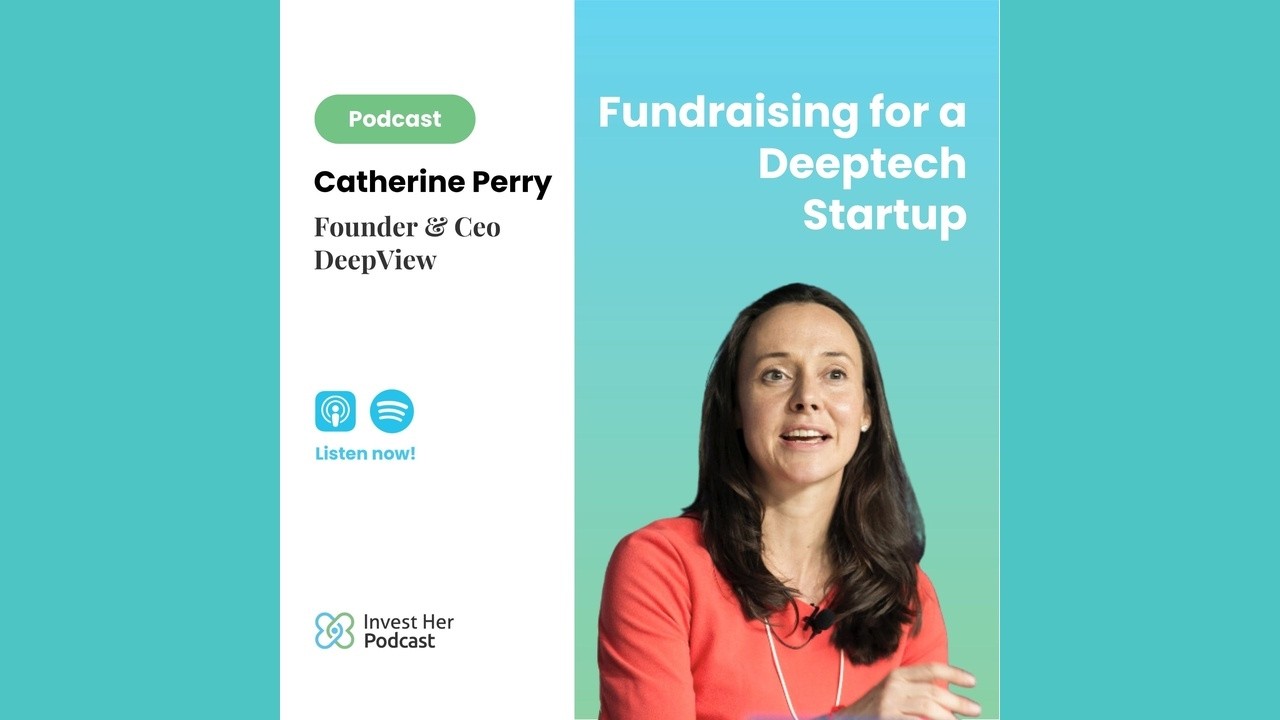
Catherine Parry, CEO of DeepView, built an AI compliance tool that monitors social media for regulated industries like finance and healthcare. She's raised £2.3 million and shares how female founders should approach fundraising: organized data rooms, bold asks, and early term sheets. DeepView detects confidential information in images and video, then alerts in real time.
Chapters
Welcome to episode 22 of Investor Podcast, and this week is going to be a great episode. You're going to hear from Kafsan Parry, who's the founder and CEO of DeepView, which is a deep tech startup based in Los Angeles that is really changing the game when it comes to security on your social media. So why do you want to listen to her? Well, because she's a serial entrepreneur. She has Sold her first company, has already raised $2.3 million for her startup DeepView, and is currently on the raise. And honestly, we had such a laugh in this conversation. She is so full of great tips for founders and you know her insights on what it's like to raise money. So yeah, take a listen. I think you're going to enjoy it. Investor Podcast is for you, the female founder who has a product, a service, or a message. that you believe in and need to get funded. Or for you, the investor, who wants to learn more about the huge untapped investment opportunity that gives you a higher return— women entrepreneurs. My name is Anne Ravanona. I'm an entrepreneur, TEDx speaker, and women's advocate, and I'm passionate about helping women entrepreneurs get funded. In each episode, we'll take a behind-the-scenes look into real-world funding tactics and strategies To help you get the funding you need faster. Let's put the fun into funding. Thanks for spending some time with me today. Now let's get started. Great, so welcome everybody to our latest episode and our latest funding conversation. So the idea behind our funding conversations at InvestHer is to have real conversations all around funding in an easy, fun, relaxed way that kind of breaks down the process step by step for both those early-stage founders who are about to go on this journey and don't know about it, and for investors who may not know of fantastic women entrepreneurs that they need to know about and ecosystem players. So today we have Catherine Parry with us from DeepView. Hello, Catherine.
Hi, Anne. Thank you for having me.
How are you? It's been a while since we've— how many years have we known each other? We were kind of reminiscing, going, gosh, how long we go back.
I remember, I remember meeting at Crunchbase, I think, in San Francisco. Was that when we met? I remember seeing you then. I think we maybe met before then, but I will remember seeing you in San Francisco because it's always— seeing a fellow European in the US is always a nice thing.
So let's kind of get this started, and I wanted to, to To top and tail this by saying that this is going to be full of practical advice, Catherine. We want your funding journey, kind of, and your story and your advice, warts and all. You know, this is the opportunity for you to share your experience because you've been down this journey before, you're currently on a new journey, and that's why we really wanted to feature you as one of our special guests, to kind of showcase what you've learned so you can share with others. And then so others can learn about your new startup with DeepView. What is deep tech? What's all this good stuff that you're doing? Because more people need to know about it. So let's start with maybe just a warm-up question around a fun fact. What would you say would be a fun fact about you that people don't know and just to get to know you a bit better?
Oh, well, so I've just got a new nephew. I think that's probably the most fun thing in my life right now. He is now, 2 and a half weeks old. So I'm currently in LA, can't wait to go back to the UK and give him a hug. Um, so yes, that's right.
That's wonderful, brilliant. Okay, so for those people listening in, we can definitely hear a British accent, so tell us about where you— like, where you're from and how did you land in LA? Tell us that story.
Okay, so, um, brought up in a place called Hungerford, been working in London for the last at least 15 years, and then always knew that the US was a market opportunity for DeepView. And actually, the previous company we sold to a US company as well. So I've always enjoyed the US operations and the style of business. And so came in February 2020 to a conference, so RIA— RSA, thank you, RSA, in California. And then something in me just said stay, and I've been meaning to stay in the US, and it made sense for the business, and I spoke to everyone in the team, and we all kind of agreed it made sense for our targets of the future, which is US clients, building out the tech and so on and so forth. So I headed a little bit further south because LA's a little bit warmer and various networks down in LA. And so here I am, and that's why. It's been a great year.
Oh, how lucky. So I have to ask, do you see any famous stars walking down the streets of LA or not at all?
That's such a good question. I do, honestly, I haven't been looking enough and I probably need to.
I actually, when I was in San Francisco 10 years ago as a leadership consultant, I was doing a seminar. I was going for breakfast. I was sick of having breakfast at the hotel, so I went to a little place down the road, and guess who was having breakfast in there with his son?
Sean Penn. Oh, nice.
You know, it was a cool breakfast, natural breakfast, right? And I was, of course, very— I didn't go near him. I leave him alone. He's with his child, you know, all deep and leave them alone, let them have their breakfast in peace. But you could see the people ogling him, and I just felt bad for him because he's used to it, but still, you know, they needed their space too. But anyway, let's look at this. You become an entrepreneur. How did all this journey start? Because I want— take us to the beginning and your first company.
Yeah, wow. So I think with many entrepreneurs that you You probably speak to Anne, it's a similar story, so I was dyslexic. So as a result, you're, you're not— well, you're slightly, I think, misunderstood. You get very used to not being understood, and you also have to figure out a way to figure out the solution in a way that your teachers will never explain to you.
Mm.
So from, from even from the spell tests, You are— it's almost like you're gaming everything in your life. You're trying to figure out what the adult wants, what the teacher needs, what the exam needs, what the pass rate is, and then you figure out how to get to that endpoint because the typical, like, arithmetic or however you're taught by a teacher does not go through your brain in the same way if you're dyslexic.
Yeah.
Anyway, so the sort of fast track then, um, We had a barn at my parents' house that was being unused, actually completely fell down. And all credit to Dad, he rebuilt it. So, and then I was thinking, this is kind of cool, like why don't we do something with this barn? So did, tried out a few things, sort of trial and error. It's almost like you sort of do the MVP of a tech product. We were doing the same thing with the business, right? We were sort of— So we had a couple of 21st birthdays and then Someone asked us if they could host an art fair, and then we had, and then we had a wedding. And the wedding was by far and away the biggest success.
Right.
And the preparation that was put in place and the way the barn was set up and the structure, that worked. So as far as the MVP, the wedding was a success. So then we turned the MVP into a full product and we built out a wedding website. It was one of the first wedding websites. So that business is called Templars Weddings, it's still operational. And it's a beautiful company that I'm deeply proud of. I have— there's a wonderful team that run it. And so that was my first business. And I think it was— I was about 16 when I kicked it off. And—
Ah, you see? Okay, I just have to pause and say here, there's a couple of parallels that— and this is something I'm going to wish forward wish for you, because as many people may or may not know, Richard Branson is also dyslexic, and look how he ended up. Okay, but the thing is, he started off really early as well. And I know quite a few very talented, you know, people who have dyslexia as well. And as you say, it's just— I think the fact that you've been misunderstood in the past just makes you push barriers and just move faster. And like the fact that you kicked this off, this business loan opportunity at 16, it's like, okay, I'm gonna make this work. And so how did you build it up towards an exit then? Because you mentioned that you sold it to an American company. So, and how long did you Did you take to build up that company, Templar?
Yeah, it's actually— that was my first company. Second company is the one that got sold. So the second company was then a financial communications firm that I built out 10 years later. So the wedding company is still running. I joined WPPE on their grad scheme and then went to a company called Lanson, then set up the second company. So there was a bit of a journey before that. And really with that communications firm, so you learn, like, being misunderstood is only something you can change, right?
Mm-hmm.
You're the person, you're the common denominator. So you're the one that has to get better at communicating to people. And it's a funny thing that I think you see is you learn how to, or I'm constantly trying to learn better, but you try to learn how to sort of match with people and what, how you can relate to them. Because if you can relate to people and understand the challenges they're having or their worlds, then you've got a better way of engaging with them. A little bit like when you're a kid and figuring out the solution, then you understand people and you're understanding where, how everything works. So really that communication firm, there was a niche in the financial market at the time for a smaller company that operated with the kind of organization of the Hill& Knowlton WPPs where I'd learned my grad— where I'd been a graduate and learned my training.
So what are the WPPs? Because some people may not be familiar with that term.
Sorry, WPP is a very large PR and advertising firm worldwide. And they look after incredible clients ranging from like all kinds. Adidas, I say Adidas obviously, but Adidas in the US, through to Nike, through to— I mean, it's a complete spread of consumer, sports, finance, business, tech. And so, but the way the structure is very— we had a very defined structure and it was very well done. And that was a great training ground. So then moving into the financial service side at Lampson's, which was excellent to kind of understand how financial services worked. It was a very interesting kind of— you've got the celebrities, because we worked with Cilla Black, who was a wonderful character, Gerry Hall, who brought so much energy to our photo shoots and so on, and so many wonderful stories. And you kind of match their the strategy with them to the financial services space, as well as the strategy behind it and the thinking and so on and so forth, and really getting the financial services space into the kind of front pages. That was really— that was, you think, it was 2009 when we were doing this. It was post— it was that crisis time we were seeing.
Yeah.
And people were worried about money. So we could get onto BBC Breakfast a story about car insurance. And so that was really what we were looking to do then is help people with their money. And that's what Templars kicked off with doing and was a really wonderful business for so many. It was a great learning training ground for me. We took— I didn't raise money. We just, we built clients. We looked after clients. We built clients. We looked after clients. And then yes, in 2018 sold that business. to Vested, fully vested in New York, who have been a superb acquirer. I've enjoyed their ambition in growing the business and making a— they're doing incredibly well. They've been named Fast Track PR Company, and it's really, really great to see. So we became their London office.
Amazing. And so that's very— I think it's useful for those early-stage entrepreneurs who are listening, who are not used to that, that's what we call an exit. So when you're able to sell your company or go public, that's a really nice juicy exit, particularly for investors. In this first case, you didn't need investors. The best form of funding, as we always say, Catherine, is a paying customer, which you obviously succeeded in doing phenomenally well. And so what was it just at the exit process? Like, how was it selling your baby? Did it feel like your baby? Because I think sometimes when it's our You know, a funny term, but sometimes people are, you know, founders were very attached to our company, you know. And okay, it was your second one, so you've been around this journey before, but how was it? How did it feel to actually sell it and let it go to somebody else to carry on the flame?
It's funny, I don't know if it's a British thing, but I don't think I learned to feel until a couple of years ago. A few years after I sold it. I don't think I knew what feeling really was. It was something I was gonna do and it needed to happen. The business needed it. It was good for the team and so on. And actually, the concept of DeepView began 2 years previous to the sale. So we did a fundraise for DeepView. I remember having 2 data rooms in 2018. One data room. So for those on the call, a data room is literally between anywhere between 35 and 100 documents for either somebody that's investing in you or somebody that's acquiring you because they want to know the business. And it will range from the financial projections, the cash flow, the employees' contracts, the office lease, the service agreements with your clients, Everything, everything. And so I had 2 Dropbox data rooms, one for the fundraising of DeepView and one for the selling of Templars, running consecutively whilst running both businesses.
Wow.
Thank goodness the team for Templars weddings were pretty self-sufficient, so that was— that didn't take too much time. But it was quite a full-on year. So yeah, no, I really didn't have much time to feel about it. It was a joy when it was— it was a joy to do it with such a great team and sell to Vestas. And I think it really just felt like a kind of closing of a book. You know, you get to the end of a book and you're like, oh, that was quite fun. And now it's ended. Oh, okay. Oh, well, next one. You know, it's kind of how I look at these things.
I love it. Okay, so now take us on the journey to DeepView. First of all, what is DeepView? And what do you do? Let's start there.
Excellent. So DeepView is a single platform that unifies social media channels. So it means that any bank, pharmaceutical company, financial organization wanting to use social media to speak to their clients can do so safely and within the compliance requirements. So we archive, we filter, we review, and the kind of cool bit that I like, the deep tech as we talk about, is really the intelligence around the AI and the models we've built in recognizing photos and videos. That's where we've got the patents.
Sorry, no, I was going to say kind of like explain to people, explain to our listeners why this solution is necessary, particularly for in the financial services, because people may say, okay, hold on, social media, why do we need DeepView? What are the implications of people working in those industries using social media? Kind of walk us through that, because I know it's a bit of an education piece, but I think it's important, especially because when we're talking to deep tech, you know, ooh, let's maybe start there before we get into the nitty-gritty with DeepView. Like, what is deep tech for those people who don't know I want deep— what the hell is deep tech?
Yeah, okay, good point.
I'm gonna do problem and then I'm gonna do deep tech.
So problem, um, regulation. So the regulators, uh, we all, I think, know what they have stipulated, various regulations. Um, in Europe it's MiFID, and that gets converted by each of the local regulators. So the FCA have converted MiFID into something called Now that's the requirement that all chats with clients must be recorded. Many of these chats are happening over WhatsApp, and that's only become more prevalent with COVID In the first 3 months of COVID WhatsApp use went up 40%.
Wow.
One example. Some of the banks block LinkedIn because they can't record the chats. And they know their people are chatting to potential clients and clients on the LinkedIn chat. We also see the photo and video point is critical because photos and videos get shared via WhatsApp, via email. We might also see Zoom conversations happening. Your background's very well organized and perfect for public view, but we have seen documents in the background or a whiteboard with some writing on it or similar. And so this is where— and I will explain the deep tech concept in a moment— the deep tech is useful. And also again, you think about Instagram, people taking photos and videos maybe of their computer screen, or they take their little guy or girl to work, or their little guy or girls at home in front of the computer looking cute on the trading terminal. And people take photos and put it on LinkedIn or Instagram. So, in terms of this deep tech, we have spent hours and hours studying photos and videos to look at what are the identifiers that share non-confidential information.
Mm-hmm.
And it is a whiteboard, it's a computer screen, it's a password on a Post-it note. A notebook. And those are the components that we can now identify in a photo or video using what we— it's a machine learning model. So we have a model per item I've just described.
Yeah.
And the algorithm we've built will then alert the user. So if you're on Zoom and something's in your background, it will alert you and say, heads up, something in the background. Could be. So that's how it works. And in terms of the way deep tech works, it's just training more and more.
So you need data. You need tons and tons of data, don't you?
Absolutely. So actually, we're just recruiting a new data— we're just about to recruit a new data scientist. So calling all data scientists out there focusing on image specialty. We are recruiting, we're looking at either Eastern Europe or India. So the— that is— and so our solution, DeepView, really allows the organization— because the whole belief system, given the problem I've just explained now, is social media will be to email what email was to fax. especially in the US. Now we've got Biden in power, Gary Gensler's running in place with the SEC. We have seen a lot of money coming out of Treasury and so on. It is likely that regulations will increase, and that's everything, and the penalties with that. And so it's time for organizations to get these types of things sorted.
Sorted. Because kind of explain the liability, because I think understanding what you do at DeepView, you're really— it's kind of risk management for those financial services companies because you're helping them, you know, stop any potential illicit, illegal insider trading conversations that could potentially be happening that need to be Track, monitor. I mean, we just have to go back to Madoff, and I don't know if you say Madoff or Madoff, and how the hell did these people get away with it? All these, you know, secret conversations and stuff that was going on in the background. So if I've understood correctly, your technology is there to kind of help prevent that and identify when it's happening and create an alert for the organization to say, oh, this is happening, and just so that they can quietly alert the employee as necessary. Because of course, what you're describing around stuff on the whiteboard And in a notebook, even having a photo like me taking notes here. And if I— if you take a photo and somebody can zoom in, I mean, we have seen those examples of politicians walking with the whiteboard and then the confidential— and we know the past president was guilty of doing that a few times, you know, with confidential information just on the top page of his notebook. He's not the only one. People, a lot of world leaders have kind of at some point or another been caught doing that. So like, you're— it sounds like that you guys are super poised to kind of take on the world, Castro. This is a very exciting space for you to be in, and right now.
Thank you, Anne. Yeah, it feels— it does feel very exciting. But as you say, it is exactly— it's risk management. Because as the senior manager, the FCA under the senior managers regime stipulates that if your business has any activity in the UK, you fall under some something called the Senior Managers Regime, whether you're a retail or commercial bank now, or institutional bank. Now that means that the guy at the top, or girl at the top, lady at the top, responsible for data recordkeeping requirements must ensure that every single individual within that organization is doing so. Otherwise, there is potential criminal liability. That's how strong we're looking at this.
Yeah.
And so you imagine all the organizations that even just have one person in the UK or in Europe. And then also you have the same thing in the US. You've got— in the US it's slightly different because there are so many different regulators. You've got the OCC, you've got the SEC, I mean FINRA, and so on. And so every organization has to meet every one of those regulations. And so our job is to understand global requirements from the SFC in Hong Kong to MAS in Singapore to the FCA in the UK to the SEC, OCC, and so on, and be able to put them in a melting pot as we have done and define a product which is ChatGuard to record WhatsApp or WeChat or LinkedIn or Slack. or ImageGuard for Zoom and Instagram. And we're also building out an API to review all data together, which is going to be a really exciting thing that we're probably going to be launching in the not too distant future, which is going to be very exciting.
So what I find very exciting is like, as you're describing your solution to this really important problem, Catherine, I'm already seeing other verticals. That's just the way my brain works as well. And I'm like saying, healthcare, medical records, hospitals, doctors who are writing things on paper, or people capturing information on paper where it's not secure and it's like medical information or the person's personal information. I think that the opportunity for you guys is enormous. So it's like, where are you in that thought process in the product roadmap? Do you want to stay deep dive in the financial services because it's so much to be done, or what are your plans?
Yeah, it's really exciting. So we've actually been asked to white label. It went up by 2 companies yesterday. So I thought we were going to be asked to be— I was going to be saying we've been asked to be white labeled by 4 companies, but actually it's gone to 6. So, and 2 of those do already sell into the healthcare space. So that growth feels very exciting. So we're just in discussions around implementation and pricing and so on. And I really— that feels like this is going to be DeepView's fast-track moment.
Yeah.
This is what we've been working towards.
This moment. And I think what would be interesting is to kind of— I want you to pedal backwards for just a second and tell our viewers and our listeners about, like, your past experience on Understanding regulation and social media, because you've been working in this space for many years before you went to the States. And like, because I know you've given us the shortened version of your wonderful career and path, but I think in this instance, it's good to kind of remind people of the breadth and depth of your expertise in this. So it's not just, I'm Catherine, I was, you know, I've sold 2 companies, I have an incredible PR and media understanding and worked really cool with, you know, really strong with financial services clients. Actually, there's a whole lot more to it because you were also working with the UK government. Please tell people what you did and the standards that you did, because hey guys, you know, when I see brilliance, I want to showcase it. And, you know, I think it's important that you know who you're talking to. Katherine is a global expert on this, and you haven't even mentioned WEF and stuff. So please, this is a little shine a spotlight moment, please.
I have only sold one company so far, but I think Gabriel might be looking at it too. So 2014 was shortlisted a Young Global Leader of the World Economic Forum. Thank you, Anne, which was such a— really such an honor. The people involved in that community are dear friends who I have deep respect for, and each one, every time you speak to to never fail to inspire and impress and just beautiful, very intelligent, bright souls, all of— many of whom have been through very tough early childhoods and similar, or have had tough parts of their life. And I think that kind of all makes us all very unique. We don't settle for an easy life. That is not in the YGL description. Anyway, so that was wonderful. So that meant starting to go to the Davos. Conference, which is in January in Switzerland. And many of the conversations I was having from 2014 onwards were, we want to do social media, we know our people are on social media, but we don't know how to manage it. We've got marketing saying they wanted to use it, we've got sales saying they're wanting to use it, and then we've got compliance saying no, because they couldn't see where the regulators were going. And so as a result, decided to put in a room in the House of Lords an event with, with the UK regulator, the FCA, and a selection of the largest global banks and asset managers in London. And we got marketing, we got compliance, heads of marketing and compliance, and said to them, right, We've got the FCA about to write their social media guidance. We've got the compliance guys wondering and ladies wondering how this works, how it's going to work, so we can future-proof these organizations as the regulation is being built. And then we've also got marketing saying, now, please stop holding us back.
Mm-hmm.
So, and very much the point was, rather than meet regulation that is written and have legacy issues, why can't we meet it in advance? And so that was really exciting. And as a result of that meeting, we got a huge amount of wonderful press. We then wrote something called the Social Media Charter. And from the Social Media Charter, also wrote something called Social Media Guidelines, which the FCA used in part in their social media guidelines, which was an utter honour. And that was really the genesis of DeepView. the foundation of where we were coming from.
That's why people need to know about that part. I think that's very important that they need to know about that because it just shows the depth of your expertise, plus the fact that, like, you're convening all of these stakeholders in one place and bringing them to the table to try and preempt what was happening. And for me, there's kind of like a parallel with with what's happening in AI and machine learning, you know, because there isn't a lot of regulation in this space. And that's what makes me happy you're in this space, Catherine, because I know that you will be helping through whichever ways to make sure that, you know, your solutions are helping to prevent stuff happening and be part of the, you know, future-proofing and creating new standards of different types of security.
Yeah, we've got to be very mindful of AI bias and the training around that. The person in white lab coat, if they're female, is a nurse, and if they're male, is a doctor, is something that we have to be so alert to.
Yes, and that's— and I mean, I know that UNESCO came out and OECD came out with the new AI guidelines. So they've come out with a charter just recently in the last weeks. I think it's UNESCO. It is UNESCO. It's not OECD. You know, because this stuff isn't regulated yet. And you're absolutely right. We've got to kind of get rid of bias, which is a lovely segue into the funding journey you've had so far with DeepView. Because I'm just, you know, let's walk us through, because I'm sure at some point bias came in, because it does, because you're a female founder. So, but before we go on that slope, If you'd like, just walk us through— you've currently raised how much for DeepView? Tell everybody.
Yeah, we've raised £2.3 million, which I'm really proud of, especially because, yeah, it's a different journey as a female founder. And in essence, so We— our investors include VCs, we've got a hedge fund in New York, family office in London, wonderful angels ranging from Stuart Popham, who's the ex-Vice Chairman of Citibank EMEA Banking, Chairman of Chatham House. through to Guy Fernando, who sold his business to Facebook. So we've really got some incredibly powerful people behind us who are supportive and understand business.
Hmm.
And we've raised in part via convertible loan notes, equity, and our current fundraise is on a SAFE note. So that's where we are.
And so for people, so when you started DeepView, Catherine, did you have some cash in the bank before you started? Like at the very early stage, can you walk back to some parts? Because it's always very exciting, I raised €2.3 million, I have all this long list of super sources of funding, and it can seem like, wow, how did you get there to that stage? Because that's really important to remind everybody.
And I'm actually— so I'm going to take you back to the PR, the communications company, because I was able to invest money from the sale of the PR communications company into DeepView.
Yeah.
So that was the foundation of DeepView.
Yeah.
As well as some very early angels. And really, I'd say to anyone going out there, Have a data room, be organized, show what you— get your deck together, get your financial projections together, get your pricing plan together. Those 3 items are your most important. Your investor deck, which can— if you can keep to 10 to 12 slides with where are you going, what does your team need to look like, does it look like, what's the pricing structure, what's the go-to-market. Obviously have the problem in there and why you are the solution. The pricing structure is critical. How will you grow the business in terms of pricing your product? Why does it sit at that price versus competitors in the marketplace?
Hmm.
So that you can raise that early money very— as quickly and easily as possible, because that's the— funding you want to do as quickly and easily as possible, because investors will want to take up your time. They'll want every ounce of your time. Because they're interested and it's their job to learn more about businesses. So as an entrepreneur, it's about sales. You sell, that's all you're doing. You're selling your product. And unless you're bringing in money to sell your product, it's not useful, right? So that's kind of forefront. So funding needs to be short and quick. Easy.
Okay, so that's exactly what I was gonna say. So I totally get it. I totally agree with you. I mean, how long would you say, if you kind of can remember back to back, how long did it take you to raise the $2.3 million?
Oh, it's a good question. I mean, it's been a few years. I mean, there's not even a kind of— I mean, in an ideal world, and I think also coming out of the UK, it's a very different— I think it's in total, there's reports just come out that from 2009 to 2019, $25 million went to women in the UK.
Yeah.
0.5% of VC capital. And so the whole point here is anyone on this call who's a female entrepreneur or knows a female entrepreneur or who's thinking about investing in female entrepreneurs, this is now the vertical that will make a lot of money.
Yes.
Because we've seen tech, we've seen bio, healthcare, whatever we're looking at. We're now— society is now recognizing that women can do business and understand women's voices in business. So as soon as the capital starts flowing to women, it will become a new underfunded vertical which people make money out of.
I totally agree. I mean, I've been saying for years since I started Global InvestHer that, you know, women entrepreneurs are the greatest untapped resource in the world to reignite the global economy. And no, no better time than post-COVID, because again, women have been more severely hit because we, many of us, are the caregivers, either childcare or eldercare, or, you know, there are many women who are, you know, underpaid or who are working in the— who are not working in the mainstream kind of line of work. And so, okay, what would be kind of your Your tips, your key funding tips to female founders. Okay, you know, what do we need to do and what do we shouldn't do?
Have your documentation ready. Be bold, be clear as to why you're doing this and why you're wanting to do this. I think as women, we're often taught to be people pleasers. We're brought up being peacemakers. That is not what is being asked for here. You are standing up to your dad, to your brother, to whoever in your family. And this is what you're doing on this fundraiser. You are respectfully showing what you are good at and why you are doing it.
Yes.
Because the investors will be investing in you. They want to see your passion, your determination, your energy.
Yeah.
And call it. Like, if you're like, this person feels like they're messing me around, they probably are. First meeting, they get to know the business and they see a demo. Second meeting, you can run through some documents. By the third meeting, you want to be getting terms in place. One of the mistakes I did make was letting someone doing some introductions for people, for one interested party, and we should have got a term sheet in place before I did the introductions. I later realized that they wanted my network more than— they did end up investing, but I wish I'd looked back. It's a learning. So get a term sheet in place, even if it's a non-binding term sheet.
When you say get term sheets in place, what's the best way, would you say? Did you find your own startup lawyer, or did you take some templates from online because there's a lot of stuff online from Y Combinator and other really good resources.
Online's great, or even you can have it in an email. You know, this is an agreement that they're going to commit $200K at a valuation of $2, $3, $6 million, dependent on the valuation of the business. So that you've just got some understanding of what is being invested, how much is being invested. And on what valuation.
And then what kind of the other terms around control, about rights, and about, you know, decision-making and board seats and all of that kind of stuff.
That is fairly standard and is where you need a startup lawyer.
Yeah, you definitely do, because I do know, you know, of some female founders who set up their own company and through the process raised money and at some point got kicked out of their own company because they Just didn't, you know, didn't realize the consequences in the early days and you want money so you bend. Yeah, yeah, so that's a different thing. So what are the don'ts? What are the key dos? So the key dos you've said: have your documentation ready, be bold, be clear about your why, why you're doing it and why you're worth it, and I love it, stand up respectfully, respectfully stand up for, like, show them why you're good and listen to those signals that if you feel you're being messed around you probably are. And I think, to be honest though, given that you've spoken to— you have and have had both angel investors and VCs and family offices and so on, there is a difference when you're talking to VCs, isn't there? Because they tend to mess you around a little bit less because they're, you know, their time is just as precious as yours. Or is that an impression?
Yeah, I think you're right. And also they've got a reputation now.
They do.
The VCs. Yeah.
Yeah, and this is also, I think, sometimes early-stage founders, we get very excited when somebody says, ooh, they're interested in my company, ooh, ooh, ooh. And, you know, and it might be that we haven't done enough due diligence on the angel investor. Are they really experienced enough? Because sometimes they're kind of getting their chops, they're learning with you and on your— like, at your expense.
So to the points of don'ts, I'd say, make— be very clear on updates. So we do a quarterly email update to all investors. It's fair and everyone sees the same thing.
Mm-hmm.
With our sales metrics, our projections, and so on. One. And if someone says that they want a call with you once a week, that is just not going to be possible for you because you need to be selling. So put your foot down. So 2, I'd say with investors, it's very important to say you'll ask them when you need help.
Yeah.
You do not want them offering help when— because it can be a distraction. You need to ask. Great if they can, they send you a WhatsApp or they send you a quick email saying, here are 10 people I can introduce who want the product. Can I introduce you? That's the kind of help you want.
Yes.
Otherwise, it can be very time-consuming.
Yeah, that's very— that's a very good piece of advice, because I think some people get very— again, they get excited by all these introductions and so on. But again, there is a lot of posturing in VC. I mean, the VCs want to show that they're adding value to their portfolio companies. And there's now all this kind of new trend of VC as a service, you know, so it's not just— we're not just giving you money, we're going to add on all these all these different services around it, a bit like what the Accelerator is doing, but now VCs are saying, oh well, now we better do this now. And, you know, so there's a hell of a lot of posturing going on that I think we need to just flag and say beware, be aware of it. And so what do you think needs to change in the funding ecosystem, Catherine, moving forward?
Sorry, Anne, it cut out. What was that briefly?
So what, what do you think needs to change in the funding ecosystem moving forward?
Oh, that is a big question.
Enough for a reply.
I think we need the power of a higher energy to possibly do that.
I love a Taurus.
You've asked an Aquarius a big question, so I always get philosophical on you, so I have to kind of pull myself back down to earth. What needs to change? Well, more women, we create the successful businesses and we do the Bumble story.
Yeah.
Right? And we're doing it. And we're doing it and we're proving it for the fellow followers of us, for women following us. And that's what's going to happen.
Yeah.
And it's changing. It is changing. The universe is giving us the recognition, and I'm delighted to see it. And I will carry on doing all I can to support women and fight for, for this world for us, but also more, more just so we can all be— we can all help each other. I really need the guys in our team, they're awesome. I really need our male advisors. And I think actually one of my biggest things have been a couple of incredibly supportive women. Though we've got to recognize, I think, in our generation we're very lucky. A few generations ahead of us, for women, it was very hard, like harder than for us.
Yes.
The abuse was— and so So, I've seen that play out in a few ways that I'd say for our generation, we should just be mindful of.
Yes, that's a very elegant way of saying that. And so, what would be your favourite resources, funding and fundraising resources for founders? If you had to point founders and female founders in any directions, where would you say to go and get great resources? resources?
Y Combinator, awesome. And people you trust, people you trust, ask their advice and read the energy. As women, we're so fortunate we have a great intuition and an energy reading. So trust that. If someone's helping you out and giving you good energy, follow it. And people want to help you, so follow those. They want to, so ask, ask where you need for help, but don't be too pushy.
I like that, don't be too pushy. There's a phrase that one of the VCs I know, she said, you've got to hustle, not hassle. And I really like that. You know, you do have to hustle, that's part of the game, but you don't hassle. You know, VCs and investors are extremely busy, not that we aren't, but you can't be ringing them up every 2 days. Or sending them an email and expecting, oh my God, they haven't answered me in 24 hours. No, that's not the way it works. So you got to manage your expectations as to what's going to happen.
Yeah.
Sorry, go on.
No, no, you're right.
I was just gonna say, so how can our listeners connect with you now? You're on different levels. You're currently doing a fundraise, so any potential investors and so on, how can they reach you?
Probably the easiest thing is probably email or LinkedIn. I find LinkedIn is great. So I'm Catherine Kitty Parry, but Catherine on LinkedIn, or my email is catherine@deepview.com.
Excellent. And so same, you, you've made a shout out for data scientists. So hey, data scientists or data scientists, I have to say in the record as well, um, contact Catherine. She's looking to hear from you very soon. And hey, if there are some great women in there, Please make sure you apply, you know.
Yeah, even more.
Even more, even better. Funding.
And then, so the funding notes, really exciting at the moment. I'd say primarily because of the white label partnership. So we're pricing as if the business has not got the white label partnership.
Wow. So there's, it's gonna be worth a lot more.
And then obviously if anyone wants to try the product, we love showing it to people and we're always wanting to help companies get onto social media.
I love it. So how can we— last question here— how can we put some more fun into funding, Catherine?
Oh, good question. Take the pressure off yourself and make sure you get a break. And I wish I'd— well, that is easier said than done. It's so— because when you're in it, it's all-consuming and you think it is your entire life, and it's not. It's part of your life. Really. And actually going out and seeing your friends and reminding yourself that you have so much more value than just your journey, your business journey, is really important.
It's so important. I love that. I mean, and as a closing statement, it reminds me of a conversation like last week. I was like at the Generation Equality Forum, you know, meeting presidents, meeting Hillary Clinton, and it's like, oh my gosh, oh my gosh, oh my gosh. And then like the next day I'm back at home and my daughter's like, you know, growling at me and I'm just— it brings you back down to earth. Okay, you know, you're just mom here and, you know, yeah, we got to solve the mom problems at home and so on. So it's— I think it's great to always keep that perspective and look after ourselves because we can only do so much good for the business if we're okay. That's what you're saying.
Well said. And Anne, I saw you, it looked like an incredible event. And wonderful people that you were with, in the correct company, I should say.
Yes.
I think looking after yourself, and for me, actually, like, doing the very calming, the yin yoga, the— is the balance, the balance, make sure there's balance.
Make sure there's balance. Any last questions? Ruta, you have an opportunity here to ask any burning questions you have of Katherine before we sign off, so please feel free to type it in because she's here with us live. So Ruta and anybody else, Put in your question really, really quick before we go. And thank you so much, Catherine. It's been such a pleasure. I love catching up with you.
It's been really fun.
And hey, I want to give you— make an appointment with you. We're going to do this again in a year's time or whatever, X amount of time, when we'll be celebrating. Okay, now I've done my Series A and now look where we're at. Look what we're doing, you know. So it's really cool. So that's really great. And Ruta is saying, thank you, it was a great webinar. So that's awesome. And to all of you who'll be listening to this in the podcast version, you know, contact Katherine. You've heard her contact details. Catch her on social, LinkedIn, email, best ways. They will be in the show notes that you'll be getting. And hey, Katherine, we wish you the very best with DeepView. We know you're gonna conquer the world. I'm convinced of it because I think your, your product, your service, what you're doing is vital, and I think there's going to be many more industries that are going to need it. I'm very excited about your white labeling stuff, so congrats on that.
That's very big.
That's a big deal. So we got to celebrate.
Thank you, Anne.
Thanks so much.
Wonderful.
Take care. Have a great rest of your day. Thanks a million. Bye. Thank you for listening to InvestHer Podcast. Don't miss more great funding tips and insights by subscribing to the podcast on Apple or your favorite podcast host. And while you're there, I'd love you to rate and review the show. We'd love to hear from you. So if you'd like to send in some questions, interact with our guests, or suggest other great people we should feature, join our community on the Flick InvestHer group or send us a message on investherpodcast.com. Want more great resources for female founders about funding? Check out our InvestHer Academy at academy.globalinvesther.com. I'm Anne Ravanona and look forward to having you with us again for our next episode. Let's put the fun into funding and get more women entrepreneurs funded.
More from Anne



🎙️ EP69: Get Off the Fence: Renate Crollini's Startup Blueprint | InvestHer Podcast

🎙️ EP68: Radical Truth: Robert Rubinstein Exposes the Impact Investing Illusion | InvestHer Podcast



🎙️ EP66: Global Sisterhood — Carine de Meyere on Trade Missions | InvestHer Podcast



🎙️ EP65: Capital With a Conscience: Pierre Norman Rolin on Investing in Women… | InvestHer Podcast

🎙️ EP64: Dream Bigger: Nikki Barua on Building an AI-Native Company Without… | InvestHer Podcast