🎙️ EP28: How to Raise $1M in Seed Funding and Leverage Your Network, with… | InvestHer Podcast
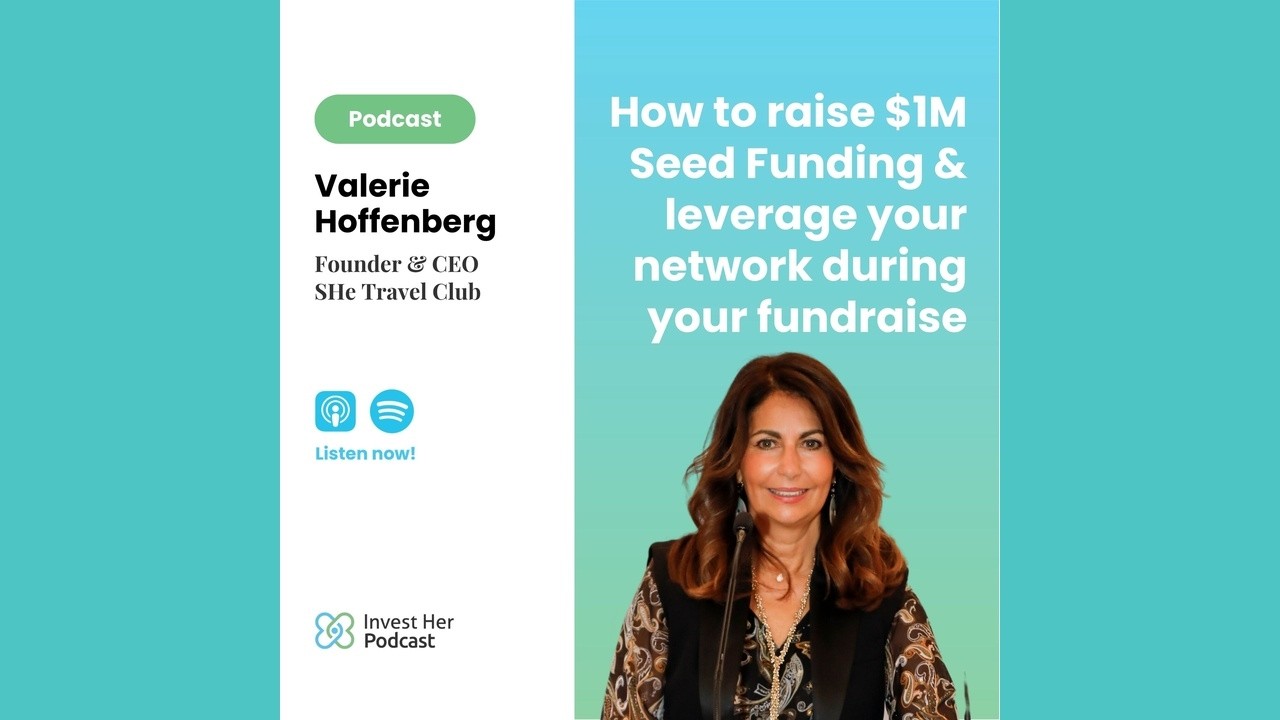
In this InvestHer Podcast episode, host Anne Ravanona interviews French serial entrepreneur and former presidential advisor Valérie Hoffenberg. Valérie shares her eclectic career—from early entrepreneurship in heating‑device distribution, to political advisory roles, think‑tank creation, and finally the travel‑tech startup SheTravel Club, a hotel certification aimed at addressing women travelers’ safety, comfort, service, and hygiene needs. She explains how she identified a market gap (women make 80% of travel bookings but feel underserved), built a data‑driven certification with four pillars, and leveraged a multicultural network to raise a $1 million seed round. The raise involved a $400 k lead investor and eight additional investors from France, Italy, Israel, the US, and Canada, using SAFEs to defer valuation. Valérie discusses the six‑month fundraising timeline, challenges posed by COVID‑19, the complexity of educating investors about SAFEs, and the importance of confidence, a strong business plan, and strategic investor selection. She also offers practical advice on building and nurturing networks, the role of generosity, and systemic hurdles for founders in France (bureaucracy, high startup costs). The conversation concludes with tips for making fundraising more enjoyable and a call to join SheTravel Club.
Chapters
Welcome to season 3 of InvestHer Podcast. And what better way to kick off our season and in 2022 than with a fabulous woman entrepreneur. In this episode, you're going to meet Valerie Hoffenberg, who is a serial entrepreneur from France, who is a former advisor to our President of France, a former ambassador in the Middle East peace process. And she's coming back to set up a travel tech startup to help women who are traveling around the world to feel more safe in hotels. Really cool, huh? So in this episode, you're going to learn how she used her vast network to raise her $1 million seed round. And she's full of great tips to help you, the woman entrepreneur or founder, to raise that type of money and how to use your network in the positive way when you are fundraising.
This is a great episode.
Enjoy. Investor Podcast is for you, the female founder who has a product, a service, or a message that you believe in and need to get funded. Or for you, the investor, who wants to learn more about the huge untapped investment opportunity that gives you a higher return— women entrepreneurs. My name is Anne Ravanona. I'm an entrepreneur, TEDx speaker, and women's advocate, and I'm passionate about helping women entrepreneurs get funded. In each episode, we'll take a behind-the-scenes look into real-world funding tactics and strategies To help you get the funding you need faster. Let's put the fun into funding. Thanks for spending some time with me today. Now let's get started. Welcome everybody, welcome to a new year, 2022, and to a very new year in our Funding Conversations. And what better way to start the new year with a fantastic serial entrepreneur, a European serial entrepreneur who is really kicking ass, who's amazing, And I want you to learn all about her, about Valérie Hufenberg. She's going to tell you her story and how she's building SheTravel Club to be the next travel tech superstar. Aren't you, Valérie? Welcome!
Of course, I hope so. Well, first of all, well, thank you very much for this invitation. It's a great way to start this year, to share passion with people who also want to be entrepreneurs. So happy new year to everyone, and I hope it will be a year of achievement. and project success and to try everything you want to try. That's the most important. I love it.
And I know that you're going to be full of amazing advice. So what I'd love to encourage those of you who are with us live on the webinar format, please feel free to continue to add your questions in the chat box, and I will be feeding them to Valerie as we move forward. And if you're listening to this on the podcast, sit back and get ready for a great ride. Not right, Valerie?
Definitely looking forward to it.
All right.
Please share your question. I'll be really happy to answer.
Wonderful. So, okay, I want you to say again, speak for 2 seconds, Valerie, while I pin your picture here so everybody can see you.
So hi everybody, and I'm really so happy to speak with you and to share with you all my experience as an entrepreneur, hoping that it's going to be a lot of inspiration for all of you.
So let's get started by understanding a little bit more about who you are, Valerie. Can you tell us a fun fact about yourself first, and then a little bit more about your background?
Well, if I have to start by something funny, I would say that, you know, when I was really young, like I'm speaking about 8 to 10, 8, 9 years old, everybody was asking me, like all the little girls, what do you want to do when you grow up? And my answer was at the time, I want to be the President of the Republic. And so of course, people were saying, why do you want to be the President of the Republic? And I said, because I don't want to be part of the people who complain, but I want to be part of people to fix things. And well, obviously, you know, I was not the President of the Republic, at least not yet, but it's not in my plan, despite I've been working beside the President for 4 years at the Élysée. But what I learned more is that to fix the world, you don't need to be the President, but the people who are most fixing the world are the entrepreneurs. And so that's why, you know, I'm continuing to try to fix everything I can fix, you know, at my modest position to fix the world.
I love it. And I love that you wanted to be president. We usually hear that in America. Let's just say it's kind of more ingrained in the popular psyche. And you see it in movies. And I grew up wanting to be president. Less so maybe in Europe. So, and you're a woman. So I love that you were an 8-year-old girl saying you wanted to be president. I totally agree with you about the fact that when we are an entrepreneur, we can can change the world. You know, we definitely, we find a problem we want to solve that's important to us. And we just try and fix it. And, and I love that because I know that you're a fixer-upper, aren't you?
Yeah, I think, but I think it's really important to be driven by this idea.
I agree. So tell us a little bit more about who you are, like your background, Valerie, before we start going into your journey.
Yeah, well, you know, I mean, I have a degree in law and political science. And then after, you know, but I never was a lawyer, because I immediately created my own company when I was 22. And once again, it's because I wanted to fix a problem. I was just after my diploma in the States, in California, and I'm part of the people who love being outside and have dinner outside, but I'm also a little bit chilly every time. And I was in a restaurant in California and I saw, well, you know, this kind of— I'm sure you know all of them, but you know, you know them. It's the heating mushroom that you have on the terraces.
Yeah.
And I saw that and I said, well, that's really great because I can eat outside whatever is the weather. And I was 22, just have a low degree, and I looked at the sticker on the mushroom and I saw an address and telephone number. And so I called the number and I say, you know, I would like to meet your manager because I'm very much interested to import your product in Europe. And then I went there, and I have to say that the manager was a bit surprised to see a young girl, you know, in the little suit and high heels come in, 22 years old. And I told him that I wanted to import his product for all Europe and Middle East. And he looked at me and he said, but are you in the business of the heating? I say, not at all. Are you in business of the restaurants and hotels? I said, not at all. Do you have your parents in that? I say, not at all. He said, but why should I give you the exclusivity for Europe and the Middle East? And I told him, well, you know, I saw that your company exists for 20 years. You never sold one heater in Europe nor in the Middle East. So what the— you don't take any risk. The worst I can do is to start the job, to start the business. It doesn't work, you stop. So put me a goal to reach and give me the exclusivity. And to make it a short story, I got this exclusivity and I've been running my own company for 14 years. And then I So I sold this company, and then I decided to do something else. Well, first of all, I had my third kid. I stopped working for one year, and then I started again, and I become a lobbyist for a European NGO, and for a few years. And then after, I went into politics. And when President Sarkozy asked me to be first an advisor at the Élysée for the Middle East affair, And then after, I became an ambassador for the peace process in the Middle East. So something completely different. It was an amazing experience, and I was elected. I was a representative of Paris also for 5 years. And then after, you know, I also ran to be a congresswoman. I lost my election. And when I lost the election, I said, okay, what am I going to do now? And I went back to business, to my first love. And so I started to build my second company, which is Connecting Leaders Club. I have tried, and I think this is important, at the time, you know, I lost the election, we lost everything, and said, okay, what I have to do? And I've tried to analyze what was my strength and what was my weakness. And I say, I have a network, I know how to handle things, and so I'm going to create this club of high-level people, and I'm going to organize some event once again that can change things and that have some impact. So I've created some event like the European Business Day and the, the morning, the economic morning with a major newspaper, because once again I wanted to have an impact differently. Political policy is something, but you can also have an impact when you are entrepreneurs or when you create some think tank. And then I created the think tank Agir pour l'Égalité. with Marie Claire, which is really something which is very important to me because, as you might have understood, gender equality is important to me. I think I believe in equality of dream. And I think it's starting like that. I believe that men and women should be equal when they dream, and then after, everybody can choose. But at least we should allow little girls and little boys to dream about anything they want to do in life. And so I've created this think tank And another think tank, which is Food and Planet, on all the, all the challenges we have to face on, you know, sustainability, food and sustainability. But I would say that when, as the president of the think tank Marie-Claire Agir pour l'Égalité that I've co-founded with the magazine Marie-Claire, I realized that there is one sector that needed to be changed in the sector of the hospitality sector. And that there was a real feminization of the tourism and of travel. And I launched a big study, a large study in 5 countries: France, UK, China, Brazil, and the United States, to understand how women were traveling, what were the expectations, and if they were happy with the offer from the hotels. And the results were really amazing. First of all, did you know that today 80% of all reservations and bookings are done by women?
Huh, that doesn't surprise me.
So this is the real power, girls, you know.
Yeah.
80% of all the booking reservations are done by women.
Wow.
And the second figure that was really, uh, that struck me is that today women represent 62% of global travelers. So we lead the travel industry, but this survey revealed or confirmed that the, the great majority of women, whatever the nationality, considers that the hospitality sector do not meet their special needs as women when they travel, and that they are all looking for some solutions. And I was part of this. And so that's where came the idea of the creation of the SheTravels Club. I love it.
And I really love how diverse your whole experience has been, Valérie, going from, as you say, a young, already very entrepreneurial young woman who know— who knew what she wanted. I mean, that's fantastic, your story. It resonates with me because I was a 21-year-old setting up a business in France too. So I understand that too. But I love that. And then going to You know, being an advisor to the president and being elected and all that. I really love the way you've moved from entrepreneurship to public policy, to think tank, to back to entrepreneurship, which is also still entrepreneurship. You've gone around kind of full circle.
Yeah, but, you know, being able to be an entrepreneur, I think it's something that gives you a lot of freedom in life. You know, because when I went in politics, you know, I went in politics because I really wanted to change things and to have some impact. And when I lost, it was not a catastrophe for me, you know, because I knew that I could again build something. When I knew that a lot of my colleagues, you know, that made all the career in politics—
Yes.
You can go for more compromise when you don't have any other choice.
Yeah.
For me, I want to do things. I finished, it's okay. I can go back to the private sector and to create something else. So being an entrepreneur First of all, it's freedom.
I love it. So tell us, before we go into more detail in your funding journey from the past and the present, I'd love you to tell us more about SHE Travel Club. So you noticed this gap in the market, this huge opportunity. What is SHE Travel Club and how do you help women who travel?
Yes, so SHE Travel Club is the first certification for hotels that meets women's needs. And so we want to be part of the transformation of the hospitality sector. We want to help them to meet women's expectations. So this certification, first of all, you know, is a certification that combines the 2 evolutions. First, it's really based on data and on technology. And the second is that we also realize that women love to share their testimonies and what they think. You know, they are the ones who work, who use the most TripAdvisor.
Yeah.
They love to share what they're thinking. So this certification is the combination of first an auto-diagnostic given by the hotel, And the second are the comments and the testimony of the women. So how does it work? We have identified 4 pillars thanks to this survey. All the women are just like— they told us what were the most important for them. And so we have identified 4 pillars. The first one, and it's not going to come as a surprise for you, it's for sure security. Women love to travel, but they are always concerned by security. And once again, One figure really struck me is that it was like 7 on 10 female travelers for business have experienced some problem when they travel. It's a lot. So security is a big issue. The second one is comfort. A lot of women still complain that they don't find what they want into the hotel rooms. The third were services, and the fourth is foods. So these are the 4 pillars of our certifications, and then in each pillar, We have some criteria that the hotel needs to, to meet. So I'm going to give you some examples, and I'm sure that it will speak to a lot of women. When I speak about security, most of the women, they say that they want— the first thing is they want to feel safe in their room. What does it mean? It means that they want to have the possibility to lock the door for interior.
Yeah.
So either you have a chain, either you have an interior locker, but it's not, you know, with all this electronic key that you have from the outside. It happens to me twice that people get into my room, and it happens to me once this summer again that I get into the room of someone else because there's a lot of problem with electronic key. So I knew a lot of women who said, you know, I put the luggage or the chair to be sure that no one is going to get into my room. So we ask hotels to have some double lockers or a security chain. The second thing is to have a kind of spyhole. Why a spyhole? Because when you are in a hotel, if someone knocks at the door and says, room service, service d'étage, you don't know who's knocking at your door. And if you have to open the door, it can be anyone. So women want to be able to check who's knocking at the door. Third point, which is very important, is also to have the lit-up corridors. So when you get from the elevators to your room, you feel secure. You want to know if there is valid parking if you've got a car and you don't want to go and go all around the hotel. Yeah, so all these little things about security that you cannot find anywhere else. If you go to Booking, Expedia, or even on the website of the hotel, you don't find this kind of information.
And I think that's phenomenal, Valérie, because like I'm a woman traveler, I have done it like you all over the world, and I gave you the example of when we chatted offline how I was at a global conference earlier this year, and I wanted— there was a gala event, I wanted a hairdresser to come to my room and do my hair. And the concierge was great, got me a hairdresser. And when the person turned up, it was a man. And he didn't even think twice about the fact of me bringing a man I didn't know into my room. I didn't feel comfortable. Within a few minutes, I could because he was a nice guy. But really, you know, there was that— again, it doesn't even come across their consciousness because they don't experience that level of Insecurity, you know.
Absolutely, you're definitely right. That's the kind, you know, of, of example, uh, that a lot of women shared with us. And the second, of course, is comfort. You know, comfort is also very important. Once again, a lot of women complain that they don't have enough hangers or that they want to have a length mirror where they can check if their shoes are okay with the jacket.
Yeah.
And, you know, you can be in a 5-star hotel or in a 3-star, it's just like a spirit, understanding that there is a lot of the customers which are women. Other things which are also important is that you want to be sure that in your hotel you don't have— you have a hand shower and not, you know, coming from the top. It happens to me 3 weeks ago where I was invited to speak at a convention in Marseille, and it's the convention who booked the hotel for me. And when I arrived in the morning, I saw that there was no hand shower, and it's a catastrophe when you have long hair and you don't want to—
You don't want to be washing it every day.
And so this is once again no way to get this information. So we ask all these G Certified hotels will have a hand shower, we'll have more angles for women, we'll have, you know, so the mirror. And something also which is very important for us is that, you know, if a man forgets the toothbrush or the razor, you have an emergency kit everywhere.
Yes.
And what about women? If we forget our polish remover, our cleanser, or more, our periodic protection.
Okay.
And there is no emergency kit. So in all the SheTravelsClub certified hotels, at least at the reception on demand, there will be a cleanser, polish remover, and also a periodic protection. We had a lot of testimonies from women saying that it happened that they had their period when they were at the hotel, that everything was closed.
Yeah.
And they didn't know what to do, and they went to the reception, do you have some Tampax or Oh no, we're sorry. And so we want to be part of this transformation of the hospitality sector to show that women count. And yes, we are different, we have some needs, and they also have to meet these needs and expectations. It's not a big deal. We're not asking to make a big change. We just want them to open their eyes about the fact that they have more women than men in their hotels and that they have to think different just to give the equal service that they give, attention they give to to men, to women.
So that's, you know, like you're talking, what you're describing is about equity. It's not equality, it's equity. It's how do we get to equality? It's where you give the different people with different needs what they need. So they're all at the equal footing. And you know, that is a very important thing for people to, to know. And, and it's, I know you're going to revolutionize the travel industry. It's so needed, Valérie. And I'm very, very excited for SheTravel Club. So can you bring us back now because we're going to jump into the kind of funding cycle of things. When you were, when you were that young entrepreneur setting up your distributorship for the, for the heating devices, how did you raise money for that? And then how did you do it when you did for, for your think tank, etc.? So run us through your funding journey before SheTraveled Club. And then let's, let's talk about how you raised the million because that's also why a lot of our, our listeners are here. They want to hear how you did it.
Well, so first of all, you know, I was 22, and so I've tried to benefit from state help. So, you know, there was some kind of state help for young entrepreneurs below 25. And I have to say that so many years ago in France, there were not so many young entrepreneurs, you know, younger than 25. And so I was happy and lucky enough to benefit from state funds. To launch my company, and that was you know the beginning. So you know I mean then after I did this and this, but it was really I launched it by by state by state loans, and I took loans also at my bank. So that was when I was twenty-two, and then after when I launched my company Connecting Leaders Club, you know I was older, and at the beginning I used my own money. So I took my own money. I invest, which I have to say you know what that was a tough decision, and I do remember at the time that some of my friends said, but I don't understand. Why don't you get a job in a big company? I had some offers from very big— well, you can imagine, I was an ambassador and I was an advisor. I had some offer, uh, to say, well, got a position immediately, uh, in, uh, in a big companies where I was sure to have like a salary, an office, and things like that. No, when I went back to my home and I invest my own money, but I wanted to be free, and, uh, and then I create this. And I would say that by building SheTravelsClub is the first time that I go by all the process of raising money, uh, with— because this is the first time that I needed so much money. And break that down for us.
So tell us a bit how you— like, what exactly did you do? Because it was brilliant, because what you've described is what a lot of early-stage entrepreneurs have to do, which is their savings, and, you know, get a bank loan if they can, get some grants or state help. So you've done That's brilliant that a lot of entrepreneurs will identify with that. So then now you've been able to take it the next step. So exactly what did you do to raise the million for— to kick off SheTraveled Club?
Yeah, before telling you that, I would say that it's also something which has to do with confidence, you know, because on the second time I created my company, I had the confidence enough in me to use my own money. On the third time, I even have more confidence in me to ask money to others. Yeah, so, you know, it's also an evolution. I love that.
That's such an important message, Valerie. Thank you for saying that because it's true. We, as we progress in our careers and in our lives, we have life experience and confidence growth, and that's so important, particularly for women entrepreneurs.
And this is, I would say, the first message is that have confidence in you, in your idea, and in your business. So of course, you know, the first thing was to create the business plan and to really materialize the idea, to come from an idea and then to transform it on a business plan and with business revenue. And I have to say that it was one of the good things of COVID because I had more time and everything started during the lockdown.
Yeah.
And I said, I have a little bit of time. So I had a little bit of time to do this. And I was lucky enough also to get to have my son, who was a student at LSE at the time, and he was next to me and helped me also to build my business plan and do my marketing. And I have my other son who is working on finance. And so, you know, we had some kind of family meetings.
Right.
And I think it's really nice because it's a kind of, you know, I've been— I think I helped in my life my kids to grow up, to do their studies. But this time they were the one, the 3 of them, who helped me to set up, you know, my business plan and to help me really to figure out how I can transform it in a, in a business. So we've been working first on the business plan, uh, and, uh, as I told you, I have one son who is in the finance business, so he really helped me just like to transform it in figures. And then after, to make the deck. We did like not 1, 10, but hundreds of times of different kinds of decks. And then when I was ready with the deck and the business plan, I used my network. And that's what I was telling you. I was in another part of my life and I was confident enough in me and in my idea to go and see friends and to say, well, listen, this is my idea. What do you think? And I mean, I need some investment. Are you interested? And I have to say that a lot of them say, we love the idea and we're going to invest. Let's be clear. I think they invested because they believe in the idea, in the business plan, but also because they believed also in my capacity to do it and to achieve it.
Yeah.
And this is also where, you know, confidence comes, is that at the time, now today, you know, I'm not 25 anymore, not even the double, much more. But the thing is that at the point, You have to use what you have at your disposal to build something.
Yeah.
And so that's why, you know, I went to see friends and family. I made the presentation, we did the deck, we redo the deck, we undo everything. Every time we were trying just like to make some modification, taking into consideration all the remarks that people were doing. And I think also it's something which is very important is when we got with your idea, also keep your eyes, your ears open to remarks and to recommendations.
Yeah.
And so then after, you know, the most important is that also that I went to see people that I knew could attract other investors.
Yeah.
So it was very important to have big names.
Yeah.
Big names, you know, that was going to say, oh, okay, see, this one is given, it's important. So I think I can also trust because people like to give when also they trust the other people, which are the other funders.
Yes.
So that was important for me to identify the right person. So I would say first, have a good deck, a good business plan, identify your— the person who are right for you. That can also be not only investors, but that can also be advisors.
Advisors, yeah.
And will understand your business, that can accompany you on the decision and adding value also as investors.
Yes.
So I want to see one, the second, and everybody was saying, okay, if this one is coming, why not? I can come, and things like that. And so identifying the good investor is very important. And then after, well, that's the way really I did it.
So when you're just— what you're describing is so fabulous, because it's exactly what— well, it's textbook what investors say that you should do as an entrepreneur. And when you're describing that, so you're describing that you had a couple of, let's say, lead investors. So some of those bigger names who could attract other people.
I had actually, yes, I had one lead investor in terms of money.
Yeah.
And I had some, uh, big names who put not so much money, but who put money. But that was a kind of caution for the other.
Yes. So yeah, it is, it's like, it's okay, they're putting their name and their reputation because that's, that's a really positive thing that they're bringing.
Reputation and network.
Yes, exactly. They are keywords— name, rep— like the person's name, their reputation, and their network— because that's how you're amplifying what you're bringing to them, the business opportunity.
Exactly. That's what I say. I took investors that can have also, um, adding value for the business.
And like, when you look at the total $1 million, how many investors would you say did you have to make up that million? Like, if your main investor, what percentage of the total did they kind of roughly— I don't— we're not giving any confidential information, of course, but just to understand Like that makeup so that people can say, okay, to get to a million, sometimes you can have 10 checks, sometimes you can have many more checks, like just to give the people an idea.
Yeah, for sure. Okay, so I have one leading investor who put $400K, and then after I had around 8 investors that put the rest.
Yeah, okay, so that's cool, and that is really, really good. So, and what is interesting what you're saying, Valérie, and which is very apparent, is that those people who are able to put in sizable amount of checks. You want people who can follow you for the next round, if you know, when you need to raise more money for the next growth stage. That's also, you know, either they put more of their own money, or they will, you know, they're happy to sell their shares on to, you know, a venture capital fund or whoever else will be coming in at a different stage.
Yes, definitely, you know, but I think some of them, you know, they want to accompany me for the rest. But, you know, why I did also friends and family is that I wanted to go quick.
Yeah.
And if you have to go, you know, I could have go, for instance, I didn't go to the BPI, maybe I will go now.
Yeah.
Just like to have some state funds. When I started, when I was 22, I needed this.
Yeah.
Today, I wanted to go much more faster and to have, as I told you, the name, the reputation, and the network. So I went to see friends and family that have a real adding value. Now I can go for, you know, other kind of money.
But just for our non-French viewers and listeners, so BPI is the French public bank, like, that supports entrepreneurship. So that's just for people people who don't know what that is, for BPI. And when you say you wanted to go faster, finally, so how long did it take you roughly to raise that million with your friends and family round?
6 months. There you go.
So, and I think that— and did you know it would take you that long when you started out on that process, or did you think it would take less time?
Well, I thought it was going to be less because I have found the people very quickly.
Yeah.
But then after, we had to prepare the mechanism and all the papers.
Yes.
And that's— this part was longer to me.
Wow. Yeah.
No, I mean, finding the people were easier.
Yeah.
Putting into place and finalizing the paper were the most difficult. And I come to one of the difficulties.
Yeah.
When you have a startup is the valuation of the company.
Yes.
How do you give the valuation when you've got an idea, which is good, but how can you do evaluation? So we decided to use the mechanism of SAFE.
Yes.
And which is used in California and which is used in Israel. And as I'm lucky enough to have international investors, because I have American, I have French, I have Italian, I have Israeli, and I have— do I have something else? Yes, and I have Belgium. Voilà. So French, Italian, Israeli, American, and Canadians. Well, this is the 5th I have. So really a lot of different kind of— and they knew about less the French, but the other one they knew about the safe.
Yeah.
So I had to first explain the mechanism of the safe and what is the safe. In French is the BSAR. It means that we don't need to raise money today on the valuation of the company. We don't give the valuation of the company today. So I don't need to dilute the company today, but it's on a future valuation in 18 months. And then all the investors that invest with me today, they will have— I give them a cap.
Yeah.
So the maximum evaluation, and they will have a discount when they will invest for the second round. So, you know, I had to choose what kind of mechanism I was going to take. We decided this SAFE, and then after we had to explain the different mechanism to everybody. We needed everybody, we had to make like many, many rounds of discussion because everyone wanted to add something, and then we have to redo again. So that's That's this part which was longer to me, and I was not expecting it.
Well, also, I think what makes it super interesting is that you had a completely multicultural group of investors, which can include— that increases the complexity, because they will be coming from different kinds of mindsets and business networks and so on. And therefore, that's probably why you had to do a lot of explaining as well as to what the SAFE is. Okay, as you say, your Americans and Canadians would have understood, What a SAFE is, and the French because there's an equivalent. And maybe the other ones, maybe the Belgians and the Israelis may not be as aware, or there's a— I mean, Israeli, they do SAFEs.
No, I mean, by the way, it's the Israeli who advised me this because, you know, I have a young guy. And well, the thing is that, yes, it took me more time, but I think it's really valuable to get some investors which are so different because I have people who are in their 60s I have people who are young guys, which are 30. I have 2 young guys from Israel that make, you know, like big money in the cybersecurity issues. And it was so nice that, you know, this guy of 32 years old said, well, I love your idea. I think it's great. I want to invest, you know, and I'm going to help you with all the technology. And I had people, you know, for instance, I can't give all the names, but—
Oh no, of course not.
Some names that I can share. which is, for instance, the president of the CES of Las Vegas, who— I mean, I was so happy because, you know, I mean, the presidency starts up, you know, every year all over the world. And when I introduced him, he said, but that's a brilliant idea, I want to be in. So, you know, that's also the kind of things when you have the trust of people like that, that you really feel super happy and that it gives you its energy. So having, you know, okay, a multi- Multicultural. Yes, it took me more time, but as I don't want to be a French startup, but a global startup, I think it was very important to get this network.
So I'm curious, therefore, where did you put the headquarters of the startup? Is it in France or in the States? That's an interesting one because given they're international, how did you navigate that part?
So that was a question. And actually, you know, I really hesitated to do it either in the US or why? Because, you know, So the main market of the— and the main hospitality sectors, you know, all the big companies, they are in the US. But then I'm in France. I'm French. I also had a position in the French government. And in one way, I think I owe to my country to create my company in France.
You know what? I love it, Valérie, because I can see you going very far and hopefully you will become a French unicorn. That's what we want for you, that you'll be one of The next 40 that France will be super proud to say, and a female-led one and owned. And yes, that's where we're going. And I want to pick up some of the questions because it's— oh, it's fascinating, the story that you're taking us on, Valérie. So we did have a question from Catherine Jeanne, and she wanted to know, how do you motivate yourself to look for funding when the business is not in urgent need for cash? I thought that was a great question. So when you don't need the money, how do you still kind of say, well, I should really go out and get Well, that's a great question because so many people ask me, but why are you again taking risks?
You know, I mean, you have a big business that works very well. And I have to say that I will come back to my first answer and story. I've always been driven by the— by wanting to fix things.
Yeah.
And, you know, I mean, as I told you, it happened to me. Every time I was traveling, I was wondering about things and why I don't find this, why I don't feel secure. and I just wanted to fix things. And during this COVID, I had time, I had time to think, and I said, but this is a great idea and I should do it. And I just wanted to do it. And sometimes it comes from here, you know, it comes from the inside of you and say, but this is for you, you can do it, and why you didn't do it? So I decided to go.
I love it, I love it. And so, and I think part of our question is, okay, when you— how about to continue to look for funding even when you don't really, like, when you're not in urgent need? I think that's part of her question because it's like you can get started, but then you can run out of money very fast. So I think it's really good that you've raised $1 million, to be honest. And I think what I would say to Catherine's question as well, building on what you just shared, Valerie, is that, you know, typically investors advise to raise for about 18 to 24 month runway, meaning that the money will last you a minimum of 18 to 24 months. That you can live, you can eat and build the product and test and do what you need to do without being super stressed. So that's what I would add as well, Catherine, to your question. So, oh, I love this. Sophia Guerin, she wants to know, what was the hardest part to start your project, to get this all started? What was the hardest part, Valérie?
The hardest part was to Well, you know, we really have to— I don't know what was the hardest part. Actually, you know what, I really have fun.
No, but I don't know if there was—
well, you know, I mean, every time though, what is important is that you, when you are an entrepreneur, you have to accept roller coaster.
Yeah.
So which means that sometimes you have very good news, you are just like super happy. And the second day you have like bad news, and you say you wonder, but why am I going through that? And so you have to accept roller coaster. And, and so when it's— you have bad news, just you have to accept it, and that it's part of the process.
Yeah.
So I would say that the hardest part, it's— there is no hardest part. It's, you know, it's a process. where you have super high day, you have some down day, and that you know that it's your way and you have to follow it.
I love that. And I think that feeds very nicely into the question, which is around, like, what were the challenges linked to the funding phase? What were the key funding challenges that you, that you experienced while you were meeting all those investors, while you were going through redoing the deck 50 million times?
What were the key funding challenges Well, first of all, I had to say it's really well. Do the deck, it's very important. Be— listen to people, it's very important too. Okay, you have your idea, you know what you want to do, but you must be ready to adjust your business model, that you can have some different part and adjust the model. But then after, you must be ready to decide, because at the end of the day, You are the one who have invented this, and you must decide. So yes, be aware, listen, adjust, move, be flexible. This is something which is very important.
Yeah.
By the way, now it comes back to me. Yes, what is the hardest part? The hardest part is coronavirus. It's COVID.
Yes, this is perfect because Susan Taffer, who's online with us, you know, I mean, Yeah, you have to accept that there are things that you cannot control. Yeah, exactly.
And the thing is that, you know, when, you know, people, some people were telling me, come on, but you are launching a travel tech at a time where the tourism industry is suffering so much and where people do not travel. So you have to live with this. And so the hardest part is not to, you know, to be down and to say, okay, I'm desperate because there is COVID and that we cannot travel and that the hospitality sector is suffering. And how can you convince yourself that you have to continue when you have this, and that you might have some hotels will tell you that well they don't have the budget because this and that. So that was really the hardest part. But at the same time, you always have to find you know the the the sun everywhere. And this is also before COVID Yeah, the hospitality sector was so good, doing so well.
Yeah.
That maybe first they didn't have the time to think about it and they didn't need to reinvent themselves.
Exactly.
So now, because they are suffering and that they will have to make even more effort for the customer experience, Yeah. they have time just like to say, okay, pause where I am, and just like to realize that the main customers are female travelers, and that they have to, they have no choice. They will have to improve and to adapt their offers. So yes, you can sometimes be paralyzed or you can be demotivated because say, okay, there's the COVID and no one is traveling. But at the same time say, no, you have to transform it positively and to say, this is why it's an opportunity.
I love it. And to be honest, I would love— I love your metaphor of you need to go where the sun is, which is obviously a travel metaphor as well. And I would add to it, Valérie, you have the sun inside of you. You have that fire in your belly that is just like nothing will stop you. And I think that emanates from you, and I think that's wonderful as well. I would add that to it. It's like—
Thank you. You know, but it's, you know, it's something which is interesting. And if we have like some female, uh, you know, women listening to this, um, there is one message which is really important because, you know, I hear a lot with my, uh, think tank, Agir pour l'Égalité, young women who believes that if they have a career, it can be bad for their family or for the kids. And I just want to say that, you know, the best compliment and the best achievement is that my 3 kids said that by seeing their mom, just like at my age, doing another startup is something which is a great, you know, signal for them that they have to go and reach their dream wherever they are.
I love it. I love it. And I think we cannot underestimate the power of ourselves being role models for our children, you know. And I remember a few years ago, it was about 2014, 2015, and I was— it was the second year of my startup, of my own company, and I was going out to do another speech and so on, or just a business meeting. And one day my daughter said to me, Mom, she says, spread your talent to the world. And I was like— What a cute You know, that was so cute. And I just loved it because she could see that I was getting up, getting out. Like, nobody tells me to wake up and to build my business. You just have to have that get up and go and that, that fire in the belly. And I, as I said, I think it's important. I love what you say, how your own adult children are like saying, Mom, you're an incredible role model to us. And we know to a lot of other people, Valerie, let's just say it. But you are an incredible role model just doing what you're doing and keep going and creating a new startup. it's at this new phase because this is exciting phase, like, you know, in, in the next part of your life because you can— I love it because you can reap the rewards of all the things that you've built.
Yes.
And that's where I want us now to kind of shift the conversation to how, you know, your key tips on using and leveraging your network when you're building your business and looking for funding. So let's start there because what you've described throughout your career is that you have learned, you know, you have developed a very vast, multicultural, and different-faceted network, a very rich network that has then made it easier, by your description, to kind of kick off in this new adventure. So can you— let's go back there. What are the keys of building a good network to begin with? So for those early-stage entrepreneurs or early-career professionals listening and watching How should they start to build that?
There is one word, it's to love people.
Oh, I love that. Yeah.
I mean, love people, care about people, because, you know, if you really are sincere with people, if you are interested in people, people are interested in you. And there is one sentence that someone told me many, many years ago at the beginning of my career, is that smile to the people on your way up, Because you will meet them again on your way down.
Oh, I love it!
And I you know this sentence is very important. You know when always be nice with people.
Yeah.
You know you never know. Maybe you will never need them. Just be nice because it's better to be nice. But maybe you know at one time you never know when they can also come back to you. You can go and you can connect with them and say, "Well, I you know guy." I mean, I'm doing this and it could be nice. And just being nice all the way, all around your life and your career, is the first and the best way to build a network. So it's really something which is very important. Do not hesitate also just like to give news to people when you meet them, not only when you need them.
Yes.
But just, you know, on a regular basis. And this is the best way Uh, to build a strong network, not only using people and meeting people when you need them.
So you're kind of describing— that's a very important tip that you're sharing. It's like you're feeding them news as well, like you're giving them information and you're letting them know how you're getting on, and at the same time giving them, you know, some information that's of value that's going to help them. Because that, that's it about planting the seeds when we're building our network. It's like—
And if you can help them by introducing them Other people, you know, building a network is done, you know, maybe I will get someone and I will introduce it to someone else. But then after, you know, just like if you care about them, if you show that they are important to you, yeah, this is the best way just like to be sure that you have a real network.
Yes. And it's funny because I loved what you just said about the previous sentence about, you know, smile to the people on the way up because you never know, like that.
You never know, you might meet, you might meet them, you will meet them on the way down. Life is roller coaster. You can really be up, you can be down. And in my life, that's really something that I've experienced. You know, I mean, I did my career, but then after I was at the Élysée, I was ambassador, then I lost the election. I found myself with nothing except my network and my reputation. And that was my wealth.
So that's another part of it that's key. So one part of building the network is, is being nice to people, to loving people, to giving value, adding value to them when you meet them. So how do you nurture that network then as you move on, like as an entrepreneur? If you go back to your experiences, um, how did you nurture that network? So one thing is to build and to build those contacts, and then it's like to keep it going many years later.
Yeah, so I have to say it's a Also, another trick that I have is that I very often organize dinner at my place.
Yes.
Just like having a lunch in a restaurant, it's something. But if you want to create really a link with people, I'm always doing, and very often at least once a month, a dinner at my place when I create links between people. Yeah. So I love to introduce this one to the other one and to the other one. So you know when people are used to come to your place and they know that they will meet nice people and that you are happy to share your network with others, be generous. You know in life when you're generous, life is generous to you. I and this is you know and that's the best way to entertain a network is to love people to and to be generous with people.
I love that.
It's so so true.
You're so quotable, Valerie. You can see me smiling. You guys will see me. The people are. watching us live and you'll see it on our YouTube afterwards, I'm scribbling, scribbling because you have so many great quotes. I'm going to quote you in our social media afterwards, you know, it's beautiful what you're saying. And like, okay, let's now kind of tackle that question from the fundraising aspect. So you've built your network, you're nurturing your network, and then it comes a time when you want to start looking for funding and you want to go to friends and family. So how do you approach How do you approach people in your network when you're raising money?
Well, first of all, I think you have to be confident in yourself and in your project. If you go and you believe that you are, you know, weak because you go and to ask money, you're wrong, and you cannot go. If you go with your project, and you go and see people and say, listen, I have a great project. And I think it could be an opportunity for you. You know, you believe that when they give money to you, it's not only for you, it's also for them.
Yeah, exactly.
Because they will get some money if they invest in you.
Yeah.
So believe in your project and believe that, you know, it's going to be good for the people that you, uh, is going to be your investors. And I think it's really something important. And I have to say that I think that men, they know much better than women how to do that.
That is so true because I think that men tend to network in a much more transactional way. I mean, they, they don't— I think with women, what we tend to see, and it's honestly across the world, is that we feel we need to kind of give, give, give, give, give before we can ask, whereas guys will just say, hi, how you doing? And ask. They are—
You're totally right. You're so right. And that's really something that I didn't do. I was not afraid.
Me neither. I'm learning it the hard way. And And it's also, and I think part of it is, as you say, is when you say you believe in yourself and you believe in your worth. That's also the thing is like you understand what you're worth, what your company can do, what your network is worth. That's important, you know, to also realize your strengths, whatever it is in whichever field you are as an entrepreneur, understand what are your strengths. And you said that very early on in this conversation, you know, know what your strengths are, build on it.
Yeah.
And you said, use what you have. That's, I love the way you said that.
said, use what you have at your disposal, at your fingertips.
What are your strengths? Build on that, and then, you know, use that as the motor to move forward. So now we're doing really well on our questions here. I love this, we're doing super well. Let's go back into funding land for a second, and I want you to say, okay, now that you've been through this first round of funding and you've been through it in a pretty typical way, let's just say, so far, and it's gone really, really well for you. What would you say needs to change in the world of funding?
Well, you know, I think the difficulties, because it's really to find the seed fund to start with, because let's be clear, you know, before everything was settled, I need to use my own money. And I can understand that it can be difficult for some other people. So yes, we should have a much easier loans from bank, or I would say also, you know, I told you at the beginning, I didn't go from the BPI or from state money because I think there is too bureaucratic, too much things to fill. It has to be much easier, much easier. You have a good business plan, you can have a loan much more easily.
Yeah.
You have your seed fund. I think also that the fees for the beginning of the launching of a company it's too expensive. For instance, when you have to deposit the name, if you want to be sure to protect your name in France, these things are too expensive.
They are.
For instance, you know, the things for the protection of the names, that's really the kind of things where you can have— you should have loans or you should have help from the state easily. At least, you know, immediately, if your business plan is good, at least you should get this to help you at the beginning, and then after you can reimburse later. But all these are very much more and much more expensive in France than in the US, because building a company in the US costs— takes less time and costs less money.
However, well, that's true. That's very true. However, what I do know as well is that they come for you with the tax very quickly in the US. As soon as you register the company, they're already kind of like, okay, you're going to be liable for this, this, and this tax. So you have to kind of know it too. It's a different— it's a— but it's slightly different. I hear you. Sorry, go on. You were saying?
But I really think that what has to change is, you know, to accompany the entrepreneurs really at the beginning. And that it should cost less money to deposit a name. It should cost— because once again, we really need to have a lawyer. We cannot go— and that's really something that I want to say to everybody. Take a good lawyer. You have to be accompanied. Understand that you are— think where you're good and things where you are not good. And when, for instance, even if, you know, if I have, you know, I have my diploma in law, I know I didn't— I was not good in that. And the second thing is that I know I couldn't do and I shouldn't do everything. And I couldn't— I have to concentrate on something. So I had, once again, lucky, I had my son who worked for the business— is working, you know, but he's working late at night to help his mother to build the business plan. But the thing is that I think it's important. You need to be helped. You need to concentrate on what you have to do. If what you have to do at the beginning is to sell your ideas, to see the investors, to convince that what is good. And this is the only— you are the only one who can do that.
Yeah.
For the rest, you have to be accompanied with a good lawyer because devil is in the details. And this is very important. You know, I mean, you could take like something on the computer and just say, oh, okay, this is a company. of example of a contract. No, don't do that. It's so important to go and see a real lawyer that will check everything.
Absolutely. I cannot agree more with you. I think that is very, very good, solid advice. And I love the way that you also say that you have to sell your idea. You know, that's very important that your job as the founder is to sell the idea. But that's also partly to attract the talents to come and work with you. That's also part of it. So you will need investors and you need the talent to come and help you. And then to know what to delegate and what you should be spending your time on. And I think that's really, really—
And I have to say that building a team is also something which is very important, very important. And so you need to have the money to invest in the good person.
Yeah.
And to find the priority, to really think every time. And that's where you really have to be flexible. And there is one maybe advice that I could give.
Yeah.
I believe that when you create a startup, you have to work like if you are doing a puzzle, not like if you are building a wall. So which means that you cannot— building a wall is that you have to be the one brick and then the other, and you have— you need to be sure that the first brick is okay to put the other one.
Yeah.
Building a startup is not like that. I've always worked like in puzzle. I started to put some pieces together, and then if sometimes it's blocking I can't find, I go in another angle and I start to build my business plan and my company by different kind of angles. I don't stop if something is blocking, I go on the other way. So I think it's very important to keep that entrepreneurs and creating a startup is like doing a puzzle.
Yeah.
And not a wall.
I love that. I think that's a fantastic metaphor, Valérie. You should use that and share that was, you know, as you continue to speak publicly like you're doing now To spread the word and to help, you know, other entrepreneurs on their journey. I think that's an amazing, amazing one. So how can we put more fun into funding, Valérie? How can we make this more fun? You're already making it fun the way you're telling this. I need to tell you, you're doing an amazing job already. So what would be your tips to make the process even more fun?
Well, I think, you know, we should try really to exchange more with other people. I think it's really something very important. We should exchange, We should laugh about the problem. We should try to find together, you know, solutions. But I really believe in communication. I believe in network. And I really think that we should really try to help each other. I love it.
So how can our listeners contact you and connect with you, Valérie?
Well, first of all, you know, I really encourage you all to go on SheTraveled Club on the website and to become all a member. And please become a member of SheTraveled Club. You will benefit from a lot of advantage. Please, when you will feel, you can also mention, uh, that you were part of the Global Investor, and you will have also special reward for that. So this is really important. So you go on my website, uh, you can contact me at contact@shitravelclub.com, Valerie, or at valerie@shitravelclub.com if you have ideas, if you have some remarks, if you have some suggestions or recommendations, I'm open to everything really. And, and I hope you will all become a part of the SheTravels Club. So my message is go to the SheTravels Club and please click and become a member.
Yay! And I can tell you all, I'm already a member. I signed up a few days ago and I'm very excited. And as Valerie says, thank you Valerie for saying that, you know, the Global Investor members will get a special Je ne sais quoi, a little thing. They will have a benefit. And you know, we're we're talking about seeing how we're going to take that further. So you'll hear more about that in future. Thank you so much, Valerie. It's been a pleasure having you with us. It really has. And thank you for you know telling the story and bringing much joy and clarity in explaining the story and about She Travel Club. I am very very excited for She Travel Club. I think you are going to revolutionize. the hospitality and travel industry. And as you can count on me to be a user, I'm already going to be a user because I— when I travel, everything you've mentioned are things that I have experienced and want fixed. So you've already got me.
And I would love to have like a lot of ambassadors. And when you go to a hotel, they ask you, say, are you a SheCertified hotel? If you're not, you should.
Yes, exactly. I love it. And you see what she's just done? I have to say to everybody, do you see how eloquently and deftly Valerie has just done that? That's what hustle looks like. That's what hustle and being a really good entrepreneur is. It's like you're always there saying, let's get more users. Let's— because what you're offering is bringing value. So be proud in what you're doing as an entrepreneur and make sure that you encourage people And you just did that beautifully, Valerie. So thank you so much.
Thank you. Thank you. And please believe in yourself and go and reach your dream.
I love it. So thank you very much. Have a great rest of your day. Thank you. Bye-bye.
Pleasure.
Bye. Thank you for listening to InvestHer Podcast. Don't miss more great funding tips and insights by subscribing. To the podcast on Apple or your favorite podcast host. And while you're there, I'd love you to rate and review the show. We'd love to hear from you. So if you'd like to send in some questions, interact with our guests, or suggest other great people we should feature, join our community on the Flick InvestHer group or send us a message on investherpodcast.com. Want more great resources for female founders about funding? Check out our InvestHer Academy at academy.globalinvesther.com. I'm Anne Ravanona and look forward to having you with us again for our next episode. Let's put the fun into funding and get more women entrepreneurs funded.
More from Anne



🎙️ EP69: Get Off the Fence: Renate Crollini's Startup Blueprint | InvestHer Podcast

🎙️ EP68: Radical Truth: Robert Rubinstein Exposes the Impact Investing Illusion | InvestHer Podcast



🎙️ EP66: Global Sisterhood — Carine de Meyere on Trade Missions | InvestHer Podcast



🎙️ EP65: Capital With a Conscience: Pierre Norman Rolin on Investing in Women… | InvestHer Podcast

🎙️ EP64: Dream Bigger: Nikki Barua on Building an AI-Native Company Without… | InvestHer Podcast