🎙️ EP29: Raising a Pre-Seed Funding Round for My AI Startup with Kanwal… | InvestHer Podcast
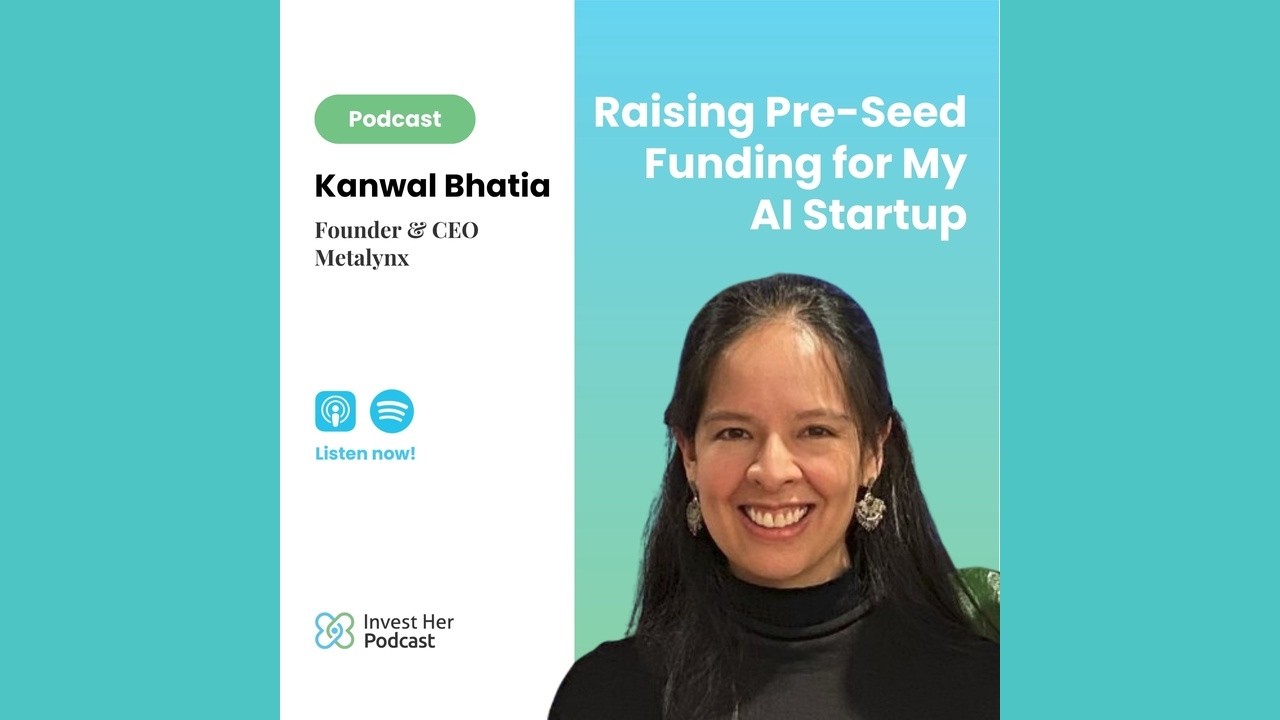
In episode 29 of the InvestHer Podcast, host Anne Ravanona interviews Kanwal Bhatia, founder and CEO of MetaLynx, an AI computer‑vision startup. Kanwal walks through the entire pre‑seed fundraising journey, starting with her entry into the Antler accelerator in March 2020, where she received an $80 K stipend for 10 % equity. She describes the early product concept, a co‑founder partnership formed during Antler, and a subsequent pivot to a different market problem after six months. When the co‑founder left just as investor interest was emerging, Kanwal continued solo, refining the prototype and rebuilding the team. She details her investor‑targeting process – initially scraping a 600‑slide deck of AI‑focused VCs, learning the importance of warm introductions, and eventually narrowing the list by stage, geography, and competitor overlap. The conversation covers the evolution of her pitch deck, which changed dramatically after feedback, and the distinction between decks for angels versus VCs. Funding milestones are outlined: a first term sheet after four months, a $200 K pre‑seed lead from a VC, followed by additional angel commitments that brought the round to over $500 K, closed in January 2024. The $80 K Antler money was spent on salaries to build a prototype; the pre‑seed capital funded a lean team (founder, full‑time developer, interns) and further product development. Kanwal shares practical advice – treat fundraising as a learning process, seek feedback from investors you don’t need money from, iterate the pitch, keep valuations realistic, and view funding as “fuel” for both the business and the founder’s network. The episode also touches on alternative financing such as crowdfunding, the time required to run a campaign, and the relevance of different crowdfunding models. Throughout, Anne reinforces key take‑aways for women founders and promotes the Global InvestHer funding newsletter.
Chapters
Welcome to episode 29 of InvestHer Podcast.
In this episode, you will hear from Kanwal Bhatia, who is the founder of Metalinks, an AI startup, and she's going to share her funding journey about how she raised her pre-seed round of funding through all the trials and tribulations, quite a few twists and turns. It's a very exciting one.
This episode is brought to you in partnership with Duen, The Dell Women Entrepreneurs Network from Dell Technologies.
We hope you'll enjoy it. Have a listen.
Investor Podcast is for you, the female founder who has a product, a service, or a message that you believe in and need to get funded. Or for you, the investor who wants to learn more about the huge untapped investment opportunity that gives you a higher return— women entrepreneurs. My name is Anne Ravanona. I'm an entrepreneur, TEDx speaker, and women's advocate. And I'm passionate about helping women entrepreneurs get funded. In each episode, we'll take a behind-the-scenes look into real-world funding tactics and strategies to help you get the funding you need faster. Let's put the fun into funding. Thanks for spending some time with me today. Now let's get started.
Welcome everybody. I am Anne Ravanona. I am founder and CEO of Global InvestHer and partner here inside Duen, helping Duen, working together hand in hand on building the funding hub. And today, I am delighted to come back to you with our webinar number 3 for our Duen members, and also to our Investor Podcast listeners. And today, we are delighted to be focusing on a really important topic. In our first 2 webinars, we were diving into what is funding 101, and then what are investors looking for. And today, we have a very special guest. And I want you to give a warm welcome to her. Please welcome Kanwal Bhatia from Metalinx. Hello, Kanwal, how are you?
Hi, Anne. Hi, everyone. Thanks for having me on.
So Kanwal kindly decided to talk to us. She is a member of the DWIN community, and today we are hanging out, having a chat, a funding conversation about her experience raising a pre-seed round for her startup. And so she's raised a good amount of money here in the UK, in Europe. And what I want to say is, even though you're hearing my Irish accent and Canwell and her British accent, all the, all the line— all the learnings you're going to get in this webinar are valid for all of you across the world because we know we have Duen sisters and Investress sisters all over the world. So you're all very, very welcome. I want to say to you, if you're live with us, Don't be afraid to put your questions in the chat box. I know some of you have sent in questions in advance, so that's great. We will be asking them, and continue to ask them live in the, in the chat box. So let's get started. Canuel, why don't you start by telling us a little bit about yourself in a few words and about Medialinx so we set the scene?
Sure, so I'm Canuel. I'm the founder of MetaLynx, and MetaLynx is an AI company working on AI tooling for visual applications. So we work in computer vision. And my personal background is in computer vision. I did a PhD in medical imaging and then worked in industry and in academia as well. And really, I decided to start this startup because while working in research and academia, you do a lot of interesting stuff, but it doesn't really have an impact on the world. So what I really wanted to do was to take that research and take those ideas and get them to a stage where they could innovate in the real world and actually make some impact. And I thought the best way to do that was through startups. So here I am quite some time later, I have to say. But yeah, getting going now. And yep, Metalinks, we closed our pre-seed round in January and Yeah, we've been, you know, using that money to build our product, hire more people, and start to become a proper— feel like a proper company then.
Yay!
Okay, so we're gonna— I'm literally, if you're watching me, I'm rolling up the sleeves. We're rolling up the sleeves, we're diving in. So we're gonna get in behind the scenes to Metalytics and your journey and the funding journey, Canwal. First of all, when did you start off? I want you to put on your rearview mirror and walk us through When you started Medallinx, how did you set up? With what kind of money did you kick it off? And then I'd like you to walk us through your funding journey step by step, and I'll pause and stop as you go along that journey to pull out some of the key learnings. That's what we're going to do first, everybody, just walk through her journey so that you can see, hey, she did it, you can do it too, because that's what this is about. So, Kanwal, tell us from the beginning, walk us through. When you set up Metalytics, how did you get started financially?
Yeah, so I actually started through a company generator, and that was March 2020. So I started in with this company generator, it's called Antler. No idea, no co-founder, just the idea that I wanted to build a startup. And they take people in at that stage, and then they take you through the program, and after 2 months, if they They believe in you and your vision, they invest in you at that stage. So it was a kind of a low-risk way for me to get started. They give you a stipend. I didn't have to prove anything before I went on. I joined the accelerator and it just gave me the time to focus without any other distractions on just building a company. So that's where I started. It was a bit of a, weird time because 2 weeks into that program, COVID hit and everyone went into lockdown. So it wasn't the predicted experience, but somehow we got through. And after 2 months, got the funding from Antler, which was again, just enough to get started. So it wasn't enough to start hiring or start building a company. It was just to get you off the ground and to kind of support you while you While you build and while you figure it out, really.
So remind everybody, so Antler, it's this, it's kind of an incubator accelerator in the UK, correct?
It actually has worldwide locations. So I did, I did it in London, but they have, they're global. So they have in Malaga, I think a couple of locations in the US and Canada and throughout Europe and Asia as well. I think they're growing quite fast and it's a similar program all throughout. You, they bring you on without any idea or any team and really starting from absolutely zero and give you the support to build a company. You still have to do it yourself, but they give you the framework in which to do so.
They set you up. So just a technical thing, Canwell, I think your mic is kind of banging off your lanyard a little bit because we're hearing a bit of interference. Thank you. I don't want to annoy our listeners, distract them from your important messages. Thank you so much. Okay, so when Antler invested in you, can you tell us, like, how much they invested in you for what percentage equity?
So they invested $80K for 10% of the company. And that, I mean, that might seem a lot, but it's really at a stage where you wouldn't get investment elsewhere because you're far too early. So you don't have enough proof to get investment from elsewhere. So you give up that chunk of equity because they're taking a bigger risk. For me, it worked out. For me, it was kind of like I needed that support to start. I felt I needed some, you know, some guarantee of cash flow just to get off the ground. So it made a lot of sense from my point of view.
And so, okay, so once you started and the program, so you've mentioned it was a 2-month program. It was a funky time because it was kind of hybrid. Therefore, you had to go online, all online because of COVID right?
Yeah, so it was supposed to be in person, and then obviously the same with everyone, you know, we all had to start working remotely. So it wasn't actually intentionally hybrid, but it was at a stage where nobody really knew how to interact very well online. So, you know, now we're doing these webinars, it's kind of second nature, but at that time it was like, how do we— how do I get my mic working? Do I have a webcam? So it was quite an interesting experience. Yeah.
And so tell us a bit more, because when you were at Antler, you found a co-founder, didn't you? Tell us about that part. So then, so you got your $80K, you've done your 2 months, and now what's, what's MetaLynx? What shape is it in at that point?
It's actually in a very different shape to where we are now. And I found a co-founder and we worked well together and we were actually working on a very different idea. We were working still in computer vision, but on a particular application. And then just the more work we did on it, the more we realized that this wasn't really right for us. It wasn't a company that we should be building. We were kind of building a company we would've liked, but that wasn't driven by market need. And so we basically pivoted quite dramatically to what we're doing now. And that was in January last year. So it took us 6 months or so to actually get to the point where we felt we were in the right area. And to me, that was one of the advantages of starting in a program like this. Like, I think everybody, every early-stage startup goes through some kind of pivot and just having that support to make those mistakes was quite useful from my point of view.
And I'm glad you're saying that. It is part of the startup journey, 'cause it's never what we think we're building is never what we build at the end, because we're always pivoting and, Trying to understand our customers, trying to test the product, and then get to the magic product-market fit. And that requires a lot of back and forward and pivoting. So, once you came out of Antler, then what happened? And how did you start continuing to raise money for your company?
Yeah, so basically, the Antler money gives you enough to support yourselves. to pay your own salaries, to pay for some basic office space. And then you have to kind of build a company that is investible and get money from elsewhere. So we started that, we started with this new direction in January last year, and it took us 6 months or so to get the first interest from VCs and from external investors. And at that stage, actually, my co-founder decided that this wasn't something he wanted to do for the rest of his life, or at least for the— intentionally for the next few years. And so he left. So it was—
Just when you're starting to look for the funding?
Yes, just when we're starting to get interest in funding. So we started in like maybe March last year. And then in the summer, we kind of started to get some Some term sheets, some people actually saying, yes, I want to invest in this company. And just as that happened, he decided to leave. Because I guess that's the point when you make the decision to commit or not.
You've got to commit.
Exactly. Investors putting money in, you have to decide, yes, this is what I want to do.
Which it's probably, with hindsight, I mean, how was that for you, Kanwal? That must have been pretty tricky, that moment. How did you feel when that situation happened? Because it does happen.
Yeah, I mean, it's, it's, it is, it is tricky. It is very difficult. And it's difficult because there's so much to do. And there's so much kind of, in a very small company, when there are 2 people, if one leaves, that's half the company, right?
Yeah.
It's something that has an impact, not just from an investor point of view, but from your day-to-day point of view, you have stuff to do and things that need to be done. So I don't, I don't remember having any kind of, kind of existential problems because it was just, I just needed to do things.
Too busy to have an existential problem.
Well, you know, we have to continue with the ways we have to do the admin, the legal work to do with his leaving. So many, so many things just started building up that it was, there wasn't really time to start saying, just stop feeling sorry for yourself or just start thinking about what I'm going to do with the company. It's just, you just have to get through day by day.
And so, and I think that's a good lesson. I mean, I'm sure there are so many of you Dwen members listening in, and, you know, please type in, put in the comments, because we want to see, we'd love to see your interaction, you know, comment what you're hearing and say, oh yes, that me too, or that happened, oh my gosh, how did you do it? Because we love to hear that live interaction if you're with us live. And so, okay, so You mentioned that you started then that on the journey, those first 6 months of fundraising. So explain that to us. So how, how, how much money did you raise then in that, in the, in the, during those 6 months? And how many investors did you start talking to? What kind of investors?
Yeah, so we, we started, um, you know, very shortly after we changed direction, we started talking to investors and You know, we have a background. So my background is in computer vision. We were building a product in computer vision. So there was a kind of, we had a clear idea of the product. So we had reason to believe that investors would invest in us at a pre-seed level.
Hmm.
So we just started talking to, you know, our favorite investors, the ones which were focused on AI and deep tech. And we didn't raise any money for a while. We had a lot of rejection in the first few months. It took us till about till the summer, so 3 or 4 months until we got our first interest and our first term sheets.
And so, so how, when you were targeting investors, how did you target them? Because I remember you were telling me that you talked to a certain type of investor first, and then you realized, okay, You kind of changed your strategy. So, so how did you target those investors? You said, okay, AI, I'm building an AI company, I want to talk to AI. So how did you find them? And where did you look for them?
Yeah, it was quite laborious. Like, we did actually search through, you know, I remember looking through a PowerPoint slide deck of 600 investors looking for the ones that said they they were interested in AI and contacting every one of those. So there was that kind of meticulous process of actually just doing the kind of boring work to get in touch with them, seeing who your contacts were, seeing if you had any mutual contacts. And unfortunately, having a warm intro is still useful in getting funding from VCs.
Mm-hmm.
Just trying to contact as many people as possible. Obviously, in a space like AI and deep tech, there are some kind of famous investors that have built a good reputation for themselves. And, you know, we just applied to them thinking that, you know, we were suitable for them at this stage. And I don't think we really had a strategy of how to approach or who to approach at what time.
Mm-hmm.
And that's something that I definitely In hindsight, we visit and do in a different order. Yeah, we had— we learned a lot through the fundraising process, and the pitch that we gave to our first investors is not the pitch that got us funding from our later investors.
So, okay, so let's unravel that a little bit, because it's very important what you're saying, a few things. Number one, what you learned through this first phase of the process was that it was super important to have— to build your list of investors, potential investors, but actually to have a strategy. So to not just go and contact anybody, you know, even just because they say they do AI, you need to make sure that you're the right stage for them, the right geography, you know, that they have not already invested in a similar portfolio company to your own. So there's that kind of level of homework that's Super important, just sharing with everybody to do. And we have a couple of questions coming in, so I wanna field them to you, Kanwal. So, Ladan, she wants to know, did you have your product ready at the time when you were raising this pre-seed? Did you have an MVP or was the product ready?
We had a prototype. So we had something, we had a demo that we could show. It wasn't a demo we could sell, but it was a prototype. we knew what it would look like. So we could demo a kind of a dataset that we had already prepared, but it wasn't live to be sold, wasn't ready to be sold.
And so Rebecca wants to know, how did you know which organizations or individuals to reach out for funding? So you mentioned you found this list, but how do you know? I mean, okay, you have a list of 600 people. How do you wade? How did you do that first selection?
Yeah, I think very much in the way that you described, you know, you look for VCs or investors who are interested in the stage of your company, the geography. We stayed basically in the UK. And competitors is a very important one that I think people overlook. If they've invested in a competing company, they won't— they may talk to you, but they won't invest in you. And that's the worst thing, that you actually have a conversation, but That was never leading anywhere.
Yeah.
So, you know, making sure you tick all those boxes, that's a way to kind of filter it down. It doesn't necessarily tell you who's going to be a good investor, though. Yes.
And I think that's— so that's for all of our DWIN members. That's something that I talked about in our webinar number 2. I'm going to be putting the links here for you. So we'll be picking that up as well. Yeah, because it's super important to really do your homework on the investor, because even in the fund, like, and this is to Rebecca's question, like, how do you target the individual as well? Because in a fund, you can have several partners and several investors, and you're like, okay, which one do you go for? So yes, you do need to kind of scout out the ones who are sector-specific to your sector, who are saying, yes, I invest in deep tech or whatever, because they tend to kind of out which startups they want to invest in and talk to by their area of expertise. So it's important to do that part of homework. So this is great. There's a few things coming through. So Anna wants to know, she says, thanks, super helpful. Did you see good results from cold emails versus spending time getting warm intros?
It really depended. So our lead investor was cold. We got that one just by applying to them off their website. But then we also had, once we had some investment, we had a lot of, a lot of our subsequent investors were warm intros through our investors, which is a, I think it's a really good way. If somebody says, I've put money into this company, you should take a look. That's a great recommendation because they've put their own money in. So mixture of both. If somebody's invested in you and they tell their friends, then their friends are much more likely to invest because they know that they put their money where their mouth is, really.
Yeah, so you're kind of talking about that, that's very typical in funding when you're fundraising, is that it's helpful to have a lead investor. So if you've got first someone, sometimes it's, you know, it's that person's going to take the lead and help round up more investors because, like, they're really behind you, they believe in you, they've put their money where their mouth is. And then they say, yeah, I'm gonna, I'm gonna try and rally the troops, get some more investors in. And why is it important to have a lead investor? It's also that when it comes to negotiating the term sheets, the contract that you have with those investors, it's helpful that you do all the conversation with the lead, and the lead then has the conversation with the others so that you're not like multiplying 50 conversations. That can also be a very useful part of the lead investor. And then If it comes to a point where you will have investors on your board once they have invested and you give them a board seat, if that's part of what you decide to do, then it's very important to have that lead investor because they say, okay, that's the person as well who's going to help share the information to the other investors. So that is important. I want to pull out another question from Ladan. She wants to know, thank you for your answer about the MVP. Would you be able to elaborate on How or who created your MVP? Because building that is a challenge if you're shorthanded. So you're on your own. So how did you build that MVP?
Yeah, I built it. It's a challenge. It's a challenge building a startup. You will have to do a lot of— you will have to wear multiple hats and do a lot of different things. You don't have to build an MVP that, as I said, our MVP could not be sold. It was enough to demonstrate what we were trying to do, to convey both to clients and to investors. And so you can build it like with low-code, no-code tools. An MVP doesn't have to be a working piece of software. It's, it's, I think that the term MVP is kind of overused because it has a different meaning at different stages.
Yes.
At the stage we were at, it was really, what am I trying to do? What is this product going to look like? And can I communicate that through some functional version that an investor can understand, that a client can understand, and that you can get really good feedback. So a client can look at it and say, yes, I would use this, or I think it doesn't quite work for what I'm trying to achieve and my goal. And then you can then decide what to actually build. So I think it has— yeah, the completeness of the MVP is is different at different stages.
I think that's super important, and thank you for sharing and reminding everybody there are lots of solutions out there that are non-code. You don't have to be a developer if you're not. I mean, remember, Kanwal has built a— she has built a deep tech company, right? So this is very much a tech company, you know, working on AI machine learning, and you were using, you know, non-coding products just for the MVP to get it up and running. So that's super important. Anna wants to know, when your co-founder left, how did you make the decision to move forward alone versus find another co-founder? Oh, I like that question.
I actually did try to find another co-founder, but it's also quite difficult because you're coming in at a stage where you've already got a plan, you've already got something, you know, that looks like a product. You kind of know where you're going to go. Bringing someone in as a co-founder, I think, isn't always that easy. So it's quite difficult to find that right person just because they're coming in a little bit later.
Yeah.
So it's— I don't think there's a right or wrong. It just depends on your situation and whether you can— you know, part of the reason I went into Antler in the first place was to find a co-founder, and because I'd struggled to do so outside. So I think it's just difficult to do, and you still have to get on with building your business. You can't stop to be a full-time recruiter, you just have to keep going.
Exactly, exactly. Ladan is saying, thank you, that's very useful and helpful to know. So that's good. Now, let's get back inside your funding journey. So you've got the first $80K for 10% equity from Antler, and you've been talking to A lot of investors. Tell us now then how much you raised. What was the next— when you had those first investors who were interested, first of all, what kind of investors were they? Were they angels or were they pre-seed venture capitalists? What are we talking about here?
Mix of both. So our lead investors are pre-seed VC, and then we have angels on board as well. So it's a mix. It took us a long time to get that first term sheet. But then once we got it, we had a lot more momentum and that kind of gave other people trust in us, I think.
So when you say a long time, how long roughly, if you kind of look backwards, how long was it from the time you got this MVP ready to getting that first term sheet signed?
I think it was about 4 months.
Yeah.
But then it took us a while longer to close the round because my co-founder left. So the first term sheet took about 4 months.
And how much were you raising for this round, Kanwal, for the pre-seed?
Yeah, so actually, we started by— well, our initial aim, you know, when we started fundraising in March was $600K. And then, we got a term sheet for $200K, and my co-founder left. And so, I kind of revised down my expectations and said, okay, $300K, stop. there, just get on with it. But it was actually quite interesting because once we, once we had that $200,000 and once we put that little bit more work in, we got a lot of interest.
Yeah.
So we kind of boosted it back up to $600,000. And okay, we didn't, we didn't go as far as $600,000, but we raised over $500,000 and then just let's stop. Let's Let's start building.
So that's interesting.
So you had set your sights on a target of 600 when you had a co-founder, and when he left, you said, oh, I have to kind of revise my target down a little bit. And then when you started to see the interest, oh no, I'll put it back up. Is that right? Have I understood that correctly?
Yeah, that's right. I'm not saying that's good, but it's worked.
No, it's just interesting. And I think that's— it's cool. So that you then, once you saw that you had that first investor of $200K and everybody was starting to bite, people were starting to get interested, that the confidence went back up and say, yeah, no, actually our round is $600K. You went back up to say, hey, I can do this by myself. And that's why I wanna say that and say, yes, Canwell, that's what it's about. That is the kudos and that is the chutzpah that you need to be an entrepreneur and just pick, dust yourself off and keep going. So that's really, really cool. So, so you've got £200K, and then between £200K to the, to the final £300K, how long did that take? And were they— what kind of investors were there? Were they with, like, were they from only UK as well, or were they from other countries?
Yeah, so this was, uh, so the first term sheets, like, in, in August of last year, and then, you know, co-founder issues, and then we closed the round in January. So actually just before Christmas, with the money coming in in January this year. So, it took a while. It did take some time. The other investors were all angels. And it was the case of, you know, one person invests, they tell people they know, and then it built up quite quickly.
So, I want to debunk a myth. So, when you say you close the round, like, when is the round closed is when the money's in the bank, correct? Yeah, that's, yeah, that's, and I think that's super important because like, how long did it take between the time roughly when you got the term sheet? So when they say, yes, I'm going to invest, and they put the money in the bank? This is super important practical information for everybody here to know, you know, how it works.
Yeah, so the term sheet is, it's just like one investor saying, I'm committing to putting this money in, and then you have to find the rest of it. So that was the first 200, and then I was supposed to find the rest, the other 100 or the other 300 in the end. And then once you have all the commitments, then you can kind of have your close, and then the money comes in, and then you can, you can actually ask for the money to come in. So we had all the commitments in December, just before Christmas.
Yeah.
And that's when we said, okay, now you can— now we're not waiting anymore. We're done. You can transfer the money. So the money only came in in January.
Yeah, so that's important just to remind everybody that it is, it is like the money, you don't, you don't, you're not funded until the money's in the bank, guys. The term sheets can be pulled. It's an important lesson in this funding journey, okay? Thankfully, it didn't happen with Canwell, and that's great. I know it has happened to other founders in the past, so just know that. It's important to know. We have a couple more questions coming through.
This is great.
So during this fundraising time, were you paying yourself for your time with that $800,000, sorry, with the $80K? Curious if you were drawing any salary or was all your funding going towards other resources? Good question, Catherine.
Yeah, so basically all of that funding was going towards salaries. As I said, $80K is not a lot, so you need to decide what you need to do to to get to the proof point for the next stage and how you want to spend the money. So, in our case, because I was building the product and the prototype, it made sense to spend it on salaries. And just to, I mean, you kind of also have to resource yourself, right? You don't wanna be stretched too thin as a founder because that doesn't do anyone any good.
What kind of founder salary do you usually see? I'm not asking you to tell us how much you paid yourself. I wouldn't do that. However, when you see, In general, what is the kind of range, salary range, do you see that founders kind of allow themselves to pay themselves what they're at this stage when you've got that first funding?
Yeah, so pre-seed is low. So $80K is basically, you're surviving, you're not living, you know, you're paying your expenses and nothing more. When you get pre-seed, you pay yourself a bit more, but I think basically anyone who's starting a startup can earn more outside.
I love it.
Yeah, you don't— at pre-seed, you're still not paying yourself close to what your market rate would be.
Okay, we've got some cool comments coming in here. So Barb is saying, I'm a founder who also lost a co-founder early, so I can appreciate your story. My issue is trying to make growth projections when I'm just a startup. Do you have any tips for making growth projections and financials attractive for investors but also realistic for a startup?
Ooh.
Nice. Yeah, I mean, I'm a bit skeptical about growth projections and financial projections at the pre-seed stage. And I think basically, they're a little bit made up. You don't know, you don't even know what you're doing. You're going to pivot for sure. And the growth projections, I think, are just a way to see that you can make some, you can put together a model.
Yeah.
That you have some sensible model, like, you know, you're not spending, you're not hiring 10 developers in your first year to build something, that you have a kind of sensible plan to get to the next stage. So what's your next stage? I want a prototype, I want a product that I can start selling. What do I need to get there? Is that one developer? Is that— what is it? I don't know what your particular businesses, but the actual growth projections and the fact that, like, my revenue is going to be whatever in 2 years' time is meaningless at this stage. I wouldn't— make a sensible plan, but I very much doubt they evaluate you on that particular thing.
I totally agree with you, Kanwal. I mean, at pre-seed stage and even seed stage, stage, everybody. Investors are interested in projections, let's say, 3 years, right? You don't— if you don't bother doing 5 years, even 3 years is a bit of a stretch, but 3 years is kind of the average. And they just— exactly as Kamil said, they just want to see that you know how to do the mechanics. And what's important is that when you do any kind of projections, you back them up with the assumptions. You say, this is our assumption behind this. So we're assuming we're going to get these customers, or we're assuming we're going to enter this market, or we're assuming we're going to hire this person at this So when you have your projections, what they're really interested in are your assumptions behind them and how you back them up. That's what the game is at this stage. They're not expecting solid financial projections, if you will, until you start getting to Series A, because by Series A, you should already have traction. You should be making some solid revenues up to about— up to $1 million a year. So, you know, they— then you've got figures. that are— that you can look backwards and therefore have much more sensible projections moving forward. So when you're at pre-seed and seed stage, you, yes, have rough projections. Most important are the assumptions behind it. Don't spend hours and hours. Don't hire a CFO to do tons and tons of projections. Pull in good people behind you to help you do those figures if you need, but just don't overthink it. Really, that's important. And I would also say for all our women founders, when you're asking for the the funding, how much you want to raise, don't go in and say, I want $2,531, because that's— I've seen it. I've seen like, or $200,051. I've seen those figures, or $500,000. You know, investors want to see kind of, yes, bigger figures, but it's like, don't give them the super detailed figure down to the last dollar and cents, or, you know, pound and cents. That's not how they think. Round it up, round it up, round it up. Okay, that's also an important tip when you're looking for the figure. So—
Sorry, Anne. Yeah, can I just add one thing?
Yes.
I think it's a very good process to go through, and your point about the assumptions being important, I think it's a really good— I think like building a business plan, building the financial models, a really good process for you as a founder to go through yourself. Not because you want that number in the end, but because you want to know what you need to know. You want to know exactly the assumptions, like what do I, what do I need to build this? Does this market actually exist? And by putting together things like business plans and financial models, you ask yourself those questions.
Yeah.
And going through that process, to me, I think it's more important than the actual number that you get out of it, which is always a little bit of a guesswork and it's not meaningful at this stage.
So true. And in fact, when we think about it, the pitch deck that you share and pitch to investors, it's a condensed form of your business plan. It's literally a slide for each of the key kind of chunks, the key parts of your business plan. So you need to have done that thinking in advance. It's super important. Very, very important.
The Lean—
yes, Daphne's reminding us the Lean Startup Business Model Canvas. Exactly. That's the way to do it. So, you know, don't go into— don't bother doing 40-page business plans. And please do not send 40-page business plans at pre-seed or seed level to investors. They don't need that. You need a— yes, a more detailed pitch deck. You don't need 40-page business plans. Keep it tight. Yeah. Keep it tight. Ladan is saying, generally, at pre-seed and seed stage, what is a good realistic amount to allocate for developers, yourself, and other key personnel?
This is so dependent on what you're building, and only you can answer that. This is something that— this is what you raise for, right? You decide what you need to build what you want to build and to enter the market you want to enter, and then you ask for that money. And that's, you do it that way around rather than allocating money and seeing where it fits. It's too dependent on your individual business.
Yeah, it's a good answer. I totally agree with you. And I want to come back into your funding journey and just kind of look now, now that you can look back, what were the key challenges that you faced? The things that challenged you the most about the funding process itself?
So I think I was quite naive in terms of the whole process, and I was also quite naive of where we were and how— and looking back, it seems ridiculous that you can think, okay, 3 months into the new idea, the new pivot direction, you can get funding and people are just going to throw money at you. It's kind of It sounds simple, but at the time, you know, you're still a startup founder, and there's a— what is the irrational optimism that a lot of startup founders have, that you think you can get money immediately. I learned a lot through the conversations with VCs and investors. And I think that's something that I really take away from the whole fundraising process, that it was challenging, Because they were challenging parts of the business that I hadn't thought about. And it was— I was too early, but I think you have to start too early. You have to start too early and then get feedback and then figure out why investors who, you know, generally are good investors and they've seen a lot of companies before, they've seen companies that succeed and companies that don't, and figure out why they don't like it and why they— why they're challenging you on certain ideas and use that to kind of improve your business and improve how you're looking at your own business model and plans. So I think it's good to start too early and it's good, but it's also good to be aware that you will need to take that feedback on board and use it to improve your company as well as your Financials.
Yeah, I think that's really good advice. And I think, like, if you— well, so when you started, it was just you. So now with the funding you've raised, how big is your team now? So that's also playing into the question we got there.
Yeah, it's still small. So for the time being, it's just me, a full-time developer, and an intern. Getting another couple of interns. So we have a software intern currently. We're getting another couple of business development interns. over the summer, and then in October we're going to hire some permanent hires. So we've kept it quite lean, we've kept it quite agile, and that's because we're still figuring things out. So it can be tempting, you know, once you've got a big chunk of money in the bank to go and spend it, but I think we were deliberately a little bit cautious in terms of making permanent hires because we're— when We're still pre-seed, we're still gonna pivot, we're still trying to find that wedge into the market that we need.
And so tell me more about the pitch decks, 'cause I remember it was when we were having our conversation beforehand, you were mentioning, okay, I had one version of my pitch and I said, okay, this is gonna be the pitch, one pitch for everybody, and that's grand. How did that work out for you? Tell us a bit more about the fun around the pitch deck and how that— what was that process like for you?
Yeah, so the pitch deck we raised money from is not the pitch deck we started with. It's a very different pitch deck. It has a totally different vision. I mean, we're still building the same thing. The pitch deck was totally different. It communicated a different message, a different vision. And I'm not talking about like the aesthetics of the deck. I'm talking about the actual content. And kind of who we are as a company, just because we had so much feedback when it was negative feedback, right? It was a lot of rejection and a lot of questioning about what is, why certain things would not work. And, you know, is your go-to-market strategy, what's your go-to-market strategy? Because this is a general strategy that will never work. And then you kind of think your first reaction is they don't know what they're talking about. And then you go and think about it a bit more.
Right.
Well, maybe they have a point. And then you adapt your company and you adapt your pitch deck. So it's— so to me, the pitch deck has kind of evolved. It's not that this is your one pitch deck and that's it. It's something that you have to keep going back to, keep improving, keep changing based on the feedback. And also, you know, you have different— if you're pitching to a VC, you might have a different pitch deck if you're pitching for an angel because they're looking for different things. They are kind of moved by different, but what's important to them is different and you should be adapting for your audience all the time.
Yeah, Lucinda is saying that she loves putting together pitch decks for her films 'cause she's a film director and she has a very detailed question that I'll try and get to at the end. Lucinda, I'm not ignoring you, I have seen it, it's just detailed and I wanna come back to it. She also does different decks depending on who's receiving it. I think that's very important. And also to realize, yeah, as you say, the deck you started out with is completely different. It's important to take on board advice. So having said that, you mentioned as well that you were getting a lot of advice from investors. How do you decide which advice to take on board and which advice to ignore? That's That's tough, that question. But yeah, how did you do that in this phase for yourself?
Yeah, that's a tough one because, you know, it wasn't— you can't take on board all the advice because a lot of the time it conflicts with each other. I mean, you have to make the decision in the end, but I think it's kind of okay if you have something that is being repeated by many people, then maybe you you should start to consider that that's something worthwhile to think about.
Yeah.
It also depends on, like, a VC will give you some advice or will challenge you on certain points because they want to see a business that can be backed by VC, which is different to the points that an angel may raise because they're not necessarily interested in returning, in having the same returns. But they want some.
Yeah.
So different people are going to give you different advice based on what they want as an investor. You still have to build the company you want to build. I think it's just you— it's important not to be too stubborn. I think it's important to kind of believe that your company will change.
Yeah.
It's still your decisions and still your kind of— you're building what you want, but it's never going to be what you thought it was like a month ago. It's always going to change with new information. And it should, it should do. The more information you have, the more it changes. But you're still the one that kind of gets all the information from everyone. So the person you're pitching to gets that one-time information from you. You're getting information from everybody, and you're the best person to collate that information and to see actually what makes sense and what doesn't. So I don't know if there's a particular way. I think you just have to kind of go with your instinct on it, and having heard many different opinions, and get many different opinions, you know, get it. I would say pitch to people you don't want investment from.
Yes.
To practice your pitch and to get feedback from them.
Yes, that's very important. That's very important because I remember when we were kind of talking before this conversation, you were saying that you'd gone to some of the top investors straight off and maybe when you weren't ready. You realized afterwards that when you weren't ready and then you were like saying, how was that? What exactly like happened? And then how did that make you change your strategy when it comes to then talking to investors moving forward?
Yeah, so we got good feedback from the investors. Good not being positive, but being, okay, there are flaws in your business model, your strategy is not gonna work. And the problem is that that's a one-time thing. So you basically cannot pitch to the same investor more than once at the same round. You will get feedback and then you will be expected to take that feedback on board for the next round. It's very hard to go back in the same round.
Yeah.
At least with VCs. So I would say, like, you know, expect that you are not going to have the best version of your pitch. early on. And I would, if I was doing it again, just delay those conversations with the kind of investors that I really wanted to get investment from till later in the process. So start by pitching to people you don't care about so much, and they can give you good feedback, and they will give you good feedback. I mean, I think just take as much feedback as possible and take it on board in a constructive way. and use that to improve your business and to improve your pitch, to learn more and get more information. And then once you get, you know, as I said, you're the one collating all the information, you can make those decisions about how you want to proceed, but it's always going to improve. The pitch we went to, we took to investors who gave us money, totally different. And looking back on it, you know, you can see it's kind of a child wrote the pitch at the start, and then it's more in line with the company at the end.
And I'm just going to share, like, some of the key tips that you're saying. I'm going to share the link here to some of the previous webinars we did in the DweN Funding Hub. So hold on a second, I'm sharing it now. So the first one we did was all about the funding game. So it's like, what is this funding? What it's all about? So that's where we share. That's where I explain exactly what Kanwal is saying. It's like, this is the game, you know, you need to be talking to— at certain stages, you need to talk to certain type of investors at certain stages. So, for example, at pre-seed, you need to be talking to namely angel investors who are private investors, individuals who have disposable income, and they can invest in startup. It's their own money. And then pre-seed venture capitalists, VCs. So pre-seed VCs— VCs, venture capitalists, are professional investors. They invest other people's money. They've gone, they've raised a lot of money, a huge pot of money. They may have put their own money into it, and then they go and invest it over 10 years. Okay, but they are looking for very different returns. They're usually looking for up to 10 times return on their investment, whatever they invest in you. So they're going to be there, and professional investors, this is all they do every single day. So when you're having a conversation with those guys, you've got to be polished, you've got to be ready. And you can be polished and ready because there's some great information in the Funding Hub and in the information that we share. So I've just shared the link to the Funding 101 that we have in the DWIN Funding Hub. And then also, Because we have a couple of questions coming up on the sources of funding. So let me just— I'm going to say, answer some of those questions. So some of the questions you sent in advance were, some funders and grantors won't fund businesses with less than $100,000 in revenue. Any idea why? Okay, so some— That's because they want to see traction. So I'm not sure whoever sent in that question. I want to say investors want to see some kind of traction. And sometimes it's not only revenue. It can be in the number of users. You could have a free product, but it could be exploding. You have loads and loads of users, and they want to see returning users. They want to see the number of users going up every single month, every month on month on month on month on month. That's a sign of traction. They want to see how long those users stay using your product, how often they come back. So even if you don't have revenue at that stage, you can show that. Kanwal, with your product, did you have a price tag on it when you launched the first version, or did you do a freemium model? What was your pricing strategy?
Free trial. So I would say, I mean, just to address that point, like, I think it also depends on if you're B2B or B2C, how much traction means. As I said, when we pitched for investment, we only had a prototype. We didn't have something that we could then sell to customers. So, and we were clear about that. This is what we are going to build if you give us the money to do so. But they need to have faith that you can build it. And I think what's important, if you don't have, and this is mainly for B2B, if you aren't able to build it and sell it before you pitch, before you go out to raise money, you need to show some level of interest from the market. Like, who have you talked to? What have they said? How have you— what evidence have you got that this is going to be something that people are going to buy? So maybe that you have a letter of intent. Maybe you just have some quotes saying that this is a huge problem. Like, what is your proof that this Could achieve some return in the future, even if you don't have money right now.
Exactly. And so we're getting a couple of questions around crowdfunding, and I want to— so I've shared the second link I've shared with you is about the second webinar we did around the different sources of funding. So that was to help you understand All the different sources of funding that are available in the funding menu, right? So crowdfunding, we have a couple of questions coming up. One of them, Catherine wants to know, what is your advice on crowdfunding? Is it good to use or is it not worth the trouble? What's your take on that, Kanwal?
I think it just depends on what you're building. Just to add one thing on to the question about the $100K revenue, you may possibly be looking at the wrong investors. At that point, you're looking for later-stage investors when you could be looking at angels or crowdfunding, perhaps. Crowdfunding, I think it's good. I think it's much better for B2C products than for B2B, because you're kind of— I think whoever you get money from, they should somehow be invested in what you're doing. They should care about what you're building. So if you're building a consumer product, crowdfunding might be a really good source there, because you're telling Customers, you know, this is what I'm building, are you interested? And if they're interested, they put a little bit of money in, that's great. You have your— you've surveyed your customers in a way by them giving you money, which is—
It is, it's totally like crowdfunding. Like, there are different types of crowdfunding, first of all, okay? It's not all one type. That's the first thing to say. You've got— you have reward-based crowdfunding where, you know, somebody will give you money and you'll give them a reward. It could be a product, it could be a t-shirt, it could be a service or an experience of part of what you're doing. You have donation-based crowdfunding where it's like you're raising money for a cause or you may be a nonprofit and that's where you're looking for donations that you're not going to return, you're not going to give back either. And then we have equity-based crowdfunding, and equity-based is where you can give a part of your company, so shares, equity in your company, and raise money through crowdfunding. So I want to share the good news is that in the Dell Hub you also have a course that we've done on crowdfunding. So we explain crowdfunding 101 if you have questions questions about it and you want to understand what the hell is this crowdfunding, is it right for me, when should I do it, is it worth the bother, exactly your questions that you asked here. It's a tough one because what I would just say to you is you need to understand what is your objective. Crowdfunding takes a lot of time. Just so you know, I'm going to condense it. The key tip is it takes about 3 months minimum to prepare a crowdfunding campaign. So if you think it's just about creating a funky video, sticking it on a crowdfunding website, and then sending a couple of emails and you raise a million or whatever, loads of money, wake-up call! Smell the coffee, smell the water. It's not like that. So, you know, you need to kind of to learn more about it. So check out that course. And to your point, Canwell, I think it's more crowdfunding can be more adapted to consumer-based businesses or services because it is a great way of getting marketing out because you're building your tribe and you're bringing your community to it and you're building your tribe and you're testing the reaction to your product and you can kind of do pre-sales as well through that crowdfunding campaign. So there can be some great ways and reasons for you to do it. So check out the links that I've shared as well in it. And yeah, Sarah is saying the crowdfunding platforms take a lot of money. So they do take a percentage of the raise, you know, and on average, if it's an equity-based crowdfunding platform, they can take up to 5% of how much you've raised. That's quite a bit of money, you know, so you need to know that. Lucinda's saying she's done both. She's done so many of them, both successful and unsuccessful. She prefers to stay away from them now if she can help it because they're so time-consuming. See, thank you for sharing that, Lucinda. They can be very time-consuming. And you can get organized and it's— you can do it. Just know that it's a minimum 3 months preparation, okay, to actually do a proper crowdfunding campaign. It's not then when you stick it on, make it go live, and then you do nothing. There's a lot more work also that happens once you go live. So just to say, um, so I'm just looking at some of the questions. Approximately how long did it take to get the funds you needed to start your company? How much funding did you have before launching? So You've mentioned that. So before you started, you had nothing, and you had $80K then when you went through, through Antler. What would be your key tips, Kanwal, now that you've been through this first round of funding? I want us to wrap up because we're coming to the close. What would be your key tips to the DWIN members, the Investor Sisters, and to anybody listening on raising money?
Yeah, so I kind of Having been through it and my position now is that I view the fundraising process as really part of the kind of company building process, part of learning about your company, part of adapting your company to be a better company, to be a more successful company. I think when I started, I kind of viewed it, okay, I need money and that's what fundraising was about. And on the side, well, I build my company and then I get money in as 2 separate things, but I think they're very related. And I think I think it really helps to view them as part of creating a much better company because you're creating, you're starting from zero, you're starting from nothing, and you need to build this company. So use the fundraising process as a way to learn about the strengths, the weaknesses of your company and adapt. And, you know, I feel that where we were once we started to get term sheets was very much influenced by the feedback we were getting. And like I said, pitch to people you don't want money from. Pitch to people, get feedback from people who have been in the game. They have good— they have interesting things to say. They know about the field. Get feedback because you want feedback from a company perspective, not just from a financial perspective. And, you know, expect to get it wrong at the start. Expect to make mistakes. Hold off on your best— on your perfect investors. Don't go to them straight away. Yeah, just, I think, view it as a kind of growing process, both for your pitch, but also for the company itself.
I love that. I think that is golden advice to all our listeners and our viewers. That's golden advice, Canwell. Like, view it as a learning opportunity that you're learning and building and iterating as you go along, and it's part and parcel of the whole journey of being a founder. Yeah, and it's not inextricable, and it is also going to help you make your business better because it's so important, the mindset that to have when you go into the fundraising process. Like, you're able to share that now because it's your nugget of wisdom, Canwell, because you've you've been through that first phase of the process. And if those of you haven't been through it yet, you know, kind of look at it from, okay, the mindset is, I'm gonna do this, I can do it. And it's gonna make my business better, it's gonna give me fuel. And I like you to kind of use the catchphrase, funding is fuel. Just think of it as funding is fuel for your business, but it's also fuel for your mind, fuel for your connections, and you're building more business partners with those investors. If you have— we have lots of other questions also around like what's happening, the forecast for getting seed and Series A at the moment in today's times. I won't have time to go into it now, but I want to share— I'm sharing a link in the chat box to any of you who are interested. You can sign up. We have a free newsletter every week at Global InvestHer. a funding newsletter, and all the information is about investors, founders who've raised funding, everything to do— it's all women founders from around the world, women investors, and new funds that are funding women and women entrepreneurs. So if you want to know anything about funding women entrepreneurs and the founders who've raised money, the women founders, see other people in your industry, or check out competitors, sign up for our weekly newsletter.
It's free.
You have the link there in the chat box. Kanwal, any last message to our listeners today? Your last message to help them be boosted on their funding journeys?
I'd just say good luck, enjoy the process, like learn from it, and also, you know, have faith in yourself that you can do it. You know, I changed my valuation just after, like, a lack of confidence, but Yeah, just really believe that you can do it, but also just take feedback as constructive. And yeah, good luck and enjoy the process. I wouldn't be doing anything different. I would— I can't imagine myself doing something else now that I'm on this journey.
Oh, see, that's— thank you for ending on that very positive and uplifting note, Kanwal. Thank you so much for your time. Thank you everybody for joining us live. If you have any last— not questions, but any feedback to Kamal on her story, thank you, just pop it in the chat box now. It's always nice to hear. So Sandra says, thank you for sharing your story. So does Robin. Thank you for a very informative webinar. Will there be a recording? Yes, April, you'll hear that you'll get it in Duen on InvestHer podcast on Apple and everywhere. We will be sharing it. And everybody's saying thank you for a great webinar. Thank you so much, Canwell, for your time and for sharing your nuggets of wisdom. And thank you all for being with us live today. Oh, so good. Thank you, Lucinda. 3 AM in Australia. Oh my gosh, go to sleep. Thank you, Lucinda, for joining us, and we are so happy you were with us. Ruth says thank you, excellent presentation. And so does Germaine, says thank you. Thank you, everybody. Enjoy this recording. You'll hear it again in Dwen. And on Investor Podcast. And thank you, Campbell. Thank you, everybody.
Thank you for listening to Investor Podcast. Don't miss more great funding tips and insights by subscribing to the podcast on Apple or your favorite podcast host. And while you're there, I'd love you to rate and review the show. We'd love to hear from you. So if you'd like to send in some questions, interact with our guests, or suggest other great people we should feature, join our community Join the community on the Flick InvestHer group or send us a message on investherpodcast.com. Want more great resources for female founders about funding? Check out our InvestHer Academy at academy.globalinvesther.com. I'm Anne Ravanona and look forward to having you with us again for our next episode. Let's put the fun into funding and get more women entrepreneurs funded.
More from Anne



🎙️ EP69: Get Off the Fence: Renate Crollini's Startup Blueprint | InvestHer Podcast

🎙️ EP68: Radical Truth: Robert Rubinstein Exposes the Impact Investing Illusion | InvestHer Podcast



🎙️ EP66: Global Sisterhood — Carine de Meyere on Trade Missions | InvestHer Podcast



🎙️ EP65: Capital With a Conscience: Pierre Norman Rolin on Investing in Women… | InvestHer Podcast

🎙️ EP64: Dream Bigger: Nikki Barua on Building an AI-Native Company Without… | InvestHer Podcast