🎙️ EP30 - Accelerating pre-seed pan African Startups with Mope Abudu, General… | InvestHer Podcast
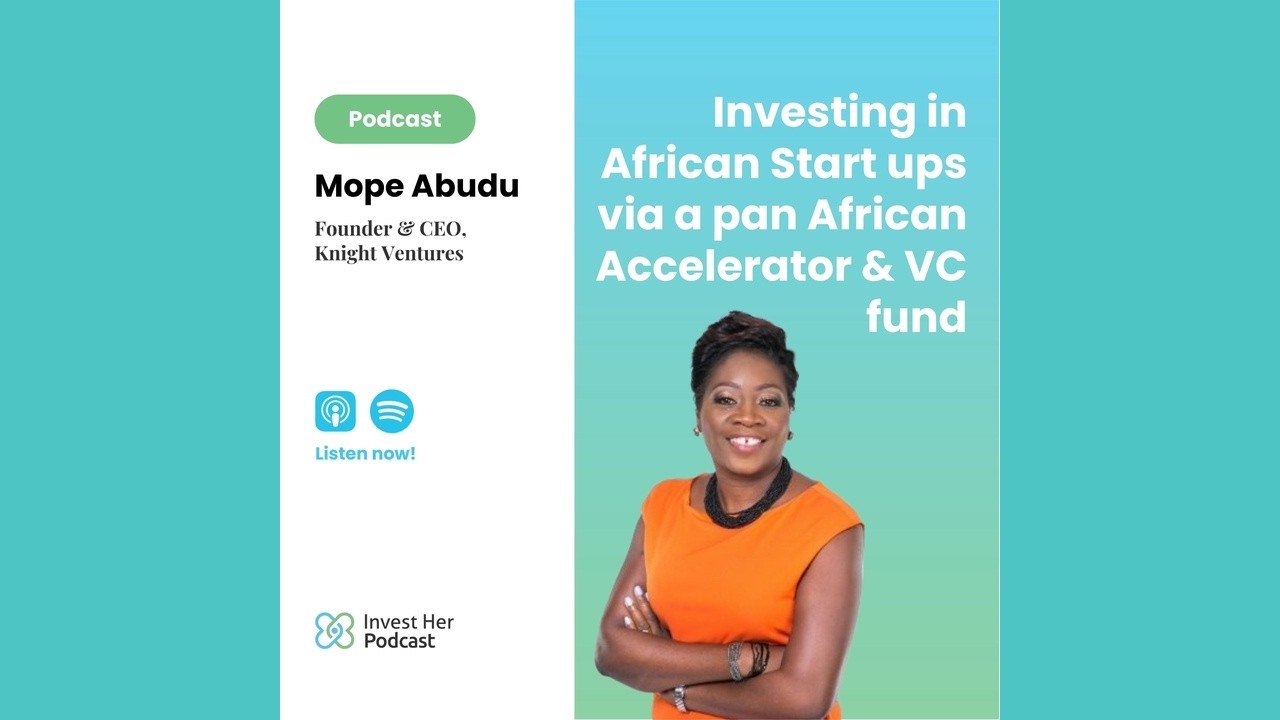
Mope Abudu runs Knight Ventures, a pan-African accelerator offering a three-month program with a street-MBA curriculum and market validation. Her AfriGlobal VC fund targets $10 million to make 40 pre-seed deals of $25-100k each. About half the accelerator's founders are women, but she stresses the need for more women investors and founders to build networks and push harder.
Chapters
Welcome to the latest episode of InvestHer Podcast. And this week, I'm really delighted to introduce you to Mope Abudu, who is founder and CEO of Knight Ventures, the Pan-African accelerator that is helping early-stage pre-seed companies in Africa and Western Africa in particular to get off the ground and to get to the next level. What's interesting about Mope and her journey as a VC of one of the only women VCs in Africa is that she decided to first create an accelerator, and then go on to create her own VC fund that she's currently in the process of finalizing to be able to invest in the companies that she accelerates. So it's an interesting model. And in this funding conversation, you're going to learn more about the state of funding in Africa, in particular, what needs to change, what's happening in angel investing, in venture funding. It's a really, really interesting round-the-world tour of what's, what's going on to give you some more insights into the African funding ecosystem. I hope you really enjoyed this episode as much as I did having this conversation with Mopit. Investor Podcast is for you, the female founder who has a product, a service, or a message that you believe in and need to get funded, or for you, the investor who wants to learn more about the huge untapped investment opportunity that gives you a higher return— women entrepreneurs. My name is Anne Ravanona. I'm an entrepreneur, TEDx speaker, and women's advocate, and I'm passionate about helping women entrepreneurs get funded. In each episode, we'll take a behind-the-scenes look into real-world funding tactics and strategies to help you get the funding you need faster. Let's put the fun into funding. Thanks for spending some time with me today. Now let's get started. So welcome everybody to this week's funding conversation. I am so happy to welcome you here. I am your host, Anne Ravanona, from Global InvestHer, and our guest today is Mope Abudu, and she is coming from Knight Ventures in Africa, in Nigeria to be precise, Welcome, Mope.
Thank you so much, Anne, and to the attendees, a warm welcome. Thanks for signing up. It's going to be a great conversation and looking forward to, you know, learning and sharing on experience.
Exactly. Thank you, Mope. And I think what's important to say for those of you joining us live, please feel free to say hi in the chat box and put any questions you have for Mope. I will be looking there and I will be making sure that we ask them on top of the ones that I have prepared. for her. And, you know, make sure that this is, this is a really good conversation, you get the maximum out of, out of your time with us. So also, for those of you listening back on the podcast, you can check the show notes to hear and to see the links to some of the great resources that we're going to be saying live. So I love it. Loads of people saying thrilled to be here. So let's get started. So Muppet, tell us a little bit about you and how you became a VC. Let's start there, because it's always interesting to learn about you. And it's to kind of— this is part of us demystifying what investors are really like. You're human. Oh, you know, human.
Thank you so much for that question, Anne. And I think really, it's so important that we demystify what seems to be so obscure. So yes, I am human, I do have feelings and emotions. But I think it's also very important that you choose a path which resonates in terms of how you want to feel fulfilled. And how did I get into VC? Well, my background is in finance. Yes, I love numbers. I love, you know, crunching them. But I think very early on in my career, I found the numbers in itself were not really the solution. It was what it was telling you, what's the story behind it? How do you actually make it become something that has a bigger impact, bigger picture, and that was really where I got more fulfillment. So I remember in my earlier days, finance used to have 2 sides. You either moved to more of the audit, which was more the accountants with the stick and tell you you didn't do this or you didn't do that, or more on the management side, which was more futuristic, which was more how, you know, how would you change things and how would you make businesses become a whole lot more impactful and You know, obviously get more money. So my background in finance kind of influenced most of my career opportunities. I was opportune to work in three different continents: in the U.S., the U.K., and Africa, and Nigeria specifically. And I worked with a lot of businesses who had a lot of innovation in terms of solutions, and the financial institutions in particular. I was headhunted back into Nigeria, into UBA in the early two thousand. And then moved more into advisory. And I think advisory is such a good platform where you get to work with founders, entrepreneurs who are dreaming big, but sometimes don't have the tenacity or the structure or the wherewithal to actually transcend that dream into reality. So I did quite a lot of work in terms of making businesses become more structured, institutionalized, so to speak. And then obviously capital was always a very, very important part of the puzzle. which we're trying to put together. So having worked with a lot of businesses, both in my advisory function and then of late in the accelerator, it became obvious that we needed to also fix the issue of you need capital to make everything work together. And that really has been the force behind why I've actually moved into venture capital.
I love it. And I love the way you describe your your journey, because there are many, many paths to become a venture capitalist, aren't there? And I think it's important. Yes, you are from finance and you've crunched the numbers. What I'm hearing really clearly is that, like, you're passionate about people, projects, getting them to the next stage and innovation. And that's what's propelled you now into this next phase. And as we move into more detail, I always think it's nice to kind of start this part off as well to share maybe one fun fact about you. So again, to know you, the human. Behind the VC.
Well, it's true, to be honest. People who love numbers normally seem to be very boring and very nerdy, so to speak. You know, you just look at numbers all day. So yes, you do have to be a human person. I am a party pooper. You know, I love to dance. I get carried away sometimes when the music is really, really great. I constantly try and compete with the younger folk when it comes to dancing. scene and the rest. But I guess it's even a stress reliever as well. So I think it's just good. But when I hear music, I hear different things. I'm able to dissect the actual instrument that is being played. It's more than just the lyrics. It's like really pinpointing it. So I think I do a bit more business analyzing of the music as well. So it's interesting. Like, that's the trombone, or that's the drum, that's the guitar, the bass guitar. Yeah. So— So you've got a—
You've got a superpower in your hearing, which I'm guessing if we bring that and bring that to kind of funding startups, I'm guessing that you— that makes you a very good listener and a very good person who understands a business thanks to that super hearing power. I'm just making a guess.
It's a skill that really comes in very handy, especially when you want to see what's behind the scenes, you know, sometimes.
Exactly. Okay, so now we know a little bit more about you, and let's dive more into Knight Ventures. So tell us about the accelerator, how you set it up, and the why. Let's start there before going deeper into the criteria of the type of startups that you, that you're looking for.
Yeah, um, I think generally, um, the accelerator idea was birthed out of necessity.
Mm-hmm.
And the word accelerator sometimes is very loosely used. It just seems to be, oh, that's, that's the next fad. But in reality, the accelerator is just like the word. It's meant to be a platform that really, really moves you from where you are, where you might have just been strolling, into an accelerated, you know, growth. And growth comes with its own challenges. It's no more just about a great idea. It's about transforming that idea. And there are a whole lot of other skills that are really, really, really needed to be able to, you know, accelerate that. So having worked with great founders, you know, in different industries in Nigeria, I must say that there is no dearth of great ideas. What we have is the dearth of these ideas becoming, you know, great businesses and, and, you know, really being sustainable in terms of their growth and impact, as well as the returns. So the accelerator was birthed out of the need to support founders in some of the market, specifically the product-market fit. And I think what we, what we try to do is to give what I call the street MBA at the accelerator.
Yeah.
So it's time to roll up your sleeves. It's time to really, really see how you're going to transform and make this a success. And what is key about the word business is that you are providing a service or a product for which people are ready to pay for, not once, but consistently. So defining your business, to a stage where you have a market, you can penetrate that market deeper, you can continually innovate and keep them as your loyalists, willing to part with money at a price that is very competitive to make sure you are making a profit. And also able to attract the other stakeholders, which are the investors, who will then fulfill that need to continue to grow in terms of your your geography or your expansion plans, and, you know, continually move forward. So the accelerator for me is a necessity when it comes to the, you know, the African terrain. We have so much that we're blessed with in Africa, and we just need to commercialize these opportunities into a very, very, very good position where we become leaders in the different sectors that we're in.
I love it. And I, I love the way you say that you're— you provide like the street MBA, because like we know that African founders are so savvy, you know, you know, you sometimes they have access to fewer resources, so they got to be smarter. And so I think that's a real strength of African entrepreneurs in general. And so I think it's great that you kind of harness and say, okay, we know we're good at that. Let's be even more scrappy. Let's harness that and take you to the next level and give you this, you know, built-in the support around you to help you succeed. So can you tell us a little bit more then about the criteria? Like, first of all, which— let's maybe the geography even. So which startups from which geographies do you want in your accelerator? How long is the program? And then the criteria to get in.
Well, the accelerator is intentionally on a digital platform so that we can be pan-African.
Yeah.
And the geography in terms of being pan-African was because there are a lot of synergies that can actually be, you know, harnessed if, you know, businesses or founders within different African countries can actually collaborate in terms of their expansions, in terms of learning the markets that they want to get into. So It provides a platform where you can co-discuss and even see possibilities beyond that. Now, in terms of the criteria, beyond the theoretical criteria, which is obviously have what we would call the MVP, which is meaning at least have an idea that is in some states where you can actually prove, not just the idea.
Mm-hmm.
We do also say that you should You could have pre, you know, pre-money, maybe not yet profit, but at least you've actually been able to test that idea. We are quite bullish on the founding team. Either the founding team is co-founded by 2 people, or if it's a single person, actually has a team that is actually supporting. But I'll tell you why the team is very important. Entrepreneurship is not a sprint. It's a long haul.
Yeah.
And it's even more difficult when you are building. You're not just, you know, reaping the benefits. So there will be times when you really feel like throwing in the towel. But we need to make sure that you have a team that can address different areas. So what we look for is, does someone carry the hat of the technical aspect? Does someone also carry the business aspect? Because not all technical people are very good orators when it comes to selling the product to the market. And if you can't sell the product, then you almost have, you know, you're stuck with just an idea. So we try and see that there's a balance there. And when we are selecting our— we have one-on-ones where we can actually see if that is there. And we also try and test the tenacity, and that tenacity can be evidenced in different prior engagements to see, are they really going to be able to go the whole haul with it? Because I will tell you my experience, we've seen a few vendors who actually resigned from their own business at the end of the day, you know.
Wow.
Which is unfortunate. So you kind of want to make sure that, you know, people who want to say— who want to accelerate their business are really ready to be there for the long haul. And then most importantly, we try and see the viability, you know, the viability of the business to attract investments. That means, is it a product that can be leveraged, that can use technology for scale, that can attract investments both locally and internationally? We don't want to be very short-sighted to just say only mom-and-pop, you know, businesses in terms of investments. We want to attract global investors as well. So we look at that potentially.
Yeah, and I think you're raising the key points that are super important for any startup to join an accelerator. But I love the point that you're making around the tenacity, because that's some— and it's good that you kind of try and test that in the one-to-ones before they come on board. Because as you say, I love it. It's so good you remind us that entrepreneurship is a sprint. Sorry, it's not a sprint. It's a marathon.
Not sprint.
Yeah, it's not a sprint. It's a marathon. And you've got to have that tenacity. You've got to have that grit to go the long haul. It's not easy. So Because it's an online accelerator, Mope, how long is it? How long does it last? And tell us a little bit more about the— I don't know if you have the components of the accelerator and if you've got particular type of mentors or also particular type of sectors that you tend to focus on or not.
Yes, one of the key criteria, and I tried to mention that, but maybe I didn't deliver on it is where the accelerator is sector agnostic. However, there must be an element, a very visible element of technology being the engine for scalability.
Yes.
And the adoption of technology is really key for any founder who is thinking of making an impact. And that's just the name of the game.
Yeah.
But what's also very important is during the accelerator, we start first of all with a little bit of education, and the education is not really what you would probably get from a typical school. It is applying it to your business. So you're going to have tasks that would actually encourage you to have milestones from your business with the education that you have. And that's really setting the standard in terms of, oh, you may have thought you were at a particular point, but when you are exposed to the level of detail that you need to put in at a particular stage, and it's very fast-paced because the whole curriculum is roughly about 3 months, and then afterwards we would continue to support you. But the 3 months is the timeframe for the accelerator. And then we move to what is called the boots on the ground. And this is when you actually leave your comfort seat and you go out there. We actively believe that partnerships, value chain individuals are key to the acceleration of the business. These linkages provide you a platform to test your venture proposition, the value proposition that you claim to be offering. of, you know, so great importance. Your customer base, you're actually able to do that. So the boots on the ground aspect is really you going out there, developing a product-market fit, creating the customer base, developing and penetrating the market much more deeply, understanding that your customers have a choice in terms of competition. It's also understanding how you could be better than the competition that is probably holding more of the market share. And this is a very hands-on, out-of-comfort-zone kind of aspect. We do give a lot of milestones which need to be reached, which will stretch you, and it prepares you for what it takes to, you know, really, really run at 10 times faster. And if you think that's difficult, when investors come in and are giving expectations in terms of the kind of returns, you really just need to buckle up your shoes and move fast. So the Acceleration prepares you right up to the part where you would have to present yourself to investors on the investor platform. And that's when you have to talk about your traction. If you don't have traction, investors are really not going to just want a story. Investors only think about what were your results, what did you do, what are you proposing to give in so-so number of time, and you need to have some of these figures, you know, at your fingertips.
And do startups— so do you take any equity at that stage, at the accelerator stage, and/or do startups need to pay to be part of your program? What's your model? Because, you know, we see a lot of different versions of accelerators.
Yes, there are so many different versions. And I will say, for one, what we have chosen to do is at the very beginning of the acceleration, we do inform them that there is a— I would like to call it a token fee that will be paid for the acceleration.
Yeah.
But it's to get the founders to understand that you do need to make some investments on your own hand as well in order to get ahead.
Yeah.
We do not provide investments at the beginning of the acceleration. But at the end, you are in a very good position if you're able to finish the accelerator because it doesn't— it's not automatic. that you'll be able to finish because there are certain milestones that need to be achieved. And if you're able to get there, you stand a very good opportunity of actually being presented to our investor network or being invested in through the vehicle of our venture capital fund, which is the Africa Global VC, as long as inviting other— venture capital firms who would be interested if the thesis aligns with their own as well. Now, being able to present yourself to investors provides you an opportunity for 2 things: capital mentorship and access to markets as well. And I think what we need to get founders to understand is that throwing money at a problem is not really the solution. You probably need the money and the network as well. So we— the network sometimes could even be a whole lot more impactful than just the capital. And what we've realized is that some businesses are not even really ready to access the capital because it comes with its own expectations as well.
So I'm seeing there's quite a few questions coming through, and I want to kind of reissue— Mark Zorro has $50 million. So Mark, I will be sharing all your questions with Mope afterwards because you have so many, just to— just because I want to manage your expectations. We won't get to all of them here. And I also just to— Who's also sent in questions, we will be— we will be— I'll be asking those just after this next section because I want Mope to explain now about her VC fund. But before we get there, I was particularly interested when you were saying, given that you're Pan-African, how many startups do you have in a cohort? How does that work? And that was my first question. The second one linked to that is when you said that you connect your startups from the different countries to see how they can, you know, maybe have access to markets, maybe share information, do cross-market research, etc. So yeah, maybe answer those 2 questions.
To be honest, to do a good job, you need to be able to dedicate time. and have a lot of resources to support. So our cohorts are normally in the size of 10 presently.
Yeah.
And to get to the 10, it's a very, very detailed analysis of the applicants to ensure, you know, they meet all the expectations of, you know, and our criteria. But for everyone who doesn't get in, it's not a castaway, because we do have quite a few opportunities to actually just either send them to mentors who may just be able to provide immediate support, or if it means that they need to kind of work a little bit on their pitches in terms of how they presented themselves, our incubation, which is more of a generalist platform can also serve them as well. And then we will always have quite a lot of coffee days where they're able to interact and learn from other peers as well. But we do intend to increase the size of the accelerator as we are growing, but intentionally want to make sure that we're able to give them the time, the expert advice, the office hours, the boots on the ground, which is very, very intense. And, you know, be able to ensure that their successes are more or less guaranteed after the program.
And how many cohorts do you run a year, Mope? Is it like 1 or 2? Is it a spring, summer, autumn, fall, or is it 1? How does it work?
For now, for now, we're going to run 3, and that's also because we've also realized It's good to balance hard work with a bit of— take some time off. So we do find that sometimes in the summer, attentions are a little bit diverted.
Very elegantly put, yes.
And it's better to come back refreshed and re-energized to make sure that you're okay. So for now, we're going to be running about 3, but there are thoughts that we may be having some kind of sprints, which are probably not the full 3 months, but that will be unveiled as time goes on, which will be more, you know, short but very impactful kind of sprints, you know, and a bit more specific in those areas.
Brilliant. So now that we have a good view of the accelerator, tell us more about your fund, about AfriGlocal, because so you, you have the accelerator and then you explained that you you will invite investors to invest in those startups at the end of the process. And then that you could potentially also invest as part of your own fund alongside some of those investors. So tell us more.
Yeah, and I think this is where the excitement really sets in. Venture capital is a new— not really new, but it's definitely getting a whole lot more attention, particularly on the African continent as an asset class that really is serving a key purpose. And venture capital in Africa is really meant to support that, or be a bridge between moving away from just, you know, your angels or just your, your close network. And then, you know, getting to the bigger players in terms of maybe the private equity. So there's always been that gap, which hasn't been solved successfully by the commercial banks. It's a mismatch of capital to, to the needs, and hasn't always had a very successful story. So venture capital is, you know, a mix of handholding, bridging, and also providing these businesses an opportunity to, to see the bigger picture that they're getting into. Now, we decided that we wanted to play in the venture capital for, you know, a number of reasons. One, as a woman, I've also been quite frustrated when I've seen beautiful businesses not accessing the capital that they should have for one reason or the other. And, you know, this has been quite a, you know, painful situation. And it's important that we have more representation to be able to showcase businesses that have the potentials and can probably even do better than some of the ones that are there. So that's, that's, that's one key aspect. But second of all, we also want to ensure that we have a multiplier effect across Africa, even though our focus initially is on the West African area. We, we are seeing opportunities across. Venture capital brings an opportunity of the whole ecosystem to play in the African rising mantra that I say. So it's not just about the founders coming up with ideas, it's about the local Africans also partaking in the growth of these businesses. And, you know, it's my dream to see more Africans taking active, you know, active steps to invest in these businesses that are African in terms of their nature and African in terms of their reach. But I dare say that also requires a bit of education on the investment side. But that really is critical towards it. And then maybe from— you could tell from our name, Afriglobal, we are extremely proud of our local talent, our local businesses. We want to showcase to the world that what is local has a global reach and can actually impact established businesses, established countries and continents and economies in terms of what we have to offer as well. So venture capital is an opportunity and an engine to move away from just the bootstrapping opportunity to a class where you can attract funding across the countries within Africa and beyond as well.
And so what is the size of your fund? I believe you're currently raising, and so if you want to kind of just— what size fund are you building?
Well, we're starting in between. We're roughly just under 10. But what we've also realized is that venture funding is a continuous process.
Yeah.
Each fund is aligned to a particular deal flow that have already been, you know, set up. once that has been deployed, you can move on to the next fund as well.
Yeah.
And what is very interesting is even with the fund being deployed, you can start lining up follow-on funding in terms of those who are playing more at the seed level. We are more at the pre-seed level. seed. And just for the audience to, to expound on the pre-seed, it's really that point where they are moving to a stage where the business can become profitable, you know. So we're actually making sure that, you know, their product-market fit is agreed, and they are then able to start earning revenue and profits as well. And that pre-seed is really where most of our African ventures find themselves in.
Okay, so that's interesting. So that's super interesting. So you're a very early-stage VC fund. So you are one of the very rare ones. I totally agree. There are not many who focus on pre-seed areas, so that, that stage. So that's really exciting to hear. And in the fund, do you have any particular verticals that you're more interested in? Or, or not?
Well, you know, Africa is, is such a great continent in terms of the, the opportunities, in terms of our population size, in terms of the, the age. You have so much youthful people. It's estimated that, you know, Africa is going to be the most populous continent, and the youthful— youthfulness of that population, and that presents in itself a whole level of opportunity. So in terms of who would be the consumers, you know, that's really where it is. So that's really where the market is. But you also need to make sure that there is a lesser reliance on import, you know, importation, you know, in terms of goods and services.
Yes.
So we need to make sure that there is a funnel Yeah. That will continually get businesses away from just mom-and-pop kind of scenario to bigger businesses, and I dare say even conglomerates. And why not? Why shouldn't we have so many conglomerates, you know, in each, you know, in each area? So the pre-seed—
Wow.
Yes, and why not? We shouldn't just be counting them on our fingers. We need to make sure that there conveyor belt process to move these businesses along the line.
Yeah.
But why we actually chose that particular area, we have within our sections over 50 years experience of the talent that has been working with businesses to become more institutional, and we know that is where our forte is. So we want to make sure that that we harness our expertise in that area and then move them along. And I think that's something that we all need to know. There's no point just grabbing more than you can chew, but rely on where you have— we have expertise in that area. Our deal flow is very, very particular about getting very innovative businesses, work with them, and make them shining stars for the next the next stage.
So, and I love that. I want us to pause there because it's really important what you're saying, Mope. What you're doing is contributing actively to Africa rising. You're contributing to actually helping those very early-stage companies move on to the next level where they can then go on to raise their seed and hopefully Series A and so on, but at least get them out of the mom-and-pop status, get them thinking global. That's what I love. That's why Africa— Africa— AfriGlobal Local is really good. The way that I think tying in with your vision of, you know, developing local, that's so important. Because as you say, Africa is so full of incredible resources, the youth being the number one resource and the talent being the number one resource. And then it's like, yeah, I mean, we— your home markets will— like in all the different countries, they're so massive.
Yes.
That's why It's so exciting. It's an exciting time for Africa. And that's why I really wanted you to be on this podcast and on this webinar, because people need to know what's happening. Because I said it to you in our— yes, I had said like, the world does not have a clue because Africa is where it's at. And Africa is going to be the growth engine of this whole world.
Definitely.
The West has been very comfortable thinking they're the masters of the universe. The East is rising, and our Eastern friends are definitely powerful. And Africa is the future, right? That's— it's the past. It is the birth of humanity.
The future. And it's the future.
It's the future.
You couldn't have said it better. In fact, you only need to be there to see the energy. And and, you know, the ability to turn nothing into something.
Yeah.
Now, agreed, we do have our challenges, which is not to run away from the obvious. You know, infrastructure is very key, and that's also an area that we want to play on. Um, the financial inclusion is very important because for that population size, you want to get everybody, you know, as much as possible to, you know, be able to create interconnectivity between our institutions, our banking, and create a lifestyle that is leveraging on technology for ease of transactions.
Yes.
But the hidden beautiful objectives of all of this is to create a better healthcare system, a better educational system, a better logistics system, a better housing system, a better investment and understanding for wealth creation of, you know, of both the young and the old. You don't necessarily have to be age 50 before you start, you know, making money. But more importantly, money is not the end in itself, it's what it can do. And that's the difference between having a cash business and a wealth mindset. So you actually want to make sure that you have a multiplier effect. And, you know, the living standards are increased and impactful. And, you know, everyone is actually able to be self-sustaining rather than reliant on anyone. And once you're self-sustaining, you actually are more akin to providing opportunities. And, you know, that is really where we see— so you see the financial institutions, which has leveraged on the backbone of the telecommunications opportunity, which came in, you know, over years. And you just see how someone in the interior is able to, you know, access, you know, funds very quickly and build up a business. Yet there are very, very many more that still need to get on this bandwagon. So financial— the fintech has been the beautiful bride, like I say, in terms of that. But it is now impacting so many other areas. So we are actually looking at these very interesting industries and seeing how, you know, they can actually be, you know, improved upon.
So I have to ask the question because you're here on Global InvestHER. So I'm going to ask, out of your cohorts, do you know kind of the percentage of women founders or co-founders that are in the accelerator? And then also in the— in your pipeline that you're looking at for your fund, what percentage are women founders? Because this is the Another myth we need to bust in Africa. You guys and many like big country— big countries inside Africa, because we always have to educate people, Africa is a continent, it's not a country.
Yes, it's not a country.
It is hundreds and hundreds of countries with incredible differences in wealth and in languages and cultures and the rest of the thing. So it is a continent, right? So that's why I'm like coming back to that and saying So tell us just inside the accelerator, like, if the percentage of women founders or co-founders and in the fund— and why was I going making a point about Africa being a continent with all these incredible countries is because there are so many of the countries in Africa that have higher rates of women's entrepreneurship. And that's why I want to showcase it, because the world doesn't know it. I still think Rwanda is number one. one for women's entrepreneurship in the world. So, you know, we need to know this. And Nigeria, Ghana, Europe, you know, and you and I know a couple of those incredible women founders in common. So answer— sorry, I got all excited talking about this. Yeah. So tell us about the women.
No, it's a beautiful— it's a beautiful question and very important. And over the past few years, there has been a great increase in the number of women entrepreneurs. And I think women just being who they are and, you know, our makeup, um, we do have to find different options. And that has translated into, um, looking beyond just the status quo of getting a job. And, you know, um, the, the idea of the side hustle has translated into a lot of entrepreneurship kind of opportunities.
Yes.
So across Africa, particularly in countries like Nigeria, South Africa, Kenya, and some parts of Northern Africa, there definitely has seen an increase in the women industries. However, I will say that as much as there are more women in entrepreneurship, we do need to still work on the audacity of our visions.
Yes.
In terms of how big we can think of the, you know, whatever solutions we're coming with. We do find sometimes that that audacity may not always be at par with our male counterparts, and that is why sometimes that is a reason. Now, not in all cases, but we do need to be able to think bigger, be ready to drive bigger than just passive kind of, you know, businesses. So we have so many who are doing the passive businesses, but when you want to be very intentional about being recognized, we need to have that audacity and, and just do it fearfully. So in terms of our accelerator, I'm very happy to be in the driving seat of ensuring that there is a recognition of women in the accelerator. And we do have at least very close to 50%, not as much as we would want, but we have started, and that's intentional. And we are even more determined that the results at the end of it showcase that the women, they can play hold their own. So we will do everything in our power to put them on the limelight, put them in spotlights, you know, help in their, in their growth and investment as well to showcase them. But I think generally we need to see more women founders. We need to see more women investors.
Yes.
Either as angels or in the venture Capital space, and we need to write bigger tickets. Yes, not complacent tickets, but, you know, bigger tickets as well. But the tickets need to go hand in hand with the support as well.
And so that leads beautifully into my questions about your insights into the funding landscape in Africa in general. And maybe because that's so broad, maybe if you want to focus on the key countries that you're mainly operating in, that's fine. But if you can just give us some insights as to, like, what tend to be the sources of funding in some of the key countries you operate? Let's start there.
Well, what has been happening of late is, particularly in the VC space, which is where, you know, we're playing currently, is there have been more international funding, investing, I would say recognizing earlier on some of these opportunities and has, you know, really, really given rise to most of the unicorns that are coming out of Africa. And what this has done is it has now gingered quite a lot of the local investors to, you know, pay a bit more attention to the opportunity of this asset class. I think there was a report that just came out last week which actually said, you know, most of the African investors, you know, sometimes play, at least those in their individual capacities, play, you know, beneath $1 million But that is rising, you know, and now you actually want to start, you know, writing bigger tickets for this place. It's very encouraging to see more venture capital firms rising up and more women in that place. And we would definitely be making, you know, our visions very, very, very clear.
But on that point, though, when you say that you're seeing more VC firms and more women, are they African firms? Or are they kind of African spin-off, like entities of international funds? Because I think we're seeing a bit of both, isn't it? Because the Westerners are like, hey, we know that we got to have a foot in certain countries in Africa, we want to get there soon.
Yes, yes, it is. It is. To be honest, we don't have enough women, African women VC fund players. We almost have what I would call just representation, you know, in these areas. We need to have a bit, a bit more locally sourced funds as well. So yes, we do have quite a few players who are extensions of the, you know, Western offices in terms of footprints on the African locale. But regardless, I would still say, even if there's, you know, footprint on the African scenes, you do have to localize the understanding and how the funds are going to be, you know, deployed, because you cannot cookie-cut what works, you know, in the Western world and just, you know, expect it to give the kind of returns, you know, that there are peculiarities about the terrain in Africa that require an adjustment to how VC funds, you know, would play. But it's a gradual process going forward.
And what's your take on angel investing? Because when I've spoken to other investors in Africa, they're like, I remember a few years ago trying to build a table of sources of funding in Africa, and it was so difficult because people are like, no, it's really hard. There's not that many angel networks. It's like you can count on your— that was a few years ago— count on your fingers and your hands the number of VC funds. So what's your take? Because you're on the ground there on, on the other sources of funding. So you've talked to us about VC. What about angel networks? What about, um, other types of sources of funding?
It is true. The angel networking ecosystem is still at its nascent stage, and it goes back to what I was saying in terms of understanding really that there are other ways to invest. Now, we do have a very good, what I would call entrepreneurship kind of mindset in local African countries where you train, and then after supposed training, you are given some kind of family initial fund to go set up your own, you know, your own outfit. But it's, it's still at the very, you know, smaller stages. What we need to do is to catapult that idea into a much more structured angel investor network. And we are presently doing quite a bit. There are angel networks which are springing about, you know, particularly in Nigeria and some of the African countries, which is a much more structured environment to get people, one, educated about angel investing, what they should be on the lookout for, understanding the risk, because that is also very critical. There are risks involved, but you need to be able to weigh these options against your risk appetite and see, you know, if that fits with your current financial situation. But it is growing. It's not yet at a stage where you can very comfortably say everyone is, you know, very, very aware about angel investing. And what you find is that the longer you have have stayed within angel investing, your critical eye becomes a whole lot more sharpened about what you can do, and then you can move into other areas. And I would actually recommend people actually, you know, a stint of angel investing, you know, to get familiar with it.
So this leads beautifully into a question from Ambibola. So they're asking, and sorry, I don't know if it's a man or a woman, that, that first name. So I'm gonna say they are asking. So Ambibola is from Nigeria. 2 questions. How has— okay, how has the VC journey experience been for you, especially in Africa? Like your experience? And then what advice can you give to new entrants into the VC space? So that's great that they want to become a VC. So what's been your experience as a VC in Africa? Um, Nigeria, sorry, go on.
Have you been on a roller coaster ride You know, you look at it from afar. You look at it from afar. You see people screaming and having fun. You want to get in. You get in, and then it hits you. But you're already in it. So you have to go for the ride. And then once you survive the ride, it's such an exhilarating feeling. But the bumps, the turns, the twists are definitely there. So VC fund, you know, VC is— it's attractive on the outside, but sometimes it's also just like the founders. You need to do a lot of networking. You need to understand the risk. There is a burden of making sure that you are the custodian of funds that need to, you know, deliver. And in order to make sure that they deliver, you need to buckle down on those who are the recipients as well. So it is a lot of twists and turns and everything. And just to pitch in at this stage, like I, you know, mentioned, there's a lot of education that still needs to go go in to the investor side, but even to the founders. And what we see is there is a need to ensure that people raise funds at the right time.
Yeah.
Unfortunately, we see quite a few stages where some founders have very convoluted cap tables at a very early stage, and they don't become attractive for investment anymore. That has nothing to do with the solution or the product they're having. That's good on its own.
Yeah.
But in terms of attracting investment, they're no more attractive because the cap tables are actually already very, you know, convoluted at a very early stage, and they haven't even got up to later on funding needs. So So we are very, very upfront about trying to make sure that you raise what you need, also making sure that there is an interest for the investors and you are able to transform that investment into results that would attract the next stage of funding. Otherwise, you could be in a position where you have a great, great, great idea, but if you need VC funding, it might just not be Right.
Yeah.
So I hope I answered that question for Abimbola in terms of what attracts, you know, so if you love— I love roller coaster rides, I go on it, I still went on some this summer. It's exhilarating, but you really need to have the liver for it.
And so what would be your advice to them about their first steps, taking their first steps to get into VC then?
Well, first of all, don't be just attracted with, you know, the fad and the fact that, you know, you can dish out funds. For anyone who's actually looking to go into that, there's the education aspect, but there's also an understanding of a variety of industries, you're going to find yourself looking at pitch decks that transverse different industries, different markets, new trends. If you are an individual who is very on the ground in terms of what is happening, both on the private sector and the government sector, what's happening in different countries and in Africa, for example, then you stand a better chance to making a good person within the VC space. You really cannot have a myopic view because that would limit what you are interested in and the opportunities that you would recognize. And it's all about recognizing opportunities Very early on before it becomes public, public knowledge. We are very keen on working with very good ideas that are not yet public, and then packaging them in such a way that they are ready to hit the limelight, you know, very quickly.
So what would be your advice Advice to women entrepreneurs when they are looking for funding? The can and don'ts, if you will.
Yeah, well, first of all, as much as we are getting a whole lot more interest as women in terms of funding, I will say that's to our advantage. But don't only play that part. At the end of the day, you do need to have a great value proposition in terms of what your business or product is providing.
Yeah.
You must have the ability to build networks that will support your idea. Like I said, you also need to have that tenacity. Your Ability to translate strategy to implement. Implementation is also very, very, very important because women are sometimes timid when it comes to pushing forward, and it is that it's that aspect that our lovely fellow men do better than us. They are, they're very bullish. They're very, you know, no apologies.
Yeah.
So we need to come out there very vocal, you know, not rudely, but very vocal and very sure of ourselves and what we, what we have to offer and be ready to compete and not always play the woman card. And then after all of that, let them just realize, and guess what, This great idea is being driven by a woman, whichever makes it, you know, better. So we need to make sure that we can be audacious in our aspirations, and we're really ready to pivot. Sometimes our emotions get the better of us, and we're hugging on to ideas that are just more emotional rather than, you know, business-wise. And I think the successful women are able to kind of move beyond just emotions and drive it forward.
And I have a last question from Casey from the US, and she wants to know, what's your typical check size and the number of deals that you're targeting for your fund?
Okay, so presently we're looking to invest in about 40 businesses with this present fund. Our ticket sizes would be between the regions of $25,000 to $100,000 USD. It all depends on the stage of the business as well. And what we've also seen is that if we're able to get good businesses, there are chances of follow-on investments as well. So our ticket sizes roughly between $25,000 Amazing.
Well, we are on— at the time, we have, we have just reached 2 minutes over the hour. So I want to be very mindful of the time. And thank you so much, Mope, for really giving us a great picture of the Accelerator of Knight Ventures, of Afrique Local, your VC fund. I would like to make a call out to any potential LPs. I can do it. So any potential people who are interested in discussing the opportunity of being part of that adventure with Mope, please do contact her, contact me, I can say that. And so also startups, now you know, if you are watching us or listening to it on the podcast, apply to her accelerator. Or if you know of a startup, and particularly women entrepreneurs, pass on the link, we will be sharing all the links to, to the accelerator and the fund and all the information in the show notes. So check below in the show notes when you're watching this after the podcast comes out. And Mope, I just want to say thank you so much for sharing and for being who you are and doing what you're doing. We need more women VCs like you. I mean, thank you for doing what you're doing and being full spectrum from really early stage, like, and in a pre-seed fund. That's so exciting.
Anne, it's been a great pleasure. I love what you're doing. It's such a great platform to showcase what is happening, particularly women. And my, you know, clarion call to women in Africa, either in the funding space or in the investment space, there's a lot to be done. We are really, really, really interested in supporting businesses who have a great potential and also have that willingness to become unicorns in the nearest future. So let's join hands together and see what we can do.
Yes, let's join hands. And we are going to be in contact because we want to put the showcase on you, on your accelerator and your fund in the future. And thank you all for being with us. Thank you to all the participants who are with us live. And if we didn't get to your question, please do not worry. I will share it with Mope. Okay, so it's not lost. Yes, that's very important to say. And thank you for being with us. Have a great rest of your day, and good luck, everybody. Let's get fun.
Good luck. Thank you.
Thank you.
Bye. Take care. Bye. Bye.
Thank you for listening to Investor Podcast.
Don't.
Don't miss more great funding tips and insights by subscribing to the podcast on Apple or your favorite podcast host. And while you're there, I'd love you to rate and review the show. We'd love to hear from you. So if you'd like to send in some questions, interact with our guests, or suggest other great people we should feature, join our community on the Flick InvestHer group or send us a message on investherpodcast.com. great resources for female founders about funding? Check out our InvestHer Academy at academy.globalinvesther.com. I'm Anne Ravanona and look forward to having you with us again for our next episode. Let's put the fun into funding and get more women entrepreneurs funded.
More from Anne



🎙️ EP69: Get Off the Fence: Renate Crollini's Startup Blueprint | InvestHer Podcast

🎙️ EP68: Radical Truth: Robert Rubinstein Exposes the Impact Investing Illusion | InvestHer Podcast



🎙️ EP66: Global Sisterhood — Carine de Meyere on Trade Missions | InvestHer Podcast



🎙️ EP65: Capital With a Conscience: Pierre Norman Rolin on Investing in Women… | InvestHer Podcast

🎙️ EP64: Dream Bigger: Nikki Barua on Building an AI-Native Company Without… | InvestHer Podcast