🎙️ EP32: How You Can Invest In Public Companies Run By Women CEOs with… | InvestHer Podcast
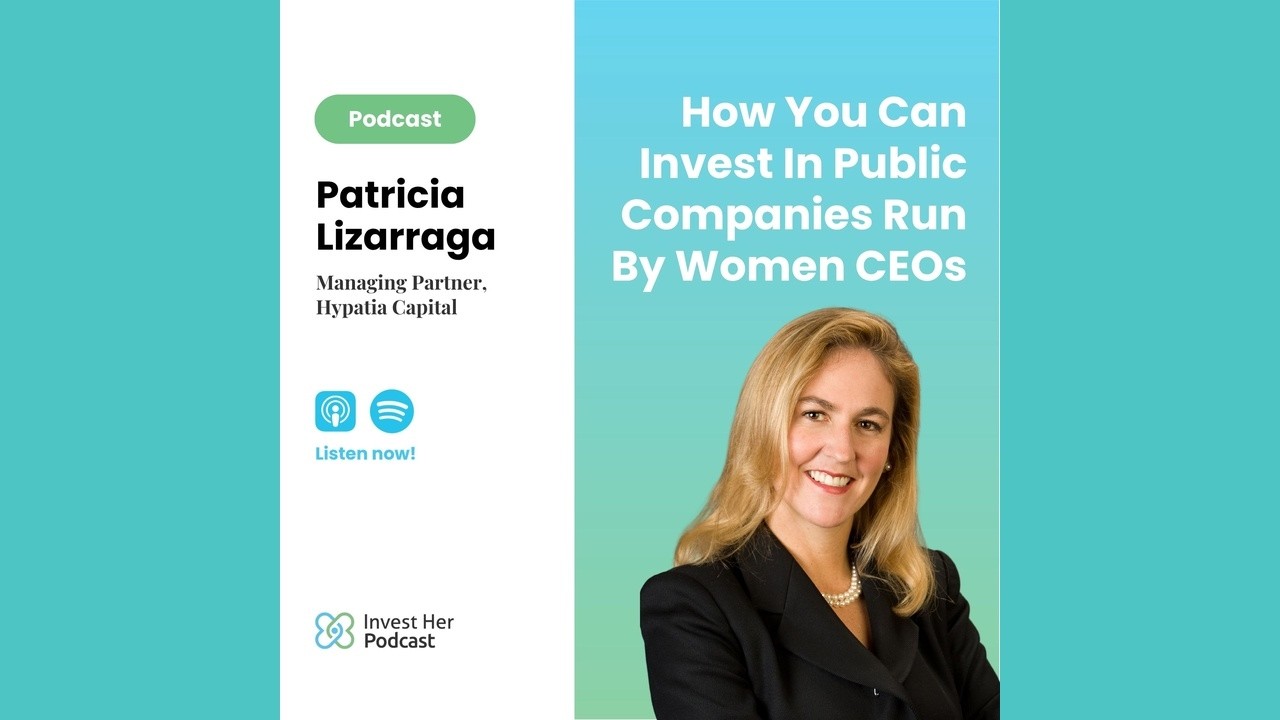
In this episode of the InvestHer Podcast, host Anne Ravanona interviews Patricia Lizarraga, founder and CEO of Hypatia Capital, about the launch of the WCEO ETF – the first exchange‑traded fund that exclusively invests in U.S. publicly traded companies with women CEOs. The conversation covers Patricia’s background in investment banking and her motivation to create a firm focused on women in leadership, an explanation of what an ETF is and how the WCEO ETF is structured (126 stocks, minimum market cap $500 M, equal‑weighting, industry‑neutral methodology). They discuss the investment thesis that women leaders generate outperformance, present back‑test results showing the WCEO index beating its small‑cap benchmark by 300 basis points and the S&P 500 by 500 basis points in 2022, and outline the benefits for investors: diversification, liquidity, gender‑balanced exposure, and alignment with equality values. The hosts explore market traction, current assets under management, distribution challenges, and growth strategies, including targeting individual investors, students, families, and institutional investors. Patricia highlights transparency measures such as publishing CEO photos for the top ten holdings and provides practical guidance on how to purchase the ETF through standard brokerage accounts. The episode ends with a motivational call to action, urging listeners of all ages to invest in the WCEO ETF to promote gender equality and potentially achieve superior returns.
Chapters
Welcome to this week's episode of Investor Podcast. This week you are going to meet Patricia Lizarraga, who is the founder and CEO of Hypatia Capital. This episode's going to be very interesting because you are going to learn all about the very first ETF, which is an exchange-traded fund that has been created where you can buy shares on the American Stock Exchange of companies that are all led by women CEOs. So this ETF is called WCEO. It's really interesting and an exciting new way to invest in diversity and to create the world you want to see. I think you're going to find her very, very interesting. Even if you don't know anything about ETFs, mutual funds, all that stuff, honestly, have a listen. She's fascinating. And I really think this is going to be a revolution in how people, men and women, invest in diversity and move money with the power of their purse. Enjoy. Investor Podcast is for you, the female founder who has a product, a service, or a message that you believe in and need to get funded. Or for you, the investor who wants to learn more about the huge untapped investment opportunity that gives you a higher return— women entrepreneurs. My name is Anne Ravanona. I'm an entrepreneur, TEDx speaker, and women's advocate, and I'm passionate about helping women entrepreneurs get funded. In each episode, we'll take a behind-the-scenes look into real-world funding tactics and strategies to help you get the funding you need faster. Let's put the fun into funding. Thanks for spending some time with me today. Now let's get started. So welcome everybody to this week's episode of Investor Podcast. And I am delighted to introduce you this week to a very special guest. Now, I'd like you to meet Patricia Lizaraga. And Patricia and I, we go back 10 years. We were, we were reminiscing, Patricia, when we first met physically in Paris 10 years ago. Welcome to the podcast.
How are you? Well, thank you very much for having me. I'm very excited to be here and share updates about the WCEO.
Well, I can't wait. So we're going to dive in. And before we start, Patricia, can you tell us a little bit about yourself, like your background, who you are, so people know how wonderful you are before we start? And then we're going to get into what you've built, which I think is phenomenal. And listeners, hang on to your seats because this is life-changing, game-changing, economy-changing, world-changing. Okay, there you go.
Thank you. Thank you for that. So, so I started my career straight out of business school as an investment banker, and I focused primarily on M&A, mergers and acquisitions. So my clients were primarily and overwhelmingly men. They were CEOs and CFOs. So they were overwhelmingly men, and very occasionally I would have a female client. and be just blown away by her business acumen, poise, and interesting, so much interest in her career. So I started thinking, wow, I would love more female clients. And that's when I thought of forming my own firm so that I could have a more balanced client base. Now, that was 15 years ago, and I've built Hypatia Capital, and I've also along the way Been asked to serve on a couple of boards. I'm originally from Peru. So I've been, I serve on the board of Credicorp, which is the largest financial services firm in Peru and the largest bank in Peru, Banco de Crédito. And in the US, I serve on the board of John Hancock Complex of Funds. So, you know, over $200 billion in assets. But my passion is continuing to grow Hypatia Capital.
So tell us first of all about Hypatia Capital. And then we're going to get into this incredible tool and product that you've created that is just— I want the world to know about. That's why we're here. So tell us about Hypatia.
So Hypatia is an asset management firm, we're investors, and we invest in and promote investing in women in leadership. That is our sole focus.
And so you've been doing this, you said, for 15 years. So you were ahead of the curve before people were suddenly thinking this is a good idea to invest in women and women leaders. I mean, tell us about that.
What got—
what brought you to create Hypatia in the beginning?
So again, it was the fact that my client base as CEOs and CFOs were so overwhelmingly male, then when I did have a female client, it was a wow moment. And there weren't that many of them, but there were enough that I started doing the research of how many women CEOs and CFOs Are there, are there heads of M&A? Are there division presidents that are women? Could I create a business? And at that point, Catalyst had already been counting and identifying women leaders for some years and also talking about the outperformance of companies with more women on their boards. And that gave me the research tools to figure out how to create a client base.
Amazing. So now tell us a little bit about— so we're going to get into what have you built, like what is this? And I want us to explain first of all, what is an ETF? So explain to our listeners, for those who may not be as familiar with this, what is an ETF? Sure.
So on January 9th, Hypatia launched the WCEO ETF. So the ticker symbol is WCEO, and then it's the Hypatia Women's CEO ETF. So what is an ETF? An ETF— ETF sounds— stands for exchange-traded fund. And what it is, it's very much like a mutual fund except that it actually trades on an exchange, so you can buy it and sell it at any point in the day. So most of us are familiar with mutual funds. That's where the majority of our assets lie. And the exchange-traded fund is something that really only started 30 years ago, but it is the growth engine of investing right now because of that liquidity component and other benefits that ETFs bring to investors. So what is a mutual fund or ETF? It's basically A fund of pooled assets, right? So instead of investing in one stock, you can be— in the case of the WCEO ETF, you're invested in 126 stocks. So that brings diversification to your portfolio, and diversification is a key concept of investing.
Yes.
As I'm sure you are aware. So, sorry, diversification.
Yeah, well, I'm diversifying.
Liquidity. Yeah. Diversification and liquidity are the 2 key components of ETFs. Because as opposed to, say, early-stage investing or venture investing, which is a very important part of your portfolio as well. In ETFs, you have daily liquidity. So you are— your money is not tied up for years. It is basically tied up for 3 days, if that's what you want.
So, okay, so that's— now we know what an ETF is. So tell us about WCEO. And this is so exciting because this is, this is groundbreaking what you have created, isn't it, Patricia? I mean, nobody else has done this. And it's on the American Stock Exchange, like Really, really important to start from here. So tell us more about WCEO ETF.
Yeah, so the WCEO ETF invests in all American companies that have a female CEO and are publicly traded and are from small to mega-cap. So anything over $500 million in market capitalization enters into our fund. And there's 126 of those right now, out of 3,000 publicly traded companies. So it's a very small number, but it's very inclusive. We included absolutely everybody. So it's a diversified portfolio of women CEOs.
And so how did you get them on board? I mean, you must have— tell us the backstory, because I think that's always fascinating. This is incredible. So you must have come with the, with the idea, with more than the idea, with the project, How did you get those first stocks and those, well, those first women CEOs on board and those companies on board to be in your mutual fund?
Well, the beauty of this is they're publicly traded.
Yeah.
So we just buy them on the stock exchange. What was the interesting concept was saying, can we isolate what we call the female factor, right? Hypatia's belief is that women outperform.
Yeah.
We have all collectively read dozens of reports that say that diversity outperforms, women outperform, but there's no way to capture that alpha in your portfolio. So our thought was, how can we create a product that isolates female performance and captures that alpha in a definitive way? And the reason we're saying it's definitive in this ETF is that for the US companies, for American companies, we include every single woman.
Hmm.
Therefore, it's inclusive. And in our methodology, we believe it's definitive. So we offer investors the ability to get that potential alpha in the performance of female leadership.
I love it. And like, what, what, what are the key research and data points that drove you to do this? Because you know them off the top of your tongue. And I think it's really useful for our listeners to be reminded of these key economic drivers and facts. I mean, this is an arbitrage opportunity. Let's call it a spade a spade. There's incredible opportunity here. It's been over looked undervalued as always. And so, so explain a little bit more to us about that.
Sure, sure. So we do believe women outperform, and our investment thesis is that, as McKinsey and Lean In tell us every year in their Women in the Workforce report, it is harder for women to make it to the top. It doesn't matter the industry, it doesn't matter This, the size of the company, it doesn't matter the asset class. Yeah, it is harder for women to make it to the very top. So by definition, the women who are successful and make it to the very top successfully have something more than the average CEO.
Yeah.
But the average CEO is male, overwhelmingly. Therefore, if you can isolate— this is our thought— if you can isolate that female factor You should get alpha. So when we created the product, we said, okay, how can we isolate the female factor? And what we said is we have to make it not about size and not about the industry. So the way we did that is we made it equally weighted. So the largest company in any given industry is equally weighted to the smallest company in any given industry.
Wow.
So, for example, in energy, our biggest stock is Occidental Oil, led by Vicki Halmhuber, gets the same weighting as our smallest company in energy, which is International Seaways, which is actually a tanker transportation company. So, therefore, we're not investing in size. We're investing equally. And the second thing we did is we said, okay, well, there's more women in certain industries than in others. Unless we make it equally neutral, it will be an industry-weighted index, not a— or an industry-weighted ETF, not a female-weighted.
Yeah.
So we also made it industry-neutral by having it match the benchmark that it follows in terms of industry. So that's, you know, we worked really hard to think about how do we isolate the female factor, and we were successful. When you look at the tracking error, and tracking error for all, for those who aren't aware, tracking error just means how you deviate from whatever index or benchmark you're following. Mm-hmm. So You want your tracking error to be, you know, as small as possible. And with public securities, you can actually figure out where that tracking error is coming from. And in our case, tracking error is coming over 90% from the individual stocks we're picking. And the only thing our individual stocks we're picking that have in common is that they're women.
Hmm.
Balanced in our proprietary methodology. So, so that's how we did it. And what we did is we went and created a backtest of 5 years. So we created an index. It's called the Hypatia Women CEO Index, and it's part— and its calculation agent is Wilshire. And it goes back 5 years. And I want to be really clear, the index is not the ETF, and past performance will not dictate future performance.
Yeah.
But our backtest outperforms its benchmark, which is a small-cap index, by over 300 basis points since inception. Wow, that's a lot. And as a matter of fact, the index outperformed the S&P 500 by over 500 basis points in 2022.
Wow. So I mean, this is big news, isn't it, Patricia? Because like what I say, big news, you've known it for many years. Many of us have known this for many years. But what you're doing and what your index is doing, and also what the ETF, your ETF, WCEO ETF is doing is bringing it to the forefront and say, haha, you know, you can actually get outsized returns when you back women leaders, when you back those companies that are headed by women leaders, because of all the factors that you've mentioned, how we need to jump so many barriers to make it to the top. So the ones that are at the top are this super, super excellent, and therefore, you know, you would expect outperformance. But what you're doing is you're proving it.
So that's what our, that's what our investment thesis is.
And so how, what would you say are the key benefits of, of, of buying into your ETF? If, if somebody's new, why should they think that they said, yes, I'm going to diversify part of my portfolio. And I said, I'm starting on the stock exchange. I'm starting from scratch. Oh, there's this new thing on the block. What's in it for me? Why should I care?
So, first of all, this is a product for all investors, right? It's for all investors who believe in equality. So, if you think about investing, the vast majority of your portfolio is Going to be equities for the vast majority of the population, public equities. Therefore, if you're going to be in public equities, you want to be well diversified. This is a hundred and twenty-six different stocks, which are in this and the. ETF is in is is industry balanced, right? So we have to follow rules of the SEC in order to be a balanced ETF. We cannot be overweight.
Yeah.
Or it no longer is able to be called a balanced ETF. So for new investors. This is an appropriate investment because it is diversified and it's balanced and it's liquid.
See, and who wouldn't—
It's appropriate for every investor.
Yeah, sorry, go on. You were saying it's appropriate for everyone.
So it's appropriate for, for every investor because it adds diversification to all portfolios.
Do you know what?
For a new investor, it's diversified and it's balanced. But for any investor, because your portfolio right now is over 90% male CEOs, it adds the diversification of this female factor.
Hmm.
And it adds stocks that we are fairly sure are not In most ETF products.
So tell us more about that. Like, how do— how often do— like, it's a slow change, isn't it, for more women to become CEOs of publicly traded companies? So how big— how much bigger can you kind of predict that your ETF is going to grow in the coming years, given that it takes a long time for those women to climb that ladder?
So, so we, we want a world that is 50/50, right? We believe in equality. Hypatia believes in equality. I believe in equality. Therefore, and according to the World Economic Forum's 2022 report, it will take 132 years for the world to get there.
Yeah.
And I don't want to wait 132 years if I don't have to. And I can't change the whole world, but every investor can now change the world in their own portfolio. Anybody now can have a portfolio that is balanced from a gender leader perspective. There is no reason why your portfolio should not be equal amount of men and women if you believe in equality. So that is, how it can grow if people understand that it is up to themselves to have equality in their own portfolio. And that's really our call to action.
Hmm.
Is for investors who believe in equality to say, you know what, that's how I want my portfolio to look. And so if we do that, this ETF, can grow tremendously. And the way it's structured right now, it can go into the billions without us having to change our methodology or lessen our investment in any one stock because we have chosen publicly traded companies. So it's really about engaging the investor world to see that we are active investors. Our portfolio is an active reflection of our beliefs, and we are hoping that investors join us in this, in this journey towards equality. And if it is, and, and every bit counts.
Yeah.
We have, you know, we have a— we obviously can see the, the volume coming over the New York Stock Exchange because we trade on the New York Stock Exchange. And we see trades of 10,000 shares and we see trades of 1 share.
Hmm.
We see trades of 4 shares sometimes. That means there's some person who says, I want, even if I only have $27, I'm gonna buy a share of WCO. So we think this appeals to all investors. All investors who believe in equality.
See, that's, that's what really gets me very excited, Patricia, because like I see anybody, anybody who— let's, let's take different brackets. If you are a student and you don't even have a lot of money, start, start, because you're— even if you're still in your studies, or even if you're high school and you, you can— what is the youngest you have to be to be able to buy stock?
Normally, what's the rule in the United States? I believe it's 18 to open up the account for yourself. It's not— parents have to do it for you. So that's pretty much all college students.
So all college students, you should be doing this. You will thank us.
And not college students, because— yes, this is, this is something I will say. I believe that this should also be an institutional product because I think that The pension funds should be interested in this product as well.
Yes.
Because the pension funds should believe in equality and should— or I hope pension fund managers believe in equality. And this is a performing— right, this, this, our investment thesis is about performance. And I want to reiterate that our investment thesis Is that women outperform.
So what— let's talk about that. What kind of traction has your ETF been getting, Women CEO ETF, been getting so far?
So we launched a month ago tomorrow, so we'll even have our first month returns out, which are looking really good tomorrow. But this is a stock market, so it— we get priced. I mean, let's remember this. So if you were in a In an early-stage investment pool, VC or angel investing, you have to wait a long time to see what your returns are going to be.
Yeah.
And they— but with an ETF, you see what your returns are every day. So, and you see the change throughout the day because the market changes throughout the day, and you probably follow it and see that Wall Street in the morning thinks that things are going great and stocks are going up, and then in the afternoon they may have changed their mind and things are going down. So we get priced throughout, and ETFs, as opposed to mutual funds, actually get priced throughout the day. So the price of the ETF changes day to day, but overall it follows the equity market. So it is still the largest part of it. portfolio, most probably. But so we launched a month ago and we're averaging right now about 3,000 shares a day.
Wow.
So we're doing, I would say, okay, but that is not enough.
Yeah.
And the reason it's not enough is because, at least in the US, the market is— has 3, you know, More than 3, but has some very strong players in asset and wealth management. And those players have certain barriers for ETFs to be distributed on their platform. And those barriers are usually $100 million for the largest ones of assets under management.
Yeah.
So in order for us to grow, to $100 million in assets under management and be able to be distributed on the larger platforms like JP Morgan, like Morgan Stanley, like Merrill Lynch.
Yeah.
We need to be closer to 3,000 shares a day. So it is really— and the way for us to raise assets right now is by reaching out to individual communities such as Global Investors. That can spread the word and get more assets. And remember, you can put in 1 share, 100 shares, 1,000 shares, or a million shares.
So this is where, this is where I wanted to go.
There are investors out there that can do it.
Yeah, no, and sorry, because there seems to be a little bit of lag on, on the internet on your side. I don't know, because it's slow a little bit, but—
Oh, I'm sorry.
It's okay. But there are— so I wanted to say where I was going with the student is like, people need to start doing this as young as possible. So I want to— let me do a bit of an ad for you here. Like, that's what I'm going to do, like an ad here. What I would say and what I would really encourage everybody who's listening to Patricia and to this podcast, we can change the world. We can change the world for the better and create a more equal world if we use the power of our purse. Now, the power of our purse is in what we buy, from whom we buy, from when we buy, and when we buy it. So from what we buy and from whom, here is an incredible tool, an incredible tool to allow you to start, you know, really putting your money where your mouth is and where your values are. And that's much more important. I think it's if you care about equality, if you care about equality for now and for the future generations and creating generational wealth, which is extremely important. We need to start now. And so what I was going to suggest is for different categories of people, get started. So first of all, for college students, anybody over 18 who can do this by themselves, get some advice from your parents if you want on how to set it up to be able to start buying here on WCEO. College students, start now. I know you're gonna say, and I've got college debt, I have student debt. Yeah, you can buy it from one share. Okay, you want a bit more than one share. But the point is, Start small, build it up, because then even though you have your student debt for the first, you know, these 4 years until you start working it off, in parallel, having this money aside, showing the banks that, that, okay, you have student debt, but look, I've got this aside. That's really, really good collateral for everything, for when you need to go to get your apartment, for when you need to go and buy loans, when you need to do— start now. I have started doing it. I started life assurance for my life insurance for both of my children, my adult children. So my daughter is 21 and my son is 18. And I dragged them to the bank and they were kicking and screaming, Mom, why do I have to do this? And it's like $30 a month, guys. It's nothing. Like, okay, it's not nothing, but it's something that they have to put aside. And they're like, Mom, I said, you will be thanking me in 10 years' time, in 20 years, you will be saying, oh, thank you, Mom, because you have put aside that money. And that, okay, is a life insurance policy. But for here, this is more liquid because if you do need to take it out, you can. So this is the beauty of it. Hear what, what Patricia said. So college students, get on board. For families who are thinking of their future grandparents, grandparents, instead of a Christmas buying a gift, buy stock on WCEO and gift it to your grandchildren. Gift it to your family members. This is how we can create a real movement and a real revolution, Patricia. It's like, let's get out of the consumer thing and in the sense of let's get out of just buying a thing. Let's buy a stock that then if you— it's going to gain value, you know, most likely far faster, like you're saying about the higher performance and the liquidity. And when you can, if you need to sell part of it afterwards, you can. So it's accessible and liquid. So that's very important. So I'd call the students, I call the grandparents, I call those working parents who are working their rear butts off every day to pay off those, their own loans, their future college kids' savings, and so on and so forth. Do it. If you believe in gender equality, if you've got children, if you have, even if you don't have children yet, if you are an adult who's working, who can put a little bit aside, and even from time to time, it doesn't have to be monthly. You could, whenever you get a bonus, Or if something good happens and you come into some kind of money, put a little percentage, put a percentage of it towards this. These are the way the behavior changes that when they compound, when they compound and you leave them as long as you can, when they compound, it all makes sense. And so, and then of course, to those, those more active investors who are already on the stock exchange here, Patricia, out. You're already in there. If you are in there every day, you know, or not in there every day, but if you have stocks and you have different stocks there, start thinking, okay, let me, let me diversify. So we're not saying add more money. It just means for some of those stocks that you've been holding and other mutual funds, just take a look and say, okay, what if I just move this amount that I have here, I have held up in this fund, Let me move the same amount over into WCEO. So we're not even asking you to spend more money, just move it, reallocate, reallocate and test it.
And especially in the US, for people who have IRA accounts, yeah, there is no tax consequence, right, in your IRA account. So in the IRA, for people who have IRA accounts, this is a very easy thing to do.
And Why do you—
why does— why would one want 90% of their companies to be headed by men if, A, there's quite a lot of data that points to outperformance of women, and B, you believe in an equal world? This is the opportunity to just make it so.
It is. And I want to kind of play on both of those key arguments and benefits pushing forward because, you know, we're gonna have male listeners here say, Anne, I really don't care about equality, I want the better performance. So that's— if that's what gets you going, this is why you should do it, because you're gonna get a higher performance. All right, so that's great. And it's nothing— there's nothing wrong with that. We want that. That's the whole point. We are showcasing it actually works, and it's a fact. So we want more people to benefit from that fact. So if that is your key motivator, brilliant, go for it. And if Equality is your key one of your key motivators. Go for it too. So we don't care which one you choose. Just choose.
Exactly.
Just think like I really believe in what you've created. I think you can hear it in my voice. I am very excited. I am so excited because the world needs this. We really need it, and I know it's just the beginning. I want to say to you. Let's make an appointment for the end of the year. This is January, so let's do another episode for this podcast in December and look back on the year and then tell everybody how well that WCEO ETF has done. And then like everybody, there'll be so many more people on board. So tell us about the, the, the press traction and so on. Who, who's sharing about this? Who's sharing this news about WCEO ETF?
Yeah, we've had tremendous support from the press. We're really grateful. The trade publications, ETF.com and such, have all really gotten on board. Even Fox Business wrote a great article about us. So we're not political. I really want to say that we're about performance. We're not political. We're about performance and equality. And so we think that the We have invitations to join different TV networks to go. We're setting up those meetings, and that's what we need is visibility because it is a well-balanced, diversified portfolio that fits into anybody's portfolio that believes in equality. So we're extremely grateful.
I love it. So what's the best way— let's— okay, what's the best way for our listeners to Buy WCEO. How do they do it?
It's very simple. Anybody with a brokerage account at one of the major brokerage firms can buy it. It doesn't matter if it's Schwab, E-Trade, TD Ameritrade, Robinhood, um, can execute a trade if in their own account, if that's how you invest. If one has an advisor Then one has to call the advisor and ask for what's called an unsolicited trade, because it's not yet on the platforms. But we only know of one or 2 platforms that won't execute an unsolicited trade. Almost every platform in the United States, at least, if you say, this is one I bought— want to buy, they check unsolicited and they put through the order for you.
Perfect.
So it's very easy. The information about— we're fully transparent. So if you go to www.wceoetf.com, you can see our holdings. You can see our holdings. You can see how much, what we hold, and how much we hold of each stock. We're fully transparent. And in addition to that, on our website, by regulation, you do have to disclose your top 10 holdings. Without a click. And what we've done, which we think is really great, is— and as far as we know, we are the only ETF that does this— we put the pictures of the CEOs of every single one of our top 10 holdings. So there you see it, you know, 10 outstanding women, and, and it is a differentiation.
I love that. And you know, that's very, very important. important, Patricia. It is that— it's that visibility, um, that we can see who they are. And then when you click inside, I presume then you can see their names as well. Like, it's just amazing to see that. Like, you have to see what you can be, and people need to know their names because the sad fact is that majority of people don't know who these ladies are. They don't know who these women are. Even when it comes to women entrepreneurs, they don't know. If you're asked, you know, name a top entrepreneur, you're gonna get Elon Musk, Steve Jobs when he was still with us, you know, blah, blah, blah, Jeff Bezos, everybody, all these people, Richard Branson, off the top of the tongue. If I ask you, okay, name, you know, famous women entrepreneurs, people really struggle. And it's the same with women CEOs of these companies. So I think what you're doing is very important also to show, to give them the visibility. I mean, as in just show them. show them. People need to know that they, that, um, they are there.
They'll be great role models. Great companies in all industries. And I think there is this visibility for women professionals to see who the leaders are in their industry when they're younger. When you're older, you might already know. If you're in consumer, you might know who the CEOs are in your, are in your, um, industry. If you're in the oil and gas industry, there's very— there's really just one, so you— or two. So you probably know who those are if you're a woman. But maybe if you're younger, you're not as aware. And that's one thing that we really hope to be able to power up, is to show young professionals and young professional women who the leaders in their industry are so they can, as you say, they can see it and they can know that they can be it.
Yes. Exactly. Fantastic. Okay, so I think we have kind of come to, to the happy conclusion that guys, ladies, anybody listening, if you're an American citizen, you have an American bank account, and you can buy stock and you have the possibility to do so, start, start now. Just start small, give it a try. Hold it for a couple of months. Don't just do a month. Come on, guys, the stock exchange goes up and down. And you know Warren Buffett, what he said, like he doesn't to sell before 10 years unless he really has a good reason to do so. Because things are going to fluctuate. I'm just saying, I'm— I am not an expert, but I listen to what he says. And that's what he says. It's like, hold it for 10 years at least, because that's when you're going to start to see the compound. So definitely, I'd love you to check it out. I want you to go— in the show notes, you will have a link to wceoetf.com that Patricia has mentioned. We will have links to their social media as well, to Patricia on LinkedIn, If you want to learn more about her, if you want to do an interview with her, but also if you want to, to learn more about the next stages of how this grows, just, just contact her directly on the contact details we're going to share. Any last message to our listeners, Patricia?
You know, I want to reiterate that the world, it takes time to change. You know, 132 years. According to the World Economic Forum. But in your own portfolio, you can achieve equality today. We can each achieve equality today. And if we do that as a group, this ETF will be a huge success and it will send a message to Wall Street.
Yeah.
That investors care about equality and that women care about women.
Yes.
And that in itself will create and accelerate the change that we all want. But we don't have to wait for it. We can do it today in our own portfolio.
So tell me, who, who was— which was the company that put the statue of the girl on Wall Street? That, that beautiful girl in the cape?
Um, I believe it's State Street Global Advisors, right? Fearless Girl.
So I want you to all have the image in the head of the Fearless Girl, and on her chest she has WCEO written on it, right? WCEO ETF. Because she's standing there looking at Wall Street and saying, come on, I'm going to show you guys, I'm going to— I've got the cape, and I can outperform, and I will, just watch me. So I want you to see when you see that statue, you see WCEO ETF on it now. And therefore, come on, let's show everybody what we can do. The power of the community, the power Of us, as of us together. Let's do this. So thank you so much, Patricia. I wish you the very best of success. I know this is going to explode. I'm just so privileged to be here at the very beginning of your journey. I'm so, so happy to be alongside you and very happy to showcase you and your work. You have done an incredible job here. And I'm very excited for the future. I think the future is going to be very bright. And I encourage every one of my listeners, our listeners, and anybody who knows me in my community, if you are an American and you can do this, start, reallocate part, just start small, or start big. If you believe in equality, just go for it. Come on, we can do this.
And international people can invest in the US stock exchange. You just have to consult your own tax advisors and legal advisors to make sure it's right for your portfolio. It may not be right for some people, but it could be right for quite a few of the people that would be interested in, in having, um, in having this in their portfolio, actually.
Amazing. So you see, really, there's no more, no more barriers. There's no more limiting beliefs here. There's no more things that you can say, why not? Instead of saying, why should I, I say, why not? Just try it. And then afterwards, give it a few months, And then come back and see what you think. All right, so that is my wish to you all. Remember the girl on Wall Street? She's got WCO on her chest and she's proud and she's looking at the guys going, come on, I can show you. I'm going to show you the outsized returns. So thank you so much for being with us today, Patricia. As I say, I wish you continued success. I know this is going to be incredible and congrats on what you've done so far. And I'm so excited to see where it goes from here.
Thank you very much for having me, and I really appreciate the words of encouragement, and, uh, we look forward to the growth as well.
Fantastic. Thank you so much. Thank you for listening to InvestHer Podcast. Don't miss more great funding tips and insights by subscribing to the podcast on Apple or your favorite podcast host. And while you're there, I'd love you to rate And review the show. We'd love to hear from you. So if you'd like to send in some questions, interact with our guests, or suggest other great people we should feature, join our community on the Flick InvestHer group. Or send us a message on investherpodcast.com. Want more great resources for female founders about funding? Check out our InvestHer Academy at academy.globalinvesther.com. I'm Anne Ravanona, and look forward We look forward to having you with us again for our next episode. Let's put the fun into funding and get more women entrepreneurs funded.
Yay!
More from Anne



🎙️ EP69: Get Off the Fence: Renate Crollini's Startup Blueprint | InvestHer Podcast

🎙️ EP68: Radical Truth: Robert Rubinstein Exposes the Impact Investing Illusion | InvestHer Podcast



🎙️ EP66: Global Sisterhood — Carine de Meyere on Trade Missions | InvestHer Podcast



🎙️ EP65: Capital With a Conscience: Pierre Norman Rolin on Investing in Women… | InvestHer Podcast

🎙️ EP64: Dream Bigger: Nikki Barua on Building an AI-Native Company Without… | InvestHer Podcast