🎙️ EP40: Building Money Confidence in Young Adults with an AI-Money Coach,… | InvestHer Podcast
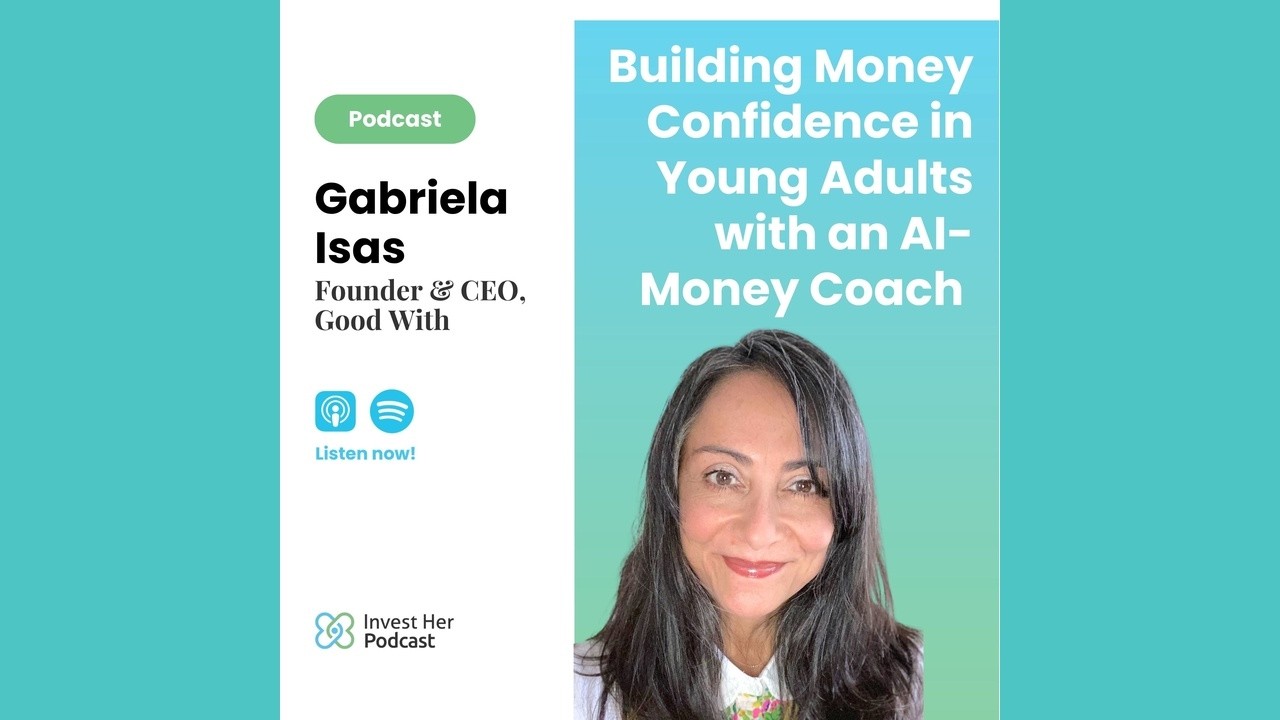
In this InvestHer Podcast episode, host Anne Ravanona interviews Gabriella Issas, founder and CEO of Goodwith, about the company’s AI‑driven “money coach” designed for 18‑30‑year‑olds (the credit‑invisible segment). Gabriella explains the problem of inadequate financial education, the emotional anxiety young adults face around money, and Goodwith’s holistic solution that combines objective data from open‑banking with subjective psychometric assessments to produce a personalized FinIQ pathway and a psychological “readiness‑to‑borrow” score. The app uses machine‑learning, natural‑language processing and a chatbot to deliver contextual, CBT‑informed coaching, goal‑setting tools, and eventually matches users with fairer financial products. The conversation covers the target personas (e.g., “Frugal Coco” and “Drake on Fire”), the multidisciplinary team (behavioral scientists, neuroscientists, designers), pilot partnerships with UK credit unions and banks, and the plan to expand internationally (US, France). Gabriella details Goodwith’s funding journey: early Innovate UK grants, £750 k raised to date, a current £1.1 m round with £600 k match funding sought, aiming to close by February 2024. The episode emphasizes the societal and economic impact of improving young adults’ financial confidence, the value proposition for financial institutions (better risk assessment, alternative credit profiling), and offers contact information for further engagement.
Chapters
Hi, it's your friend Anne, your funding friend, back for another episode of InvestHer Podcast. And in this episode, you're going to learn from Gabriella Issas, who is the founder and CEO of Goodwith. And she has built an incredible AI money coach to help young people aged 18 to 30 better understand their emotions around money and to build that financial capability, that financial muscle. So, so important for our young people nowadays. This is a fascinating episode. So you're going to learn a lot whether you are a young person, parent to a service provider to this population, you want to listen into this episode. Enjoy. Investor Podcast is for you, the female founder who has a product, a service, or a message that you believe in and need to get funded, or for you, the investor, Who wants to learn more about the huge untapped investment opportunity that gives you a higher return? Women entrepreneurs. My name is Anne Ravanona. I'm an entrepreneur, TEDx speaker, and women's advocate, and I'm passionate about helping women entrepreneurs get funded. In each episode, we'll take a behind-the-scenes look into real-world funding tactics and strategies to help you get the funding you need faster. Let's put the fun into funding. Thanks for spending some time with me today. Now let's get started. Welcome everybody to this latest episode on InvestHer Podcast, and I'm thrilled to interview and to help you get to know better Gabriella Issas, who is the founder and CEO of Goodwith. Now, Gabriella is a fantastic woman entrepreneur in her own right. She was one of our winners of the InvestHer Summit very first pitch competition. And today I want you to get to know more about her, about her company, her funding journey, why you should know her. And she's gonna really educate you on a cool new way of looking at things in the fintech industry on how to manage your money. So get ready for a great ride. Welcome, Gabriella.
Thank you so much. Thank you, Anne. It's really a pleasure to be here.
I am excited. I really am genuinely excited to have you because I know that you have important messages to share on this podcast today. And I want our listeners to really learn from you about how we need to kind of reshape our way of thinking about money, managing money. And you're going to give us some really great science-backed insights. And that's why I'm excited to have you because we're all about let's get down to the evidence, what works and why the hell you're doing this. So before we do that, Gabriella, Tell us a little bit about yourself, who you are, so that our listeners get to know you a bit better.
Absolutely. So I am, as you say, a CEO and founder of Goodwith, and I have a background in marketing, in research, and in innovation. I've over 30 years working with and marketing to young adults, researching markets, being acting as a consultant across radio advertising, marketing with large brands. So that's kind of my background. So I came to the UK actually from, from, from Los Angeles to start a marketing agency that, that spoke to young adults. So it's always been a passion of mine to communicate, to, to help people and brands understand people. And when I moved to this country, I realized that, you know, we are still not serving our young people in terms of education, financial education in particular. So it all started with me when I went to university back in the States. After graduating, I got into a lot of credit card debt. Rather than think about what I want to do with my Spanish literature degree, I was thinking, how am I going to pay this off? And how am I going to keep my parents from finding out? So it was a very kind of stressful, anxiety-ridden time. But really, it was a system that, that was not teaching people what credit is. And as a kind of child of immigrants who didn't use credit, I was completely oblivious to, to what it was. And so with no financial education to speak of, I was paying minimum balance and maximum interest, and it was my first very expensive lesson in compound interest. And fast forwarding to today in this country, I still see that we aren't paying due attention to the lack of financial education and what that means. So what it meant for me is rather than thinking about, you know, what I wanted to to do with my career, I was thinking about how much, what job is gonna pay me the most. So really seeing that it reduces people's options, life options, and how do I today with my background in kind of innovation and digital and tech and understanding enough of it, how do we provide a solution that is holistic and appreciates the relationship that we have with money? to start teaching people about money and how to manage it and to start teaching people about their relationship to money. And the larger problem is that we still ask our young people to spend on credit to build credit before they know anything about money. And it's the real kind of slippery slope. And I'm hoping that we can change that.
I love it. And, you know, it really resonates with me personally. I have 2 adult children. My daughter's 22, just graduated in her first job post-graduation. My son is 19 in his second year of university. And yes, of course, we've already gotten loans to finance that. And I'm already teaching them, okay, I've set up life insurance policies for them. They're looking at me as if I've got 3 heads on me. They're like, why? And I'm like, you need to save, you need to do this, start building up savings history so that you have all this good, you know, things that I wasn't taught. And I'm, I know I'm going to learn from you, Gabriella. So I'm eager to learn. I'm being selfish here as well. It's like what more I can learn from you as well on this podcast and your great work with Good With. So tell us a little bit more about why, like, your, your big why as to why you started Good With in the way that you did. So we're hearing, you know, you had your personal experience and said, this is uncomfortable, I didn't have the knowledge, I wish I had it, and I want young people to have it. Tell us a bit more who you're targeting, like what age group, um, and And why that particular age group that you've chosen to serve, basically?
So we are serving 18 to 30s to start with. So we looked at the market and understood that really the big, the big opportunities to make a mistake, financial mistake, are at 18 when you don't have any education about how money works. So we wanted to focus on what they call credit invisibles. So these people obviously are coming into the economy. They— it might be university, it might be a loan that they have, it might be a grant, it might be their first job. And the potential to make really big lifelong mistakes start there. So that's why we want— and because we know that, you know, we're in a financial crisis. 80% of 18 to 34-year-olds talk about feeling anxiety around money. So this is, you know, it might be subclinical anxiety, but it's still really important to help people understand the relationship to money and really help people who are new to it, who are new to the economy, to grasp, you know, the most important aspects of money, you know, the kind of financial literacy aspect, but also the emotional part. And the reason why we built good with as we have is because of this emotional connection with money. And that plays a vital role. If you can understand it, if you can understand your relationship to money, then you have a better chance of feeling financial well-being. So our approach is holistic. It takes, you know, objective measures of financial capability and subjective measures of financial capability. And we have a team of behavioral scientists, neuroscientists, clinical psychologists, Obviously developers and human-centered designers to help people understand and reflect on, on their relationship to money so that we can build their financial capability and we can start to build this alternative credit profile that is based on psychological readiness to borrow, which is a better predictor of risk than how we currently measure today. Whoa.
Okay, I want us to Pause there. Because there's a lot of great value that you've just unpacked in there. So you're like saying, okay, whoa, whoa, whoa, we need to be careful. As from 18, that's when we can start making mistakes that actually can reverberate throughout our whole lives if we don't, if we're not careful about it. So you need to know this information now. So to all those parents out there with younger children or teenagers coming into that zone, or who have those adult children such as myself, and and more, listen up. Okay, that's really, really important. And to all those financial service companies who serve those markets, you're going to learn a lot from Gabriella. So that's really good. I love the way you're focused, Gabriella, is on minimizing that potential to make those lifelong mistakes. You want to cap— you want to nip it in the bud at the very beginning so that— And I love the two-pronged approach that you're describing. So we need to understand the financial literacy, the nuts and bolts. How does financing work and why should I know about it? But also the emotional part. What are the emotional drivers that are driving me to make certain financial decisions? So that's super interesting. And I love the fact that you've described that your approach is very much behavioral scientist-backed and evidence-backed. And that's very, very important to understand what drives us to make those emotional decisions that then impact how we how we see money, how we manage money, how we spend money, how we lose money, how we save money, all of those things. Okay, so first of all, why? So tell us why you called it Good With, and what is exactly the solution that you've built? Bring us into now into your world. What's the Good With world?
So Good With, you know, we're sitting there talking about what are we going to call this endeavor. And a lot of the research we were doing, everybody started with, I'm really bad with money.
Hmm.
Bad with money. And it was kind of almost a preemptive badge that people would put out there, like, okay, I can't talk about money because I'm really bad with it. So, and that just kept on coming through. And when we just thought, what if you could be good with money or good with decisions or good with, you know, these these, whatever it is. We didn't want to limit it to just money, but good with yourself, or, you know, so it just seemed like the natural name for something that we wanted to— we wanted to change people's perspective and have them confidently say, I'm good with whatever it is I'm good with. So that's how it came about. It just seemed to fit. And really what we're doing is You know, our, our research also showed that these credit invisibles were being misjudged by banks, and they're being misjudged by banks and financial services because there's not any data on them. So we were looking at how up to 2.7 million young people who are actually really good with money, and we call her— she's our prototype, she's our archetype. and persona. We call her Frugal Coco because she's really good with saving, she's really good with managing her money, but she suffers low confidence.
Hmm.
And, you know, we see it in, in, in the amount of female investors as well. So again, if we could get in there early and help Frugal Coco build her confidence, then she starts to manage money better, she starts to engage with financial services, she's getting You know, loans to achieve her goals, whatever those are, at fairer rate.
Oh, pause, pause, pause. I love it. Hold on, hold on. So listen up, guys and ladies. Above all, Gabriella is gonna help you ladies who are even— who've got that money and you don't know what to do with it. And in the sense that you have disposable income, you could become angel investors, you could become investors or VCs or whatever. You're also going to learn stuff. Whoa, Gabrielle, that's a hidden benefit I wasn't expecting out of this conversation. I'm super excited. Keep going. I wanted to see—
Absolutely.
So Frugal Coco has got 2 heads. She is the, she is the, the young woman, or the young woman who's, who's making her money and has saved it and is lacking confidence. But it could be that career professional who has more experience and has more disposable income and maybe lacking a bit of confidence to Taking, starting out on the path of angel investing. Woo, I love it. Keep going.
Absolutely. It's 100% relevant and we would love to create more angel invest— female angel investors through our app. But that's just giving them the confidence, the knowledge and the behaviors they already have. So what we're saying to banks is like, you're missing 2.7 million of these young people and they need to, well, you need to be able to service them fairly and we'll give you the data that you need to do that.
One question before you go forward, Gabriella, what's your geographical scope with Goodwith? Is it only the UK or is it also countries? Just because I think that's important as we move forward in this conversation.
At the moment, the UK is our beachhead market. So we're, we're early stage and we're proving out the concept. So we need to focus on the UK. And once we can get that up and running, then we can— then our mission is to scale internationally. And, and for me, as a, as an American, it's very critical to, to be able to launch the solution in, in the US in the not too distant future.
I needed to take it because when you're saying 2.7 million, like people say, hold on, there's a lot more than 2.7 million 18 to 30-year-olds. So that's why I'm nipping that because people must be wondering. So keep going. Yes.
Sorry. So, so we have them and then we have about 3.3 million UK young adults that are being lent money, but so, but have low competence. So these people are, because they're in the right postcode, because of other things that don't really have anything to do with their financial capability, are being lent money. But we call him Drake on Fire. He's our persona, and he, he's not really competent with money and is probably at risk of defaulting. So You know, we want to work with financial services to say this is a, a better way to, to measure risk for those thin credit profile people.
Mm-hmm.
And to safely lend and to more fairly lend to, to young adults. So that's kind of our, our mission, and that's what our research is showing, that, that these people are being misjudged because of their lack of credit history.
Mm-hmm.
But this means that everybody is losing. They're losing out on good customers. They're losing out on potentially, you know, risky customers and are putting at risk a lot of money. So we're here to hopefully help them. And we do it through this, what we're calling a readiness score, and it predicts readiness to borrow, psychological readiness to borrow better than current methods.
Mm-hmm.
Because it reveals a person's true financial capability through data points that are unique to them. So that's how we're trying to get rid of the spend on credit to build credit methods of determining risk. Yeah, so that's kind of our process.
And so tell us more about the behavioral scientists and why you specifically chose to come in on the emotional side as well of the emotional impact of decision-making on managing money, because that's, that's very unique, isn't it, in your approach? So tell us a bit more about that. Because, you know, banks and financial institutions, if I'm playing devil's advocate, they say, well, hold on, Gabriella. I mean, we've been doing managing money for donkey's years. We don't need you to come and tell us how to, how to determine the risk profile of our customers. We know what we're doing. So I think you're here to say, well, Actually, maybe on this particular segment, there's some information you're missing. And that's where we can fill that gap to help you have a more realistic view of that, of that population.
Exactly. So we are, we are looking at, I think I mentioned earlier, you know, your objective measures of financial capability and subjective measures. So we use open banking for to understand people's objective measure of financial capability. because we can understand how they're managing money, how they're, you know, achieving or not achieving their goals. But on top of that, we layer the subjective measures, which are psychometric and behavioral. And so we're looking at how there, there are science-based methods of understanding people's self-efficacy and self-reliance. And those are very important measures of of risk. So we're looking at how we combine those 2 data points and aspects to build out this readiness score because it's better understanding. And with lack of data that 18 to 30-year-olds have, it's a better understanding of the risk that they represent so that we could also— consumer duty is regulation in the UK now. And that means banks have to protect and can't missell products to consumers. And what we're saying is through our process, we have our readiness score, but we also have a, what we call a Fin— the FinIQ, which is a personalized financial psychoeducation journey that helps people understand themselves and the relationship to money, as we said before. But that's also giving them, helping them grow their financial capability, helping them understand their relationship to money and giving the tools they need, CBT-based, cognitive behavioral therapy-based tools that help them reflect on the decision-making that they're— the decisions that they're making around money. So it gives them a kind of a personalized AI money coach that understands them and that helps them kind of build up their financial capability across not just, you know, the understanding APR compound interest, but understanding their self-efficacy and things that they're doing that might be sabotaging their ability to reach their goals. So that's kind of the very broad view of, of why it's different. And these are data points that no one else is collecting. No one else, because it's an app, because it's a process. Those data points are coming through the actual process of the app. And we're able to collect, analyze, and deliver insights back to the user, but then eventually back to financial services, which helps them hopefully lend more fairly.
Wonderful. Okay, so I want to unpack some of that because you've given us a really good overview from both the advantages for the financial service companies and why this is a useful tool for them, as also, and also from the user perspective, the end user perspective. So I want to just dial back a little bit when you were talking about The objective measures. You said you use open banking to measure how people manage their money and achieve their goals. Can you explain a little bit more to those people who may not understand what that term open banking is, who are not in fintech land? What do you mean by that?
Yeah, so open banking exists in the UK and exists in a few other markets. But it essentially says that your data, your financial data with your banks is yours. And it can be, should be provided to you in a digital format, In real time as much as possible so that you can make sense of it. You can give it to another company. What they call us are account information service providers.
Mm-hmm.
So we say we connect securely with your bank account, your bank, they give us the data, we go through an aggregator, another company that helps us collect that data, puts it in the app so that we can understand Again, we can measure how good you are with money or where you might need support so that it's very personalized support rather than generic. You know, here's, here, here's a budgeting tool, you know, 40/60, whatever budget you're using. It's very personal to their specific situation so that we understand, you know, where they start in their money journey. And it's very tailored to them. So that's the open banking side of things, which is, is regulation here now in the UK since I think the end of 2018.
That sounds super interesting. I'm not sure if that's the case here in France. I know, for example, even asking for what's, what's your credit score, our own bank manager won't tell us what our credit score is like. It's crazy. You don't have easy access to that information in France. Like, of course, they have a credit score on us, but we don't know it. Like, they don't tell us. They don't make it— it's opaque.
It's in their system.
And what they will use to determine whether or not we're creditworthy and they'll give you a loan, you know, but it's not necessarily like in the UK or the US where people can readily know what their credit score is and therefore their capacity to access credit and other forms of capital, you know. So that's why I thought it's useful for us to understand what you mean by this open banking because it doesn't exist everywhere. So great. Now you've given us that context. So then bring us back into the— and I love the fact that you're saying, if I've understood correctly, Gabriella, that thanks to this open banking regulation, the information you're pulling in from the bank, the person's bank account, it's truly personalized. That's what you're saying. So it's like they are getting a really personalized experience in Goodwith, in the app with you. It's not just some generic stuff that everybody will get, say, oh, you're 18 to 30, so we'll just throw out this stuff at you. No, you're giving them a highly personalized Experience. Is that also— I have to use the magic word— is it AI-based? I'm guessing there's some AI in there somewhere. And is it your AI or the bank's AI, or how is that working?
Yeah, it is, it is AI-based. So we have, um, we're developing right now the, the chatbot, the kind of the, the money coach. So it's AI-based on, on— again, that's how we get it personalized. Um, we're using machine learning and natural language processing. So all these things to really make it contextual, timely, frictionless, all these things that, you know, young people are used to. If it's not on their phone, it's not easy to use, it doesn't understand me, I'm not using it. So from our perspective, we, you know, our team are data scientists and behavioral scientists, but we're also human-centered designers. So we look at, you know, what is going to be engaging. When you look at our app, It's light green. It looks nothing like a bank. And we've been told that helps it become more approachable. So if people are anxious about money, they don't want to see their, their immediately their, their bank statement, we call it FOFO. So fear of finding out, you know, if you open your— If you're already stressed about it, and you open your app, and it shows you how little or how much money you have, it's gonna be a deterrent. So we're really looking at how we engage with young people, knowing that they're gonna be stressed about money, knowing that they're gonna be avoidant, because we have those— some of those characteristics are with people who— with low financial confidence. So we're designing it in a way that makes it inviting. That makes it personalized, contextual, relevant. And that's using AI and machine learning. So yeah, it's very much based on that.
So that's why I'm saying I'm asking you those key questions is because to the investors listening here to this episode, you're hearing the magic words, you're hearing fintech, you're hearing AI, you're hearing personalized, you're hearing machine learning, you're hearing All of those things, the natural language, you're hearing a tool that's going to help the banks make more money and serve that customer base better. It's going to increase confidence in our young people because guess what? The decisions they're making now is impacting their whole financial future and therefore global economies. So guys, ladies, I really want you to hear what Gabriella is saying. This is revolutionary. And that's why In this podcast, we want to unpack this to make it very easy to understand so that we're educating. Because basically what you're doing, Gabrielle, is you're helping to educate a market and the market and several markets on, on how we need to use the benefits of AI plus the data science, like the, the, the, sorry, the emotional sciences that you're also talking about on how we make those decisions and how it impacts us emotionally and our confidence levels. This is pieces that honestly, objectively, I think a lot of banks and people looking at risk, they, they, they're ignoring to their peril because they're used to using old models of, of modeling and business and risk analysis. Correct?
That's correct. Yeah, absolutely. So, excuse me. That's what, that's what we're saying. So really, it's, it's looking at innovation, You know, as my co-founder, we haven't talked about her much, but she's a doctor in behavioral psychology and really took up the challenge of making this a holistic approach and understanding people and meeting people where they are on their financial journey is really what's gonna make it successful. But she and I have our own experience of, you know, mental health around anxiety around money. She was a single teen mom of 2. Now she's a mom of 2 teenagers, so she's paying for it now. So yeah, so we are very much, you know, with lived experience of the problem, and that's what keeps us going. And knowing that it's more than just, you know, learning about again, APRs or compound interest. It's really about how do we approach the person and help the person and meet them where they are on their financial journey.
Listen, I love it, Gabriella, and this is very important also to all those parents listening out. Like, I had the recent conversation because my daughter is a young professional now. She's in the professional world, she's getting her first paychecks and not understanding them and getting super stressed, like so stressed she didn't want to look at them. And I literally sat down with her and said, okay, let's look at them. Line by line. This is what this means. This is what this means. This is what you're paying. This is what your employer is paying, and this is what it's going to the Social Security and to the tax, and etc., etc. And this is what's going into your retirement fund, and why that's important. And these are other taxes that they take, and they've nothing to do with it. But you know, they're taking it anyway, and that's life. Okay, you know, when you're into the professional world, this is what it is. Because of course, when they're starting out, they're like. Holy smokes, I'm— I thought I was getting this and I'm getting this at the end. Where's the rest of the money gone? And so, but her fear was palpable, her discomfort. And after, like, she didn't even want to ask the questions of her new boss. She was scared to bring up the COP topic. And I said, look, Emily, you need to, you need to have those conversations. There's nothing to be scared about, especially if it's in your first role. This is normal. And in any role, you can always ask these questions. You don't need to be scared of this stuff. It's your right. It's the money you're getting for the work you're doing. So you need to have those open conversations. And then she went and had the conversations and her bosses walked her through it and she felt much better. So, but she was like, it's interesting to watch from navigating our paychecks to understanding bank loans, how credit works, to Like, to understanding just general how my bank account works and what, why, oh my God, this life insurance policy. Oh, Mom, why do I have to pay €30 a month? That's killing me. And I'm like, you'll be so thankful to me in 10 years' time. You'd be like, Mom, I'd be on the knees going, thank you, thank you for doing that. I'm like, don't ever close that. This is really good. You're building up. And other people are saying, well, you know, maybe you should be putting on the stock exchange. And it is like, it is her life. This thing is, is on the stock exchange. So it is making good money. for— will be for them. But the thing is, they're not taught this at school, Gabriella. And that's why, you know, they're coming out of college or they're in college. And, you know, my son managing his money, he's gone the uber— the opposite side of the spectrum to your— to what was he called? The Dookie? Drake on Fire? Drake on Fire. He's the opposite. He's the miser. He's the little— the guy, he's won't— he's afraid to spend a penny to the point of like, I'm like, You gotta spend the money to buy food. Oh no, but like, no, no, no, no, that's a non-negotiable. So like, that has to happen. Don't be ever stopping yourself from buying money for food. That has to happen. But the point is, they're not taught this at school. Yeah. So tell us more about when a young— now let's do this dive deeper. When a young person downloads your app, Gabriella, what's the user journey they go on and, and how does your app help them?
Right. So they download the app, they connect their bank account. So we see their kind of objective capability. They then answer a few questions, psychometric quizzes, and, and, and we are able then to understand their subjective financial capability. And they, we produce a kind of personalized FinIQ pathway. So that means here are some lessons. Here are the things that, that you, you might find beneficial if it's really psychometric. psychological? Is it, you know, their approach, their anxiety? They're given tools that help them with that. They get kind of reflect— a time to reflect, a time to understand kind of— we do, we go into story mode so they can make decisions on behalf of some character. So they're really constantly doing exercises or understanding what— being able to reflect around decisions that other people are making. So it helps them. kind of reflect and understand the decisions that they may be making in their own lives that aren't helping them. And this is creating a kind of really rich picture of their financial capability. They're building up their, their readiness score and kind of their understanding their financial health, kind of their complete financial health. And when they're ready, if they're ready, we match them, safely match them with a product. So it might be a better current account. It might be a loan that they, they get a better rate on because now the banks understand the risk that these people represent. And that's, that's kind of our business model. So we get a fee for, for, for matching them.
Perfect.
But they, yeah, they continue to build their financial capability. They continue to set goals and, and we help them achieve them.
I love it. And that's the whole demystifying part, because it's like, okay, let's see what your situation is. Let's, let's help you understand it from the objective and the subjective point of view. And then let's play. Let's, let's show you how other people with a similar profile are managing their money, and then, then get you comfortable with that from a third-party view. It's not you yet. You get—
Yes.
I mean, warm them up, and then when they're ready, okay, now that you've been through that and you're more comfortable with it, here are some ideas and suggestions that might be, you know, might help you make better decisions with regard to your financial future. Now, like, these are things you could explore without being too pushy. I presume, like, you know, you'd be very sensitive on that. It's just, it's always I love that path. It's like building the confidence in them and in the tool and in your— and building trust, because all of this is built on trust and say, okay, I feel understood, I feel heard, then I'm going to trust what Goodwith is saying to me. And therefore, if they're— if they are proposing this type of financial tool here, it's because they're— how they've mapped my data and they've understood me. they're, they're able to match us in the best way, because they really have taken the time to understand me. And therefore I should trust them.
Yeah, exactly. That's perfectly stated.
Yes. Yes, I got you. I'm just like, I'm just like, why isn't this in France? Oh my gosh, I need to introduce you when you want to come to France. I'm going to introduce you to as many people as I can say, come on, let's get this into France. I know people in the banks. Okay, so not just— but I know people high up in the banks and say, okay, let's, let's get this in. Because I think it's Amazing. So hurry up, finish conquering the UK, and then come to France. We're coming.
We're coming. Yes, absolutely.
Come, come, come. So now let's backtrack for the— I want to come into your funding journey. Or is there anything you want to say just to the financial service companies as to, okay, how Goodwith is going to help them better understand this very important group of people, because guess what? These are the— these are Gen Zers, aren't they? Or are they Millennials in this population? Correct me, um, Gabriella.
Yeah, they're, they're Gen Zers mostly, and, uh, the younger Millennials probably.
Yeah, and the reason I'm saying that is because I've just come back from a very big event, um, in the United States where they were talking all about the importance of Gen Z, like the world is going to be run by Gen Zers and Millennials afterwards. So banks, financial institutions, insurance companies, you cannot avoid them. On the up, au contraire, as we'd say in French, you want to love on them, you want to really understand them. And this is where Goodwith could be a great partner. So tell us how you partner with financial institutions, Gabriella. Absolutely.
So at the moment, we're running a few pilots with financial services of all kinds of stripes and sizes. And, and we are keen to get more financial services on board. And what we deliver to them is an under— a better understanding of this target, which is really difficult at the moment. So we're keen, we are keen to work with financial services in the UK, and we're working with credit unions and credit retail credit providers. And we'd like to work more with the retail banks as well.
Right, so Gabriella is saying it softly, I'm shouting it out, retail banks. You're gonna get all of Gabriella's contact details at the end of this episode. Really, come on, reach out. You've nothing to lose, you've everything to gain. I think you're going to learn a lot about, um, this very important target audience for you. So check it out, please, please, please. Okay, so we want more of the retail banks on board, um, insurance companies as well, or is that later down the road for—
Probably later down the road, uh, yeah, but it— there is a lot of relevance there.
Okay. All right. So I want us now, Gabriella, now that we've got a good understanding, do you want to maybe finalize on the USPs, what makes you unique? So we— that's very clear in our minds before we move into your funding journey, because I want to take us into the funding journey real quick to say, okay, what do you need to know?
Yes, fantastic. So really, we're— we've developed a model that predicts psychological readiness to borrow, which doesn't exist in the market. We're working with young adults, and in a way that speaks to them in a way that helps them not fear money. So building their confidence and competence. And, you know, we're, we're a team, we're a multidisciplinary team that, that understands people and people data. And together we, we think we're doing something that's truly innovative and that will help society and benefit young people, young adults.
And I wanna make the emphasis on help society. And help young people, help society with a capital S. That's all of us. Okay. And it's also gonna help our economy because the better, you know, if we can help capital credit move around faster and better and just more tailored, this is the future. The future of is now. And that's what I want to encourage the listeners here. Don't wait. You can already be engaging with Goodwith. If you, if you're not in the UK, it doesn't matter. You have friends in the UK, send them to have a look at Goodwith. And then as soon as she's ready in the US, she's gonna let you know. And in France, because as you can hear, she's coming to France now, of course, as a result of this. So Gabriella, tell us a little bit about your funding journey with Goodwith. How did you get started with your co-founder? How did you fund this so far? What's that journey like?
So we were really lucky with Innovate UK grants. So these are government grants that are super competitive and look for a step change in innovation, and you have to be able to prove that. We did get a few of those investments early on and we had to match race it. So I went to friends and family and told them about the idea. And they've known that I've had this idea for a while. So they were, you know, there was some credibility there as to how we get it done. Hired the team, found my co-founder, Dr. Ellie Kellis, and just got going. That was at the end of 2021. So essentially 2022, we started. Um, and we've managed to raise over £750,000 so far, um, are now raising an additional £1.1 million with another Innovate UK grant. Um, so we're seeking £600,000 match investment, um, and have secured half of that. So really £300,000 is what we're looking for now.
Right. When are you closing this round?
We're hoping to close by February.
Right. So this is cool, because by the time you're listening to this podcast, ladies and gentlemen, this will be out in December 2023. So well in advance of February 2024, you want to get in. I think you, if you are interested, if you're working in the financial services industry, I think this is a great thing. If you're a personal, a person who has some disposable income and could be interested in this, and are an angel investor, come on, if you're not an angel investor, this could be a great great starting point for you because you understand the industry, you're going to understand it. And guess what? This can also give you great insights for your companies that you're working for. So come on, $300K, that's easy to find, ladies and gentlemen. Like, honestly, it is, it is. So I'm wishing this for you. I'm wishing the people here listening to this that they'll be rushing to contact you because I think it's very innovative what you're doing. The other thing to say to those people who don't know About Innovate UK grants, it is extremely competitive. They do a lot of due diligence before they give out those grants, and it is really government money that's going to invest the future of innovation, right? So when Gabriella is saying that it's very competitive, it's for step-change technology, it's absolutely that. And that is a good thing for you to know, because guess what? Therefore, the investment in Goodwith and in Gabriella and her team is de-risked because Innovate UK have done a lot of that due diligence for you. That's what I really want to bring home for those of you who could be like, oh, this could be interesting, but I'm not too sure. Listen, they've done the homework. They've dotted the i's or dotted the— yeah, dotted the i's and checked the t's, crossed the t's. They've checked all of this stuff. So you're in safe hands. Once you know that a big government entity that's giving these research-based funding has done their homework on a company like Goodwith, you know you're in save hands for that match funding. Sorry. So yeah, that's— I know you can't say that, but I can say it. So I've said it. There you go.
And I've got to say, I have a— I should have said this earlier. I've got a hard 11 stop.
Yeah, we are going to close. Okay. So any last tips, Gabriella, to any women entrepreneurs listening?
My tips are, if you've got an idea that you've looked at, that you've researched, that you're passionate about, don't give up. It's an up and down journey every day, every second it's up and down. So it will be difficult, but it— if you're passionate about it and you think you're solving a real problem, don't give up.
I love it. Okay, and last thing, how can people contact you? Where's the best place to find you, Gabriella?
Best place to find me is, um, on my email, which we can, we can provide the email address, or on LinkedIn, connect with me. I'm always eager to connect with more people. So yes.
Wonderful. Thank you so much for being with us today, Gabriella, for educating us, for giving us hope and showing this— there is a light at the end of the tunnel. And that by helping our young generation, Gen Zs, to better manage their money and their confidence around money, we're going to have much better citizens making better financial decisions. And that's going to be good for our global economy. So Thank you for everything you do and very best of luck. And not— you don't need luck, but I just want a lot of resources going your way to this. Thank you so much.
Thank you, Anne. Thank you so much. It's been a pleasure to speak with you.
My pleasure. Thank you for listening to InvestHer Podcast. Don't miss more great funding tips and insights by subscribing to the podcast on Apple or your favorite podcast host. And while you're there, I'd love you to rate And review the show. We'd love to hear from you. So if you'd like to send in some questions, interact with our guests, or suggest other great people we should feature, join our community on the Flick InvestHer group or send us a message on investherpodcast.com. Want more great resources for female founders about funding? Check out our InvestHer Academy at academy.globalinvesther.com. I'm Anne Ravanona and look forward to having you with us again for our next episode.
Thank you.
Let's put the fun into funding and get more women entrepreneurs funded.
More from Anne



🎙️ EP69: Get Off the Fence: Renate Crollini's Startup Blueprint | InvestHer Podcast

🎙️ EP68: Radical Truth: Robert Rubinstein Exposes the Impact Investing Illusion | InvestHer Podcast



🎙️ EP66: Global Sisterhood — Carine de Meyere on Trade Missions | InvestHer Podcast



🎙️ EP65: Capital With a Conscience: Pierre Norman Rolin on Investing in Women… | InvestHer Podcast

🎙️ EP64: Dream Bigger: Nikki Barua on Building an AI-Native Company Without… | InvestHer Podcast