🎙️ EP44: Investing in Change: Shaping Policy and Practice for Inclusive… | InvestHer Podcast
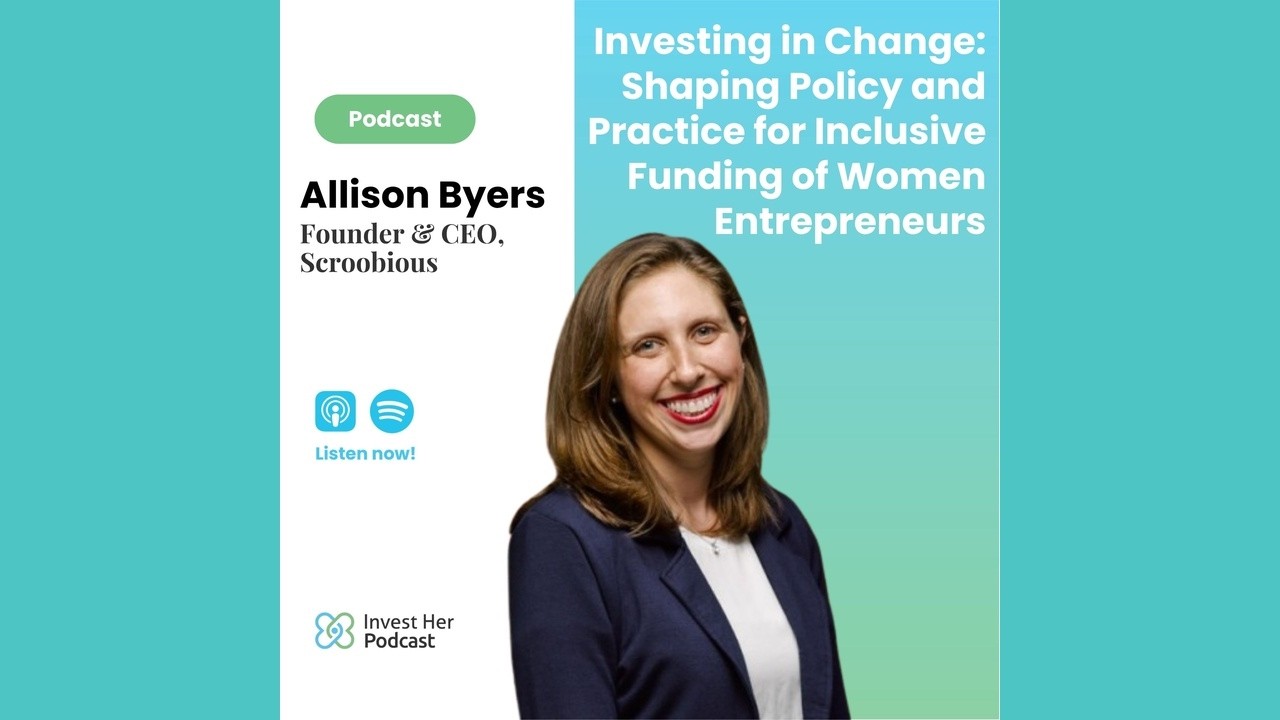
In this InvestHer Podcast episode, host Anne Ravanona interviews Alison Byers, founder and CEO of Scrubious, to explore her three‑fold role as an entrepreneur, policy advocate, and angel investor. Alison recounts her non‑linear career, from a tech operator forced out after maternity leave to founding a medical‑device startup that exited via an asset sale, and then creating Scrubious to give under‑represented founders affordable, expert‑level fundraising coaching and pitch development. She shares stark statistics on venture capital bias (women receive 1.8% of VC dollars, Black founders 0.48%, a $1.7 trillion funding gap) that motivated her mission. The conversation details Scrubious’s platform – free tier, micro‑lessons, community Slack, reviewer feedback, and investor‑facing marketplace – and walks listeners through the founder sign‑up journey. Alison then explains her advocacy work, notably co‑authoring and testifying for California Senate Bill 54, which mandates diversity reporting for VC funds with a California nexus, and her involvement in similar legislation in Massachusetts and outreach to international policymakers. She describes her role as co‑chair of the Boston chapter of AllRaise, a nonprofit that connects women founders with investors, and shares insights from her own experience as an angel investor in 11 under‑represented founders. The episode concludes with practical fundraising advice – personalized networking, understanding investor mindset, building relationships, and injecting fun into the process – and a call to action for listeners to engage with Scrubious, AllRaise, and policy initiatives.
Chapters
Hi, it's your funding friend Anne Ravanona, founder and CEO of Global InvestHer, and thank you for joining us today. Thank you for being part of the InvestHer podcast community and family. We're so glad you took some time out of your day to listen to this episode, and I know you're going to really, really enjoy it. Why? Because we are speaking today with Alison Byers, and I call her the Swiss Army knife Of funding and fundraising, because you're gonna hear 3 angles of her journey from being founder and CEO of a company called Scrubious that helps other underrepresented founders to get their pitch ready, super honed for fundraising, to being an advocate for change. And you're gonna hear more about the incredible work she's done to bring new laws into, into state in the United States to change the funding game. And then the third hat she wears is she's an angel investor. So she's a founder, a funder, and a changemaker. How awesome is that? So I know you're going to really, really enjoy this episode. When you're listening to it, listen to some of the key lessons that Alison said. She's so eloquent. Thanks for taking time today. Let's get started. Welcome everybody to this latest episode of InvestHer Podcast. And today I am thrilled to have with us Alison Byers from Scrubious. Welcome, Alison.
Thanks so much for having me here, Anne.
I am thrilled. So, okay, for your listeners and those of you watching, all right, you're in for a real treat because Alison is like a Swiss Army knife of funding. All right, let's put it this way. So she's not only a successful entrepreneur, she is an advocate for change and has done some kick-ass stuff that I don't want to tell you now because you're going to just hear it from her, which is always better. And not only that, so she's changing the system, and she's an angel investor as well. So my God, that's why you are a Swiss Army knife in the best possible terms, Alison. Thank you.
I take it as a compliment.
Compliment. Okay, so let's— before we get started, tell us one fun fact about you, something fun. It could be from now or the past that people don't know about you or may not know.
Okay. Well, I don't know how fun it is, but let's see, way back when, a long time ago when I was in undergrad, I was a complete psychology nerd and all I did was clinical psychology, like in the basement lab. I totally geeked out over it. I had dreams of being a famous psychologist. And then I went into business after that and loved it and apply all of that going forward. But I think most people wouldn't picture me as that psych nerd.
I love it because I consider that as a superpower that you use in all the different hats that you wear. So it's, it's absolutely there, Alison. So that's why I want to say, oh my gosh, that's so exciting. Okay, so let's unwrap this. First of all, how did you become an entrepreneur? Like, what was your path to starting Scrubious? And then we're going to, to go more into the Scrubious journey.
Yeah, it's so— it's really interesting, and I talk a lot about this, uh, especially with younger women or newer entrepreneurs, is I have the most non- linear career path I think you could possibly have. Um, but the reason I got into entrepreneurship, it's a little bit of a separate question. Uh, it is part of that passion that I have and why I do what I do. Um, so I was a tech operator within larger companies for over a decade and was actually forced out of my role when I came back from maternity leave with my first child. And entrepreneurship was literally the only way I knew how to get back to work. This was a while ago. Fractional roles were not really a thing for someone who's highly educated, highly paid. How do you do that and have your— have, you know, be a mom and have your life? And entrepreneurship was that path for me. So Scrubius, my current company, is my second time. And my first company is a lot of what led to what I do now. But that's how I got back into the workforce. And so with my first company, I helped launch and co-ran a medical device startup that we spun out of MIT and a hospital system here in the Boston area where I live. Um, and, you know, did, did all the things. It was my first time at all of it. I didn't know any of these statistics or, you know, facts about capital allocation that I know now. Uh, and so also, you know, did our fundraising there. We raised about $10 million for that company. Yeah, yeah, which was awesome and great. Uh, but for any listeners who are in a medical device field, you also know that it's Very capital intensive. We were an FDA regulated device running human clinical trials, different capital needs on that side. And that company, we ended up going to early acquisition and an asset sale, which, you know, I'm very honest about all of this. Not enough entrepreneurs talk about what their exit actually looked like because I struggled to raise our Series B. I really was challenged to raise those big checks. And so—
Pause though. What is an asset sale for anybody who's listening who doesn't know that term? Let's demystify it.
Yeah. So when you have an exit event or when you sell your company, so it can take any number of positions, right? Just like when you're negotiating a term sheet, you have all kinds of different terms that go along with that infusion of capital, or in this case, you know, an acquisition. And sometimes it's for the assets. Which means you don't profit off of that exit. So you can say you're an exited founder. Your innovation can live on, which is, you know, a success rather than it falling away. But it means the investors did not profit. I invested my, you know, in that company too. We lost money. And that's, you know, what an asset sale means.
Thanks for saying that because it's not, it's not Something that may be familiar to a lot of our listeners. Okay, so you did an asset sale for that first one. Tough, tough, like what you've just described, but also in medical device. Like, you chose like super easy stuff to start with. Like, hello, of all the things you could have done, let's do a medtech, a medical device out of MIT. Let's make it super easy.
Why not?
Why not?
But also, you know, another reason why entrepreneurship is so attractive for a lot of women and people of color is that you get to pursue mission-driven initiatives and things that you feel are making a positive contribution to the world, right? So our device was in the space of Alzheimer's detection, very personal to, you know, I think most people given the incidence rate, uh, and myself as well. And really, you know, became very, very passionate about having this, you know, in the world and, and having this out there. But just to wrap up that story, Anne, it gets even worse. Um, so— Men acquired our company. And shortly thereafter raised $55 million. Uh, and that was the moment when I said, how could I have failed so badly? Obviously this company had all the signals it needed to raise those larger checks and we had venture funders and, right, I, I was traveling all over the place doing this fundraising. How did I mess up like that? That's the first thought. And that's the thought a ton of entrepreneurs have if they don't know the statistics.
Right.
So for me, I looked into it. I said, well, what does the world of fundraising look like and capital allocation and pitching? I have to understand this because I was having, you know, an identity crisis here. And then you find out women get 1.8% of venture capital. If you're a Black founder, it's 0.48%. It's less than half a percent. I was statistically almost never going to raise that money. I just didn't know it. And so that was my moment of, okay, well, now I'm obsessed with working toward more equitable capital allocation. How am I going to do that? That's my new mission. So starting Scrubious is one of the ways I'm working toward that. I know we're going to talk about others as well. But that's really, that's my origin story and the drive. Wow.
And I mean, thank you for sharing that because you've— you're giving the latest statistics. They keep getting worse year on year. We're going backwards. Things have not improved in the last 30 years and it's unacceptable. So it's great that you're out there in the world making a difference, Alison, and, and sharing that. And like, we have a similar aha moment where it's like, hold on, is it harder for women to raise money? And, and learning the statistics and going, oh my God, right? So the system is stacked against us. Basically, in many different ways. But let's, let's dive because we're gonna go really deep into that. So don't worry, I'm not running around it here. So first of all, you have to demystify what the hell is scrupulous? What does that mean? And then what do you do?
Yes, absolutely. And so you, you kind of already hit on it a little bit when I looked at this landscape to see where could we make a big difference. And that understanding of The way that venture capital has evolved is systemically not viable for those who don't pattern match previous successful investments. And because over 90% of those investments historically have been in men and in white men, we are not going to succeed in that system until there are more Czech writers who have decision-making authority.
Yeah.
that have similar lived experience to us. I help work on that part of it as well. But that's a long-term change. That's generational. And I was interested in what can I do quicker? What can I do now? And so I started to look at non-venture capital sources of investors and of capital. And it is an enormous opportunity. And I know you and I are very aligned here. There is more collective capital sitting with angel investors and family offices and other sources of capital than venture combined. And they have different motivations, different needs for what success looks like that are much more reasonable, much more attainable, uh, and much more sustainable for growing a business model in a way that allows entrepreneurs to really affect the change they're looking to with their innovations. So I do focus on founders who identify as underrepresented. It could be race or gender. It doesn't have to be. We don't define it for people. There's a lot of other categories of underrepresentation and intersectionality. But we have built a scalable tech platform that brings affordable, accessible, expert-level guidance to founders in how you fundraise, and how you create investable, compelling pitch material so that we can bring this to everybody. And it isn't restrained to just those founders who already have access to knowledgeable networks and money for pitch coaches and all of that. Almost all of the time, we actually can bring our platform to investors at no charge to them based on our own business model. And we've now worked with nearly 700 founders in the past 2 years because we fundamentally have built something that is scalable. Then on the other side of this platform, if a founder chooses, they can expose their opportunity, their pitch material that they have worked through our program to create to investors on the other side. And we do focus on angel investors, family offices. We have great partnerships like with InvestHer and lots of accelerators, universities, programs where it is only beneficial to have more help so that we can all work together and help these founders who have been marginalized and overlooked get their innovations in the world so we can all have access to it, help them build generational wealth, and that will contribute to the growing check writers on the other side.
Ah, listen, this is where, like, I just gobble up every single word that Alison says because we are 100 million percent aligned on absolutely everything. We say so much of the same things to everybody to change the world, and we're both working on short-term and long-term stuff. So it's like, oh, love everything you've said. And it's so, so important that you're giving the tools and access. This is about access to opportunity. Like, yes. And it's about giving them something practical and the knowledge they need, the technical tools, the incredible, you know, pitch acumen and that polish. Because I'm sure that what they learn by using your tool and using your platform, they can bring that to other kind of pitchy salesy conversations as well, because you have to learn how to position your arguments. You need to know, you know, adapt what you're saying to the audience each time. So I'm sure it's like, so I know it's so valuable what you're doing. And I'm so thankful that you exist and that you are doing it for those underrepresented and overlooked founders, because hell yeah, we're 100 million percent aligned.
Oh, I really appreciate that. And, and you're right, that's really the key to any presentation, right, is understanding the mindset and the needs of your audience so that you can be compelling to them. And what is especially hard for these founders who have been historically blocked from accessing investors or getting honest feedback is they cannot understand the mindset of an investor. You can understand the mindset of a customer, of a partner, of an academic if you're in that field, of a scientist. You can present to them because you understand, you can think like that. It is so opaque how an investor thinks, and that's what we teach, right? So it's the polish on the actual material, but it's also the meat of it.
Yeah.
The teaching them, this is why it matters. This is why the advice you're getting matters to an investor, and it makes all the difference. And then all of a sudden, right, you have these super compelling, super interesting pitches because it's speaking to an investor mindset.
Absolutely. And it's like, I think an important thing of what you're describing is teaching the founder to sit in the chair of the investor, like really to switch places in that sense. So you get into the mindset of the investor and understand where they're coming from. Because so often founders can fall into the trap, they're so intently focused, intensely focused on sharing their key messages or just delivering the pitch because they're so scared of it because it can be so intimidating that all the energy goes on that instead of actually, I have a human being on the other side of the table who has objectives and values. Let's see where we can align and see this as a business partnership because that's what we're talking about. It's not a power game, which unfortunately a lot of investors like to make it into. But really, when you bring it down to first principles, it shouldn't be a power game. It should be 2 business partners seeking to join forces on a really good opportunity where both are gonna gain.
Yes, exactly. This is, this is why we're friends and why we partner together. It's exactly right. And that's part of what we help entrepreneurs understand is they, you know, women and minorities in particular tend to go into it with an I am less than perspective, right? The investor knows more. I need something from them when they are truly equals. Because investors don't profit if they don't invest, right? The whole point of it is I have to put my money in something, and then you, entrepreneur, are gonna turn it into more money for me later, right? So you're offering the thing they need, and you are truly equals, and you should be aligned to build the value together so you both profit off of the opportunity. Um, so absolutely. And that's, uh, One of the other sides of it, the human angle, is what we've built into the platform as well. Didn't talk too much about that because we're currently building it, but we're using decision science to understand an investor's reaction, not only to the business opportunity, but also to the founder, because we know that it— this is a human game. This is relationship building, right? And you have to take that into consideration. to understand how to curate for an investor, here's what's gonna be inherently interesting to you. Um, one key really interesting statistics we found is that 65% of angel group members are latent, which means they are not investing in the opportunities coming through the group, but they're paying to be in the group.
Yeah.
So there is a need there, but the curation element, because it is such a one-to-one human decision at the angel level, it's your money. You're not managing someone else's money like a fund, right? We need to understand the people better too.
Yeah. So tell us exactly how it works. So if when a founder wants to sign up, signs up on Scroobius, what happens? And just take us through that user journey very just as clearly people understand the value of what you're offering. So I just want people to know, oh my gosh, all the founders listening to say, oh, where do I sign up? And don't worry, we'll be sharing the links to sign up in the show notes. So yeah, just take us real quickly through that.
Yeah, I really appreciate the question, Anne. So when a founder signs up, we have a few different levels of membership. Our lightest level we make basically free so that anyone can access it. But I'll talk about the higher levels, which we actually partner with service providers to cover the cost for founders. So again, we can try to keep as much of it free for founders as we can. But a founder signs up, they get instant access to an online platform. So a web application as well as a community. So they join our Slack community full of hundreds of other founders in similar positions. Everyone is early stage. So you're anywhere from ideation through raising a Series A, but you're working on a pitch for some, for some need, whether it's to apply to an accelerator or do your fundraising or just flesh out your business plan. It can be any of those things. And you access tons of online micro lessons that are very pointed at everything from the very beginning of helping explain what even is the purpose of a pitch deck through really deep stuff like how do you calculate a bottom-up market size. We have a whole suite of lessons about everything that you might need. So you can access it when you need it, when you want it. It's not a cohort model. It's not bespoke. It's meant to be accessible to everyone to get exactly what they need and teach them. And they can upload draft pitch material and get comprehensive actionable feedback from our trained reviewers as well. So we found that combination of asynchronous online learning, human review, and then community and events— we run a ton of events and workshops— helps founders really efficiently understand how they communicate their investment opportunity. By the end of working through our program, they'll have a pitch deck that is multipurpose that they can use for any, anything as the base of that. And we give lessons as well on what if you have a 1-minute, uh, demo day, how do you adjust your pitch? We have all of that in there, uh, and they create a 1 to 2 minute intro video straight to camera, them being a human introducing themselves, and they have those assets to use however they want. That's their material, including if they want to hit publish and have investors on the other side of our platform be able to see it, and investors can then communicate, reach out to the founders that they're interested in. We already have multiple success cases of investors discovering and funding founders that they found on our platform, bringing those founders to their angel groups, to their networks. And it's a really, really special environment.
I mean, doesn't that sound amazing, everybody? If you are listening in or watching this on YouTube, you're going, oh, That's what I wanted to say. Thank you. Like, I just cannot recommend more highly enough because I know the love and care and professionalism that Alison puts into everything she does. So I know with my eyes closed you could just go straight running towards this to check it out. There will be a link in the show notes straight to scrubbious.com, so you'll be able to, you'll be able to access that and see how you can fast forward. This is about giving you the knowledge, the skills, the confidence, because it comes through practicing and shaping and honing, and then even potential access to investors. Like, holy, holy smokes. Amazing, amazing stuff. Okay, so I want to pivot now to the second hat, which is a very important hat that you wear, which is as an advocate for change. Alison, tell us about the California Senate bill that you helped to bring into law. What is that? I mean, this is like, it's giving me goosebumps just saying those words. Please tell everybody, because if you don't know this, you need to know about this very important law in California and why it's important. California, like, hello, Silicon Valley.
Hello.
Go.
Yeah, no, this was an incredible, incredible thing that I am so lucky to have been involved in. But yes, it really speaks to the power of the change that anyone can build, right? I've become an activist and an advocate. I wasn't before. I don't have a legal background. None of us do who were on the, uh, non-legislative side of bringing this bill. Uh, so, uh, California Senate Bill 54 was recently signed into law by Governor Newsom, and it will go into effect in 2025. We're currently working through, um, and, you know, the legislators are, how does this get implemented?
Mm-hmm.
Um, but it is a groundbreaking legislation. It is the first of its kind, and it requires venture funds who have a nexus in California. So either the fund is in California, they have a major presence there, or they have invested in a company that is headquartered in California to annually publicly report diversity metrics about their investments from the prior year. So we can start to have some transparency, we can have some public accountability. It is not telling anyone what they have to do with their money. There are no mandates, right? But we get to see so that entrepreneurs can make informed decisions. Programs can have access to this, and we can understand what are the best use of resources to help increase the equitable distribution of capital and increase access. And yeah, I was, I was part of a very special, very small group who actually Wrote the bill with the legislators and co-authors, and I went out and testified, testified for that bill and really pushed to get it signed into law.
I mean, it's amazing what you all accomplished, Allison, and your part in that. And we will link to Allison's post on LinkedIn. She has it where you can see her actually testify. You had what, 8 minutes less? You had 4 minutes? It was really—
Oh, 2 minutes. We had 2 minutes with a cutoff.
Sorry, like TED Talk? No, no, no, 2 minutes. So eloquent. You must have practiced that like over and over and over to get it.
100 times.
Oh my gosh, like really, it's so impressive. Like congratulations, Alison, to you and everybody, everybody who was involved. That is monumental because when you take away the walls, the what's happening behind closed doors, and you make things transparent That's when we can no longer hide behind excuses, and we need to see things the way they are before we can change them for the better. And as you said, it's very important what you said. It's not about pointing fingers at anybody or making people to, you know, make decisions, telling them they have to make decisions one way or the other. But in any case, they know now that the decision will have a consequence because it's now going to be visible instead of invisible. And that, that's going to, as you say, dictate or certainly influence where capital gets allocated in future. And the fact that it's in California where Silicon Valley is, is so important because that's where the whole world looks up to as the, you know, the center of venture capital in particular, but capital to startups and growth companies.
And it's not even where they look to. It is where the majority of capital is either distributed or invested in. So this law will have a global impact because of how much capital is controlled within the state of California.
It's amazing. And so that wasn't enough though, was it, Alison? Because what's happened next? Like, okay, so this law is going to come into effect in 2025. You're helping on the implementation preparation and all of that stuff. But that wasn't enough. What's, what's next on your plate?
Well, we're not done in California yet either. Our bill team was very special and we are remaining a unit. And cooking up some other things. But I'm also working with multiple other states who want to pursue similar legislation. So there's the California very data-oriented approach of that bill that we're working with, again, multiple states on that. And then there's also another effort in Massachusetts that I've become involved in, testified for as well, that has a bill to extend workplace protections against harassment and discrimination to entrepreneurs, um, because we are in a place today where entrepreneurship is a career in a way that it wasn't before.
Yeah.
And women, minorities, others who are marginalized have no protections in this process of fundraising where your investor is really akin to a boss, to a, you know, a situation in the workplace. And it is rampant. discrimination and harassment. And that is, you know, one element of why there is such an imbalance and why there are these biases. And so that's a different take. But, you know, what, what I'm very encouraged by is that SB 54 is law, right? It, it broke the ground, right? That's what groundbreaking means. And we have now inspired this constellation of other changemakers, both within the US and outside the US. We're speaking to changemakers in Europe and Australia. Australia and other countries as well who see that, hey, this is, this is something that we can do. Legislators actually don't know about this inequity. They have so much that they are focused on. Once you educate and help them understand how this negatively impacts the economy and the justice rights of their citizens and their constituents, It becomes, you spread that awareness and they do have the power to change, right? And they will become strong allies in this. So I encourage anybody who wants to think about pursuing legislative action in their place of residence, in their state or in their country, to investigate it. Again, I had no background in this, right? And people will listen. if you make the effort to talk to them.
Amazing. And if you make it more personal in the sense that just as you've described it, like, so that legislators understand the impact, like, at the end of the day, a lot of people have to get elected, and then, you know, work with the legislators to make things happen, right? So the people who need to be elected and represent us are very aware of public perception, but also job creation. And so that's where it's like, okay, this has huge economic repercussions, and on their ability to raise more funds themselves for their campaigns. Honestly, it does. And it's terrible. It's like, I had an opportunity to speak with a member of the European Parliament. And she said, Anne, what would you like us to do? And I said, well, you know what I want you to do. And I told her, blah, blah, blah, blah, blah. And she said, yeah, but this is an election year. So let's bring it down to here first. And then we'll go back up, ramp it back up. And I said, okay, again, you gotta— it's the European elections, which is fair enough. Absolutely fair enough. And we all need to understand the context in which we we work to bring about the change. But again, that's fantastic. And I love how you're explaining, Alison, that like you didn't have a background on this, you're passionate of this, and you wanted to help be part of making this happen. And how I love also your call to action and inviting other people to contact you and to reach out to learn, and also just on the ground for them to get curious locally to see what's happening, start studying it. And you know what, I'm good, you're gonna laugh, You remind me a little bit of an Erin Brockovich, because like, that's what she— in the sense that she was, you know, a mom who was concerned, etc., etc., somebody who people overlooked, underestimated. I'm not saying they overlooked and underestimated you, but in that case, in that story, overlooked, completely underestimated, and who, you know, made huge corporations crumble and pay for the impact that they were doing, the negative impact they were having on people's health and on the economy. So Like, I think it's just so amazing, um, the work that you're doing. And so I'm so proud of you. Like, I really am. I remember very well when you posted your— the hearing—
your—
it's not the same. What did you say? The present? It's not the—
it was the testimony.
Thank you. The testimony. It sounds like a hearing, like you weren't on trial. It was the opposite. Yeah, the testimony. I remember when it came up on my LinkedIn and I watched— I think I rewatched it twice or 3 times. I was So impressed, and you were so eloquent. So bravo, bravo, bravo, bravo, brava, brava, brava. We're doing a good job.
I appreciate it very much. It was— I am proud of that testimony very much. This was a team. You know, that was one of my big learnings too, is grassroots efforts themselves still need teams. And, you know, and you pull in so that you expand beyond a grassroots, but Can't just be one person.
No, no, it can't.
You can't just be one. No.
And the— but that's the other thing. You're absolutely right to say that. And that's why I've said a few times, you know, kudos to you and the team. But it's also sometimes the team needs really important spokesperson also, or spokespeople who are effective communicators to get to be heard. So that's another learning. What were your key learnings from going through that process? Because that's so cool.
I mean, there were a lot. I'm learning every day. I'm learning more about it. But, you know, I just want to, I want to double down on something that you brought up and that you do as well, because you're an activist in this space too. And the, the need for strategy and the combination of data and facts with impact and call to action is critical. Right? And even when you, you know, if anyone listening goes and watches my testimony, that is what I did. I pulled in information that is objective and combined it with how it impacts the people I was talking to. And that is so key. It can't just be one or the other. It can't just be numbers and it can't just be passion. You have to—
I'm so— oh, I'm sorry. I don't mean to interrupt you, but I'm just so happy you said that because a key sickness of the fundraising and the funding game and the ecosystem and all of this stuff is that a lot of why we have this huge imbalance in the allocation of funds is because the majority of investors who happen to be white men, majority of investors make decisions based on perception, not fact. That is the pure definition of bias is when you make a decision based on a perception, something you perceive to be true, but it's not a fact. So that's why what you said is very important, and we're both very aligned. We both absolutely always make sure we have the figures right, that we have the facts right whenever we're advocating, because that's where you grab them— attention. First of all, you got to grab their attention before they start to listen to you, and particularly men who can kind of, again, not maybe take us very seriously until you say, well, yeah, what about the $1.7 trillion funding gap? Like, you know, that, that was pre-COVID. We did— the World Bank hasn't had time to update it post-COVID. And like, that's what got me started as well, is when I first in 2013, like you, like we all have that aha moment. And I discovered, I asked a woman entrepreneur, what her biggest challenge was. And she was speaking on stage, and she said access to funding. And the light bulb went off in my head. And I said, wow, is it harder for women to get funded? And that's when I went like you down a rabbit hole to say, right, show me the research. And at the time, the research that I found from the IFC World Bank said that that global credit gap between male and female entrepreneurs was $300 billion. And that made me angry. I said, that's what I need to work on.
Yeah.
Now it's gone from $300 billion to $1.7 trillion. pre-COVID. It's unacceptable. We keep getting worse, worse, worse. So this is why your work about bringing things, bringing this bill, the California Senate Bill 54, into law and working on the MA Senate Bill 978, these are so critical because, yeah, it's about holding people and decision makers accountable. And being transparent is both.
Yeah, well, and it's how we're going to affect the change we want to see, right? Strengthening the awareness of this is a huge part of it, right? And that's a lot of my public posts are about how this is an everybody problem. This isn't just people in finance. You're not accessing the medical care you need because women innovators in healthcare are not getting funded and we're not having products developed for us. It impacts, as one example, it impacts everybody, but they don't realize it. They don't realize that this is at the core of the issue. Oh my gosh, I lost— I get so worked up about this stuff. I lost my train of thought there for a second.
No, I mean, but we're talking about like the impact of the decision and making things transparent and how that can—
Oh yes, yes. So it's making it transparent, but it's also You know, this is how we get stuff done, right? That's that. It's the talking about it is critical in elevating the conversation into public rhetoric, but laws are laws, right? You have to do that. So even if it doesn't get the attention that it should, it did not get the publicity that it should, it's still a law.
For obvious reasons, you're ruffling a lot of feathers, you ladies and gentlemen. And behind all of this, like, of course, there's big money behind that. I don't want to show off my very bad figures with regards to diversity in my fund allocation. I don't want to be—
Oh yeah, no, hey, the, our opposition was from the venture capital community. And again, because this is the first legislation of its kind that's touching that industry. But whether it's legal activism or regional programs, getting involved with your mayoral staff, with local offices at a city level, policy and government initiatives are things that the public can get involved in. But you have to show up with a strategy and a voice and the facts so that you can get them put in place. And that is another way beyond just publicly talking about it.
Yeah.
To actually do something and actually affect that change. And that's part of why it is so exciting to be involved in law creation because I know it's going to do something right in combination with raising the awareness.
Exactly. And I think part of what you're talking about, having the strategy, having the, you know, the communicate— the way of communicating the importance of this, linked to that is also— and the facts, that's what you mentioned as well— linked to that is also having the case studies, the best practices of what has worked elsewhere, because that's what's very important too, is to encourage governments and local governments and regions and mayors, don't reinvent the wheel. Look at California, look at Massachusetts, look at other parts of the world. And that's what we do as well with the work we do in the advocacy for the W20 on policy recommendations to the G20 leaders for women and girls. We're like all the time say, okay, look, guys, don't need to reinvent the wheel. Here are the key topics. Here are the key themes. Here are some really good examples. Now, this is exactly what we need you to do and why and how it's going to make the world better. And you're economy better and jobs, etc., etc., etc. And here are some best practices. Now off you go. Like, we— that's how things get done. So we do have to do a bit of homework to push them.
Oh, exactly, exactly. And that's a part of why we did a data-oriented bill as well, is like, sure, I would love to go in and advocate and say we need to mandate an equal distribution of capital, right? That's never going to pass. But there are Plenty of historical examples of laws that require data transparency that have created demonstrable, measurable change in a positive direction for what that law was intended for. And that's exactly what you're talking about, that type of homework that we did that anyone can do to bring with you to say, hey, this is a parallel example.
Yeah.
Different, different need. But exactly the same methodology, and it worked. That's why this is going to work here.
Exactly. And that's why it's very, very important. Okay, so now I want us to move. We've done 2 hats. We've done the entrepreneur hat, we've done the advocate for change hat. Now I want to come to the 3rd hat, which is angel investor. So now tell us a bit more about AllRaise for people who don't know about AllRaise and that you are the co-founder of the Boston chapter. Is that correct?
Uh, co-chair, not co-founder.
Sorry, co-chair, co-chair of Boston. So what is AllRaise for people who don't know?
Yeah, so AllRaise is a great national nonprofit, uh, and there's, uh, you know, a, an HQ, a national HQ. It's a funded nonprofit. If you, you know, search for AllRaise, you'll get all kinds of great material about it. And it has regional chapters in some key cities located within startup and investing hubs. That are volunteer-run by kind of local thought leaders and, you know, people of, you know, importance in that area. And so I'm co-chair of the Boston chapter. We have a great steering committee primarily comprised of general partners of funds. It's very fund— funder kind of organized and run, but we focus on same mission, right? All the things I do are under that same mission of working toward parity and capital allocation. And so we provide a lot of events and programming for female founders, female investors, female limited partners, as well ecosystem partners to help build more connection and more understanding and more Elevating more women to check writing abilities and check writing capacities so that we can get more funders that will flow capital to women entrepreneurs.
That's amazing, because what is it the research showed that if you have a woman check writer, she's 2/3 more likely, or is it 2/3 or 1/3? I can't remember. 2/3 more likely to invest in a woman, I think. Isn't it 2/3?
Yeah, I can't remember that exact data point, but significantly more likely. And it makes sense, right? We tend— whether you're a general partner or you're an angel investor, you tend to invest in people like you, right? People who have a shared lived experience, because you can see a market opportunity and you can understand a market opportunity that others can't.
Yeah.
And that's where you find alpha. That's where you find profit is in Overlooked opportunities or undervalued opportunities. So yes, increasing the check writers, all, you know, both on the fund manager side for the bigger checks, but also on the angel investor side. And angels are much more diverse than fund managers right now, is critical in this effort.
And so you're a business angel yourself.
Yep, I became an angel investor myself. I've done 11 angel investments in underrepresented founders.
Amazing. So, and what did you learn from doing from that side of the table, Alison? Because obviously throughout all of this, you've been able to look at the whole process, the system, the, the, the, the, the players from different angles. So what did you learn with that hat as a business angel yourself?
Yeah, it's been really interesting, this journey. Um, you know, Part of it is my desire to put my money where my mouth is, right? I'm fortunate to be in a position where I can invest and vote for what I want to see with my dollars, but also so that I can best help those in my own community at Scroobius, right? My constituents are founders, angel investors, and service providers. I, I need to be in the mindset of an investor in order to give that best guidance and experience that I can. And you do learn, you know, how to deal with the sudden influx of cold inbound pitches, right? Because I am so vocal and visible online, I get a ton of inbound and I have a deeper understanding for Oh, yeah. Sometimes I can't respond for over a month to someone, and I feel terrible about it. I'm not ignoring that person, but that person probably thinks I am. Right? And so having an understanding for that side of things, understanding for an angel, this is not my primary occupation either. Right? And so helping founders understand, if you don't hear from someone, it isn't you.
Friendly.
Assume the best of the other person. Assume they are overwhelmed and this is a side thing for them. This is their own day job that they're coping with.
So important to say that, Alice, and thank you for saying that because people forget that very important detail, you know, very important. They're not venture capitalists, private equity, or other types of funders whose day job it is to allocate and invest, you know, other people's money. This is very different. It's like your own money, your own checkbook, and You're doing it on the side because you care and because you want to have a return, but mainly because you care about what, what that founder is doing.
Yeah, exactly. And it's all, it's that, it's understanding the why behind the angel, uh, and, and understanding their, uh, ebbs and flows of activity and how you maintain that relationship. Or, you know, uh, you know, understanding someone's thesis, what they're looking, how involved do they want to get. But doing that on my own and going through that and also seeing for myself how the founders in my own portfolio communicate with me, who is standing out post-investment versus pre-investment in terms of proactive communication or progress, that's all been really illuminating because before now, I only invested in myself, right? I invested in my own companies and I know me, I'll take a bet on me. It's very different to really put, you know, a significant amount of money behind someone else. And you as an angel have to build that muscle and have to learn your best practices so that you get comfortable in building your own portfolio and to be able to bring those insights and that, again, that lived experience to my founder community. has been immensely helpful.
And so where can people learn if someone— I know there are people listening to you and listening to this episode and saying, I really want to become an angel investor. How can they get started and where should they look?
Oh, it's such a great question. And I have these conversations all the time. We do, for anyone listening who is building in this space or is an investor, we need more of We need more education, right? We, we do have plans to build that in at Scroobius, but it's not there right now. And we're evaluating who can we partner with. Like you said, we don't need to recreate the wheel if there's really good programming out there. So I am on the DEI task force of the Angel Capital Association. They have some great education that they put out. There are other members that I'm happy to share with the investor community when they're ready that are being made right now to help in the angel education space, particularly aimed at women to get more women angel investing. And maybe I can send you some more resources that we can link, you know, in the show notes.
Yes.
But I can share for myself, you know, I'm a little more educated and active in the space, but I very purposely picked all the channels I could to learn about angel investing. So I joined an angel group. I specifically joined Vitalize Angels for a number of reasons that's run by Vitalize, the fund Vitalize Capital out of Chicago. They have an angel group and one of them is they have a suite of education and they teach actively new angels how do you do this? How do you look into this. I joined a few syndicates. So you just start getting deal flow, you just start seeing it. You have to start seeing material after material to identify what stands out to you. I did some direct investing, just start talking to founders who aren't doing any of those things, right? I'm in EIR and an accelerator, you start working closely with the companies. So the more you can get involved in organizations and ecosystems where you increase your exposure, to founders. That's a great way to learn too.
Ah, love it, love it. Such great advice. Okay, so now I want, as we're wrapping up, I want to switch tack to those women founders and those underrepresented founders. Um, what advice will you give to them when it comes to fundraising? With all this wealth of, of 360-degree that you have, what would be your key tips of the key dos and don'ts to those founders when they're looking for funding?
Yeah, so I mean, I'm a— and I think, you know, I'm a pretty brutally honest person.
I love it about you.
I believe everybody deserves, uh, deserves that, uh, and it's, it's difficult, right? I don't sugarcoat things. So some of this depends on what stage of funding you are looking for, right? Are you looking for your very first checks, your first round? Have you already done, you know, an angel round or a pre-seed round or one of the early ones and you're looking for your first larger checks, maybe you want institutional or venture funding, those all impact the advice I would give. But in general, I am of the opinion that it is worth the time to have a much higher personalized approach to your fundraising than just a numbers-based approach. Uh, and the work to be done is almost networking your way to your funding. Identify people who will understand what you are doing. They will just get it based on who they are, right? Based on their career, their level of seniority, success that they've seen, what they post about, what their online presence is. Who is just gonna feel what you're doing?
Mm-hmm.
Get in touch with them. Don't ask for money right away. Genuinely want them in your inner circle as you're building, for advice, for connecting to their network. Get them involved. Most of the time, those people are also angel investors, but this is a relationship game.
Yep.
And you have to build that network of people who are not just helpful, who are not just in the startup world, which has its own whole thing, but who get your business, right? At our last company, I was not in startup world. In my med device company, our initial investors were clinicians, Finnish physicians, uh, academics, people who got what we were doing.
Yeah.
Uh, and you have to, you have to go find them, and fundraising will become more natural and easier because it doesn't feel like a fight anymore when you have people working with you.
Such good advice. Such good advice. So how can we put more fun into funding? I like, I like to kind of wrap up with that one. How do we put more fun into funding?
Yeah, I love the question. I actually did, I did a whole talk for an organization here, Startup Boston, putting the fun in fundraising. Um, uh, I mean, This is a heavy thing that we take on, right? Like, this is, this is a rough, rough go. You have to maintain some humor. You have to like what you're doing.
Yeah.
You have to, or you end up in a real bad place, which is what happened to me, you know, at my last company. Just every day, Have something that you enjoy, have conversations where you're laughing, where it's fun. And again, the more practice and the more you can maintain that mindset, an authentic mindset of this is not me begging someone for money.
Yeah.
This is me getting to know someone who might be a good investor and might not. And if they're not, I am moving on because there are literally Millions of investors. And actually, it's funny, and I share this when I give workshops or, you know, work with founders and accelerators, is for me, I've developed some rules for myself where I'm judging the investor on the other side to say, are we going to be a good fit for each other? Just personally, you have to, you have to like them. For me, if I can't make someone laugh in the first 5 minutes, no good. I'm not interested. We are not going to work well together. You have to have a sense of humor. That's very important to me. Uh, and so whatever that is, whatever is fun for you, it might not be that you need people to laugh like, you know, like I need, but whatever makes you feel happy in that interaction, make it a priority for you. It's not just all about the money. Make sure that you're enjoying your time or you're gonna burn out.
There's that. And absolutely. And I would add to that, it's also because you will be in contact with them, kind of married to them for at least 5, 7, or more years. Depending on the type of funder, so an investor. So you, you gotta get on and you gotta know that when bad things happen, that you can call them. When good things happen, that you can call them and that they're gonna have your back and that you don't wanna have some surprises. I've had several conversations in one of our most recent podcast episodes with Sarah Dusek from Enigma Ventures, and she was saying how she was having a very important conversation with an investor. Something, a blip happened in the startup that they needed to get some legal advice. And they said, look, this blip has happened. It's a little problem. We're sorting it. We've got the lawyers on it. It's going to be sorted. And the potential investor threw a wobbly, got super fired up, super. And she was like, whoa, this isn't even a major thing. And the, you know, the response was so disproportionate that she didn't take them on. And thank goodness, because that was the right thing for her, the business. So I would also Encourage. And you keep saying it's a people game. Trust your gut, really do. If you don't feel that, if you get any little voice saying there's something there that I'm not— doesn't ring well with me, that's what you're saying with the authenticity. Really listen to it, please, because it's always right or wrong whichever way you look at it. If you don't listen to it and you do something and it doesn't work out, you should have, you know.
Yes, absolutely. And it can be so hard. I can tell you for Scroobius, we've raised funds where I'm still fundraising now. I said no to a venture fund's offer a little earlier on in our journey because I got that. I got that during the process. I said something, something is not right in how we're interacting with each other. I am not being treated the, you know, this is indicative of future and I just, I just don't. think that that's the right decision, even though it would have substantially changed the trajectory of the company. Yeah, it wasn't going to be right long term. And I've been through, uh, when relationships can turn sour when you're later stages in your company. And it is— it— you're absolutely right. But I know it can be the hardest thing in the world for a founder, particularly an underrepresented one, to say no to a term sheet or to money that's being put in front of you.
Because I know in, in Sarah's one, I can't remember, I think it was a big— it was either $1 million or $7 million. It was a big amount of money. I think it was $7 million that she turned down. And she literally said, Anne, I stood in front of my whole team and I cried in front of them. I said, I know it's the best thing to do. And she said, what happened was it galvanized everybody because everybody really understood. And they said, no, no, we totally agree with you. You made the right call. And then they were so galvanized that they did go on to find When she went on her fundraising journey. Well, I'm not going to tell you more. Go, you have to go listen to that episode. We'll hook it in.
I'm gonna— I want to go listen to that.
It's amazing. You really want to hear it. Okay, so last thing, how can people contact you, Alison? What's the best way to get in contact with you?
Yeah, absolutely. So you can always go to our website. I know we have a funny company name. I know it is hard to spell. It has a great story behind it. Go to the website to check it out. It's S-C-R-O-O-B-I-O-U-S. It's from a poem actually called The Scrubious Pip. Go to the website, check it out. You can find me on LinkedIn. I'm very active there personally. The company is also very active there and on Instagram and all the social channels. If you just search Scrubious, however you spell it, we will show up. Reach out to me, reach out to our team, and, you know, we would, we would love to Amazing.
And I want to also wrap this by saying, um, Alison's going to be a speaker at Investor Summit. Um, and this is like, it's happening in Dublin this year. So Alison's going to be a speaker. Not only that, she's going to be a judge. You heard the, the acumen, the knowledge. She's gonna be one of our pitch judges to help you. And she's very generous, um, sponsor of as well of the pitch competition, um, giving the, the applicants who are going through the second round access to Scrubious platform that you described. And thank you so much, Alison, for doing that, because this is like— that's walking the walk, and you're so awesome. So thank you so much for being a fabulous partner. We're honored to have you with us on this journey.
Oh, well, I'm so glad to be on it with you too. And you know, it's— but maybe as our, our parting words here, but There are, uh, they're sometimes very hard to get past a feeling of competitiveness when you come from a marginalized group and you feel that you have limited access to resources. But for you, for me, for so many others where we partner and support each other, it is the only way we have. There aren't enough of us to make the change.
Exactly.
that we want to see, we have to work together. It's all under the greater mission. We all share a mission. And that's— I'm so proud to partner and provide help to these founders. It's why we work to provide as much help to people, both of us, as we can.
Yeah.
Because we, we all need to be supporting and amplifying and working together, no matter where we overlap or what we do, so that we can all see that change that we're looking to make. So I'm always, you know, our door is always open to help whoever needs that fundraising help so we can really get capital where it should be going.
Amazing. Thank you so much for being with us today, Allison. Thank you for telling us your 3-hat story and, uh, and for being who you are and for the amazing work you do. And we wish you continued, continued huge success with everything that you do. And yeah, thanks again for partnering with the summit. Thank you for everything you do.
Oh, thank you as well, Anne. This was a great conversation.
So here are some of the key takeaways I got from this conversation that I hope will be useful to you too. The first one is remember to use your own experience, leverage it to solve a problem for other people too. In this case, Allison used her negative experience of the fundraising process to decide to go and make a tool to make it better for other underrepresented founders out there. So use your own experience to push you, to propel you to solve that problem for others too. The next takeaway I have is about remembering to understand that fundraising is a people game. It's all about the relationships, and you need to understand the investor mindset. What's going on in their head and how do they approach the deal? What are they looking for? In order for you to actually cut through all of the noise and really connect with them, you've got to understand it from their perspective too. So that's very, very important. The third takeaway that I got from this conversation is you don't need to be an expert to make a difference. This is where it was super interesting to hear her incredible experience to bring in a new law in California on transparency in VC funding. How she worked with a close grassroots group of people as a team coming together, using data to drive advocacy. And that was a really good thing. And she was encouraging us to start local. We can all make a difference. Start with your mayors, with your local politicians. If you want to change policies, you can. But let's also learn from others. Let's not reinvent the wheel. And the last key takeaway that I took from this is you need to know what type of investor you're looking for, what are the values that you most value in them, and trust your gut. She mentioned how she needs to know— her litmus test is, can she make that investor laugh, or can they make her laugh in the first 5 minutes? And if they can't, it's not going to work out. She just knows. So I think knowing what works for you and listening and trusting your gut is an important thing. I hope you've enjoyed this episode. I really had a fantastic time having this conversation with Alison. If you love this episode, make sure to share it with other founders and funders and policymakers who really need to hear this. There are so many different angles to this conversation. We'd love you to make sure other people in your network hear it too. Thanks for being with us and see you soon.
More from Anne



🎙️ EP69: Get Off the Fence: Renate Crollini's Startup Blueprint | InvestHer Podcast

🎙️ EP68: Radical Truth: Robert Rubinstein Exposes the Impact Investing Illusion | InvestHer Podcast



🎙️ EP66: Global Sisterhood — Carine de Meyere on Trade Missions | InvestHer Podcast



🎙️ EP65: Capital With a Conscience: Pierre Norman Rolin on Investing in Women… | InvestHer Podcast

🎙️ EP64: Dream Bigger: Nikki Barua on Building an AI-Native Company Without… | InvestHer Podcast