🎙️ EP46: Connecting the Dots in the UK & Global Entrepreneurial Ecosystem with… | InvestHer Podcast
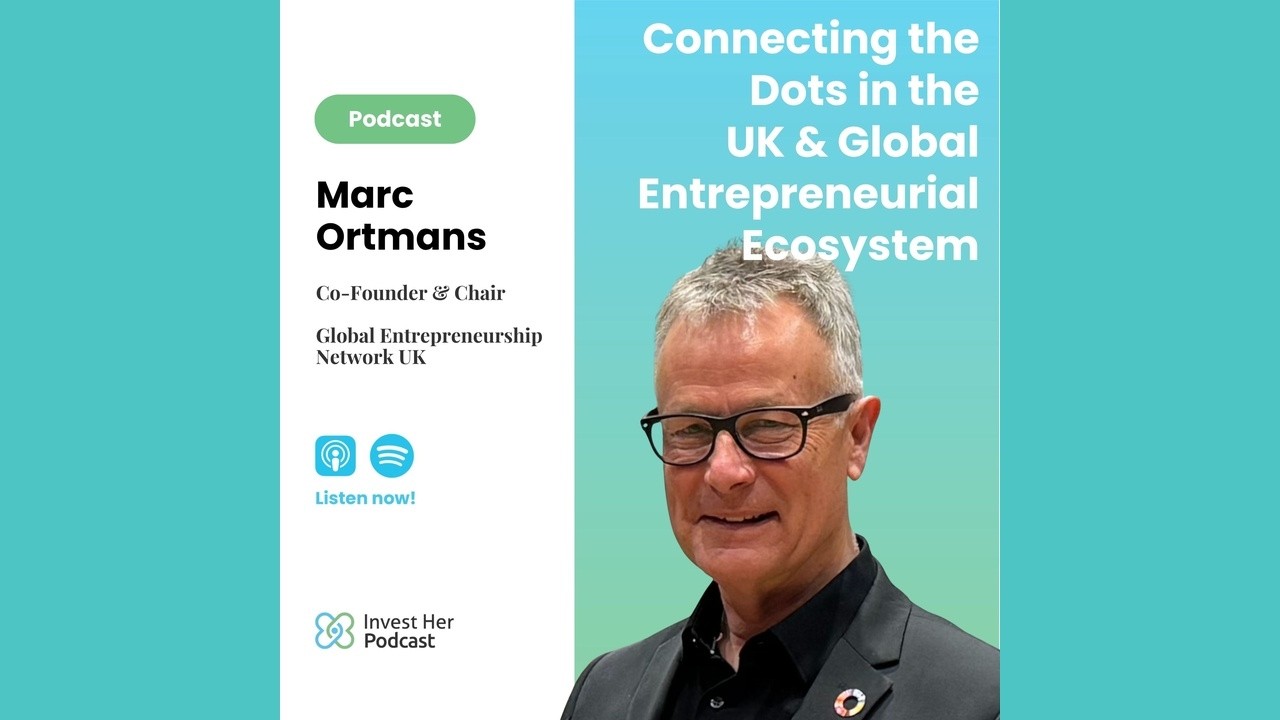
In this episode of the InvestHer Podcast, host Anne Ravanona interviews Mark Ortmans, leader of Global Entrepreneurship Network UK (GEN UK). Mark recounts his career from graphic design at the BBC and Channel 4 to founding a design agency, then pivoting to entrepreneurship advocacy after the 9/11 downturn. He explains the origin and evolution of Global Entrepreneurship Week (GEW), its expansion to 200 countries, and the creation of the Global Entrepreneurship Network (GEN) as a neutral, non‑political umbrella that coordinates country‑level chapters like GEN UK. The conversation covers GEN’s flagship events – the Global Entrepreneurship Congress, annual GEW celebrations, and the role of ecosystem mapping and data (e.g., Startup Genome) in shaping policy and investment. Mark highlights several impact programmes: the Restart Ukraine online accelerator for displaced Ukrainian women (200 participants across three cohorts, now focusing on tech founders), the Lazero Innovation Prize for green mobility, and Startup Planet’s sustainability‑focused conferences linked to COP 26‑27. He shares concrete examples of grassroots innovation (cold‑storage solutions in Congo, Life Bank’s blood‑delivery motorbikes in Nigeria) and discusses how GEN UK connects ecosystem actors, mentors corporate partners (KPMG, Accenture), and seeks funding to scale its initiatives. The episode ends with a call to action for listeners to support women entrepreneurs, attend GEW events (Nov 18‑24, including Global Women Entrepreneurship Day on Nov 19), and contact Mark for partnership opportunities.
Chapters
So welcome everybody to our latest episode of InvestHer Podcast. And I'm absolutely thrilled to have with me today Mark Ortmans from Gen UK. Now you're going to understand what Gen UK is in a minute. And I'm going to let Mark introduce himself. But I want to say, Mark, I'm so happy to have you with us. And it was just so fortuitous that we met in Westminster a couple of weeks ago. And we just hit it off. And I want the world to hear about all your good work because we're so aligned on values and everything that we're doing. So huge welcome to you.
Well, thanks so much, Anne. Yes, I mean, as you say, we— I think we identified there's probably about, you know, 100 different topics that we want to get into an animated conversation on. So yeah, wonderful to get an opportunity to talk about some of those today.
Wonderful. So let's start a little bit at the beginning, Mark, because I want people to get to know you as the ecosystem shaper that you are. Like, what brought you to become an ecosystem player, shaper for entrepreneurs and specifically in the UK. What was your journey to coming here? Like short and sweet because we want to get into all the rest.
Well, just in headline terms. So I started as a graphic designer in television working for the BBC creating title sequences for programs. So that was a wonderful start. So I had 5 years there. doing shows. Anybody knows the kind of UK TV scene, things like Top of the Pops and Little and Large and all sorts of entertainment, Wogan and lots of shows. And then moved on to Channel 4 and ran the presentation graphics for Channel 4 as the head of design. And then there was a move towards uh, designers starting to understand a lot of the technology that the traditional commercial world didn't really understand. So, uh, because we're in a kind of special effects area, and, um, so we set up a company, uh, Altmanns Young, uh, which became Altmanns Young Internationals. We got more and more widespread in our briefs, um, and did that 15 years creating commercials Launching a lot of TV channels. I think about 20 different news programs around the world, from CNN to Channel Five here and Sat. Eins in Germany and and so on. So it was a wonderful mix and a wonderful adventure. Then, of course, we had 9/11, which paused the economy globally, and we were in that wonderful position where we had million pounds worth of business on the books, but they'd hit the pause button. So we decided to close rather than. Wait it out, and it turned out to be probably the right decision. I then moved into doing brand strategy as well as continuing to be a freelance director. I then got asked to run a company called Button, which had offices in Los Angeles and Cannes in France and London, and that was in the business of exhibition design and print and a whole range of different disciplines. Um, and while I was doing that, uh, Gordon Brown was meeting, uh, in London with the Kauffman Foundation, and they decided to come together and form Global Entrepreneurship Week. Um, well, my brother was involved at that point, uh, and currently is now the president of, of the network, but, uh, we'll come on to that later, but Uh, in that he— I, I had my arm twisted, as brothers only do, you know, could you brand it? You know, I have no budget. Um, so that's, that's where the kind of that journey started. And then—
Okay, hold on, pause, pause. That's super cool, super cool, Mark. I didn't know it. So you're the man behind the actual brand, the actual look of Global Entrepreneurship Week that we all know and love.
Yeah, the, the compass, as we call it.
Yes.
So it's how you navigate.
That's amazing.
So yeah, and it really was a fairly straightforward idea of an abstraction of international flags, national flags, turning them into bars of color. And there's an interesting story on that, is that a few years later, the UN came out with its SDG Goals badge, which looks remarkably similar.
Yes.
But, uh, and it's remained a very good talking point that we didn't sue.
That's how similar you are.
That's it. For those who are listening, there's Anne showing me it on her water bottle. Um, so, uh, anyway, so that was, that was the beginning. And then doing promo videos for Global Entrepreneurship Week, the first one was in 2008. Uh, so I think we've now hit If you can believe it, year 17 of Global Entrepreneurship Week, and it's grown and grown and now is celebrated, as it will be this month and every year, in 200 countries.
Wow, wow, wow, wow. And like, what was the— so tell it now, tell us a little bit more about the impetus behind Global Entrepreneurship Week and then your role as, as the leader of Global Entrepreneurship Week UK. So what's the objective of Global Entrepreneurship Week now that it's in 200 countries?
Yeah, yeah, it's a good question because if you flip back to 2008, not many people were even using the word entrepreneur or even knew what it meant. And, you know, I think, was it George Bush saying You know, uh, what's French for entrepreneur? You know, um, uh, but, uh, so I think it was starting to introduce it as a concept to people that they didn't have to take a job if they could find one, they could make a job.
Hmm.
And, and that was driven by also, uh, the benefits of entrepreneurship, um, several as we know. And, um, and those are, for example, it's a meritocracy. So it doesn't matter upon your background or your education. It's down to if you've got a great idea and you're able to run it as a business. And so it's a great leveler in that sense of opportunity. Beyond that, it also was an opportunity of— it's a creator of jobs. You know, all new jobs in the economy and most of the GDP growth comes from the startups.
Hmm.
Now, against that, you've got over the years different numbers according to country, but a huge death toll of startups in the first 5 years. You know, it can be up to 80%, depending on where. So that's an awful lot of sweat, effort, sacrifice, money, time that goes south in that, those situations. And some people learn from it and they start, pick themselves up and do it again. differently. Uh, some of them should go to the wall because they're not actually a very good idea, they're not sustainable as a business, or the founders actually maybe are not, not that able to run a business very well. So, um, so one of the things that's emerged over the years is starting to kind of understand, if you like, the science of entrepreneurship. You know, how can we guide people to— well, well, one, to fail fast if they're going to fail, but also to avoid failure if they didn't they shouldn't have failed. They accidentally failed through oversight and other things. So that's how that kind of started. And, um, so Global Entrepreneurship Week really started as a campaign, a one-week campaign.
Mm-hmm.
It was so successful in many countries, the brand was being used throughout the year because nobody else had an entrepreneurship global brand in their— these various countries. And so by the point we got to, I think, 2015, we introduced what I called retrofitting a parent brand. So you had all these orphans, uh, including, you know, we were running a congress, which we continue to do every year in a different city of the world. We've got, uh, um, organizations like Startup Nations. We bring together all the business angels associations from around the world. all the researchers, the policymakers, and so on. So lots of activities going on. So now they could all sit under one parent brand hat, which is— we called it the Global Entrepreneurship Network, GEN for short. And so that's really helped hugely. And then as part of that, we launched GEN Countries, of which UK is one of those, an example of that. and continued to run the week. And, um, so we've found that Global Entrepreneurship Week is, uh, not always hosted or by the same organization as the country. And in some places there is no country organization, there's just a Global Entrepreneurship Week campaign organization. So sometimes there are government departments doing it, um, and sometimes they're private organizations that are doing it, uh, and so on. So it's a Every country is slightly different. And the other aspect of this, which is quite important, is the state of, of an economy in every country is hugely different, as you know. And therefore, the role of entrepreneurs is either very developed or at a, at a much more fundamental level, just getting started.
Yeah.
In terms of recognition.
Yeah.
What the brand offered was an opportunity for people in those countries to get recognition by their government, that to be able to support programs and so on. So to kind of formalize the, the advocacy of entrepreneurship and education, and, and that's another part of it, is connecting with universities and schools and All of those aspects.
Yeah.
So it's, uh, it's interesting because it's remained fiercely, uh, non-political, um, and it's also non-commercial. Effectively, everybody's a not-for-profit or charity, largely run by volunteers in a lot of cases as well. So So that has meant it's, it's, I call it, we fly the Swiss neutral flag, which is a huge advantage because it means we can be a go-between catalytic organization and enabler between governments and private sectors and other interest groups.
Yeah. Oh my goodness. It's, it's so, I'm writing to those who are not watching this video, I'm writing Profusely. I'm taking lots of notes of what you're saying, Mark, because I think it's a fascinating story, and it's great to hear the backstory about how, you know, the whole Global Entrepreneurship Network was born and the importance, the impact it's having. And also, as you say, the stages of its growth from like a movement into much more than that, into, no, actually, we are a key ecosystem convener. and gatherer and an influencer for good, and to be able to put the spotlight on certain players in a very neutral way. So you, you, it's, it's amazing what you have achieved, um, globally. It's absolutely amazing. So tell us a little bit more about like, how does it work? So you've mentioned these different things, this Global Entrepreneurship Week, There's the summit, there are country events, and I know you've other initiatives which we're going to get into a little later, but maybe drill down a little bit more. So now you've given us the history of it, what actually happens during Global Entrepreneurship Week globally? And then let's go into, um, Global Entrepreneurship, uh, Network UK.
Yeah, I, I think, um, it's always struggled to some degree because it's trying to balance the needs and the opportunities of what you might call the B2B ecosystem research policy side with the, what you might call, B2C, traditionally to consumer, who are the entrepreneurs, the startups. So how are we talking to them and supporting them directly? So on the B2B side, we have this thing I think I just mentioned, the Global Entrepreneurship Congress.
Mm-hmm.
So the last— we were in Melbourne last, uh, September in '23, uh, then in, um, the spring we were in Cape Town for a regional one bringing together 43 African nations.
Amazing.
Uh, and in the summer in Puerto Rico, uh, bringing together the Americas. And the next one is actually going to be in the US next June, and anybody wants to attend You're very welcome.
We will put the link in the show notes so you will be able to get information.
Yeah, um, and that's going to be in, uh, Indianapolis in Indiana, the state of Indiana. And, uh, that's first week of June 2025. What happens at that? Well, we get, um, I mean, in Melbourne we managed to get 123 countries represented, um, out of our 200-country network. That was really quite an achievement to get them all down there.
Yeah.
Um, And it's an opportunity. And who are those people? Maybe it's worth just saying that, that you've got the ecosystem builders, all those ecosystems or entrepreneurship support organizations. Somebody likes calling them ESOs. There's always initials, aren't there? And then you've got the policymakers. So we bring together ministers and their teams. So we have a ministerial, what I call a kind of Davos for entrepreneurship. And we put them all around one big table, which is usually a giant Compass logo, which is quite an impressive thing to see. And then they spend the day and a day before and day after exchanging ideas, policies that work, some of the data that comes from different places. I know some of the projects you're working on would actually be great input.
I'm thinking that immediately as you're saying, I'm like, we should be— we will definitely talk more about that.
Yeah, because we work with Startup Genome, which I think we've mentioned, and they do an assessment of all the ecosystems worldwide, all the cities. So that kind of information sharing, experience sharing is a very powerful opportunity. And again, because we're non-political, you've got a lot of countries that wouldn't necessarily even be sitting at the same table, but they're talking about entrepreneurship.
Yeah.
I won't name countries, but countries that you are not talking officially are having side meetings because their ministers are there. They can have a, you know, an unreported, unrecorded, unofficial— lots of uns— conversation. And So, I mean, that's not the purpose, of course, but it's, it's definitely one of the benefits that flows out of that kind of coming together. And we've been in some interesting places. We were in Moscow in 2014, uh, Crimea was being invaded, so that, that was an interesting one when we're being hosted by the, the city next to the Kremlin, just to make it even more, you know, poignant. Um, And yet, uh, you know, later we were hugging Russians in, in Istanbul because while our governments were arguing on different things, whether it's poisonings in Salisbury, we were, uh, able to kind of rise above that with entrepreneurship. So, um, so it is a great way of, of— it's a kind of— has a peace dividend to it, I suppose, or a kind of— because it's on a human exchange basis. So what else goes on? Well, we've got awards.
Pause, pause, pause, Mark, because remarkable. I just want to say that is remarkable what you've just described. You have described like a United Nations of entrepreneurship, basically. Let's call it that. You have created the UN of entrepreneurship. I'm calling it that anyway. And I think it is remarkable. And it's so needed. And I think even more now, and you know, I will always bang on the drum for women's entrepreneurship and what we can contribute to those global economies and so on. But it's so necessary because you know that the majority, like you mentioned earlier, the majority of jobs in everybody's economy are coming from private companies and from a lot from startups. I mean, that's where the majority are coming from. And I think it's incredible how many governments are slow to recognize that. You know, they kind of manage all the big budgets and, and so on, but they are slow to recognize where it's coming from. Yes, it's the big corporates. Yes, they have to manage all the government stuff. And as we know, it is the small businesses who are the backbone of all of the economies all around the world. And I think it's radically important. And I use that word radically. It is radically important. And what the work that you do to, to put the spotlight on entrepreneurship as a class of its own, as you say, a meritocracy, but as a driver, an engine for economic growth, but also peace and innovation. There's so many angles to entrepreneurship. So I just wanted to flag that and say, congratulations on all the work that you, your brother, and the whole team around the world have done so far. because it is so needed. You— what, what you've described is like you've taken entrepreneurship out of the shadows and you've really put it into the spotlight, but also as a, a mechanism for bilateral things that you just described. So I think that's— you have to please take a lot of credit for that because It's really difficult. What you've described very eloquently has taken many years to get to, and you've described it and told that story, and I understand the blood, sweat, and tears that have gone behind it. So congratulations on everything you have achieved so far, on everything the organization and everybody has achieved so far. And like, it's just so needed. So thank you for all your hard work.
Thank you.
because I'm sure not many people tell you thank you. So thank you, because I know you've been working like a Trojan behind the scenes for many, many years. So I'm glad you're in the spotlight in this podcast to say thank you to.
Well, thank you very much. And it, it, it, yes, it, it is. I think one of the drivers is you just feel you're making some kind of difference. Yeah. And, you know, I think you know, any of us are very lucky in this life, um, that the reward for your work is that you actually make some impact.
Exactly.
Positive impact for, for people.
Yeah.
Um, not just making money or anything else. And so I think that's the, the kicker really to it. And, and, and I think it's also, um, I mentioned before different countries, you know, 200 countries. We've got small island states, And then we've got, you know, huge countries, you know, China's involved and America. And, uh, and so you've got that cultural mix and also the cultural sharing going on. Yeah, I sometimes describe our, uh, Global Entrepreneurship Congress as a bit like that old, uh, commercial, I'd like to buy the world a Coke.
Yeah, yeah, I watched it not, not long ago. I need to show my kids, who are adults now, because they don't— I think I showed it to them and that song. You're going to— thanks, Mark, you've stuck that in my head now because I'm a '70s girl, so I'm gonna remember singing that song in my head all day.
And it is really the way it works. So, and that's why I, you know, encourage people to kind of come, come along to the Congress because it's, uh, really where you do meet the world. And for me, over the years, it's become my kind of global family, if you like. Um, and everybody's there to help each other. Yeah, it's not like going to a commercial, uh, expo or, or trade show where everybody's selling each other.
Yeah.
Um, you know, the, the, the mood and the atmosphere is completely different. So, um, so that's— yeah, that's the Congress. And then, as I say, we get involved with lots of other things. The, uh, the countries allow us, or the country model like GEN UK allows us to do other things throughout the year.
Yeah.
Every country has its different challenges, so, and it's probably actually ironically hardest for countries like UK because it's such a developed economy with— I mean, we are, we have so many, I mean, I can't even remember the number, but it's, you know, well over 600 accelerators and incubators in the UK. Now, some countries are, you know, struggling to get to 10.
Yes.
And then if you look at the investment options and the, you know, the tax breaks and, and, and, and the system is very sophisticated to support startups and scale-ups. Still a lot of work to do.
Yeah.
But the opportunity for us to intervene and really create a revolution there is a lot more limited, ironically. But equally, it's giving a hand up to those other countries where they need to be able to get the insights and learn from the lessons and the proof of performance of what the more developed countries have done.
And I mean, I totally agree. We mentioned earlier in preparation of this call that like I'm working on a funding blueprint with Dell Technologies of this different, you know, funding blueprint for women entrepreneurs of sources of funding in London. And I mentioned some nationwide ones too. But it is is spectacular. And London is the number one city in the world for women entrepreneurs when it comes to funding. But because of— thanks to many things, all of them systemic, um, and, and it is built on many, many, many, many years and centuries of, you know, systemic leadership on the one hand. But it also— to you say, like what you, what you just said, it's London is, um, and the UK is very sophisticated. You are far ahead on so many things. Yet, as you rightly said, there's still work to be done. And what I like that, like what's so progressive on the tax incentives, that's like the EIS, the SEIS, like we're— that is world-breaking. We'll put links to this. We're not going to go into details here. But just know, for those of you listening, it's very, very, very fabulous tax incentives. You invest quite a lot of money, 6 figures into startups, you can get very, very nice tax breaks. And even if you lose the money, you still get a tax break. It's amazing, an amazing system. And that, like, I've actually put forward in the W20 work that I do as a best case, you know, best practice to say this is what many more countries should be doing to incentivize personal, you know, private angels and investors to invest more in startups because we still need the money. But come back to And back to, to GenUK. So your work with GenUK, Mark, tell us a bit more about your role and how have you, in this complex context where you are very advanced as the country and the nation is very advanced economically and organizationally and ecosystem-wide, tell us a bit about your work within that constraint. But also, I like already how you've said, and that's just you, you wanna help others. And it's like, how can we share what we've learned, what's worked in the UK that could be useful, culturally adapted in other countries? Again, not copy paste, but it also has to be culturally adapted.
Yeah. And as I say, we've, we've tried, you know, thought about this a lot about how, you know, we can be of value and make, you know, some, some useful impact. So we've picked topics that have been you know, interesting where, you know, we don't need to run accelerators and incubators. As I mentioned, they're coming out of our ears. And, but what we can do is, is we can very— I mean, one of the— somebody called me the other day, you're a dot joiner.
Yeah, you are.
And I love doing that, actually. It's actually, you know, that's a sport in itself, is connecting people you think should be working together. And that's you know, for example, trying to, if you take cities, for example, there's a lot of organizations within a city that might be working and aligned in their missions, but they're not working together.
Yeah.
So, and sometimes they need to be introduced, even if they're next door to each other, it's ridiculous, but there you go. But then also recognizing, you know, we've talked about ecosystems and, you know, one of the ways you really make that more effective in the way you manage it and the performance of it is to map it.
Yes.
And, you know, and that's almost physically mapping out a city, let's say, where you work out what are all the sectors, how much investment's going in, what kind of companies are they, how big are they. So you kind of model it. So instead of seeing little houses on the map, you'd see lots of little companies and much larger ones. Um, I mean, I was talking to the marketing director of Nottingham the other day, and she'd only just got into her job, but she said, you won't believe it, but I've just discovered we've got a fintech sector.
Hmm.
And so that was an example of, with, with a closer, more kind of holistic approach to discovering what's under your feet, you'll be quite surprised that, you know, there's gold in there, and that starts to affect policies about and demands for training, opportunities for jobs, inward investment, local, you know, neighboring city trade and collaboration, export, you know, all of that is interconnected. So I'm very keen that we kind of try and play a role of being the connector there and introduce also them to all the partner organizations that could help them deliver all of that. So, and, you know, the report you talk about is exactly the sort of thing we need to make sure that is distributed to mayors, for example, of cities. That's a very exciting area, you know, that mayors are really driving city futures. Other areas we've got involved with, the We talked about Russia earlier that, as we know, they invaded in 22. They invaded Ukraine. So after that, we thought, well, what can we do to help? Because, like several other countries, particularly in Europe, the trains and the planes were landing in the UK, and the majority of those refugees were women. Quite often, they also might have had their children. Young children, possibly a mother in tow, and needing to kind of reconfigure their lives as they'd been displaced. We discovered that a lot of them had had businesses or wanted to start businesses. We thought, well, that's an area we can assist with. So we set up a program called Restart Ukraine to assist them with starting a business or restarting a business, recognizing they were changing markets. Um, and effectively, it was, uh, it's been run as a kind of online accelerator for them, but in a slightly broader sense, giving them more mentoring and support, um, on a human level as well as a business level.
Yeah.
And helping them also become part of a network uh, of, you know, of fellow Ukrainian women, uh, in this— in these— finding themselves in these circumstances that they're living quite often in somebody else's house, they're working in a second language, they don't have their support network around them, uh, the tax rules are different, uh, exporting to the EU and so on, all of those things. So, but they have been the most extraordinary group of women. I mean, I You know, can't praise them high enough. I mean, they're very resilient. They are all pretty super smart. You know, the the education system seems to be working there, and very independent. You know, you almost have to twist their arm to take some support and help. But against all of that adversity, they are succeeding. So. We had an example.
How many women have been through this program so far, Mark?
We've run 3 cohorts and the total is 200.
Amazing.
200 women and their businesses. So our next stage is to, we thought, well, that's what I called our paramedic stage, you know, and now the dust has settled for many of them wherever they've been displaced. they, they're pretty much settled there. So we thought, let's focus on a sector because we can be maybe more, uh, targeted in that way. So we're looking at female founders with tech businesses from Ukraine, and, uh, so that, that all the focus will be on start and scale in tech for Ukrainian women.
Yeah.
Somebody said, well, are there that many? And I said, look, I've stood in a room in London where there were 200 women. None of— well, actually, there were only a few on our program at that point that happened to be in the room. But 200 women, they were all in tech, all Ukrainian, and they're all standing in the same space in London. I thought, wow, that demonstrates if we've got 200 in the room, how many more are there? You know, thousands.
Thousands, of course.
Wow. And I have to say, at that point, uh, NatWest and Mastercard was signing them up as fast as they could because they could see they had this amazing inflow of tech talent, uh, for all of their projects. So, uh, you know, hats off to them for their support. But, um, so that's our intention. So we're, uh, we've got amazing software companies that are offering all their expertise, uh, as mentors and as tutors Um, plus, uh, we've had support from people like LinkedIn before who've given us a grant. They provided free licenses to the women to be able to network, and then they also taught them how to network successfully on LinkedIn. So a lot of practical hands-on help. Um, we have software that we offer them, uh, the Canva, Canvas style, which allows them to model their businesses. And we train them on that as well. So trying to make it as practically beneficial as possible. Uh, so we're really quite pleased with that because it, it's taken quite a lot of time to design and develop and, and run it, but it's really delivered. You know, if you look at the testimonials from these women, it's, it's, you know, very, uh, rewarding to, to see that We made a difference.
So, oh, okay. If you were watching this, you'll see me, huge smile on my face. And again, I want to say thank you so much, Mark, for what you've done for them. That's amazing. And like, I'm just so proud of them, as you say, because despite every piece of adversity thrown at them, they are thriving. They are full of grit. Oh, and they are They are going to become, I would say, in the future, until they can go back to their home, they're going to be a backbone again in the UK economy, a bit like what happened when we have a lot of Indian, Indo-American start-uppers who are doing incredibly well in Silicon Valley, and they've taken it over by storm.
Yeah.
I foresee these Ukrainian women in tech being an incredible group of formidable businesswomen making change and impacting as well. So It's fantastic what you've been doing to support them. And, you know, I can't wait to share the links about all of your work here in the podcast and more broadly, because, yeah, we're going to do lots of things together. That I know. Because indeed, well, I mean, we have to showcase some of them here on this podcast, Mark. This is an open invitation. We need to showcase some of them. Yes.
Yeah, no, indeed. And I you know, we're very keen to do that. We, we like to, in a kind of rather grand way, we call it building an economy in waiting.
Yes.
Because, and that's why I'm particularly excited about the next cohort being tech businesses, because, uh, that's going to be really quite an important area. And particularly if we, because they're tech businesses, they're likely to get some investment from the UK and, uh, and so on. So we can grow them into something a bit bigger and more meaningful that can make a greater impact on their economy when it gets, uh, you know, reconstruction is allowed to go ahead.
Yeah.
Um, so yeah, so, and, and interestingly, now we've got that model, we've thought, well, uh, again, we need supporters to make these things happen. But, uh, if you take the fact that, uh, There are still a huge number of Afghani women who came out after the Brits and the Americans and everybody else pulled out of Afghanistan, who are still not properly placed. They're still in hotels, but they're the kind of forgotten group. But we could be supporting them. There could even be a role for Palestinians, men and women, in the future.
Yeah.
So we can see that we've got this ability now to be able to support specialist groups. So that's probably one of the greatest.
And talking about joining dots, it's already— dots gone off in my mind because when all of that happened in Afghanistan, a couple of my sisters in W20, we got together to, to work on that and to helping supporting them. So 2 of my sisters who are lawyers, they managed to get over 100 women out. before the doors closed. It was amazing, and they've been supporting them in their new lives in other countries. And again, I'm protecting their identities, but there is a dot there to be joined because again, some of them are young women who are now studying in the best business schools or the best engineering schools in those, you know, welcoming countries. And I think it would be great to join the dots on that. So I'll definitely pick you up on that. And again, okay, there's so many dots. I mean, Mark, when I met you, I said there are gonna be so many dots. So tell us more also about Startup Planet, because that's the other major initiative and work that you've been doing recently on how can we get to net zero. So how are you supporting startups in that frame? In that?
Yeah, it came about because COP26 was held in Glasgow. So it's in the UK. And that coincided timing-wise with Global Entrepreneurship Week. So we thought, well, why don't we have a kind of, uh, green sustainability focus? Um, and we got talking to our friends in, uh, our GEN friends in, uh, Copenhagen in Denmark and decided to collaborate and do it together. So we set up a— we did a one-day conference in Glasgow, and the idea was really just to recognize, um, the views of startups, to air them, to make them a little bit more visible. The, the UN called those net-zero startups the unheard voices, so we're very keen to kind of recognize that as a challenge to to overcome.
Yeah.
And, uh, so then following that, we thought, well, what do we do now? It's moving down to Sharm el-Sheikh. That's not really in the UK. But I've always been, uh, slightly criticized by our global teams, um, that, you know, to stay in your box, you know, you're supposed to be looking after the UK. Uh, and so my argument's always been that the UK's, uh, for hundreds of years has been dealing with the rest of the world. So you can't really keep us down. So it's quite difficult. No. So we found ourselves down in Egypt doing a conference there. And again, just starting to— we did a lot of them online because of the difficulty of trying to mount an event down there where there were probably more waiters than entrepreneurs in Sharm el-Sheikh for COP27. We did do something interesting, which is quite fun. We this is what happens when you have a drink with a friend and go, what if? And we thought, wouldn't it be fun if we could drive the road from COP26 to COP27 in an EV? So we did. We, uh, a wonderful woman, Clara Stone, uh, who's a rally driver amongst other things, um, she, she actually drove the, this Kia, uh, EV from the Glasgow Science Centre through several countries across Europe, stopping in at the British Embassy, different embassies in different countries along the way for a cup of tea and a charge.
I love a cup of tea and a charge.
And dropping in on sustainability centres. We had Bloomsbury Radio covering her daily, you know, so, Clara, where are you today? You know, Uh, drop-in interviews. Um, she could only get as far as Athens, I'm afraid, because there's no charging network in Egypt, and there's, uh, we couldn't drive through Syria for obvious reasons of the war. So we did actually pick up a second car down in Sharm el-Sheikh and, um, uh, badge it up and take it to the Green Zone. So we did as well as we could with that. Anyway, that, that was a kind of just a for-fun exercise, uh, which got out of hand.
You're dangerous when you have a nice drink with somebody.
I know.
I like it. I like it.
But it, I don't know, it just made us smile to give it a go. So we did. And then we brought entrepreneurs together from different parts of the world for, I think it was about 8 or 9 panel sessions online. And that really covered all sorts of topics. But it started to expose to me the most exciting part about this whole net-zero innovation area is at the heart of making any impact that's going to help us achieve the UN goals. It all starts with an idea from an entrepreneur.
Yeah.
And the innovation is the value that's created And then it struck me that there are 2 other groups that we need to make that work, and that's the investors, the ESG investors.
Yeah.
Plus the policymakers who are casting around looking for ways to deliver on their targets of getting to net zero by 2030, '40, '50.
Yeah.
And so in my simple way of trying to understand the world, I thought, well, if you can put these 3 people in the, in the room together, you're on your way to being able to get it adopted, funded, and scaled, and creating an impact.
Yeah.
So that's the thinking behind it. Uh, last year we did it again. We had, um, got even more mad. We, um, I teamed up with the University of Birmingham. They have a fantastic, beautiful campus in Dubai. And so we put together a 3-day conference, um, there. And so I ran 3 days of plenary sessions, which nearly killed me.
Uh, sure.
Particularly when you find you're the MC, the interviewer, and the wrangler of getting the speakers to turn up.
I empathize a million percent. Been there, got that t-shirt, know exactly what you're talking about. Go on. Yes, you did the 3-day.
So that was, that was good fun. And we also ran last year, I set up another What If that spun out of the, um, the, the taking the car on a rally. We called it, uh, we created something called the Lazero Innovation Prize. And so that was around, uh, green mobility and, uh, and everything connected to it. So energy charging, batteries, and so on. So we got entries from 32 countries, which was remarkable.
Yeah.
But again, finding some extraordinary solutions.
Yeah.
I mean, I'll just tell you very quickly one, if that's of value, which came from Congo. And what was interesting is it wasn't about new high-tech. uh, solutions. It was the application of existing technology to make a difference. So if you're in Congo and you're a farmer, um, probably about half of your produce is going to rot or go to waste because you can't get it to market in fresh condition, uh, or when you get it to market, it's, it's oversupply, and so it goes to waste. So, uh, The solution they came up with, which they'd started to build, was leasing cold stores to farmers. So if you imagine like a container, yeah, that sort of size with solar panels which had cooling fans inside. So that meant they could keep their stock once they'd harvested it and choose the right moment to take it to market when the market price was going to be best.
Yeah.
Then to transport it into tricycle boxes with boxes on the back, again with the solar panel that kept it cool on the way to market. So it's just solar panels and it's a lease scheme, but those 2 things were a very powerful way of adjusting that or dealing with the problem of food waste. And in a country that's struggling economically, at the best of times. So what I really liked about that was that made a really great impact. It was avoiding the waste of, of those farmers' toils, uh, and feeding people better, people better, and probably at a better price and so on ultimately. So, um, and those farmers were going to have a more sustainable business, and they didn't have to invest in capital, uh, projects like building That's amazing.
You're reminding me of Temi from— so she's a woman entrepreneur, I think it's from Nigeria. And so she set up a company called Life Bank. And basically, it was to transport blood freshly by motorbike to where it was needed and when it was needed, because, you know, when people needed it for operations or whatever, after major accidents, etc., etc. the ambulances couldn't make it through on time, and people were dying because they were not getting the blood that they needed or the blood products. And so she created a business in Nigeria to begin with. Now I believe she's in several other countries in it, on motorbikes to get the blood to where it needs to be and the plasma products, etc. Ingenious as well.
Yeah.
But again, coming from, you know, a need where, you know, somebody who she loved was in need of blood. And I don't know if they passed away, but it was one of these ones. I had another amazing woman entrepreneur who set up— she had her best friend died again, I believe it was in Nigeria, because she took fake medicine. But the fake medicine was given to her at a hospital.
No.
Right. It's the, it's the, it is the distribution chain. Because unfortunately, you know, in lots of countries in Africa, A lot of placebo or wonky medicine are sold on marketplaces and so on. And somehow this counterfeit medicine had made its way into the hospital delivery chain and her friend died from it. So she created up a whole system to be able to verify and do the delivery chain, etc. So, you know, again, I loved your example. And that's why I love giving these examples of the women entrepreneurs as well to say like, it's It's incredible. The— that's what we love about entrepreneurs. It's like when, as you say, using an existing solution, finding another application for it doesn't have to be complicated. It needs to work where it needs to work. And that's amazing what you described. So, Mark, we're coming to the end of this episode. I could speak to you for hours. And I just am conscious for the— for our listeners to say, okay, this is cool because it's a great, really in-depth conversation. Let's just take this as number one, Mark. We will need to have more because, you know, I think let's, let's have an open invitation. I like to give open invitations on this podcast to some of our amazing guests. So what I want to say is like, how can, how can people and organizations support your work? So how can they be sponsors or partners to the amazing work that you're doing? at GEN UK?
Well, we, we have an open door to all those conversations, really. It's really down to what somebody wants to achieve. So are they looking for a project that they, you know, would like to champion, either because it fits with their CSR goals, or whether it's in alignment with their business, or what they're trying to do with their staff. So for example, you know, we've had companies like KPMG and Accenture who they've loaned us their people to be mentors.
Yeah.
So, and that's a nice thing to offer to your staff, you know, that you can do a kind of give back.
Yeah.
So that's, that's an opportunity. And I, and Also, we can create projects, you know, it doesn't have to be something we've actually built already. So what are they, you know, what would they like to do that we could help them deliver?
Yes, right.
I mean, ultimately, there's always the practical reality that we need money to make these things happen because we have to pay some people to do some of the roles. We've got a platform and that has a cost, but, you know, covering costs is what we're talking about rather than anything else. But more to the point, it's about— and also the value is that because of our network, we can bring in all sorts of brilliant and expert people to make something happen. So if, you know, I'm really open to those conversations. In terms of Restart, we're looking right now for funding for the, uh, the next cohort.
Mm-hmm.
So that's, uh, and that's ready to go now. We've got all our mentors and, uh, organizations in place to be able to deliver that. Plus, um, we have a complete learning management system on our platform now. So, uh, right through to— they will finish the course with a certificate. You know, so, and we then, you know, the other thing is, which is good out of these, is that it's not just all that time period. There's an alumni that can build up.
Yes.
So particularly, you know, we're talking, imagine the tech alumni of women entrepreneurs from Ukraine that emerges because they all went through together. Yeah. And what that means in the future. Yeah. How, you know, do those relationships evolve?
Yeah, I love it. Amazing. So how can people contact you? Like, so, okay, we're hearing there's opportunities, there are opportunities for custom bespoke projects, basically for any organization to reach out to you and say, okay, how can we find a common goal and support each other? Right? And then you've specifically the opportunity for Restart Ukraine. If anybody's listening, please reach out to Mark because he's there with open arms and ready to make more impact. And so that's fantastic. How can people contact you, Mark? What's the best way?
Well, I'm not quite sure where you'll put details afterwards and links, but by email, very happy. You can go come direct to me, which is— I'll spell it out.
mortmans@genuk.org. Yep.
mortmans@genuk.org. And, uh, uh, you know, we can start a conversation there and then. So, um, and then, uh, also, as I say, we have events coming up. We've got, uh, I'm organizing the national launch of Global Entrepreneurship week. In the UK, that's on Monday morning of the 18th of November.
Yeah.
So we're gonna have a whole wonderful lineup of people to speak there. I'll do a little spoiler alert. We've got, I think we've got the Mayor of Manchester, Andy Burnham, who will be speaking, and various other people covering different areas, including some fantastic entrepreneurs.
Amazing.
And I think we've even got the fastest woman race driver in the UK.
Cool.
Inspire a girl from Hull who's broken her back and still getting in the seat and doing it. So determined. And so that's an opportunity to meet in person. And of course, there's lots going on during Global Entrepreneurship Week. And we can put links afterwards for people to find that, I hope. And come and say hello and join all these events that are going on everywhere, wherever you are, because, you know, we're in 200 countries. So I'm sure there's somewhat something happening near you during the week, 18th to 24th of November.
And thank you for all your work. And I want to remind people that women entrepreneurs, that Global Women Entrepreneurship Day is on the 19th of November. It is part of that week. So that's what we celebrate, all the women entrepreneurs around the world. So you can bet that we'll be, we'll be shouting out about amazing women entrepreneurs. But thank you so much, Mark, for this wonderful conversation and for much, much more. To all of our listeners, as you are listening, and I'm sure the light bulbs are going off as you were listening to Mark, share this episode with somebody you think needs to hear about the amazing work. Learn about, um, Gen UK, learn about Global Entrepreneurship Week, learn about Startup Genome, learn about, um, Restart Ukraine, about Startup Planet, all the initiatives. But what I hear is the humanity, the, the dot connector. That's what I hear. And so share. I want you to share this episode with people who you want to feel inspired by this, to other entrepreneurs, and particularly women entrepreneurs, to be part of this. And let's All be part of Global Entrepreneurship Week and your national, um, events. Get more involved. There's opportunities here to make magic is what I'm hearing. So I want to encourage everybody to do that. So thank you so much, Mark, for being with us today. Take it as number one, and we'll come back and do another episode again. But it's been an absolute joy to have you with us. So thank you so much. Thank you.
Well, thank you. I've really enjoyed it. And yes, I'm very happy to talk to anybody who would like to get involved. There's always ways we can do things. So if you've got some thoughts on that, love to hear them and we'll talk beyond that. But thank you so much. It's been a pleasure.
Wonderful. Thank you.
More from Anne



🎙️ EP69: Get Off the Fence: Renate Crollini's Startup Blueprint | InvestHer Podcast

🎙️ EP68: Radical Truth: Robert Rubinstein Exposes the Impact Investing Illusion | InvestHer Podcast



🎙️ EP66: Global Sisterhood — Carine de Meyere on Trade Missions | InvestHer Podcast



🎙️ EP65: Capital With a Conscience: Pierre Norman Rolin on Investing in Women… | InvestHer Podcast

🎙️ EP64: Dream Bigger: Nikki Barua on Building an AI-Native Company Without… | InvestHer Podcast