🎙️ EP48: This is Penny, Revolutionising Pensions for Women, with Lesley Tully | InvestHer Podcast
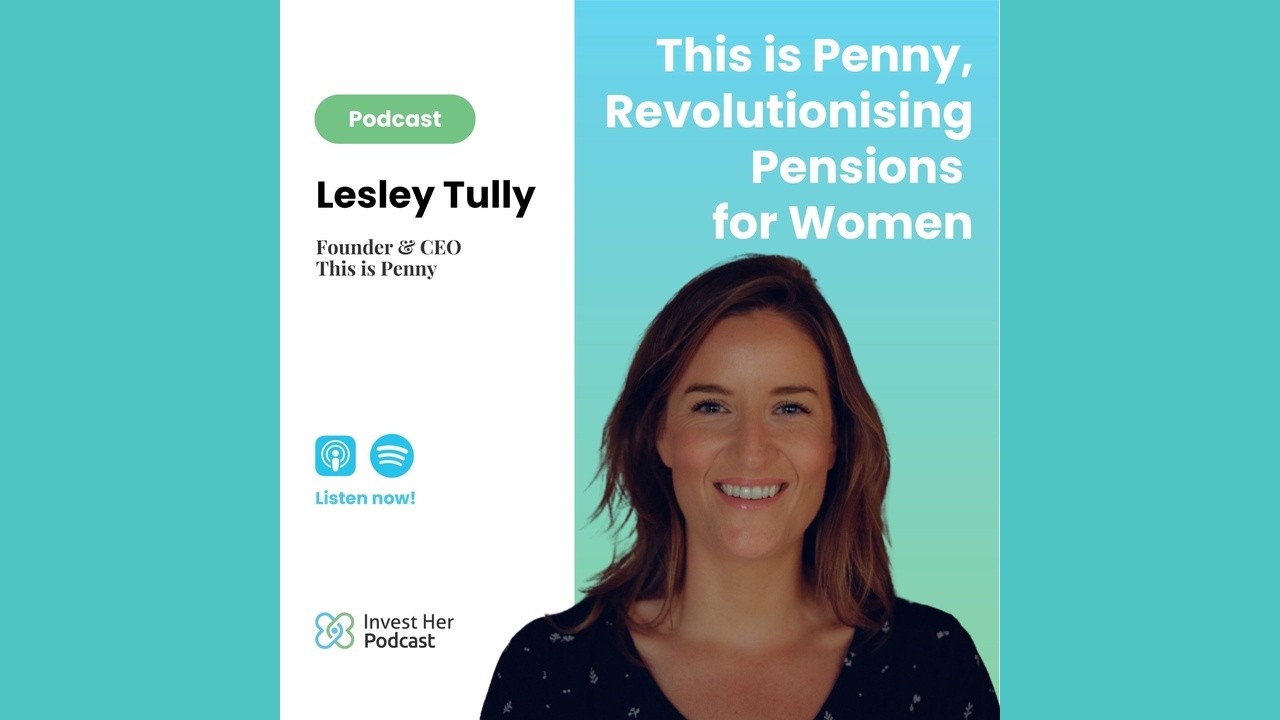
Lesley Tully founded This Is Penny to close the gender pension gap. Irish women have 40% lower retirement income than men, and over 500,000 lack a private pension. Her app offers a free calculator and education to help women plan for retirement.
Chapters
Welcome to this latest episode of InvestHer Podcast. If you are new here, welcome, welcome to the InvestHer family. We are delighted to have you with us, and you're going to get loads of great insights and information on everything funding women entrepreneurs. And if you are a regular, so great to have you back. So if you have clicked on this episode, it is because you are curious about this new tool called This Is Penny and how it can help revolutionise women's pensions and women and access to their pensions, how they manage their money. Now, as you listen to this episode, you're going to hear from Lesley Tully, who set up This Is Penny. And it's such an interesting one, because it really helps us to understand why it's important for women to think about their pensions, plan for it, invest in a private pension. So super important for us to learn how to do this and to build that residual wealth and also to build generational wealth. So I really think you're gonna find a lot of value in her key tips, in her journey, and you'll see how she's really worked hard and very thoroughly to make sure that this is an excellent product for you. Now, you will also hear us referencing InvestHer Summit Dublin. So by the time of this recording, it will already have passed, but no worries, you can click on the website link and learn more about the summit, which was fantastic in Dublin where Lesley was also a speaker. So welcome everybody to our latest podcast episode, Investor Podcast. I'm Anne, your funding friend, and I am so, so happy today to have with me my funding friend, Lesley Tully from This Is Penny, based in Dublin, Ireland. How are you, Lesley?
I'm great, Anne. It's wonderful to be on your podcast, and I'm so excited about Investor coming to Dublin in June. We're very excited over here in Penny headquarters. And I'm so excited to have you on the podcast.
Oh, well, we're very excited, very excited to have you speaking on the fintech panel. So if you are listening to this before the summit, come and see and hear all about what you're going to hear in even more detail. And get— come and meet Leslie, because it's always better to meet the person. So, but before we get into that, Leslie, I like to start off our conversation with, tell us a fun fact about you, something that people wouldn't know about you in general.
Okay, well, um, my fun fact, Anne, is I was once in a musical. Yes, I had a musical career even though I'm a terrible singer, but I had a musical career about 20 years ago and it was the most fun you can have with your clothes on. It is the greatest craic being in a musical, so that's my fun fact.
Do you want to say which musical, or people are going to be Googling now which one?
Well, thank— it's pre— it's pre-internet, thank God, so I don't think they'll find it. Uh, no, it was in Chess many, many years ago, which is a bizarre musical but great fun. Lots of chorus lines and dancing and costume changes.
I just know the main song, but that's it. But it's all good. Brilliant. Fantastic. Well, I love that. That's a cool fun fact. All right, so before we dive into what you're doing now, Lesley, tell us a little bit about your background. So how did you— before you became an entrepreneur, what were you doing? Like, what's your background? And then let's dive into what you're building and what you've built.
Yeah, sure. So, um, I— my background is fairly textured. I grew up in a family business which was a retail business and it was almost 100 years old. So I got to see firsthand what it's like to be a business owner. Both my parents ran and owned the business. So that was a very formative experience for me from the age of about 8. And I loved it. I never wanted to go to school, so much so that when my dad used to drive me to school, sometimes he'd forget to drop me off and I wouldn't let him know. So we'd both turn up at the shops and then he'd be like, bloody hell, you're supposed to be in school. And I'd be like, well, do I have to? So I love the business and it was amazing and it gave me my work ethic, I'm pretty sure of that. But I didn't end up going into retail for a couple of reasons. One, retail is a very hard business. It's great when you're busy, it's fantastic. When you're not busy, it's very slow. So I ended up going to art school which I loved, and I studied film, and I worked in film for a while, and film in Dublin was quite difficult in the late '90s, early noughties. The industry here was quite underdeveloped. So I ended up doing my first pivot, which was into the art world, and I stayed in that and loved it because it was this combination of creativity and commercialism, which is hard to find. If you love creativity but you also love money, getting those two to come together in a career is difficult.
Yeah.
So I did that, and I ended up running fairs in Basel in Switzerland and New York and in Dublin.
Wow.
And then I— yeah, and so that was really interesting. And so from there, actually, then I ended up going into banking. And when I look back, as Steve Jobs famously said, you can't connect the dots until you kind of look backwards. What I figured out is I like old industries that need innovation. That's actually what I'm drawn to. That wasn't my strategy, but that's ultimately what I'm drawn to, which is why I'm in pensions today, one of the oldest industries that needs both a lot of creativity and innovation. So that's how I got started, and, you know, I was always very keen to design my own career because I wasn't a very consecutive kind of person, and so that forced me to do things a little bit differently.
I love that. So tell us a bit more then about your corporate life Very briefly, because we want to get into your own.
Yeah, yeah. So yeah, yeah. So I pivoted into banking, into the innovation department, set that up with Ireland's largest bank, and I did that, and that was really, really successful. And we then put a design department, and during that time I was doing a lot of research, and I was seeing that men are really well taken care of when it comes to their financial lives, and I started thinking about what's happening with women, and that's where I came up with my idea for my business.
Brilliant. Okay, so now you have everybody intrigued, so tell us more. So what is your business and who, who are you solving this for? So what's, what's the problem?
Okay, so my business is, uh, our website is This Is Penny, um, Penny for short. It's named after Penelope, who was Odysseus's wife, from Greek studies, and I named it after her because she was quite a ferocious and shrewd heroine, and I wanted somebody that would embody our values, which she does. So what we do is we are looking to help women build their economic power, and we design honest financial products that improve women's lives, and that's starting with a digital private pension. And that's what we're excited about. That's what we're bringing to market in Ireland, along with financial advice and education solely focused on females.
Amazing. I love that. So, so tell us more, because like, of all the things you could have done, what was it that enticed you into that space and to start off with pension? Because as you say, most exciting product or industry. I love that you're going in. And I love— I like you. I love seeing what are the elephant, old dinosaur industries, and how do we Push them, bring them kicking and screaming into the 21st century.
Oh, and boy, do pensions need that, Anne. So, so you look very quickly, when I was in banking, there was lots of amazing innovations happening. It was the advent of Revolut, payments were getting really disrupted, and rightly so, and blockchain was a big thing. And all that's great, and it's very, very innovative. But I started researching pensions, and I just thought, God, this product has been around for almost 300 years. It's an extraordinary product. And I came across 2 stats. One at the time, which would have been 2016, was that over half a million working women in Ireland had no private pension. And you just don't get scale like that in Ireland for a business if you're looking to double down on a particular market, getting that kind of scale in a working population of almost 2.5 million is quite rare. And then you're looking at this product and it's like, oh my God, this has been around forever and it's still behaving the exact same way. It's— even today it's sold via paper. People don't understand it. It's made extraordinarily complicated. And because pensions aren't my official background, I came to it as a novice. So I asked all the stupid questions and just couldn't understand why it's not better looking, why it's not easier to use, why it's not targeted at women when they really need it. And I thought, my God, like, this is wide open for both revolutionizing and also innovating around. So that's why I went into pensions. Little did I know it would be as difficult in terms of the industry and as painful.
I— okay, I'm laughing because I can hear the t-shirt, the sweatshirt, the sweatpants, and everything that goes with that. Because yeah, This is especially when you say this is a 300-year-old product, an elephant, let's say that, but we're trying to move here. What have, what have been the challenges that you've come like? Because of course, something that is so institutionalized, they don't want to change. Like, why? Everything's fine. Thank you very much. Who are you, Miss Lesley Tully, to come and tell us what to do with our industry? So tell them what they need to know.
No.
Yeah.
Correct. Uh, well, you know, as a sort of insider, so to speak, you know, the first challenge is the language around it, and there's all these euphemistic terms. So it's no wonder people just don't understand and don't want to learn about it, which is a major barrier. And it's very much, you know, it is industry-focused, so it alienates a huge amount of people. Um, it's very hard to get information about it. Right? Like, even as somebody who was qualified and was in banking, getting clear information that is the truth across all different providers is exceptionally hard. And I mean, you know, we— when I say like research, so we research women for almost 7 years now across the world, and then we did academic and industry research with experts from retirement, wealth management, etc. And the discrepancies across practitioners is extraordinary. So you're looking at it from a consumer side and you're like, how in the name of God is anybody don't really understand what this product is about, and so they just get turned off. You know, it's very male-dominated, right? So the number of conferences I went to where there would be 300 or 400 men and there'd be maybe 2 women, and I would be one of 2, you know, and that is in any industry, is very, very frightening because if the default position is just one set of people, that's not good for any industry or any product.
We can't leave half the population behind. And not just that, the population, the people who are the ones who are holding up our global economy, because that is the fact without women. And I mean, of course, it depends on the— you mentioned earlier, like the percentage of women in the working population, of course, in the labor force, that's the key statistic. But You know, if we didn't have those women working or providing care at home, literally the global economy would stop. So I think it's absolutely amazing what you're doing. And I'm really proud and happy that you've built this because we need it. And I'm wondering, like, when you said that you built this because a lot, like 500,000 women, half a million Irish women don't have a private pension, maybe for those who are not in the Irish system, but you've researched across the world. Let's break down how that works, because normally some countries have— you have the public pension, the government pension that you get when you, when you reach a certain age, and then a private pension. Can you maybe just— let's demystify a little bit what you found and then what— how you're doing things differently for women to serve them. Because let's do that first, because I'm curious that a lot of those working women you're talking about would have been maybe doing maybe some of the jobs that would have not have been as highly well paid. Some would have been part-time, some would have been living and working at home and bringing up children. So therefore, we're not paying into pensions. And then they're left with like €800 a bloody month to live on. And you can't live on that when you retire. So break it, break it down for us.
Yeah, so look, that's an excellent point. So the simplest way to understand pension systems are there's 4 pillars, but we'll just keep it to 2. There's what's called the state pension. Right, and that is why we pay our taxes, and that gives you a, a pension when you retire. That is only designed to keep you out of poverty. Yeah, that's all it's there for, right? People forget that. So in Ireland, it's about €14,000 a year for everything, a year. Um, so, and that is for everything. That's for your, your medication, your food, your transport, the whole lot, right?
And that's to pay your mortgage because A lot of women may not have paid their mortgage because they didn't have the salaries, etc.
Correct. And so that pillar of your pension is predicated on you working, having tax credits, and you having enough tax credits that you can get that full State Pension. And I know from our research there is an overwhelming majority of women in Ireland who don't get the full State Pension, exactly to your point, Anne, because my mother, your mother, lots of mothers took rightly time off to manage the family and their children and weren't earning and weren't getting tax credits, and then roll forward, they can't get the state pension. So they're left negotiating with the state to say, can you give me what? And often case, the average pension a woman today in Ireland is getting is between €8,000 and €10,000 from the state. So that's just your state pension. Okay. Then, then the private pensions came on stream, and we saw this in the US where it's like, said, okay, can we find a way? People don't like saving, it's so far away, can we find a way to incentivise them? Private pensions came on stream, and the carrot and stick was your employer will match your contributions. So essentially, it's free money. I work for Anne, I put in €100 a month, she puts in €100 a month, and the benefit to Anne as the employer, she gets tax refunds on that €100. So everybody wins, and then you have this great compound effect. And so really, you want to be looking at having both those pillars, particularly the private one, because you're going to get better returns and you've got free money from your employer. So that's broadly how the system works. The challenge, as I've just kind of started with there, is for women, you know, who don't have enough tax credits for the different ways we work, they're going to get a very low level from the state, right, for everything. And then if you don't have a private pension, you're either going to be working till much later and not necessarily in really high-end jobs, right? You know, because you're going to have to try and get work that is potentially not as high-paid or whatever. But we're seeing that actually you're seeing women in kind of lower-paid jobs to supplement the pension you should have. And this is all because they're not accessible through their language. People just get turned off rightly by the industry jargon. They don't actually understand fundamentally how it can work and why it should be started earlier. Because the, the, the bad guy in all this is Father Time, right? It's not anti-men, it's Father Time, right? That we're— us women certainly know about the clock in our lives. So, so that's, that's a situation that needs to be fixed. And even today in the papers, they were talking that a woman has to work an additional 9 years full-time to make up for the pension gap in her life compared to a man. So to make that into real figures, a retired man in Ireland today lives on €430 a week. A woman lives on, on average, about €189 to €203 for everything, right?
Yeah.
And if you think about how much money you spend at the weekend compared to when you're working, right? And who wants to be old and poor? It's just, it's the worst combination in life.
Right.
So I'm very passionate about that being fixed under my watch because we do have the information, it's highly accessible. If my company and other companies can make it really easy and simple and enjoyable for women to wrap their hands around this and make sure that they're not left the way— in every single EU member state, women today live on 40% less than men in retirement, in every single EU state.
Wow.
40% less. That's a huge amount to be living on because we've got a system that has heretofore been designed for a certain cohort. Yeah, but now that's not a good enough excuse anymore. There's enough women in the workforce. We're over 50% of the working population. We're in positions of high education and, you know, senior positions in industry. So I think it's incumbent on us to force these changes through for the good So tell us now, bring us into This Is Penny.
Tell us about Penny. How does it work? So if I just— walk me through. I am a woman who has had X number of children. I haven't paid, I didn't have a private pension or whatever. Just tell us what, how it works.
Yeah, so, so very quickly, we have researched over 3,000 women in 7 different countries. Penny started in the kitchens, homes, and offices of 400 women around Ireland doing ethnography, which I can talk about later. And from that, we were able to understand what is it that women want. So they told us they wanted 3 things: information, calculation, and education. So what Penny does is it will give you a quick quote— what's your number, how much you should have as a pension or start saving into pension. It was, you know, obviously taking into your salary and your age.
Hmm.
In terms of calculation, within 24 hours we'll provide you with the recommendation looking at the totality of your financial health. So we'll look at any other pensions that you have outstanding, any assets you have. In the industry, we call that a financial needs review, and that's just basically to see where are we at today, what's your current reality, and then from there we'll suggest if it's appropriate the kind of private pension you should have. In some cases, it may be that actually what you have is enough, or in other cases, you may need to get another product. And then we have an education platform that we'll be increasing some of our features now later in the year, but we're really keen for women to understand how they think about money, and that's called your money mindset. That's determined before the age of 7. It's exceptionally difficult to change. It can radically change within families. You know, we've talked about this, Anne, siblings can have very, very different mindsets even though they've grown up with the same values and structure, but that's how we are as humans. So it's my belief that if women understand how they think and act around money, they can make better decisions. And also it means the industry isn't selling the wrong products to somebody, right?
Yeah.
So to give you, to kind of illustrate, one of the personas is we have, it's called an experiencer. I'm an experiencer. They're typically very positive around money. They've been around money, right? That doesn't mean they've been rich, but they've worked maybe when they're young. They're used to cash or money.
Yeah.
But they like experiencing their money. They like traveling, they like buying things, they like going out, but they're not afraid of money and they always know they'll have it. So So our position in that is, well then, you know, an experiencer at 22 is going to want to experience her money. So you're not going to say, you know, start saving and don't go out. That won't work, right? Because there's a mismatch. But what you are going to say is like, look, put a really small amount in that you don't even feel. Go on the holidays to Greece, get the avocado toast and eggs, but at the same time, just put a tiny amount away. And Part of what we do is kind of help people where they need to flex some of their behaviours that aren't helpful.
Yeah.
So that's in our education centre. And then we have an advisory, a digital advisory service called Ask Penny Anything. And that's basically a free— you can have a 15, 30, or 60-minute call with a qualified advisor to understand your financial picture, where it is today, what needs to be done to get to where you're going. And then we coach you over 3 quarters of the year with a clarity call to make sure you're staying on track.
And like, how do— so what's your business model with this, Annie? How does it work?
Yeah, so our business model is based on 3 things. It's based on, first of all, creating value, right? So that's the first part, and that's where we spent a good 18 months on creating value around a proposition. Then how we deliver that value— value delivery is through our technology— and how we capture that value, the economic piece of the business model, is through commissions we get paid from the pension companies. That's how the industry works today. That's how we work today. We have ambitions to change that, but that's how we get started. And we're very transparent about our fees, and we're very independent. We work for our customers, not our pension companies.
So that was my question. So if you— so does the customer pay for your app, or is it free, or how does it work?
No, it's free. It's free. So The only service the customer can or may want to pay for is for a full financial needs review, which involves kind of gathering a lot of data and to ensure that, like, you've got a robust compliant plan. So, you know, that's on a fee basis and it's deliberately low. Again, our mission here is to lower the barriers to entry for women, right?
Yeah.
So we've set it at a price that's very affordable. So that's our service. And then any products that are sold through the platform, we get paid a commission from the manufacturers, and that's how our business model works.
Yeah, that's cool. And I mean, I love it. I love your mission. I love your— like, what's your vision for Penny? How do you see— like, you're starting with Ireland, and then, yes, what's the next step? So where do you want to take her? Because I'm calling—
Yeah, so, yeah, so, so we're starting in Ireland because that's where one of the biggest problems are. And then we'll move into Europe. So we did a paper 12 months ago called Millennium Money, looking at women and how they work and live and save in every European country. So we have a number of countries that we've earmarked that we'll do market entry in, in the next 18 months. And our vision is that there is Penny in every country and that it is a platform for women. We really focus on selling women honest financial products that improve their lives. So we are not going to be just flogging any old product that comes along. The next kind of— to give you an example of the next product that we'll add onto our roster, we want to look at fertility services for women as a product. We want to look at emergency savings, some health and insurance products as well that women currently aren't getting today that we feel they should be getting and at the right price. So that's the, you know, all of our product design comes from hidden needs analysis, and that comes from talking to women because we believe if you want to win customers, it helps if you understand them and talking with them.
Which is why I want to come back to a really key point of your USP, which is this is research-backed, that you've done serious academic and customer research. Can you tell us a little bit more about that? Because I think That's very important to highlight.
Yeah, and, you know, if COVID gave us one thing as a company, it's the space and the time to be able to conduct deep, deep research, which, you know, with no distractions is rare. So a couple of buzzwords for you. So we do what's called ethnography research, and that means sitting in people's homes. We don't do surveys, we don't do, you know, quizzes or any of that stuff. So we do ethnography, we go out and visit women in this case, and we understand what their lives are like, and then money in the context of that. That typically was about 2 hours per meeting. We did 400 of those across Ireland, and then when COVID happened, I wanted to broaden it out to see if the insights we're getting from Ireland were the same across the world, and they were. So we get the research, and then what we do is we do a form of coding, and what that involves is tagging all of the insights from all of the interviews and essentially creating a lake of insights that then get boiled down into a couple of themes. And why we do that is so it's not just our personal view that's coming across, it's the research speaking. And that's very, very lengthy, you know, that's a 6-month process, right? A lot of coffee.
Yeah, it is. I've done it like with the very beginning of Global Investor as well. I did hundreds and hundreds of, again, I didn't know it was called ethnography, but it was literally me sitting down with the founder for a couple of hours saying, tell me about your funding journey. What are the pain points? And the same thing. And then you're like, okay, now what are the themes? What are the themes? And suddenly like 10, 20 themes and even boiling them down. Okay, what's this problem? And then trying to pull that apart and say, what is the real problem? Which part of the problem do I want to tackle? It's a big body of work. That's why I feel you because I've done it as well.
Well, and this— but this is why, you know, Global Investor resonates, because there's a deep understanding of your audience and who you're designing for. And my contention is, if you design for everybody, design for nobody.
Yeah.
And so, so that's the approach we took. We got great support from Enterprise Ireland and Nimbus down in Cork, who were just terrific. And then we boiled that down into our initial proposition, which is pennypenny.com. And look, we're really excited about sharing the research so women don't feel stigmatised or alone or feeling that it's just me that's crap at maths or bad at pensions. It's not, by the way. There's nobody good at either in terms of their financial lives when it comes to these subject matters.
And, you know, I think that's so important. Like, as you mentioned, the money mindset as part of your education suite, It's absolutely critical because I want to come back to a key point that you said, that, that money mindset gets set in our mind from 7 years old. Tell us more about that research. Where does it come from? I mean, that just makes— it's flabbergasting to me. And how, you know, the same family can have different money mindsets like that. That's another layer. So let's pull both of them before we jump into your funding journey so far, because I want to go there too.
Yeah, yeah. I, you know, look, this is about the psychology of money, right? And you know, I think a lot of your listeners, certainly I can identify my, my, my emotional happiness is completely tied to my bank balance. When it's high, I'm in great form. When it's low, I'm very, very stressed out.
Yeah.
Um, and I think that's true of most people. So actually where money mindsets originally came from, if you peel it right back, um, a lot of it came from the Quaker school and how they determined money moving into communities, and they started looking at, you know, what impact was it having on the community and how different people were reacting to commerce, so to speak.
Yeah.
So that's initially where it came from as a form of research, and then in the kind of '60s and '70s, they started broadening that out and looking at different religious groups and how they actually handled money, and one in particular was at the Jewish community, and they started looking at children in Jewish culture. And I'm talking kind of broad Jewish culture. Children tend to be given 3 jars, right? And they're in the kitchen, and there's a jar for saving, there's a jar for spending, and there's a jar for the community. And each child, depending on the family, has to decide where that money is allocated. So they learn from a very early age. And so one of the studies looked at how kids in the same family allocated money.
Yeah.
And so from that, they were like, okay, so how is it you can have 3 siblings and, you know, 2 might be over-indexing on community and the other one is over-indexing on spending? And they started looking at those behaviours, and from that then they started doing a lot more, I guess, neuroscience research in terms of how the brain reacts to money and the and the behaviours that come out from it.
Yeah.
So that's the origins of it. And then what we started to see, particularly in the US, we started seeing it applied to debt, which is a massive piece. And certainly I would have done research in my last job around how debt affects the brain and certain behaviours. And obviously we look at how saving affects the brain. But, you know, money mindset comes in specifically with some of those personas like experiencers. where actually the more debt they get into, the more risk they take.
Right.
So this curious thing of, you know, well, you're in a hole, stop digging. Some people continue to dig, and part of it is a psychological tick where they're like, I'm kind of, you know, screwed here, I'll just keep going, right? It's a bit of a gambler's mentality. And I just think time has come for people to really understand that we do have these unique mindsets and that labeling everybody or people self-labeling that they're bad at maths or bad at these things is not helping. It's actually sometimes it's fundamental to how you've been raised or what you've absorbed around your community. And actually some of these things can be changed. You know, the brain is plastic. We know this from, from, you know, pedagogical learnings. So these things can be adapted if people are armed with the knowledge about themselves.
And I think that's so important what you just said, because particularly like we're talking about limiting beliefs. So limiting beliefs that we have, we have sometimes inherited, sometimes they come from ourselves, as you say, from the family unit, from society or the culture that we're part of, the culture group that we're part of. So I think it's very important to say, okay, I like even when you break down your products, like you at one point you need to say, okay, now where are we now? What's the temperature check now? And I think that can be helpful for people and their money mindset to say, okay, what are my beliefs around money? And it can change. And it's like, I recently listened to a podcast on the Mel Robbins Show. She's got— she had an expert, a money expert, and it was really amazing because she gave very practical tips on budgeting and how to do it. And like, I'm like, I'm applying that. And she says, you need four bank accounts. This is where it works. Da da da da da da. And you, and I was like, oh my God! Like I literally have opened up the next one. I literally this week. I'm like, I'm applying that. I need to do that. And it's like get past myself and say, oh my God! Like you say, whatever limiting beliefs that we can have in our heads to get just say, look, just do it. And to say when you're trying these new experiences, it's it it. Your brain is neuroplastic and it can learn and we keep doing until we die. So you just don't— none of this rubbish, I'm stuck in my ways and so on and so forth. So I want us to now come to your funding experience, your funding journey so far with Penny. Like, how did you start the business and walk us through your funding journey so far? Okay, like, are you ready? Okay.
Yeah, so, so I wouldn't suggest my approach is the intelligent one, just to put that on the table. I mean, I really just had this idea and then said one day, right, I'm leaving, and that was it. I'd love to have said that I had everything lined up and I had everything kind of orchestrated. I didn't. I just said, right, that's it, I'm done. I really believe in this idea and I'm going to go for it. So I had I had some savings and my journey started with me funding the business and I did that through a combination of my savings. So I put all my savings in. I started a second company to fund Penny and I did that up until I just couldn't run 2 companies anymore. And I was was really lucky. I met my lead investor on Valentine's Day in 2020, and I was nervous as hell. I was listening to Chaka Khan, I'm Every Woman, walking to the meeting going, how am I going to ask this stranger for money? But I had a lot of coffee and sat down with him, and he was just fabulous. And he said, I'll give you your cornerstone investment. So I walked out of there, I I rang my sister, I took her for cocktails, and then about a week later COVID hit. Geez, my goodness. Wow. Yeah, so, and my— that investor rang me about probably 2 weeks after we met and said, Lesley, I'm really sorry, but I'm in income preservation mode. I can't invest in your business. And, uh, and he said, what are you gonna do? And I said, well, I'm going to keep going, which obviously was a massive lie because I had no money and didn't— had no idea what I was going to do now that he couldn't. But I did. I was like, okay, well, I'm faced with choice here. It's COVID, it's lockdown, there's nothing else going on. Just put one foot in front of the other. And I did that. And he rang me about 6 months later and he said, are you still doing Penny? And I said, I am. And he said, right, I'll put money in. So that was the start of my journey, which had all the drama you love in a startup. And so that was the start of it. And I was very, very cautious about taking money from people, to be very honest. I was, you know, everybody around me was a man, which was great, but they were like, go and get $2 million, borrow this, borrow that, and just get it. And I was like, you know what, I can't put hand on heart and go and take money when I'm not sure, is this actually really going to work? Because I didn't know. I'd researched and had hunches, but, you know, I just couldn't. So I took a hard road and kept going, kind of bootstrapping until each milestone was met. And that got us to today where, you know, late last year we got Enterprise Ireland funding. We're in the middle of a pre-seed round and we've got great commitments in place. We're holding some places back for more female investors. We've got 2 and we're looking to get another 3 to even out our cap table. So yeah, so we're— look, we're pre-seed and we've got a strong valuation and we've got all the fundamentals in place now. So now I don't have the same sort of hang-ups about asking people for money because those things are in place. So that's been my funding journey. And, you know, listen, raising in COVID when you've only got Zoom to do your networking is an interesting experience, put it that way.
And like, what kind of figure are you looking for your pre-seed? What would you like to close it at?
Yeah, so the raise is quite modest. We're doing half a million raise, and that is to get us to onboarding the rest of our waitlist. We have 2,000 women on our waiting list, so we've been onboarding them for the last while, refine our technology, and then we're going to be doing our roadmap into Europe come early next year. So, you know, it's taken— if I'm being honest, it's taken— I'd say it's taken a good couple of months to get my head around the cap table in terms of You know, what's a sensible raise, not get too diluted. And you'd be surprised how difficult it is to actually really do the right fit for your business.
Yeah.
And it's one of the things that I think puts people off startup and tech because you think you see these big raises, which are amazing, but you're like, okay, well, how much have they gotten diluted? What value is going to be left by the time you can get to Series A?
Yeah.
You know, you can very quickly find yourself as a founder having 10 or 15% left.
Yeah.
And who are you working for then, right? And what's the journey been for? So, you know, my strong advice to anybody going into this game would be, and it's not talked about, I think, enough, is getting somebody who's got corporate finance experience. Like corporate finance, as opposed to other experience. That to me has been amazing, being around those people, because they've seen much bigger deals than our deal and they know the long game. They know how it plays out. And having somebody— I call them my shepherds— that knows what a 10-year flight path for a company looks like and what the success of rounds and how much it costs is definitely something that I would suggest to your listeners to think about.
I think that's brilliant and It's so important to note that and to say, okay, like, what— talk to the professionals, the people who do this in and out. So like corporate finance, talking to the VCs, talking to the people who do this day in, day out. It is good to talk to angels, but at the end of the day, if they— to the more sophisticated ones who have a portfolio, who have been investing for quite some time. That's what I do, that with that caveat, because you don't want to waste Not waste your time, of course not, but it's like, yeah, if you can get to talk to the people who know, you can speed up your round. And what has been the biggest challenge on your funding journey so, so far, and how did you overcome it?
Um, I would say the biggest journey has been accessing female investors.
Yeah, so tell us more about that. Like, How we've been trying to go about it and where—
Yeah, yeah, yeah. So like, I, I've had teams of interns, I've had, you know, all my friends pulling together all the, the kind of women profiles that, that are obvious and then not so obvious. We know all the, the great women that appear in the Irish Times and they're known, but I, I have always had a hunch that there's lots of women out there that don't have those profiles profiles and will believe in a business like PENNY because of the cause that we're behind. But trying to find those and trying to, in some respects, educate them, in other respects, get in front of them, that's been a challenge. And, you know, we're still working through that. I am committed to having a 50/50 cap table.
Right.
I was about to ask you that question.
I said, okay, what are you— what's your objective?
Yeah. Brilliant. Yeah. Yeah, that's what I'm committed to. And, you know, the male investors I have, I don't know if they classify themselves as feminists, but I would. They don't question it. They're like, they totally believe in Penny and start talking about any woman or any female in their life that they think would be positively impacted. But getting female investors are so important because it's a lived experience for women, this.
Oh, I'm so glad you're saying that because that's one of the key messages I say now when I do a lot of public speaking. So it's like, I tend to try, I say to the women founders, have a target of a minimum of 30% women investors on your cap table. I love that you're so ambitious to say 50%. That's amazing. Just a testament to what you're doing. And it isn't easy. And as you say, it's like a lot of angel investors, they want to, you know, and high net worth individuals, they want to stay under the radar for obvious reasons. It's hard. Like, and we created a funder directory of global sources of funding. And I'm like saying to angel networks, get your women angels to be on there. Like, yeah, but Anne, they don't want to be found. And I said, yeah, well, they're still— they're behind a paywall. It's not on the internet. People will pay to access, and, and only the people who want to be found be on it. So we're not, we're not unmasking anybody. So it's difficult. And to your point, it's in across many, many countries. It's not a— it's not an Irish thing, far from it. You know, it's— I remember when I set up Global InvestHer in 2013 and had our first event, uh, in Dublin in 2015. Um, we— like, I was looking, I said, okay, I need— I want some women VCs to speak at it. And at the time, there were 3 women VCs in all of Ireland. Now it has gotten a little bit better, but that just says everything. It's gotten a little bit better. It's not Stupendously better.
Wow.
So like, it's 11 years later and we're like, maybe I haven't gone and counted them yet. But you know, if we know that globally between 12 to 18% of VCs are women, we still got a long way to go. And also, even with business angels, to your point, it's hard to find for many reasons. Like in the UK, about 15% of business angels are women. And that's just moved up from 14%. It's been stuck at 14% for many, many, many, many years. And that's like official figures from the UK Business Angel Association. In the US, you're talking about 20% of angels are women. And again, that's the ones who declare. A lot of people prefer to be under the radar for obvious reasons. So, you know, and the thing is, we need to— this same way you're unlocking pension and security, financial security for women, and democratizing that, we need to encourage more women to become investors. That's the virtuous cycle.
Yeah.
It's like you make a super fantastic business, and then you invest in other women, etc., or whatever. And like, that's the, that's the virtuous cycle we all need to do or encourage other women to get it. Because just, and maybe that's the future part of Penny. It's like you've got the pension and then say, well, how do we have the Women Angel Investment Clubs? Like, it's then it's going the next, because the women who've got great pension funds, who are— have had really good careers and have a solid pension, say, okay, well, would you like to diversify part of your saving portfolio? And say, I'm going to allocate a certain percentage of my pension fund to invest in startups if I want, and co-invest alongside people to get my toe in the water. you know, build a small portfolio. So, so tell us a bit more from the— like, how does it work with the pension funds? Like, how do they see you? Like, obviously they want to partner with you, but do they see you a little bit of a threat? You're like, who's this woman? She's gonna steal some of our thunder and some of our market.
I, I would love to think we're a threat to them. I mean, the pensions industry there's a lot of competition, right, by its nature. You know, this is an interesting topic for a couple of reasons. One, you know, we need more diversified wealth going into pensions, right? And something that I'm keen to get to the bottom of is to understand, you know, the journey a euro makes across the pensions landscape. Where does it go? How much, you know, goes into you know, certain products in certain funds, you know, and what can we change? Because ultimately, don't we want a better world in terms of the SDGs? So, you know, and the industry is still catching up to that. The industry would say it's about value, not values, which is a very clever turn of phrase to say we are still about returns for our our shareholders and our stakeholders, and I understand that, but at the same time, that's part of the thinking that's got us into the problem that we're in in the first place. And I mean, you know, adjacently, the banks in 2019 put in over $200 million into fossil fuels of bank fees, right? This is the thing, like, these are abstract numbers, but then you think a typical bank earns $150 million in bank fees, that money goes into a fund, funding goes into, right? So, you know, there is great work being done, but there's more.
Yeah.
I certainly— we've gotten a lot of support from our pension partners. So we work with 3 pension partners, 2 global and 1 local, and they get it. They absolutely get it. And I'm talking to oftentimes men, and they know they can't talk to women. That's why they're not doing this. Or if they do do it, I'm talking about the pension companies. It's cheesy and it's tokenistic.
Yeah.
And it's this kind of like, it's just, it's weak. I mean, you know, it's ineffectual. So do I think that if they see a business opportunity and can be part of it, they'll be supportive? Yes, I do. We've gotten the support and I think we'll get more as we continue to grow. But I'd certainly like to see the industry at large be a lot more, I guess, even have an activist approach to the funds piece because it is your money and my money and everybody's money. But here's the rub, right? Here is the rub. You know, when it comes down to the consumer, when you ask consumers, do they want sustainable products? More often than not, people will say, I want to return. And this is humanity, right? This is humanity, you know. But one thing I would like to just come back to our earlier comments, I think women really need to understand how they're going to build their wealth. And we know from our research women don't like the word wealth.
Yeah.
That's why we don't use it. Women as a group per se, we don't go out to accumulate wealth, whereas men do.
Fact, yeah.
Right, but we as women need to understand that wealth kind of works in 2 ways. There's linear wealth, which is I work for an hour, I get paid for an hour, right? If I don't work, I don't get paid. That's linear, and you're constantly doing the same thing over and over again to get the same results. And then there's residual wealth. So I buy an asset, it increases, it pays me an income. I don't have to turn up for that hour's work or You know, I, I, I've— and property, etc. And I, I think women especially need to get our heads around that because of all the caretaking we do, because we're paid less and live longer. Because to be honest, you know, one of the big things that came across all the women across the world was time.
Yeah.
Women are doing so much more than any other planet on— any other animal on Earth. Yeah.
Right?
So don't we need our money to be earning Yeah, I loved—
and that's a good catchphrase. I'm sure you use it in Penny, but that's it. We do need our money to be working for us, and, and we need to be more strategic. And I, I remember you and I had a conversation, and I was like, when I was a young professional at the beginning of my career, I had a fabulous salary, I had practically no costs, and I spent it all. I didn't save. And I'm like, oh my God, I regret it so much that I didn't put money aside. And that's to your point, you were saying time is the biggest enemy here. And like, if you start— and so with my children, I've started, they're both adults, they're in their early 20s. And I said, okay, like 2 years ago, I kind of dragged them to the bank, literally kicking and screaming. They're like, what are you taking me here for? And I'm like, okay, I thought I set up with life assurance for them. So I said, let's just start there. €30 a month, you're going into— and they're like, why am I doing that? I said, you will Thank me in a few years' time. Thank me, I promise you. I wish that my parents had— of course, in the '80s, that wasn't the thing. But, um, and, you know, like you and other people say, yeah, well, and, you know, there are other products. Life insurance is one thing. And there's probably more and better things that we could be doing. But it's just, it was really more a step in the water and say, right, you know, let's start to have something and building it up. But One thing I wanted to touch base on before we kind of wrap up is around— I think when we were talking, you were saying that you want to be a B Corp. That's, that's your plan, or you're working on it. So that also is a big USP. So tell us more about the why, and, and because that's— yeah, to be a B Corp.
Yeah, so we're on track to be, to be accredited, um, this year. Uh, I think B Corp is the start of the journey, broadly speaking, right? It's not a silver bullet, but it is the start of the journey. So it's of no surprise to any of your listeners, you know, or people in general, business is all about trade-offs, right? And to be purpose-led as a business, it sounds great, and we are purpose-led, but the only way you can really be purpose-led is to manage those trade-offs, right?
Yeah.
And that means very honest conversations with investors, who are there to get a return. That's why they're there, right? And we love them for that. But there's going to be times when other things are going to need to be chosen before return. And so we've gone for B Corp because, first of all, it sets out in our constitution that we align with B Corp values. It's a massive education piece when we go to make big decisions, right? And particularly for someone like us who will be engaging with an industry that that is very old and very complex and by nature going to be conflicted. You know, we talked about the pension funds. It'll be very important for us to have those things set in stone from day one. So, for instance, I mean, even when we were choosing our technology partners, I had a gender program that asked all the technology partners how many women work. And I don't want just the girl at reception. How many people are on your senior management team? And in some cases, like, they were really honest and said, we've got no women. And it's like, okay, well, you know, that's gonna be a problem for us. And in some cases, it wasn't quite as severe. So we're really— we've the luxury of being able to start as we mean to go on. And so B Corp is a massive part of that. And that's, you know, one of the upsides of being a startup. You don't have the legacy that banks and insurance companies that have been around for hundreds of years have. You know, you can start with these I love it.
So, okay, I would ask the quickfire questions. What would be your top key tips, your dos to women who are building their company and who are funding their company? What are the key dos and the key don'ts?
Um, so the key dos: keep your advisory circle small, keep it tight. Everybody's got an opinion. And it can derail you. So keep it tight. Um, don't— so I'll do the dos first. So keep your advisory circle tight.
Mm-hmm.
Keep your vision for what you want clear, very, very clear, and that it resonates with you. Um, so they would be the dos. The don'ts, I would say the don'ts— God, there's so many. So always ask for more. Definitely don't— you know, I've had to teach myself that. It's a well-worn trope, but looking after your mental health and ensuring that you have other people in your corner or a program in your corner to keep you going is really, really clear. Because a friend of mine said he's going to fintech. He said, you know, it's all the edge emotions in this game. It's wild highs and low lows, right?
Yes.
And people think, oh God, really? But it is the wildest, and that can be in just one day. So, you know, keep it in the day. Don't think that one day is going to be be a predicate on the next day because it's not. And it all sounds very self-indulgent, but it's just such an individual journey building a business.
Yeah.
And so the other do I would have is read, read, read, read. There's people who've done it before, and I'm reading a great book, Rockefeller's Letters to His Sons, and it's a small book, it's fantastic. That is a brilliant book too if you ever need it in terms of the entrepreneurial journey. I love it. It's fantastic. It's small, it's only like 40 pages, and it's him writing to his sons around his thinking on business. So it's a rare insight into a man who's obviously built, you know, something epic, but he gives very honest advice to his sons.
I love it. What would be your go-to resources to— well, apart from that one, what What would be resources that you would say to women entrepreneurs who want to look for funding or build their business? What are some key resources that were useful for you and that you would recommend, say, yeah, go here, here, here?
Okay, so the Global Investor Newsletter is fantastic. That kept me going during COVID And we didn't know each other, but I used to get that and I was like, oh my God, this is incredible. There's, you know, positive news stories and amazing things been done. So I would say definitely that, and obviously attend the summit. The other good resources, if you, you know, I think in terms of, you know, stay away from the noise would be my preference. And Harvard Business Review is a really good resource for any problems that you might be coming up with in business because you get that academic, very sober view on things when, you know, you sometimes need. So that's an amazing resource. In terms of Ireland, I mean, obviously the events Dogpatch Labs do, phenomenal events, um, Tech Founder, um, again, Investors Summit, like there's extraordinary stuff happening and there's nothing like being in and around other entrepreneurs to learn and have chats with. Um, so they'd be the resources I'd use. And then the, the 4th one I use is Y Combinator, is brilliant for just general kind of tech entrepreneur advice.
Yeah.
Brilliant.
And last question, how can people find you, reach out to you, whether they are the women investors who are listening and say, oh my God, I love Leslie, I want to invest in her business, or the male investors? They're welcome to, but particularly to the women and/or to suppliers or team members or partners. How do they get to you?
Love it. So, uh, we are on Instagram as This Is Penny, or you can email me, Leslie, at We're based— our offices are on Hume Street, so we'll be doing events, but you're more than happy if you want to call in and have one of our homemade cup of coffees, and we do that. I'm on Twitter, on Tolster, and I'll be at the Investor Summit in June, which we're really, really excited about.
Brilliant. Well, thank you so much. Honestly, Lesley, this has been brilliant. I want to wrap up with some of the key things that I've learned from you that you've been like First of all, thank you for being so honest, open. What shines through is really are your values, your personal values that have driven you to build This Is Penny and your big why. That's very important. You've been very clear on your big why and how you want to democratize, you know, access to wealth, to management, to money management, and educate women and give them just more freedom. And free them, free their minds as well as their purses, if we put it that way. But I think it's, it's, it's also a couple of things that resonate when you're building your startup. Yeah, have that clear vision, but do the research. And I love the ethnography. I, I think not enough, you know, startups do that really close invest— like, I should say, consumer or customer research beyond the surveys, because we can get very— say, oh, let's do this, or we'll have just a couple of chit-chats. But you went very deep. deep and do then tagging and then analyzing your research to really get to the— I think that's very important. And I love the clear, the very clear value proposition. And the fact that you are a B Corp is very— that's great. And I would say the last thing that I absolutely love is that you want 50/50 women, male, male, women, men and women on your cap table. I love that. And I think that's a great thing. Thank you so much for being with us. So everybody, if you're a woman in Ireland, please go and visit This Is Penny. You will have the link in the show notes below. Download the app, start doing this. Share this episode with other women in Ireland and young women who need to know about this. There's no early age, like you should be— this is the regret I have with my kids. I started in the 20s. You don't have to wait. If you're a teenager listening, say, oh, this is cool. I've got to see how could I start. And even the 3 jars, that could be 3 bank accounts, your savings, your emergency, and the future, you know, your current account. Start doing that. So download This Is Penny and keep tuned because you can see there's so many great new products coming from them in the future. So thank you so much for being with us today, Lesley. I wish you the very best. And I want to say, I can't wait to have you at the summit and to see you shine. But also I'm opening, giving you an open invitation to come back in a few, you know, in a few months' time or whatever, and we'll do an update on This Is Penny and how things are going after you've closed the round and how things are moving forward. So thank you so much for being with us.
A pleasure, Anne, a pleasure. And thank you for all you do with the ecosystem. It's phenomenal. You are a lighthouse for us. So thank you so much. It's amazing to be part of your community, and we will see you in June.
June, and I'd say right back at you, you're a lighthouse in pensions and in women and, and, and helping to free women. So thank you so much too.
Take care, Anne. Bye.
More from Anne



🎙️ EP69: Get Off the Fence: Renate Crollini's Startup Blueprint | InvestHer Podcast

🎙️ EP68: Radical Truth: Robert Rubinstein Exposes the Impact Investing Illusion | InvestHer Podcast



🎙️ EP66: Global Sisterhood — Carine de Meyere on Trade Missions | InvestHer Podcast



🎙️ EP65: Capital With a Conscience: Pierre Norman Rolin on Investing in Women… | InvestHer Podcast

🎙️ EP64: Dream Bigger: Nikki Barua on Building an AI-Native Company Without… | InvestHer Podcast