🎙️ EP50: How Latiwa Foundation and Build Her a Future offer Entrepreneurship &… | InvestHer Podcast
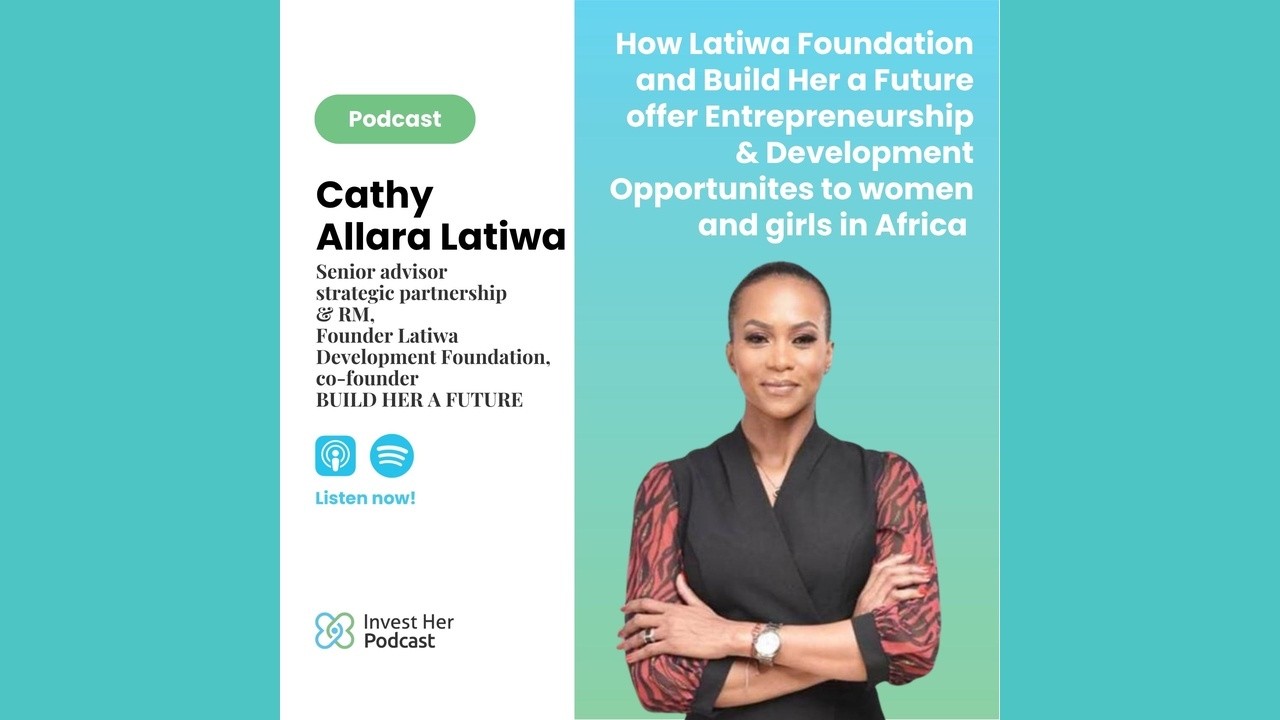
In this Investor Podcast episode, host Anne Ravanona interviews Kathy Latiwa Alara, founder of the Latiwa Development Foundation and the Build Her Future accelerator. Kathy recounts the grassroots origins of the foundation in 2014‑2015 as a cultural platform for artists in Abuja, Nigeria, which evolved into an NGO focused on education, health, and women’s empowerment after raising over $100,000 in its first event. She explains the foundation’s expansion to the Democratic Republic of Congo, Cameroon, and Belgium, and its role as a bridge between Africa and Europe. The conversation shifts to the new Build Her Future program, launched in 2023 in New York, designed to up‑skill women entrepreneurs from “stage 1” (survival‑level businesses) to “stage 2” (scalable enterprises) through two training tiers: basic skills (financial literacy, mental health, digital literacy) and emerging skills (digital marketing, agribusiness, finance, health). The program targets Central‑West African countries—Gambia, Togo, and DRC—where digital access and financing gaps are greatest, and aims to reach 60,000 women and girls over five years (20,000 in‑person, the rest online). Kathy outlines a fundraising goal of $10‑15 million for 2024‑2030, recent MOUs with mental‑health, finance, and AI partners, and the imminent launch of an Abuja accelerator cohort of 80 entrepreneurs. She emphasizes the importance of networks, mentorship, and continuous learning, sharing success stories of women who have built factories and businesses from scratch. The episode concludes with a call for partners, mentors, and donors to support the foundation’s mission.
Chapters
Welcome to today's episode of Investor Podcast. If this is your first time here, huge, huge welcome to the Investor Podcast family. I'm Anne, your funding host. And if you are a regular, delighted to have you back again. So if you have clicked on this episode, it's because you want to learn more about entrepreneurship in Africa. And no better woman to learn from than Kathy Latiwa, who has set up an incredible foundation across several countries in Africa and bridging into Europe to help women and girls develop themselves also through entrepreneurship. She's also going to share how she built her grassroots foundation from the ground up and the new accelerator that she has launched called Build Her a Future to help women entrepreneurs learn the skills they need to grow and scale their businesses. So great that you've stopped by. I think you're going to love this episode. And if you Love what you hear, and you know people who are in the development world or who are working with Africa or want to learn more about the Latiwa Foundation and Build Her Future. Please share this episode.
So welcome everybody to our latest podcast episode with Investor Podcast, and today I am absolutely thrilled to welcome to our platform Kathy Latiwa Alara. She is the founder of Latiwa Foundation and also of the Build Her Future program and project. You're going to hear more about that. She is from Africa, one of our wonderful sisters from Africa. Very, very warm welcome to you, Kathy.
Thank you. Thank you, Anne, for having me. Thank you. Hi, everyone. Hello.
Brilliant. So, okay, let's get started. I want, first of all, where, which country are you calling from? Which country are you based in, Kathy?
So I'm based in Kenya since almost a year now in Nairobi. I mean, the beautiful city of Nairobi. That you should visit.
Oh, I would love to visit. Don't get me started. We'll plan a great visit after this for sure.
Yeah, we have to. We have to. Sure.
Okay, so I— let's get started, Kathy. First of all, can you tell us your journey? How did you create Latiwa Foundation? What's your journey to that, first of all?
Yeah, so that's, that's incredible journey. 10 incredible years that Latua Development Foundation were built in Nigeria back then in Abuja. So you have to know, yes, I'm from Africa. My mom is from the dear Congo. I was born in the east of Congo, but my dad is from Oman, Muscat. I'm Italian. I'm a citizen of the world. I've been living in Brussels for years. So leaving Brussels, coming back to Africa for me was a dream. When we decided to live in Nigeria, my family and I, to work there, then with a group of women from different backgrounds, different nationalities living in Nigeria, we decided to create a platform, a platform to support young artists and designers. Why? Because we thought that music, culture can bring everyone— music, culture, and arts can bring everyone together. And around those subjects, you can talk about anything you want. And we were thinking we can not only put a platform for those young artists, designers from Nigeria, from different African countries, and also European and Asian countries, but we can also talk about important issues, important things that we can support. It was around a coffee, a day, an afternoon around the pool, and we thought, Why not, like, go to different vulnerable ways and pitch artists, sculpture, painting, music, designers? So that everything started that way. And at the end, an idea around a coffee became a great platform. For our first event, we had 350 participants, guests. We had more than 15 sponsors and partners from embassies, from private sectors. We had a designer from Burkina Faso, Senegal, from India, from Italy. We had a singer coming from Milan. So it was crazy because we could give a platform to, to few designers, sculpture, And at the end, we raise funds for education, for good access to education, because that first edition we thought, what can we do to make a difference to the country where we are? So that was a success. That's how Latua Development Foundation was created from a platform to support designers, to support access to quality education and health. To an NGO, because our first event, we could fundraise more than $100,000 at the time in naira because we were in Nigeria. We could build a school because they give to 2 orphanages land. The government gave land to 2 orphanages. So they were going to a school without roof. You know the stories because that's happened in so many countries, but we could build a school, train teachers, For, uh, with this money for more than 150 orphans, uh, the land was near the orphanage. So, and the money that left, I, I remember that time it was more about $10,000, uh, €9,000. We want to visit another orphanage. That one was for kids that was killed because they were albinos, because they were twins, because of belief of a different, uh, um, uh, cities and villages. So the journey started when we saw this second orphanage with this amount. One, we thought it's great to support and give funds for them to build school, etc. Well, but how can we do it efficiently? How can we make sure that this money will go one penny by one penny in what we want so that we see the right result? That was one. And 2, seeing the environment where those kids were living, and, uh, they were just depending on, uh, on funds and some people who was helping them. We thought, no, the thing is not to give fish but to teach how to fish. So we thought, how can we do to help the second orphanage? That's how all the women who came told, we want to build a platform to do access to good quality healthcare and well-being because of the environment, climate, et cetera, sanitation, to access to quality education, not only for those kids to go to school, but also for the one who finished school or couldn't go to school, like 16, 17 years, how we can build capacity so that they can also raise funds or have the resources to support other kids. And what can we do to those parents, those couple who was helping those 100 children, it was to build the capacity for them to have an activity to get also money to support all the kids, not to wait for people to come and help. And also we noticed something is that people are helping because they think they should help or support, but they don't have the needs of the one who needs something. So, and the need was not only clothes, food, or to pay the school fees. But it was many more. It was people who can come and train nurses, all environment sanitation. There were like capacity building and financial literacy, so many help. So after the first event, 300 people and raise almost all those money, we turn out to be a platform. And then with all the organizations supporting private people, friend and family, we couldn't just raise fund or put together Some money being a platform. We had to register Lativa Development Foundation, and some people were like, "Lativa, it's your name. You want to be in the front?" No, I never. I never wanted my name to be there. But while we were brainstorming, one of my friends said, "But Lativa means someone who never give up, someone who follow his dreams till he achieve it." It's an Arab Swahili name from the north between Sudan and Diyarbakır. And that Latiwa means someone who never give up, a woman who never give up. So that's how we gave the name of Latiwa Development Foundation, because we want to work on governance and development with women rights for women, especially because they are vulnerable, and youth to be independent and to participate to social economic impact of their communities. I love it so much, Cathy.
I love how it really was and is a grassroots movement, like from seeing a need and say, okay, let's, let's first of all honor and put the spotlight on culture, on artists, on incredible women, culture and artists, to what more can we do, seeing a need and then solving one part of the need through the orphanage, but going further. And, and that's the capacity building and helping to build the next generation. As you say, you're describing entrepreneurs who do it out of necessity, but more than that, also it helps to build their confidence and to give a sense of purpose, you know. So, and to— you said it's teaching them how to fish, because we know that given the devastation of the results of colonialism and all the hurts that we have, you know, done, the Western world has done in Africa, you know, and in other developing countries, There that has, as we know, created sometimes this need for people who are saying, "Oh, we need aid, we need aid," and you're very clear. Like, and we know Africa is the continent of the future. You have the youngest population, the most innovation coming out, and we know it's going to explode. So this is about okay, how do we harness that innovation, create more opportunity? Access to opportunity is what you're talking about to move the needle forward, and really like that it's you know focusing also on the women and girls.
So tell us a little bit more.
Which, like, what year did you set up the foundation, Cathy?
So why did I set up the foundation? Because I thought not only in Africa but around the world, you know, women are half of the society, so we constitute more or less 50% of the people. Youth also, also 51% in Africa of the population, but As you know, it's 51% of people who can contribute to the development of the community, of the society, of the countries. That's one. 2, why did I, with other women, create Latua Development Foundation? I was born in Bukavu, and Bukavu is east of Congo with so many resources, gold, coltan, so many things, but we have war. And the people who are vulnerable and used as arm of war are women and children. And the ones who after that are damaged, traumatized, they are women and children, families, but more women and children. That's 2. And 3, those people, it's not like they don't have the capacity or they don't know, they don't have the skills, but they need to be boosted. One, personal development, to know who they are. Whether you are a refugee, whether you are a displaced person, whether you are a normal person like you and me, or vulnerable about grassroots, we need to know who we are and where we want to go. And for that, it's very important. Why? Because I saw how vulnerable people from where I come from were, how strong they can be because they are still resilient despite the war. There is City of Joy created in Bukavu there. They are still working in different organizations because of what they are seeing. People are saying, I want to be a psychologist, I want to be a nurse, I want to build. They are are many who build, develop products because of necessity and needs around them. So I told those, this part of population needs to have support. That's one. And 2, I was raised by a single mom, a single mom who was divorced, who, who had violence within her, uh, her marriage. Not only because, because she was vulnerable, she, she came from a very famous family, whatever. But because she was in an environment who didn't help her to get out, it was difficult for her, despite of the background she had, academic, professional background, etc. So she had to get out of them. That's the personal development, that's the mental health things, which is very important. And 2, once she gets out from this environment of violence, she could work hard to raise 4 kids. So I thought we are different from men, but we can, once we have the capacity, once we have the skills, once we have access to information, we can do so much and participate strongly to the development and social impact of our community. That's the why of Latiwa Development Foundation. And wherever I'm going, I can see women can adapt even if they are not in the comfort zone. I'm from Congo. I used to live in Brussels, then I moved to Nigeria. English-speaking country. I could adapt, and I met other women coming from India, from everywhere. They could adapt, find— be mom, be women in a marriage, be a man, be professional, work. And then, you know what I mean? So those people need a boost.
Yep.
Those people need a boost, not only a personal development boost, mental health and self-esteem. They need also access to information. quality, uh, opportunity, access to equality, equal opportunity. Sorry for my English, but equal opportunity access. Yes, that's very important. That's why women's rights and all that, um, follow her. Yeah, and that's why I did law also, because I'm a jurist, international law.
Yeah. Yeah, and I love— I loved how you— thank you for sharing your story and, and sharing your powerful story of a strong role model that your mother is and how that's shaped how you have, you know, the, the areas that you focus on with the foundation. And I love what you said. This is about, of course, building up the, the mental health, and that's one thing, but then it's also about skills, access to education, so that the women can participate strongly in and have an economic impact in their community. And that is very, very important because that is exactly how we at Global InvestHer and how Investor Summit sees women entrepreneurs. We see women entrepreneurs as the greatest untapped resource in the world. And it is like, that's why we are so united, your foundation and us, what we do in our joint mission, which is we are talking about access to opportunity, right? And different access to resources. So specifically access to funding, access to markets. Right. So that's, that's very important. So which countries? So tell us more about the program, um, or tell us more, um, Kathy, what year did you set this up in?
So, um, we set Latua Development Foundation— we started 2014, but it was a platform. Then end of 2015, uh, we registered officially Latua Development Foundation in Nigeria. 4 years later, that means 2014, 2000, 4 years later, 2018, 2019, we opened the Latila Development Foundation in the DRC, Congo, because I'm originally of there. You know, whatever you do everywhere in the world, you want to participate and And you participated in economic development of your country of origin. One year after that, we created Lativa Development Foundation in Belgium. Why in Belgium? Because this space, the organization needed to create a bridge between European countries and those African countries where we were working at, to exchange expertise for partnership, and also to create space and more information exchange between our program, between our activities and action in those African countries and Europe, Brussels, because it's the capital of Europe. And then in 2020, just during COVID we created Latua Development Foundation in Cameroon with access to quality health and all sensitization around COVID and how to survive and women to continue continue to keep the business on track because of the pandemic, during the pandemic and after the pandemic. And so we are in 4 countries now: Nigeria, DR Congo, Cameroon, and Belgium, where we implement our projects and activities. And why also Brussels? Because we've been founded by European Union. We had European partners like German government through the German Embassy, Republic Czech Embassy of Poland, and the government of Poland as well. We had many other partners, private sector, et cetera, but we needed to create this bridge between those 2 continents. And since 2 years, we are also trying to access the American continent through the CSW68 and other projects with partners in the US and around the the world, Asia, etc.
That's where we met, Kathy. We met at CSW at our Investor Summit meetup. It was fantastic to actually meet you in person, and that's why now we're planning more and more world domination at the summit through an African delegation to showcase you and all the incredible women entrepreneurs. It's so great. Um, so now walk us through Um, today what the foundation does, or is it— do you want to go straight now into Build Her Future? What, what's going to be the best way to tell people how this is moving and how people— what your work is now? How this— you've told us a journey up to now, so what is the work of the foundation now?
So, you know, so far, um, I think we, uh, we had more than, you know, 15,000 beneficiaries. That's what we can estimate more or less. But, you know, in Africa and in few communities, once you touch a woman, you touch a family, a community. So, I cannot even estimate the number of women that we've implemented projects with them, starting from personal development to capacity building to entrepreneurship program to marketing, digital marketing, etc., in the business implementation. And upskill skills in the entrepreneur journey, from mentorship to coaching, etc. So, where are we at? That was fantastic, as you said, meeting around the CSW in New York, because we think really that partnership is the key. And where we are at now, talking about Build a Future. Why Build a Future? During our 10-year journey, we had We have built resource centers and accelerators in those countries. But we thought, that's not it. We need to learn with the trends. We need to give more than that to women or to support women to access to information and access to funds, to investment. But how can we do that? We need also to be on the same level of conversation with the rest of the world. Not only with our community, our society, our countries, our continents, but we need to know how others did to get there. So that's why we talk about role models, we talk about mentorship, and we talk about talking with other organizations and platforms like yours, Investor Global. It's very important. So, Build a Future is the new project that we launched in March in New York City. Build a Future is more than a resource center, is more than an accelerator, is how we upskill women business, young entrepreneurs from stage 1 to stage 2 through technology. How do we do that? How do we help them to do good proposal project? How do them to access to investor? to access other partners, to access other markets, not only the country, the region, Africa, but around the world. You have women who have good businesses, they have products, but they don't know and they don't have enough to sell in other countries, or only to showcase to people who need them. So, thanks to InvestHer for this partnership. And build a future needs partners. So it will be implemented in Gambia, in Togo, in DRC. So you will tell me Africa is big. Why only those three countries? Because we thought when you check the map of Africa, when you check access to digital access and technology, you will see that some regions, some region in Africa doesn't have the. That those countries have. South Africa, Kenya, where I am today, Nigeria, they're very advanced in technology and also in everything investing, financing access, etc. So the gap is less. We thought Central Africa has a huge gap in access to technology and digital skills and also funding because information is not there. And also there's not enough training about that. We are not talking a lot about that. That's one. That's why we thought about Central Africa. And why Congo? As you know, Congo is one of the biggest countries in Africa with more than 18 million, uh, 82 million of population. In Kinshasa only, we have 19 million of people. So can you imagine? And we have— Congo has 9 neighbor countries. So when you touch country, you touch Congo, you can touch the neighbors, you can touch 10 countries by touching only Congo. So we thought if you work on reducing the gap in technology and upscale skills of women entrepreneurs, stage 1 and stage 2— when I talk about stage 1 is, uh, the first entrepreneur, the, the first level, the first level that those women and girls at a certain age who start businesses, small businesses on the street, etc., uh, but they are doing it only to survive. What they gain with the money is to go to school and eat day today. We don't want them to stay on this stage. They need to go to the, the second stage where they can have shop. If you sell recharge cards or whatever, now you can have a, a shop. You can be the, the, the, the official distributor of a, a telecom company, you know. So we need them to upscale. Then when we are talking about the stage 2 of those entrepreneurs, they are the one who already have a certain level of knowledge but also the business are stable. We have many of them, the one in cosmetic, in healthcare. In— we have one lady who just, uh, create a product to regulate electricity in different houses. So we want them also to access other markets and to access enough finance so that they can produce more and, uh, and develop the, the, the product and the community. So that's why Central Africa. Gambia, you can know Gambia is a country In another country, in Senegal, they have more need in not only technology and also access to finance, to investors, because many people doesn't really know the country and the opportunities of this country and the women who are working there. So when we talk, I remember we met the Gambian government in a CSW And they said, we are here ready. We have land for you. We are real. We are here to support. And even the Ministry— Minister of Gender and Women Affairs came to New York. So why Gambia? Why Togo? Togo, we have also— Togo, as you— I don't know, you may know, Togo is the finance capital of Africa. It's the financial capital of Africa. All the big banks, the summit, financial summit happening in Togo. But the only thing is, even if they have the stage 2 of entrepreneurship, stage 3, but they need to access other countries' markets. It's a small country, one, so the population itself just— it's enough for small level of entrepreneurship, even if the entrepreneurs are eager to do more and to go further. So we thought, how can we support them to access other markets and to know how to access more funding so that they can go around the country but also out of Africa. And you have to know that from Togo, our implementing partner, because in each country we have implementing partners, our implementing partner in Togo, our partner has already a a resource center and has been working as entrepreneur for 15 years. She does what we call Made in Togo and Made in Africa. And by her, with herself, she has 4 other countries' partners: Benin, Burkina Faso, Niger, and Mali. So you can, can you imagine touching, working with Togo with this partner? We are working 4 other countries. So we will empower, or we will support not only one country, we will support 4 other countries, and we will help this region to exchange products and do business around them. So the business will not be only a Togolese business, an African business. We want it, we hope, with investor summits globally to access also European markets and Highland market this year. So that's more or less about Build Your Future. I love it.
And I mean, I love your, your, your vision and your mission and your passion. It comes through so strongly, Cathy.
I love it.
And, you know, it's fantastic because you've taken us— you're also educating a lot of us about the difference between countries and the resources and the resources gaps. And I love how you've targeted those key countries. And your message is very clear, like we need access to, yes, the digital tech also to be able to go faster and to scale. But we also need— I love the strategic element of what you're describing, because it's like when we work with one country, actually touching so many other countries. And it's learning how to do access to markets within the country, within the region, and the countries around that country, but also externally in order to grow. So how does the program actually work? Have you— where, what stage are you at, Cathy? Tell us, have you kind of started and where have you started and which partners are you already working with?
So actually, where are we at with Build Our Future? We were really lucky. I don't know how to say blessed because, you know, networking is really important. Is your network. Your network is your net worth. We always tell women, we were lucky to be in different platforms, women with female founders, and also platforms or international, regional, African regional, international platforms. We were lucky to assist to many events like the one CSW, to your events, to Davos, to many African regional events. So we met a few partners with whom we've been working. So I'm here, the co-founder of Build Our Future. I have a partner, key partner, with Edith Diong Idang. She's from Nigeria, working also in the development sector for more than 15 years. She's the founder of Initiative for Peace and Women's Rights in Africa, working with one of the biggest development sector and development philanthropists in Africa. So thanks to our network, with the background job we've done, we got some partners already. But the partners, I think we signed a few MOUs in New York in mental health, in finance, because people who can support us in structuring structuring our, our model, uh, in, in finance, in mental health, in also in, uh, intelligent artificial. But we are still, uh, seeking for experts in, uh, leadership. We know that we, we will found in leadership in anything investing and capital fundraising. Um, so which stage We are going to start our fundraising stage because we, with few partners that we have, we build module and structure module. We have implementing partner already in the few countries as we told you, we sign MOUs. So we are ready to go to start the fundraising stage. But as we does always with our project, We say small project with big impact. So we are not willing or waiting to raise all the money that we need because it's $10 million for 5 years. So it's 2024 to 2030. One year more will be for monitoring and evaluation. We are not waiting to raise those $10 or $15 million for those years. We are going to start. So the good announcement today is that tomorrow we are launching the Abuja Accelerator. You'll tell me Nigeria is not part of the countries, but while being in New York talking to some government officials, they were like, no, you cannot start without doing Nigeria. We have everything ready. We have entrepreneurs waiting. We have people ready. So come and work with us. So everything went so fast that tomorrow we are launching in partnership with Abuja Accelerator and the Secretary Mandate of Women Affairs of Abuja, the Minister of Abuja, who works also with the First Lady. We are launching the first cohort of 80 entrepreneurs tomorrow in Nigeria. So we are not waiting to raise the $15 million, but we are starting already with what we have. So the first stage will start tomorrow, and we are planning after all the structure ready and the module ready in 2 months, God willing, we will start in Togo because our implementing partner has already the space and the beneficiary. So that's the stage, and we are waiting for you to partner with us in those different expertise that we still need. Yeah, so we are advancing slowly, slowly but surely.
Slowly and surely. And so when you're talking about the women entrepreneurs that you're helping and the different— with the accelerator and different parts of your program, are there any particular— is there any particular sector focus that you're working with for them or not?
So, to start, we have a particular sector that's digital marketing.
Mm-hmm.
That's one. We have financing, access to finance, anything finance literacy. We have agriculture. So, business, agribusiness, we call it agribusiness. And we have health. So in health, we have mental health, etc., because we are not going to do only personal development starting, but we are also doing training of trainers. So in mental health. So when I'm talking about finance, we have everything around investment, etc. As I said, we still need experts on that area. So you need to know that Build Your Future has 2 stages of trainings. So the first stage is anything basic like financial literacy, like personal development, mental health, etc. Any basic thing that the entrepreneur needs to know, digital literacy, before even they go to the second stage. So, at the second stage, we call it emerging skills. Emerging skills is all expertise in which they want to go. And in those expertise, we need, of course, communication. We need digital. We need, as I said, investing and finance expertise so that on that stage, women may know What to do, how to build a strong proposal to raise funds, but also to start an agribusiness. How do they have to do? You know, we have experts in those areas as well, but we still need experts to agribusiness. So that's it. I mean, there is 2 stages. We have a document and a page we will share with you if I forgot any information. And everything we are doing is through technology. Why? We are not only doing the in-person training because it will be less. We are targeting 60,000 people for 5 years and 20,000 in person, and the rest will be online training.
That's why we need strong support in anything digital and And that's why it's excellent, because you, you know, at the summit, a lot of the sector focus areas— we've 8 sector focus areas— some of them overlap what you've discussed. So I know you're going to meet incredible people there. We have tech partners there, you know, so there's financial partners there. So I think it's going to be super, super fantastic. So what is the best way for people to contact you, Cathy, and to learn more about both the foundation and the Build Her Future program?
So the better way will be LinkedIn, of course. My LinkedIn, maybe we will share it. I don't know how you will share it, please, Anne, if you do share it. We have also— Latvia Development Foundation has a page, a website, if you want to know more. But please don't hesitate to contact us through the website or through my LinkedIn or through Didi LinkedIn. We will share that as well. For now, we don't yet have an official page of Build a Future. It is in process. Soon we will have more information on Build a Future page. As we say, we are working with a team in intelligent artificial— artificial intelligence, so they are trying to put together nowadays things. So yes, please don't hesitate to contact us, to call or to write to us via LinkedIn. Or via our website, and we have an official email as well. You can find it on the website. You can, you can have more information about what we need in terms of expertise, in terms of partnership, in terms of support, in terms of anything, mentorship, or our program, how we, we made them in Africa.
Yeah, amazing. So I want to recap. So to all of you who are listening or watching here on YouTube, this is Kathy's call. This is Kathy's call for you to partner, be part of making her movement work and bringing so much impact to women and girls in Africa and all the countries that she said her aim is to target. She wants to help 60,000 women and girls over the next 5 years, 20,000 in person and online. And she's outlined a really strong vision. She's already got loads of things set up. So I'm so excited to partner with you and to help build out our connectivity as well, our connection with Investor Summit and Global Investor, Kathy. So thank you. What would be your last message if you want to? If you had to give your last message with the people who are listening in, what would it be?
So before, and before I give my last message, you know, we've been talking, I didn't talk about our success stories, because success stories is not only us impacting this number of women around those 10 years, but we had women who today has factories, factories with different products. They started, they started from, from scratch. There were women like 9-to-5 working women every day, but they came with dreams, they came with change, they wanted to change in different sectors, like this girl who built this electric magic box, you know, and another one who was doing toothpicks with bamboo. Today, she has a factory with these toothpicks. There is one who wanted to develop coconut oil. She's osteopath, but she wanted to do that. Now she has a factory of coconut oil and selling around 4 countries. So we have different success stories from scratch to businesswomen, well-established businesswomen that exist. I want to salute them. I want also to salute all our partners from the years, family and friends who invest and support us, grants from different partners, because those grants, you don't grant people just like this. It needs trust. You need to see what and how they came from those grants who supported countries, international organizations, private sector platforms as yours. And also especially there is a platform called Makutano Business Network in the DRC who supported many entrepreneurs through also our foundation. So I want to salute them. Talking about my last word, my last word is we need we need to se remettre en question. We need to question ourselves. We don't need to be afraid to question ourselves in any stage of our life because when you believe in yourself, you believe in a dream that you want to achieve. It's fine to stop. Stop, sit down, question yourself, and see how you can change strategy. It's okay to fail. Failure is part of the journey. It's okay to fail. It's okay to seek for help and support. Even if you have 10 doors who are closed, it's okay to continue, to stop, sit down, think, and stand up again and continue. It's very important to continue learning and be on the same page as the trends. Mind to update itself. Today we are talking about technology, uh, artificial intelligence, etc. If you want to achieve your goals, your goals, you need to open up to learn and also to seek for help, for help to, to learn more. I mean, uh, myself, when I was starting, I was not okay with finance and, uh, and, and, and numbers. But I had to learn during my journey. Today I'm doing strategic partnership and resource mobilization. I had to learn to understand the numbers, to understand budgeting, to understand how to put together a strong proposal. And so learn every day. We need to learn and to ask, to be surrounded by experts and people who know knows what we don't know. We cannot be experts in anything, but we need strong partnership in each expertise. That's very important. We need to continue learning in our sector. If you want to work in agriculture, please, you need to know more about all the process of agriculture because there is so different steps to do business in agriculture from from plantation to the different machines and everything. So it's important to know and learn about your sector, to be the expert of your sector, and to network. Very important to network, and the right network. We don't need to be all over the places, to any conferences that exist, but to choose the right partnership, the right network that identifies yourself or your dreams or what you have to do. So never give up on the important place of family and friends in your life. Enjoy yourself. Take time to have fun and to enjoy, to rest. To to travel, that's that's very important.
So about it as well, Kathy. You know, because sometimes when we're entrepreneurs and we're like, we pause and we have a break and we're like, I have so much to do. But yes, we need to look. That's part of the self-care and the mental health care. And it's like, yeah, you need to take the time to do that. Wow! That was a lot of parting messages and so important. So thank you so much, and thank you for the shadow. Congrats to all your partners and everybody who has, who has been part of your success story and the success stories of your beneficiaries, of those women. It's wonderful to learn. So we look forward to having the African delegation at Investor Summit and to building a partnership with you because I think it's amazing what you're doing. And I think together we can go further for sure. So thank you so much for being with us today, Cathy, and our regards to Didi and the rest of the team. And yeah, let's keep going and let's keep learning.
Thank you, Anne. Thank you so much for having me. Thank you for having us. Thank you for what you are doing for women to close the gap in finance and investment. We need more women like you because we need to support each other. We need each other. Women and men are complementary. So, and for that, we need women like you, platforms like yours. And thank you for having me. Thank you for everything you are doing for women.
More from Anne



🎙️ EP69: Get Off the Fence: Renate Crollini's Startup Blueprint | InvestHer Podcast

🎙️ EP68: Radical Truth: Robert Rubinstein Exposes the Impact Investing Illusion | InvestHer Podcast



🎙️ EP66: Global Sisterhood — Carine de Meyere on Trade Missions | InvestHer Podcast



🎙️ EP65: Capital With a Conscience: Pierre Norman Rolin on Investing in Women… | InvestHer Podcast

🎙️ EP64: Dream Bigger: Nikki Barua on Building an AI-Native Company Without… | InvestHer Podcast