🎙️ EP53: Feminvest, leading the way investing in women founders in the Nordics… | InvestHer Podcast
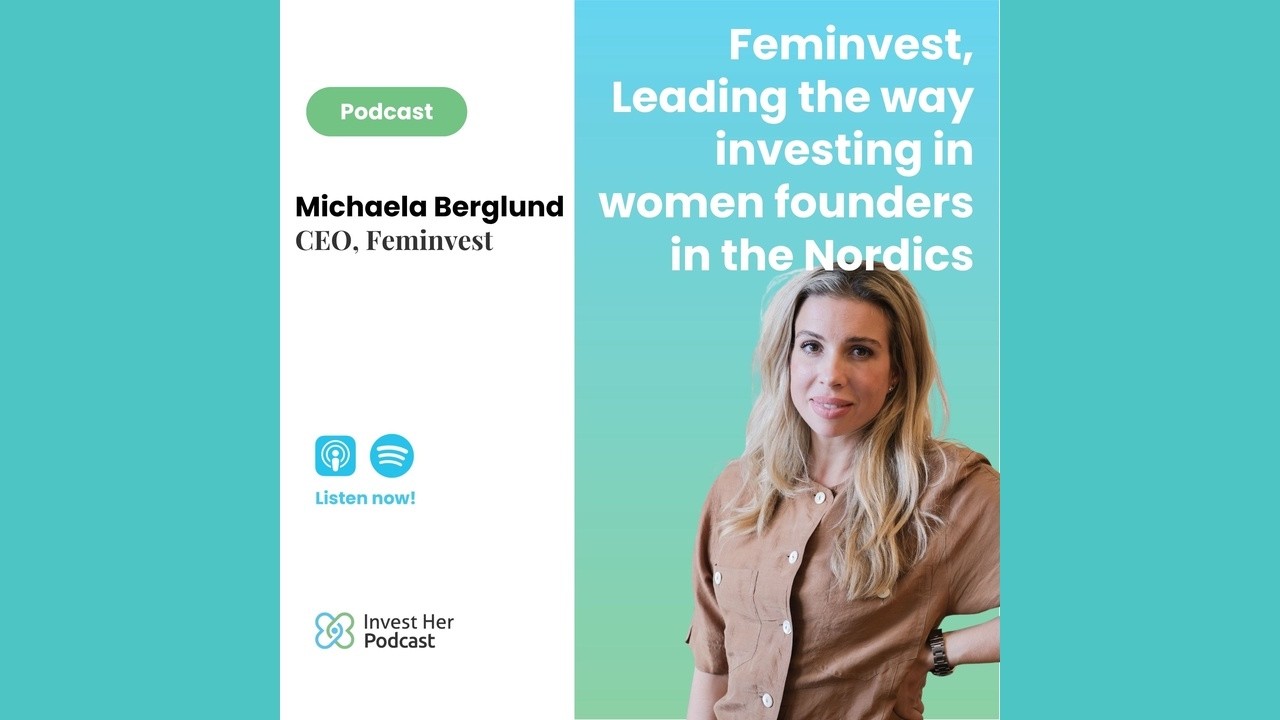
In this episode of the InvestHer Podcast, host Anne Ravanona interviews Michaela Berglund, CEO and partner of FEM Invest, about her personal journey from investing a modest €20 a month at age 18 to founding a women‑focused investment platform and launching FEM Invest Ventures, a €20 million fund targeting Nordic start‑ups that are at least 50% owned by women. The conversation covers the stark gender funding gap in the Nordics (e.g., less than 1% of private‑equity capital going to women‑led companies and under 20% of investors being women), the creation and rapid growth of FEM Invest’s network of over 400 female investors, and the strategic focus on early‑stage tech and retail companies with paying customers. Berglund shares practical advice for women who want to start investing – emphasizing “act first, think later,” diversification, and building confidence through community and education. She also offers guidance for women founders seeking capital, stressing early relationship building, due‑diligence, avoiding late‑stage fundraising, and ensuring in‑house competence. The episode highlights FEM Invest’s ambition to become a Nordic unicorn, its inclusive approach (men can be involved but ownership must be female‑majority), and provides contact details for entrepreneurs and investors. Throughout, Berglund stresses that taking action reshapes self‑perception and creates generational wealth, challenging cultural taboos around women and money.
Chapters
Welcome to this latest episode of InvestHer Podcast. I'm Anne, your friendly funding host. And if this is your first time here, delighted to have you here. Welcome. And if you're a regular listener, it's so great to have you back. And thank you for spending time with us today. So if you've clicked on this episode, it's because you want to learn how to become an investor, why it's important, why it's more important that women become investors, what you can create when you become an investor, and learn from a seasoned investor herself. So today you're going to learn from Mikaela Berglund, who is the CEO of Feminvest, which is the Nordics' leading investor, and they have just launched Feminvest Ventures. You're going to learn all about her new fund, but overall you're going to learn lots of her tips and insights into the investment mindset and what brings you to investment, how to get started early, and why it's important. We really are sisters in kind because we want to have more women investing. And it's a great opportunity to learn how she did it, how you can get involved, and maybe how you could do something similar. So sit back, relax, enjoy, and listen to these great insights from Michaela. Enjoy.
Welcome everybody to our latest episode of InvestHer podcast. It's Anne, your funding friend, and today I am thrilled to have with us Mikaela Berglund from FEM Invest. And Mikaela is the CEO and partner of FEM Invest, and she's a fabulous, fabulous lady. If you want to know about funding women founders in the Nordic, she is your lady, she's your gal. Welcome to the podcast, Mikaela.
Thank you so much. It's so exciting to be here. And you know what I love is that we can connect globally by the mission and vision that we work on together, and it unites us with such strong bonds.
Absolutely. And, and that started off exactly that way when we first had a conversation about a month ago and you reached out and we had a chat and we just bonded over the common vision mission. what we want to do and change the world of funding to get more funding in the hands of women founders who deserve it to be able to grow and scale their businesses. So yes, sister, you are a total SIS Funding sister, and I'm so thrilled to know you. And that's why we want the rest of the world to know you. And if people don't know you, I want them to start— let's start at the very beginning, Michaela. What led you to become an investor? What's your journey to becoming an investor? Because I always think that's a very interesting way to start these conversations.
Yeah, it is interesting. And I think, you know, so many times we have to look at ourselves and remind us of what we are capable of when we imagine that we can do it. And this is the same with investing. It's an area where a lot of women hasn't— not yet conquered the confidence or been acting in, in, in terms of starting investing and being confident in owning that they are responsible for their financials overall. So this is something that I'm super passionate about. I think that when you do are in charge of your financial decisions, you grow so much. And it starts with the small decisions of what you do with your salaries and your savings on a monthly basis, but it doesn't end there. And I myself Amma story in regards to that. So I started investing 200 kronor, which is like €20 a month, when I was 18 years old. And when I did that, I started that path to get more confidence and feeling responsible for my own investment decisions. And with time, that has taken me to investing in listed companies. It's been taking me to doing exits. It's taken me to, you know, buy Feminvest, I was a part of a listed company and I purchased the company 2 years ago. And it's also taken me to launching a VC fund to invest in women in the Nordics. With that, we look for companies that are 50% owned by women. So it completely transformed the playground where you're acting. And it starts with small decisions. And we are looking down on those small decisions usually. So I'm very much here to start inspiring people to, to act and, and don't neglect that first step because, okay, you never know where it can end.
I love that, and thank you. That's such an important message, Michaela. What— I mean, you were really ahead of your time. What possessed you to start thinking of investing at 18? That's a very young age to begin. Did you have parents who were financially savvy who taught you, or is self-learned, that you just got curious? What was— to your point, there's a chain effect that comes from decisions, and I love your message here about let's make the right decision, you know, let's have more women to become investors, the earlier the better. So what was that defining moment for you that made you start so young?
I actually had a friend that started investing that shared her success story. in regards to that. My parents were very, uh, not active on financial markets. They were actually encouraging me to put money in the savings account, so they were not encouraging. So it started with me actually not sharing that much information with my friends. So in the meantime, I think I realized that, you know, what would happen, you know, this one person inspired me to start and look where it led me. So what if we overall would talk more about our financial decisions together as women and friends. Because, um, and that was one of the first steps that we started working on in FemInvest, started to gather women around talking about investment decisions and sharing knowledge, inspiration, and community around that. Because it's, it's, it— we normalize. And if, if we look at financial magazines and newspapers, it's not very frequent that women are portrayed there. It's a lot of men in suits that looks in a certain way. And we, if we don't feel that we are, if we don't see people in the, in the media that is doing, how should we start feel that we are? Because we don't feel connected to that person. So a lot of, it's important to share a lot of thoughts and be open and more transparent about what we do with money. And it's not just earning money and investing, it's also about giving. It's about, you know, all the different ways we need to— how we spend and use money, right?
Absolutely. So, and I think we do not, and I think it's very culturally bound, isn't it? This conversation around money and women in particular. So in There's the patriarchy, the overarching global patriarchal culture that means that we don't openly talk about it in most countries. But then that can be compounded by the national culture or the local culture in which you sit, where it's kind of considered dirty to talk about money or unladylike, unseemly. And, you know, for example, like in Ireland where I come from, we don't naturally talk about money. It's not— you don't Compare salaries. You don't discuss it, and people, if someone is successful, they look down on you and say, "Oh, you know, look at them. They they're big-headed and da da da da da." And then people get jealous of of of that success. So I think you're totally right. The the more open we are to having those conversations, the better. But before we go more into feminist invest, tell us a bit more about your background. Like what did you? Study? Um, and how did it— how did you start your career? And then how did your investing change? Because you were saying when you started at 18, were you buying public stocks at that point, or were you already investing, um, in, in a startup? Or like, take us a little bit on that journey, both from your studies and your— or your experience that helped to shape your way of investing and your thinking around it.
Yeah, definitely. Thank you. I started investing in listed stocks. That's where I started. And I purchased my first flat when I was 19, or I was 18 too, but I turned 19 that year. And I saw that as an investment. And then I studied. I moved to London for a few months and I worked for Gent, and then I moved back to Sweden to study in Uppsala business administration.
Really great.
And by that, I knew I wanted to come back to London again. I really loved the big city and I felt that Uppsala was too small in a way. So I moved back to London and all of my friends, like one of my good friends, she was working at the trading floor at Deutsche Bank and even though she and I shared this interest in financial markets, we never spoke about our investments. Even though we were interested, we— she was so confident, had a great competence in terms of why the movements were, you know, happening the way they did or why this market wouldn't perform. But we never spoke about that. So I think, uh, I worked for an American company for a year, and I think so it's like small steps along the way that led to that I started my first company in the UK together with a friend of mine, and we worked together for a while. And after that, I started a first company in Sweden. I moved back because of love, and I started to move back and forward because I was like, oh, Sweden is too small. But then it was really intriguing to get into the Swedish market and understand that it was— it's very trend sensitive, a lot of things that's happening. And I got closer to financial markets. I work with marketing and investor relations. And by that, I actually found a spot where I got the opportunity to work with companies and being a part of companies being listed and understanding that I was quite representing the number of women being introduced to being part of an IPO, for example.
Yeah.
Because there was this report in 2021 that showed that women are in management, the board are owning 1% of the companies they work for. And I was being a part of an IPO and I own equivalent, like the number was not too far away. And I thought, Oh my gosh, like, I am just representing the number of women owning. And, you know, I, I got some money out of that investment, but I was the largest women owner in the company. So, and I thought, this is an important tool. Can we assist women in, in being part of exits and create wealth for more women than we can we can be a part of creating change over time. So it was a transformation in myself too, that I started with small investment decisions. And then I was, I was invited to be part of the group of men that actually did business together. And then I was that woman that is, that is usually, there's usually one woman in a room of men. I realized that, and that was really— it really hit me.
What I love about what your story and your experience is, again, how you had that light bulb moment and saying, we need to have more women in this room with me. We need to be more women taking care of our finances early on and thinking ahead and being part of those investments decisions, but also to create wealth. And, and like, I love it when you say— that really resonates with me when you say, hold on a second, I realized that I was part of that 1%, um, statistic. And it didn't sit well with you. Like, yeah, it was great to be part of it. At least you were there, to be frank. But on the other hand, it didn't sit well. And that, that kind of made you to, um, to pivot and to say, okay, I wanna, let's get more women to become investors. So what was the journey then? You sold your part from that IPO company and then, or you mentioned that you bought FEM Invest. So tell us a bit more about that journey, 'cause that's cool because that's, your journey in itself is so interesting to hear because you can be so inspiring to other people, Michaela, and say, she did it, I can do it too. And that's why I'm asking you to pull out these things. For you, it's a natural thing, but it's so much learning for other women. So that's why I want you to share.
Yeah, yeah, definitely. So I was starting to work with Feminvest in 2020 together with my first colleague Rebecca, and I had this option that I would get majority ownership the first year I— we were profitable. And then we worked really hard together to be profitable the first year. So I, I got majority ownership and I realized really early on that this company had to be owned by women. Same too, you know, that exit opportunity I was a part of, that like this company, it was owned by listed companies. It wasn't men as such, but it was a lot of men in management in the company that owned 49% of MFS.
Mm-hmm.
So, and I felt that they were, they were really lovely people, but they represented traditional finance. And I wanted to build something that could challenge that and, you know, bring some fresh air into the industry. So me and Rebecca, my first employee, we purchased the company together with the chairwoman of FemInvest and with the board member Eva and a couple of more advisors that have been following me throughout the first 2 years that we were active. So we actually bought it out together. in 2022.
I love it.
Yeah, so it was so important. It was fully women-owned before we scaled, and when we scaled, since then we've been growing profitably. So we grew 300% last year. We built a Nordic community, and by that, we actually had a plan all the time that we would use our platform to ensure more women founders would get investments. And if you look at how to do that and who needs funding, if you look at the market, it is women at the earlier stage that needs to get funding to grow and to be able to show themselves because they never get the opportunity in market. So that's something that we, we wanted to accomplish.
So tell us then, what have you built through FEM Invest? Because there's different arm— there's different parts to it. So what have you now built that, and how are you expanding FEM Invest? And then we'll talk about the fund.
Yeah, so, uh, we started with bringing together investors because if you have investors together. It was, it was actually after meeting with an investment bank where I, I spoke to a man that founded it and he's been doing it really successfully and he said there are no women investors. And in that meeting I thought, you know, he's got his databases, I can't really argue with that. But what if there are women investors? And so I said, I stated in an article that I had an investor network. I didn't have that many women investors at the point, actually. But that article resulted in people reaching out, and we started profiling ourselves as an investor community. And we were a few to start with, but we grew, and today we're— it's more than 400 women.
That's amazing. Yeah, yeah.
And when you have investors, you get deal flow of entrepreneurs. So entrepreneurs came and they were all women-owned companies. So it was automatic, uh, really. And what we did there was that we were formalizing, because to make good investment decisions, you need to understand the market and you need to follow entrepreneurs over time, because entrepreneurs are, are people that you need to really believe in because they have an idea. It's very hard work in the beginning of, uh, of a time, uh, where when they're launching something new, revolutionary, or whatever idea they have, you really need to, to, to believe that this particular person is, is the one person to bring this idea or business venture out to the world. So, uh, we formalized it. So we, we built the Nordic community. We realized that It's, it's very small. It's a very small market. It's very tech savvy. It's a lot of knowledge and competencies in this area. It's easy to scale internationally. So it's a really good market to grow and establish a business within, and then you can take it out internationally. And we see some great examples of that. It's like Klarna. Spotify, and so many more. So that was something that we wanted to use to our favor.
I love it because I love your ambition, like, and you're saying, yeah, we want to become a national unicorn. Basically, that's what you're saying. And I love an international unicorn, and we don't have enough women unicorns. I'm actually in the middle of writing a a report on the funding ecosystem in Bangalore. And Bangalore is unicorn and soonicorn. I didn't know that term, soonicorns as well, but it is the capital of India for unicorns and soonicorns. And I think it's so important that we showcase those ambitious women and say, hey, I'm going to become a unicorn. FEM Invest is going to become a unicorn. We're going to show that Having women investors, becoming a woman investor, and investing in women makes good business financial sense. Apart from doing good and showcasing and bringing great ideas and, and, and, uh, products and services into the world, it makes good business and financial sense. And that's— it's peeking out of you, Michaela. I love that. I love that.
But it's so important because some people mistake investing in women as as just value for money, but it's not.
Yeah.
It's, it's, it's business. And, you know, and I think that's why, like, the fund structures of VCs and private equity is a good tool because people expect revenues out of investing in them. And it's a model that we know of that we can use to showcase That, that it's, it's, yeah, it's good. It's good money. You'll get good money back if you invest in women.
Yes. And that's what I think a lot of people don't realize. And, you know, we get that rubbish comment, oh, it's just, you know, it should be doing philanthropy. There's no women investors, no good women companies. Bullshit. I'm calling it out. That's a load of rubbish. And you see so much deal flow and you see great women investors. Zone in on us now. It's great to have a Nordic specialist here. So tell us what, what is like the percentage of funding in the Nordics that usually goes to female founders? And what percentage of investors in the Nordics would you say are women?
Oh, that's actually great data. It's interesting because if you look at, at the Nordics, and if you look at Sweden last year, less than 1% of private equity went towards women entrepreneurs. So we are in a way, we are famous worldwide, and the World Bank States that we are one of the most equal countries in the world. But if you look at private equity, we are, we are actually catastrophic. And I think there are many reasons for this. One of the things is that we are, we think that we are so good, so we get a little bit comfortable and perhaps lazy.
Yeah.
That we actually don't have to deliver to the same extent. We know this by now, though, so it's time to change. It's also, and the number of investors, as you say, is, uh, it's very low. Uh, we have less, at least less than 20% of women, yeah, uh, check writers in, in Sweden. It's way below that, but I don't have the exact number at the moment, but it's never been more than that.
And it hasn't been globally. I mean, in the UK, for example, it's been 14% women investors, business angels, for the past 20-something years. I think it went up to 15% last year. I, I interviewed, um, Jenny Tooth, who's the CEO of the UK Business Angel Association. I interviewed her in about 2013, '14, I want to say. At that time, it was 14% business angels. This year, 2024, I think it's 15%. We got 1% extra in 10 years. Not good. USA, about 20%. So what you're saying is that there's this kind of— I wish we can smash these psychological ceilings that are in place. It's like, why do we accept that only 20% or 14% of business angels are women? Why do we accept that less than 1% or 1% of venture capital goes to women-owned companies? It's unacceptable. And that's why we want to join hands. We want to collaborate and help each other rise and raise because we've got to change this. And there's so— I see this as a huge opportunity cost to the world that when we are not having more women creating wealth that can then be generational wealth to pass on, and with wealth gives to coming back to your Starting point of this conversation: wealth allows you to have more freedom in making certain decisions. Yeah, it makes it gives you that level of comfort so that you know okay and to be able to manage risk in a different way. And I wish I learned that. I look back at myself when I was 18, 19. When I was 21, I graduated, and my first job, I had a really well-paying job for my first job. out of college and I spent all the money. I didn't save it. It was like I didn't have those learnings. And now I look, so with my adult children, I like bringing them to the bank saying, we're getting you this life insurance, we're starting you on this savings. And like, I want them to learn this now and not be in their 30s saying, they're like, oh, I have to pay €30 a month for my life insurance, which is on, you know, stock, French stock exchange. I was like, yes, you will thank me in 10 years' time when you need to have that deposit. You've got a great savings history, and when you can, you can cash in on that and you have your deposit for your thing, or whatever amount of time. And you were brilliant to be able to do it at 19. That's spectacular. Um, but teaching our young people as well as, as, as, you know, career professionals who are listening, the women who are listening and saying, oh yeah, I could, I could be investing in that. I'm, you know, Okay, so what would you say to the women who are listening who haven't yet become an investor? What would you say to them to say, okay, this is how you start and why you should start?
We always think that we can think ourselves into acting, but the thing is, it's so much easier to act your way into thinking. So you have to talk to— yeah, I think that is my absolute most important advice. You need to start today. and do something. And it doesn't have to be a big step, but you need to do something, and that will, that will change your path rather than the opposite. The thing is, if you, if you just continue to think, you'll, um, it might even be that you, you judge yourself for not starting after a while.
So, so you— yeah, because you mentioned about this thing about women not having the confidence to become an investor, and which also transpires, women not having the confidence to ask for funding. So tell us a bit more.
I've got reports from all banks across Europe. Every bank that would distribute a report on women and money and compare it to men and money, they will all say the same. Women state that they don't have the same confidence. They don't feel that they have enough competence to make the financial decisions. So it starts with how we look upon ourselves, and it's not Swedish statistics, it's universal. Yeah, it's universal.
So what would you say— so you said start now. I love what you said, it's easier to act your way into thinking than think your way into acting. That was brilliant, that's the nugget, I love it. Um, so what would you say to a woman who has disposable income sitting on her bank account? It's probably in a savings account, or she has maybe bought some real estate, but it's Like she could be doing more with this. What would you tell her?
Always, uh, you know, diversify in time, in markets, in assets. And, you know, you should always sleep good at night, but you need to take some risk. And the thing is, when I started my first company, that was the scariest thing ever. And with the time, now I have a few different companies that I've started, and I don't even think about it, you know.
Yeah.
You will feel, um, you will feel risk based on your emotions of doing something you've never done before when it comes to something that you are risking, which is, you know, assets of some sort. So, um, act is, uh, and do a little bit of something like distribute it to different assets over time. And continue, never give up. Because every— I decided that, you know, I've lost so much money, I've earned so much money, but I don't regret anything because I own my own investment decisions. And if it's money I could lose, which I've always invested, then it's lessons.
Yeah.
So I don't regret any I obviously, I wish I would have done things differently, but I learned so much from doing bad mistakes too.
Which is, which is a big part of life. I mean, that's exactly— you're just, you're giving the definition of life as well. We have to dare in order to take risks, calculated risks.
And it's also freedom. Freedom is owning your own investment decisions.
Yes.
Knowing why you do what you do with your money, you know.
Yeah.
So it's, it's not only freedom in terms of having X amount of money in your bank account. It's about— I think that freedom is something you have now. It's not something you can chase for. Do you see what I mean?
Yeah. Yes. It's not something you need to be thinking in the future. You have it right now. I love that. That's a very strong message. So now tell us a bit more about how you help, how you train with feminists, how FemInvest, how you train women to become investors. What do you do?
We have regular meetups every quarter. We do specific educations on, on financial investments, the DD process, what due diligence you need to do when you make an investment process, how to build a portfolio. We have pitch sessions, we have afterworks and networking sessions across Nordics. So we do, we build because we think that relationships with other women will spur a change.
Yeah.
And then because we normalize that women are investing, and we normalize that they have good advice when it comes to investing and that they are confident and know what to do. And we also offer great investment opportunities and assist companies in their scaling journey. So it's— we do a lot of hard work in regards to this area, and it's just the beginning. But my goal, I even said to a journalist a couple of years ago, I said, We will surprise in the ways we ensure women own more. And I want to stick on to that, that, you know, we can do it in so many different ways. And, um, but it always has to come back to that: is women owning more if we do this?
Yes, yes, absolutely, absolutely. And so The women that you serve at the moment, it's the Nordic, um, so different markets. Which, which, just for our international friends who may not know which countries you refer to, um, those women investors in your network and those 400 women?
Uh, Sweden, Norway, Finland, and Denmark at the moment.
Okay, so, and there are plans to do more elsewhere?
We are absolutely looking into, you know, how we can— the fund is only investing in women entrepreneurs in Nordics. We look for companies that are, that are looking to become international, though. They should have paying customers at the time when we arrive as an owner. And something that we look for too is at least 50% of the company should be owned by women. We want, we want it to be inclusive. We want men to be on board, and we believe that it's important in the scaling process that we have men on board too. But ownership is key for us.
I love it. I mean, that's very clear in your message. It really is about that. And so how big is the fund, and what's the name of your fund so that people know about it?
FEM Invest Ventures. So we are looking to invest €20 million.
Amazing. And so you're, you're actively deploying now? So to those women in the Nordics who are listening to you now say, oh, I did not know about FEM Invest Ventures, are you actively deploying or about to so they could start knocking on your door?
Yeah, they can definitely knock on the, on our door. We are, uh, we are open to do our investment in the upcoming months.
Great, great. So, so that was part of my next question, is like, okay, so how can people— where's the best way for people to reach out to you?
Uh, you can email my colleagues at dealflow@feminvest.se. You can also follow me on Instagram, Michaela Berglund, or you can reach me on LinkedIn, Michaela Berglund, too.
Okay, brilliant. So now I want you to tell us what would, what would be your favorite resources for women founders to learn about funding or to, to try and find investors, apart from FemInvest, of course. So if you were to say what other resources that you particularly like, whether it's for them to learn about the, the investors or—
Yeah.
The other The other things they need to know?
You know, the best source actually are talking to the people that successfully raised money. Yeah. And also, so that would be my, my one option, whether it's men or women.
Yeah.
Understanding what, why they got funding. And secondly, I would start the investors very early on to know which ones you want to approach when you need the money to scale.
Yeah. Yeah.
So, so many times I feel that entrepreneurs are very, very late.
Yeah.
When they look for funding, and it's almost as if the desperation of having that money in your bank account right now stresses the whole process.
I think that's very good advice. And what, what would be your other key tip to women founders who are about to look for funding or who are currently looking for funding, apart from start early, building those relationships early with investors, talk to other founders who have successfully raised? 2 brilliant tips. What else on the dos and then maybe the don'ts?
Um, be— don't be too late. Like, uh, don't be up too late. Even don't Take on investors that you haven't taken references on. Definitely, because it's, it's a long lifetime relationship, you know, you'll live together for a very long time. And also, um, don't bring in investors if you, if you're not doing that sort of scaling journey.
Yeah.
Um, you have to know who you are in the market too.
Yeah, yeah. And I think that leads us nicely into the don'ts that you would say, don't do this, don't do that, because I think that is true with first-time— some first-time founders, they don't realize that they're talking to the wrong people because they think they should be talking to VCs because all they hear about is VC, when actually they're not at the right stage or they're They're not fundable or they never will be. The type of business that they're building, it's never gonna be VC-backable. So what would be part of the don'ts that you would share, key tips to founders who are listening?
I would also, if you look, well, it's always easy to give advice on what to do, but I think, um, Always ensure that what you're gonna do, and you have to ensure that you have the competencies inside the company. So whether you're building a technical platform, don't outsource that knowledge to someone outside of the organization. Always ensure you have the skills for what you're gonna do in-house.
Mm-hmm.
That would be something I highly recommend. And Um, also don't wait, don't procrastinate, jump into it.
Okay, I love that. However, there's a lot of women who hold themselves back, who don't have as much confidence. I believe that a lot of women do, okay? Um, but there are some women who hold themselves back, who self-sabotage, who just don't try. What would you say to them when you say like, you know, don't hold yourself back, go for it? Okay, but what does that look like?
But we are, we are so scared of so many things. I was actually talking to a person today in regards to something I'm doing, and I thought, you know, what, what is the worst thing that can happen? It's the worst thing that could happen if we— if it really comes down to that, that would happen, it would be that you would fail. And how bad is that really? You know, I've seen, I've seen a couple of women entrepreneurs going into bankruptcy this spring. That could be looked upon as failure. Do you know they bought the company back a week later?
Wow, I love that. Okay.
So it's, it's never— it's never— failure is only something that you, you know, give your title that you give to something that has happened to you. But you can also choose to see it as a lesson rather than a failure. So like either you get something you never dare to get Or you learned something that you would never learn if you didn't do it. It's a matter of— and even my, my chairwoman, Maria, she's amazing. She said to me when I had a challenge that I thought it was taking a lot of my energy and she was like, but, you know, choose to look at it as something, as something that you will learn from. Like, this is really exciting. I've never done this before. And talk yourself into that. position, because we all have doubts. We all have those moments.
Yeah.
And I completely resonate. But it's actually— you can change it by the way you think about yourself. So rather than saying, oh my gosh, this is so stressful, it's like, wow, I get an opportunity to handle a challenge I've never done before. How am I going to do this? I will learn so much by By taking this challenge. It's difficult, but it works. It works.
It totally does. I love it. It's like reframing it. I love the way you said that, reframing it so that you see the kind of positive aspect instead of— you need to get out of your fear and use that energy that's feeding the fear to propel you forward and to say, look, what's the worst thing that can happen, as you say? And I love that. That's so inspirational to hear. You know, the example you gave of some of the women founders earlier this year who went bankrupt and then a week later were able to buy back their company. Because, you know, yes, I think sometimes we need to have our back against the wall to really feel it before we jump into action. And I love what you're saying is you don't need to get to that point. Act, take action, um, and you know, you will learn from it.
Yeah, I know, I know. I, for every day that happens, I, I do things that I've never done before. And, and I mean, yeah, and it's just like, okay, solve one problem at a time, move forward, and by that you build knowledge, you build confidence, you build securities. So I, I love it. I just wish, I just wish that everyone that listened to this episode would feel the confidence and the, the I can do it despite the fact that I don't, I feel like I can't do it, you know, that they would feel that because it completely changes. Like I said, it changes the playground you're playing in.
Yeah, I love it. I love it. It's so inspirational. So inspirational, Michaela. I love it because you're very straight talking, and I really like that about you. And so kind of let's wrap up here. Also, just circling back to FEM Invest and to FEM Invest Ventures, you are the first VC fund in the Nordics, aren't you, focusing on investing in women founders?
Yeah, with this size, yes. Yeah, we are the first. Yeah, we are the first fund to invest in, in women, um, entrepreneurs and looking at it, uh, from a— we are an alternative investment fund, so we are regulated by financial authorities and, uh, you know, we are the first one.
Amazing. So obviously you're walking the walk, you're not scared to be the first, and what I love about you is you're also opening the door and you're holding it open for other women to come through and you're saying come Come with me, whether you want to start on angel investing, come learn with us in FemInvest, whether, um, you are looking for funding, come with me and don't hold yourself back. And I think that's very, very inspirational. What would be your parting message, Michaela, to our listeners?
That, you know, by acting— I'm coming back to this again— but by acting, you will change the way you look at yourself.
Yeah.
And it's, it's the power of that is so crucial for changing any situation you are in. You know, we are, we are actually, we think we are bound by circumstances, controlled by other people, but it's not really the case. It is the majority of it is the perception of ourselves.
Yeah.
And it, it has to start with you. Yeah. So no matter what, I think that if one is listening to this podcast and one, you know, we've been inspired now by seeing in the summer, we've seen those Olympics, Olympians showcasing their talents and, and, you know, their hard work. And so many of us today, we're so used to things coming easy to us, you know, whether it's like a growing Instagram account of a few million followers in a few years' time because it's an easy life to get, if you— if that would be something that people look for, or if it's, you know, having, uh, X amount of money earned through cryptocurrencies, like those fast earn money fast dropshipping, all those things have been trending on social media and work-wise that are so attractive. People don't— they kind of— they're not used to the persistence of continuing to do the very same thing on a daily basis over a long period of time and what the power of that. And I think that we need to get back to it because that is where change happens. That is where we build something.
Yeah.
And, um, and we are— we've been living in a fast food environment for too long.
Absolutely. Oh, I love that. And that, that's very inspirational, Michaela. I love it. I like your— I love the way you said good things take time. Like, let's break this fast— this fast food culture. Um, and to your point, those Olympians, they have worked consistently every single day, day in, day out, in the pool, jumping the high jump 6, 7 hours a day, every single day, hail, rain, or shine for years to have that moment when they shine. And that is a good lesson. And I think it's a good lesson for us to remember also as both entrepreneurs and fund managers that it takes time. It takes time to build the track record. It takes time to get the funding. It takes time to build a fundable company and to get that product-market fit. And I think, yeah, it's really good advice to remind us to be in the moment, to take action now, but also to remember that each of those actions compound on each other. And that's what it is, a marathon. It is a marathon, and all good things take time.
All good things take time.
I love it. Well, thank you so much for being with us today, Michaela. I've really, really enjoyed our conversation and your nuggets of wisdom. If I look back on all the things you've said, I've taken pages of notes, but from them what comes out very strong is that you had a vision of what you wanted to do, um, with Femme Invest and like helping other women to get more confidence in making those decisions, the earlier the better, in making investment decisions and in getting funded. And you know, it's— you mentioned the freedom in owning your own investment decisions, so you're very clear about that. Be clear where you want to go. Recognize that you have more power and the power you have is now. It's not in the future. You can take that action now. So don't hold yourself back. And to— when things get— when you get stuck or you get in your way and you hear the little fear monster talking in your head, reframe it and say, okay, yes, you could think this way, but what's the worst thing that can happen? And in any case, you know you're going to learn from it, so you shouldn't have any regrets. So I love it. Like, and last but not least, it really is— I love the way you say it's by acting that you will change how you look at yourself and you will gain that confidence from doing it. And that is absolutely true, especially as founders or first-time fund managers. Every day we're doing things that we haven't done before, and you just learn by doing. And there's a lot, there's a lot of good in that. So Thank you so much for being with us, for sharing your wisdom, Michaela. And I give you an open invitation to come back in X number of months, uh, or next year, and we'll see how you're doing, what you're, you're excited about. Are there some first deals that you can already kind of hint at in the sectors? Maybe not mention companies yet, but the things that you're excited that you're looking up to for your first portfolio companies with FemInvest Ventures?
Yeah, I'm really excited about to see the amount of companies that are growing at an early stage with the, like, business-wise, but also with an impact focus. So they both generate money and revenues, but also create change. And, and that combination I'm really excited about exploring further. We look for companies within tech and retail. So that would be the segments that we look at.
Okay, so all you tech retail women founders or co-founders in the Nordics, you have an open invitation here to reach out to Michaela and her team. You heard her. We will put the link in the show notes to the email addresses, to her LinkedIn, to Insta. And, um, yeah, just do it. I, I really— I think that sums up what you're saying. It's just do it. Take action. It's just like, just do it. So thank you so much for sharing your story.
What are you gonna do today?
What am I going to do? Oh, I love it. Um, I really am gonna take to heart what you just said about getting out of your own head and stop thinking and just start acting and start doing it. I really mean that. Um, on things that I'm like, I I want to over-intellectualize stuff too much or want things to be too perfect. No, no, just do it. And it's like, so that's what I'm doing today and I'm continuing to do. Yeah.
Thank you for sharing.
So thank you so much. And yeah, we cannot wait to see how you get on with Fem Invest. I know you're going to do extremely well. Thank you for what you're doing. We need you. We as women entrepreneurs, we as women investors, we need you. Thank you for sharing your story and inspiring us all today, Michaela. And I really look forward to seeing all the success stories that come out.
Thank you so much and see you soon.
See you soon.
More from Anne



🎙️ EP69: Get Off the Fence: Renate Crollini's Startup Blueprint | InvestHer Podcast

🎙️ EP68: Radical Truth: Robert Rubinstein Exposes the Impact Investing Illusion | InvestHer Podcast



🎙️ EP66: Global Sisterhood — Carine de Meyere on Trade Missions | InvestHer Podcast



🎙️ EP65: Capital With a Conscience: Pierre Norman Rolin on Investing in Women… | InvestHer Podcast

🎙️ EP64: Dream Bigger: Nikki Barua on Building an AI-Native Company Without… | InvestHer Podcast