🎙️ EP55: From Basement to Boardroom: How Shena Brien Built Ireland's Most… | InvestHer Podcast
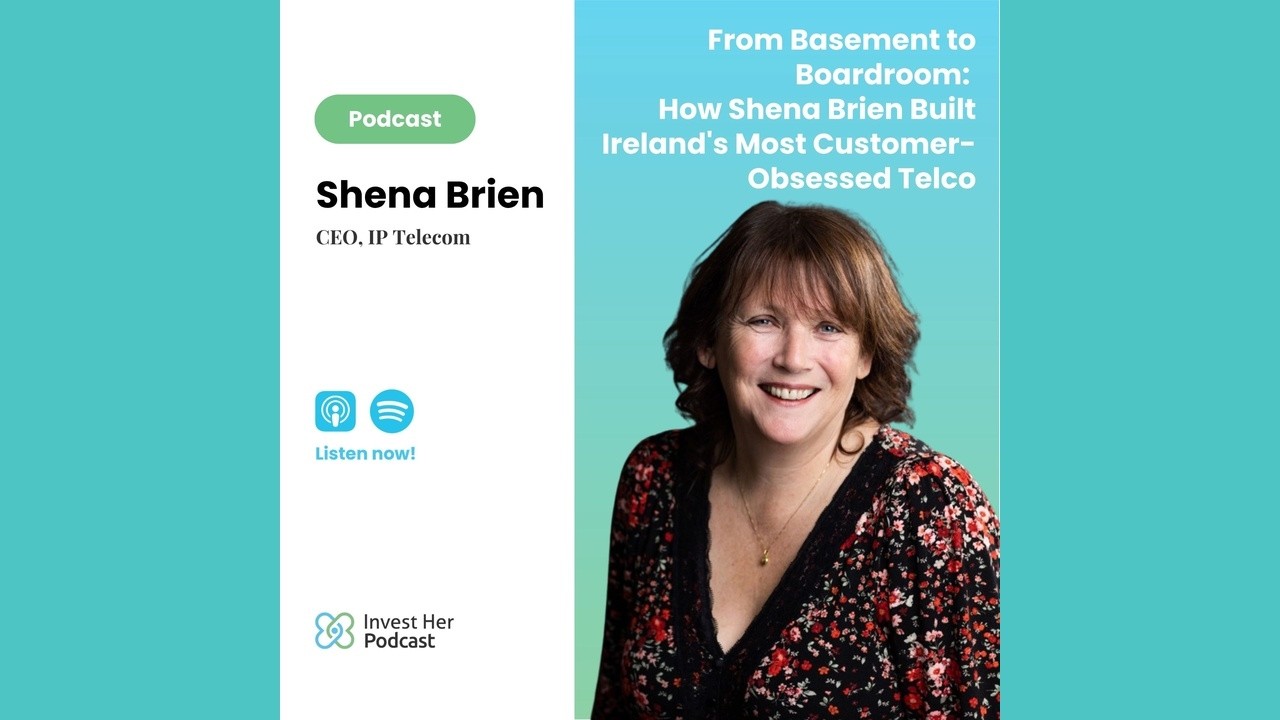
In this InvestHer Podcast episode, host Anne Ravanona interviews Sheena Bryan, founder and CEO of IP Telecom, to trace her 15‑year entrepreneurial journey. Sheena recounts her early life studying electronic engineering as one of few women in her cohort, her first technical roles supporting travel agents and later as a pre‑sales engineer, and the mentorship that gave her confidence. In 2010, she and co‑founder Brian Chamberlain launched IP Telecom from a basement, offering SIP‑based voice services over customers’ existing broadband to replace costly copper lines. The company was bootstrapped with friends, family, and personal savings, using second‑hand equipment and a single data centre that later expanded to a redundant two‑site architecture to guarantee zero‑downtime. A customer‑centric culture was built from day one, leading to organic growth, a steady move through increasingly larger offices, and a workforce that now numbers about 40 people with roughly 50 % women and staff from 15 nationalities. Sheena describes the deliberate hiring philosophy, the importance of diversity, and the development of a supportive, “family‑like” environment. After a decade of self‑funded profitability, the team decided to seek external capital in 2022 to “leap‑frog” growth. With the help of auditors (Azets) and a financial director, they prepared an information memorandum, interviewed potential investors, and ultimately partnered with an Irish private‑equity firm (Development Capital) in 2023. She also discusses the acquisition of Centrecom to expand managed connectivity, ISO 27001 and ISO 9001 certification, and a proof‑of‑concept “telco‑in‑a‑box” venture in South Africa that proved resilient during COVID. She shares practical advice for founders – leveraging personal networks, being scrappy with equipment and outsourcing, establishing solid HR policies, and treating investor meetings as two‑way interviews. Finally, she outlines her vision for IP Telecom to become one of Ireland’s top five telecom providers, continue expanding product offerings, and maintain a culture of diversity and customer obsession. The episode ends with Sheena’s parting message encouraging listeners to pursue ideas boldly and lean on supportive networks.
Chapters
Hi there. Welcome or welcome back to InvestHer Podcast. I'm Anne Ravanona, your host and funding friend, and I'm so glad you're here. InvestHer Podcast exists for one reason: to share the real, unfiltered stories of funded women founders, investors, and ecosystem changemakers from around the world, and to give them the visibility and airtime they deserve. Because here's what we know: women are building extraordinary businesses, Women and men are writing checks and leading funds that invest in women founders. And yet their stories are still too often missing from the conversation. We're here to change that. Every episode, I sit down with someone who's in the trenches of building, funding, or backing women-founded ventures. And we talk about the real stuff, the pivots, the rejections, the fundraising lessons nobody tells you about, and the wins, because there are plenty of those too. Whether you're a founder navigating your first funding round, an investor looking to do better, or simply someone who believes we need more women building, scaling, and investing in women-founded businesses, this podcast is for you. Now, I can't wait for you to hear this. Let's dive in. Not many people build a profitable company for 13 years before they ever take a penny of outside investment. Sheena Bryan did, and she did it in one of the most competitive, male-dominated industries out there— telecoms. Starting in a basement in 2010, in the middle of a recession, Sheena and her co-founder grew IP Telecom through sheer focus, customer obsession, and a refusal to grow before they were ready. When she finally did go looking for investors in 2023, she walked into those meetings and interviewed them. Not the other way around. Whether you're building something of your own, thinking about your next move, or just looking for a story that proves slow and steady really does win the race, this episode will inspire you. Let's get into it. Welcome everybody to our latest episode of InvestHer Podcast, and I am absolutely thrilled to have with us today Sheena Bryan from IP Telecom. Sheena is a trailblazer in Ireland and internationally in the telecom industry. She's laughing because she's being modest already before we even start, Sheena. But I have to say it is a fact, and I'm delighted to have you with us today. Welcome.
Thank you very much for having me. And I'd have to say I do smile because not so much trailblazer. I do believe that I've been in the industry so long that I suppose I had no choice but to be a trailblazer. So, you know, thank you very much for having me today.
Well, it's an absolute honor. And really, the whole objective of today, Sheen, is for the rest of the world to get to know a little bit more about your story, the story of IP Telecom, what's brought you to here and what's coming next. next. So we're going to kind of go through all of those things in our conversation today, with the objective really to inspire, inspire the next generation of women in STEM, women leaders, and male investors and everybody out there to say, hey, look, this is a fabulous woman leader doing it. And we need to see more innovation and great women leaders growing their companies and scaling their companies. So with that said, let's go backwards a little bit. I want you to take us at the Back to the beginning, Sheena. Tell us a little bit about who you are and what has been your, your journey to becoming who you are before you set up a company and all of that.
Oh goodness. Okay, so my journey is, um, background— I purely did electronic engineering in college. I think I have to start there. I can't start when I was a baby. Um, I started doing electronic and electronic engineering. I always knew I wanted to do something technical when I left school. I didn't want to go into— I went to a convent. My education was through a convent, so they didn't really know what to do with me. You know, I did physics, but that was about all I could really do. There was no engineering in my school, but I just knew that I needed to do something computing, something— and this predates the internet, you know, it's before the internet. Internet was just in labs at the time, and it was over in the universities in California, but I knew I wanted to do something in that field. So I did electronic engineering, one of 7 girls that started out of 120.
Wow.
And 5 of us graduated, which I think is really good testament to the girls that, to the girls as they were, that I went through. And to be fair, I've actually kept in touch with them, and they're all still working in different fields. They've actually moved away from what they started off with. I'm the only one that stayed I've always been a very customer-focused person. Um, previous, I guess when I was in college, I was doing summer jobs and whatever in bars and restaurants like all the other students, but I actually enjoyed meeting people. They weren't an issue for me. I actually wanted to provide them with the service. So when I started my career, it was a subsidiary of Aer Lingus, and I was supporting travel agents. Probably the, the best fun of any industry ever. It's a great industry to cut your teeth into. Wonderful people, very small margins. It was very, very tight for the poor people we were supporting. Um, and it was obviously, this was in the early '90s. So, you know, money was not exactly flush, but I got a great opportunity in there. I was working shift work, I was working networks, I was fixing all kinds of stuff. I had a screwdriver. I had a bit of a rep for leaving equipment back in the office when I was going off to do sites. So that was kind of funny. But it taught me a very valuable lesson in that, you know, in the very, very early days, I used to always, then I used to have a checklist and I would tick off equipment that I was bringing. So, you know, every job I've done along the way has taught me something.
Mm-hmm.
I worked in the UK for 4 years. I didn't do the normal journey. I didn't go over, work forever, and came back. But, you know, there was a recession on here. It was very hard to come by jobs of any value at that stage in Ireland. So I moved over to kind of kickstart my career, and I was very lucky to work with an amazing man, uh, Phil Innes. And I have to give him a kind of a shout out. He won't be listening to this podcast, and he's well retired at this stage, but he really encouraged me, um, as a woman, really encouraged me. I was the only woman in the team, and he put me front and center, and he basically gave me the the mentorship I needed to have that confidence. And, you know, Phil's background, he ran a barrow in a market, in a street market. Again, that customer thing, I got it from a very, very young age in my career. So I had that the whole way through. And then I'm gonna fast forward. I guess a couple of things happened to me that kind of put me in a position where I thought, right, I'm gonna have to do this myself. The first thing, and I'm not gonna mention the company, 'cause I'm still very fond of this company, we still deal with them. A company I was working for as a pre-sales engineer, made me redundant. It was a heartbreaking thing. It absolutely rocked my world. I was so happy in the job. I loved what I was doing. I loved the people, still do. They're still amazing people. Made some great friends in there. And I was very, very lucky to have, I think, 8 weeks of terror where I thought, I'm never gonna get a job again.
Mm.
And I came across a gentleman called Mr. Rory Arda, and he's very well known in our industry in Ireland, set up Formis Telecom, and then went on to found Leap Broadband. And together with his brother Charlie and another business partner, they kind of— they got me in to do everything. So I was their engineer. So I was building high sites, I was building wireless sites, I was supporting customers, supporting our partners, installing customer equipment. Oh my God, it was insane. And I was doing this halfway through my career. This is not an early job. You know, this is the— you know, I was also configuring routers. So I was like very, very hands-on techie and I loved it. It was— I had been doing it for quite a while at that stage and I really loved it. And, but, you know, I took a job because I was worried I wasn't gonna get a job. That's what everybody thinks when they're made redundant. But, you know, not only that, they taught me about running a business.
Mm-hmm.
'Cause I was like the employee. So I was sitting with all the founders of the business and all the challenges they dealt with and getting them up and operational and then getting them across the line. So it was a very exciting job. And they, again, they were very supportive. So in that job, I met my current, my current, my co-founder. So Brian Chamberlain, who was one of my partners. So I was supporting him and when he was installing for his customers. And from that, we were bought by Magnus. So he, he came along with us to Magnus. And so we just had this relationship built over a mutual admiration for our different skill sets. So Brian's a coder, developer, and technologist, amazingly talented person. And there's me, and I, I can talk to the country and I love customers. And I think it seemed to be a really good fit. And so one day when he just said to me, look, I have this idea, what do you think? And I said, oh, that sounds really cool, but, you know, could we do it? And he says, do you know what, we might as well give it a punt. And because I'd had the experience of, you know, not having a job, getting a small, you know, whatever, and carrying on, I thought, you know what, yeah, you're right, let's just do this and see what we can do. And our goal really in the early days was, if you go back to, I suppose, I guess Blueface would've been the trailblazers of our industry. Um, I can say that, I can talk about them because God love them, they're no longer around. Um, but we kind of figured what they were doing was, was good, but that we knew we could probably do it better, and also we could bring it to the customer. Um, I think—
Tell people a bit more about Blueface, because if people don't know, if they're not in the industry, they may not know them.
Okay, so sorry, so Blueface could have been the first. Uh, so okay, everybody knows about telephone calls and how you make a telephone call. You use a telephone line and you make, you know, there's copper wires coming into your house, that's how you make telephone. For businesses, those, those pipes are actually a bit bigger, you know, so you've got multiple calls you can make at the same time, and that was digital. It's, it's costly, and it was expensive because there was only one company at the time in the country that was there who was actually laying these bits of wire. And we just started— broadband had just started coming on and just started improving. So the key to— the key driver to this was broadband technology getting better, so becoming digitized. So, so, so Blueface would have said, right, Blueface went out and they, they developed a SIP solution. So SIP is basically— it's almost like you're taking a copper wire and you're making it digital. You're putting it across internet, you're putting across broadband lines. And they were developing phone solutions for businesses and residential customers over these lines.
Hmm.
So again, fast forward a couple of years when we came along, things have improved to the extent where we were able to piggyback on the, if you like, the knowledge they had spread out to customers. So basically businesses were now able to get, you know, using their broadband line, which they were already paying for anyway, they were able to use it again for their phone service as well. They didn't actually have to have multiple lines in, so they were saving money. We started IP Telecom in 2010. So if everybody, if anybody can remember 2010, it was not a great year for the economy and people were going out of business. So we were actually, what we started off doing was keeping people in business. We were going to them and saying, get rid of all your phone lines, just keep your broadband line and we will give you your phone service. We'll deliver your phone service across your broadband line. And we cared, you know, at the end of the day, we actually cared about these businesses. They were really struggling. So for a lot of them, they would've had one-off deals. In the early days when you're trying to get customer numbers up, it's like, okay, so what could you pay us almost, you know?
Mm-hmm.
So we firmly believe that we could do it better, uh, just from a customer perspective, because we've always— and, and to this day, we are a customer-centric company, you know, first and foremost, that's what we care about, even if it's the customer of our partners. So we have a reseller model. So, you know, even if it's, if it's an indirect customer, we still care. We care about our partner, we care about their exposure to their customer, um, and how it feels. So that was, that was how the journey— that was how it got to, to where we were. So yeah, we— So we started off in a garage or in the usual, in a basement of a house. So, you know, one of our houses, we used to get together and work on getting customers on board. And we didn't have the cash to rent an office. And then an opportunity—
But how did you do that? I mean, 'cause did you then, like, just practically, if it was yourself and Brian, like, you were then piggybacking on the Blueface technology? So you were kind of—
No.
So Blueface—
How did you do it? No, so Blueface had set the market. We have nothing to do with Blueface. I mean, to be fair, They had set the idea of there being SIP technology was available.
Right.
That we were able to do this. We didn't have a budget for marketing, so somebody had already done that for us, created an environment where potentially we could go out and set this up. Basically, we had equipment in a data center. That's all we could afford to do is we both pitched in a bit of cash. This is for the founders out there. This is what you're going to have to do. You're going to have to either get a car loan and put it into the business or do something, just raise whatever capital you have, friends and family, which is what everybody always talks about. And I did approach my brother. I remember this at the time very, very clearly, and he regrets not doing it now. But he was probably the only one in my family who had any spare cash at the time. But so it was a friends and family thing, give us some cash. They were supporting— obviously partners were supporting us, you know, with earnings. So we were actually able to do this without actually earning a salary. So we had equipment in one data center. So data centers where all these cloud— everybody talks about the cloud. So all our cloud is in one data center at this stage on secondhand equipment. And I hope our current customers who have been with us as long as they have don't realize that they still have a great service. And our big things, we do things customer-centric and zero downtime. We did not want to have a service that had no downtime. And it's very hard to do that when you've got one data center. So our biggest priority in the early days was to have a stable network to basically roll out to 2 data centers and have some failover. So I know I'm getting very techie, but there is a growth to our business. So every time we had a bit of cash, it went straight back into buying new equipment. You know, in the early days, we were bringing in new people into the company, and we got an opportunity, uh, to trade for office space. So we went— we went into a managed office and we looked after their IT, and they gave us a great reduction on the space we had. And that was in Leeson Street in Dublin. It was a brilliant location to have. It was absolutely fantastic.
Yeah.
And I always talk about Paul and how great he was and very generous he was to us in our early days. He's still a customer. He's an amazing customer. So, um, So that was our— that's how we got started, um, really in an office as grown-ups, still just the two of us. And Brian was doing the development, network build, and tech support, and I was doing the customer service. And I was the one that was going out to customers and crawling around under customers' tables and installing phones and stuff. So, so back in those days, it was very, very much get your hands dirty. But oh God, it was lovely. I mean, it was just— we were doing it for ourselves. It was just so exciting and just so brilliant. You can tell.
What I love is like First of all, for those who are listening, you cannot see her face lit up as you're speaking. It's beautiful because you can tell the passion and you can tell you absolutely loved it. It wasn't like, oh, I have to do customer service and, oh, I have to get on my hands and knees and install this stuff. You're like, let me at it.
And we're still there today, to be fair. If somebody wants me to go out to a customer today, I'd have no problem crawling under their tables, you know. No, but that's the fun. That really is the fun part of setting up a business, the early days. And You know, if I was going to give somebody some advice now, I'd say, I would say enjoy that phase. Take the time to step back and think about it and smell the roses, because that does change and it does change relatively quickly. You know, if you're driven like we were, we knew we were going to grow and we just needed to manage our growth. And again, this is all self-funded initially. So we, we had an opportunity to partner. Again, no money. We had the opportunity to partner with somebody who was really good at sales. Uh, because we didn't— we couldn't sell. We were, we were contacting people we knew would buy from us. There were contacts, they were old friends, they were people that we had worked with in the past, and we were building up customers. And then it was word of mouth pretty much. We weren't advertising. I think we had Google Ads, a very, very small amount of Google Ads initially just to get us started. But it was literally like when we got money in, it went back into the infrastructure. So we finally had an infrastructure that was in 2 data centers. It was a little bit more— we knew it was more resilient. We were going to have failover, and we could stand over our zero downtime. I mean, that's something we've always been very, very strong about— zero downtime. So from a 2-person company, it was interesting. Um, but lots of late nights and lots of working around the clock and weekends and everything else. I mean, that's a story I think of every founder. Every startup is always the same, and it's just, it's just good fun. That part of it, probably not so much fun, but it is. But it was— we knew it was going to get us to the next stage. So we went into business with this, uh, with this outsourced salesperson, and then things really started to grow. So we started to get the numbers of our customers started to generate, and then we hired our first employee. And our first employee is still with us. I'd love to say this, tell the story. He came into us, I think he worked with us for 3 hours a week, and then it was 5 hours a week, maybe then 1 day. And as we had money, we could pay him more, and he came in for more. So he was our billing guy. He was the guy to make sure that we did the billing and we made sure that the money was coming in and everything. Oh, it's another tip for everybody. If anybody's had some service industry, And we were really— we had this thought from day one, and that is that we, we don't have the time to sit there and chase, chase for money. We were offering a service, it was a utility, and so it had to be paid for by direct debit.
Mm-hmm.
Um, and I can't— this is a real— this, it would have killed our business if we hadn't had this because we were too small.
Yeah.
So we were very lucky to get the support from my local bank, and they gave us a direct debit facility. Not every company gets that, um, but it's worth putting the effort in and getting somebody who knows numbers and who knows the financials and knows your business plan in order to to assist you to get that, 'cause that would make a difference in our business anyway, in service industry, it's a have-to-have.
Hmm.
So we had that from very early. So the money was coming in. So it really was a case, it was very, we had very little bad debt, still don't have very much bad debt because of that. And so we were able to grow and every penny we were getting in, we were reinvesting again. So suddenly they went from 2 to 4 and then the company just grew and it grew organically. When we had money, when we could invest, we actually invested and we grew. And that was great. And we moved a couple of offices. We kept on moving offices every 2 years. So we kind of go from, I'd say, the one room in Leeson Street to, um, we call it the Red Room in, um, off Jamestown Road, which basically had red carpet. So you had red all over your shoes when you came home. That was an interesting place. Again, very cheap. That was 200 quid a week it was costing us. It was nothing. It was really huge space. So that was amazing. And then we got our first leased office, and that was in Park West.
Hmm.
Um, and I think we kind of felt once we got to Park West, we were sort of home. We really liked the environment. It was a good location to get to. They have a train station. So again, And then when you're hiring your first employees, commutability— if you can't be in the city centre, which it was insane to think of growing in the city centre for us, to be fair, it's really important to have easy commutability for younger staff because you're going to be bringing in customer service people and support.
Yeah.
So we have a train station at Park West. It's an amazing facility. And also there's some really good bus services. So that was very important to us. So we were very, very content in that office and we started to grow very rapidly. Um, so we knew we were going to run out of space very quickly, and we had a little bit of extra cash in the bank, and it was just before they changed capital gains tax around buying business properties. So we said, right, we've got to get in and get, get our first— our park— our bits— our asses. So we did. We bought a premises in Park West, in the Plaza in Park West. Can't get much more central than Park West. And that has been our home ever since. And we have grown to, to the stage— so we moved in there in 2018. And, and we have just leased another office across the hall because we've actually grown out of that office. So it's been, it's been quite rapid since 20— I think 2016 we moved to Park West, and so we've been there since, since then. So that's 9 years, and we're probably 5 times the size we were when we first moved in.
How many people are you now?
We have 40.
Wow, that's amazing. That is amazing.
I'd say a lot of it happened in Park West. I think Park West When we moved into the first office, and that's where we really became a company. So we had 4 directors at that stage. We had our finance director, sales director, Brian was the technical director, and I was doing operations at the time still. But I was starting to, I was starting to grow into this. I was looking after HR, I was looking at hiring. So I was starting to grow into the CEO type role as well at that stage. But we were not so presumptuous to have a CEO in our company, you know, we were just directors. So, so, um, So yes, we moved into our new offices and then I guess 3 years ago we realized that, so we, it's basically been the same product we've been doing all along, various different flavors of it, adding new features and functionality, but basically the same product. Brian and I's background is broadband. So we weren't doing broadband, we had been selling broadband and we realized that obviously what goes very well with a very good phone service is very good delivery mechanism to make sure that you actually get the best quality phone service.
Hmm.
So we signed agreements with the various, I would say, I say, if you like, uh, carriers in the country, not necessarily carriers as such, the wire producers, if you like, the people who are putting the wires to the ground, the fibers into the poles and whatever. Um, and we're now able to resell, uh, broadband for any carrier in the country. So basically that's, you know, we're up there with the big boys really. Um, and we're selling, so we're selling broadband and this is our big year for growing in the managed connectivity space. So we bought Centrecom last year where we're actually, I'm skipping forward, but just to get us up to date with where we are with the company.
Yeah.
We've bought a company called Centrecom who are a partner company of ours, but they also do, they do managed connectivity. connectivity. And so it dovetails into what we're doing with the broadband. So very breathlessly, that takes us over the last, the last 15 years of IP Telecom. You know, really, that's sort of where we're at, where we are today. Uh, 40— yeah, 40 people, a board of 6 people, um, 3 women. And I, I'm really happy to say that about roughly 50%— it does vary because obviously people stay and go, but very— it does vary, but roughly 50% of our workforce is also, um, are also women. Amazing, strong, fantastic. And what kind of jobs do they work?
Like, did you go out, Síona, to say, yeah, there weren't enough women in when I was studying, or there are not enough women in this industry, how can we find the women? Or did it just happen? Do you just attract it?
I think there's 2 things there. I think we do attract it. I think having a female CEO does make a difference, especially when you're hiring senior positions. And I think the women— I think women in general are a bit reticent about saying how great they are. So it's nice to have a woman who gets that 100%. And I felt that myself in my career, although I have some amazing male mentors. Trust me, they've been fantastic. But I do think Women like supportive women. And I'd like to think that I am that woman in my company. And I— if it comes down to people who are coming in, it depends on the fit. So we have development. We have amazing women in our development team. And developers is traditionally a male role. So, but these women have brought such an amazing, an amazing mix to our dev. So it's just not— it's just a normal— they're like a family. Our development team are like a family. They all look after each other. And I think that's a really good thing. So was it by design? I think I'd like to say yes, slightly, but not in a— I didn't go out and say, right, this is now a women-led thing. I'm hiring a woman. Yeah, yeah, and I'm not gonna do that, because that's not it. It's really the best person for the job. If that best person happens to be a woman, and it's not just skills we're looking for, you know, when you hire development, obviously they have to have the prerequisites, but it does come down to, will they work with everybody else? Will they fit in within the team? And I might be biased, I'm probably— I am very biased, obviously, because of my gender, but I do think that women are used to having to try to fit in and try to make themselves. So I think they're very adaptable.
Yeah.
And I do think that that's part of why we have so many women in our company. And they are across the board. So we have from development, the only team that doesn't have a woman, and I must have a word with their NOC manager, is actually our network team. But that's because it's a very small team, necessarily, because it doesn't need to be that big, 'cause we, you know, we don't have a huge amount of equipment. And everywhere else in the business, we have a cross of women and men, and it's amazing. amazing. And the dynamic is fantastic and the slagging is fantastic and it's just a really, really good bunch of people. So it's really, really good. So now, yes, since being involved, I mean, I have to say our journey, and I'll talk a bit about our investment journey in a second, but since being involved in our investment journey, we're learning more as a corporate company. So obviously we were always a telco, we're services, this is what we did, we're all techies. Whereas now we're becoming much more all-rounded and a lot more fuller as a team. And the importance, we're learning a lot more about the importance of having mixes. And it's not just for me, it's not just gender, we also have a multinational company and 40 people were representative in, I think I was doing the numbers, 15 different countries. So like, it's amazing. So very, some very obscure. We've got a gentleman from Venezuela. So some people you wouldn't, countries you wouldn't even think of having. Um, but you know, multinational and, you know, genders, it's just really important to have a melting pot of everybody.
And you have just named the secret sauce to the best level of innovation that exists. I mean, this is research-backed. It just has been proven that the best type of diversity is gender diversity, then the national, the cultural, all that other stuff. But when you have a gender diverse team, you do get better results and more innovation just because our brains are wired differently. We know this from experience in life, but it's technically true. We are wired differently. So we spot different problems, we solve them differently. And that's what brings about even more innovation. So especially in the telco industry, which is innovation based, and you always still need to be innovating, That is, I would, I would like to put forward, it's also part of your USP, actually.
Yes.
Having, having that, having that innate diversity in all of its glory of what diversity looks like, that is part of your USP, along with customer-centric, along with zero downtime. It is also the diversity piece, you know, that maybe as you, like, as you tell the story, as you tell your experience, it wasn't explicit but has become so.
Yes.
And, you know, that's— I'm sure if somebody walks in, obviously from how you're describing, if somebody walks in now to your offices, they would see that diversity immediately. They will feel the bantering, as you say, and that, and that, um, that really good atmosphere, uh, that comes from the culture that you've created, that you and Brian have created, because that's where the corporate culture comes from. It comes from the leaders. So you being so happy and, and, and, you know, Pro-diversity, especially in these times. We won't go down that road. But it's like, it's, it's, yeah, it's very challenging at the moment. But that's where, that's where it comes into play. Thank you for that really fantastic roller coaster journey of IP Telecom. So now tell us a little bit more about your funding journey. How was that? So you said you both set up the company with a little savings, a little bit of skill. Tell us the journey from there. And then did you take external investors? And how did that go?
Okay, so, um, so we actually, because we were selling and because we were actually successful, we were very successful, so we were, we were able to self-fund for an awful long time. And I think I mentioned about the broadband. I think this is, this is obviously the turning point for us. We, we got to the stage, we knew we were always going to be good at what we did. That was, that was kind of a given. That was— and you talk about innate knowledge, I mean, that was our innate knowledge. We knew we were good at what we did. So we just knew to— we just needed to make sure everybody knew about us.
Mm-hmm.
And once people became to— became aware of who we were and what we did, We actually, as I say, we continued to grow. We haven't had a dip at all since we've been continually making, you know, increasing our revenue year on year.
Mm.
So we have always had money in the bank. We never had an issue with finding money to pay for something, but we really, really wanted, we have a vision to get to the next level. And I think that was the thing that was driving us at this stage is like, we still got the story to tell. We are the best telco out there. We still wanna tell people this is how it should be done. People should care about their customers. And we wanna tell everybody this. We wanna make sure that we're one of the large guys We don't wanna be, you know, we don't wanna be the mid-level telco that everybody knows about. They're really, really good. We wanna be out there selling with the big guys. So the only way we were gonna be able to do that is actually get some funding in and grow rapidly and grow properly in a structured way.
Mm-hmm.
Not organic, you know, make sure that we had plans for the future and consolidation of our ideas of what we were going to do with respect to the, you know, with respect to the broadband and the voice and the managed services. We're pitching ourselves to be up there with the top 3 in the country. And at that level, as a small company, it just wasn't gonna, it wasn't gonna work. wasn't going to sit. So we needed to grow in every which way, and the only way we could do that was, was by inviting a partner on board to, to fund us and to allow us to grow, um, in a shorter space of time. I mean, we've done it over the last 15 years, so it was quite steady. It was steady, steady growth, whereas now we need to leapfrog. So we were very lucky. Uh, we brought in David McNaney, who's our financial director. Came, joined us in— I'm trying to think— it was probably 2016 at this stage, just before, before we moved into our new offices. And Dave's got a vast amount of experience in running businesses. And he had brought along who the company that was PKF at the time. They're now they've now they're now Azets, and they were suitable for us as an SME, a small company. They came in, they did their auditing for us, they looked after us, and as they grew, we were growing. And they they also have all these they have a really depth of knowledge of of investment, of getting investors, and and what you need to structure, how you need to structure yourself in order to secure investment. So they supported us by presenting. They they got together a an information memorandum that. that we could send out that was professional, because it certainly wasn't— it was left to us, I don't know what we would have had. And that's very useful. And again, another, another tip I think I could give to anybody in the same, in the same space is try and get outside people to come in and have a look at your business. Because once you, once you find somebody to work with, they're going to be coming inside and looking in and out of your business. I mean, they're going to take— they're going to tear everything you've said about the business apart.
Yeah.
So, in a nice way, in order to know, you know. So So yeah, so the key thing for us was to trust somebody that we— somebody we could trust to come in and give a first eye over the business, put a bit of gloss on it, to be fair. You know, obviously we're selling ourselves. This is, you know, we've been— we're used to selling ourselves to our customers, but now we're looking for funding. So we have to sell ourselves and say, like, why would you want to give us your cash to invest in our business? And what are we going to do with your cash? So that was a very new journey for us.
But when did you start that then, Sheena? So into your journey from 2010, when did you say, okay, now we're We're now— we want to leapfrog. Now it's ready, we are ready, we want to go bigger, and therefore we need to take that outside investment.
Okay, so that was only like— we got investment in 2023, so we would have started in 2022. So very late on. As I say, we've been self-funding.
Like, we—
that's amazing. Yeah, we could grow, we definitely could grow with what we had. Um, and it was just a case of, yeah, just It was just, now's the right time, you know. And I think it was, we were, we had a very stable network, we had some really good customer, our sales team were in place, everything, the company was sort of ticking along, you know. We were, and the managers, we were, we were having the management team, most of the management team were in place. So we were sort of happy that we could take some time out to do this, to actually focus on this, um, because it's not something you want to do and be running the company at the same time. It's a very, very hard job to do if you can avoid it.
But you're lucky because you are a scale-up, you're not a startup. So we are a scale-up, you know. You are a scale-up, so you have the— what I'm hearing, the strong word you're talking about is the structure and the operations in place. That's the thing.
Absolutely. Yeah, yeah, you really do. And to make sure that we had somebody. So I think on my side, I actually— we just brought in our head of operations, and that was a key driver for me to be able to separate myself out and to be able to do this. And Brian also brought in some senior people in his team. So we were ready, we were prepared, we were ready to go. So yeah, bringing in outside help to look at your business, and your auditors are always a good place to start with because they know your business already. So you bring them in, they prepared this documentation for us, and then we just went out and interviewed people. And it is a beauty contest, you know, you're talking to people and that they want to, you know, the people who come and talk to you generally want to give you money. So that's always very, very good. It can be very, very flattering until, you know, you're in the weeds of it, but it's, you know, it's quite nice. And, and really, you need to find people who are like-minded, who can work with you and want to work with you on your plan and where you want to go. And there were a couple of people who, who didn't, and they were let go very quickly. And we ended up with, I think, 2 or 3 parties that we were seriously talking to. And, and really, it could have been any of them, really. Um, but we liked who we ended up choosing. Well, from a personal perspective, I think I wanted to get an Irish company. me. I wanted it to be an Irish entity because I wanted them to understand what we were all about in the Irish market. Now, now, purely where we're obviously— where we've done some other work overseas as well. We started a company in South Africa, um, a couple of years ago. Um, that's another story. That's a completely other story. No, it's, it's another— it's a really interesting story, and it's— and it could be part of our future as well. We, we did a proof of concept to set this company up, and it's since been divested, and the, the partner we had in South Africa has taken over, and they're actually a customer of ours now. We're providing wholesale services to them. So it's a really good, you know, and NEI partnered with us on that. So it was actually really interesting. That was very exciting. So we had, we had a good story to tell. And, and then our— so when our investors came on, so it took us about, I'm gonna say about a year to find— to— by the time we went through, maybe even a year and a half, by the time the, the marketing bit had been done and people knew about us and the, and the pitches had come in, and then sit down and talk to them, it took us a year to actually sit down and sign contracts with the party we were going to be dealing with. Maybe a year and a half. Yeah.
And what kind of party are they? Like, what kind of—
oh, they're financial, they're a financial house. So basically, it's— so our investors are Development Capital, this private equity, and they grew out of BDO, and I think it's a very well-known company in Ireland. So I was very, very happy that we were dealing with an Irish entity, you know. For me, that was really positive because they were supporting another Irish company. So that was, for me, that was really important. And they got us, you know, they understood that we had the enthusiasm and the dreams, and they were there to support us. So, and I'm not saying the other companies wouldn't have done that, but I think that it's hard to— it's looking back, it's very hard because at the end of the day, we are dealing with the company we're dealing with. So I have no clue. We just don't know. But I know the times that we made the decision, all our boxes were ticked. Everything we wanted to do, what we needed out of an equity partner, this was that. This was that partner. And—
Like any state, like any EI funding before, you mentioned for the for the, for the, uh, proof of concept. I like the smile. Like, but just tell us, like, did you get it?
Or were there any EU grants?
Because I mean, for sure you could be a great candidate for the EU to say, okay, let's keep telco, you know, sovereign EU companies in here in the IP in the EU. And I love this big smile.
No, no, the EU grants, no, we didn't. But Enterprise Ireland have been very supportive. Um, so So because— so this idea of South Africa was amazing. So I— and I have to go back in to explain where we went with funding. So South Africa is obviously pretty much in the same timeline as us, that they're, they're lots and lots of miles away, but they are pretty much in the same, uh, time zone as us. It's a 1 hour out.
Mm-hmm.
Um, and we actually had a partner down there, and it just seemed one of these serendipitous situations where we found somebody we could work with who's of Irish descent, of course, and, uh, his dad is Irish, and, um, and was really excited. And we'd been talking to him, to be fair, Brian had known him for an awful long time, and was very keen on doing what we're doing in South Africa. So we contacted Enterprise Ireland and we asked for a market discovery grant. So they were very generous to loan us that, or to give us that, sorry. And we went down and did some market discovery. And we've had this thing, and Brian will kill me if he hears this. So I've always had this thing, I've called it telco in a box.
Yeah.
So our solution is in a data center. And in theory, you can ship the software down across the digital wires, you can put some hardware in place, you can download it and it'll work. And you don't actually have to be on site to do or so.
Right.
So that was the concept that we had, and, and the South African company was proof of that concept. So we launched the company unfortunately in 2021, which is really bad timing from a market perspective because obviously COVID hit.
Yeah.
Um, but we'd had some— it was partner only, so we had some partners already signed up for us. Obviously COVID doesn't affect systems and data centers.
Yeah.
So that was quite lucky, so they could continue to sell. And they didn't have the same experience as we had in Ireland. In Ireland, it exploded for us. COVID Like, we basically went off the charts during COVID because we had just launched our Teams integration. So it was a— yeah, it was huge. We were ready for COVID. We had just finished our business continuity plan, not knowing this was coming down the line.
Wow.
We'd changed everybody from using desktops to laptops, literally, I think the month beforehand. And that Paddy's Day, it was literally, whoa, all the kids, you know, all the kids, all the guys in the office, what are we gonna do? It's like, see those new shiny laptops? You'll pick them up and you'll go home.
home. Yeah.
And if you don't have broadband, let us know, we'll get broadband installed for you. So we carried on. And that weekend, that Paddy's weekend, the phone started ringing and they just did not stop. It was constant for about 3 or 4 months, constant. We hired more people, we grew the company. So that would've been a, you know, an injection on where, what our trajectory was, you know, at that stage. It was, it really, that assisted that year huge. And it had a converse dip the next year, but sure, that was just people going, phew, we survived, you know? And so, yeah, so South Africa was very, very different. They just locked down everything completely. People weren't trading, businesses closed. It was insane. But, but we had to invest in the company. Like, they were still—
they—
so we didn't get any money to invest in the company. We did all that ourselves. So it was self-funding, um, because again, we had money in the bank and might as well invest in ourselves rather than going out and getting a partner in. At this stage, we felt, we felt it was too soon, and it was too soon to go outside. Um, so we set up the company. It turned profitable just before we we divested it. Um, so the success story, if it hadn't been for COVID, I think it would have been a 4 or 5 year turnaround, you know. I think, I think we would have reached profitability a lot sooner. But it's a successful company and it will continue to be successful. And I watch this space because I think they call themselves IPT or IPTel at this stage. So IPTel SA, they're going to be a very successful company because, because their CEO has the passion that we have. I mean, they're really— he's really excited about the product that he's selling. So that's sort of where we ended up that, that was that journey and how we proved this concept. And it's still— we now know it works. We now know we can drop a box into other countries. So, so one of the things we're looking at is potentially some of the emerging markets. Uh, we've got a new product coming out that I cannot talk about next year, which is, which is a really exciting project. It'll be a game changer, um, in the industry. And, and, and sort of we're looking for markets that we might launch that in if we don't launch it initially here in Ireland. Where do we launch that? So that's what we're looking at at the moment. So yeah, so it's very much a journey. I just can't believe how quick it's been in the last few years of where we are, where we are, where we are. But it was, yeah, we were very lucky with our partners. I have to say that that's a critical thing for us. Our auditing partners, our partners who knew, who had known us for many years were really, really useful, very, very helpful, great advisors for us. And we talked to other people who've been on the journey as well. You know, we, I would've listened to podcasts like this and I would've listened to, I would've gone to meetings and various conferences to see how other people had done their journeys. And I think they're pretty similar, you know, it's like you go and talk to as many people, talk to as many people as you can. And I think that was probably the one thing I didn't do. And maybe this is a woman thing. And I'm going to say this because I think this is a learning for me to other women, is don't be shy about going to these conferences because they're majority male.
Yeah.
You know, you don't have to be, you don't have to be an exuberant, hyperactive, crazy woman to go to these. You can sit in the back and just listen and learn. Yeah, but it's important that you learn. It's really important that you learn, um, because there's stuff that I didn't know on day one that I do know now, and I wish I'd known on day one, you know. So, you know, um, and, and I guess that's, that's the bit of advice I would give, you know. Don't feel, don't feel you don't belong because you do.
Oh, I love it. Um, that's so powerful coming from you, Síona, because because, you know, of the, the, the dearth of, of women in STEM. I mean, we just don't have enough, and it hasn't gone up in God knows how many— 30 years— and still it's going down instead of up. It's ridiculous, even though that is the future. I mean, you are the future. You're part of building the future. Um, I love what you're saying— don't feel you don't belong because you do. That's, that's amazing. We need to hear that. And I think there's some keywords I want to pull out from, from your story and your funding journey. You're just a growth journey to You, like, what comes out very clear is you had your hyperfocus. You guys knew what you wanted to do and you were very, very focused in the how, like, as in we are going to be customer-centric, we are going to be zero downtime. Those are our USPs, right?
Yeah.
And you said nothing is going to detract from that and you just focus, focus, focused on growth. Um, I really like the way you said that when you did go looking for, like, you built the relationships and that's it. Like, what you're describing is how So you were discerning with the partnerships and you were going very much as, do these people think along the same ways? Are they going to follow our vision and dream and not make us want to go away from it? And that's very important. That comes out very clearly from what you're saying. I really like what you said earlier about how you interviewed these potential investors. Like, that was like— that word just stuck in my head because— and I really invite other women and just other startup founders This is so important. It's something that I do say, but it's really important coming from you because you've experienced it. Um, the fact that you're the— like, it's not going into those conversations where you're feeling less than the investor.
No.
They have the power. No, you're interviewing them as much as they're interviewing you. And I like the word interviewing instead of like— that's— I think it's just a very powerful way that you said it, and it stuck. it stuck out, um, in my head. And the other thing that comes out from what you've said is that you were very prepared. It's just like you took your time, but you were very prepared for growth. It's been considered growth. It's not like, okay, not like somebody's shining you the cash and say, hey, let's go.
Yeah.
You're like, no, we're going when we're ready and when we are— when we know what we want to do. So I think those are very important learnings. What comes through your style, Sheena, is that you're very focused, clear, you know what you want, you don't take any bullshit, but you do with a smile on your face and hard work. And you're like, I love that. I just— that shines out of you, and that's so inspiring. It's really great for others to hear.
Thank you. Thank you very much. I think you've nailed my smile. People laugh at me because I smile all the time.
It's so refreshing. It's so refreshing. So, and if you now, you can look at the beauty of hindsight. Now you've mentioned that, like, you know, things that you learned, like go anyway, even if you're the only woman. And even if you're listening, learn, learn, learn. What would be some of the key challenges that you did experience on that journey to now? And how did you overcome them? Because those also are tips that can be helpful to our listeners.
Never let an opportunity out of the room is a big one for me because I, I speak about Well, I speak about, you know, when I talk about our office space and where we were and how we got into our various offices, um, I don't— I think people discount friends and family in scenarios like that because I think I know a lot of small businesses that continue to work in their, in their founder's front room. And I think the key thing— and maybe that's changed a little bit since COVID so I don't know, because obviously we're a lot more familiar with working at home now. We have our workspace and everything else.
Yeah.
Um, but, but we used our network, and, and, you know, we call it a network now, but back in those days they were friends and family. These were people, a lot of them would have been business associates, but in Ireland, you know, there's a very thin line between business associates and people you go for drinks with.
Everybody kind of knows everybody. It's crazy.
Exactly, exactly. So, you know, they're, you know, keep, keep in touch with your friends and family, find out the opportunities that are out there, see what you can get for free.
Yeah.
That's, that's always a key thing.
Yeah, that's scrappy. You're scrappy. You were very scrappy, and I like that. And that's why you've been profitable, and that's why— because you're like, okay, we're gonna find a deal on this. So how can I—
Yeah, absolutely. I mean, if you saw the equipment, I could, I could laugh. As I say, we just moved into the office. We've just moved into a new office, and I don't know whether it's because he doesn't want to let it go, but we have a trolley with servers stacked high, about 7 or 8 servers, and they have been in Brian's office since Oh gosh, it's got to be 3 years since we moved into our new offices. And I said when they moved into the new office, this stuff had to go. I think it's an emotional attachment because I have a funny feeling this is part of our original network.
Yeah.
You know, so it's like, so we bought secondhand, we bought off, you know, there are reseller markets out there. So in our business, this is something you would do. And there are also resellers that buy, that sell secondhand or refurbished equipment. So refurbished PCs, you don't have to have, you know, thousands of millions of euros in the bank to set up your office from the best equipment. You can get it secondhand and it can work. Outsource your IT. You do not need to have somebody in your office who knows how to do the IT, and it's really cost effective.
Yeah.
Um, outsource your HR. That's what we've done. Uh, outsource your HR until you have money and people to actually warrant bringing it in-house. So, and, but outsource— excuse me, it's outsourcing at the right price. I mean, don't be outsourcing stuff just because you think you should need somebody. HR is one thing I would say to That's a lesson learned. It's a— it's— and it's been a hard lesson learned for me. And not, not in a really bad way, but just in a— get advice.
Yeah.
Don't ever take a pitch yourself. Don't ever think you know it. There are people out there you can pick up the phone and ask. Um, if you've got a good family lawyer, go talk to them even, because they will give you the legal— the legalese on it. If worst case scenario, you don't always want to do it on the legalese, but just, just get the right advice at the right time. And if that means you've got to pay for, you know, a couple of hours consultancy with somebody, don't take risks with HR because that will cost you.
Yeah, yeah.
So we've had an employee handbook for— so we're in business 15 years this year, and I've had an employee handbook probably for 8 of those. And I told you we grew up very slowly. I think once we had, once we had more than 10 employees, we had an employee handbook, and that's my Bible. That's basically— that tells me everything I can and can't do. And if it's not in the employee handbook, I can't do it. And teach your managers this as well and bring them into it very early on as well. Yeah, um, but get the right advice. It doesn't always have to be expensive. Yeah, you know, you might build your circle, build your network. You might have somebody in your network who does HR and they might be able to do a consultancy for you for a couple of hours, you know, like that's the kind of stuff, you know.
Yeah, yeah. And I think that's such wise advice because Because there's nothing more expensive than the wrong hire or keeping somebody too long that needs to go before, you know. And it's, you know, there's an opportunity cost or loss to it as well. Yeah, they know it, yeah, but if you had somebody who could actually do the job better, you would be saving time, money, and energy, etc., etc.
So you can't tell in an interview, no matter how good your interviews, even if you do psychometric testing, you still, you get people who are very, very good at those tests and you cannot tell until somebody's worked with for a period of time and has come across every single eventuality they're ever going to have to deal with, that they're the right person or the wrong person. So you will, at some stage in your career, come across a stage where you're going to have to let somebody go after their probationary period for a very good reason, and it's going to take you a long time to do it. Do it right, do it slowly, take your time, and please remember that the person you're trying to exit is not a bad person. Yeah, just not the right fit for you. You know what I mean? Just, they're not the right fit for you. Absolutely. So Yeah, so that'd be my biggest bit of advice really is the HR thing, I think. Yeah, yeah.
Okay, so now I wanna talk, as we kind of come to the final stages of our conversation, let's talk a little bit about the future. Now you've mentioned you have a new product that you can't talk about now, but like what are your plans for the company moving forward, Sheena? How do you, where do you see IP Telecom in the next 5 years? Ah, that's a real HR question, isn't it? But like—
Everyone asks for the company. So we're taking ourselves to the next level. So coming into this year, We last year, 2024, we had some goals and, and a couple of goals were we needed to get ISO. So we didn't— not doing things by half. Yeah, not doing things by half. We decided to do 2. So we did ISO 27001 and we did ISO 9000, and we got both of them inside 9 months. Amazing. Kudos to my amazing team. Absolutely worked so hard and we, we got it. Um, so that was our goal because we need to position ourselves higher up the food chain. So we do, we do a lot of of— we deal with an awful lot of SME customers and high-end SME, and we have really good quality enterprise customers. Um, so the products we develop are, are suitable for everybody from the small entry level to the largest possible corporate or international company you can get. So our, our goal for the next 5 years is to basically be the person, be the company to go to SME enterprise going forward. And I have a personal vision, and I'm trying to instigate this into my board because I think this is a really good vision for us. There are very few telcos in Ireland that do, do things right. Very few. Okay, I mean, I'm not knocking my competition because they're all— they've all had their flavors of what they— nobody does everything right. They all have different flavors of what they do right. We still believe that we do the best and, and we do it right. Um, I want to step us up and I want to be up there with the big boys. So I want to be, as I mentioned, I want to be in the top 5 in this country numerically, obviously revenue-wise as well as customers, you know, sort of, you know, I want I'd like to be the first choice for most people when they're talking about the telecom solution. And if we don't fit, we don't fit. But I think third choice would be better, but I want to be one of the top 5. And that's, that's my goal for our investment. I'd like to get us at that stage from when we got our investment. And, and, you know, there's definite, you know, plans afoot. That's all I can say. That's good.
That's good. And so, so what would be kind of your parting message to our listeners today, Sheena, if you had to kind of say, okay, Wrap it up in a nutshell. What are your key messages that people should retain?
People in general, go for it. If you have an idea, just try it. What's the worst thing that can happen? You can fail. That's the worst thing that can happen. The worst thing that can happen— people say that you have 3 businesses and the 3rd one is successful. 2 failed businesses before you have a successful business. And I was really lucky. I had one and it was a success, but I had an amazing business partner. So, you know, I give all my kudos to Brian in that respect. And so just go for it. It's the worst thing that can happen. And lean on friends and family for support. And don't be timid. And I said it already, you know, you belong here. If you have an idea and you feel— if you have an idea and you feel passionately about it, you will not fail.
Hmm.
That's— I've even got chills on that one. I promise you that if you have enough— if you have enough dedication and you believe in your product, you believe in yourself, You will not fail, and it helps to have somebody along with the journey for the journey, so you're not doing it on your own.
Yeah, I love it.
Yeah. Oh, great!
Wow! What? You're giving me the chills. Do you know what I love, Sheena? Is every time I have a guest on the podcast, I always walk away saying I needed to hear that message today. Like it's true in every in every every guest that I have. There's always some nuggets in there, and it's just absolutely fantastic what you're sharing with us. There really are nuggets. nuggets. And I just want to say again, thank you for— thank you for sharing your wisdom, for being who you are, for being the go-getter. I mean, you have this amazing energy, and I love that you love your customers and you love the quality. You want to make sure you give them the absolute best, and that shines out of you. So I say to you, my invitation to you is in 5 years we have another— before that, we should have another conversation, have another podcast episode, because that's fine to do several ones with the same guest. Because it's always good to see the trajectory. But I predict great things for you in the next 5 years. And I think in 5 years we'll be looking back and saying, do you remember? And now look at us now. And I can tell you, so I'm— it's an open invitation to you, Sheena. You have an invitation. Let's come back in 5 years.
That's great.
Thank you. Thank you so much for sharing your wisdom today and for being with us. Thank you for being who you are. Um, what's the best way for anybody to contact you, whether they are potential customers, potential partners, potential future investors who may want to be interested to start building conversations with you for the future, for your future growth, what's the best way to get to you?
So I think probably the best way is to contact me directly on my email address. So it's, uh, so sheena@iptelecom.ie, and Sheena with one E. Okay.
Yeah, yeah, yeah, I got it.
My parents, there was a bit of an argument on the way to the registry office, I said, to register my birth, I think, and my dad might have got it wrong. But anyway, I'm—
that makes you unique, Tina. That's what's beautiful about it. And you are unique. If I could bottle your smile, I would. I think that would be the best part of your— it is a huge part of your, um, USP and IP as well, Tina. So thank you so much. Thank you for being with us today. Thank you for being you, and the very best of continued luck. As I say, I can't wait to see the This is so, so exciting.
Thank you, Anne. I really appreciate it. Take care. Bye-bye.
More from Anne



🎙️ EP69: Get Off the Fence: Renate Crollini's Startup Blueprint | InvestHer Podcast

🎙️ EP68: Radical Truth: Robert Rubinstein Exposes the Impact Investing Illusion | InvestHer Podcast



🎙️ EP66: Global Sisterhood — Carine de Meyere on Trade Missions | InvestHer Podcast



🎙️ EP65: Capital With a Conscience: Pierre Norman Rolin on Investing in Women… | InvestHer Podcast

🎙️ EP64: Dream Bigger: Nikki Barua on Building an AI-Native Company Without… | InvestHer Podcast