🎙️ EP56: From Serial Fundraiser to VC: Melinda Wittstock's $20M Journey | InvestHer Podcast
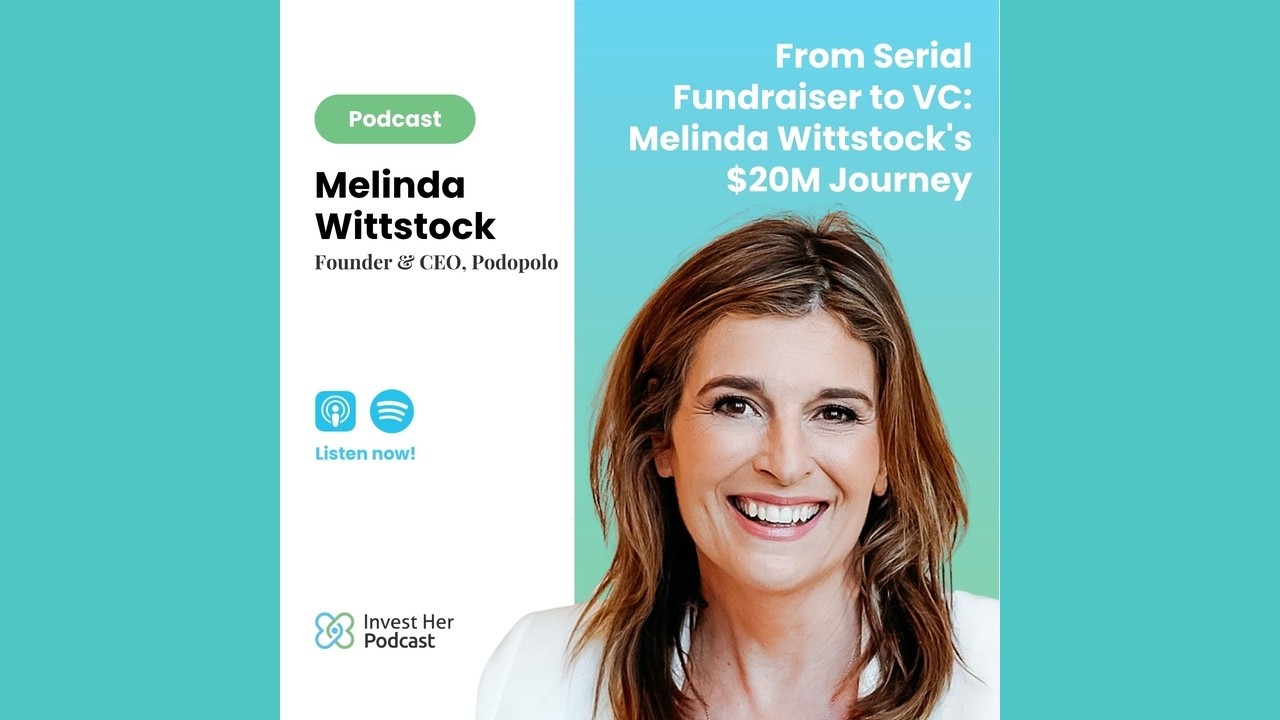
Serial entrepreneur Melinda Wittstock built five companies before founding Podopolo, an AI marketplace for podcasters and advertisers. She raised over $20M across ventures, navigated VC rejections and fund closures, and now seeks $15M while building toward 6-figure ARR. She advises women founders on valuation, investor qualification, and overcoming perfectionism.
Chapters
Hi there. Welcome or welcome back to InvestHer Podcast. I'm Anne Ravanona, your host and funding friend, and I'm so glad you're here. InvestHer Podcast exists for one reason: to share the real, unfiltered stories of funded women founders, investors, and ecosystem changemakers from around the world, and to give them the visibility and airtime they deserve. Because here's what we know: women are building extraordinary businesses. Women and men are writing checks and leading funds that invest in women founders. And yet their stories are still too often missing from the conversation. We're here to change that. Every episode, I sit down with someone who's in the trenches of building, funding, or backing women-founded ventures. And we talk about the real stuff, the pivots, the rejections, the fundraising lessons nobody tells you about, and the wins, because there are plenty of those too. Whether you're a founder navigating your first funding round, an investor looking to do better, or simply someone who believes we need more women building, scaling, and investing in women-founded businesses, this podcast is for you.
Now, I can't wait for you to hear this.
Let's dive in. Melinda Wittstock has built 5 companies, raised $20 million, and she still shows up every day fighting for the women who come after her. But here's what I love most about her story. She kept building even when the money wasn't there, even when the VCs had empty funds, even when she was a decade ahead of the market. Today, she's the founder of Podopolo, an AI platform rewiring the economics of podcasting for creators, listeners, and advertisers. And she's becoming the investor she never had.
By the way, she was one of the winners of our 2024 pitch competition.
And you'll understand why when you listen to this podcast. Whether you're a founder, a funder, or someone who needs proof that backing yourself is always worth it, let's get into it.
Welcome, Melinda. How are you?
Hi, Anne. I'm great. Thank you for having me on. I'm so excited about our conversation.
I am so excited too, because, you know, for our listeners, I am so, so excited because Melinda is a serial entrepreneur. So you're not just gonna get the funding journey and all everything, the behind the scenes of what she's building with Podopolo, because you're going to learn it's a super, super super company, and what they do is very, very interesting to all those podcasters, advertisers, corporates, people who need to connect with audiences. But she's going to explain it much better than me. But because she is a serial— because you're a serial entrepreneur, this is so cool. We're getting like 5 for the price of 1, Melinda. Is it 5 companies you, you have, uh, founded? Is that correct?
That's right. In fact, my kids, when they were little and they would hear that I was a serial entrepreneur, They misunderstood that and they thought I ran the Cheerios company.
Oh, that's so cute. I love it. I love it. I love that so much. Okay, so take us back to the beginning. How did you become an entrepreneur? When did it all start and what was the first company? And then walk us through the subsequent steps.
You know, I think it was in my DNA, Anne, because when I was almost 6 years old, I went out with my black lab To go door to door demanding prepayment for my show. Okay. Oh my God!
Prepayment—that's sophisticated. Wow! I don't even know.
I don't even know where I got that idea. It was just—it was just obvious to me, right? Like I have expenses. I've got to get the music together, and I have costume changes, and I want this sort of stuff. You know, I need to. And literally, I went around the neighborhood, and—and I think my—my lab was sort of my enforcer. Do you know what I mean? Like come on, pay her, right? And I came home with, you know, a lot of money because I was charging $1 and everybody paid because it was a cute little girl, I guess. Of course. Yeah. So, like, no one's going to say no. And, and I came home and I asked my dad where we could get 100 chairs. And he's like, what?
That is amazing.
You know? And so that was the beginning. I think I've always been entrepreneurial, like, you know, but I didn't even know what an entrepreneur was like. So I never set out in my life to be an entrepreneur. I think I just was one. And, um, um, I did all kinds of little side hustles and things, um, you know, um, as a teenager where I, you know, made money. I put myself through college, you know, those sorts of things. When I was on my student newspaper, because, uh, I, I went to McGill University and had a daily student newspaper, and the, and the paper was struggling, um, with money because we weren't getting enough money from the student council and, and such. So I said, why don't we start an advertising department? And, and then, then I kind of quickly realized that, oh, just the campus distribution is not big enough to really support an advertising model. So why don't we figure out a way to be distributed citywide in Montreal? And but why would anyone read a student newspaper? I know, let's create the first English language entertainment listings and food listings in the city, which we did. Which made the paper very popular. So we increased its print run and its distribution, and we had a really lucrative ad department. So I would spend the day like I'd go to class, and then I'd go out and sell ads, and then I'd write my stories.
I love it.
Okay. So I mean, but I didn't think I was being an entrepreneur. I didn't— I like, again, I didn't really know what that was. And, and I— my career, really, my early career was in journal— excuse me, my early career was in journalism. And I became the business correspondent, a business correspondent, and ultimately the media correspondent of the Times of London. When I was 22 years old, I joined the paper.
Wow. Yeah.
And I had the experience, which was great, of being able to interview Steve Jobs.
Wow.
With Richard Branson shadowing as a reporter. And because I was naturally an entrepreneur, I was a sponge. Like, I was just learning everything from all the people. In the business world that I was interviewing, and ultimately in the media as well. So that really stood me in good stead by the time I got around finally to launching my first real company.
Amazing. Wow. Like, I love it. Like, there's not very many people that we— well, you're the first on our podcast who can mention off those 2 names off the drop of your tongue to say that you've interviewed both. That's so, so cool. And I love both. I know Steve was— yeah. Steve is Steve. I mean, you met him. I've seen him on stage. We went to, like, we're super Mac maniacs, and we went to see him at Macworld in Paris. So we saw him when he launched the iPhone. Pretty cool. So that was really good. Um, but amazing. So tell us then about your first company. So you went straight from college into setting up your company, or did you have, uh, after the journalist, after the Times?
Yeah, so I was a journalist for a while. So I, you know, I was on the Times of London. I broke a lot of big stories. As a result of breaking all these really big stories, I became a TV pundit, and then I got recruited by the Financial Times to create Financial Times Television and host that program, which I grew as a co-executive producer and the host into pretty massive distribution with a deal with CNBC in Europe and Asia.
Yeah.
And from there, on that success, I got recruited to the BBC where inexplicably, I mean, I'm not English. I was one of their main news anchors of BBC World Television. Um, and then I started creating shows for the BBC. And in fact, I created a show for the BBC that grew to an audience of 20 million people around the world, um, out of the New York bureau. Very entrepreneurial. I mean, I couldn't—
You're an entrepreneur. Yeah, it's—
I was like an entrepreneur.
Entrepreneur. It's oozing out of you. I love it. I love it. Okay, so when was— when did you take the leap then from BBC?
Or— well, I was at the time, I was anchoring for— I think it was at that time, let's see, I moved back like from London to New York and I was anchoring for a little while for ABC News.
Yeah.
And then for MSNBC and CNBC. And I was getting kind of— it wasn't enough for me to be reading prompter, you know what I mean?
Yeah.
I had, like, really felt that I had done it. And then 9/11 came along. And I remember thinking to myself, gosh, you know, everybody's talking about our democracy. It's so important, right? How can we maintain our democracy. And I realized a lot of people weren't voting. And my journalist mind said, oh, it's because political news coverage is really bad. It's not really serving people. It's not involving them in the process. So my first company was called Capital News Connection, based on the principle that all politics is local, and that if it was reported in a way that was relevant to people's daily lives on a personal level, on a local level, people would be more engaged.
Yeah.
That company grew to serve 300 public radio stations within a year with localized coverage, moving on to serve, like, you know, commercial television stations, digital news properties, and such. We had a 3 million daily audience just after a year. And the real innovation— there was a lot of technological innovation in that, but being able to figure out a business model where you could localize at scale. And, and, and that was the real innovation that allowed us to do really award-winning content at a fraction of the cost to run a regular newsroom while at the same time winning loads of awards. And I ran that company for, I guess, 10 years. And in that period, I got really interested in technology and technology and computer-assisted journalism and all these sorts of things. And, and, you know, creating apps. And I created an app Ask Your Lawmaker, where anybody could ask any question of their senator or representative in the US Congress and vote the questions up the order. And our accredited journalists would go and get those questions answered for people to comment on, share, ask follow-up questions and such. That app grew to 3 million users in just 8 months.
Wow.
And that's at the point where I was, you know, coming to the end of, you know, I wanted to do my next company. So sold Capital News Connection. And went from there to really deep diving into technology. And that's really around the time that my work in the beginnings of AI really, and I think uniquely AI from a journalistic perspective, which is very different than how an engineer approaches it.
Mhmm.
We can talk about that a little bit later, but I think that's one of the really key differentiators in all, all my companies. So like 2010, you know, I'm starting to work on natural language processing, probabilistic models, kind of, you know, you know, natural, you know, supervised machine learning, which is the kind of precursor of, of AI and these language models with this perspective of a journalist seeking truth. Yeah. And so that was really, and then all the different companies were, have been really at this intersection of media and technology.
Amazing. And so when you, what was the name of that company? And then take us through the other ones. So just kind of—
Yeah. So the first one was Capital News Connection.
Yeah.
And then the next company was called Newsit. And I realize now that Newsit was a bleeding-edge company. Okay. And it was well ahead of its time because one of the things that— and I'm a visionary— and one of the things that I had noticed about social media, which was, I mean, I love social media, I loved its potential, but I also saw the potential of the filter bubble being a really bad thing for democracy, for truth-seeking and such. And I saw that very early on.
Mm-hmm.
And I had this whole idea of involving people in the— in journalism because traditional media models were breaking at that time. No newsroom was really big enough. And what could we do with crowdsourcing and algorithmically? What could we do to really ascertain not only the relevance of content to somebody from a recommendation engine kind of perspective, but how could we understand the reliability or the probability that crowdsourced content was accurate? So in effect, 2010, 2011, I'm solving the fake news problem with Newsit, which was one of the first crowdsourced mobile apps. Grew this to 500,000 people creating content. I was innovating the mobile UI because don't forget, Facebook hadn't even gotten that right yet. Instagram hadn't even launched. I mean, people— this was a, a crowdsourced platform where you could upload photos, video, you know.
Wow. Yeah.
It was very sophisticated. And at the back end, we were using, you know, the beginnings of AI and probabilistic models and all these different things to be able to kind of ascertain and rank Whether content was relevant or reliable. Now, here's the thing. It was so hard to raise money for this company because it was ahead of its time. Yeah. Now, I mean, it would really— like, I think people would really see the need for that company. Yeah. But, you know, it's like 15 years early. Yeah. But here's how the investor conversations would go. Just kind of funny.
Like, I love it.
I would be in a room with a major investor, like some of the early people on Twitter or Facebook or whatever. And they'd say, well, this is really great, Melinda. Somebody's gonna do it. And I'm like, are you looking at me? Like, I am doing it. I have 500,000 users and whatnot. And, and they'd say, well, you know, you don't really fit our pattern.
Mhmm.
I said, that's interesting because we use pattern recognition technology, you know, and I, I still wasn't getting it. And, and finally, you know, they would say things like, well, look, there's a lot of risk in this because You're, you know, what makes— you're banking it all on mobile. You know, what makes you think mobile is going to be big? Well, you know, there's these studies by Gartner and like this and that and whatever, right? Like, it really is the future. Like, everybody's gonna have one of these things in their pocket, you know? So that's why we're going mobile. And I'd say, okay, fine. But if you have, say, even if you're, you're successful and you have lots of people using it, and I was like, I'm reminding you, I have 500,000 people already. $850,000 invested in the company. And I have 500,000 people using this thing. I'm happy, right? So, like, I've proven that I can get users. And they're like, okay, fine. So even if you get users, you're gonna have so many people, your costs are gonna be crazy. How are you gonna manage that? And then I would say, well, there's this new thing called the cloud. And then the conversation would be, well, what makes you think the cloud is gonna be big? Yeah. I'd be like, oh my God. Anyway, and I walked away from some of those meetings thinking, let's see, I don't fit the pattern. So I didn't go to MIT, Harvard, Stanford. I did not drop out of any of those schools. I do not have a garage. I'm living in New York City. You know, I don't have a garage. I don't eat ramen noodles because there are too many carbs. You know, I mean, you know, it, it was just, it was really, really tough. And I, I mean, I love that company because it was so successful, even though it ultimately wasn't because we never got funded. Like, we just never could do it. And I ended up pivoting that company into another one called Verifeed, which used the same sort of backend technologies, but applied it to the entire Twitter firehose.
Mhmm.
And, you know, social conversations on Facebook and such help people find their, you know, lead gen and whatnot, their ideal customers. And before the influencer was a thing, we were identifying micro influencers for companies and such. And, and that was a successful company. We did well with that. I ultimately sold that, but I didn't love that company. And we were under a lot of pressure to become more of an agency, like, can you do our social media for us and that kind of thing, where it was actually really a technology company. Also, really, it was, it was hard to raise money for that one as well. It grew almost entirely bootstrapped on revenue alone. And, you know, a lot of enterprise, you know, enterprise ARR type things. And then when I sold that company, I took a break to really think, what do I really want to do? And I kind of found my media roots and discovered, you know, podcasting originally as a pay it forward. Like, I, I wanted to create the podcast I wish I'd had as a female founder. Early on, like, how can I really help other women? And that grew into beyond a podcast into a business of— this is where I became that kind of internet marketer version of myself, right? Where I had retreats and like membership courses and, you know, one-on-one trainings and this whole thing around, you know, mentoring women to really succeed. And And that was kind of cool for a while. And, you know, I ran retreats. I did all of that. I learned quite a lot, you know, through that, that company. But that doing a podcast was really what led me to Podopolo because I realized very early on that there was a structural problem that prevented podcasters from, you know, growing their audience, you know, getting the attention that their great content deserved. And let alone making money. Like, 98% of podcasters don't qualify for ad revenue. Their audiences will never be big enough to fit the way the advertising industry was looking at podcasting. Podcasts convert at a really high rate. And just through that experience, you know, because at one point I felt like I had all these additional businesses to support my podcast, even though it was a good, you know, the whole wings business was, was good and it was profitable and such. it was never gonna be a big scalable exit type company. You know, it was a good lifestyle business in a way, right? But it wasn't really me. I wanted to do my next, like, really big thing. And I saw that opportunity with Padopolo to take all the learnings of Capital News Connection, News It, Verafeed, doing the podcast Wings and whatnot, and really, um, uh, leverage that learning, uh, to, to really grow this amazing company, Padopolo. Um, and so that's where it all comes together.
I love it. And, and I think that's, that's, it's— thank you for sharing the journey all the way, because I think that's super important for, for all of every— everybody to hear that it's not a straight path. And I love the way you say, I've taken all the learnings of all the way through. And as we were, you know, chatting before we went live, you were saying that over the course of those different companies in different shapes and form, you've raised about $20 million over the course of all those companies. So you've got some t-shirts involved in the fundraising process. I'm gonna ask you about that in a minute, but before that, let us circle back. Tell us more about Podopolo. So when did you set it up? And tell us, how do you serve the different, you know, users of Podopolo?
Yeah, so I first really had the idea during the pandemic. Um, and, and, you know, as I, with my own experience in podcasting and the frustration of like, God, it's so hard to, you know, build an audience and such and be discovered, I started talking to other podcasters who had the same problems.
Yeah.
And I thought, okay, so the podcasters aren't being served. I have an idea for how to do that. But what about the listeners? You know, are the listeners being served? And I just, I discovered that a lot of listeners were having trouble discovering new podcasts, you know, search and a lot of the, you know, Apple, Spotify didn't have good recommendation engines, things like that. And a lot of listeners said they wanted to be able to talk with their friends about a podcast that they were listening to, you know, at the same time, or have that ability to connect in community around a podcast. And then I started looking at the advertiser side, and I started to realize that advertisers were really being shortchanged in this equation as well, because they didn't have the data. And that data became the issue of, of this 3-sided market, in effect, that if you could get that right, which I knew I could with AI and all the things that I'd proven previously, then you could really not only add billions to an ecosystem, but also save billions and really help all parts of that process. So in 2020, I started doing, you know, I did a lot of in-depth research to begin with. Like, I think when you're much younger, you're just like, this is a great idea and I'm just gonna go with it, right? In this case, I, I was, you know, I was a little bit cautious.
Mhmm.
I, you know, I was like, okay, I've got another one of these kind of shoot for the moon billion-dollar companies in me. So I'm gonna make sure that I get this right. So I spent a lot of 2020 on that kind of research and like, you know, how exactly would we do this? And really, first line of code on what was a Padopolo started with a Padopolo mobile app that was social. First line of code was written in like March 2021.
Mm-hmm.
Um, uh, with AI in the backend powering, you know, recommendations, an automatic ingest engine that brought in all this content and was able to also understand as we had more users on the platform, correlate user interests with and behavior with what was going on topically, you know, on the podcast. And it started in almost entirely as a consumer-facing app. And along the journey, you know, as we raise a little bit of money here, a little bit of money there, a little bit of money there, probably all in about $2.5 million has been invested into Podopolis so far.
Yeah.
We were co-creating with our customers, with podcasters, with listeners, and with advertisers. And with the AI, because our AI, I mean, we do use some of the different large language models, but we have our own proprietary AI as well. And we literally have created our own model, which It's a small language model. I mean, it's 6 million podcasts.
Mhmm.
That's 22% of the internet in terms of time spent on internet, 22%. So we have this, it's not small, but it's a quality and contextual language model where we really understand what's going on topically in this podcast. And we had this aha moment last year where we were thinking, gosh, we have a really great enterprise solution and we have really great SaaS tools for creators.
Mhmm.
We— that might be a much better go-to-market ultimately, even though we have the app and people love the app and, you know, that's going well. Um, this other opportunity was just a little bit of a pivot there. It was— I think sometimes also when you're in a situation where last year, really over the last couple years, once interest rates started rising, very, very difficult to raise money.
Mm-hmm.
And so we had to think very carefully about What's the fastest path to revenue?
Mm-hmm.
And growing a consumer app where the revenue is gonna come only when you, you know, that blitzkrieg kind of like blitzscale that Reid Hoffman talks about, like that model is very difficult for women entrepreneurs because we never get that kind of money to open ourselves to, to be— we're capable of building an Amazon, right? Or building that. But you need buckets of money. And women founders just— I've never met one yet that's had that kind of backing.
Mm-hmm.
And so we do get forced into different ways, and we can still get to the same destination, but it ends up having to be a different route. So that really sunk in with me last year. I was like, okay, we're gonna have to find a different way to grow. And ultimately, that delay or the difficulty in raising money focus the mind on what we could do on the enterprise side and revenue. And as a result, you know, we have 6-figure ARR deals, right? You know, recurring revenue. We're at a stage right now as we wait for our funding round, which we really, oh, please, we do need it now. That will allow us to just do the final productization, you know, of a lot of our AI. And I haven't even gotten to the blockchain part yet, which is, I'm really super excited about. But, and really bring all that to market with the, with the added benefit that through our partners, we're bringing listeners to the platform, we're bringing podcasters to the platform, the podcasters are bringing their listeners to the platform, etc. But we're making nice monthly and annual recurring revenue as we do that consumer play.
I love it. I love it. And that's smart to have both, well, the 3 sides. It's super interesting to have the consumer, the SaaS, and the enterprise model. So you, You're just very solid when you have it all and you can lean on the enterprise and the SaaS while you build up the consumer when you have more money to plow into the marketing because that's what it's all about. It's like, how do you get eyes on the traffic on it, basically? You know, it's so exciting.
Exactly. I mean, it's a classic flywheel. Yeah. When you architect a business where you think, okay, if I do this one thing, what are the— is there a multiplicity of outcomes from this one action? Yeah. If the answer is yes, then okay, good. Right? And so looking, and this is the way my mind works. I always look for these points of leverage. And I don't, I'm not a linear thinker. Not at all.
You can tell.
So I like to see these chocolate peanut butter things. Like, if we do this one, and that's the beauty of our AI, because this one thing that we do allows variously you know, really wildly improved podcast search and discovery and recommendations. Yeah. It allows generative AI content for the podcasters that save them time and money. Yeah. Because it, it, it really, you could think of it as very elegant repurposing engine because, you know, you have your transcript from the podcast and then that immediately gets parsed into like audio clips, video clips, captions. You can have real-time captioning, show notes. Social posts, you know, whether it's like a Twitter thread or like an Instagram reel or a, you know, whatever it is, workbooks to make the, what people are learning on a podcast actionable, custom prompts, you name it, all of it, right? And that's just getting more and more and more sophisticated as well. And then the other piece for the advertiser is because we're able to correlate what we know about the audience, their behavior, their interests and such demographics, with what's going on on a podcast episode in real time and over time. We know exactly what episode an ad should be placed in, but not only that, but where that ad should be placed in the context of that show to really increase its likelihood of higher conversions.
I love it.
While also protecting the brand with assured brand safety, which has been an issue in podcasts because people, again, Advertisers have been blind, um, to what's actually going on. So you like place an ad and you're kind of, because podcasts, you know, they go all over the place in terms of maybe about entrepreneurship, but on that particular day they might be talking about an industry that you don't want your brand associated with or something like that, right? Yeah. Yeah. Yeah. Yeah. So it's one thing that does all these different things.
And from the, then from the, um, enterprise side, that's the advertisers. Is it really? That's, that's that leg. Yeah, perfect. Yeah.
Yes. Well, so with advertisers, for instance, but also podcast hosting companies, I mean, really anybody on that, any business that's really supporting or a podcast network, they need this data and these systems, right? So, so we have an API that's customizable and fully embeddable with the ability to, you know, create, you know, custom dashboards and things like that. So say it's a podcast network and they wanna know what's going on with all their podcasts and they wanna get more efficient. And more successful and drive higher conversion rates on their advertising, for instance, right? They would leverage this podcast hosting company. They can leverage this API for that as well. A lot of hosting companies are also ad networks now, or they partner with ad networks, but they can also use a generative AI piece of it as well for all their, you know, all the podcasts that they, that they host. And likewise, an ad agency. We've even been approached now by PR agencies that look to place guests on podcasts. So which is the best podcast for the guest and vice versa. So think of it like it's like a matchmaker. It's just a really efficient matchmaker for the whole, for the whole ecosystem.
I love it. And how does it work? So what's the business model? And what do podcasters pay? What do, um, you know, enterprise, and what do listeners, how do they engage?
Yeah, so, um, business model is, is, it's interesting because it's part advertising. and sponsorship.
Yeah.
And it's part, you know, recurring revenue from, you know, SaaS enterprise API, you know, that kind of thing, right? So, um, listeners don't pay anything currently, although we, we do have plans that we could do some subscriptions, some different things for listeners, but totally free for listeners. Download the app, start listening, invite your friends. You know, you're going to discover great podcasts. You're going to have a better way to organize your listening. You'll be able to create share clips across all of social media with one click, you know, you know, sleep timers, all the things, right? Um, uh, just more feature functionality than Apple or Spotify. It's a really great app. So for the listener, it's, you know, a good listening app and a good social app, right? Um, for the podcaster, it starts out, it's a freemium model, right? So a podcaster can sign up, and when they go through the process of claiming their podcast. Their podcast is already on Podopolo, which is a mobile and a web app. So their podcast is already there, but they have to authenticate that they own their, their podcast to be able to start to take advantage. So effectively, they sign up. That's free. It gets them a little extra juice in the recommendation engine. It gets them kind of beginner analytics of what's going on on their podcast, and it gets them the beginnings of free ad placement. Well, they don't, they don't get ad placement yet, Right, on the free level. But they do grow their audience and they have a whole bunch of different things to help them. Then it's tiered pricing starting at $97 a month that allows the GenAI tools, ad placement, all the things. It's a graduated, you know, there's different packages depending on like what you want. With each tier up, you get a bigger share of the ad revenue for your podcast. And, you know, more, you know, more AI, more fancy analytics, more tools, that kind of thing, right?
Yeah.
And then for the enterprise, for the ad networks and such, and, you know, that's a lot of the— those are, you know, enterprise is kind of long sales cycle negotiation depending on what they want because there's a lot of development on our side and, you know, that kind of thing.
Yeah.
And in the context of actually sales to advertising. We partner with ad networks. And but one of the use of proceeds of our funding round is to build our own sales team as well and create that whole, you know, ad piece. So we're able to use our technology for the actual ad placement as well rather than relying on third parties for that.
And I mean, it really is the all-in-one solution for any, anybody who has to get involved in any way with podcasting. I think it's fantastic. And I love that it's a 3-way marketplace. Just one second because I have to close my window and it's lashing rain. We will cut this out, but one second, it's coming in. Sorry, Melinda.
Don't worry.
There we are. Apologies. But so I was just saying that it really is an all-in-one solution. I mean, it made me super excited because one of the things is you applied for and won in, in, you know, a key category in the AI deep tech category of the InvestHer Summit, um, Global Pitch Competition, and for a very good reason. I mean, you just shone for the whole jury. It was just like no-brainer. This is an amazing company, an amazing product, an amazing founder. It's like you were just streets ahead, um, in, in, in, you know, the applicants. And we had lots of really good applicants, so it was just, it was just great to see. And it was just wonderful to hear the behind the scenes a little bit more from you. Um, and I would love to say to all So everybody listening who has a podcast, who listens to podcasts, or wants to reach the audience of podcasters, check out Podopolo. You will have all the links in the show notes, but you can hear directly from Melinda. This is a labor of love, but more a labor of, of just leveraging all of the vast experience that she's built and from— and looking at it from a very keen, you know, journalistic but also systemic And tech. That's what's super interesting, um, that you're kind of— what you built with. Yeah, it's all— it's this magic combo. Yeah, it's a very good combo, a very good combination, which is really, really cool. So now I want us to circle back into your funding journey through all of this. So I don't know if you want to pick up some highlights and lowlights or like war stories from the other, um, experiences, the other companies before you came to Podoplo, or do you want to just focus on Podoplo and what the funding journey has Yeah, I mean, I told a little story about, about Newsit and, and how hard that was, right?
Like, that, that was, you know, a lot of head damage to the point where I was like, okay, that's it, I give up, I'll never get— so with Vera Feed, I didn't even really— oh, sorry, that's my, that's my, that's, that's my, that's my, that's my dog.
We can't hear him. It's all good. Zoom.
Augie likes to be involved in podcasts, and so he's got strong— he's got very strong opinions. Anyway, he's an English Cream Golden Retriever, and he got good at Zoom bombing during the pandemic.
Oh, listen, I have 2. I have a corgi and a mix between a corgi and a staffie, so they're quiet at the moment. But don't worry, Zoom is very good at blocking out the high-pitched bark. I have the maximum No barking on, so don't worry, we won't hear him.
Well, he's actually the Padopolo mascot. Like, I think his picture is somewhere on our website. So anyone who loves English Cream Golden Retrievers—
Oh God, who doesn't?
Go to the Padopolo website and you'll see some pictures of Augie.
I love it, I love it. But okay, so circle back. So you had told us some of the war stories. So actually, your experience just with the first company put you off Looking for funding for the next one.
Yeah, well, they did. Like, so yeah, exactly. By the time I got to Verafeed, I was like, oh gosh, there's no point. I'm just gonna bootstrap this. And then it was the same thing like with, with Wings, um, as well. But with Podopolo, it was going to be the type of company that, that did need funding. Yeah. And, and, uh, you know, the board chairman of Verafeed, um, ended up becoming the board chairman and lead investor of Podopolo. at that early stage. So that was our seed money and the relationship was already there. And so that was very helpful for just that kind of seed stage of kind of getting going.
Yeah.
And in the early days, we also got podcasters so excited that a lot of podcasters also invested, albeit at small amounts, you know, like $50 grand here, $100 grand there, $25 grand, whatever. Right. And so all of that was done in the form of convertible notes because we were too early really to do like evaluation or whatnot. Yeah. So that whole thing has been our funding to date, almost $2.5 million to get to this stage, which is considerably lower, I'm just gonna say, than any other AI company, right? Like, it's actually— I have to remind myself, it's amazing what we've been able to do with very little. And I think that tends to be the case for most female founders.
Yes.
Unfortunately.
Yes.
We're forced to be really good and efficient.
Yeah.
With the use of capital. But on this journey, we've had so many things go wrong with the funding, like weird experiences. So this has happened to us quite a few times where we've had like a term sheet and really excited and whatnot. And it turns out that the venture fund just never receives their funding. Oh geez, that's happened to us like 6 or 7 times. Oh no, no. And it's interesting because it used to be, Anne, and you probably know more about this than me, but it used to be that VCs had their money before they started taking pitches from, from, you know, startups.
Yeah.
Now it's actually quite the reverse. A lot of them get their deal flow, and then they go and raise money based on the companies that they've attracted.
They line it up. It's exactly— it's so hard because you're there just, you know, pitching your heart out, not knowing, and on the basis that you're assuming that the money's gonna be there when they close it, and then suddenly say, sorry, we don't. And that has happened. And what you've described, I know it has happened to some of the funds that I even interviewed in the past, that like they didn't— they never closed the fund. It was so frustrating. For everybody involved. Yeah, yeah, yeah.
And also there's a lot of pretenders. I mean, there's a lot of people around that call themselves investors and they talk a big game and they're like not really real. Like, and, and so I think for women it's very important to figure out how to qualify this early on, just like not waste your time. So like, I, I have these little sly ways of saying, so where are you in your fund? Yeah. And, and such, right? And because that's going to make a big difference as well if they're at the beginning of it or the end of it anyway, even if they do have money. So like, just being really savvy about that. And then, but I think that the toughest thing for us has just been the— we've, for 2 years now, you know, we've had a commitment from one VC that's gone through a whole bunch of different potential LPs. And like, finally, they really were on the right track. And it's a very— I can't really talk about the details of it. It's very, very complicated, but it's essentially a $25 billion fund through the repatriation of bonds and such. It's a new way really of raising money, but it's been very complicated. And I have an unusual window into what's actually going on with it just by virtue of, you know, the fact that, you know, our VC, the 2 VCs now who are funding us from the same source of money, have just been uncommonly transparent with us. And I think in part because it's taken a long time. Anyway, we are— I'm just touching wood because there have been all kinds of delays and hiccups along the way on this one, but we are weeks away from closing.
Yay!
We've got $12 million of the $15 million we're raising. Kind of committed.
Yeah.
Right. So a little bit of extra on that, on that round. Um, and, you know, just like it's, it's go time for us because, um, you get to the point where a startup where you have, you've done everything that you can do to really be ready for a very explosive go-to-market. You know your marketing strategy, you know exactly, you know exactly your team, you know exactly what you have to You've got all the systems in place and whatnot. That's where we are. But we just need the cash to now run and execute, which we know how to do. And I love— so it's kind of like, I feel like this horse at the gate, you know.
And this, and this is it. Like, I was just gonna— I was sorry, I didn't mean to interrupt you. But I was just gonna say that the timing is now right, Melinda, you're now at the right place at the right time, not 15 years ahead of it. That's what's, you know, hopefully, because that's just, it's just Let's just say the Force is strong within you, Melinda, and the forces are aligned around you, and this is going to happen. So what are you— when is the closing date of— when are you closing your round? Uh, is it the 30th of September, or—
So it looks like, it looks like it's mid-September. Mid-September capital calls are just about to begin, and so we do have some space on that. So anybody, you know, depending on when this podcast is airing, I mean, you know, because the minute that— we're calling that round our super seed. Yeah. Because we're a little bit beyond seed, but we're not quite A. Yeah. The minute that closes, we'll be starting our kind of trumpy for our A round anyway.
And anyway, listen, even if this gets aired a few days after you've closed, it's all good to be oversubscribed and say, that's okay, we can still keep—
Exactly.
Like, it's all good.
So we'll have the conversation with the, you know, with the right investors. Because one of the things that I haven't even shared with you, we've talked a lot about the AI, but I think one of the truly disruptive things that we're doing, Anne, is with blockchain. We happen to believe that when you look at the AI landscape and who's really gonna win, but also in terms of our society and what's safe or not, or what's ethical or what's not, we believe a decentralized approach to AI is gonna be the answer because a lot of concentration in the hands of only a few.
Yes.
look like entirely like the same as each other and such. Yeah. Yeah. Yeah. It doesn't really— same things. It's really the answer. And we believe that blockchain is a necessary component in AI. So when you think of podcasters and you think beyond that to the creator economy as a whole, imagine the change of being able to own your own data, be able to own your own community.
Yeah.
And that power shift. And that's really the big story behind Podopolo. Now, what we're doing with that, I think I'm really excited. In the fall, you'll start to see wallets debut on the Podopolo app. So for the fan, it's a way to automatically accumulate redeemable points towards, you know, access to your favorite podcaster or a deal with your favorite advertiser or a social impact donation, you know, like a donation to your favorite charity, whatever that's gonna be, right? Gamified. Now, as fans are, are being rewarded for doing what they already love to do, like, yay, podcasters in the meantime have a mechanism whereby they can validate and authenticate the ownership of their podcast. And with that, also their own data in a transparent interoperable way that really changes this whole ecosystem in, in, in a massive way. So, so that's really where, where we're going. Because we set out really to begin with to really democratize the, the creator economy. And so that's, that's where we're going.
I love it. I mean, I think that's super exciting. And this is where I say it just It oozes out of you. It's pulling back from your journalistic ethical roots that you want to be able to have that transparency and, and quality control over. When you say we have so many downloads and users that they're actually verified, it's not some bot that's just, you know, because that's also happening. And so for everybody involved that you'll be able to say, well, no, these are real users, they're real downloads, and these are the real hits or whatever that you're getting from the advertising, that you— they are listening to your segment, etc., etc. So you can have that full traceability. And I think that's fantastic what you've built and what you are building. Um, I'm super excited. Like, I remember sitting through your pitch during the pitch competition, and I wasn't judging because I wasn't allowed to, but I was listening in. And, and, um, you know, because we had the jury of investors and Yeah, it was just so fabulous to listen to you because it's just— I'm like, I have a podcast and I had a million questions afterwards. Like, we're on the podcast and I was like, oh my God, oh my God, this is amazing and I want everybody to know about it. Um, but I love the way in your, in your sources of funding and in throughout your journey, there's been a real mix of like leveraging your past, experiencing the new tech, being visionary, being so far ahead, but each time leveraging you know, on top of your previous experiences, your pivots, bringing it all together. And that's what's super exciting. And I really do believe that this is the convergence. And obviously, if you're, you're in the right place, and it's so great to hear that you've already got 12 million of your 15 million, um, you know, confirmed, because that's what we need to have more super success stories like that to be heard and to hear more, you know, tech founders to say, hey, you can do this, women founders in particular, and to be at the convergence And say, and, and again, you are being a, a visionary and you're doing a triple-sided marketplace. A double-sided is not enough. You happen to do triple-sided, and then say, and on top of that, we're gonna do blockchain with AI. Why not? Like, excuse me, it's so cool. It's so cool, Melinda. I'm super excited listening to you.
I think, you know, any— and my theory is, you know, every now and again, right, I, I realize about myself that I do tend to pick hard Right.
I don't know.
I don't know what that's about. There's some deep subconscious. I don't— who knows, right? Okay. Um, um, you know, I lie down on a sofa for that one, but I do tend to pick, you know, hard things. But on the other hand, you could look at it— any business is hard, right? And any business is going to be hard because the market's constantly changing. There are a whole bunch of things beyond your control.
Mm-hmm.
There are like new entrants. There are all kinds of— so many things that can go wrong. wrong. Some of them of your own making, a lot of them not. Like, it's just circumstance or timing or whatever. Every business is hard, right? And so at the end of the day, just walking through these challenges, because they're always going to be these challenges, I think for women in particular, a couple of things are really important.
Mm-hmm.
Is to realize that we're really not alone in this. And that's why I think what you're doing is is so important. And the more transparent we are and, like, with each other about, like, actually, it's one of the reasons I'm so transparent on this podcast sharing this journey, because it's really hard for everybody. And I think sometimes as women, we look at the other women who have succeeded and we think, oh, well, I must be less than because they did, you know? Right? And no, like, everybody has this. And so the more that we can really support each other just in that emotional sense, I think is really important. But beyond that, a real passion of mine is encouraging women to really think about and get good at, get educated about, and actually commit to investing in other female founders.
Yeah.
Because I think that's the thing that's really gonna change what has— like, venture is broken for women. I mean, you could argue that venture is broken, period. But like, it's really broken for women. It just doesn't work. So what are the new ways? How can we put our heads together to figure out how to do this? Because frankly, women and also minority founders, diverse founders spot opportunities that other people miss. We have a different perspective.
Yeah.
We're really good at this when we really leverage a lot of the things that are I don't know, women, you know, just the emotional intelligence or the empathy or just our intuition, all those things, right? We tend to be very good leaders when we believe in ourselves and very more collaborative. I think that's also the way the economy is going. So I'm just very passionate about, you know, any, you know, certainly by the time Padopolo exits, My next act is as an investor. I'm already kind of really learning the ropes of that as well.
Yeah.
And, you know, bringing, you know, I'm a kind of a junior partner in a venture firm, actually our board chairman's firm. And he, by the way, is committed to investing in women. And I'm really learning the ropes of VC in that case, you know, as I go. And I'm I really think the more we can get confident about investing and taking exit money and plowing that into other women, or just even buying each other's products.
Yes. Oh my God. I mean, you're singing, you're singing to the choir here because that's exactly what we're doing through FundHer on GlobalVestHer. So FundHer is where we have two-sided marketplace. So it's, let's say it's a directory of diverse deal flow. So it's basically a search engine for investors to find diverse women Founders. Boom. So instead of saying, I don't know where to look, come on, fund her. I'm part of Global Investor. And then the second part is access to markets, which is buy from her. So that's so important, um, because I totally agree. Like, I've been working in this industry for the past 11 years, and again, like you, 11 years ago nobody was talking about funding women founders. Everybody thought I was crazy. And like, they're like, what are you talking about? There's no problem. What's it— oh, it's just a woman thing. So then it's like, you know, it's been such a journey. To your point, when you're too far in advance— up until now, there's a lot of educating that you have to do. It's exactly what you described for your first 2 companies. You had to educate because you were so far ahead, and they were like, well, they didn't understand what you were doing, the problem you were solving, or how you were doing it. It was like all of those things, which is— I totally get because that has happened to us as well because we were so far ahead. Now there are other players, which is great, and like fabulous. Like, there's a $1.7 trillion funding gap. There is room for many of us, and I want us to be many. I want to be put out of business, and we don't need to exist to connect founders with funders. But that's— it's so important what you just said, and I, and I'm so glad that you've described your serial founder journey into funder and into an investor. That is so important because for me, that is the virtuous cycle that we showcase on our website as well. It's like, that is it. It's like the virtuous cycle is we help more women founders get funded, they have a successful exit, or as they are building their companies, become investors in other women. And alongside, we convince more male investors to invest in women and increase that cycle and increase that pool and increase the table.
That's how we do it. And even if you don't have the money to be an investor yet, there are things to do. Like, I realized when I launched my podcast, Wings of Inspired Business, it was really with almost 900 episodes now. It was with a mission not only to affirm and acclaim the female entrepreneurial journey, but to really lift as we climb, hence Wings, right?
Nice.
And in doing so, creating a platform that really encouraged people to buy from women So as of this, like, I started in 2017, I've driven more than $4 million of revenue to female-founded businesses.
Wow.
Just through the act of doing that podcast. Right. So it has been like an investment of sorts, even though I'm not getting a return. Yeah, it feels good all the same. So there are things that we can do, and if we step up to to be the change that we want to see in the world, then it just, you know, it inspires more women to think, yes, like, we can— we don't have to be in scarcity. We can be in abundance. Um, when another woman succeeds, that helps everybody.
Yeah.
It doesn't mean that because she succeeded, you can't, right? That, you know, that old thing that I think so many women have been stuck in historically.
Yeah.
I see that beginning to change. But really being in that, that place of abundance is critical.
I love it. So what would be your key tips, your key dos and don'ts for women founders who are about to go into— on the funding journey, journey in particular? What would be the key dos and the key don'ts?
Okay, so don't get discouraged. I mean, I know it's easier said than done. It's really hard. Like, it's, it's hard. So there's, there's a number of different things I think to get right here. The thing that I see most women do, and I had to recover from this myself as well, Nobody is doing you a favor by investing in your company. Like, you should not be showing up psychologically with a begging bowl like, oh, please, please, please, from— because you're giving them an opportunity. You're doing all the work, you're taking all the risk. It's you that like are sacrificing like to grow your business, right? It, it's, it's— so in other words, know your value. I, I think this is very, very— I love it. very important for women.
Yeah.
To get that psychological balance right, not least of which you're going to be more likely to succeed in your pitch because nobody wants to, you know, like no investor is looking at your thing as a charity, right? They're looking and they're looking for you to know your numbers, know what kind of return, like just be on top of that, but get the psychology of the pitch right. Like it's confidence and whatnot. And that confidence You kind of can't fake it. So you've got to go through this process of learning, right? Like, you're going to make mistakes along the way. The other thing I would say is, like, just figure out how to forgive yourself for those mistakes. God knows I've made so many, and I still have this dialogue with myself because I'm like, oh, man, I could have done it better or whatever, right? I think as women, we're really hard on ourselves.
Mhmm.
And so I'm saying this to myself as much as I'm saying this to any other woman. You know, it's, it's really important just to take all those failures, large, small, micro, Just as an opportunity to learn, you know, and be, be curious and talk to lots of people. You're going to get a lot of nos, you know, right? Yeah. And learn from my thing— make sure that the fund actually has funding.
Yeah, yeah, for sure. But how do you do that? Because they, you know, to be fair, so many investors string you along. So I mean, and also not to be too hard on yourself as well. I mean, they're very good at putting on the masks because they also to talk a big talk. So what— how can you help? What advice would you give to founders to kind of— what's the lie detector in there?
It's really interesting. I mean, it's easier in a way to do in person than on Zoom. And I mean, I think the pandemic really set us back in fundraising because so much about fundraising is relationship, and it's just much harder to create relationships on Zoom. So like a lot of That dance is just like getting to know people, right? Because I would also say a really good thing for a founder to do is, okay, so you take a meeting with the VC or you're thinking of a VC, look at who their portfolio company is like. Yeah, right. Call up the founders. Yeah. What are they like when the, you know, whatever, you know, the proverbial hits the fan?
Exactly. Yeah.
How do they be, you know, that kind of thing?
How do they, how do do they treat you? Look and see, have they invested in any— are there any female CEOs on their list of portfolio companies?
Yeah.
Just do your research, you know, ahead of time. And then there's other kind of questions that you can ask, like, okay, so, you know, uh, what's the size of your fund? Where are you in your fund? And, and, you know, and I have, in answering— in asking that question to a couple of folks now, I've saved myself a lot of time because they've actually said, well, you know, Fund 2 is kind of closed out now. We're in the middle of raising Fund 3. It's like, okay, when do you think you will have Fund 3, right? Some of them are honest, some of them are not. But if you, at least if you ask that question, and that also gets, I think it gets their respect too, because it shows that you actually, you actually understand, like, you know, the game. Right. So you, in other words, you should be qualifying them. Yeah. As much as they're qualifying you. Exactly. Come with the right questions. Yeah. The other thing too is in the realm of not taking it personally, some of the people who are the worst in this case, right, where they don't have a fund or they're, they're being the big ego, usually, right?
Yeah.
They'll find some way to who, because they don't have money, they'll find some other way to say it's not a great investment or whatever, right? And it could be total BS. And so feedback from investors, you've got to take with a little bit of a grain of salt. I've seen a lot of founders, particularly women, get like blown off course with every— the— with the last pitch meeting they took because they, they got feedback from somebody saying, oh no, you should be doing this instead. And they pivot, but it's not the right— you can get overcoached and you can lose your North Star. You can lose that direction and realize that people aren't necessarily— don't necessarily have your best interests at heart when they're giving you advice. Yep. It's got to be really good at qualifying that as well.
I love it. Really sound advice. And what would be your last message to our listeners, Melinda?
Oh, just, you know, for women, just just believe in yourself and be true to yourself.
Yes.
Right. I mean, just in the pattern recognition of me of interviewing 900 female founders who built 7, 8, 9-figure businesses and like everybody's had the following issues. And I would take it all down to mindset because entrepreneurship is an inner game. It's like what we kind of manifest and whatnot. We all have these personal subconscious beliefs that could be about money, that could be about our own value or sense of do we deserve success, like all these things. And they manifest in all kinds of weird ways. Like I've seen women just not wanting to look at their numbers because maybe in 5th grade someone told them girls are bad at math. Or it could be that their parents argued about money all the time. So they think that, you know, they secretly— they want money, but they secretly don't, right? Or they don't ask for the sale, you know what I mean? They're good at planning, but like, not actually, you know, or it's like, okay, I'll take all those photos for my Instagram promotion and stuff when I lose 10 pounds, you know, all that kind of stuff. For just, man, there should be an AA for perfectionists.
Yes.
Perfectionism is the thing that holds back female founders more than anything else. It results in like procrastination, not creating with customers. Like, perfect is the enemy of the good in this case, for sure. And I think women fall into this because we're so busy proving that we're good and we're worthy and we're valuable and whatnot, that in the time that we're doing that, we can miss opportunities. So it's okay to be authentic, real, ask for help. Oh my God. And the last one, be able to receive Right? Um, right. And because we're, we're not— we need to develop that muscle more about asking and receiving as well.
Yes, totally. I love it. No, but that's so good. That's so good. I mean, and I love particularly what you said about, like, you know, what women manifest are sub— those subconscious beliefs. Because as you say, even when you look at the money belief, when you unwrap it, it's like, yeah, I want to make money, but I don't want to look at my numbers. I don't want to wanna make more money and I don't wanna be too successful. Oh my gosh. So resonates so much.
On the pricing, like I was doing as a, with my investor lens, I was looking at a bunch of startups the other week on like a Zoom call. And honestly, this woman had a business that potentially, assuming her technology was good and whatnot, could be potentially a billion-dollar business. But she was projecting in her out years like 2028, that like it would be amazing if she was making $10 million in revenue. And I'm like, no investor is gonna be interested in that. Right? And I actually asked her because women never get asked these questions. They usually get asked questions by investors like how they're gonna mitigate risk or like that kind of thing. But no one ever asks a woman, how are you gonna maximize this opportunity? Like, what, what would like wild success look like to you? What do you think is your maximum amount? Like, if all the stars aligned that you could make?
Yeah.
make in 2028? And like, she should have said $1 billion, but like, she couldn't. Like, she couldn't get there. She couldn't see it.
Yeah.
Even though her company, you know, based on like a 5-minute pitch with a scalable technology, had that potential, but she couldn't see it herself. And so I think, um, women sometimes rule themselves out by being a little too cautious in their numbers. And like, yeah, I, I asked her twice, We're trying to give her a hook.
Yes, yes.
And like, and honestly, investors are not going to do that for you, right? I was trying to be really kind. I mean, like, just change it, raise your numbers.
Yeah, no, it's so true. It's so true. But how, like, because you've been through that, through the mill several times, Melinda, how can you, like, what would you say? And you've mentored Hundreds of women. Like, what would you say to somebody who has that mental block and who's ruling herself out? Someone who is holding herself— so that woman who was not getting the cue, if you could speak frankly to her now, what would you tell her?
Yeah, I mean, it's like, what is stopping you? Like, or I mean, there's a whole bunch of different— actually, this is a really interesting question, Anne. Thank you for asking that, because there's a different approach and it depends on the different situation. I can only really say what I'd be curious about It is like, I would like to ask that woman, how would she feel if— who would she be if she was running a billion-dollar company? And, and that question is really difficult for women. Women struggle to imagine that, and I think that's part of the issue.
Mm-hmm.
So how do we figure out how to stand in that? Like, literally, like, imagining, writing down, drawing, whatever. Like, what would your life look like? What would you be doing with that kind of money because it triggers all those things that then trigger follow-up questions. There's a journalist in me speaking now.
Yeah.
Follow-up questions like, what about that is making you uncomfortable? Do you think you don't deserve it? What would you have to do to deserve it? Who would you have to be to deserve it? Because I think there's a real block That all of us, for, for understandable historic reasons, and we all miss that, we need to recover from.
No, it's true. And it's like, there's the systemic ones, there could be the family ones, there could be the own internalized things, it could be past trauma. But with women, we tend to have that compounded in several layers.
It's fear. It's fear too, because I think, I think a lot of women— I think, I mean, I remember this, Aaron, when I was doing a a retreat associated with a podcast just before the pandemic. And I was bringing together women for, like, a high-performing, you know, high-performing entrepreneurs for this retreat. And the price point was like $7,500 for, like, you know, for a— I'm sorry, just a second.
No worries. No worries.
Loudly, can I pick up on that, guys? I'm on a live— I'm on a podcast, please.
I know what it's like. I haven't— I do. It's all good at the end of the night. Go on.
This is tape. I'm just gonna start that answer. Is that okay? Yeah, of course. Okay, thank you. Um, all right, so, you know, associated with my podcast back in 2019 before the pandemic, I was doing these retreats for high-performing female entrepreneurs. You know, these are women with 7, 8-figure businesses, price point was $7,500 for like a 3.5-day retreat and whatnot. And I remember on the sales calls, you know, when I was trying to recruit people into this, I would say, well, it's time for all of us to get together and play a bigger game. And I noticed like there was this split second where I could see in their eyes this like fear, just like a bigger game. And it took me a while to understand that what they were feeling was like, oh my goodness, I'm already really busy. I'm already burnt out playing a bigger game. That means that I have to do more. And they couldn't see the— like, I'm already doing everything. How can I do more? And so I think a lot of women were ruling themselves out. And I don't know, I had this epiphany that it was just a lack of understanding of the power of leverage. courage and why women are too late sometimes to hire, why sometimes we hire people to do things rather than return results, why we have a hard time asking for things, receiving things, or like think we have to do it all, right?
Yeah.
And like just really developing that delegation muscle. Like, yes, somebody won't do it exactly like you, but that doesn't matter. You may not love it 100%, but like, you can't do everything. And to build a scalable business, to play that bigger game, you've got to be able to hire, inspire, create a team. Your role— I mean, your role really changes as a CEO at that point where it's not just you. You have a little small team, and that's fine, but you— to get to that scale piece, it's like you've got to almost be like a different person. You have to master that. And so I think that's where a lot of women get stuck in small business. Yeah. And like service, you know, service-only type businesses or just doing— yeah, like it's, it's, it's a glass ceiling of our own architecture.
And I'm so glad that you've, you've, you've really opened up that box and to kind of to talk about the fear and the bigger game and thinking bigger. And I think, and the power of like what you were saying about leverage, thinking bigger and really projecting into the future and actually understanding the understanding the power of money and in the positive sense, 'cause I think that's it. 'Cause we can get hung up on, I don't want to be too successful because this, this, and this, or I don't want too much money because this is— but then when you see the other side, when you see or walk in the shadow of very successful business people who have, who have made the millions and who have a lifestyle, and you go, oh, I wish. But then you see the power, the freedom it gives them to have more choice and to have more time to make different decisions.
100%.
That's what for me is like, it's an eye-opener because I don't have the millions yet. I hope to have the millions, and I'm working to have the millions, and I am working on all of those things to, to, to move things forward. And I see some of my friends who are— thankfully, I'm so proud of them— in those positions and learning from them and saying, my God, it makes— it is a completely different world that you live in when you don't have to worry about money, where you have— you can basically manage your time whichever you want, have several businesses on the go, have several projects on the go, and be able to pick up and do whatever you want because you have that financial freedom. It is, it is life-changing. And, and I've had the privilege of, you know, being in the shadow of some people like that, and it's like, wow, I definitely want that. Like, you know, it's like now— but I think I wasn't ready. To your point, Melinda, I wasn't ready to allow myself to dream or think that big in the past, but now I am.
Yeah, exactly. And that's the thing. It's a process. And so in the realm of advice, I mean, you know, it's interesting. I was looking at the Forbes 50 Over 50 list, for instance, and there's a lot of young women in a hurry, you know, and I was one, right, where everything had to be done by the time I was 30 and then everything had to be done by the time I was 40 or whatever, right? I think women are kind of interesting. I think we're at our best as entrepreneurs in our 40s, 50s, and 60s.
Yeah.
Even into our 70s, actually, we're kind of like unstoppable. And it doesn't have to be a rush. You'll get there. Right? It is definitely, definitely a journey.
Yeah.
And understanding that leverage piece, I think, is really important. I think the other part, though, is a fear that we think, oh, if I'm a really strong woman, maybe I won't get a man, you know, or other women won't like me. I'll be cast out of the tribe.
Yeah.
And this is why your family is not the same as your business family.
Yes.
Yes. Right. Okay. Because your family will be projecting all their fears onto you, and they'll be dissuading you from things and making you feel— because they're threatened a little bit. But they also— they also— I mean, they're— even if their hearts are in the best place, subconsciously, you know, they're a little bit destabilized by, like, you're gonna leave them behind and that kind of thing. Right. So, like, even if they mean well, So you need to surround yourself with people who are genuinely excited about your big success.
Yeah.
And that is absolutely vital because it's hard enough.
Yeah.
And it's isolating enough. Like, I remember when my kids were small and being in the school, like, drop-off or whatever, and all the other moms thought I was a freak. There was no way I was going to be able to show up with all the muffins or all the— you know what I mean?
Yeah.
And that was weird because you can feel a little bit— and I think as women, we want to belong. So it's that kind of fear, I think, of being shunned that is a part of this as well. And just like, the more we can come into kind of conscious— I'm very spiritual. So the more we can come into this kind of conscious awareness of just Just being aware of what we're feeling and kind of like, oh, that's interesting. I wonder, right? When you get triggered by something or whatever and just being aware and just moving through that. I joke that if you want therapy, just become an entrepreneur. It will provide.
It does. But joking aside, I know that it's so important for entrepreneurs to actually go to therapy. It's a really important thing. And I know that some investors are like, yeah, no problem, you can put it as a business expense because like we need you to be on top of your game. And if you need to go and have a sound box over there and get your head sorted out there, all good, because we know that you're looking after yourself and work through your—
You know, I joke with Steve with Zero Limits Capital that I don't know if you ever watched the series Billions, you know, about sort of the hedge fund world or whatever. But this firm had an in-house kind of therapist. Yeah. You know, and the character was Wendy. And, um, and, uh, you know, I kind of say like every VC, every startup kind of like needs their Wendy, you know.
But it's true. It's true. And even if the therapist— and no, most of them don't come from the startup world. Of course they don't. They don't understand and they don't have to be a an entrepreneurial— an entrepreneur therapist as such, but it just can help with perspective and help pull out all the— because of all the power dynamics and all the things that we have to negotiate with investors, with customers, with team members, with suppliers, it can be just so good because we're so in the weeds. They can just offer— just pull your head out and say, okay, now I can see how you're managing this type of situation is, is coming across it's polluting these other areas that you're working on, and you better fix it there so that then it won't blow. That's all helpful. And I think I just, I just pulled it up when you said about becoming aware about what you're feeling. And, and, and I think that's— it's very important for founders to look after themselves, particularly women founders, because we're drained and pulled in so many ways that you said. And I also love that you talked about the 50 over 50. And because it's true, there is always a rush to be the 30 over 30. And then there was a 40 over 40. Now there's a 50 over 50, and it would be even better if there's a 60 over 60. That'd be amazing.
I'll be a 60 over 60.
Yeah, yeah, absolutely.
I mean, hey, so, but listen, qualify for the 50 over 50.
Yes, I'd meet— me too. Like, we're, we're there. Okay, so what's your parting message, Melinda? I know we kind of talked a few things, but if you had to sum it up, what, what would you like the listeners to kind of of get from this conversation?
Okay, so depending on who you are, if you are a content creator, which just about everybody is this day, okay, in this day and age, my dream for you, okay, is that you will be empowered through the creation of your content and the value of your own voice to be able to support your family and your dreams just by putting your voice to a microphone or your visage to a photo or a video. Like, I am in this to change that dynamic so you own your own data, you own your own community, and, and you can literally support yourself and your, your business, right?
Mm-hmm.
And I want that for you. So, um, this is what Podopolo is all about. We really encourage you to be part of the Podopolo family. The easiest way to start is by downloading the Podopolo app, whether you're a listener or a podcaster, um, checking out our website, um, We've got a lot of things, a lot of product launches and things coming in the fall that we're really, really excited about. Of course, if you're an investor, invest in Podopolo. It's a multi— I love that. Company changing a whole global ecosystem, addressing the largest markets, like with a team that has 16 exits between us. Like, come on, it's a no-brainer. So please get in touch with me, melinda@podopolo.com. That's really easy. If you're a female founder, I really encourage you to listen to my podcast, Wings of Inspired Business, because in a long back catalog, it's 900 episodes with women who talk really openly about their journeys, their epiphanies along the way, much like this conversation. And actually, and you have to come on my podcast too, by the way.
I'd love to be. Yes. Thank you.
Like, check that out. And if you are a female founder and you wanna get, you know, featured on it, you can like ping me again at melinda@padopolo.com and such. can, you know, get you scheduled so you can tell the story of your business and such. We can send some business your way. So those are kind of all the ways that I can think of. I'm kind of a bit, you know, I'm mostly— I use LinkedIn more than any other social platform at the moment. I do some stuff on, you know, Instagram, but I find a lot of the social media sites kind of a time suck, and they don't necessarily, you know— I can hardly wait for the day where I can just hire someone to do my social media for me. That's kind of how I feel about it. Um, but you know, you'll, you'll get to me on LinkedIn.
Perfect. Well, we'll make sure that we have all those links, um, in the show notes. And investors, you have an opportunity. Do not miss the window. You will be kicking yourselves. You will say, oh, that was one I let go. Do not, do not put yourself in that position. You've heard Melinda. Honestly, she's amazing, as you can tell. Um, what you've built with Podopolo is amazing. I'm super excited for this, this next round. I cannot wait to see what happens next. And it's an open opportunity for you. I'm an open-up invitation to you, Melinda. I want to say in X months' time, I don't know when it will be, I want you back so you can tell us the other side of the story and then what's been happening next in the blockchain, etc., etc.
We need to know exactly what's going to happen the minute the money closes, right? It's super busy. Like, we're recruiting, like, onboarding. We got PR efforts, the marketing efforts, like more product. I mean, you know, it's gonna be very, very busy. And I think in that, in that phase of a business where you're growing really quickly.
Yeah.
Another little bit of advice, just like self-care. So I'm thinking a lot right now in this little quiet period in August of like, what does my life look like? How do I navigate this personally? Like, so that I don't burn out and, you know, that kind of thing. Right.
But it's exciting. That's so exciting. Well, listen, thank you so much for sharing this part of the journey so far with us, Melinda. To be continued, dot dot dot, is all I'm going to say. All the best for closing this round. We know it's going to happen super soon. And as I say, investors, you still have an opportunity. Jump in while you can. And thank you so much, Melinda. And I look forward to having you on the podcast again for the next part. Thank you so much.
Thank you for who you're being in the world. and everything you're doing. It's, it's amazing and very inspiring.
Thank you.
More from Anne



🎙️ EP69: Get Off the Fence: Renate Crollini's Startup Blueprint | InvestHer Podcast

🎙️ EP68: Radical Truth: Robert Rubinstein Exposes the Impact Investing Illusion | InvestHer Podcast



🎙️ EP66: Global Sisterhood — Carine de Meyere on Trade Missions | InvestHer Podcast



🎙️ EP65: Capital With a Conscience: Pierre Norman Rolin on Investing in Women… | InvestHer Podcast

🎙️ EP64: Dream Bigger: Nikki Barua on Building an AI-Native Company Without… | InvestHer Podcast