🎙️ EP58: Pitch, Bootstrap, Build: Christine Ntim's Funding Masterclass | InvestHer Podcast
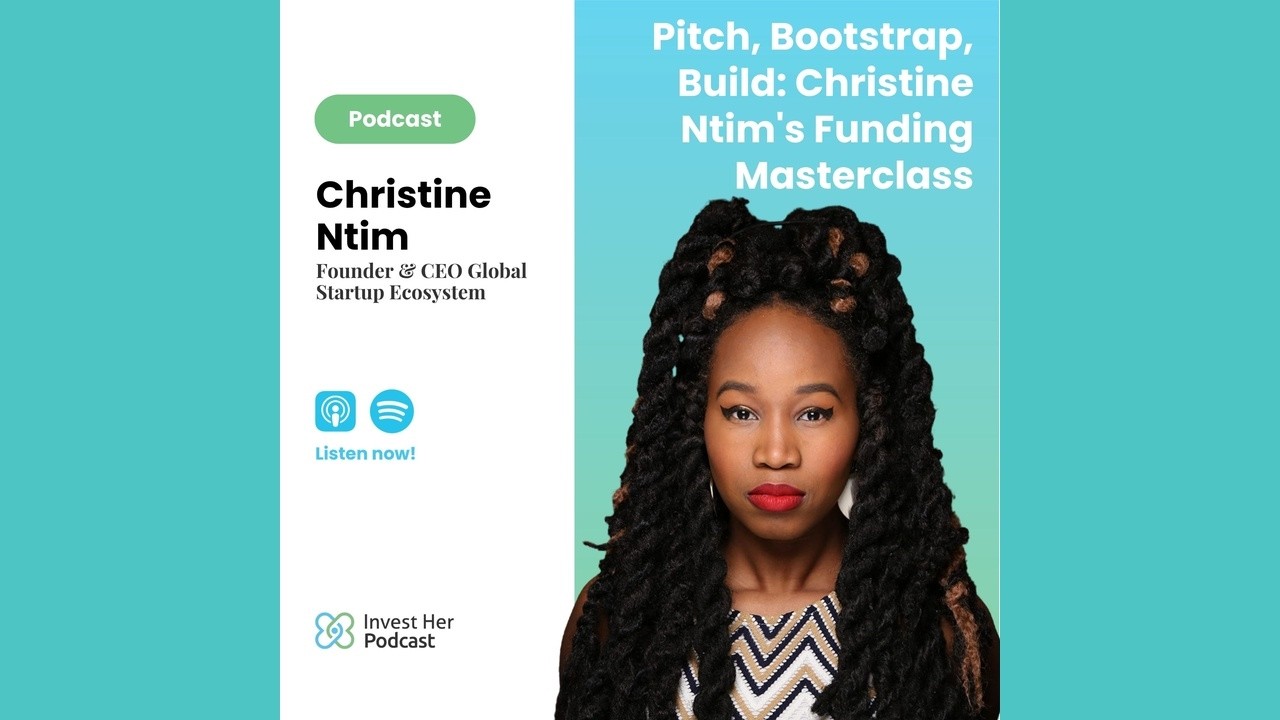
In this InvestHer Podcast episode, host Anne Ravanona interviews Christine Ntim, a three‑time founder and ecosystem builder behind the Global Startup Ecosystem (GSE), the world’s largest digital accelerator. Christine shares her personal background—growing up in a family of Haitian entrepreneurs, studying at Dartmouth, and early work in banking—before launching her first startup, Vendetti, which digitized informal street‑market economies. She recounts how Vendetti became a Harvard Business School case study despite initial investor skepticism. The conversation then shifts to GSE’s mission to accelerate 1,000 startups annually across 70‑90 countries, emphasizing purpose‑driven, legacy‑building entrepreneurship and the evolution of the entrepreneur’s public image. Christine outlines five creative fundraising pathways she has used: pitch competitions, equity crowdfunding/crowd‑equity campaigns, sponsorships and event‑based fundraising, bootstrapping via payment‑platform financing, and leveraging alternative resources (office space, venues). She provides tactical advice—pre‑work for crowdfunding, storytelling grounded in data, maintaining confidence, avoiding mass‑email blasts, and managing burn rate with minimal tools. The dialogue also explores challenges such as lack of network privilege, the importance of authenticity, defining success as personal fulfillment and founder‑desired outcomes, and the value of learning from both successes and regrets. The episode concludes with actionable calls to follow Christine on LinkedIn, apply to the free GSE accelerator, and consider premium personal‑branding programs.
Chapters
Hi there, welcome or welcome back to InvestHer Podcast. I'm Anne Ravanona, your host and funding friend, and I'm so glad you're here. InvestHer Podcast exists for one reason: to share the real, unfiltered stories of funded women founders, investors, and ecosystem changemakers from around the world, and to give them the visibility and airtime they deserve. Because here's what we know: women are building extraordinary businesses, And yet their stories are still too often missing from the conversation. We're here to change that. Every episode, I sit down with someone who's in the trenches of building, funding, or backing women-founded ventures. And we talk about the real stuff, the pivots, the rejections, the fundraising lessons nobody tells you about, and the wins, because there are plenty of those too. Now, I can't wait for you to hear this. Let's dive in. What if I told you that you could raise over half a million dollars without giving away a single share of your company and use that to build a global ecosystem for entrepreneurs? That's exactly what today's guest has done. Today I'm reconnecting with the phenomenal Christine and Tim, 3-time founder, award-winning ecosystem builder, and the force behind the Global Startup Ecosystem. It's the world's first and largest digital accelerator supporting over 1,000 startups a year in up to 90 countries. Christine is on a mission to build the next generation of purpose-driven, legacy-building entrepreneurs. This conversation is a masterclass in fundraising creatively, owning your story, and building a business with integrity. Enjoy. Welcome, Christine.
Thank you so much, Anne. It's a pleasure to be here with you. Thank you.
I mean, okay, so before we start, I would love kind of to warm up the audience to get to know you a little bit.
Can you tell us maybe one Yeah, I mean, I mean, I think at surface level people know about my entrepreneurial journey, but, um, I'm actually a really great dancer and I know how to choreograph. A lot of people don't know that about me, that I could choreograph African dance moves, like, and I do that with a lot of my peers, like, just as a hobby for fun.
That is so cool. That's a very good skill and superpower to have. I'll be looking you up on that, Christine. I, I love that. I love salsa and stuff, but I've never tried African dancing.
It's so energetic and so beautiful.
So let's kind of get started. I want people first of all to learn a little bit more about you, Christine. Tell us about you first, your background, before we go into, um, why you set up your organization and do all the amazing work that you do.
Yes, I mean, I appreciate that. I mean, it's such a loaded question, like, you know, what is your background, right? How do you condense an entire lifetime of experiences in just, you know, one simple moment? But I always begin with the fact that where my mission is, and my mission is really to build the next generation of entrepreneurs. I have had a very crazy— we were just connecting before this— a very crazy and very defined entrepreneurial journey. And simply because my upbringing, every single person in my community were entrepreneurs. My mom was an entrepreneur, my grandmother was an entrepreneur, my aunts were entrepreneurs, and they craved entrepreneurship through their talent. So I have such a passion for entrepreneurship and supporting the next generation that I really, really am passionate about just Really just entrepreneurship in general.
And we pause there. Can we pause and just say how lucky you are to have had all these incredible strong women? Oh my gosh, it's rare to have multi-generation. And like, it's like not just your mom, it's your aunties. It's, it's, you know, and you're the next generation and bringing in the next generation. That's fantastic. I just want to say that because not everybody has that incredible background of, of role models and opportunities to to absorb from an early age.
And I'm so grateful for it because I could see myself passing the torch to my daughters who are watching me build businesses right before their eyes. And so, you know, my entrepreneurial journey started with, like you said, my family growing up in Haiti. I was born in New York, but I grew up in Haiti in the Caribbean. So I got to see resilient entrepreneurship, you know, street markets, street vending, food, restaurants, hairstylists. Like I saw such a variety of entrepreneurship that by the time my mom, you know, immigrated to the United States, States and started her first entrepreneurship journey selling Haitian craft artwork. It was one of the most unique in the entire New York City. You can imagine New York City being a city of immigrants to have one place where people were buying Haitian artwork. It was really amazing to see her blossom and be able to build her entire generational wealth of buying homes and being able to provide for our family just through entrepreneurship alone. So I was very passionate about how you could set um, a solution and really give back to communities, the things that you love to do as an entrepreneur. And so when I got my first opportunity to just take a leap of faith and go for it, that was that. So my background has always been diverse, um, and exposed to real thought leaders who are building businesses that matter to them and the communities that they serve.
Okay, so, but you did go to college, didn't you? And you did— what did you study in college? Because this is fabulous. You got the College of Life and Entrepreneurship Live, which is the best college, we all agree on that. But you did go to university as well.
I did go to university. As a matter of fact, I'm the first in my family to go to college. So it was a huge deal for my family. I went to Dartmouth, probably the farthest Ivy League up north. Loved it. Phenomenal experience being at Dartmouth College. And I started my entrepreneurial endeavors in college, actually. I had like small little like gigs here and there as a freelancer, turned it into a business. So I really got my foot wet in that experimental phase in college. And when I graduated from college, during that time, I actually traveled to close to 20, no, about 30 countries while in college.
Wow!
Yeah, I really— at Dartmouth, I got to do a lot. I went through, like, you know, India to Japan to Ghana to— like, I really got to travel, um, because I was really— you can imagine being the first in your family to go to school, like, you're very headstrong about your academics, also exploring and maximizing those 4 years as much as possible because it was precious to me. Um, so I got to travel a lot, and my journey of traveling was really understanding street markets around the world because that's where I grew up, around street market economies from my upbringing in Haiti.
Yeah.
And so fast forward to when I graduated, um, got into banking to make some money. Everyone knows traditional roles, sometimes it's okay to follow traditional path to understand the market, to understand the world. And after 2 years, got promoted several times, did really well in corporate, but I knew I had to handle that itch, I started my first startup in 2014, 2 years after graduating, and I've never looked back since.
So take us on that journey. What was that first leap that you took? And I'm just sitting here as if I had popcorn. I'm just like loving just listening to you, Christine. And you're an incredible storyteller that we know because you also help entrepreneurs, you know, really express their true why and soul and connect with audiences. So I just love— I just want to say, you know, it's wonderful to watch you exerting, showing your craft as we're getting the opportunity to get to know you. Just giving that little, little nudge. So tell us more about when you took that leap. What did it look like 2 years out?
Oh my goodness, it was crazy. So first and foremost, I always try to tell people, build something that's worth it to you. Don't try to build something for the masses, right? I think entrepreneurship has really changed where people are building businesses for clout and not for purpose. Yes. And so I remember, you know, after traveling to so many street markets, I said, you know, this is a huge economy. I think we should digitize this and digitize access to this economy. And I remember every single person I spoke to, whether it would be in the corporate space or academic space, all of them really just like shunned it, right? Just didn't understand if there was any economic viability in doing that. And I remember while the first thing I did, I actually relocated to Dubai.
Mm-hmm.
'Cause Dubai was very unique at the time. It was just such a pop cultural hub for innovation. Activity and travel tourism as well that I thought, you know, let me go somewhere I've never been because I traveled so much but I haven't been to Dubai. And the first thing I did when I got there was really started pitching the story of street vendors. And I remember someone walking to me, it's like, I've never heard someone talk about people that I pass by every single day. Wow. Street vendors you pass on the street who's selling like maybe a street food or a street product, you don't really think about their stories. You don't really think about the fact that There's a whole billion-dollar, multi-billion-dollar economy that's literally in the streets and informal economies.
Yes.
And from there I kept going. And I remember I got the opportunity to actually travel to Brazil during the World Cup to pilot test the street markets in Bahia in Brazil. And I remember I posted it online and it went viral. Like everyone was sharing images of the street markets that I was going to. And from there, like people just started really hearing more about the Vendetti story. That was my first startup, Vendetti. And within 2 years, it's now actually business case study at Harvard Business School, the journey of building that company, dealing with rejection, dealing with, you know, investors not wanting to invest in the business model of digitizing economies, but more so the profound story and journey of building something that has impact and purpose, people were against it, you know. So that was a really crazy ordeal at first. But in hindsight, it really inspired a lot of entrepreneurs to build products that serve the communities that they want to serve.
I love it. And I think you've mentioned a few things that are important I want to kind of grab on at. One is the multi-billion-dollar economy that street markets equate to.
Yeah.
You know, they are, as you've said, the informal market for the most part, even though they would probably have to pay for licenses to have their stand where they are. But still, apart from that, it's mainly informal. And I think the more governments that actually take the steps and measures to help formalize that, because Those people would like more stability. There is no question. I say those, I'm not making them other. I, when I was a child, my mom, to make extra income, which she's done entrepreneurship so many times over, but one of the things she would make these beautiful apple pies and I would be on the stands at 8 years old. I've done door-to-door selling. I've been on the markets and I loved it. I loved it.
You get it.
It's like, so, so, and it has set me up for who I am. It's very character building, as you say, to get your door slammed in your face and people literally ignoring you or not saying, and you just having to, you know, try and, and get that sale. But, but what's important in there, what you're saying, is that what was so interesting is how investors were overlooking the opportunity because they weren't even considering this whole huge economy as part of the economy when it's just vital to the economy, really, you know.
I'm so glad to hear that you've experienced the character-building experiences that you just shared. And this goes back to like where I'm a I'm a 3-time founder, by the way, so I've built multiple businesses since then. And it really helped me as an entrepreneur to not take things personal, right? And sometimes the best doors that, you know, are available to you are the ones that are closed.
Yes.
People truly understand that we're always trying to break down barriers, break down doors, but sometimes closed doors are great opportunities. These rejections really redirect you to, first off, reevaluate your why. Why are you building this company? What is the purpose, right? And second, Are you building something that is worth taking in? Right. And so with that said, you know, with, you know, vendetti being such a success factor early in my entrepreneurial career, like you said, that character building got me to launch the Global Startup Ecosystem, which I manage today, which is home to the world's first and largest digital accelerator, where we really help entrepreneurs take an idea to market and launch through our annual flagship digital accelerator program. We accelerate about 1,000 companies a year around the world.
Amazing.
Showing them that resilience.
And so these companies are all different types of sectors. Tell us more about the companies that you accompany, and are they— they are both men and women-led companies, I assume?
It is such a diversity of startups. I mean, you can imagine we're accelerating about 1,000 startups per year. So I interact with thousands of entrepreneurs, thousands of stories on an annual basis. And these entrepreneurs, like you just said, they're different sectors, they're different industries, they're in different countries. On average, we're, you know, supporting about anywhere from 70 to like 90+ countries per cohort. So it's a very diverse group of entrepreneurs. And the biggest thing that I will say that we have seen over the past couple years with the type of startup entrepreneurs that are coming in is like now, and this is where my passion lies today, in going beyond preparing entrepreneurs to build a successful, profitable business, but also build their thought leadership as well.
Yes.
We have now changed our idea of the ideal entrepreneur. If you could recall, Anne, during the time when we first got got to know each other about probably like a good 10 years ago now.
Yeah.
Um, entrepreneurship was buzzing, you know. The entrepreneur was such an iconic brand and identity. Like, people were inspired by entrepreneurs. A lot of the thought leaders that people wanted to grow up to be were entrepreneurs. Fast forward to probably around like just right before the pandemic, entrepreneurship is not as glamorized. People are now skeptical of someone who calls themselves an entrepreneur because we've seen scandal after scandal after scandal take place. in mainstream online circles that now we question the credibility and the innovation and promises of entrepreneurs.
Mm-hm.
So our thought process now with GSC and my mission right now is in building the next generation of thought leader entrepreneurs. Don't just build a business, build a legacy because what you build is beyond the product or service. It's like, how are you building your personal brand? What legacy, what value are you leaving behind? What story are you sharing with the world for people to kind of re-engage and believe again in the power of entrepreneurship and the innovative solutions that entrepreneurs can bring to market again? And I'm very passionate about this right now.
You can't, you can't tell. No, I think it's, um, it's, it's so refreshing. And I think it's, it's very important what, like what you said, there's, there's There's kind of these ebbs and flows when it comes to entrepreneurship. Entrepreneurship and small businesses and micro businesses are the backbone of all the global economy. They literally are. And again, as you said, it's it's so interesting because over that time we have seen some companies scale and go go stratospheric, being funded to the guilds like with silly amount of money for business models that are not even profitable. That it's all just basically. users, and there's no money being made, but it looks good, it shines good, and hey, I feel good putting billions into this. And instead of that, I like your focus on building, um, impact businesses, legacy businesses, and I would push that a bit further and say generational businesses. It's about building generational wealth, which is kind of LinkedIn. I'm reading the subtext in what you're saying and where When you're saying I'm— it's about leaving a legacy, not just a legacy for the planet, for your community, for your family, but it's, it's, it's also helping sowing the seeds so that the future generations around you are going to have maybe access to different opportunities, different innovation, and different role models thanks to you having been there and being a part of that ecosystem.
Absolutely, absolutely. And I think right now you know, you know, over 90% of businesses fail anyway, right? And despite all the programs, all of the tools, that statistic hasn't really changed over the past couple years, has it? So it's not a matter of like telling people how to typically build a market strategy, build business development, customer acquisition, the typical things that we talk about in entrepreneurship.
Yeah.
What we talk about and what I share with people is like, you know, what is the why behind your product? Who do you serve? What are their needs?
needs? Yes.
And why are you the best person to serve that market? And particularly in this day and age, what's going to keep you integrated into the mapping out of this business? Because one thing that I was saying, especially looking at the evolution of entrepreneurship right now, you could actually be successful and resent your business, right?
Totally.
Are you outside of your business? And these are essential questions that I think that many entrepreneurs are facing and they don't know that they are. And so one thing I would challenge the women in your community week who are fundraising and don't know what they're fundraising for because they think that they have to build and fundraise their companies in a certain way. Um, that you need to really reevaluate what are you doing this for, and is this something no matter what happens along the years, right? Because usually, typically, a business after 5, 7, 10 years, that's when you really see the magnitude of your, of your investment. Who are you outside of that business? And is this something that you're proud of?
And, and is there congruence? Because I think that's very, very important. So you do talk about, uh, building your personal brand and thought leadership, but for me, it's, it's about being authentic in the business, on the business, outside of the business. That the same person, the same Christine I'm speaking to, you're the same person if we go and have dinner together, you're the same person if our kids play together, you're the same person if you're giving a kick-ass talk. book, you're the same person if you're building a program. And that for me is what— that's what I aspire to be and what I think I encourage as well entrepreneurs to be. Because again, linked to what you were saying earlier around this aura around the old aura around entrepreneurship, is that an entrepreneur needed to look and be a certain way, right, and act a certain way. And therefore Or if you got lots of funding, you have to like this is like you have to put on the show for the investors, not just for the customers, not just for your employees. You gotta hold all that up, and you gotta put the show on for the investors. Make sure they feel good, and you make them look good. So that's all part of the game. But I think if you are an authentic leader, an authentic entrepreneur, congruent standing in your truth, in your North Star. then that doesn't become difficult because you are the same person in each of those things. And then it's only when you rise to and get over the difficulties that happen in your professional life, in your work life in parallel, that you truly shine and know what you are, who you are as a person, but also as a leader, as well as the entrepreneur hat. Because I, you know, sometimes when people ask me, if they don't know me, what do you do? And I say, I'm an entrepreneur and I help women entrepreneurs get access to capital and markets, and I'm on a mission to get a million women entrepreneurs funded by 2030 through all these things and through community.
And they go, good.
It's sometimes I feel like entrepreneur is still a dirty word. Christine, do you, do you find that? I mean, it's just like something because those people who are in the kind of brick and mortar or the traditional industries and sectors, they kind of look at you Huh? Like, you look like an alien to me. Entrepreneur?
I'm so happy that you said that. Like, entrepreneur still, still feels like a dirty word, and for a different reason. When I was growing up, entrepreneur means that you couldn't get a job. Okay, that was what it translated for, especially in markets like mine where it's just like you didn't get a job, so you call yourself entrepreneur.
Yes.
Then there was, for the first time, a revolution about 10 years ago, especially with the rise of Silicon Valley, where entrepreneurship was really cool. Everyone wanted to call themselves entrepreneur, CEO. It was probably the first time that entrepreneurship came with actually really great branding. Now entrepreneurship is back to being a dirty word, but not because you can't get a job, but simply seen as something where, are you building the business for real or is this for clout? Because people find that entrepreneurship is probably the fastest path to a successful brand online. And I think it's because we had a whole generation of gurus teach people how to build businesses the wrong way. And I want to preface this by saying, for my entrepreneurs on the call, if it's taken longer to build your business the right way, keep going.
Yes.
You want to build the business in a way that you don't lose your soul in the process. Don't chase the trends. Don't do things in manipulative ways. Don't try to force customers. I mean, I'm seeing so many bad business practices at the highest level. I'm talking about Fortune 500 companies right now. Literally just like the way they do business lacks such integrity. Customer service is just down the drain. Um, we currently have a trust recession. People are skeptical of everything that comes through their front door.
Mm-hmm.
It's taken longer to build. I promise you, the person you become when everyone is burning out because they're doing it the wrong way, they're following gurus based on very superficial, um, vain metrics, not based on purpose, not based on integrity, not based on why. Find your purpose and build it the right way. Because at the end of the day, who you become on the other side of that journey— your friends might pass you, but you're going to be a solid person where you're going to be proud to look at yourself in the mirror to know, I built something worth talking about.
Exactly. And it is so much— thank you for saying that, because it is also so much about the journey. It's not the end in itself. And it's like, you know, when you start off building the business, we're like so excited and we're like, oh my God, it's like a big shiny object. And then, you know, it comes the hard slog and you're in the middle, and then there's the highs and the lows. And in every single day, there's a high and a low in every single day. The roller coaster is real. But what I love what you're describing, the resilience, the perseverance, and how that shapes you as a person.
Yeah.
So that you become a better person, a more whole person through, through the experiences you've had through building the business if you're doing it As you were, you know, inciting us and inspiring us to do in a trustworthy, integrity-based way rather than the quick buck and looking for the profits and being in the hot sector, etc., etc., following the pattern recognition. So that's, that's very, very important. So tell us now, because this is InvestHer podcast, I wanted to kind of pick your brains and share some of your experiences of your funding journey or how you have funded Global Entrepreneurship Accelerator. How have you supported your business throughout different phases of the development and on your journey? Uh, let's start there.
Yes. So first and foremost, for my women on the call who are trying to fundraise and capital raise, embrace the fact that money is just a tool. Okay? It is simply a tool to execute on the goals and aspirations. It can either accelerate you, it can stabilize you, Regardless of what it could do for you, it is just a tool. And I think we need to have a very conscious conversation about money and capital flow because I think there's a lot of resentment and pain. The headlines around fundraising and women, it's just— it's just— I just don't look at them anymore. Just don't.
Yes. Just ignore it.
It's BS all the way. You got to look at yourself as an individual person. If you are looking for something for the universe to give you, it will come.
Let's start there.
Second, when I think about, you know, the capital raise journey that I've been through as a 3-time founder— I've been the founder of Vendetti, you know, the founder and CEO of the Global Startup Ecosystem, founder of the brand AdvisoryLive— I've built 3 very well-known, globally award-winning businesses. I've been featured in Entrepreneur, Forbes, and all different media outlets and work with all different types of institutions. And capital raising for each business was very different, but also capital raising at different different phases of the business as very unique. So I'll start with the journey of building capital raising efforts in different ways. First and foremost, the first thing I would say is that you have to be open to capital raising in different ways.
Yes.
And not in the traditional sense. I think right now the narrative that people give is that if you don't raise capital via VC, you're not a successful entrepreneur.
Yes.
In the headlines, in the media waves. Listen, it's not for everybody. And even for those that it's for, it's not for every business that you have. There might be businesses in your portfolio Once entrepreneur, always entrepreneur that don't need capital raising.
Yes.
And it's really about control and speed. Do you want speed? Yes, capital raise. If you don't want speed, then let's talk about building a company in the way that really follows the control and timeline that you want. So that's why I wanna correlate fundraising through VC route through speed and not just worth and value as an entrepreneur.
Yeah.
My first business Vendetti, I think we talked about this before, it was all through pitch competitions. I raised a quarter of a million dollars in 6 months purely through pitching because I had really good stage presence and I'm really good with data and facts and information. And so any question that was thrown at me about my business, that's another thing. I knew my numbers, I knew my stats, and I never shied away from answering questions that might be problematic about my business. If anything, I said, yes, I'm aware of this problem, but by the way, these are the other problems that you judges didn't even state that I'm willing to tackle. That type of confidence and commitment and humility changes how people see you when you're pitching. pitching again, pitching for prizes and competitions.
Mm-hmm.
So I won the MasterCard pitch competition, the global Citigroup competition. I mean, there were so many different competitions that I competed for. And so one word of advice, if you want to capital raise through pitch competitions, one, have your story on, um, executive one-page summary. Do a video of you pitching that business in 1 to 2 minutes or less. Have it already ready because every competition is going to ask you for it. Always save all your answers for every single competition because they usually ask the same questions over and over and over.
Mm-hmm.
And last but not least, make sure that even if you get rejected, you message the people and ask them if they can give you feedback or just say thank you. I've had a lot of capital raising, and I'm going to transition to the other way I've capital raised, where I got money from the applications I got rejected from, or they would tell me another competition that I was suitable for, and I won that competition. So it's this mentality of— I remember one year, Anne, I applied to about 90+ applications in a space of 2 months. I was getting rejected 10 applications, 20 applications. I— it wasn't until my 74th application that I finally got— not even that I won it, I got to the next round.
Hmm.
And by the 80th application, I started just winning them back to back to back to back to back. So what I'm saying here You can't give up after the 11th competition, right? So if that's the route where you feel like you have stage presence, you know how to present yourself, and you consider yourself to be a very great storyteller of vision and of purpose, pitch competitions are the way to go.
I just love— I want to pause and capture what you have just said. That is a master class in, like, just knowing, like, in a fantastic tactic and strategy, using pitch competition as a source of funding. Not very many. Like, as you say, if you have the stage presence and if you're bloody good at pitching, just go for it. And it is free money. It's free in the sense that you don't have to give up equity. It's not free in the time and effort. And I love the way you have— you see, you broke it down beautifully. You're tactical. I applied for these, these, these. I applied for more and more. I noted the questions I was getting. I had my standard answers. I knew my information at the top of my fingers. And I kept that, that those answers and the key information as blocks ready to rock and roll and to hand them out when I needed to. Um, and I got feedback, as you said, that was so important. And I said thank you. And through that— but then the last thing, summarizing from what you said, was it was from— there's a tipping point from 75 onwards.
Yes.
That's when it started, because you just keep knocking through and It's— and you've just, just, um, described one of the things I remember reading in some famous biography.
I—
and I think it was someone who— I think it was Madeleine Albright or somebody who wanted— who wrote and wanted to talk to Bill Clinton, and she ended up being his Secretary of State, as we know. But when, you know— and I'm probably getting this completely wrong, but the— what I remember was both, I think, her and even Richard Branson. So Richard Branson, he— when he started off his school magazine and he was interviewing famous people, and he said it, the reason I got those interviews is because I asked. Because that's less than 1% of people had the gall to go and ask. So that's why it's super important. What you're describing is a little bit about the Canva story of Melanie Perkins, how she pitched 100, you know, investors before she got funding for Canva. That's also important. Like, that's why I wanted to pull out the resilience. That's where the street market comes out. It's like, come back for more. Who's next? Who's next? Who's next? It's like, keep coming, keep going, because that's what you do every day. You're back out there on the stand, you're talking to new people. Every single person, you're saying the same thing over and over and over and over until you're blue in the face. But you get better every single time. time. Sorry to recap it. Well, I don't mean— I think it's important to capture some of that. So fantastic, use pitch competitions as a source of funding, and that's a great strategy.
And, and I forgot to add too, I also added anyone who was linked to those competitions on my LinkedIn profile, so they were following my journey as an entrepreneur just by— so whoever were judges, the applicant readers, any stakeholder aligned with any of the competitions, they were all added to my LinkedIn, so we still stayed connected.
Real quick, Anne here. InvestHer Summit 2026 is coming to Paris in October, connecting global scaling women entrepreneurs with investors, corporates, and others to scale faster. Save 20% with early bird tickets until the end of July. Join us at investhersummit.com. That's investhersummit.com. So go on, you were going to say the next type of fundraising.
So that's the first one, and I'll share about 5 just for the interest of—
Fabulous.
So the second one that I did, and this was mainly through 4GSC, where I, as an ecosystem builder, it's very different to go through pitch competitions, right? It's usually more centered for founders building startup companies with a specific solution. As an ecosystem facilitator, it's a little different. So what we did with that one, I capital raised through crowd equity. We actually went on StartEngine, we used a platform, and this is This is for my entrepreneurs who are on the call who have really committed networks. Maybe rally people in your family, people in your community, your clients. If you have a good customer clientele, maybe you're an e-commerce business or a business that actually have clients, this is a perfect way to rally them to invest in the longevity of your business. So for us, we raised about $150K from the community and $350K from partner stakeholders within, I think it was like a 30-day campaign. And that was it. So that was half a million dollars just through crowd equity. And they are all stakeholders committed to the growth and longevity of our platform to make sure that we grow and scale. So that was another thing. And that one, I would say, this is where you gotta learn how to campaign.
Yes.
A lot of entrepreneurs think that fundraising is just emailing back and forth. You gotta give a narrative where, okay, I'm gonna run a campaign for 30 days, 60 days, 90 days. This is what I'm gonna say each week. And what we did with our campaign, we had one week where we were sharing stories of people who've been through our program. We had one week of the journey of my entrepreneurship, like how I built, the things I've been through. We had one week of the stats of all the things that we've accomplished, all the places we've been featured. You could think creatively of 100 different things you could talk about because the campaign is a series of conversations with a call to action of one goal. That's what a campaign is. That's really what it is.
Yeah.
And the call to action is that you're capital raising, but you're sharing a timeline of stories about your business and your journey to get to that call to action. So that, that's the second way that you could capital raise, crowd equity platforms that can help facilitate and do that as well.
Amazing, amazing. So yeah, all of you, I hope you've heard equity crowdfunding is a very good way. For those of you product-based businesses, maybe even product like reward-based crowdfunding. And if you are a nonprofit, then the donation-based crowdfunding. So the crowdfunding It's like leveraging the community that you have built and your extended network. I think what's very important in what you said as well, and I wanted to add to that, is when you are crowdfunding, no matter what type, it's you who has to bring the crowd.
Yeah.
It's a myth thinking that, hey, I just do a beautiful polished video, put up a little website, boom, and I say bing, and then look, wow, it's all— we reached our goal and exploded it within a few days or a few hours. hours. It doesn't happen. It happens— it looks like that from the outside, but behind the scenes is at least 3 months' work warming up everybody, getting those pre-commitments that the people are already in the system and they've made a pre-commitment so that when it goes live, literally they had given their credit card already and it's like, okay, now we're taking the money because it's now live. And, and that's why you get that vision of, oh my God, we've already hit $100K in 2 hours. And it just happened by magic. It didn't. It happened through a lot of hard work. I just also think, in the spirit of what you're doing to share the key tips in a super practical way, we have to also kind of share some of that behind the scenes. Because I'm pretty sure, like, what you described with the campaign is like super masterclass. Guys, ladies, Yeah. noted down what she said, what Christine said. And I know that you had to put a lot of— you put a lot of work into making sure that that crowdfunding campaign was, as you As you said, the messaging before, during, after, and then in the closing. And there's like, you have to work with the platform, you need to give them loads of documents, they need to check and do their homework before they put you up on the platform. So there's work involved. It's not a, oh, let's sit down and do an equity crowdfunding campaign. I saw 3 months minimum.
I so love that you did that. You're completely correct, and it's the pre-work that leads up to that makes the success. D-Day is not actually when you go live. D-Day is at least at least 60 days prior to the launch of the live campaign. And another thing that I would add is that, you know, you, yes, you are correct, you bring the crowd. And so I started with how many people are in my LinkedIn list? How many people are on my Gmail list? How many people are on my newsletter list? And we were literally emailing them up until the program. But also, you could also get people in your network to be ambassadors for you and help the campaign.
Yes, yes.
So we worked with newsletter partners to promote the campaign. We worked with friends who had access other entrepreneurs who are typical investors. So you have like anywhere from probably 10 to 20 ambassadors in your community that can literally, they're saying that they're gonna promote to their networks through social media and it creates a buzz. Especially when you have these people on the same day all announcing it, it just feels like it's just, you're omnipresent.
Yeah.
So all these different strategies are set up prior. And for those of you who might feel overwhelmed, like I cannot run a campaign, Google Docs and the spreadsheets is all you need. It's not that crazy.
Yeah.
list of who you know and start informing them, right? And reminding them because you're not the only thing that's happening on the planet, right?
Yes.
Second, think of the— make a list of 10 to 20 people who could become ambassadors and promote with you alongside you because they believe in you, especially if it's stakeholders who are icons. Like I had people like, you know, celebrities and people who are— who really are well known in the ecosystem like vouch for me as well. So they might not be ambassadors but vouch for us as a company. many. And third, you have to gamify it, right? This week, this is our goal. This week, this is our goal. So that way, every week you have a purpose of like, if I send out 1,000 emails to my community, how many of them are responding and joining in on the campaign? If they're not, what do I need to tell them? Because some people are last minute, some people are early. But that is the process of crowd equity in general. Yeah.
Amazing. Amazing. So tell us more. Go on to the next stage of your fundraising journey and experience.
So that was for GSC. Now looking at, we build tech summits around the world. One iconic summit that people know me for is being the founder of Haiti Tech Summit, which is probably one of the most inspiring, tear-jerking experience that anyone could ever have in going to a place like Haiti and seeing how innovation really comes alive in this program. And one of the ways I capital raised to even do that program was through sponsorships and collaborations.
Mm-hm.
So event marketing, you can actually, a lot of you don't realize that this, but a lot of people are going to other events to get visibility, but no one ever thinks like, why don't you just create your own stage? And that's something I was really good at. It's such a random way to capital raise, but I will tell you, I launched every single company both with in-person or virtual live events. And what I did was, especially with Haiti Tech Summit, either I did sponsorship, um, with, you know, some of the Fortune 500 companies to feature their brands at the summits, and I was able to raise 6 figures from that ticket But more importantly, when I think about smaller businesses that I launched, I had virtual D-Days, right? I had a campaign 30 days leading up to the event and capital raised. Like, hey, this is a day where we're capital raising for the business where you could donate or provide or buy a product, right? I actually sold something to capital raise in a lump sum, and I've hit 6 figures doing that as well. So that's another thing too, is through events, launching, either virtual live launching or in person. And by the way, you don't have to make an in-person event very expensive. I know people sometimes get overwhelmed. I reached out to restaurants, libraries, any place where I could get the venue for free and have a collaborative partnership, lawyers, like literally. And that's the last thing I will say when it comes to capital raising, learn how to ask for the right things. Not everyone you need to ask for is money.
Yes.
I got really good at asking for alternative things that might be easy for that person, but it was the world to me. I asked people for 1 year of office space if they could give it to me. I asked people for venue spaces. If I asked 20 people, 20 restaurants for venue space and 5 of them responded, I'm not gonna say no to the 4 and just take one. I said yes to all 5 and I did multiple events throughout the year, right? This is you thinking critically about what is the, like, what is the cost of doing business and how can you reach out to different people in your network to get that off the books so you can move forward with your business? So event marketing is really great. And the last one is really bootstrapping. And what I love about bootstrapping A lot of people don't know this, is leverage platforms like Stripe and PayPal to get capital loans and capital raises just purely through the volume of your business. A lot of people don't know that there's capital waiting for them just based on the volume of sales that they're generating, where you're not pitching anything. They could even just, just log in. I guarantee there's someone on this call right now who could log into their Stripe account, log into the PayPal, and see that they have funding waiting for them. for them just through the, um, the sales revenue that they've done already through their dashboard. That has happened as well. I've been able to raise a lot of capital through that and be able to scale as quickly. So those are different ways to capital raise. And the— I think the final thought I will say is that I did not confine myself to one way of capital raising. I was very creative. And also I recognized that, you know, at different stages of your whether you're capital raising through private equity, whether you're capital raising through pitch competitions, whether you're doing it through events, or whether you're doing it through, um, just purely through bootstrapping, ask people who have done it before.
Yeah.
What they regret. I realize a lot of people actually don't go to people and have those conversations with people about how did they do this and what do they regret. So that way, when you undergo the experience, you have the inside scoop of what the person regretted, not what they did successful, because they'll tell you, oh, it was great, this is what what went right, but you want to know what went wrong so that not only to avoid it, but so that way you can move a little bit faster and also decide if it's the right path for you. I had a real conversation with someone after a pitch competition where I was literally the top, you know, presenter, and I didn't get the VC investment. And I had a conversation with someone who actually— she sat down and told me what happened after she got VC fundraising. And it was probably the best conversation I had. It made me— helped me make the decision to not cap a raise that way, just from that conversation. So have the conversations.
I love that advice, Christine. You are a whirlwind, a wealth— I mean, truly a wealth of advice that is so fantastic and so practical. Um, really, thank you for sharing that because that's very valuable. It's true that when we ask people, um, to share their insights, they're going to share the good side. And it's true that it— like what you said, like what are their regrets, that's so good because you can learn from mistakes that they made to hopefully inform your journey so that you don't make the same ones. And for that, it also means that, uh, you know, you need to have some self-awareness as well, be open to getting the feedback. Because along the journey, what you've described as well as getting feedback when you're doing pitching, you're getting feedback when you're— and even if you weren't getting immediate feedback, you were asking for it when doing equity crowdfunding, you are getting feedback because you can see what's working, what's not working, and you're adjusting as you go along because you're asking for it and you're requesting it. Um, so I, I really like that about the regret part, part. And it's like, it's also important that when we look back, it's always easier to look back, isn't it? And to say, okay, I could have done this differently, that differently. Um, and it, it is important to take stock, because sometimes we're— there's a bit of pride. We don't want to admit that we made a mistake and that we should have maybe done things differently. Um, the important thing, like, is to take it on the chin and, and be humble. Like what you said earlier, it's about also being humble and saying, yeah, I could have done that differently, and next time I will go in and maybe give things a little bit more thought, not go in so fast and not think, you know, not go in without thinking about all the consequences of what I'm deciding to— of this decision. Because sometimes, yes, we, we as entrepreneurs, we can go— we like to go fast. We see opportunity. And I don't know, I mean, that's certainly my brain always goes in 50 million directions. And I see all this and I literally have to have a future project file where I can dump those ideas and come back. Talking about like, you're working here, like, no, no, no, in there, in there, parking lot, parking lot, go back to bed, back later.
You know, I have one actually.
Yeah, you know, it's so important. But thank you for saying that it's important to ask the, the very successful people about their regrets too. I think that's, that's important. A question I like to ask people when I'm interviewing them as well is like, what was their greatest challenge and how did they overcome it? And I want to ask that to you. What was your greatest challenge on building these 3 businesses, what would you say was the greatest thing and how did you navigate it?
Yeah, so a lot of challenges. Um, I think, um, the first one I alluded to before is just the mere fact that you have to be confident in the solution that you're bringing to market because I had a lot of, um, bias towards the product that I was building, right? A lot of the businesses that I launched were not for mainstream communities. So you didn't see the economic viability of investing or, you know, putting money into those type of companies. It's funny, over the past 5 years, the world has changed and people are investing like crazy in the communities that I serve now. And I'm able to, you know, capitalize on that in many different ways. But, you know, subject matter expertise, like when you're actually the subject matter expertise because you represent the communities that you're serving. Um, don't think that you don't have economic viability because the person doesn't understand. They're not the right stakeholder or partner or investor.
Amen.
Amen. So just keep it moving. That's all, you know.
Yeah, yeah, yeah.
I tell people all the time, again, if they're not your right cup of tea, you're not for everyone, just keep it going. You're gonna find the right one. Don't try— I've seen entrepreneurs trying to mold their decks and mold their narrative, mold their mission to mainstream to get the funding. And then you start resenting not only the process but also the product because it's not the product that you initially came in with, right?
Mm-hmm.
Um, and so that was one big one, just overcoming that. And, you know, my confident self, it was hard at first, but eventually I'm like, wait, you just really just don't understand and you don't get it. And so, um, I got really confident over time just keeping moving. Years later, they reached out to me and paid me to speak at their events to give that expertise. It's funny how the world works, but that was the first one. The second one is, and this is probably a big one, especially for people of color, women entrepreneurs, is the network access. A lot of entrepreneurs either had exposure to entrepreneurship or have communities where if they launch a business, they're ready to go. They got the investors, the stakeholders, everyone that they need to be successful. It's called privilege, network privilege.
Mm-hmm.
If you don't have network privilege, I didn't have that coming in. in, I started to join programs that could give me that access. So incubators, accelerators, events, and programs, a lot of events, right, where these stakeholders came to speak at these events and build those relationships organically. Yes, it's harder, but you got to choose your heart. Are you going to pitch people blanketly on email and they don't know you, you sound like spam? Or are you going to take the time to get to know people and build a network and it's going to stay with you for life? Choose your heart. Right.
Nothing.
So yeah, that was a big one. Um, creating network access because you didn't come in with privilege. I took it as just like a journey for my life. It's fine to just build it because I built multiple businesses along the way and never had to start from scratch. And so that was the second one. And the last one, and I think I alluded to it on the capital raises, experiencing of not realizing a lot sooner what was gift. I did not waste time stopping pitching, which was doing really well for me, try to pitch VCs. If I realized how good my talent was and my craft for pitch competitions, I could have stayed on that route and probably have raised up to millions. And so, and I think a lot of founders here, you're, you're barking down the wrong chute sometimes. I don't say cancel it entirely. But if If you see that you have a knack for something that's getting you the resources that you need for business, even if you're not— say it's not the proudest way to go about it because you feel like you want that narrative, the VC journey so badly, please do yourself and your future self the favor of just doing it based on your talents. Because it will give you not just capital, it will give you visibility, it will give you credibility. And for me, that's what actually launched my speaker career where I started speaking on global stages around the world. Because of pitch competitions. So a new door of a career acceleration point that I didn't even know was possible.
So double down on your strengths, like double down on the strengths instead of trying to chase maybe, yeah, the VC unicorn route. It is not for everybody. Forget unicorn land, but I mean, that is the fantasy land, okay? And there's very few of them. Um, and you know, really also oftentimes you kind of question, as you've said earlier in this podcast, questionable techniques to get to that status because they really are just a machine to make money, more money, print more money for the investors and make everybody look good. Being like— that's why I like coming back to— now, not everyone, I'm just saying a subset of those unicorns are like that. I like the way you phrase it though, in your experience of like choosing the problem you want to solve and the people you want to serve. And that is the language we use too. It is like, do you serve? It's not like, who do you target? Who's your ideal customer? Who's the person you want to sell to? No, it's who do you serve? Because we're here to solve a problem and help them to make a transition from one state to another state through using our product or service. That's our job. That is what we choose to do. So it just then depends on how awake we are about that. That's our job. Our job is to serve better and better and better better. And I think it is when you've been saying this all along, Christina, it's when you put the focus on your why and not the outcome. That is, I want this in money. That's great to have that goal. It's not the all-encompassing why. It's certainly, you know, of the very successful business. And then that we— it begs the question, what is the definition of success? Like, what is your definition of success for yourself? And then maybe for the startups on your program?
So at least for the startups on my program, I'll start with them because they're the ones I serve. Um, success for us is first off continuation and an exit that the founder wanted to have. Yeah, exit that the founder wanted to have is because some founders want to have generational wealth, they pass it down to someone else in the family. Some people want to sell it, some people want to pivot, some people want to, you know, um, you know, IP feel like whatever they said was their initial goal, 5 to 7, 10 years out, if they accomplish that, that is our definition of success. Not how much money they capital raised, not how many awards that they got, not if they made the Forbes list, even though all these things are great. And by the way, I've done it all, right? I'm on the Forbes list. I've been on every award. So I'm speaking from someone who's attained— if you Google me, you'll see I've attained it all. And I'm truly, truly grateful for the journey of exposure that I've been able to have in my entrepreneurial journey. Mm-hmm. But when I look back on it, success for those founders, it's what they came in with. Because this goes back to my own definition of success is fulfillment, right?
Mm-hmm.
My definition of success is like, you know, did I accomplish the things that I wanted to do? And by the way, am I happy of the person I've become on the other side of it? Because sometimes even the businesses that you start are not the businesses that it is a couple years from now because you evolve. You evolve as a person. The business evolves as well. And so I want to make sure 5, 7, 8 years, 10 years out, am I happy where I, where I'm at, right? Not by metric, but by, um, evolution.
Mm-hmm.
Because if I'm still doing the same mistakes with my business, if I'm dealing with the same problems that I had when I was a startup entrepreneur, that's a problem. I want to be dealing with new, new issues, new, um, challenges. I want to know, am I proud of my evolution? Because right now now when I look at how successful I am with my businesses, I'm like, I literally could look at a product, an opportunity, and just be able to go to market just like that. So it's a different type of challenge and a different type of thing that I'm looking for, um, in terms of my growth and development. That's how I know I've succeeded. And probably the biggest one, and this is kind of weird to say this, Anne, do I give a damn about other people's opinions?
I love it.
If you can get to the point where you are just so Yes. And care less about how people view you, and you are genuinely internally motivated, my friend, in this world, you have achieved nirvana. You have achieved success.
Yes.
Because that's when you are not defined by external validation. You are defined by the metrics and the goals and the aspirations that you set forth in this talent. And that, my friend, that is my definition If you have that, you are golden.
I love it. Oh, oh my goodness, I love it. So what would you say, based on your wealth of experience, Christine, what would you say are the kind of key tips you would give to founders and what they should do and what they shouldn't do when they're looking for funding? Let's stick to that for a moment. And then also just access to markets when they're looking to access new markets, because I want you to pick your hat on, on both. Pick your hat off. Yeah, you know what I'm trying to say?
Yeah, I get it. I get it. Because to your point, I'm speaking from a founder's hat, but also an ecosystem builder hat.
Exactly.
People, how to do it. Um, dos and don'ts. So first off, don't email blast investors. Okay, people off. Anytime you email blast any community, especially in this day and age, it just pisses people off. You actually create resentment and bad, you know, reputational risk. Don't I said this before, don't watch capital, you know, headlines, right? It's not for everyone. Pick your lane, pick your game, okay? It's okay to do your own thing and rock the boat the way you feel like you need to do it. So I'm not really big into headlines. I mean, even the whole VC landscape is changing. It's now going from VC to private equity. That just shows you trends are always moving. But if you build a business in the systematic way that you're supposed to do it, including capital raising, Your gut, right? But do own your numbers. I see a lot of founders think that all they need is a story. You know your numbers. You can't be pissed off if people don't understand your business if you don't understand how to describe your business yourself. That's not their fault. It's not my job to understand why your business is relevant, why your business serves a need, why your business is needed in the market. That's your job.
Mm-hmm.
To be so passionately crazy that even someone who's not interested wanna hear about it. Like when I was talking about StreetVest, People were like, I don't know what this is about, but when you talk about it, I wanna hear more, right? Because I was passionate about my numbers, you know, my LTV, my burn rate, my runway, right? These are things that you should know. And don't underestimate the power of the narrative of connecting your numbers now to your story. So do know that, make your story compelling, but it has to be grounded in data. So do know that. Don't pitch like you're asking for permission.
Yes.
A lot, I find it so problematic entrepreneurs scared to pitch your business because they really need the funding. My— you are building an idea from nothing to make it something relevant in the world. You are a powerful creator. Like, how dare you come to a stage and ask for permission? You are bringing an opportunity.
Mm-hmm.
And the person who is listening to the opportunity can either join in or they can sit it out. Okay, now that doesn't mean be arrogant. What it means is to be confident about why you're pitching this. Because if you look at your business as one of service, to bring something that the world needs based on your talent, you don't look at it as a spam pitch commercial.
Mm-hmm.
As you trying to share that gift with others and inviting people to be a part of that journey. It's an invitation. A pitch, you're giving people an invitation.
Yes.
Of building a business of value. You're not asking for permission. So that's a really key One, change your mindset from invitation from permission. Very important.
Yes.
Um, I already said this before, do diversify your approach. I've already shared 5 options. The one that is your strength, I think that's a huge do. The last thing I'll say, and this is something that people don't talk about when we talk about the money that you need, but that's the money that you're currently spending. Um, look at your burn rate early on, even if your rate is $0 to $100.
Yes.
What you do with a dollar is what you're gonna do with $1,000, is what you could do with a million. I'm telling you this because I'm into the multi-millions now with my business, and I learned the hard way that making more money does not solve your problems if you didn't know how to correct it when you had the first dollar. And so one thing that I tell people, one of the biggest drainers of success with capital raising is getting caught up with all these different tools and software products. I think that's something that really plagues entrepreneurs right now. Keep your tools 5 to 7 max. You just need a CRM, right, to manage your contacts. You need, um, an internal communication like Slack. You need a project management platform like Asana or spreadsheets, you know, hosting feature, because every content is marketable. We need to stream, right? And something to manage your operations, accounting. That is That is it. Everything else is additional. It could be temporary, but to really look at your burn rate, because you don't want to be capital raising and you don't even know how to manage the money that you currently have. Yes, it's really a bleeding hole.
Yes, so good, so good. Okay, so how can our listeners and our viewers connect with you? How can they apply to the accelerator, get involved in your work? Now, what's your open invitation to this audience?
Yeah, so my open invitation is first and foremost, follow me on LinkedIn. Okay, I do lives on LinkedIn, I share resources on LinkedIn, like I'm across all the social media channels. But @ChristineAndTim is where you can find me on LinkedIn to get access to my world of programs, accelerators, training. Start with LinkedIn. The second thing is, if you are an entrepreneur and you want to be able to ideate and launch your business to market and you just don't know where to start, join our digital accelerator program at the Global Startup Ecosystem. You can apply via the site, or you could go to my LinkedIn profile, comment, and we'll send you the information. And last but not least, for those of you who want to be able to learn how to build and scale your business and your brand to really live a purpose-driven lifestyle, I welcome you to follow me on LinkedIn to get tips on how to build your personal brand, or or start with the personal brand challenge that I give all entrepreneurs who come through my program by literally either emailing my team at hello@christineandsimyes, and they will respond to you and give you all the information you need to join it. So that's my call to action to all of you to join, um, this journey of entrepreneurship with me, um, through my networks. I would love to support.
Fantastic. And so just by way of information, how much do the accelerators cost? How much do your programs cost? What— how does that Network free. How do you do this, Christine? Through your partners, I presume?
Absolutely. We don't charge for our accelerator program. It's all absolutely free. However, we do have premium membership for those who want to scale their businesses. It's a monthly membership around $47 per month. But for those who are coming in from ideation, it's for free. Obviously, my personal branding training coaching programs, there's an investment into that where I would coach you for several weeks and you check out more information via my LinkedIn on the feature section. It has everything you need to know. Yeah, but a lot of my entry fee is $0.
Amazing. See, I needed to ask that question. I want people to know so they flock to you on LinkedIn. Any last parting message that you want to share with everybody today, Christine? And thank you so much for, for being fantastic and sharing so many practical insights. insights from your own journey and inspiring everybody here today. So what would be your parting message?
Oh wow, uh, just like the intro— loaded intro— what's your story? Now what's your conclusion? I'll say this is one of my favorite quotes: the moment your name becomes a solution, that's when you know you've won. Build your personal brand. So my message to all the entrepreneurs on this call: make every action you take as an entrepreneur You don't know who needs to see you thriving that you could be inspiring right now. So build strong. If you need to build slow, but build with integrity. The world is waiting for you. Thank you so much for the time.
Oh my gosh, goosebumps! Thank you so much, Christine. Um, everybody, I, I know you know she's fantastic, so you've heard her call to action. Go, go and follow Christine on LinkedIn. We will have all the information in the show notes below. So just click the link and you'll have all the links. Thank you so much for being with us today, Christine. Thank you for sharing your wisdom. Really, truly, it's been a fabulous journey. I could talk to you forever. But let's just say I want to give you, like I do with many of my guests, I want to give you an open invitation. Let's just say this is part 1. We'd love to have you back at another time to kind of like, let's drill down deeper into another topic. But thank you so much for today, for this intro into Christine's land and into her world, which is part of our world. Thank you for being in the world. Thank you for everything you do, Christine. Really, it's been a joy.
My pleasure. Thank you, Anne. See you again soon.
See you soon.
Bye.
More from Anne



🎙️ EP69: Get Off the Fence: Renate Crollini's Startup Blueprint | InvestHer Podcast

🎙️ EP68: Radical Truth: Robert Rubinstein Exposes the Impact Investing Illusion | InvestHer Podcast



🎙️ EP66: Global Sisterhood — Carine de Meyere on Trade Missions | InvestHer Podcast



🎙️ EP65: Capital With a Conscience: Pierre Norman Rolin on Investing in Women… | InvestHer Podcast

🎙️ EP64: Dream Bigger: Nikki Barua on Building an AI-Native Company Without… | InvestHer Podcast