🎙️ EP59: The Guild Is Open: Chloe Guilfoyle Rewrites the Rules for Founders | InvestHer Podcast
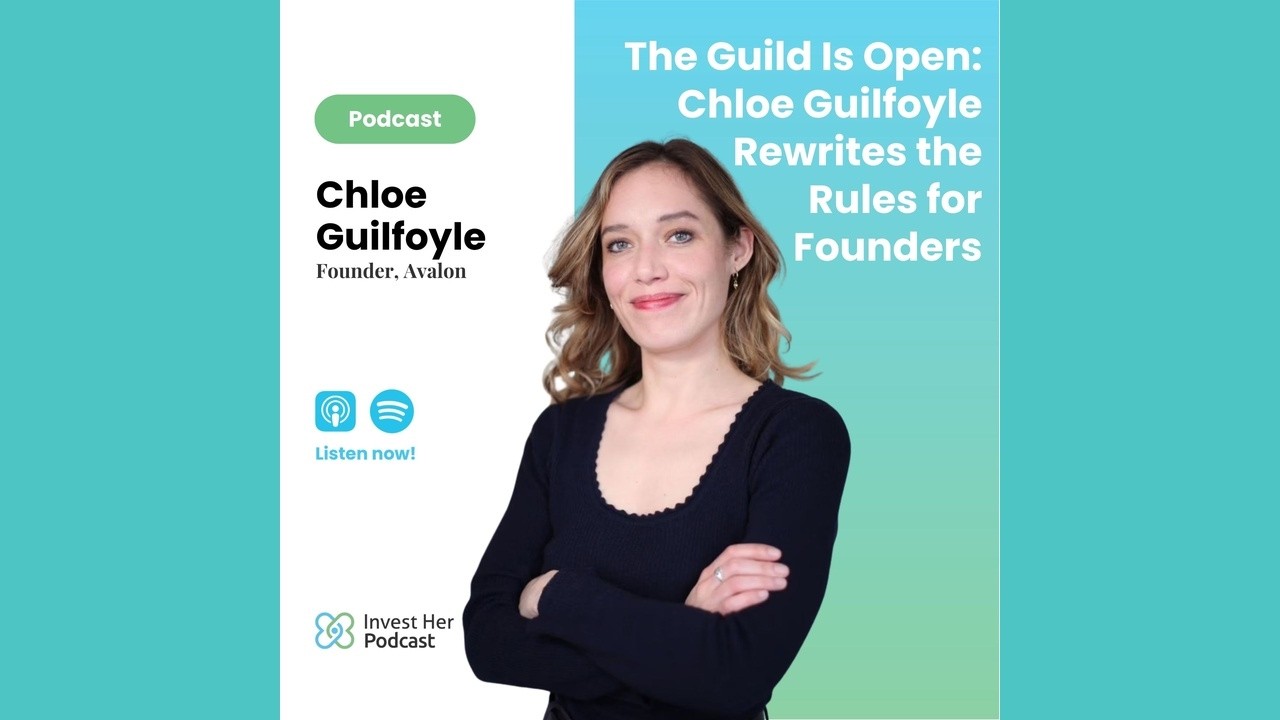
In this InvestHer Podcast episode, host Anne Ravanona interviews Franco‑Irish serial entrepreneur Chloe Guilfoyle, founder of Avalon, a hybrid entrepreneurial guild that blends a physical hub in Paris with a digital platform to create a cooperative, wellbeing‑focused ecosystem for founders. Chloe explains how her own experiences of isolation and burnout as a founder inspired Avalon’s mission to treat entrepreneurship as a team sport, offering inclusive, non‑selective membership for entrepreneurs at any stage and sector, as well as investors who act as mentors. The guild provides customized support ranging from financial health checks, mentorship, AI/automation assistance, workshops, wellness circles, and a ‘third‑space’ hub featuring co‑working desks, a café/restaurant, a studio, and evening networking events. Membership costs €500 per year or €49 per month and grants access to both the physical space and the digital community. Chloe discusses the hub’s design, its location near La Villette, and plans to expand to London and Casablanca, creating bridges across Europe and Africa. She shares her personal funding journey, highlighting gender‑based biases in venture capital, the importance of early network building, and her current pre‑seed raise of €300 k (half already secured from women investors). The conversation also touches on co‑founding with her husband Joshua, the guild’s differentiation from accelerators and incubators (no selection committee, holistic focus on performance and wellbeing), and the broader vision of community as capital. The episode concludes with calls to action for founders to join Avalon and for investors to consider the guild’s model.
Chapters
Hi there, welcome or welcome back to InvestHer Podcast. I'm Anne Ravanona, your host and funding friend, and I'm so glad you're here. InvestHer Podcast exists for one reason: to share the real, unfiltered stories of funded women founders, investors, and ecosystem changemakers from around the world, and to give them the visibility and airtime they deserve. Because here's what we know: women are building extraordinary businesses, And yet their stories are still too often missing from the conversation. We're here to change that. Every episode, I sit down with someone who's in the trenches of building, funding, or backing women-founded ventures. And we talk about the real stuff, the pivots, the rejections, the fundraising lessons nobody tells you about, and the wins, because there are plenty of those too. Now, I can't wait for you to hear this. Let's dive in. Have you ever wondered What might happen if founders stopped building in isolation and started treating entrepreneurship like a team sport? Today's guest has built an entire guild around that idea. Meet Chloe Guilfoyle, a Franco-Irish serial entrepreneur, investor, and community builder, and the founder of Avalon, a hybrid entrepreneurial guild designed to help founders build strong, resilient companies without burning out. From a new physical hub in Paris, To ambitious plans for London and Casablanca, Chloe is reimagining how we support founders, blending performance with wellbeing and turning community into true capital. You're about to hear a very different vision for the future of entrepreneurship. Welcome, Chloe. How are you?
I'm good. Thank you, Anne.
Well, I'm delighted to have you. And so before we get started, let's talk a little bit about you because I want people to get to know you, Chloe. So who are you and what's your background? What has Who are you before we get started? Sorry, go on.
Yes, so I'm a Franco-Irish entrepreneur and the founder of Avalon, so a hybrid entrepreneurial guild helping founders build strong companies without burning out. And I have a background in business law, community building, and startup leadership. And I previously founded a travel tech startup which I raised funds with and led Fem Business Angels, which is the French leading network with over 200 female investors. And I helped dozens of entrepreneurs raise funds and grow with confidence.
Love it. So in this podcast, we're going to have a mix given your kind of really interesting diverse background, Chloe. We will, we'll touch on your kind of funding journey from your previous experience, your funding journey for Avalon, but also more about Avalon and why you exist. So that's just for the meaty menu for all of our listeners who are here with us today. So let's dive in, Chloe. First of all, tell us, what is Avalon like? First of all, cool name. So it's giving me connotations of King Arthur or Queen Guinevere, although she wasn't a queen, was she? You have to fix this. Tell us about Avalon.
Exactly. So I'm French and Irish, so I grew up a bit everywhere. I was one of the first Erasmus babies, so I have quite a European culture with all of that. And I guess I've always been driven. I was a competitive athlete as a kid and teen in athletics and rugby, and then part of international mooting competitions competitions during law school, and today I'm a serial entrepreneur in my 30s. And, and for me, performance isn't about ego. It's about testing the edges of what's possible. And I truly believe entrepreneurship is a sport. It takes endurance, a team, and clarity of mind. So I created Avalon because I saw too many brilliant entrepreneurs burning out, not because their ideas weren't good, but because they were building in isolation. And especially women, they were building and doubting at the same time. And I was one of them. And I shut down my first company for that reason. It wasn't the lack of ambition. It was the absence of support that was aligned, human, and strategic. And I wanted to create a place where strategy and emotion could coexist, where founders could grow their companies without losing themselves. And that place is Avalon. So it is kind of a wink to my Celtic culture as well. And It's a hybrid guild, so see another wink to this Arthurian inspiration, both physical and digital, where entrepreneurs evolve with clarity, structure, and community.
Wow. That sounds super interesting and super exciting and quite different to what we hear because I like the focus on, as you say, support. People can say, oh well, we can go to accelerators for that, or we can go to coworking spaces for this, or we can be part of other communities for that. Tell us a little bit more What was it in your own journey, first of all, Chloe, when you mentioned the loneliness and not feeling enough support? Tell us a bit more about that and how that is now underpinning Avalon and the way your secret sauce and the way you want to do this.
I guess you were talking about accelerators, which are mainly very selective, intensive, and somehow extractive of energy, time, and money as well. And Avalon was thought more to be inclusive, collaborative, and long-term with a long-term vision. So we wanted to develop an ecosystem for founders who want to build strong companies and stay strong themselves, and with no selection committee to go in. So if you're committed, you're in, and no competition as well. We believe in cooperation-based entrepreneurship, not competition.
Mm-hmm.
And we— I believe that it's also not about, you know, taking equity in young projects, just a fair annual membership fee, and not just tech, because we were talking about deep tech AI a lot.
Yeah.
But we also wanted to support impactful founders across all industries, from, you know, local shops to AI developers as well. And Avalon offers a physical hub in Paris. So we're opening next October. So you're more than welcome to come over.
Yeah.
And soon to expand as well to London and Casablanca, creating, you know, bridges between Europe, the UK, and Africa. We are doing that through local hubs, of course, but also through a digital platform with curated opportunities, events, and strategic connections. And why that was also, you know, from my own journey to support underrepresented voices in the entrepreneurial sphere. And so we're opening this first hub because I believe that we are, you know, in a shift today in the world we're living in, going from competition to more, you know, collective intelligence and offering access to a more decentralized kind of ecosystem with best practices. And I truly think that we believe that true excellence comes from mastering the power of and— ambition and balance, vision and execution, performance and well-being.
I love that. I love the power of and. And I love the way you've put the emphasis on collaboration versus competition. Now, It's interesting that you've chosen Paris as the first city to set up in because it's not as friendly a city as that, and it's very individualistic and very highly competitive. So I'm super interested in why you chose Paris as the first location for Avalon.
And it's true that I have, from both my Irish culture and my French culture, you know, being able to compare what's going on in a more— in those 2 countries, but also in the UK and the US. It's true that in France, everything's centralized in Paris. Paris. So that was the place, you know, to be able to start the project, the concepts, to then, you know, being able to spread out across the country. And France is very known for all, you know, their innovation, their excellence in building up really innovative projects. But the funding is another subject, and I guess we're just going to talk about it just afterwards. Yeah. Paris, you know, for the last 10 years, it was the president of France, Emmanuel Macron, who really wanted to bring startups and, you know, place France in the map of innovation. So there was a lot of opportunities to do so. But we see that all the other, you know, business clubs and incubators kind of struggling to keep entrepreneurs motivated. And we wanted to, you know, offer another alternative.
So tell us a little bit more about, about the Avalon offering. Like, what is it that you get? So it's for entrepreneurs only or investors too? And maybe, maybe let's start with who it's for in more detail and then go into your specific offering and how it's different.
So yeah, so Avalon is— we're building, you know, this new community of entrepreneurs. So all, you know, maturity stages, all sectors. I really believe in cross-fertilization between activities. But also to be able to grow as an entrepreneur, you have to be supported, mentors. So we're also integrating mentors, experts in all different sectors. It could go from financial to HR to communications and investors for them to be able to, to see the projects grow and being able to be there from the beginning, which was super important. And that's what I also learned from my angel investing network experience is once you are much more present from the beginning, of your projects, just saying, hi, look, I exist. I'm not raising funds right now, but I might be in a year. And you've, you're being identified in the ecosystem and people, you know, will be much more, you know, trusting towards you if they've already identified you.
So, okay, so it's for any type of entrepreneur, any stage, any sector, investors who can be mentors and can be part, yeah, who can be very much part of the ecosystem And so how does it work? So we become a member, and what does that membership entail? Because you said it's both physical and virtual. So tell us a bit more, bring us behind the scenes into Avalon.
Yes, so we're a team of 5 experienced entrepreneurs that are building Avalon, and what we offer to entrepreneurs is, you know, custom support. What I found difficult in incubators I've been with, especially on my, on my first journey as an entrepreneur was that they had like one recipe that applied to all.
Mm-hmm.
And I believe that, you know, building your company, it's unique, it's singular. You might not have the same ambition as your neighbor next to you. And so it's how do we start from your challenges, your daily challenges, to be able to connect to opportunities, the right contacts at the right moments, the right resources. It could be, you know, tutorials, models, you know, anything that would help you You know, grow as an entrepreneur and as an individual. And so we offer three types of support to entrepreneurs. The first one is, you know, a company in good health. So the performance of your business financially, you know, sales-wise, and so forth. That's like the the basis of of your projects. But I believe that there was a sentence in one of Arthur's The Legend of Arthur's book that said, "If the the king is not well, his kingdom." will not be well either. And that was, that really resonated in my entrepreneurial journey where, you know, you're going through high stages and low stages as well. It's like a roller coaster all the way.
Yeah.
And being able to also, you know, talk about those difficult times, hearing other entrepreneurs, you know, going through that as well, kind of reassured me in saying, okay, I'm not on my own, I'm not isolated. It's just, okay, I have to keep, you know, having this grit to continue. And for me, it was super important to federate this community in 2 spaces. So the digital one, so anywhere you are in France or in Europe, you can connect. It's community as a service, which helps accelerate. But also creating a local hub was super important for me. That comes from my Irish culture, I think, where Irish people, when they traveled all around the world, they always funded, created a pub when they arrived. Why just create, you know, connection, community-based help?
And so what's super interesting though also about Avalon is who you're doing it with. So who is your co-founder? Because that's also quite singular and it's nice, and I wanted you to kind of shout out to him.
My co-founder is my husband Joshua, who is also an entrepreneur. He's more on the financial side. His company as well, which helped us build, you know, the first stages of Avalon. And so we are building this new company as a couple, which is challenging, you know, at times because you have to, you know, be able to differentiate— are we talking business, are we talking, you know, personal stuff? So it's another type of organization, and we started, you know, working together since January full-time. And it's been actually great.
Brilliant. And okay, I want to come back to— well, I like that model. I think it's very cool. It's not for everybody. And I know that sometimes investors find that a bit risky because they're like, oh, what if the couple doesn't last and what happens to the company and all that stuff? So it's always important to take those things into consideration. But coming back to Avalon for one second, now you've mentioned there's a physical space. So how's that going to work? Like, where is this going to be in Paris? How is it going to work? Is it like an open space place, or do you tell us more? Because I'm super curious.
Yes, we're in the, you know, designing all the space right now. So it's super exciting also to see the project, you know, come to life. And we wanted to think of, you know, the future of entrepreneurship, building a retro-futurist place. So that's quite fun. And so the space, the hub, is meant to, during the daytime, it's really dedicated to the community So we have like over 100 places for you to come in, you know, put down your laptop, take a coffee, work on your thing, and also being able to chat with the people around you. So, you know, developing your network as you go. And the place was thought as a third space. So that's something that was a bit lost in France in the last few decades is you had home, the office, but no really, you know, no place to kind of talk about your issues, also your successes. So that was the idea of creating this third space. And so how we designed it is we have, you know, a restaurant, a coffee shop. The restaurant is also entrepreneurs, so we have a culinary hub that's going to open. So if you're like a foodie, you're more than welcome to come in.
I'm a foodie! Exactly.
Then we have like a space where it's more deep work. How do we collaborate through, you know, workshops in collective intelligence? So it's more meant for co-developing your projects with other founders. And then we have like a full space of a studio for podcasts or content creation because, you know, today personal branding is so important that we want also, you know, for our founders to be as visible as possible to be successful. So that's during the daytime. So it's more, you know, dedicated to the community. But at nighttime, the idea was to create a Hard Rock Cafe for entrepreneurs.
Oh, wow.
And so it would be open, you know, to all people that, you know, want to connect to network, connect to another community. And, you know, an entrepreneur could be, so, a founder of, you know, a startup, but also an artist that has a project that needs funding, that needs a team behind them. And the idea at nighttime would be to create, you know, big banquets, really like the hospitality, as we call it, and creating conferences and concerts for people to meet up.
So cool. And so where is this space? You have me like salivating here, Chloe. So where is it going to be?
So it's in the center of Paris, in the northeast side, near the big park called La Villette. And that's especially thought as well to do yoga sessions in the park during lunchtime, picnics as well, to, you know, go and breathe between calls.
Mm-hmm.
And the idea was that this hub is thought to be less than 20 minutes of each big train station for anybody, you know, from abroad or out of Paris to come easily.
Very cool. Very cool. It sounds so exciting. Now I want to come back and circle back into the mind, the mindfulness part, the how you support founders on themselves as the king or queen of their company. So tell us more about the services that you want to offer there.
So we have a team of facilitators that are, you know, those super connectors to be able to find you the right contact at the right moment for you, you know, to save time, money, and energy. When, you know, somebody can fast forward all that to you. So the well-being part is, okay, how do we, um, you know, create, uh, groups and circles to be able to liberate, um, you know, uh, the— your challenges as well? So it could be, you know, um, how to be more confident when you're speaking in front of an audience. It could be, you know, so many different, um, things that we, you know, are really inspired through nature, through artists, through different, you know, type of discipline that we want to put in. And I believe that, you know, diversity and variety is super important when you're building a project because it opens perspectives, horizons.
Hmm.
And so we're not going to be therapists, but we have like a full people of mentors, experts that are really, really good that we want to put forward and being this, you know, trustworthy partner, sparring partner in your adventure.
And so now you have me curious, like with regards to the services and so on, is it all going to be in French or in English as well, Chloé? Like, I thought that's a practical question because I know you're going to be based in Paris and it's very international.
Exactly. So the first step, we had to start somewhere. So we launched in French, of course, in France. But, you know, as we are growing, we're over— since January, we're over 200 today in the community. The idea is to, you know, translate everything in English and being much more international by the end of the year. So, you know, it's what I learned from my first business is not rushing, you know, into things. It's building brick by brick, you know, test and learn all the time, iterate on what you're building. And I think it's quite, you know, a super project because we're federating so many other projects that we're, you know, entrepreneurs that we're supporting are actually, you know, giving back and supporting us as well in building the company. And so it's, yeah, creating a really fantastic energy.
And so you mentioned about the business model because we're going to get on to the funding part in a second, but I think it's important for people to understand. So it's a membership. So tell us a bit more about that. How's it going to work?
Yes, we want it to be as inclusive and accessible as possible. And so our business model, as we thought of it, has, you know, 2 sides. The, you know, the more digital community. So for €500 per year, You can have access to the full community, contacts related that we put forward, the platform with content, tutorials, workshops every week, and the hub as well. So for €500, we wanted to do that all included. And we're also planning to gain revenue through the hub from the restaurants and creating events as well.
Okay, so the membership gets you access to the physical space and the online space for, for the year. And do you— is it monthly or do you have to pay the €500 upfront? How does it work?
You can pay monthly, it's €49 monthly, or you can pay annually.
Okay, excellent, brilliant. So I'm so glad we've got all of that out of the way, and in the sense that now people have a better idea, how would you say you would be— you're different from Station F, from Accelerators, from the other players who are in the Paris market?
As I was saying previously, we're kind of in the middle of an incubator, a business club, and all of these ecosystems that offer each one part of the solution. We wanted to do something much more global. And I guess we're a bit different where we address— there's no selection at the entry.
Mm-hmm.
There's this physical hub as well that's there with the digital side that enables to have a much more broader approach. And, you know, it's having this holistic kind of approach. So business, well-being, vision. And also, I didn't mention it earlier, but it's also helping founders implement, you know, AI automation tools in their companies for them to, you know, delegate to tools the part that's, you know, really taking time. It could be, you know, accountancy, it could be communication, so many things. It depends. You know, each founder is unique. And so it's also, you know, taking the the ride of the AI journey and helping founders implement that in their business. It's just building as we go and also taking founders from their day-to-day lives, the operations, and helping them also take a step back. For that, it's also not talking about work nonstop 24/7 and creating moments. It could be a board game night where people just create Link without being interested or having To have a forced networking.
Real quick, Anne here. InvestHer Summit 2026 is coming to Paris in October, connecting global scaling women entrepreneurs with investors, corporates, and others to scale faster. Save 20% with early bird tickets until the end of July. Join us at investhersummit.com. That's InvestHerSummit.com. Let's circle back to funding. Tell us a bit about your experience because you are a serial entrepreneur, Chloe. Now you've been on both sides of the table. So as a, as an entrepreneur before, what was your funding experience like? Tell us a bit about that, and then we'd love to know more about Avalon and your funding journey for that too.
So raising funds, uh, as a woman in France, um, that's my experience, so I can only talk about that, but it often feels like playing a game where no one gave you the rulebook and you're expected, you know, to smile while guessing the rules. And I really hated my first roadshow. I was 27 when I first did my first fundraising round. And I think, you know, you know, while analyzing what I did good, what I did wrong after that, I tried to be the good girl following all the rules. But here's what I learned. So only 12%, I think, of venture funding goes to female and mixed gender teams and just 2% of all to all female teams.
Mm-hmm.
So that was why I didn't really have— I kind of went straight for it. And what I didn't anticipate is, you know, I gave myself 6 months to raise funds while, you know, also managing the sales, the operations, the day-to-day life of the company as well. So it's kind of, you know, 2 different speeds I was kind of navigating. And what I would have done differently is, you know, much earlier on, try to connect already with, you know, business angels or, you know, investor networks networks, not, you know, when you want to raise funds, but much earlier on, so they identify you. And what I saw is, you know, as I was mentioning, there's not much funding that's, you know, distributed to female founders, unfortunately. But that's, you know, the subject you know by heart. But yet, women, you know, in France represent 40% of entrepreneurs.
Mm-hmm.
And what the gaps I actually found was, first of all, there's a bias in evaluation. And I think that was a study by Harvard Harvard that showed that women get 63% more risk-based questions while men get asked more questions about their growth. And that was something I experienced where I was raising funds with one of my male friends at the same time, and we were kind of, you know, boosting each other out of, okay, what kind of questions were they asking you? What kind of questions were they asking me? And what I noticed is that I had questions about, okay, are you planning to have a family? How's it going your partner? Really personal questions, actually, or, you know, number-related questions. They would take my business plan and ask, you know, super specific questions like, do you really understand your business plan? I was like, I built it. I kind of know where I'm going with this. And for my male counterpart, it was more, okay, where do you see yourself in 10 years? Much more inspiring questions.
Yeah.
That was the first bias I kind of noticed. The second one was network access. I didn't really do, you know, those big business schools in France, and I don't know if it's the same in Ireland or in the UK, but there is kind of this strong alumni networks that are really strong and that I didn't have access to once I finished law school. And what I saw is that most deals still happen in closed, male-dominated networks.
Mm-hmm.
And that's what was super interesting in my investor journey with FemBusiness Angels is, was I was leading a fully female investor network, and I could see that they were not asking the same questions as, you know, male business angels. They were much more careful of the impact of their investment, not the return on investment. It's important, of course.
Mm-hmm.
So, you know, the sensibility was quite different. And the third bias I faced was underselling myself. myself. And that's something I kind of noticed with other women pitching, is women ask for 30% less than men in financing. And it's not due to a lack of ambition, but due, I think, first of all, to social conditioning, but it also being much more, you know, prudent and realistic to what you're capable of doing. So that was quite interesting. And with Avalon, I kind of changed approach. Okay, I've done my mistakes in the past. I saw, you know, through the business angel lens, what were the things that were really important. And so on this new fundraising run I'm doing with Avalon, um, so we bootstrapped the, the project for the 6— the first 6 months, which was, I guess, reassuring as well to investors, you know, mitigating as much risk as possible. In parallel, you know, securing banking, um, loans and public grants as well. So you're arriving to the business angels with, you know, a fully packed, uh, de-risked project. And so now I'm currently raising $300K, so I don't need more. I don't, you know, that's also a mistake I saw in a lot of entrepreneurs is they want to ask for the maximum. Do you really need that much money? Because you're gonna spend it as much, you know, as fast as possible. So it's also, you know, um, bridging and, you know, um, having all those next steps where you want to go. So raising maybe less money, being super clear where, you know, with the vision where you're going. And what's funny is I've secured half of the funding on this raising, on this funding round, and it's exclusively with women.
Well, that's wonderful. It just shows to your earlier point the power and the importance of networks and building those relationships early on. So you've already built those relationships and they know and trust you. So therefore, it's a much easier conversation to have. As you said, they have spotted you and they know, okay, I want to back that, and also believing in your vision. But I do think it's great, it's fantastic to hear that you've got like half of the funding already thanks to women founders. That's excellent. And were there any new ones or were they all people you already knew?
A bit of both, actually. Some people that knew me that wanted to be part of the adventure, you know, on my side. And it's true that, you know, having a hybrid intercontinental model isn't, you know, so VC standard. So I'm mostly focused on business angels.
Yeah.
And what I mainly did and what worked quite well was creating visibility on LinkedIn. So posting, being able, you know, being identified, going to events. It could be talk shows, it could be, and really, you know, selecting them. 'Cause that's what was one of my mistakes is I wanted to do everything, you know, going out 5 times a week, and that was really tiring, you know, in the long run. So really selecting that and, you know, just saying hi, oh, we met at an event, and it's super easy then to initiate a conversation with that person on LinkedIn following that. And also, you know, just adding people on LinkedIn, like, I saw your last post, I find you super inspiring, I would love to have a coffee or have a chat, and that works quite well.
Yeah, amazing. And like, so What have been any challenges then around trying to find investors? Because first of all, well, before I go into that question a little bit more, it's, um, you did mention, so you're raising $300K. So this is what, what do you consider this, a pre-seed round, a seed round, or, or what do you consider it?
It's a pre-seed round. I'm anticipating, you know, a seed round in 18 months.
Okay, that was my next one.
So when do you want to close this So ideally, I would love to close this round before the summer so that we can completely focus on the opening of the hub in October.
Excellent. Okay, so, and what we will do is at the end of the podcast, we'll say, we'll tell people how to contact you about that because I want to, I want to learn all about that. So tell us now, with everything that you've learned, what are your wishes What are your messages for people to know about why they should absolutely be on board with Avalon? Let's say start off calling out to the entrepreneurs and then let's have special messages to potential investors.
So the idea is also to stop, you know, making founders audition for survival. You know, you can pitch some moonshots. It used to work well, you know, 5, 10 years ago. Now, you know, the global market as we know it is kind of, you know, we're still looking to where it's going to go. So it's building much more resilient and robust businesses that's going to be important. And that's why we want to, you know, to federate around the Avalon startups, of course, because they're agile, they're flexible, they're innovative in their mindset, but also, you know, making them, you know, meet small and medium businesses owners as well because they've been there in the market for 10, 20 years. They have profitable companies, but they have other challenges. They need to take the digital side super quick before they get surpassed. It's creating this diverse ecosystem that was super inspiring and we see it like we've already know, have over 30 entrepreneurs that we follow day to day, and we see that we're already making an impact with them. And I guess it's flipping the narrative also that's going to be important. Investors should ask women about, you know, potential, not just risk.
Mm-hmm.
I think it's opening doors as well. I think it's— there's like the 3 quarters of startups deals happen via warm intros. So if you're helping out somebody, you know, in your, you know, your network that's looking for funding, that's looking for, you know, advice or anything, that's like a super accelerator for founders. And, you know, women and men, of course, need access to those rooms. So it's facilitating that. That's going to be, for me, super important. And you're not asking for a favor. You're asking— you're offering an opportunity. opportunity to invest in a great company. That's how you have to change the narratives, which I found quite interesting. And I think too often founders are funneled into— it could be soft networks, which VCs today want deep tech and AI. And I think it's not that other projects are less ambitious or more risk-averse. It's really how you tell the story that's going to be very important to where Love it.
And so, okay, where's the best place to contact you? So tell us, what is the website and LinkedIn? What is your preference that people can reach out to you?
I'm pretty active on LinkedIn, so you can find me with Chloe Guilfoyle. Don't hesitate to go on the avalon.fr website. It's in French for now, but we'll promise we'll translate it soon, and I really believe that, you know, community is everything. So if you want to follow us on social media, we're, you know, on different platforms, is everywhere. And, you know, to avoid, you know, either founders burning out or business failing, I think it comes through community mentorship and support.
Hmm.
And funding, you know, is part of it as well, and it's about trust. Trust is built through relationships as well. as well. So yeah, warm intros, you know, industry-aligned mentors, peer support, and that's what we're building with Avalon today.
Amazing. And so what would be your parting message to our listeners, to our viewers, Chloe, that you really want to impart on them, that's a special message?
So for me, community is capital. You know, I built the first community with my first company, then the community of female investors, and I also Community is capital.
That's it. Yeah.
Yes. Or there was another one, network is your net worth.
Yes. Yeah.
That one you might know. And so to, you know, every founder or investor listening, so you are not the pitch. You are the builder behind the company. You are not— you are allowed to evolve, to doubt, to pivot, to rest. Those are all okay. But I guess it's to never forget that your vision matters. If you believe, you know, in your idea, your project, your business. It's, you know, having all the best support you can have that will, you know, enable you to have all the chances of success. And I'm sure, you know, there are people out there like us who believe in it. And so my few tips would be, you know, don't wait for validation. I know it's easy to say, but it's a work of every day, you know. You know, develop— personal development is super important.
Mm-hmm.
And your idea deserves funding, but it's, you know, creating an opportunity, not begging for money. So it's kind of a mindset. shift and find your people, find your tribe, find your believers, because they exist. And I think that's fundamental. So Avalon is where ambition meets care, and we can go further together.
I love that. That's a beautiful way to wrap this up. So really, I love that. Calling all the founders, if you're in Paris, you've got to check out Avalon. Go to the website already, avalon You can already sign up, become a member, and we'll be so excited to see how things work and the 4-year launch in October. Tell us maybe as we wrap up a little bit about your international plans because you mentioned the UK and I think Casablanca. Is that right?
Exactly. The idea behind that is like, okay, we're creating a new type of standard for entrepreneurs, a guild. We called it the guild, but it's a new type of ecosystem. But the idea was, okay, we're building a new ecosystem, but if we don't open new markets, we're gonna, you know, face another wall.
Yeah.
And so we're opening this first local hub in Paris, followed by London and Casablanca, to bridge ecosystems and foster better B2B collaboration through diversity of backgrounds, sector, and stage. And as I was saying, you know, early on, it's to shift this paradigm of competition towards cooperation and offering access to a more decentralized, you know, network where best practices circulate and collective intelligence fuels growth.
Wonderful. You're so quotable, Chloe. So quotable. So thank you, everybody who's listening. Listening today. If you loved what Chloe said, and I'm sure you did, please share this episode with people in your network. If you're an investor and like, wow, I love this, I really want to be part of the adventure, contact Chloe on LinkedIn, contact her via the website, but go to her on LinkedIn. She'd love to hear from you. And yeah, let's, let's keep talking, Chloe. Let's, let's kind of— I like to say let's make an appointment for in even one year to see how far you'll have Come and, um, you know, to have an update on Avalon. But in the meantime, very best of luck. Thank you for sharing because I love the whole concept about community around cooperation and care. And like, the mindset and the well-being of the founder is so critical and is so overlooked. So I'm super interested and looking forward to learning more about your how, how you do that. So congratulations and very best of luck.
Thank you. Thank you, Anne, and thank you for, you know, helping reshape the, the funding game.
Thank you so much.
More from Anne



🎙️ EP69: Get Off the Fence: Renate Crollini's Startup Blueprint | InvestHer Podcast

🎙️ EP68: Radical Truth: Robert Rubinstein Exposes the Impact Investing Illusion | InvestHer Podcast



🎙️ EP66: Global Sisterhood — Carine de Meyere on Trade Missions | InvestHer Podcast



🎙️ EP65: Capital With a Conscience: Pierre Norman Rolin on Investing in Women… | InvestHer Podcast

🎙️ EP64: Dream Bigger: Nikki Barua on Building an AI-Native Company Without… | InvestHer Podcast