🎙️ EP60: Money as a Tool: Julianne Zimmerman's Investing Playbook | InvestHer Podcast
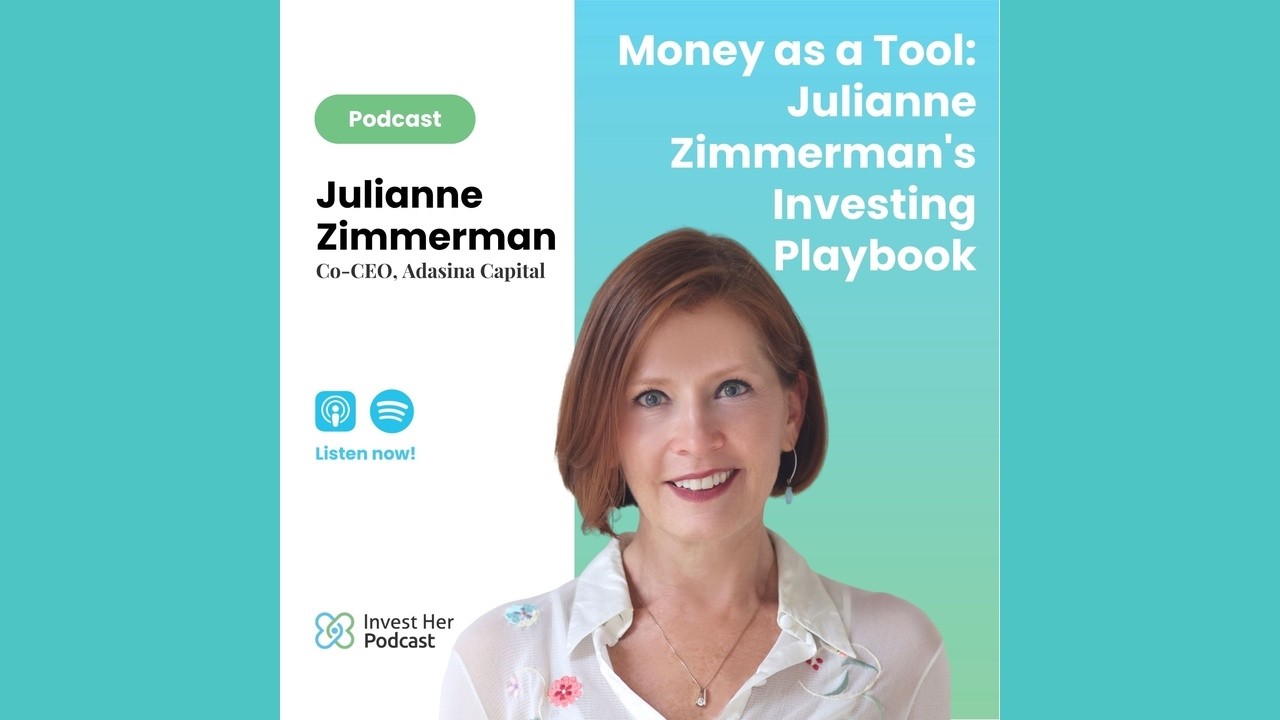
In this episode of the InvestHer Podcast, host Anne Ravanona interviews Julianne Zimmerman, a former aerospace engineer turned venture capitalist and current public‑equities impact asset manager at Adesina Social Capital. Julianne shares a forward‑looking analysis of funding trends for 2025, highlighting the severe macro‑economic headwinds, declining capital for women‑ and BIPOC‑led founders and fund managers, and a broader retreat to perceived safety in traditional finance. She counters this with emerging hopeful signals: inventive community‑capital models (e.g., Boston Impact Initiative), a resurgence of revenue‑generating, locally‑anchored businesses, and a growing cohort of women investors and LPs. The conversation moves into a generational wealth transfer, noting that trillions of dollars will shift to women over the next decade, reshaping stewardship and values‑driven investing. Julianne outlines sectoral hot‑spots for 2025—AI governance, distributed clean energy, regenerative agriculture and manufacturing, circular fashion and consumer goods, employee‑ownership models, and impact‑aligned public‑market strategies. She stresses the need to view money as a tool rather than an end, urging founders to clarify their purpose, align with trusted partners, and avoid taking capital that constrains mission. Funders are encouraged to scrutinize where their money “sleeps,” push for responsible end‑owment and pension investments, and leverage all levers to drive systemic change. The episode concludes with practical do‑and‑don’t advice for founders and funders, and contact information for Julianne’s work at Adesina Social Capital and Malaika Ventures.
Chapters
Hi there. Welcome or welcome back to InvestHer Podcast. I'm Anne Ravanona, your host and funding friend, and I'm so glad you're here. InvestHer Podcast exists for one reason: to share the real, unfiltered stories of funded women founders, investors, and ecosystem changemakers from around the world, and to give them the visibility and airtime they deserve. Because here's what we know: women are building extraordinary businesses. And yet their stories are still too often missing from the conversation. We're here to change that. Every episode, I sit down with someone who's in the trenches of building, funding, or backing women-founded ventures. And we talk about the real stuff, the pivots, the rejections, the fundraising lessons nobody tells you about, and the wins, because there are plenty of those too. Now, I can't wait for you to hear this. Let's dive in. Right now, trillions of dollars are shaking shaping our world, and most of it is not working in service of equality. Let's welcome back today's guest, Julianne Zimmerman, one of the rare leaders rewiring how capital flows so it actually advances justice instead of undermining it. She brings a clear, uncompromising lens to who gets funded, who's left out, and how we can redirect money to create the future we say we believe in. If you're serious about aligning your investments with your values, This conversation will change how you look at every financial decision you make. Enjoy. I'm thrilled to have with me today the wonderful Julianne Zimmerman from Adesina Social Capital. How are you, Julianne? Delighted to have you with us.
I'm, I'm delighted to be with you, Anne. This is such a wonderful thing you do and share with the community. I'm, I'm just delighted to be part of it.
Wonderful. Well, I'm going to put the pin on you because I want everybody just to see you, Julianne. And for the benefit of, of all our listeners and viewers today, what we're going to talk about today, we want to pick Julianne's brains. So the topic— and she's got fantastic brains, and we're going to learn more about Julianne in a second— but to give you an overview, I want Julianne to have a crystal ball over basically the rest of 2025 and what she's seen so far. What are the current trends in funding? which is going to be super useful for both you if you're the woman founder listening to this and to funders, because I want, you know, they'll be listening and say, hmm, that's interesting to have your take.
Yeah.
And so before we get into that, Julianne, tell us a little bit about yourself, who you are, your background, and how you became a VC.
Well, the short answer is I fell into it backwards. And, and in addition to my work as a VC, my primary role right now is with Adesina Social Capital. which is a public equities impact asset manager. And I'll come back to that in a minute since you asked about my background. I started off as an aerospace engineer and I had a fantastic first career in the human spaceflight sector. And that was a wonderful adventure. I loved it. And my colleagues and I, starting in the 1980s, Basically challenged the preconceived notions, the established understanding about what was possible. And, and we had this tiny little upstart company in which I was employee number 7, in a point in time when we did not have the startup culture that exists now. It was just not part of the popular awareness. And people who cared about me took me aside and said, what are you thinking? Everyone knows that if you're going to work in the aerospace sector, you go to work for NASA or one of the other space agencies, or you work for one of these giant corporations. And, and I'm really, really delighted and thankful that, that I didn't take that advice because I got to do things that, that normally most people in an entire working life would not get to do. And along the way, my colleagues and I proved that more things were possible than had been part of the standard expectation. That led me to the early 2000s, when again I was looking around at what was happening in the environmental sector. And at that point in time, really almost everything was remediation.
Mm-hmm.
So in the States, we had Superfund sites, which were these terrifically, horrifically contaminated locations that were being slowly cleaned up. And we had a whole bunch of brownfields, which weren't as bad as Superfund sites, but which again were contaminated land. And so I started asking, why are we not preventing the mess at its source? Why are we only doing this after-the-fact remediation? And so I ended up co-founding a clean energy company with some colleagues. And again, people said to us, why are you doing this? This is, this is not a thing. And no one will invest in clean energy. And you're out of your minds. And I was called a hippie and a communist. And, you know, within a few years, the cleantech wave formed and grew. And then all of a sudden, we have a cleantech era.
Mm-hmm.
And similarly, over the subsequent years, I got involved with a whole bunch of upstart founders as an advisor or mentor, or sometimes board member. Sometimes I would go in-house and join them for a period of time. That led me to form my own investment thesis, because once again I was seeing things because of the people I was working with and engaged in supporting that the venture community just was not seeing. And so I co-founded a seed-stage venture practice focused on what I called at the time the vital sectors: energy, water, food, and health, the things that we cannot do without. And that led me to be recruited to stand up another venture fund focused on women and people of color, bringing high-value enterprises to scale. As a result of that experience, I was invited to now join Adesina Social Capital 2 years ago, and working with people I've known and respected and admired for more than a decade— Rachel Robichaudti and Maya Philipson— and in a team that is predominantly BIPOC, predominantly female or gender expansive and predominantly queer, which is just nirvana. These are brilliant, brilliant colleagues I'm proud to work with. So at Adesina, we are, as I said, a public market impact investment firm. We have products in the market that are global investment strategies, and we work to advance social justice. across the entire market, which is a wonderfully, again, audacious proposition that many people don't believe is possible, and we're proving them wrong.
I love it because if I could pull out from your amazing wealth of experience, Julianne, for me, you— that's why I'm glad I used the crystal ball analogy earlier on. You love picking moonshots. Let's go back with the space and aerospace. You love I love picking those areas that people don't see yet, and you're going for very ambitious goals that include like very complex projects and multifaceted lenses at looking at the landscape or solving that particular problem. I love that you were involved in identifying and starting in cleantech way before that was cool and that you were called a hippie for it.
I think that's so cool.
And then how you've built up your thesis and your practice to even more inclusive. So I love how you've gone narrow, wide, narrow, wide, and that's such an interesting scope and angle that you bring to everything, Julianne. And that's what I love, and I keep having you back as a guest and as an advisor. You're so interesting, and your lens is so interesting. So that's why I'm really excited for our conversation today. So—
Well, thank you. I just want to say, Anne, you know, it's Sounds very glamorous in hindsight, but in the moment, you know, when you're— when you are one of the founders or one of the funders who are part of the Global InvestHer community, you know that in the moment it's just really hard and really frustrating, and it can be really isolating.
Yeah.
To see something that others don't see.
Yes.
And so I'm always delighted to share that experience because I think it's important for to acknowledge that and respect it and not just gloss over it and talk about, you know, our celebrations and successes and accolades.
Yeah.
I think it's really important for us to share that experience of how difficult it really is when you are working on something that's not yet well understood or well accepted.
Totally agree. And thank you for highlighting that because it's true. And again, you've had so many different hats, both being, you know, an expert within a vertical to setting up funds, to working in startups, to scale-ups, to being then going from private, like VC, into the public markets. So, so interesting. And thank you for calling that out, that it is hard to be a visionary. And it's hard because you're in the trenches doing the slog and you're seeing things others don't. So you have to do a lot of education, educating the market about what the problem is, why they should care. And it's quite frustrating, frankly, because you're going to say, well, how can they not see this? I totally feel that way. I've felt that way all my life as well. And it's only now in my 50s that I've realized, yeah, and I have been visionary and seen things others aren't, systemic thinker or pattern whatever you want to call it, seeing things before others, it's very lonely and isolating, which is also the path, I think, of a lot of founders and others.
Exactly.
Funders as well in here who are starting funds and creating new sources of funding or new mechanisms to fund when it hasn't been done before. So I think that's, that's why I like the— we could summarize it by saying being a pioneer and having that pioneering spirit. I think that you embody that really well. And thank you for calling out all the founders and members of our community who are all I mean, we're all pioneers in some way because we spot a problem, want to solve it, and we want to solve it in our own particular way and bring our own wealth.
Exactly right.
Yeah. So, so that's very, very cool. So now, now that we've sat down in the armchair, in the proverbial armchair, and everybody now knows who this amazing Julianne is sitting in front of them, now let's— this is where you get to have fun, Julianne, and you're like, we're saying yes. Use that crystal ball. We really want to hear from you. So, okay, let's kind of talk a little bit about what would you say are the current trends that you're seeing in startup funding or scale-up funding here, like in 2025? Let's start really big and then maybe go down into, into geographical areas or sectors, etc. But what are you seeing as the trends for this year that we need to know about?
Well, unfortunately, I think we're all acutely aware that 2025 is shaping up to be a really severely challenging year, to put it kindly.
Hmm.
And we are seeing conflict and political disruption and outright war. We are seeing the funding to women and people of color diminish even from where it has been in the past. And historically, it's been less than 2% globally. Less than 2% of LP dollars go to female and BIPOC fund managers, and less than 2% of capital globally goes to female-led founder teams.
Yeah.
So I think we have to start there, acknowledging the very sober reality of where we are.
Hmm.
And I don't want to stop there, however, because to your point, I think there are some really interesting and promising developments that I see as indicators that we don't have to have a permanent set of conditions like the ones we have now. So for example, as you alluded, I'm seeing more and more people come up with really inventive ways to use capital. Some of those are quite new.
Mhm.
They're truly innovative where we see people like the Boston Impact Initiative here in, in my backyard, really thinking very creatively about how to use community capital to invest in the community and keep the returns and the value creation in community as opposed to siphoning it off and concentrating it somewhere else.
Mm-hmm.
And, and we see return to pre-existing investment models that have been sort of shoved out of the way by the popular focus, the really widespread global focus on venture and private equity. But we see, for example, a kind of return to investing in revenue-generating businesses.
Yeah.
And in growing those, sometimes brick and mortar, sometimes service-based, enterprises that, that do create wealth. And again, that, that keep that wealth in the community and, and that are the vibrant backbone of communities. Right. So any livable community has an abundance of products and services that are local to the community.
Yeah.
And while we're all used to seeing global brands on our streets. Nevertheless, I think we all can agree that it's, it's the local individual proprietor shops that give us the most pleasure and delight.
Yeah.
And, and have the, the most satisfying, again, products and services for us to draw on. So for example, you know, we see that more and more investors are looking at local investments. More and more investors are looking at revenue-generating enterprises as opposed to the, you know, long illiquid investment in a venture fund or a venture proposition. And I think that's very healthy. I think our overreliance on venture has really distorted the entrepreneurial space and has really caused a lot of founders and investors too to make frankly quite poor decisions.
Yeah.
So, you know, I see cause for hope there. I also see a lot more women entering the field as not only fund managers but as LPs and as asset owners seeking to invest their money in more productive value creation ways. And I find that really exciting. And that's women of all identities, by the way.
Yeah.
I'm saying women in the most inclusive way possible. Women of all ethnicities, women of all racial identities, women of all nationalities, women of all gender identities. We are seeing, I think, a really wonderful flowering of creative thinking in finance, which gives me tremendous hope.
And I'm glad you have hope because you are a Cassandra seeing ahead of, seeing ahead of the wave. You know, it gives us hope to, to, to realize, yes, things are changing, even sometimes they're slow. And when we're talking about changing the funding game, that is a very— we're talking about a generational, a generational change. And so it's not going to happen in our lifetimes. But we do the best we can to put down those building blocks so that the cathedral will be built by future generations. And I like the way— thank you for pointing out that, yes, there is, there is a move, you know, we don't Venture capital and private equity is not the be-all and end-all. So I think that's, that's very important. And as you say, a move— investors moving more towards those revenue-generating companies. So less of the back-of-the-envelope, fly-by-the-pants type of investment, or just because I like the look of you and you came to my school, I will invest in your kind of funky idea for a dog walking app. That is like maybe got some users on it, but no revenue generation, and or the WeWorks and all these other people who are now scrambling to come back. But where it was just ridiculous, we could see the billions being thrown at business models and companies that were not even making money. It was just hype. So I suppose, would you compare this to kind of a dot-com bubble burst type of situation or not really, Julianne, in the sense that, um, there was a lot of hype in VC. Of course, there's still going to be funky sectors, and we're going to get down now into a more nitty-gritty kind of geographical and sectoral look. But yeah, I mean, what, what do you think? Is it, is it, are we looking at a real shift, or is it just a gradual still that It's a great— it's not tectonic shift, it's a gradual shift into different asset classes, into more diverse people having access to assets to invest and deploy.
I think it's both. And I think venture and private equity have an important role to play in highly capital-intensive, particularly hard tech sectors where you really cannot— and for that matter, in medical and health tech, right? Where you really cannot build any kind of successful enterprise without very significant speculative capital.
Mm-hmm.
Right? So I think venture and private equity have a significant role to play. I do think, however, that as we've mentioned, The prominence and predominance of venture has been excessive and has really distorted the entrepreneurial community. And I think it's distorted the finance community as well.
I love the way you say that.
And it has, as you alluded, it's meant that a lot of high-value solution kinds of companies have been overlooked in favor of convenience apps and other propositions that are frankly easier to monetize, right?
Yes.
So one of the things that I see happening is, to your point, there is a kind of generational shift that does take a very long time to unfold. And I see that happening at the same time as some really fantastic developments that are measurable on the scale of years as opposed to lifetimes.
Mm-hmm.
And so I see, for example, there are more and more investors who actually are looking for enterprises with real solutions.
Mm-hmm.
There are more and more investors who are looking at the inclusiveness and the ethical founding of a company because they understand that there's real legal risk and there's real performance risk associated with companies that have unhealthy or unethical founding.
Right.
And so we see, for example, even in venture, there are more and more funds that are focused on things like clean and fair food supply chains.
Yeah.
Right. So we see things like investments that are focused on smallhold farmers and investments that are focused on eliminating human rights violations and environmental damage and frankly legalized slavery from manufacturing and agricultural supply chains. Right. So I do think that we are seeing a shift that is happening in front of us at the same time as we're seeing these larger, longer timescale shifts unfold. And I think also we'd be remiss if we didn't talk about the generational wealth transfer.
Yes.
That's also occurring over currently, but all over the next 15 years approximately.
Yeah.
And that's a global That's a global phenomenon as well.
So tell us a bit more. I'm glad you brought that up because I was going to bring it up in the kind of big picture analysis before we go into deeper levels. Tell us a bit more about that generational wealth transfer and the not just generation but also the wealth transfer to women. It's— there's 2 different aspects to it. So tell us more. Right.
So I think probably everyone listening to this podcast is aware that the generational wealth transfer is occurring. And one of the, as you've alluded, one of the interesting attributes of that is historically it was the case that men owned and controlled, again, 98% of global financial assets.
Yeah.
And, and because of the, the social and economic developments we have seen over the past generation, it's increasingly the case that, that women are coming into those roles of stewardship over family wealth. Right. So just for a reference point here in the States, It was only in 1988 that there was federal legislation passed guaranteeing women the right to sign their own loan agreements, including credit cards.
Mm-hmm.
So it's quite a recent development, actually, that women have the legal standing even here in the States. I mean, globally, again, this has been a kind of generational shift for women to be widely permitted and protected to have those rights, those financial rights. And, and that in itself is a tectonic shift, as, as you named it.
Yeah.
But we're also seeing that many of those inheritors, certainly not all of them, but many of those inheritors are beginning to interrogate the legacy they want to Steward for their families.
Yes.
So we see, for example, quite famously, some heirs of very significant family fortunes built on extractive industries are beginning to say, we respect and admire and we are grateful to the patriarch of our family who created this wealth and We want to hand to our children and our heirs a legacy which is about, again, creating a healthier, more just, more safe, more resilient future. And we believe that by creating those conditions, we will also create greater prosperity.
Hmm.
Right? And so there's a kind of not only a generational wealth, Transfer, but there's also a kind of generational perspective shift that again is not a denial or a rejection or repudiation of our families, but it's a way of reframing the way we think about protecting and serving our families.
And like, what is the statistic as to By 2030, the amount of money that's going to be transferred to women. Julianne?
You know, the funny thing is I've seen so many different numbers. Yeah, I don't know which are more accurate than others, but we're talking about, regardless of the specific numbers, we're talking about trillions. Yeah, not billions, not millions. We're talking about trillions. Yeah. And the thing that's really important to keep in mind is that that is occurring even in families who don't have high or ultra-high net wealth.
Yeah.
Right. So that's occurring in regular families like mine.
Yeah.
Right. So I don't come myself from any significant wealth. In fact, my family origin is extremely modest. Right. But in my family, it's increasingly the case that women, my sisters, my nieces, All have a much greater say, and in some cases a controlling say, in how their family wealth is managed.
Real quick, Anne here. InvestHer Summit 2026 is coming to Paris in October, connecting global scaling women entrepreneurs with investors, corporates, and others to scale faster. Save 20% with early bird tickets until the end of July. Join us at investhersummit.com. That's investhersummit.com. Now take us into a little bit more into maybe the geographical and sector analysis, Julianne, of what you're seeing. Like, what are key geographies? Like, where are the hotspots in the world where the funding ecosystem is more vibrant or where things are slowing down? Let's start there, and then we'll have a look at the sectors.
Sure. So again, I think I'd have to start with the bad news.
Yeah.
Right? The bad news is that here in the States and elsewhere in the world, we are seeing a kind of retrenchment occur in which investors and government officials are doing something that has been called a kind of retreat to safety because their perception is that the old way of doing things was in some way less risky.
Mm-hmm.
And I believe, and I imagine that many of the people, men and women listening to this podcast, also believe that that's an illusion. That idea of safety associated with some idealized version of how things used to be. Right?
Yeah.
And I want to also say that the people who are pursuing that retreat are not only men. I mean, there are quite a few women who are pursuing this, again, what I believe is illusory sense of safety, right? Because it was known. It was familiar.
Yeah.
And in some cases, I think people even think of it as, you know, the devil you know, right? Being preferable to the devil you don't, right? So not everybody even idealizes their past experience, but it feels safer because it's less unknown. It's less undefined. It's less uncertain, right? And, and so I think that's the bad news, right? The bad news is that this is happening really globally. We're, we're seeing this across the world.
Hmm.
And, and so I think we do have to recognize and acknowledge that that is the context in which we as innovators who are working to create, again, a healthier safer, more just, more resilient future are working in many cases in conflict, open or obscured, right? With, in many instances, again, the people we care about.
Yeah.
Not just, you know, nameless, faceless decision makers.
Yeah.
Or people we have no access to who are out of our sphere. but in many cases, people we know and love who are our friends and colleagues and neighbors and family members.
Yeah.
Right? So these are quite difficult, weighty conversations, right, that we are working to have. And again, I think that is connected with the difficulty of being, as you say, a pioneer, right? It means that you are in some sense rejecting The status quo.
Exactly.
And that is a fraught thing to do.
Yes.
Right? And so I think we just have to be clear about that.
Yeah.
That even if we're not working with any kind of animus, right, nevertheless, what we are doing in some sense is saying no, the status quo is not good enough, and we believe that we can create better. So I think we just have to start off with that. Globally, there's a lot of friction between people who feel like it's very necessary to return to some, again, idealized past, and people who feel like, no, what we need to do instead is not retreat, but innovate and advance.
Yeah.
Right?
Yeah.
So that's political, it's social, it's financial, it's economic. It's environmental, right? It shows up in every sphere.
Yeah.
And we're here to talk about how founders and funders of all identities are doing that work to bring about a better future, right? So the trends that I see there, again, are people really focusing on things like How do we create more innovative solutions to the challenges that really plague our communities?
Yeah.
How do we bring about cleaner solutions? Not just clean energy, which is imperative and which is a global subject, but how do we bring about cleaner infrastructure?
Yeah.
How do we have more safe and reliable water supplies?
Yeah.
How do we have more, more equitable and accessible healthcare? How do we come up with these solutions that, that make, again, our communities and our lives more vibrant, more sustainable, have a higher quality of life?
Yeah.
Right. And we're also seeing, I think, again, globally, We're seeing a shift to thinking about how we can make money serve our purposes as opposed to how do we bend our actions to serve capital markets.
Yes.
Right? And so you've probably heard this expression. I know I have. When someone says, why is this deal structured this way? And the answer is because the money requires it. Which is a ridiculous thing, but the way that capitalism has unfolded again globally, we tend to think in terms of what private markets or public markets demand of us.
Yeah.
Rather than how we utilize those markets, how we utilize money to achieve a purpose, right? And so if we think about The way that we came to where we are today, at the very beginning of human society, the only way to codify ownership and transfer of wealth was really through birth, death, marriage, or war.
Yeah.
Right? Like literally bodily, bodily securing or transferring wealth, right? And that was supplanted— I'm gonna simplify significantly, there are lots of stages along the way— but that was supplanted by a system of feudalism.
Yeah.
Right? Whereby power and wealth ownership were conferred by a king or a lord to, you know, successively lower classes.
Yeah.
Right? And there was very little social mobility because you were born into a class and you remained in that class, right? Economically and socially. And there was very little geographic mobility because you were born into a domain and you didn't leave that domain. Right? And that was supplanted— again, I'm skipping lots of steps— but that was supplanted by mercantilism whereby people could be granted the right, again by the local sovereign, they could be granted the right to travel and operate businesses that made them both geographically and socially mobile.
Hmm.
Right? And that was supplanted by capitalism, in which instead of a writ or a mandate or a remit from the sovereign, we had this highly transportable thing that was global currency. Right? That enables anyone to be able to codify and transfer wealth as they wish.
Yeah.
Right? And again, I'm grossly simplifying, but what's happened in end-stage capitalism is we no longer see the system and the currency as tools, right? We see them as an end unto themselves.
Yeah.
And I think that, again, has really skewed the way that both private market and public market deals have been structured. And again, I think what I see that is incremental at the moment, but I think is really gaining popular awareness, is that we can do better than that.
Yeah.
We don't have to settle for what we have. And so going back to the very top of this conversation, I think there's a lot of people who are innovating, who are saying better options are available.
Yeah.
And some of them we know from the past, again, like investing in revenue-generating enterprises and, and having relationship-based investments, right? And, and thinking about how do we have enterprises that don't just extract value somewhere But that really build value. Right. And, and I see that as a really healthy process of reexamining the assumptions that in many cases we've just inherited. Right. We inherited some preconceptions that frankly aren't very good for us.
Yeah.
And so the more people who are working around the world to say, Listen, we can do better than this. We can do better than this locally. We can do better with our national laws and regulations. We can do better with our global systems and global agreements. And for me, that's quite exciting.
Hmm.
And that's happening in different ways, as you alluded, geographically. In different countries or different jurisdictions, we're seeing different kinds of innovations being tried because the important thing is for the solutions to fit.
Yeah.
Right. So different cultural norms, different geographic demands and opportunities, different local government practices, different local financial systems. Demand different solutions.
Yeah. Oh my gosh, what a masterclass! What a masterclass, Gillian. I know that wasn't your intention, but it really is because it just helps lay the seeds for us all to have a common, let's say, a base understanding of how this whole system, the current system, has evolved and was kind of originally set up and has evolved over the generations. And therefore, the pockets of innovation that we're currently seeing and that we will continue to see moving forward, where, as you say, there has been a mindset shift. So it's instead— there's linked to comfort. What am I— my level of managing my own comfort or discomfort. So do I want to stick to my comfort and stick to investing in what I know, love, and that I've seen has given returns in the past? Will— am I willing to, to not be more risk— risk— take riskier investments? No, to, to really, um, work towards the creating the new paradigm and creating new society and, and saying, okay. And I like, I like the way you gave that, um, nuance about, yes, there needs to be cultural specificities. And, and again, As we're talking about that, there are key sectors that are super sexy at the moment or super en vogue. So maybe talk to us a little bit about that on the trends you're seeing there. And again, they are geographically, um, let's say they can be influenced geographically, but we are seeing some key sectors that are hot at the moment versus others. And then it's interesting to see how some of those sectors that from before that even 2 years ago were, and they're no longer. So this is, this is just to show the fluctuation. And, and, and, you know, because coming back to the game of, okay, owning assets, transferring assets, making wealth, generating wealth off it. But then there's, there, as you say, there are, there are those people who want to conform to that current way of doing things, and other people are saying, no, no, let's do it the new way. And originally venture capital was about doing it the new way. And if we look to the queens of yore, of yesteryear, who invested in the armadas and the new— finding new geographical territories and sources of wealth, you know, those were the very first venture capitalists. But let's come back to the key sectors, Julianne. So which ones do you see are the ones in 2025 that are really kind of top of mind for both private and public investors, or maybe there is a distinction. What do you think?
Yeah, so I don't think that we can talk about our present day without acknowledging and naming the fact that AI is ubiquitous. And as AI technologies and processes and algorithms are increasingly embedded in everything we do.
Yeah.
We are also seeing not only the energy demand for that, but we are also seeing some pushback saying, wait a minute, you know, maybe this is no longer an expression, but way back when, when I was in college and we were learning how to code software, you know, the widely understood challenge there was garbage in, garbage out.
Yes.
Right? So if you make inappropriate or inaccurate assumptions in designing the software, you will get a skewed result. Right? So there's nothing really new about AI. Being a high-powered kind of software, granted, much more evolved, much more sophisticated than the kind I was writing as an undergrad, but nevertheless still software. And it's still, I think, susceptible to garbage in.
Yeah. Right?
So AI models that are being built on preconceptions about who has merit.
Yeah.
Or what a successful person looks like, or what a criminal looks like, or, you know, all of these other kinds of preconceptions that are being used as foundational for the algorithms themselves, or that are the way the algorithms are learning. Right? These are very problematic, and we're seeing more and more people bringing, frankly, better solutions to bear in terms of how AI models are constructed to begin with and how they're trained, and then how they're evaluated once they are put in the field. Right.
So, and regulated.
And increasingly there are, there are initiatives to regulate AI, which I think are, are really, again, healthy. I think they're a bit belated, but You know, there's an adage. I don't know if this adage exists in other cultures and other languages, but there's an adage that the best time to plant a tree is 20 years ago. Yes. The next best time is right now.
Yeah.
So, yes, ideally we would have had regulation some time ago, but it's being enacted now, and that's a good thing.
Yeah.
But I also think that people are coming to the realization that there is literally no amount of money. You can't name a number big enough that compensates you for the loss of arable soil.
Yeah.
Or the collapse of fisheries.
Yeah.
Or the poisoning of your water supply.
Yeah.
Right. There's literally no amount of money That will compensate you for that loss.
Yeah.
Right? You can't eat money. You can't breathe money. You can't drink money.
Yeah.
Right? And not only that, but if you have collapsed infrastructure or if you have a collapsed health system, you can't be reliant on, on any of the systems that enable our communities and our families to be safe and to be healthy. Right. And so I think one of the things that is really exciting to me is how many people are bringing innovations to bear, again, both founders and funders.
Mm-hmm.
And how do we structure investments so that they are not extractive exploitative, or destructive, right? How do we think about creating value which is sustainable and resilient and creates better systems, right? Rather than extracting value from what we have.
Yeah.
Right? So rather than getting everything we can squeeze And converting that into money, right? How do we think about, again, using money to create systems that are healthier and that create more value, right? In which that money has more use.
Yeah.
Right? If you're using money to improve the conditions in which you live, then that money has more value, right? Because you can use it in context of those healthy, vibrant systems.
So if you had to name the sectors that linked to that second category of creating the systems that are healthier and add value rather than are extractive and exploitative and just spinning money into the air, what would be those key sectors that you see developing even more at the moment in 2025 and in, you know, in the future? Sure.
So, you know, I'm seeing more localized and distributed energy generation, right? Instead of trying to build vast grids that have enormous losses at every stage, I'm seeing greater— I'm seeing greater innovation around regenerative practices, regenerative ag, regenerative manufacturing. So ideas about how products can be not only recycled by putting them in your bin. Yeah, right. But how can they be upcycled?
Yes.
By having those materials either repurposed in their current form or reprocessed into A different form. Yeah, which is very exciting.
Yes.
And, and I see that happening across the full spectrum from what we think of as, as low-value goods, but which are necessary all the same, like eyeglass frames, for example. You and I are both wearing eyeglasses today.
Yeah, right.
So eyeglass frames are being manufactured from recycled materials. That may not seem very significant, but when we think about how many people wear eyeglasses, yeah, exactly, it's not a trivial market, right? And similarly, we're seeing in fashion and consumer goods, which again you might not think of as particularly high value, but nevertheless the fashion industry is one of the very largest consumers of natural resources and polluters of local environments, as well as one of the places where we see really widespread human rights abuses. And the same with consumer goods.
Yes.
Right. We see this highly extractive model that creates enormous waste.
Yeah.
As well as really ubiquitous human abuses, right? So how do we think about those systems in a circular fashion? And I see a lot of really exciting innovation there. And finally, I'll say I see a lot of really exciting innovation again around employee ownership and around defining ways to generate and harvest value that are much more distributed.
Hmm.
Right? So we're not seeing the extreme concentration of wealth that is itself very destructive and risky to our societies and to our economies. So when you look at the World Economic Forum Global Risks Report, for example, and that report which surveys thousands of business and finance and political leaders across the world, You see that the central node of that risk map is inequality.
Yeah.
And several of the larger nodes connected to that inequality have to do with climate and infrastructure and supply chains.
Yeah.
Right? So when we think about the innovations that have the potential not only to give us that higher quality of life and more more prosperity in real terms, we're also talking about decreasing risk, right? These are not high-risk endeavors. They're not high-risk investments. They're not high-risk innovations. They're actually the innovations and the enterprises and the investments that are going to reduce our risks.
Yes.
Right? They will in fact make us again safer. They will make our societies healthier and more just, and, and that, that does create greater prosperity.
Wow, I could listen to you all day, Juliette. I mean, I mean that sincerely. I mean, it's— you've just such in-depth knowledge. It's a pleasure to listen to you. So if we had to kind of wrap this up into the top keys and don't— do's and don'ts, let's say key tips to founders on how to navigate this system and any messages to funders as well with what you're seeing, these trends for 2025. So what would be the key tips to the founders first, maybe do's and don'ts? Yeah.
So, you know, the— I think the advice to founders doesn't really change at its core. And that is be super clear about who you are.
Yeah.
And what motivates you? What are the things that you truly care about? And what does success mean in context of those things, those values or those aspirations or those concerns or those constraints? Like, what are the things that matter to you? that motivate you as a founder? And how do you think about what success looks like in terms of addressing those things? And then work with people who are aligned.
Yes.
Work with co-founders and advisors and employees and most importantly funders.
Yes.
Who are aligned with what success looks like.
Yes.
Right? Don't work with people you don't trust or you don't feel good about.
Yeah.
I've seen far too many founders come to tears. And I mean that metaphorically as well as literally.
Yeah.
Far too many founders come to tears because they've been given this terrible advice to just take the money and figure it out later.
Yeah.
And unfortunately, once you've taken the money, your decision space has been constrained.
Yeah.
Right? You have very little latitude to figure it out later.
Yeah.
So first and foremost, who are you? What is your why? What does success look like in those terms? And then I think, you know, focus on the— focus on what success and solutions look like to your constituents, to your customers, to your employees, because they're the ones who ultimately will make your success or not. Right. Nobody is successful on their own. We have this terrible mythology of the soul genius. Right. It's a terrible, terrible myth.
Yes.
So put people around you who, again, are aligned with you and who complement you. Know your strengths. Know your shadow side. That will have a lot to do with the things that you lean into and the things you shy away from.
Yeah.
So put people around you who complement you.
Yes.
And enable you to be a better, more informed leader.
Yes.
And who will challenge you.
Yes.
Right? Because that challenge helps you to make better decisions.
Yes.
And I think the same is true for funders. I think it's really important to be listening to what are the things that are evolving and developing. We like to think as funders that we're evidence-based and we make our decisions based on facts, but very often, just like any other human being, we make decisions based on what feels easiest.
Yes.
Right? And what feels easiest is by definition not what is most innovative and not what is most likely to develop into something which is truly distinctive. Right. And for everyone, I would say, you know, think about all the ways in which you use money, not just investment dollars, but loans and lines of credit. Where do you bank?
Yeah.
Where does your money sleep at night? Which is a growing expression. I don't know who coined it, but it's a growing expression because where you have your bank account is either, again, acting in your interests or acting against your interests.
Yeah.
Right? That money that is your money may very well be serving interests that are entirely contrary to yours.
Yeah.
Right. And think about where are— if you have a retirement or pension plan, either that you are contributing to or that you have for your employees, what are the things in that retirement plan that many of those plans again, contain investments that are themselves exploitative, destructive, extractive, that perpetuate human rights abuses, including against you and your community, right?
Yes.
So choose or force your administrator, your pension plan, or your retirement plan to give you better options.
Yeah.
Right? So think about all the ways in which you're using money.
Yeah.
And if you have relationships with an alma mater, a college or university you attended that has an endowment, pressure them as an alumna or alumnus. Pressure them to make investments that are consistent with the interests of the institution, because none of our institutions will fare well in, in climate collapse.
Yeah.
Or in environmental collapse. None of our institutions will fare well.
Yeah.
And, and that are in the best interest of the students, staff, and alumni.
Yeah.
Right. So, you know, again, think about all the ways you use money. Think about all the ways you can influence Money. Yeah, whether you're a funder or a founder, either one, we all have more levers than we tend to think of. Yes, use all the levers.
Yeah, I love it, I love it. What an incredible, incredible message. And what's the best way to contact you, Julianne? Because I'm sure people are going to go, wow, I want to know more about you, about, uh, Adesina Social Capital, or the other projects that that you're interested in, how can people reach out to you?
Yeah, so at Ascena Social Capital, we've hardly touched on, but again, it's a public equities impact asset manager with global social justice strategies, and our products are available in the market. I have certain constraints and prohibitions by our regulators that prevent me from giving you any product details, Yes. But I encourage you to check out adesina.com to learn more about what we do and our products.
Yes.
And the way that I try to connect and be helpful across all of my work at Adesina and as a part-time GP with Malaika Ventures, which is malaika.com. Um, is really to, um, start conversations and, and deepen those conversations in relationship again about what we care about.
Yeah.
And, and what I care about and what I'm working very hard to do is to effect durable, transformative, reparative system change.
Yeah.
So I'm not omnipotent. I'm not omniscient. I'm not omnipresent. Like other human beings, I have very specific constraints to my time and my physical presence. And with the time I have available, I really try as much as I can to be helpful to other people who are trying to make that same transformative system change. So if there's a way that we might collaborate, I encourage people to reach me via LinkedIn and, and tell me, how could we collaborate? What do you have in mind?
Yeah.
How can we effect greater more durable, more transformative, more reparative system change. I don't write checks, so I'm not a funding source, and, and I'm not a politician, so I don't have, you know, government access or legislative influence. But what I have is a set of insights And a set of network connections. And I have the position I occupy as a visible and vocal advocate for those things in public and private markets. And so again, if the listeners to this podcast have a specific idea about how we can collaborate to that end, Then please share that with me, and if I can be helpful, I will.
Oh, and I know you— I know that you walk the walk when you say that, Julianne. Thank you so, so much for this incredible, incredibly insightful podcast and just masterclass.
I want to call it that.
It really is. Thank you for your insights into the big trends, into what you're seeing for 2025, globally, geographically, sectorally, and values-based, and what your key tips for sharing your key tips to both founders and funders and all of us on what we can do differently and how we can think differently to affect change and to be, to continue to be those pioneers and change agents for the and build the future we want to see and to pass on to future generations. So it's been an absolute pleasure. Thank you so much. To all of you listening and watching, you'll find more information in the show notes. All the links that Julianne has been referring to will be there, to the different websites, also to the report that she mentioned and her LinkedIn. So thank you so much, Julianne, for being with us today. It's been an absolute joy.
Thank you, Anne. It's always, always a pleasure to talk with you. And I know that you are also a longtime committed advocate leader in developing a stronger, more diverse, and more closely interconnected ecosystem of changemakers. So thank you for leading that collective action so authentically and with so much integrity and creativity. Thank you for having me on your podcast.
Thank you. It's an absolute joy and an honor. So thank you so, so Thank you so much. Thank you.
More from Anne



🎙️ EP69: Get Off the Fence: Renate Crollini's Startup Blueprint | InvestHer Podcast

🎙️ EP68: Radical Truth: Robert Rubinstein Exposes the Impact Investing Illusion | InvestHer Podcast



🎙️ EP66: Global Sisterhood — Carine de Meyere on Trade Missions | InvestHer Podcast



🎙️ EP65: Capital With a Conscience: Pierre Norman Rolin on Investing in Women… | InvestHer Podcast

🎙️ EP64: Dream Bigger: Nikki Barua on Building an AI-Native Company Without… | InvestHer Podcast