🎙️ EP63: Proof of Concept, Proven: Megan Sorby Is Scaling Regenerative… | InvestHer Podcast
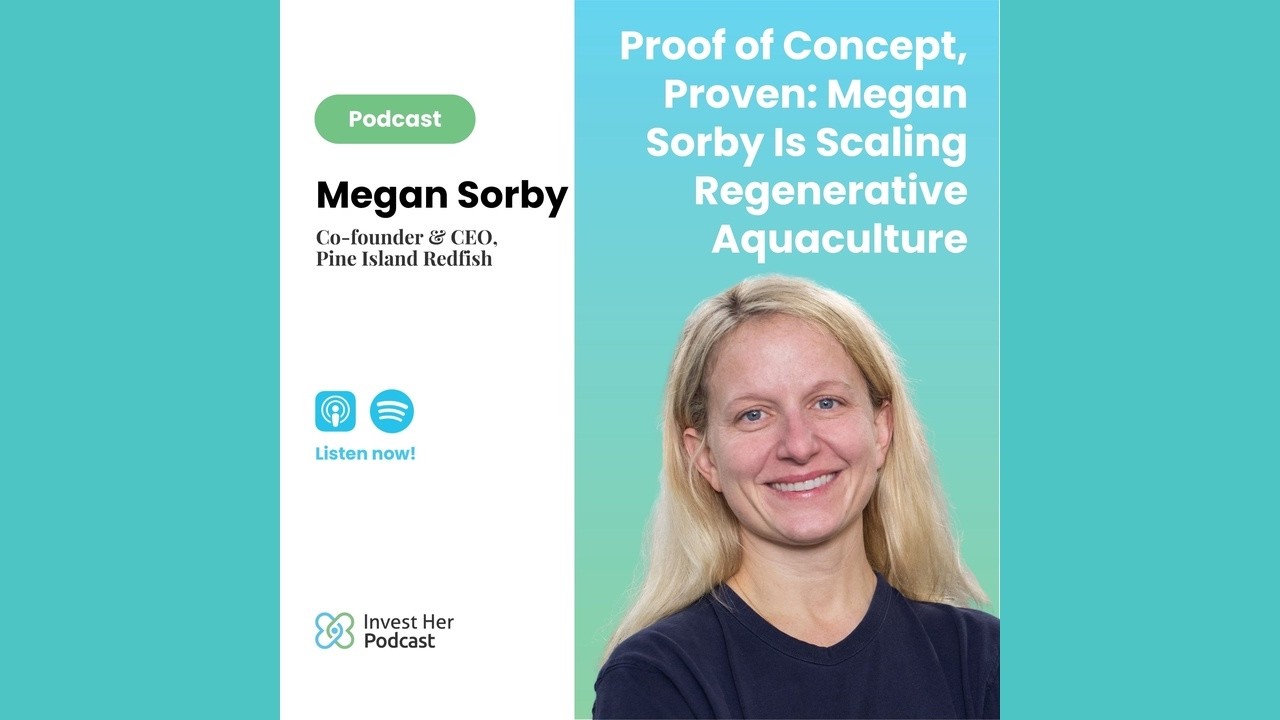
In this InvestHer Podcast episode, host Anne Ravanona interviews Megan Sorby, CEO and co‑founder of Pine Island Redfish, a Florida‑based land‑based regenerative aquaculture company. Megan explains how the company raises red drum/redfish in a recirculating aquaculture system (RAS), captures the salty waste stream, and converts it into a nutrient‑rich compost that fuels mangrove restoration, creating a closed‑loop, carbon‑negative model. She details the proof‑of‑concept milestones achieved between 2024‑2026: fish production grew from a few thousand to tens of thousands of pounds, and mangrove output expanded from ~5,000 to ~50,000 plants and from half an acre to over 25 acres of restored habitat. The conversation covers market traction—partnerships with Publix and entry into major markets such as Los Angeles, New York, Boston, and Washington, D.C.—and the storytelling and QR‑code feedback loop used to educate consumers and retailers. Megan outlines the funding journey: an initial pre‑seed/seed round of under $1.5 M from individual angels and demonstration funding at Mote Marine Laboratory, followed by a $5.5 M Series A (with $1 M remaining) targeting Q4 2026 close. She emphasizes community‑first networking, the importance of choosing early investors wisely, and the challenges of operating a capital‑intensive, male‑dominated seafood industry as a woman founder. The episode ends with practical advice for women founders, a call to investors to view sustainable seafood as essential infrastructure, and contact information for Pine Island Redfish.
Chapters
Hi there. Welcome or welcome back to InvestHer Podcast. I'm Anne Ravanona, your host and funding friend, and I'm so glad you're here. InvestHer Podcast exists for one reason: to share the real, unfiltered stories of funded women founders, investors, and ecosystem changemakers from around the world, and to give them the visibility and airtime they deserve. Because here's what we know: women are building extraordinary businesses. And yet their stories are still too often missing from the conversation. We're here to change that. Every episode, I sit down with someone who's in the trenches of building, funding, or backing women-founded ventures. And we talk about the real stuff, the pivots, the rejections, the fundraising lessons nobody tells you about, and the wins, because there are plenty of those too. Now, I can't wait for you to hear this. Let's dive in. Most of the seafood on American plates has traveled farther than we ever will, crossing oceans, racking up carbon, and losing any real connection to people or place. Today's guest is changing that. Meet Megan Sorby, CEO and co-founder of Pine Island Redfish, a land-based regenerative aquaculture company in Florida that's bringing redfish back to American tables and restoring the mangrove ecosystems that protect our coasts. Megan is leading a capital-intensive, highly technical business in one of the most male-dominated industries out there. And she's proven a different model: local, traceable seafood, a circular system that turns fish farm waste into mangrove restoration, and a community-driven approach to markets and investors. If you care about food security, climate, and backing women who are literally rebuilding critical infrastructure, this episode is for you. Welcome back to InvestHer Podcast. I'm your host, Anne Ravanona, and I'm so delighted to finally have my next guest with me. This conversation has been 2 years in the making. So Megan Sorby is the CEO and co-founder of Pine Island Redfish, a land-based regenerative aquaculture company in Florida that's on a mission to bring red drum redfish back to American tables sustainably. Now, before founding the company, Megan helped run one of the most advanced advanced land-based fish farms in the US, and today she's building something remarkable in an industry where you don't nearly see enough women leading. So Megan and I first connected when she won the Global Pitch Competition at our Investor Summit 2024, so it's a real full-circle moment here. And I want to share a quote from one of the pitch judges just to give you a flavor of what you're in for today. So the pitch judge who judged her entry said, Such depth and breadth of knowledge in her subject matter and huge potential to, to address the massive gap in the U.S. market for fresh fish. This is fish farming at its most responsible. Megan, welcome! I'm so thrilled to have you here.
Thank you so much, Anne. And wow, what a quote to start the show off with. That is, uh, just an amazing compliment, um, and truly what we hope to do, which is to spread knowledge and awareness about seafood and where it comes from. Um, so what, what a compliment. Amazing. Thank you.
I'm so glad because I found it just before we came on. I shared it with you, and the compliment is well deserved, Megan. So well done, you. So it's only going to shine even more throughout this episode, and people are going to understand why and what that, what that judge saw in you. So, but before we get started, um, how about you tell us one fun fact about yourself, something that we might not know if we did a Google search Well, aside from being a fish farmer, I have a secret addiction, which is to the candy Swedish Fish.
I don't know why that is my, like, my nice little habit, my little sweet treat, but I have to have it. And it just so happens to be fish as well. So I guess it's just on brand, perhaps. But yeah, it's a secret addiction, but not so secret now, I guess.
So tell us about your fish farm. So now everybody knows what to gift you for Christmas or your birthday.
That's it, that's it. Any old day, just bring the Swedish Fish.
I love it. Okay, so it's been 2 years since, uh, you won the Global Pitch Competition in Dublin. So how has Pine Island Redfish evolved since then? Just give us a lowdown before we get into the high and everything.
Yeah, well, first of all, Anne, what you put together in terms of the InvestHER Summit and the community around it, it truly is that, uh, community. And so being part of that pitch competition, listening to other women founders, entrepreneurs, funders speak about their passions, about the projects that they're working on, it's so welcoming, but also very humbling in the sense that you realize very quickly that you're working on one problem, right? And there are so many to address, but that there are amazing people out there with amazing tools that are really trying to find leadership in their space. So what you do with the InvestHER Summit is incredible. And I would advise anybody listening to find their way to Anne and find out how to attend because it's an amazing opportunity to connect with people. And so I appreciate that so much and I really enjoyed that experience. So, in 2024, when we really came to Anne and to the judges with our business and our model, we were still in the very early phases of bringing our demonstration production to life. So, we had fish in the water and we were starting to grow, but we really hadn't launched our product fully into the market yet. So, just to rewind a little bit and explain who Pine Island is. It is. So Pine Island Redfish, I co-founded it with my husband and partner, Tom, and we've worked together in aquaculture, specifically of marine fish, or those species that are non-commodity species that still have bits and quirks that need to be figured out in terms of how to raise that animal from egg to market size. Mm-hmm. Over our couple of decades in this space, what we realized was that there were two big issues that we wanted to tackle. One is the people factor and the connection with seafood. I think when you when you ask someone to close their eyes and think of a farm, you you think of cattle or chickens or pigs, and and you know what that looks like—the pastoral scene. But when you ask someone to close their eyes and think of an aquaculture farm, most people don't know what that looks like or where to begin with assembling that image in their minds. And we wanted to change that. We really wanted to connect a seafood story with people. And the second thing is the thing that all of us are tackling in probably every supply chain, any production system, whether it be food manufacturing, otherwise, is waste. How do we deal with the waste stream or the byproducts? upstream of whatever we're trying to primarily produce. And particularly in fish farming and farming of a marine species in saltwater, that waste is salty. So it's not like we could just land apply it like conventional compost. So we really wanted to say, how do we tackle that issue, but also connect people with this whole process? And I have some history here in the Gulf Coast of Florida, so it was a bit of a homecoming, and it was actually the first place Tom and I lived after grad school. And we said to each other, this is the place. And we started to look for opportunities, the right species, the right site, the right story to tell. And that's where we came across redfish. We had worked with the species many years ago in a research capacity, and we really said, well, this right here, this is the seafood story that we should be telling. And this is one that I think echoes for the States, but is true in other geographies too, which is that, um, we import, depending on what number you use, 80 to 90% of our seafood, which is—
Whoa!
Sorry, I'm making that reaction because I'm like, that's mind-boggling with as much coastline as we have. Exactly, it is. It's mind-boggling. And we also have some of the highest value seafood products in the world. So what are, what are we doing? Um, and redfish really tells So most people don't know that redfish was made popular. It had its boom moment, its gone-viral moment, in the early 1980s when Chef Paul Prudhomme, who you can still find his spice mix in your local grocery store, he made blackened redfish. So you get a cast iron pan searing hot, as hot as you can make it, smoking. You pat the fish with this really hefty spice rub and you put it on that searing hot pan. pan and it blackens that and crisps up that edge and creates this really delicious flavor. Well, he did that with redfish because that was what was homegrown in Louisiana. It's native to our Gulf Coast and it just went gangbusters. So in 4 short years, we more than quadrupled the commercial harvest. So we were pulling 4 times as many fish out of the water on an annual basis, which we just couldn't sustain, obviously. And for once we did the right thing. Our Fish and Wildlife, who kudos to them, they were really watching and they say, it's time to shut this down. We can't sustain this. And it really has become a success story in terms of a fishery coming back. But as of 2008, we also designated it a sport fish because since closing the commercial fishery, it was designated just for recreation. So you could go out and catch it yourself, cook it yourself within a certain size, but that was it. And it's now one of the most lucrative fisheries that we have in the US. So it's very much a success story. But what most people don't know is around that same time, we actually took adult redfish through a research program and we sent them live to Taiwan, and they formed the basis for a lot of the farmed redfish that you see out there today, which is why this is the seafood story that we need to tell. We literally took our most valuable natural resource Shipped it out, and now we buy it back with less transparency, less traceability, bigger carbon footprint, when we have all the technology and all the know-how to grow it right here at home. And little known, this happens a lot of places because of our globalization and the interconnectivity of global trade. This has happened with multiple species in multiple geographies, but this is one that we could really easily highlight. So that's why We started with that species. And so it was an easy find for us. We said, great, we can do this. Now what are we going to do with the waste? Let's tackle that. And that's where we said, well, what do we do with manure that is salty but still has all these rich nutrients in it that we could grow something with? Well, naturally we started looking for plants that could tolerate high salinity or high salt content in soils. And lo and behold, Probably one of our most threatened ecosystems globally are mangroves. So we grow mangroves in the byproducts of our fish farming process. So we use the solid waste, turn it into a compost that we use to pot our mangroves, and then we feed it a continuous fertilizer of dissolved nutrients coming from the water that act as a continuous growth enhancement for these mangroves. And that's the whole thing. Pairing a business, a production system with a nature-based solution that can actually be funded by that production system itself, it's the type of projects that we need to see across so many verticals right now.
Yeah.
We can't continue to operate on this input financing and, and obviously deliverables, but it's a recurring need for new financing. We have to find ways that these solutions can self-fund. So that's what we really try to demonstrate on the Wayside. So that was our concept in 2024. And getting back to your original question in a very long-winded way—
Oh, I love it because you need to give us that context so that people understand what it is you do and why. That's what I was coming to, but you're saying it beautifully, so please continue.
So since 2024, we have made the progress from getting to a concept and a model, a demonstration piece that was ready to show what we wanted to do, to it actually showing what it can do. So in just those 2 short years, we have more than exceeded our fish production metrics, and we have delivered fish both to our regional market in food service and in retail. We have some fabulous retail partners. Shout out to Publix. They are a fantastic retail grocery retailer here in our, the Southeast region that has been so supportive of what we do. But also we have put our fish into strategic markets where maybe people haven't had the experience of redfish. They don't know that story, like Los Angeles, New York, Boston, Washington, D.C., and getting people to connect with the story of our fish, what it does for their environment, But also knowing the power of domestic seafood production, that's really been quite rewarding. And in that same window, we have gone from producing around 5,000 mangroves a year to 50,000 mangroves this year, and grown from half an acre of restoration work to working over on over 25 acres of restoration, which sounds like small potatoes when you're talking about some of the huge mangrove restoration efforts around the world.
Mm-hmm.
But it is a big step for, I think, the United States where we have so many competing stakeholders around our coastlines and getting people invested and aware of the need for our mangrove ecosystems has really been our focus and why we've been able to get to such an exponential growth in such a short time. So we are very very proud of the progress that we've been able to make in the past 2 years. It's been a really rewarding time for us.
And I mean, huge, huge kudos to you. And I want to pause on— come back and put the spotlight on a couple of the things that you mentioned. So you've basically proven the concept, more than proven it, and exponentially, as you said. So like for investors listening in, and we'll get to that in a minute, this is, you know, your proof of concept is more than proven. Um, that you also getting into pub— to publics. Tell us a little bit more about that journey because this is so important when there's a startup or a scale-up. It's like, how do you get to the next level and how do you find and nurture the relationship with those first partners who are so important to prove the concept? But more like, how did you get into them? I think give us a little highlight on that part because It is, you know, what's important to scale any company is access to finance and it's access to markets. So I want to touch on both of those things. So that part, let's dive in a little bit more about that first.
Well, to be truthful, Anne, it's something that we learned from you. Community. Community first. That's it. Um, so I had the pleasure of working with a wonderful woman previously who, um, was really into seafood sales. It's all that she's done her whole life. And when I told her what we were doing, she said, let me help you. Let me find you the right outlets for where we can trial this fish, where we can demonstrate it, where it's going to make the most impact. When you go to talk to investors, they want to see 2 things. They want to see the diversity of where you can place the product in the market. And 2, that you can move the volume that you're talking about, that you have the ability to scale and move that and make an impact. And she said, I have the right person for you. And it was truly through that one phone call of talking to a former colleague and explaining what we were doing that she made the connection with the director of seafood at Publix, who is a wonderful person, Guy Pizzuti, if you don't know him. He's an amazing person, but he brought his team out to see the farm to really vet, are these people doing what they say they It sounds pretty great, but let's go check it out. And they took the time to walk around, to really ask questions, to say, what do you feed the fish? How does the system work? When you harvest, how do you treat those animals with care and with good animal husbandry? And their investment of time in understanding our process really spoke volumes. And we are so fortunate to have worked with them through this growth phase where they Hey, we're, we're a new farm. We have things to learn. We don't have it all figured out. Not every day is going to be perfect, but give us the feedback and, and tell us when things look great, but tell us when we need to change something. And that was really, um, I think that's the two-way street as a, as a founder is that you envision your, your vision is that you see it, you've built it, you're so proud of it, but you also have to stay in that mode of I am going to learn something every day.
Mm-hmm.
from this process, and I'm going to learn from my customer base. And ask for that feedback if you're not getting it. I think that was the big thing that we tried to really focus on was every week that we were harvesting, every time we were sending product into the market, we say, tell us what the retailer is saying. Put the QR code out there. Not everybody is going to scan it to read about your story, but the 10 people that do, they'll connect with you. And we got so much feedback directly via our website. that the retailer maybe didn't see just through a flat purchase or a flat walking past the seafood counter. Maybe somebody didn't buy it that day, but they scanned our QR code. They wanted to get added to our mailing list to find out more about what we are doing. So it's not always about, at the end of the day, making the actual sale every time.
Mm-hmm.
It's about spreading that story and making people connect with it because the next time they see it, maybe on a menu and they go, oh, yep, I'm out with my spouse and I'm going to eat that fish and I know the whole background about it. So I have a conversation piece at the table and somebody else learns about it. So it really is, as I said, that whole process all comes down to community, both on the front end in making the connection, but on the back end in terms of getting the feedback that you need as a founder, as an entrepreneur to keep growing in a way that your market wants.
Yeah. And I mean, it's, it's, it's— thank you for sharing that because I think it's so insightful for any founder or funder or partner to listen to how you put it. Um, what I really admire in your approach, Megan, is the heart and the hear, the listening, the care that you really put in. Because when we started this conversation, you flat out started off by saying it's all about the story. It wasn't— you weren't telling me this is about the product. Of course it's about the product. You kicked off this conversation talking about the story and hooking into the story and connecting it with your why and helping other people to connect into the why and then into the circularity part, which is so, so important. So like you're not only educating the end customer, but you're educating the distributor and the partners along the way as well as gathering that feedback in. So I think that's so, also important because you've kind of answered— this is brilliant. I have a list of questions. Megan is just so great and professional. She doesn't know my questions that I'm asking, but she's answering them live as we go through it. Because one of the things I was going to ask you was what were your USPs versus other aquaculture, uh, players? And like, you know, it was kind of saying around native species and circular model, but you've kind of talked on those things. Maybe go in a little bit more about your circular model. You've talked about how you then discovered, okay, we have this byproduct, we found that mangrove is going to do really, really well with this byproduct. How did you kind of get that in motion to actually build that circularity? Because that's again so easy to talk about, but actually to do and to do well and to do sustainably is hard. So can you go into that a little bit more? Yeah.
Yeah. Well, I think it's important to acknowledge, in talking about the USPs, to acknowledge the people that walked the walks so that we could run, right? Which is that we're not the first people to farm redfish. Redfish actually was farmed in ponds historically, in saltwater ponds. And this is largely along coastal Texas. Some of those farms still produce today.
Mm-hmm.
It's a very different production model in the sense of a sort of all-in and all-out type of harvest, but it's really the use of a type of growing methodology that's right for that region. Here in Florida, and today, those outdoor farms are having to adapt to lots of new changes and threats, which I don't need to tell this audience because we all acknowledge our changing planet. But this is where recirculating aquaculture systems, or RAS, really adds something. And we saw this boom in the controlled environment agriculture space a few years ago ahead of the boom in recirculating aquaculture. But the theory is the same in the sense that you are putting the farming process indoors so that you can control all aspects of it. We like to say that we give our redfish their optimal environment, their holiday environment, 365 days a year, sometimes 366, right? And that for them means that they grow faster, they grow more efficiently, they convert feed into meat more efficiently. And for us, as not just the farmer but also as consumers, we want to look for food production that is most efficient. So we can do that in this type of system. What has happened in developing recirculating aquaculture and why my And my background is so important and informative to how we got to the mangrove side of our production is because the big issue when you try and bring something indoors and control that environment is you're actually consolidating all of those waste streams or those byproducts into one place, which in theory makes them easier to manage, but it also means that you capture more of it. So it's also It's more condensed, it's heftier, and you really have captured everything. So it's a very clean way of producing. But now you have all of this and you're like, what do I do with this? And it's where our sector really has to take a page again from those people that walked before us. We have so much to learn from agriculture and the history of agriculture over time. They have solved in many ways a lot of these problems, and that's why you're seeing such big moves in agriculture today and more large companies shifting towards regenerative practices. And we now in aquaculture, I mean, we've been around a while, but a much shorter time window than other types of food production. So we're still learning on the fly. And that's where we said, okay, well, we have to trial this concept to really say, are we regenerative? Because just like the word sustainable, a new phrase, a new hot-button word can be thrown around and maybe doesn't mean so much in a few years' time because everybody's using it. So can we really make use of all of this waste? And that's where we said, well, we better pilot it first. We better demonstrate it first before we go to the next scale. So through our founding investors, who all came from very different walks but still related to our industry, we talked about this need and they were all in. So they funded our demonstration demonstration phase, and we found a research partner. We currently operate out of Mote Marine Laboratory's Aquaculture Park. So Mote Marine Lab has a long history in both oceans and fisheries research, but also in aquaculture. And so being able to walk in here, clear ourselves a space, build the system that we wanted to use, and actually say, okay, we can do everything that we're saying and let's see how it works. That was the ticket for us. And so I think the big difference for us along the way as we went into fundraising for expanding, which is the phase that we're in now, we have numbers on a spreadsheet that aren't just numbers on a spreadsheet. They are real numbers, real numbers that show this is how it works, this is how it can scale. These are real contingencies from the experience that we have. But we know everything that it takes to put into to the fish and the growth of our mangroves. And we have validated that. So now it's not theoretical, it's something that you can actually say, this is the reality of how it can move forward and succeed. So that was a real— I think that's our real strength beyond everything else. Some happy notes that came along the way, and this comes back to real USPs, is that what we found in the control of growing those fish in that environment, we actually came out with product totally different to redfish that most chefs and consumers had experienced before. A much cleaner flavor profile, a much whiter and almost translucent type of fillet. And so it allowed us to spread out into markets where redfish hadn't really been used before. So we had a chef using it in crudo and ceviche, and then ultimately we had a sushi chef add it to their menu, which was incredible because people came onto social media and were like, I didn't know you could eat redfish raw. And that speaks to the quality, and it really speaks to how we can produce food in different ways and enhance the consumer experience. And I think that's the real point that I think was the happy unknown from Oh my gosh.
So I just want to say, now do you believe what our pitch judge said? Because talk about subject matter expert. I mean, it's— I could listen to you all day long, Megan, because it's, it's such a pleasure, because you really know your stuff. You walk the walk, you test it, and you know how to share that passion with the audience. passion with the facts and the science and the production and the financials beside it and alongside it. So well done, you.
Thank you.
I want us to kind of circle back now into your funding journey. And before we get into that, I want to say that, like, you know, you're leading this capital-intensive business, okay? And you have physical and biological— biology stuff as well alongside. So it's very scientific. It's production, it's regeneration. I mean, you have so many parts of that process and of the business that you're managing and leading in a very male-dominated seafood industry. What has that been like for you as a woman, as a leading woman? Because you are a renowned person in this industry. What has it been— I'm not just saying it, it's a fact to our listeners, and you'll see in the show notes, we will link to all these things. What has it been like for you to navigate inside of this very male-dominated industry. Let's talk about that first and then get into the funding journey. And as an expert, because you know your stuff, like, it's just like, just listen to her, she knows her stuff.
I don't— I, I appreciate that so much, but I, you know, especially participating in your events and, and within the InvestHer community, um, I don't think I'm unique in that. I think you, you listen to any of the founders that I've met through through your network, and they're all experts in things that are very, very different to me. I mean, I could sit here and talk all day about fish and buying seafood and, and growing seafood, um, but, you know, it just— the breadth of, of, and diversity of the group that you're exposed to with InvestHer, it's amazing, um, because you realize that all of these founders are just subject matter experts in fields you know nothing about. So that's why I find it fascinating, and the podcast itself the same. So many empowering stories. It is a male-dominated space. I think there are many male-dominated spaces still.
Yeah.
And that's something that I think sitting here I can laugh about, but I know outside of a situation like this, it's a daily frustration for many. I would like to say that I'm very fortunate in that I have had male leadership in this space that has always been encouraging. I think that passion can show. And certainly, I can say hands down that I couldn't imagine doing anything other than what I'm doing. I get up every day and consider myself extremely fortunate to work in the space that I do because I truly love it. I think much to the annoyance of my 5-year-old daughter right now who is starting to Yeah. So we'll see how that relationship progresses. But I have always had leadership in this space, both men and women, but particularly men, that kind of buck the norm. I think women can be encouraging and empowering to other women. And I certainly have experienced that. But I also have experienced and continue to find leadership in our space that doesn't always come out and say that they understand that we are in— our feelings about a male-dominated space, but certainly encourage us to use our knowledge and empower us to take on leadership positions. And certainly between my partner and I, we have always tried to emulate that and to do the same, maybe not always successfully. I would always like to say that in farming, we are fish people first, rather than people people.
Yeah.
So probably my biggest phase of growth is and continues to be relationships and dealing with people and trying to be a more effective leader on a daily basis. But yeah, I do feel like I've been very fortunate in the exposure that I've had in our sector that I've always had really encouraging leadership. On the fundraising side, I can't say that I can't say that I have had positive or negative experiences specifically, I think, because I'm a woman, although I would— I maybe could blame it that way some days. I certainly have had or experienced a lack of awareness, I think, on some of the framing of questions we get asked about our growth and the future of the company and where we see the leadership heading. Specifically, and I think most women experience this, is the balance of family life and leading a company or being a co-founder. I think that's a difficult one that we will always fight. But it's sort of— I am hopeful that the shift is coming and we're starting to see more balance. And it's through programs like yours and that it really has the opportunity to highlight the fact that women are out there, women are are in leadership positions. I always like to tell the story I had. I had a colleague, I took a management role on a farm with a species that I had worked with elsewhere, but this particular fish still has a lot of research and development ahead of it before its full commercialization. And the woman who was leading the broodstock or the parent fish division, she'd been in the sector a very long time, never in a management role. outside of a department head. But talk about an expert. Talk about someone that was a leader from the seat that she was sitting in, regardless of whether that is a management role or the day-to-day grind of working in very cold water with fish. She really— she was the expert that everybody turned to. And I liked that because she had the history, she had the background, and I'm just sitting there trying to manage all departments working together. So it really didn't take anything from me, but I learned a tremendous amount about leading from the seat that you're sitting in, regardless of what level that is. And I think that's extremely encouraging with exactly as you say, the struggle that we're in, which is that there are women in the seafood space. I mean, in fact, most people don't know that women make up about 70% of those that work in seafood globally.
Mm-hmm.
You know, And that varies country to country. But the percentage in leadership roles is much, much lower, not even 20%.
Right.
So how do we empower women first to lead from the positions that they're in and then start to work on shifting the mindset so that they are looked to first for those promotions and for management roles where their adaptability, our ability to naturally multitask, right, that should be acknowledged and utilized by these, these major leading companies. I think those are, those are the big takeaways, and certainly not all related to fundraising, which has been a much shorter journey in my overall time in this space. But I've always been very fortunate that I think the men that have been in the management roles under which I have have always been extremely encouraging.
And I am sure, just listening to you, that you are an incredible leader and role model to any women in the industry who have come across you, work with you, as part of your team. And that goes without saying. And your mom and your daughter has a great role model. So that's— and she's watching you from the sidelines. They always are. They always are. Real quick, Anne here. InvestHER Summit 2026 is coming to Paris in October, connecting global scaling women entrepreneurs with investors, corporates, and others to scale faster. Save 20% with early bird tickets until the end of July. Join us at investhersummit.com. That's investhersummit.com. And that leads us nicely into the funding journey. So can you kind of tell us what has been your funding journey so far? And then we want to get into the current fundraise because there's an opportunity here, and we may have listeners here that say, my God, I need to know more, I need to talk with Megan, we need to talk. So first of all, just tell us a little bit more about your funding journey so far. How did you start, um, you know, raising, or how did you fund the business in the beginning? Any key milestones and so on? Let's start there.
Yeah, yeah. So, um, so it was really Really, again, it comes back to community when you think about it. My partner and I were conceptualizing the what-ifs on the nights and weekends of, if we could build our own farm, what would we build and how and where and why? And we met a few key individuals who were looking for some assistance and guidance on another aspect of aquaculture, specifically risk management and insurance. And so we started talking to them, talking about our history and background, where we see market opportunities. And this person said, well, could we build a farm? And we said, well, yeah, we could. We got to find money, but yeah, we could build a farm. And that's really what kicked it off. So through a very small network of people who had been related to or involved in the space before, we said, well, let's find Instead of funding a site, let's fund doing a demonstration project and see where that takes us. So our first kind of pre-seed and seed rounds were solely funded by individuals who had an interest and felt passionate about the space, which is a great place to start. And they continue to be our largest shareholders and reinvesting at every subsequent fundraise. So that has been a continued encouragement or source of encouragement for pushing through— But can I be— the hard moments. And so how did you find them?
It was through the conversations in the insurance space, and they said, oh, this is great, I want to kind of— let's do this, and I want to help you do it, right? That's amazing, because that's— again, I think what, what you're describing is very, very, very niche, and I think that's great for the listeners because they don't realize in their circle that if you're passionate, you're in your niche, just talk about your— what your project and your business, and you never know who's going to come out of the woodwork. Can say yes. And I mean, just getting those first checks, it's like, oh my God, they believe in me. Yes, they do.
Yes, you know, exactly it. Oh, you're so right. And that, that is it, is it's talking about it. It's, it's leaning into that passion that you have, um, and really showing what the big vision is. Um, I think what our struggle was, or what my struggle was as a founder getting to the next phase And pushing through to starting commitments on our next round was to say, how does this translate outside of just Pine Island redfish? How does Pine Island seafood become the brand name, the household name, the Dawn dish soap, the Gatorades, the whatever brands you pick, Lego, which is a source of tension in my household at the moment. But it's It really is talking about how your model speaks to the widest possible audience and how it can be transferred. How does it apply to everywhere else in the world? And that's really what we have focused on talking about as we talk expansion, because that's our next step. What we're funding now is the expansion of this model onto our shovel site where we are ready to go and build the next phase of growth that allows us larger nationwide distribution, larger impact to our mangrove ecosystems, and building an ever-increasing volunteer base that helps us make that ecosystem impact. And they say, well, that's all great for the Southeast region. What comes next? And we say, well, yeah, you take the technology that we've developed here, the way we operate the system, And we put that in a new geography with a regionally relevant species of fish and a nature solution that's necessary for that particular environment. And across— I think right now we think across the United States because we have so many needs like this. First, we have the need for the growth of aquaculture, as we discussed earlier. But we have so many ecosystem needs that can be fueled by this model that can make coastal communities more resilient. for future change by providing that food system, but also providing the much-needed ecosystem restoration that we need. We always talk about the West Coast because there's so much opportunity there. Kelp reforestation is a huge space right now. We also have areas that need increased seaweed production. And these are all models that can fuel off of what we've built here. I think the big thing is most people know globally that aquaculture is already a very established industry globally. In the US, we're a bit behind the 8-ball.
Mm-hmm.
But how this applies to some of those really established companies is that they are moving more towards recirculating aquaculture. And right now, our technology is so fine-tuned, we actually are recirculating at a very intense rate, which means that we are reusing that water resource so many times before we actually have to get rid of anything. And that residual that we're getting rid of is so much smaller, means we can put more aquaculture farms in more places with less environmental impact. And as people are really shifting for stricter environmental standards, they're going to have to move to technologies like ours. And that's the real opportunity in the future. This doesn't apply just to our region. And so that's where we're at.
And, and so I think that's, that's, that's super important to— you've described kind of that journey so far, and then we're going to talk more about where you are. Like, can you give us an idea then? You had— you worked with several business angels, like private individuals that got you through your pre-seed and seed round. Can you give us an idea of figures without— we're not naming any people or whatever, like, just because it's very capitalistic. intensive. Like, just, you know, that's— and then, because it's interesting for people to learn in this industry, that's what it takes to do this proof of concept, right? And it's very capital intensive. And then we'd talk about, like, what's this next round? Is it a bridge round? Is it a Series A? What is it, you know? So yeah, if you could give us a little bit more highlights, um, on that, that would be helpful just for the listeners and the other people out there and for the investors, because they've got to be interested, without revealing anything too confidential, of course, but just to get your view, that will help.
Yeah. So we actually have— in order to get through our pre-seed and seed round where we've hit several big milestones, we kept our financing under $1.5 million, which is a big feat, I think, especially as you highlight that this is a CapEx-intense industry. And what we saw in kind of the early 2010s through the late 2010s was that people really skipped this phase. And it was big checks, big tickets, big investments, big scale all at once. And we're now seeing the ramifications of some of those models being walked back and saying, hmm, maybe we should have answered a few more questions before we went for this big round, this big raise. And that's really what we tried to do was we said, look, if we can't prove it with this, we're not going to prove it if we raise 10 times that. It's not going to make any sense. So we really try to stay slim to show that it could be done bootstrapped, to get the big market wins, even if we are not a behemoth, a huge industry yet, um, or a huge, uh, company yet. Um, so our current plan—
I love the way you keep saying yet.
This is—
listen, listen carefully, listen, listen, because you're totally right, because I I agree with you. This is— it will be. And so, so therefore is— I didn't mean to interrupt you, but I had to catch that because it's true. Yet. And it's important the language we founders use because you have to believe it yourself even when it's not there yet, to use your term. Um, so what would you consider this now upcoming round? Is it like a bridge round or is it a Series A? And are you gonna go West Coast then, as you said, and with other help? Or give us a bit more.
Yeah.
What are the insides?
So this is, this is our Series A. It allows us to get to the next phase of expansion. It widens our distribution capabilities because we're hitting those volumes where it makes sense to distribute product more widely in those large volumes. So this round, the remainder that we have left unfilled is only $1 million, but we have filled the rest of the round, I am happy to say. So we are targeting a close Um, of at the beginning of the 4th quarter this year. So anybody listening, get in while you can.
Um, what's the Series A round that you, you want to aim for? The total?
Yeah, so the total was $5.5 million, um, and we have filled that both through, um, commitments from family offices, reinvestment of our core investment team, um, debt financing from extremely strong partners, um, who are amazing, um, and fully want to back this type of farming model, which is so encouraging to see coming from the banking sector. So I love it. So with all of that buy-in, we are really here. So we secured a lead for this round about 3 months ago now, and that was a great win. And then it's just small commitments here and there. And I am really happy to say that a large portion of this round is coming from local investment. And that, I think, is the story that I'm most proud of with all of this is, is that we have found such community support, such real local backing that has said, yes, this is what we want to see in our community. This is what we want to see in our restaurants, in our grocery stores. And, and this is what we want to show as, as our region pride product. And I love that.
And do you have an idea of what percentage of your investors are women, if any? Do you have any women investors?
Because that's also part We do have some participants that are women, which is great. I wish I had more. So like I said, I hope your listener base is out there and getting excited about eating more seafood from listening to this. But I think we're still seeing the shift of women investors being controlling forces and driving forces in the investment world. And I think there are so many leaders out there that are helping prepare for that shift by educating educating women investors, by telling the story of this is how you look at deals and how you assess them. So I find all of that communication so encouraging, and I'm hoping that we continue to see that leadership and participation. I will say that the support that we have had from women in various roles, not just in the investment, in connection and relationship building and introductions, that has been fundamental and is equally important Absolutely. Yeah, I think that's a vital acknowledgment, and we're so grateful that the, the network that we have around us, um, both myself, my partner Tom, um, we have just always been really supported. Um, so that's— yeah.
So, and I mean, it sounds absolutely like an incredible journey so far. If you had any funding challenges along the way, what were they and how How did you overcome them?
I think you used the word earlier, Anne, that's, um, that's really key right now, uh, I think for food production in general, which is niche. Yeah, um, people, uh, don't always see, um, food the way we see food. Food to us, and particularly seafood and protein in general right now, um, it's infrastructure. It's national security, it's defensibility, it's all of these things that ensure our survival.
Oh, wow.
Yes.
longevity.
Yes. And I mean, I think that was one of the things that just conversationally in all the times that we've pitched, we got a lot of feedback on that. Questions about like, yes, I'm interested in investing. How does this play into the increase in GLP-1 usage and the need for more protein and the focus of protein and the fact that you can have protein in your cold foam coffee and in your Cheerios, for goodness sakes. Um, and this is— I think this is where we need to, to spend more focus, is that we would love for the investor community out there to understand a couple of things. We have to invest in food production. Um, it's critical. It can't just be the tech, although there are amazing companies developing tech that make jobs easier, that make us grow more efficiently. And we're so grateful for those innovations, and they have to be funded too. But as you rightly pointed out, probably the biggest CapEx-intensive grouping is in production. And so investors see that as high risk, but it's not, because food's not going anywhere. In an age where AI is changing things a mile a minute, food's not going anywhere.
Right.
You're still going to get up and eat tomorrow.
Yeah.
And so is our growing population. So I wish that— I think if there's one thing I wish people saw food production for, the magic that it is and how we have to fund it in order to continue to eat and eat in a way that's healthy for us, for our planet, and for the future. So that's kind of one thing, and we voice that Yeah. Because I think there's been so much focus on increasing funding or financing access for ocean-related issues, which I think is amazing. We are finally getting the focus that we need, but we also need the acknowledgement that food production, particularly coming from seafood or aquatic foods, it's so nutritionally dense, it's so good for us, it's so less carbon intensive, it's so less impactful to the environment than some of the huge impacts that we have coming from agriculture. And so shifting, we do 2 things. One, we ensure our health and survival, as you said, but 2, we also start to make a dent in some of the climate-related issues that we have related to our health and survival. So, yes. And you're touching—
and what's absolutely—
I hope those things get tied together more.
And you're, as I said, you're an incredible person for this, Megan. Really, like, you should be speaking at national level, federal level, you know, an international level, because that's— and you are, thanks, a little bit through our podcast. But like, I mean, you are here. And that I would just say to everybody who's listening, if just even for what you just said, we cannot survive without food. We cannot survive also without water. And what you're doing is, you said, is you use water through several cycles and you optimize. I want to use that word. You're optimizing water, which is our most precious resource on the planet.
Yeah.
And I am sure you're going to find even more applications for what you're doing. For sure. Yes, mangrove, but there's going to be a lot more, maybe in cattle feed and other things. I know dog food, like the proteins and the waste byproducts, some of that for— it's so good for all of us. And in humans, and what I'm sure you're going to partner, I'm sure, sure. So what would you say? Let's wrap this up in a neat bow 2 ways. For women founders, let's talk to them first. What would you say are your top key tips to them as they navigate their own funding journeys or scaling journeys like you are? What would you say? This is what you must— your dos and your don'ts. And then we'll get to the investors?
Very first do, call Anne.
I'm gonna have my own, my own TV Netflix, like Call Sol.
That's it, that's it. Um, I, I think we've, we, we've talked about it. It's really lean into that community and that network that you have because you never know where it's gonna come from. Um, where that first spark, whether the— whether that's through funding, whether that's through a co-founder that's gonna support you, that brings, uh, a knowledge base that you don't have. Find— I would also strongly encourage, and I continue to be amazed by the investment team that we have and our board. We have a, as I said, they have been around the aquaculture space, either experienced it in the past working in it, or have been on in ancillary services that support the sector. But the diversity of knowledge they bring from their other businesses, from their other experiences that add to myself and my operations partner in how we think about things, how we approach problems, how we approach the tough days, it's been instrumental. So if I could say a big do, it's choose those early investors wisely. I know it's very easy It's easy to just take the funding when it comes. I myself sit there and I'm like, yep, it's funding we need. But really talk to yourself about who you want to be in the kitchen with because it has been instrumental for us, those relationships and those people that continue to believe in the mission. It's really an important first step. So I would say that. First call, Anne. Second call, And second, choose those early investors carefully. Because what you're developing, whatever it is, if you believe in it and you have the fundamental basis to support it, believe in it. And believe in it by being selective about who you have as that core investment group. And then as those next rounds come along, yeah, you want to bring new people in and bring new eyes and new opinions to the space. But choose those early moments carefully because they're, they're really, um, it will serve you well. It will serve you well. Be, be patient with it, which I know is easier said than done. Um, and if we're—
okay, so the real one is now. And thank you for that. And, and now, what would be your message to investors listening? I know you're closing, there's 1 minute left, you're closing the round, but let's wrap up in a bow for them. What, what would you say they need to know about this opportunity? Because this is what it is like. A, I, I know they're going to be hooked on you and your expertise and say, my God, like, you're so backable, you really know everything, right? So it's amazing. Not just know, you're passionate, you're in the trenches doing the hard work. So yeah, what would be your message to investors who are listening? And then we'll get to how they can find you and contact But first of all, yeah, what is it you'd like them to know?
Well, first, I hope it's that we don't know everything. We continue to learn every day and get better every day. And that's— I think that's the first thing is that what you see today is a continuous improvement project, and it will continue to be better and better with every day that we operate. That's the goal. Secondly, I would say to the investors that are out there, food is infrastructure, and that's what we're building here, infrastructure for the future, for the future of food, for the future of clean and healthy food. And I think there's no stronger vote for personal health, for the environment, for the resilience of our coastlines, coastal ecosystems, coastal communities, than by finding ways to support and promote responsible seafood production. And we're not the only project out there. There are several out there in our space that are working to do farming of aquatic foods more efficiently. So while I would love for all of these investors to call us and fill out our round immediately, I would also say look for other opportunities or contact us, and we would love to introduce you to some other farms. Because when one of us wins, we all do, because the exposure and the education to the sector is what's going to entice more investors to it and more support for models like ours. So I hope that people are interested in us, but also see that there are really amazing, passionate operators out there that are growing some amazing seafood right now.
Amazing. I love how humble and generous you are with what you just Megan, again, that's testament to who you are as a person, your values, and how you, how you carry yourself through life and the business. So kudos to you. What's the best way to contact you then? How, how should people reach out to you?
Yeah, so, um, so please visit our website, um, which may or may not have some new visuals on it. I know it's being updated as we speak, um, with new exciting stuff, um, which shout out to our, our great team, um, that takes care of that. But please reach out via our website. That comes direct to me, so I am happy to get there and put you in touch with the right people, whether that's coming out and participating in mangrove restoration with us. We would love that as much as potential investors or people interested in trying our fish, which is also a way to reach out and connect with us. So pineislandredfish.com, go to the Contact Us page and let me know what you're interested in. We love the feedback. even if just to say, love what you're doing.
Right.
We're also happy for that as well. We also— follow us on Instagram where you get to see a lot of our restoration work and our redfish hitting the plate, which we have some amazing chefs out there. We were just featured in Edible Magazine here in Sarasota, which is amazing. Beautiful, amazing chef, Chef Steve Phelps, big into sustainable seafood and a leader in educating more chefs about how to choose fish wisely. So shout out to him for doing some amazing plates of our fish. We're really grateful for that. So yeah, check us out. It's just Pine Island Redfish, and you can find us easily on Instagram. But yeah, check us out and come and participate with us. One thing I didn't get to say is that through the restoration work, we have built a volunteer network that is 300 people strong and growing.
Wow.
And that's an That's an amazing thing. We couldn't do what we do without those people coming out and saying, yeah, we'll take those 50,000 plants you've grown and we'll make sure they hit the ground and do well. So donating their weekends, their Saturday mornings to come out, hit a tide cycle, right, and plant with us. It's just amazing to watch people care, care for their local environment. So really excited to have those people on board with us. And they buy our fish because they know where it comes from. So that's a pretty great connection too.
They need to make sure to put the volunteer your form or the connection as well, that link into the show notes as well for our listeners. So what would be your parting message to our listeners now that we've, we've had this incredible time together? And I wish we could continue, Megan. I've really enjoyed our conversation. Truly, it's been eye-opening, heart-opening, thought-leading, and strategic. So well done. You've, you've hit on all those marks. So what would be your What's your parting message to the listeners?
Well, I'm, I'm definitely going to go see Anne in Paris at the InvestHer Summit. I'm going to work on that one, um, in October. So, um, that's step number one. But, uh, but parting message, eat more seafood and connect with your local farmers. Um, eat more seafood. We just need more of it. So, um, yeah.
Amazing. So thank you so much, Maggie. And it's been an absolute pleasure. I wanna give you an open invitation to, in the future, let's do another episode to touch base and say how much you've done once you've done your Series A, you've gotten the next milestones. I always like to have that. We don't put a time on it. We just say we want you back. Okay. So amazing. Bravo on everything you're doing. Thank you. Thank you so much.
Thank you so much. And thank you for the community you're building, Anne. Amazing.
More from Anne



🎙️ EP69: Get Off the Fence: Renate Crollini's Startup Blueprint | InvestHer Podcast

🎙️ EP68: Radical Truth: Robert Rubinstein Exposes the Impact Investing Illusion | InvestHer Podcast



🎙️ EP66: Global Sisterhood — Carine de Meyere on Trade Missions | InvestHer Podcast



🎙️ EP65: Capital With a Conscience: Pierre Norman Rolin on Investing in Women… | InvestHer Podcast

🎙️ EP64: Dream Bigger: Nikki Barua on Building an AI-Native Company Without… | InvestHer Podcast