From Real Estate Losses to a "Vertical" Empire: A JROC Story of Humility and Hustle
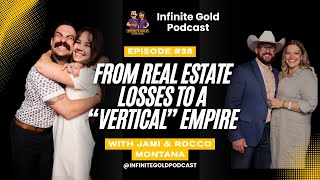
Jamie and Rocco Montana built a real-estate and construction company from a single $16,000 flip, after losing money and going a year without deals. They discovered that controlling construction was essential, merged their personal and professional lives using a marriage safety word, and now own real-estate, construction, and lending arms to reduce risk and create revenue streams.
Chapters
Welcome back to the Infinite Gold Podcast, your hosts Bri and Anthony. And today we have the amazing Rocco and Jamie Montana. We call them J-Rock. What's up, guys?
Hey, how's it going?
Hello, hello, good to be here.
Thanks for being on the show. Uh, just a heads up, this is the Infinite Goal Podcast. We talk about everything to do with personal mindset, vitality, your health, community, and professional business. Don't forget to subscribe, like the show so that way you can watch this amazing episode with Jamie and Rocco, cuz today we're gonna have some amazing golden nuggets like usual about professional real estate. We've got an amazing couple. They're serial entrepreneurs. They've got a real estate company. They just started the construction side of it. That's already taken off immensely. They've got family in the ranching business with meat. So if you need meat, they're the people to go to. That sounds weird, but trust me, their meat is delicious.
They've got the meats.
Again, thank you guys for being on this show. Uh, if beginning of all of our shows, we'd like you guys to give a quick 2 to 3 minute bio of who you guys are, and we're going to dive straight into real estate. And business? Okay.
So we own a real estate team and we also own a construction company. And ooh, almost 10 years ago now, we invested in a coaching program. Wasn't terrible, wasn't amazing, but we were going to be real estate investors with no college. I had no college education and no 401(k). Or big wad of cash sitting around, but I was gonna be a real estate investor because this program told me I could do it. Yeah. Long story short, we did a couple of deals. I did one deal, it took me 4 hours. I found a deal on Facebook, made like $16,000 and did not get another deal for a year.
Quit his job.
Quit my job. Didn't get another deal for a year. Oh, shoot. Now fortunately I had the most supportive, I don't even know if you were my fiancée yet. No, we were engaged by the time we did this. So I had a supportive fiancée. She kept her job for, well, probably a good 3, 4 years. Yeah. Into me being an entrepreneur and figuring it out and getting organized. And, you know, we got to a point we had like 4 flips going on in like 3 different cities all across the front range of Colorado, probably $2+ million in borrowed money from private money, friends, family, credit cards and all that.
Yeah.
And I was like, honey, you need to quit your job. And do all this organizational shit that you're doing for us because I'm gonna be underwater pretty quick. We ended up keeping one of the houses. We sold two of the houses for pretty significant losses. We never filed bankruptcy. We never walked away from anything. Wow. We never screwed anybody. We actually let a couple of people off the hook over the course of these ventures. And then we realized the biggest hole was construction. So the problem with being an effective flipper was having control over the contractor.
Yeah.
Mm-hmm.
So, yes, as human beings go, we were married and business partners and it wasn't as good for our marriage as it was for our business at the time. So she found a partner in construction. I continued to develop the real estate business. I had a mentor at the time tell me, don't worry about being an investor, just be a realtor. And go get transactions. Just go negotiate deals and, and get through the process. And I did not want to do that. I was not interested. I didn't want to open doors like the internet thinks all that realtors do. I ended up loving it. I really do love being a realtor. I think what helps us stand out in the space, you know, which is a flooded space, because the barrier to entry is like a 20-hour course and $800 and like, you're a realtor. Yep.
Here's your certificate.
Yeah, yeah, yeah. 100%. And, and, you know, if you ask the internet, like, all we do is open doors. So it's, it was kind of, it was really life-changing. I'm super passionate about it. You know, we, we created JROC Properties, which is Jamie and Rocco. It's our celebrity couple name.
I love it.
Jamie had, had two different business partners. She had one business partner in construction. They separated. Then we both partnered with the project manager. That was short-lived. That ended literally at the end of 2024. In between 2024, we did like 4 to 6 months of being in the commercial laundry equipment business.
Oh, okay.
And now as of January of 2025, Jamie and Rocco wholly own our real estate and our construction companies. Yeah. We just did our first flip with no ownership partners. So we have private money and we still work with investors. Again, we never screwed anybody, so we still have great loyal lenders. Mm-hmm. That work with us. And yeah, the construction business is growing. The real estate business has been steady. 2024 was a tough year, I think, for most agents, even the top producers. But it was— yeah, I mean, that's kind of got you caught up. I'm New York and New Jersey, 10 years apiece. I married a rancher's daughter. I wish I was a cowboy.
Is that a song?
We could. We could make that a song.
We've seen the photos and videos. You definitely wish.
He's— yeah, he's— I will say this. I will say this. He is— he's very coachable and he is eager to learn.
Learn.
And it is not something that being a 30-something, I suppose, when we, when we first met, um, he showed up on the ranch and he was like, I don't like smelly horses or cattle. And I literally said to him, well, you either need to figure it out or goodbye, because they're everywhere. Um, yeah, I, I grew up in a small town in South Dakota. My family has a 5-generation Angus cattle ranch. We also raise Quarter Horses. I grew up rodeoing, competing in horse shows and things like that. I grew up training horses for my dad. Agriculture and ranch life is something I'm extremely passionate about. I always wanted to marry a cowboy, and I didn't initially, but he is— he's evolving beautifully.
He's just waiting for you to tell him I'm good on a horse.
He is good on a horse. He's very good on a horse.
Good or okay?
Learned how to ride a horse until I was like 33 years old. Yeah.
Like I said, he's coachable. So it's, you know, sometimes he gets coached by a 5-year-old on how to post when he's riding, and sometimes he gets coached by a 20-year-old on how to throw a rope when he's chasing a calf at like 15 miles an hour. So it's—
he's still doing it. Oh my gosh.
Yes, he is still doing it. And that's one of the things that I love about him is his ambition, whether it's in business or in life. He truly has, um, he truly has improved the quality of of my life experience from the minute that I met him. Like, we— I'm 6 years older than he is. And I remember on what, like our third or fourth date, I, I looked at him and I was like kind of teary-eyed. And I said, I don't know if I can keep up with you. You're— I'm older than you. We do so many things.
Yeah. Yeah.
He has a huge love of life. And that's something that's very contagious and infectious, not only with our home, but also with the people that we work with. We're very passionate about what we do. We're very service-oriented, and we come from really unique backgrounds, which I think complement each other. You know, he grew up in the fast pace of Staten Island in, you know, the New York, New York City area. And I grew up in the very small pace of South Dakota. And so we bring— it brings a really unique balance. I think when we do business with people, we have strengths, our strengths and weaknesses are very different and they complement each other. So I think that's something that's really helped us grow our businesses.
You guys are awesome. I just love you both.
One of the things that you kind of alluded to, obviously, is you guys are business partners. You guys are also married. What's one of the hardest things that you guys had to deal with at the beginning when you guys were doing that, and what has made it so strong?
I would say separation of our business and our marriage, you know, and we, we got some really good advice early in our marriage from a pastor. And he was like, you guys need a safe word. And when he first said it, we were like, what?
And he said, what do you mean by safe word?
And he said, no, you really need a word that the, that you, that you honor, that you can say that essentially means Timeout, we need to take a break and we need to focus on each other. And so we did. Our word's carnation. And so if you ever hear us yelling carnation at each other, it's a good thing. It's a really good thing. Um, but yeah, we really had to learn how to honor our marriage and our businesses and be able to take those hats on and off respectively. Respectively in a way that if, if I'm, you know, if I think something's really important in our, in our business and, you know, Rocco wants to have date night without us talking about an estimate that we're building, like carnation. And we just respect that word because we don't use it frivolously. We don't use it. We don't abuse it.
We don't use it to avoid having hard conversations. We use it when it's like, hey, we're 10 hours into the day. Like we got up and we got to work and we've been on the road and like, let's go have dinner and not talk about work for an hour. You know, like things like that. I would like to add, for me, humility and communication, right? So when we first started, Jamie has a lot more experience in business than I did. Now, hers was more corporate. I mean, she grew up in a family-run business. Again, similar but different. I know, I know, you know, the cowboy code to answer to stuff like how much cattle that you have, how much land you have is enough. So I don't know how much information she was privy to as a business owner, as an entrepreneur with the family, but she has a master's degree. She managed large sports complex for a D1 university in Denver for several years, $10 million budgets, 200 employees. And like, she was telling me all the right things and I didn't want to hear it because I was the one that focused on this, like invested in the coaching program and I was doing that and I knew better and it wasn't relevant. That it was real estate related or not. Like the advice Jamie was giving was sound business advice that like I had to pay $15,000 for a business coach to tell me the same thing.
So you could have just paid her the $15,000.
Yeah. Yeah.
Yeah. You know, it, it, everything happens for a reason.
It does.
Right.
And so part of that is giving your partner time and space to learn and to, to figure it out. Right now, when it starts to be a financial detriment to your family, to your businesses, yeah, you got to raise your hand and be like, yo, look, data's data. I know you, you might feel one way, but numbers show us something different.
The numbers don't lie.
Yes, the numbers don't lie. And that's, that's where I spend a lot of my time. It's great. It can also be really bad for me to spend too much time in there because that's not the highest and best use of my time in the company. So, you know, we've really over time Right. You can't open a business and be married and, and be, um, couplepreneurs and take a loss in like year 2 and figure it out from day one. Like we have, we have given ourselves through good practice and good mindset mentoring with, you know, the, the Infinite Gold community, with the TFP community. Um, we've surrounded ourselves with like-minded people and we've really learned to give ourselves grace and understand that those lessons, while they may be hard or they may hurt a little, The value of them is exponential. So it's, you know, you really have to, A, respect each other's boundaries.
Yeah.
Understand how to establish those boundaries in a really healthy way. Respect those boundaries. And communication. It's all about communication. And then really community. Like, who are you spending time with?
Accurate. People, I hope you're taking notes on this because Jamie is dropping some serious knowledge bombs.
Yeah, if you're a couple, and even if you're not in business together, you're just in business in general, those are all phenomenal points to take note of and implement that in your own life. Like, how can you take those tools— the communications, the grace, the harmony, um, that safe word— like, if you could take that into your own life, it's gonna— you're gonna grow immensely from it. And we, we love that all intertwined. It works out perfectly.
We got some really good advice from my dad, who he obviously— he's a— he, he literally went to college, I think, for one semester and then came back on the— came back to the ranch because my grandfather really needed his help and has been a critical part of growing a ranch from when I was a kid. I mean, we had a small herd. And now we have thousands of cattle and that ranch feeds 5 families, which is amazing.
That's awesome.
Yeah, it is. It's amazing what they're doing out there. It's quite amazing. But he told us, so when we actualized our first real loss in the construction or in the, in the real estate space, in the fix and flip space, we were actually at my parents' kitchen counter and we got the number and I'm sure my face turned white and Rocco was like, oh, you know, what are we going to do? And he looked at me and he was like, you get bad news, kid? And I said, yeah. Yeah, we just under— we're just understanding the losses from our, our first loss from our, from a big flip. And he was like, well, and I said to him, I said, Dad, have you ever taken a loss? And my mom and him literally started laughing. And, and I, and I was, and he was like, listen, it's only a loss if you quit. You only lose if you quit. He said, 100%. He was like, buy another house, get another flip. He said, talk to your lenders, explain what happened, run your numbers, and then just go get another project, which is something he would say.
Quick recover.
So it was great to hear that coming from my father because someone whom I respect tremendously in business and in life. But yeah, that's something we tell everybody, like, you only lose if you quit. Just take another step and then take another step and then take another step.
That's so good.
I mean, I love that.
That's like kids, right? They fall down. They're trying to walk. Like, they don't walk right away. We're not like— was it giraffes that come out? They wobble for a little bit and they start walking? No, we, we go through sometimes a year, year and a half, 2 years till we're walking and talking and doing all these things. So I love that, you know, don't, don't quit. Just keep going.
Yeah.
So when it comes to business, let's, let's, let's dive into it. Obviously things are a little weird these days. What keeps you guys going on the real estate side of things when people are always like, you always have like both sides, right? You got the one that says, oh, you should not buy a house right now is the worst time. And then you got the other side that says, oh, you need to buy like 18,000 homes right now. It's the best time. How do you guys tread that water and how do you guys help other people do the same thing?
Well, I'm going to share something. It's going to sound a little cliché, but I don't think it's said enough in our industry is The right time to buy a house is when it makes sense for you and your family.
Yeah.
Ooh.
Market conditions are irrelevant.
Like, I love that.
I mean, the, everybody says you make money on the buy from an investment standpoint. And I recently had somebody said, well, that's not really true. I think it, you make money when you sell. And, and that wasn't just a, oh, okay, we buy, we, we do work and we make a profit when we sell. It's, the market conditions are more relevant when you sell than they are when you buy. Right. So that's something to consider right now when we're talking about buying a home. I tell everybody, when you're buying a home to live in, to raise your family in, you're like 80% lifestyle, 20% investment.
Yeah.
And when you're buying a home as an investment, it's 100% the numbers. You remove emotion completely.
Yes.
Right. So Again, 2024 was, you know, we're 9 years— I got my license in 2016, so in September 2016, and I didn't really focus on even being a realtor probably until 2020. But, you know, in almost 10 years in business, last year was the worst year as a retail real estate agent that I had. In line with that, it was the lowest amount of homes sold nationwide. Since like 2007 or something like that. So it was something along— it was almost 20 years. It was the lowest amount of homes sold. Now, looking at today's market, right, we are, we are in the end of August, middle of August 2025. You know, the rates are the lowest they've been in a year, I think, today at like 6.3%, give or take. You know, with approved credit and all that. This isn't any sort of business advice. This is just Like if you look at the 30-year average of mortgage rates, it's over 8%.
Mm-hmm.
So, oh yeah, just because a certain generation, which happens to be one of the largest generations of homebuyers and sellers right now, is used to 2.5% and 3% rates that we saw one time in our lifetime that we probably won't see again, thinks that the rates are high. The rates are not high. And in our market, it's in a slow and steady decline. And I say that very specifically. There's not a crash, it's not a recession, it's just a slow and steady decline. And I like to encourage people to think about we're having a bit of a return to normalcy, right? Like it's always been, I was always taught, again, I'm coming up on 10 years in the business now, it was always taught a normal market is 6 months of inventory. Meaning if today new homes stopped coming on the market, it would take 6 months to exhaust the supply. We were at like days. In 2021, literally like days of inventory. Like, it was insane. Yeah. I think the— I mean, I think the lowest we got was something like 2 weeks of inventory.
That's so—
we're at like a rough— in our market, at least I can speak to Colorado's Front Range, we're at like 3 months right now. So if your house stays on the market for 30, 60, 90 days or goes under contract, that's totally normal. It's not a bad listing. It's not a bad market. It's just returning to normalcy. Now, if we go to 2008, when houses were on the market for a year or foreclosing and short sales, that's a completely different environment. I don't believe we're heading there. I don't believe we're going to be there for a little while because we had so much growth from 2020 to 2022. Even with a slight decline for— if we continue to decline at the rate we're declining right now for another year, it's still not going to erase like Boulder— city of Boulder, 20% year-over-year appreciation in 2021.
Crazy.
And then I think it was like 16% in 2022 or something like that. Like it, it was absolutely bonkers. Unheard of. The average appreciation is still 6% over the last 30 years.
Mm-hmm.
So should you buy a house right now? If it makes sense for you and your family, if you're going to hold onto it for at least 5 years, you have like a 99.9% chance of making money.
Yep. So true. Now, because you said that, what is your biggest thing for yourselves and then you try to help other people is eliminating the emotional aspect of it. We are humans and we are emotional as F creatures. So how do we get rid of that when it has to do with home buying? Because yes, you want to be emotional to the home if you're going to live in it, but if you're so emotionally vested into it, you may not make the best choice or deal.
Rago is definitely the expert at managing our real estate clients' emotional rollercoaster. I don't know why. It's so stressful for me because construction has its own roller coaster.
Yes.
And I manage that really, really well. But with the real estate side, he, he manages those emotions. I think just from, from an overarching standpoint, you know, it's education, education, education, education, and not to the sense of like, let's show them this angle or that angle or this angle. It's make sure that we understand what your needs are, what your goals are, and then we can provide the information that will help mitigate that, that emotional roller coaster. I think that's one of the biggest components. Wouldn't you think?
I think everything I just shared over the previous minute and a half monologue I had, if you're a real estate agent, a home buyer, a home seller, was all gold, right? Don't try to time the market.
Yep.
Think about where you're going to be celebrating Christmases and birthdays and first steps in your home, but don't neglect your budget. The reason, the reason it's 100% no emotion for an investment and, and still only 80% when it's a primary residence or a personal residence is because you can't blow your budget. Yeah, right. You have to understand what you can afford. That goes talking to the right lender, understanding what programs are out there. First-time homebuyer programs, down payment assistance programs, veteran homeowner programs. Just understand what's available to you. Get connected with the right team. To make the right choice. And I tell you what, a big piece of advice is really hard to go backwards. What I mean is, you know, you're in California, right? So if you're a first-time homebuyer, $1 million, you can't start looking at $1.5 million and think you're just going to like downgrade to $1 million because they're very different and it leads to a terrible experience for your clients, for the sellers, and it just You're not going to have a good time.
Well, I think it's also important to— what helps mitigate emotion is to provide data, right? So here's a perfect example. You know, we've just come out of a market where everything was multiple offers, right? So when we get approached or when we approach a client for a listing, you know, they want to list at the top of the market, of course, whatever, you know. And so It's our job to show them the data, to show them actual real-life statistics that are current to, to the window that they're going to sell their home in.
And right into your local environment.
Yeah. Not information from 2 years ago or information from a neighborhood that is like comparing apples to oranges, you know. So really showing them— and we do our due diligence when You know, Rocco's getting a property literally under contract as we're, as we're speaking to you guys.
Yep. Which is awesome.
Yeah, it's great. And it's great for the sellers. The sellers tried to live in Colorado. They didn't like it. They went back to their home state. They, they haven't even owned their house for 18 months, have they?
Wow. Yeah.
I mean, they now, but they, they moved out in their first year and they bought at the peak of the market. They bought on a busy road.
Yeah.
Um, and they ended up with an agent that didn't present the house in the best light. So they spent, I don't know, 4 to 6 months on the market with 30 showings and no offers.
Yeah.
Wow.
And, and the, the moral of the story is they didn't like the suggested list price that we made.
Yeah.
We had to show them the data.
Yeah.
And then we showed them more data when they they disregarded our recommendations and we were like, okay, the data still shows this. We can sell this house. And so, so it's really helping people understand through factual information to try to mitigate those emotions.
And I'll tell you what, I think we're going to get more than I thought we were going to get. Yeah. All right. Like they want it to be at like $530,000-something. You know, we, we, we are currently— so we started at $525,000. We're down to $515,000. You know, they're going to end up in the $505,000 market. I thought $499,000 would have, would have gotten the deal done. Now, again, more education and more data. If we listed at $499,000, we might have got $510,000 or $515,000 because people— psychology of numbers.
Yep.
And budgetary restraints. People were probably stopping their search at $500,000. So listing at $505,000, we might as well have listed for $600,000. Yeah, right. Just because we're going to get— we're going to get less views.
Mm-hmm.
But again, the understanding that we made with them is we're gonna have to have a structure. Like we're gonna waste everybody's time if we list it high and we get no activity or feedback on a high price. So every couple weeks we reduce the price by so much. Our next move was gonna be down to $499,000. We're still at $515,000. They wanted to dump to $499,000 last week and I said, hey, we had like 4 showings this week after no showings for 2 weeks. Let's sit tight. Yeah.
Yep.
So we're gonna sell at $515,000 with some concessions for, for mortgage rate benefit. And everyone's gonna be happy.
Yeah. We're, we're not winging it.
Yeah. No, definitely.
Yeah.
I see.
Not winging it.
We don't, we don't, we do more than just open doors. Yes.
Well, I love that you also brought in the construction side of it now, and you basically are creating like the vertical build model of JROC. And how is that so important when people think about like when they're creating businesses or trying to scale their businesses of utilizing the vertical route? Of making that happen?
Owning the vertical has always been something that we've talked about from the beginning of our companies, and owning the vertical helps mitigate risk for us as the owners, for our clients. It helps us provide a higher level of service because we're controlling more variables. I'm actually also a licensed lender, so I'm not on a lot of real estate contracts. Yeah, I'm not on— I'm not on the real estate contract because I got it.
Yep.
Yeah.
And I have a place at the lender's seat, at the lender's table, so I can advocate for our clients when we need to push things through or if we need to have conversations at a higher level. Because I'm a licensed member of our lending team, we're able to do that. That's awesome, right? The construction, the construction components. And we saw this, we saw this, this service need in the market, obviously, in the, in the very early stages of our company, because we as you know, fix and flippers who were hiring contractors and general contractors to do our work. We had our own issues. One of the first houses we did, we wrote a check for like $20 grand, wasn't it?
Yeah.
Yeah, it was $20,000 and the guy disappeared. Now, thank goodness. Oh geez. My Italian husband found the guy and got our money back. Like that was the— Addie was upset about it too, aren't you?
Yeah, you can tell.
Yeah, that was, that was really the, the catalyst behind us building a construction company. Um, it took us a few years because construction is a complex, um, process. You know, you're building someone's home, you're waterproofing someone's home, you're, you're, you know, it's not something that you can just learn overnight. So I had some really great partners in, in the past and learned a tremendous amount about the industry itself. Construction also has a pretty big need for business-minded people. There's the construction industry is, they So many gifted people who are creative, smart hands, smart hands, right?
Mm-hmm.
So I was a really natural fit to go into the construction industry with my business management background.
Mm-hmm.
To really be able to streamline systems and processes and create efficiencies. Um, and I really fell in love with the construction, construction industry. I do a lot of design for our clients and then I also, you know, I do a lot of project management. And estimating and, and sales as well. But when we were able to put that additional service in the JROC group of, of, or the JROC suite of services, it really, it really added a value of a value proposition for our clients. I mean, now we have so many clients who will call us and they're like, oh, I have a tenant. They just told me there's mold in our house. What do I do? And so we were able to assess it, mitigate it, list his We showed up and helped keep cooler heads between him and his tenant.
Like, that's how that started.
Yeah, that's awesome.
And then, yeah, we went right into construction and we're listing the house this week. Yeah, that's the second one we've done this year since we wholly own both the real estate and construction company. We've already had two opportunities this year where the companies fit each other.
Yeah, we're working with a commercial estimate right now where the woman has— she has an exceptional agent. On the commercial acquisition of this building. But we're also able, you know, she's talking to us about like, well, the bank loan and this, that and the other and how should you— how can we structure the estimate to blah, blah, blah, blah, blah. And we're able to really, again, provide more data, provide a higher level of service because of the, the knowledge that we have behind. Yeah, both industries.
Yeah.
You guys are able to give that second eyesight on something that maybe they oversaw. And I love that. So backtrack. I don't know if anybody heard. You guys came in there to serve them, fix the mold, help them out, and what in turn happened? They gave you the sale of the property. Like, if you don't understand that in business, you start serving people, AKA you guys are also part of the Infinite Serve. You serve people, you help people out, you create a new funnel of your business, AKA construction, to help and serve people. You just now increased the dollar amount in another business, and now you could help and serve even more people. So if you're listening to this and you're— you have a business, is there something within that business that you can add on that doesn't take away from the initial, but you can add on to help bolster it? That's where you create that vertical process, and it makes it that much better.
And that's been a really exciting dynamic in our businesses and in our marriage, right? Because Rocco's extremely passionate about real estate. My first real estate client, I promptly turned into a construction client. He was also my first construction client.
That's awesome.
And she also became a private lender for Flip. She's a phenomenal private lender with us. She's retired and she— I mean, literally, we call her and we're like, hey, would you like to invest? And she's like, of course, you guys are my fun money. You know, that's amazing because you created an experience. Yes. And that's, that's really the point, right? Is if you show up with integrity, you show up with a service, with, with an intent to serve at the highest and best level you can, right? Because that's going to change over time, right? So show up with an intent to serve at your, the highest ability you can. People start to know, like, and trust you, and then they're like, well, what else do you do? Or, you know, instead of referring them to other companies we've been able to stack and create multiple companies to really control the service level for all of our clients.
Yes.
Gosh, I just love you guys. You're so good. Ditto.
So we've got this construction, we've got this real estate, we got a lot of things going on. You guys are amazing. You guys are a beautiful couple. That's why we have you on, obviously. And the next thing that you guys have coming out that a lot of people don't know about Can we share it? Can we share it?
Yes, please.
Is you guys are coming out with your own podcast, which obviously we have ours, so we love the idea and we better be able to be guests on it. I'm just saying.
Of course, you guys might be our first ones.
Yeah.
Yes, we're all for it. Now let the listeners know, why are we creating this podcast? You've got so much going on with real estate. You have so much going on with all these things. Why a podcast?
I like to talk.
Period.
Yeah. He's, you know, just period.
How, how— He's about to give our 10, 10-minute dissertation on the podcast.
Yeah. It's, it's instead of one-to-one, right? In, in a sense of business perspective, right? Like instead of one-to-one, how can we provide value from one-to-many? Yeah.
Right?
And so we're a lot of one-on-one, a lot of, oh, I get a phone call from online or I get a referral and it, we get to provide all this value and all this experience and all this knowledge and all this insight on multiple industries. To one person at a time. Yeah. How can we get to a point where we're not just helping one person at a time or just somebody here in Colorado? Like the advice that I gave about real estate today is great for any real estate agent, any buyer or any seller in the whole country.
Yep. Without a doubt.
Can't speak for real estate in other countries yet. Maybe one day. But all the advice I gave is relevant to any market, any buyer, seller, or realtor or lender in the United States of America.
Yeah.
And we're really passionate about leveling up our industries, right? Real estate, like you said, there's very low barrier to entry and it's been a, a, you know, the last decade has been like if you're breathing, you can get a deal, right?
Yes.
You know, we're in, we're in the point now, especially with the construction world where we're selling people's homes that they bought 3, 4, 5 years ago and they're like, why didn't that come up on inspection? Why didn't you know?
So I wasn't involved in the purchase. As that time. That's why I didn't come.
Yeah, exactly. So we want to elevate the real estate industry. We want to give back. We want to share our stories and, and we want to share our experiences with construction. We, you know, just like in real estate where you are the fiduciary advocate for your client, we feel the same responsibility needs to be had in the construction industry. Right. General contractors have the highest knowledge in the room when it comes to building. And if they cannot and/or will not advocate for their clients, that's a disservice to their clients. So as the superior knowledge person in the room, we want to make sure that our clients fully understand, you know, their return on investment. If it's their forever home, like, do whatever you want. I mean, yeah, put the bathroom in, in the attic. Like, I don't care. But if it's not your forever home, then we have to think through some, some different logistics. We want to help you because we are also real estate professionals. Accomplish your next goal, whether it be renting the space out or turning it into an Airbnb or, you know, making it ready for your mother-in-law when she lives here, whatever it is. So yeah, really, really continuing to provide value.
Hopefully she doesn't hear that part.
Oh shit.
Sorry, Mom.
Sorry.
She gets a granny flat.
Yeah, yeah.
We'll get her a nona flat.
A little bit away from the house. We'll make sure we have that ranch, like, in South Dakota.
Those are conversations we also have. Yeah, sometimes they have to play marriage counselor.
I know, right?
People who are married and in business together, and the wife wants the mother-in-law, like, in the basement, and the husband is, like, behind her. Like, we have to help them find that healthy balance.
Yes, which is awesome. You guys aren't just real estate agents, you guys are life coaches at the same time.
Yes, yes, that's awesome.
Got all the tools in their belt, without a doubt.
Well, and we're still learning and we're still growing. Yeah, and there's a lot of, there's a lot of development that needs to happen for us to, you know, one of our goals is name on a crane, and that would be awesome. You know, those cranes in the city that are Putting up skyscrapers. We want J-Rock on that someday.
That would be legit.
So I'm all for it.
I'll get behind that.
We'll invest in that. Let's do it.
Yes.
Let's make it happen.
Yeah. We want to build multifamily. We have, we have, you know, we've talked about really interesting concepts around multi-generational living where we're designing communities to support, you know, kids with special needs or elderly with special needs. And we've designed the community around this whole concept of, okay, all of the medical facilities or care needs are like in the core of the city. And outside that is assisted living and outside that is more independent living and outside that is single-family homes where families can live and be close to their aging loved ones or their disabled kids and but still be in proximity but still have freedom, right? Like there's a lot of interesting concepts that you can help serve your community with through real estate and construction. And that's something that gets us pretty fired up and passionate because We love humans. Like, we, we think it's, you know, it's, it, there's so much beautiful life to live and we want to be part of, you know, a catalyst behind creating healthy environments, creating happiness, creating joy.
That's so good. That's so good. We need more good humans like you in the world.
So we have a lot of them in TFP. So if anyone's looking for good humans, they definitely—
the Final Percent, Infinite Serve, all of the above. Definitely check them out. Links in the bio.
I was so blown away. Okay, I'm just gonna, I'm gonna, I'm gonna tattle on myself. Yeah, I'm not a big fan of California.
Oh, it's okay, it's okay, we understand. It's not for everybody.
I was blown away. That's what everybody says that came to the LA Totality event. We met so many cool humans.
It was pretty awesome.
And I was like, you know, Jamie, get off your little soapbox, stop being so judgy, and go visit California more. So yeah, the totality event that you guys threw, it changed my whole perspective on the state. So thank you, we appreciate it.
And you guys came out and visited right before, so yeah, that's awesome.
Hey, we make it extra sunny when you come to visit.
Yes, oh, it was beautiful.
The weather was amazing.
So we like to end all of our shows with What are the 3 golden nuggets you think our listeners should know about real estate, life, construction, ranching, whatever you think they should know about?
I'm gonna take the first one 'cause it's the easiest one. Give a shit. Just give a shit.
Yes.
Just really care from your heart. Get outta your head, get into your heart.
That's awesome.
And just give a shit.
So good.
That's amazing.
Literally what I love about these is again, We'd never get the same answers. So that's awesome. All right, Rocco, what do we got? Number 2.
Communicate. I think good communication, you know, and the communication is not just speaking, it's also listening. So receiving the communication, not just sending the communication. Good communication involves good listening and intelligent speaking. So yeah, give a shit is number 1 across all of our companies. It's one of our core values. It seems so simple. We're just in such a, we just live in such a transactional, fast-paced world. I mean, I'm always going to have to defer back to like our, like I would get it tattooed on my forearm.
He doesn't have any.
Just give a shit.
I have a couple. So do I. I know somebody you can go to.
Nice. Nice. So yeah, give a shit, communication. Don't forget to have fun.
Yeah.
I was going to say, have fun.
Fail forward. Yeah.
Like, just keep going.
Yeah. Here's your, here's your bonus. Have fun is number 3, but number 4 is you're going to be scared, do it anyway.
Yeah.
Because you're just not going to do it. So either do it scared or, or you're not going to do anything. Like, just do, just do it.
Fear's a liar, man. Just go. Have fun doing it.
Faith over fear.
Yeah.
Every time.
100%.
Love it. Well, thank you guys for being on the show. We appreciate it. Thank you for listening. Uh, if you like the show, please subscribe. Like, comment. If there's any future guests that you'd like to have on our show, if there's any topics that you'd like us to discuss in the future, please DM us, let us know. And if you're in the Colorado area or if you just want to know more about real estate, Rocco, Jamie, follow them on Instagram. Their links will be in the bio. They are a wealth of knowledge. They'd be happy to serve you, be happy to help you out. And if you're in need of a house out there, you better hit them up. Trust me, they're gonna want to do it.
We have several masterminds and networks that, you know, if you need help anywhere in the country, we can put you in touch with high-level people across the real estate and construction industries. So reach out.
See, connections.
Exactly. Connections and networking. Communicate.
Communicate.
1 1 1,000.
Heck yeah.
Thank you guys for being on and we'll see you guys soon.
Thank you both.
Thank you so much. Thanks for having us.










