Going Bonkers with Cancer: A Story of Mindset, Intuition & The CEO of Your Health with Allison Pazuk
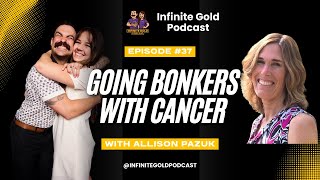
In this episode of the Infinite Gold Podcast, hosts Bri and Anthony Goldner interview Canadian author, ovarian‑cancer survivor, and empowerment coach Allison Pazuk. Allison shares a rapid two‑minute bio that traces her journey from competitive horse riding, to a 27‑year career as a high‑school math teacher, to real‑estate entrepreneurship, and finally to a cancer diagnosis that reshaped her life. The conversation explores several inter‑linked themes: the shift from a relentless "go‑go‑go" mentality to a conscious focus on rest and a structured evening routine; the development of her book Going Bonkers with Cancer and the BONKERS acronym (Brave, Open, Non‑conforming, Kick‑ass, Emotional, Resilient, Self‑advocacy) that frames a mindset for confronting illness. Allison explains how she moved from being a passive patient to acting as the "CEO of her own recovery," taking charge of treatment decisions, researching alternatives, and listening to her intuition—most notably stopping chemotherapy after six rounds when her body signaled harm. She discusses holistic supports she employed, such as high‑dose vitamin C, acupuncture, and especially fasting, detailing how different fasting durations affect metabolism, autophagy, and even chemotherapy efficacy, while noting gender‑specific considerations. The hosts also delve into the book‑writing process, the role of survivor stories, and practical advice for listeners, culminating in three “golden nuggets”: claim ownership of one’s health, seek out survivor examples, and eliminate refined sugar. Throughout, the dialogue blends personal anecdotes, actionable health tips, and motivational language aimed at empowering anyone facing serious illness or life challenges.
Chapters
Push higher, go deeper, love longer, be stronger. We'll keep climbing up the mountain.
Cause deeper than you know when you're meant for.
All right everybody, welcome back to the Infinite Gold Podcast. It's your show hosts, Bri and Anthony Goldner, and today we have a very special guest with us, good friend of ours, our Canadian friend Allison Pazook. She is an author who just launched her book, Going Bonkers with Cancer. She is an ovarian cancer survivor. Holy smokes. She is also an empowerment coach, and she is just a one-of-a-kind human being, and we really wanted to bring her on to share her knowledge, her wisdom, her expertise, and her light. Welcome, Alison.
Thank you so much for having me. You know, your, your episodes are fantastic, and your audience is so lucky that you've created this podcast. So thank you.
Thank you for that. We appreciate it. So if you don't mind, we like to, at the very beginning, get a quick bio, quick 2-minute bio of who you are, and then we're going to get right into the show. As many people know, we talk about our Infinity Model, and today we're going to focus on the mindset and your health. So it's going to be really good. We're going to have some great golden nuggets like usual. So make sure you stay tuned.
Perfect. Sure. Absolutely. 2 minutes, huh? Okay. I have to talk fast. I started out as a competitor, so riding horses, competing, then ended up moving countries. That was a fun episode. And then became a teacher. So, I was a high school math teacher for 27 years and realized my purpose was gonna spread far beyond the kids I was helping and went into entrepreneurship with real estate investing. And it was the perfect time to get into it. Everything was smooth. It was amazing. Anyone can do this until you couldn't. The market turned. Um, that ended up, we faced a financial challenge. Terry, my husband and I faced a financial challenge. Feel like we're coming out of that. And the universe goes, you know, you're still not paying attention. Let's hit you with ovarian cancer. You will rest. And So that was 2023, which was an incredible year for growth. But the 3 years, 2 years before and the year after, really was a pivotal transformational time for me. So I'm not sure if that's 2 minutes yet, but that's in a nutshell, my bio.
That's amazing.
Love it.
You had me at math teacher. I knew you were a teacher in your past, but I didn't know you were a math teacher. So where were you when I was in grade school? Because I needed your help.
Holy smokes. Yeah, I really enjoyed it. And it's the kids that hated math that were my favorite ones. Like the, absolutely, like the kids that would fall asleep in class or didn't want to come, or they were the ones that I loved reaching out to, loved impacting. It wasn't the ones that did super well and you give them a book, they can teach themselves. I really liked connecting with the ones that actually had stories. It was fun to get to know them.
So good.
You touched on rest. We're going to go into it later, but you touched on where the universe was telling you that it's time for rest. And one of the things that we talk about a lot within Vitality is recharge. So how has that changed or pivoted for you based off of everything you've gone through?
Well, rest, I've discovered, is a trigger word for me. So it's, uh, One that our friend, our mutual friend, Greg Kimball, always would tell me to do. You just need to rest. You need to rest. And it got to the point that I'm like, no, I can't rest. I've never rested. Even as a child, mom said to me recently that it was always, you always wanted to know what other people were doing. You always had to be active. And You know, then, you know, being around animals and riding and then heading into teaching where you're on the go all the time, and then the entrepreneurial world where the mindset is who needs to sleep, sleep on your dead, sleep's overrated.
I say that too often.
Apparently you do need to sleep, your body does need to heal, and if you don't, it will give you some sort of reason to do it.
No, that's so true. And one of the things that we've built out are routines, and one of them has to do with the evening routine and having a routine in order to help you sleep and get that recharge that you need. Do you do something like that, or is that something that you implement?
As of about 3 weeks ago, yes.
Okay. And how's that going?
It's actually going super well. I'm, uh, I had a regular routine, but it was kind of loosey-goosey. You know, you get ready for bed, you clean your teeth and everything. And then I would write in my gratitude journal and that was it. But now it's, it's more of, I stretch, I've got a routine that I go through where I'm just very doing a loose, quiet, relaxing stretch while I'm breathing. So there's a lot of deep breathing with it as well. Then write in the gratitude journal. And by then I can barely keep my eyes open. I'm just And I'm sleeping so much better.
So good. What have you felt the difference since you started doing that new routine now? What's like, what's the difference that you feel, things that you've noticed?
I've always woken up and be ready to go. As soon as my eyes are open, I'm like, all right, let's go. But I was starting to hit the wall around 3 or 4 o'clock. Then when I was going to bed, I'd be awake between 3 and 4. You know, that's when your cortisol levels are kicking in and that sort of thing. So I would be awake then. And then have to go back to sleep. So, it was always very disturbed. Since then, I'm just, let me go. I'm fine during the day. I'm not waking during the night. So, it's amazing what that routine can do. It seems overrated and, you know, a lot of people tell you to do it and you're like, yeah, yeah, yeah, I'll do it next week. Ah, yeah. But it's important.
Oh, that's so good. No, I love that. The fact that you're now sleeping through the night and you're not getting that interrupted, like, window. And then having to go back to sleep and then crashing in the middle of the day. That's so good. People start taking notes.
That's awesome. Uh, one of the things you mentioned as well is mindset. How has your mindset shifted throughout the years from that go, go, go mentality to maybe not as go, go, go, but still embracing that mentality that you do like to get shit done?
It's. I'm still working on it. Uh, the, when I was teaching in particular was very much a fixed mindset, uh, which seems funny in an educational institution that, that you should be yourself, you should be growing. And I would impact my kids. I want them to grow. But I guess I would say typical teacher from my perspective is that I can tell the others to do it, but I don't have to do it myself.
Um, so very much as I say, not as I do.
Yes, exactly. Very much things happen to me. Um, life isn't fair, filled with FOMO. Um, I actually read Think and Grow Rich back at that point, or at least I started to, and I thought, oh my God, this is the worst book ever. And which is hilarious now looking at it from the other side.
Yep. It's a great book. Definitely recommend it.
Yeah, exactly. 100%. Uh, now back then, no, I wouldn't have recommended it. And then in the middle, just being a little bit more aware of the synchronicities and how they aren't really coincidences that people are coming into my life at a certain point and starting to recognize that they're not just random events, you know, having For instance, driving the car, if you're in a rush to go somewhere, if you have the mindset of, oh my God, I'm going to be late, and you hit every single red light versus, I'll get there in time, it's not a problem. Every time I go through a green light, thank you. And it's just amazing how many green lights you get and how many close parking spots that you get when you're grateful for what you have. Love and forgiveness. And really and truly starting with yourself, like self with a capital S. So I started saying my self and separating the words rather than myself. That's powerful.
That is.
And then now being far more of a growth mindset that things are happening for me. So, for instance, we're, we're back in doing real estate and that sort of thing. So when we don't get our offer accepted, it's like, all right, wasn't the place for me. Let's go find another one. It's so much more calming. I'm 100% responsible for me. There's no one else to blame. And that's including the cancer. Um, 100% responsible. I brought it on myself. Um, like money and stuff. I'm just reading because I actually had that written down. Money and stuff isn't your reason or define your success.
That is so good right there. Can you say that one more time for our listeners?
Money and stuff isn't your reason, nor does it define your success.
That is so good. Before you move on, you, you mentioned the cancer and that it was brought upon by yourself. I know that wasn't easy to say, and I know that did not come out like right away. How did you grow to the point of being able to say that? And why is that so powerful?
Because— that's a big question. It's all of the things that were in place to make me the person who could deal with the cancer. All of the things that happened before that brought me to that point that allowed me when I had the diagnosis to go, Oh, okay, cancer. All right, let's get through this. There wasn't the things like in Hollywood when you see this panic and the tears and did I get them? Absolutely. But my first instinct wasn't that. It was, all right, what is this? Where did it come from? Because if I know where it's come from and I know what it is, I'll be able to know how to head it off at the pass. Um, so that was kind of the background on it and recognizing that that cancer came because of the stress that I've always put myself under, you know, very driven, very, uh, people pleasing really and truly. I, with moving countries at 10, coming from Bermuda to Canada at the end of November was kind of a big shift. Never seen snow, had an accent. It's just incredible, the, that transplantation at age 10. And I mean, we all know the story about ham sandwiches. I don't know if your audience does, but—
No, but explain it. Let's do it.
It's, oh goodness, can I say it? Just backing up, I would always trying and present myself the way I thought other people wanted, however I thought they were thinking of me or seeing me. Yeah. So I would say, okay, well, I can't really wear that because then I'm going to think they're going to think that I'm poor, or if I wear that, or my hair's a certain way, then I'm not going to fit in. And I was my height, which you can't see on Zoom, but I was 5 foot 11 in grade 6. So I was taller than everybody else.
You got that growth spurt real quick.
Yeah, taller than all the teachers. And because of that, I stood out like a sore thumb anyway. And so then I'm like, oh, they'll never accept me. They won't want me. And so I was very much in a plumb party, like poor little old me, um, not feeling good enough and always trying to fit in. So The ham sandwich reference is I'm always thinking that they're thinking things about me, but in reality, they're just thinking about what they're going to have for lunch. They're thinking about ham and cheese sandwiches.
So, that's so true. It's, it's a bad mindset that a lot of society and a lot of entrepreneurs get into is especially when they're going in for like a meeting or something, they're like, oh, how should I wear? Like, what are they going to think of me? What are they going to think about this? What are they going to think about that? And probably going into that meeting, all they were thinking about was, I wonder if I can get my coffee or my caffeine.
And yeah, what time? When, when's happy hour? Like, they're thinking of a lot of other things and they're not even thinking about you.
They're not even thinking about you. Exactly. So I love how you, you touched on to that. Let's move on though to this thing. Yes, this is amazing. We love it. Um, we've already given it to, uh, Bree's mom, who also had bladder cancer. Fought through it. I don't think she's read it quite yet.
Not yet, but I— she was really excited because I told her, I was like, hey, I was like, this is Allie, this is my friend I was telling you about, um, that I've been getting some information and picking her brain, um, on, on the cancer side of things, how she battled it because of, uh, Uncle Sean. And she's like, oh, that's awesome, I can't— she wrote a book, I'm so excited to read this. So yeah, Dude, how long have you been working on this? Uh, when did you start it?
Well, even that's a story. Uh, back in 2021, uh, at a summit, Sharon Lecter was there. And for those that don't know Sharon Lecter, she's worked with the Napoleon Hill Foundation, uh, for Outwitting the Devil. Amazing. And she also wrote Think and Grow Rich for Women. And, uh, she was there as a guest speaker and she's having lunch. No one's talking to her. So I'm like, all right, I'm going to go talk to her. That's just the way I am. So I sit down and, and, uh, so just very high level. And then I said to her, if someone was going to write a book, what's your suggestion as to how to do it? And she just opened up. She told me how to do it, how to lay it out, the concepts, the topics. And I went, oh, okay, that's kind of cool. Time to move on. You know, cool story, bro type of thing. Hey, I've talked to Sharon Lecter. Let's go. Uh, then later she's on stage speaking, and, uh, she, she calls me out all of a sudden. She's, she's in the middle, and she says, Alison, you have a story in you, and the next time I see you, I want to see your manuscript.
This was called you out while on stage?
Yes. So this was before I had cancer. So I'm like, all right, guess I better do this because I want to go and see her at, you know, next year at another conference. So I start, start working through it. I don't know how to do this. This, whatever, what am I going to write about? Then cancer hits and I'm like, ah, now I know what I'm going to write about. So I started it in 2023, at the end of '23, I started framing it out. And off, on and off throughout '24, I was dealing a lot, speaking of mindset, this was a harder process because I was dealing a lot more with imposter syndrome and who am I to write about this and what if I'm wrong and what if, you know, so all the what-ifs would pop up. So, it did take a while. Our friend Bernard Quizenbing, so when we were at a conference together, he pulled me aside and he says, what's holding you back? And he just, you know, blasted the mindset and he said, you need to have it done by December. And I went, okay. So by December of last year, I had it done, 24. And then it took from December till July to be able to go through the whole editing and design process, which is still pretty quick.
Well, it's awesome. Real quick. It's Going Bonkers with Cancer. The link will be in the bio. You definitely want to get it. It's amazing.
Yes.
And I will just say that the title, Going Bonkers, some people may look at that and think, why are you making a joke out of this? Bonkers? But bonkers is actually an acronym. So I always want people to stay bonkers because bonkers is what you need to be to be able to get the mindset to be able to feel empowered and courageous enough to face the beast. So, B is brave. You have to be courageous. Always, you have to be open, open to new ideas, open to new treatments. The N is nonconforming. It's okay if you step outside of the doctor's box.
That's good.
Kick-ass. You gotta be fierce, tenacious.
That's our favorite.
K-I-C-K-A-S-S. E is emotional. So honor all of your feelings. You will have them all, and it's not wrong for any of them. So make sure you enjoy, not enjoy, but make sure you embrace them, sit with them, and welcome them. R is resilient. So make sure you believe in yourself, believe in your strength. There we go. And S is for self-advocacy. So make sure you speak up, advocate for yourself.
So good. 'Cause if you won't, no one will. Oh my gosh.
That's awesome. One of the quotes, or one of the things you say in it is, you are not just a patient, you are the CEO of your own recovery. Can you elaborate on that for me?
So many people, when they are faced with anything health-related, you kind of feel like you're a victim. You're a patient, you have no control. The person in the white lab coat says, you must take this pill, you must do this treatment. And you, so many people, myself included in the beginning, was, oh, okay. What I mean by becoming the CEO is to be able to empower yourself, to be able to take control for every single thing that happens to your body, just like a CEO would be in control of every single thing in their business. So, making sure that your community is the right community, making sure that your information and knowledge, that you fully understand what is happening. Because it's crazy if you think about it as a CEO of a business, if there was someone who came into their business and said, you need to carry this widget So you must do this and it will make you more profitable. The CEO is not going to say, oh, okay, fine, let's put it on the shelf or let's bring it into the business. They would want to do analysis and look at how it could impact their current business. So just, just imagine that if the CEO of a business, if someone comes into them and says, hey, I've got this widget, you should, you need to have it. You need to carry it. If you implement it, your profits will go through the roof. That CEO is not going to implement it unless they go through the analysis, the understanding, and how it's going to impact their business. Why, as humans, don't we do that with our body? Why do we just say, sure, let's just have this treatment or let's take this pill? We don't look at the analysis and see how our body will profit from that. So that's so good right there, going from the passive patient to the CEO of your healing. That's the, the, the from and to that I would love people to get to. And kind of one of the, the empowerment pieces that I really want people to empower, embrace. That's the word.
Yeah, I love that. Yeah, no, those, that, like, giving them the empowerment kind of language of saying, like, I am taking control of my own health. It's not just about man or woman in the white coat that's taking care of me.
Exactly.
That's awesome. Touching into that a little bit more, you talk about like healing and you talked about intuition and how you utilized your intuition to quote unquote, maybe break free from the norm and maybe listen to your body a little bit more. Can you touch on that a little bit?
Sure. Uh, because I was blazing my own path. And not just following the norm.
So you're sure you're not a buffalo?
Yeah, right?
Yeah, actually I was going to say that in the beginning.
Just saying.
I definitely used to be a buffalo, 100%. And during that, absolutely I was. And yeah, so embracing things from the holistic realm. So I looked at Chinese medicine, yeah, decided that wasn't for me. Acupuncture, it was okay, I did it a little bit. The high-dose vitamin C, oh, this seems like to be a winner, absolutely. So I would have the vitamin C a couple of times a week throughout the treatment and what have you. Then I read about fasting. Oh, hey, this is the winner here. This is what makes the chemo drugs work even better. So, my intuition was part of it. I would do the research and then decide, yeah, no, I don't like this one. Yep, I definitely wanna do this one. The biggest part of my intuition was going through the chemotherapy, 'cause it is really hard to stand up to an oncologist who is spouting statistics, spouting the, reality of it will come back. You have to do this. So to be able to stand up to them and say no, it's hard. Or yeah, but why? And with the chemotherapy, I was supposed to have 8 or 9 rounds. At 6, I was kind of, I didn't want to do 6. The 6th one, but it was, well, you know, everyone else is saying you've come so far, why would you stop? And I'm like, okay, fine. So I had the 6th one, hair fell out again, the little bit that was growing hair fell out again. And my blood numbers went down, my body just didn't feel right. And my inner voice at that point was going, you need to stop. You're doing more long-term damage by continuing this. I mean, I went through the surgery, the surgeon could find nothing. The, uh, biopsy that they did when they removed all of the bits had nothing. There was no abnormal cells. They saw nothing. So why am I doing it? Because they say I have to. So I stopped and felt amazing with that decision. So I knew it was the right one.
Yes, listening to your inner tuition with intuition with that, and it actually served you, and it wasn't about them just collecting a paycheck on having you go in and get treatment when you didn't need it.
That's right.
Or they're just following that, well, this hap— this works for everybody else, or this works for this many people, it's got to work for you, it's going to work for you. But like you mentioned earlier in our talk, everybody is differently The way our bodies operate differently, like what works for you may not work for you or me or vice versa.
Absolutely.
Well, they're treating it like it's a one-size-fits-all in health and it's not. It's different person to person.
Absolutely. The one thing I would suggest is when you, when you're, someone poses something to you and in your head you go, yeah, but. Or what if, then ask that question because that's your inner voice, your intuition, that's throwing up yellow flags at you, you know. So go with it, sit on it, research it.
I love it. So again, we're talking about Going Bonkers with Cancer. It's Allison's book. Um, Allison, if there was— obviously you You want to put the book in the hands of as many people, but if there was that person, who would that person be that if they're just out there and about that needs this book or that should buy this book?
Anyone who has faced something. I, my perfect avatar is someone who's been recently diagnosed with cancer or someone who knows someone who has been recently diagnosed who wants to help them. Someone who's drowning in fear, the medical jargon, the chaos and confusion and loss of control. So anyone who's in that situation, this book will empower them to be able to stand strong. Basically, I wrote the book because it's the book that I was looking for. You know, I've got in there not just my story, But all of these bizarre words that the medical people throw around and they, they're using it all the time. So they know what it means, but I have no idea. And I'm trying to keep track. Okay. What was that word? What was that word? There's too many. So in the back of the book, I've got a glossary with all of the terms, or at least as many as I came across. And then in the second part of the glossary, I've expanded on, things like fasting, the vitamin C, um, and, you know, a lot of the bigger topics, uh, just to be able to help people when they're, they're in that and they need support.
I love that. One of the things you just mentioned was fasting. Um, and it's a, it's something that I've taken on more recently in this past year. And I've, I've done what, 2, 3 days, and then I did that 5 and a half day, I think it ended up being— it ended up being 5.5 or 6 days, I can't remember. I ended up losing way too much weight too fast. My metabolism went through the roof somehow. I guess I'm lucky and I still have a fast metabolism, but for some reason, it skyrocketed which since you know a lot about fasting, can you explain quickly what the benefits are of it and why does your metabolism actually go up when you're not eating? When a lot of people think that It doesn't, but for myself included and other people, like it's reset their metabolism so that way it's faster after the fast or for me during.
Yeah. Yeah. The, your, your body is designed from way back when with our ancestors, with the hunter-gatherers where they would head out for a feast, they would eat a big feast and then they would have no more food until the next time they catch something. So when you're fasting, your body is in cleanup mode. So there's, there's different stages of it depending on if you do a 12-hour fast, which most people do overnight. Um, at least I hope they do. 24 hours is, is like a gut reset.
Yeah. So I'm just thinking, I always laugh because you have people like, yeah, basically every night the majority of people are doing like a fast. You know, you sleep for 8 hours. It's almost 12. I'm thinking to myself, I was like, 8 hours. That's, that sounds really nice.
8 hours, you need to change careers.
That's a thing. Yeah, I need to, I need to do my evening routine a little bit more, but you know, business life, just better, just better. Yeah, sorry, continue. So 24-hour, which is very good that a lot of people now are starting to implement, um, explain that one more time.
Sorry, that's a, that's a gut reset. So, uh, that, and I think you've had other guests on that have alluded to the fact that your gut is like your second brain. So when you were being formed, your brain and your gut were basically being formed at the same time. So there is something to that. You know, when you say listen to your gut and that kind of thing, it is your second brain. Yeah.
But intuition.
Correct. Correct. But in terms of fasting, uh, your body is normally burning glucose from the food that you eat. So, it's not just refined sugar, but it's all the sugars. It's in all of the foods that you eat, fruits, fructose, that sort of thing. So, that's the way your body is operating. When that food is taken away, your body then flips over and starts burning— oh dear, I've forgotten the word. Your fat stores. It's your— the glucose is coming from your fat stores, and that is also being held by the liver. So it's, it's switching over to that. It increases what's called autophagy, which is where the dead disease cells, they're all being discovered and sent to the liver to get rid of the body. So it's this massive cleanup. I like to think of it as a custodian going in and sweeping and cleaning the halls and cleaning your, your, uh, your body up. So good.
After all the kids threw all the food and everything all over the floor and everything.
Yeah, exactly. Uh, and then beyond 24 hours, you've got a 36 and a 48. There are two key time periods as well. Um, I never did a 36. I kind of went 24 and 72. So I went beyond the 48. Uh, but when you get into that 3-day, the 72-hour fast, it increases, for instance, in chemotherapy, it increases the efficacy of chemotherapy by 300%. It is like not just a little, it's 300% because your body doesn't have any food or anything to distract it from its job of, um, cleaning out the dead cells and, and your stem cells then start releasing. So there's just so many things. Your body is absolutely incredible when you start learning about it and how it just wants to heal and keep you in a neutral state. So when you're off, you're eating too much sugar, then it's going to start to create other, you know, either fat stores or other ways to be able to bring you back. So it's a huge wormhole. That's a whole other—
No, no, that is so good. That's one of the things that we've been realizing that after doing it, my wife doesn't— she doesn't love them as much as I do, but I'm not a fan.
I'm a better person when I eat. I'm sorry.
But realizing how, like, I feel a thousand times better after going through my fast, especially because working so much and putting so much stress on my body, it really does reset me. Um, anybody who's thought about it, highly recommend you do it. Yes, the first day sucks. It is probably the worst thing ever. Um, but once you get past that first day, yeah, maybe 2 days if it's your first time doing the fast, it's so much better. It's easier. Um, we— I just highly recommend if your wife, um, who is a great cook, is making food in the kitchen for the family, uh, just go for a walk. Just leave the house. Uh, it— you're better off. Uh, don't try to, um, go through it. Um, yeah, but yes, I love that. I did not know 300% increase. That is, that's insane.
Why does nobody know this? Why does nobody share this?
I don't know.
That's amazing.
That info needs to be blasted.
It was going to be on ours, that's for sure. That's one of the reels already.
Yep. One thing I do want to jump into, just to go back to really quickly, is Breeze, you said that you don't find it easy, you like to eat more. Men and women, believe it or not, are different. Yes. Yeah, it's incredible. But all of the medical trials, all of the, um, every sort of clinical trial has always been done on men. It's only been in the past— I think it was 1996 was when they suddenly decided— no, it was later than that. They suddenly decided, hey, maybe we should do some trials on women. They might be different. So yeah, in terms of fasting, in terms of fasting Women can't follow the same fasting as men do. You know, women, surprisingly enough, we work on the moon cycle. So, we've got a 30-day cycle. Our hormones are changing over those 30 days. So, men, their hormones replenish every 24 hours. Ours take 30 days. So, yeah, yeah. Make sure if you are fasting, men or women, you follow the correct protocol. Don't just, you know, follow what your spouse is doing.
I was trying to look for the book. I think we got it on Audible, um, and not hardback. Um, but it's Fasting for Women.
Yeah. Fast Like a Girl.
Fast Like a Girl.
That's it. Yeah. Mindy Peltz. She's fantastic. Absolutely the guru when it comes to fasting. And I learned a lot from her. It's awesome. So good.
All right. Well, the last thing that we wanna ask you that we always tie up at the end of our podcast episodes are what are 3 golden nuggets that you would share with our listeners that you think that they should know? Whether that be if they're enduring something hard like cancer, um, tackling their mindset, life stuff, what would you tell them?
3 golden nuggets, let me see. The first one I would say is you are in control, so you have to answer to no one. Um, even family members and friends, as well-being as they are, some of them don't know what you're going through, and you do not have to be around them. During this time. It is all about you. It's okay to be selfish if you're concerned about that. It's all about you and yourself. Find the survivors. So don't just, as I've mentioned, don't just jump into what the doctors say. Statistically, this is what will happen. Statistically, I was at the dentist this morning, for instance, and you know, having all sorts of dental stuff done to be able to fix things for my body. And as I'm leaving, the receptionist, she said, she, I told her about the book and she said, oh, my dad had pancreatic cancer and he was told he had 6 weeks to live. And we challenged and challenged and challenged and he lived for 3 and a half years. So that's a lot longer than 6 weeks. So find those survivors. What did they do? And follow those, like research those and then follow what resonates with you. So that would be the second, would be finding the survivors. And the third one, which seems a little bit off of the mindset, but it will definitely help you whether or not you have cancer. You don't know what you're preventing by taking this step. Remove refined sugar. Just no more refined sugar. It is in everything. Everything. Sugar is almost as addictive as cocaine. Not that I've ever done cocaine nor been addicted to cocaine, disclaimer. Um, but my research says that, uh, it's— sugar is right up there. It hits all of those dopamine-type receptors in your head and cut out the sugar. It is toxic to humans. So just cut it out.
Love it. Those are 3 great— the best part about these is we never get the same 3 every time. Um, and it's awesome. So Allison, we just wanted to thank you again for coming on. Everybody listening, go buy the book Going Bonkers with Cancer, um, by Allison Pazooka. Yes, exactly. The link will be in the bio. Again, don't forget to, uh, like the show, comment, um, if you have any further questions about any guests that you'd like to have on or any topics you want us to discuss. Best guess, definitely reach out to us. And again, Allison, thank you so much for being on the show with us, and we'll talk soon.
Thank you, Allison. I appreciate you.










