Unlocking Relationship Potential: Insights from Meredith & Craig
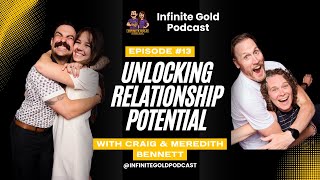
Relationship coaches Meredith and Craig share tools for couples to stay connected: micro-moments of fun like games and walking dates, daily check-ins with prompts, and a "challenge flag" technique to raise issues without blame. They emphasize the 200% marriage model where each partner takes full responsibility.
Chapters
Welcome back to another amazing episode of the Infinite Gold Podcast, Growth and Greatness. Woo! We've got Meredith and Craig, relationship coaches. I am so excited for today because—
me too.
I mean, we all think we have good relationships, and the best part about them is a lot of people think, oh, they're just gonna be talking about relationships with their husband or wife or boyfriend or girlfriend.
So much deeper than that.
So much deeper than that.
Bigger picture.
Yes.
Anybody— your friends, your family, your co-workers, your dogs. I mean, I mean, let's, let's be honest, it You don't really need coaching for that. They love us unconditionally. If anything, we need to love them more.
Yeah, because we don't deserve their love.
It's amazing. Um, but we got Meredith and Craig here. Welcome.
Thanks, we're super excited to be here.
Thank you. Yeah, so they've been relationship coaches for over 3 years, and this is just like professionally. They've been relationship coaches way longer than that. They've been together over 10 years, have a ton of information, a ton of insight. They've been in Authority Magazine, they've been in MSN, they've been on over 40 different podcasts. The best part is they have their own podcast, Road of Life. They had their 70th one uploaded yesterday. Don't worry, we will tag them in the description. You'll see it. You have to check them out. They've got a ton of good knowledge. So again, We're excited you guys are here and thank you. We appreciate it.
Yeah, it's an honor. We're pumped to be here.
Awesome. So let's start off. Relationship coaches. Let's just do it. So we're going to dive deep. Why do you think there's such this stigma of getting, let's just say, a relationship coach or going to a therapist or like, why do I need this? Like my relationship is— we're phenomenal. Nothing's wrong. Yeah.
I think there's a few things that work against us when it comes to putting up our hand and asking for help in any area of life, but especially in your relationships and especially in your primary relationship. I think the first thing is it's a little bit scary to put up your hand and ask for help in anything. I think especially in your relationship, it requires a level of vulnerability to say something's not working. I don't really know what it is. I know I need help, but I don't know where— I don't know where to go or how to start or any of those things. And I think that takes a lot of courage and vulnerability. And we don't learn how to do that in our life generally. Like, we don't learn in school how to have good relationships. We don't learn in school how to get vulnerable and ask for help. And so all of those things together make it a little bit hard. And I think there's also a little bit of shame that none of us know what goes on behind closed doors. And we live in this society now of Instagram and social media, and everyone else's relationship looks great, and my relationship looks great on Instagram. So like, I don't want anyone knowing that I I maybe need a little extra help. And we all need a little extra help in something always. And it's so the opposite of, uh, scary or shameful. It's like, it's so empowering and helpful if you can just kind of get over that initial little bit of courage that's required.
Yeah.
Oh my gosh. Well, I mean, I think a lot of people go to think or look that when they need help in a relationship, they think, oh, I need to go to a therapist. Okay, so question I wanted to ask you guys: how, how would you define, define your coaching versus going to a therapist?
So we focus on the solutions, and we're not so much worried about what's the, the past and digging in and figuring— there's a little bit of that you have to do to forgive and move forward, but we don't live there, we don't dwell there. We want to focus on solutions moving forward. Reframing stories that we tell ourselves so that they benefit us, so that we move forward and achieve the dreams that we want to have for ourselves. It's really, what are your dreams? And let's go attack those. And how do we attack those? We have to like shift stories and, and things that we tell ourselves that allow us to— to go ahead.
And I think we also have this a little bit of a stigma in our mind that when we go to couples counseling or marriage therapy or whatever, it's like this awkward, painful process. Like, first of all, we're probably gonna get in the car and drive in silence and get there and then sit there and it'd be awkward, and we're gonna say stuff, and we're gonna end up walking out of there more pissed off than we arrived, and it's gonna be more awkward drive home, and it's gonna fight. The whole thing just feels like, oh, cringe, ugly, awkward. And it doesn't have to be like that. Like, the whole process of strengthening— because I don't believe ever that anything is broken. I think your connection can always get stronger. And so if your connection— if you feel like you're, you know, got a little space and you want to get a little closer, if you feel like you need a little stronger connection, exactly. Like, we can do that, and the process can be one that you actually enjoy.
We can have fun.
We can have some fun with it. It's a heavy topic and it can be intimidating, but it doesn't have to be. You can actually enjoy the process of strengthening your relationship and have some fun along the way.
I love that. The fun part. We're all about the fun part, right? So how do you bring— okay, let's just say we're— we've been married a while. We now have 2 kids and they're both young. And maybe there are some days that this is just dragging on, like, oh, this is déjà vu. The kids aren't doing well. Uh, I'm working a ton. You're stressed. Like, how do we bring that fun back? Like, just randomly? Like, how am I supposed to be fun when I'm just so stressed and tired?
Oh, go ahead.
Jump in. You got something?
No, go ahead.
So I think it's the mundane. Like, if we're talking about—
yeah, it's the mundane.
You got to find fun in the— you got to put fun in the mundane. It's mundane. And it's like, I love that. When you're— when you are home— I know you work a lot, but when you are home, what can we do together? Like, let's, let's attack the dishes together and let's do karaoke while we're doing it. Or let's, you know, you know, I love that dance party. Or— yes, it's Finding the little things in the day-to-day that you can do. We have a game called Hide the Penis.
Hide the Cardboard Penis.
Oh yes.
Beep that out later.
That too. I remember that.
It's a body part, it's fine.
So it's basically just a cardboard thing that I made. Yeah, it looked kind of like a penis, so I made it look exactly like a penis. And we just hide that around the house for the other one to find. And there's actually two of them. And when one person finds it, they have to then go hide it and surprise the other person with it. And it's just a little game that, like, you— she'll come out of the bedroom wearing a pair of pants and I'll be like, ah, gotcha, I know, I know that I had that in there. So I know you found it, and now I know that it's, it's somewhere for me to find.
Yeah, that's awesome.
So just little things like that where you can just, you know, find fun in the mundane.
Yeah, because like literally 95+ percent of life is the mundane, like the the have-to-do things, the to-do list of your life. And we get so caught up in the busyness of life that fun tends to fall off the list. Like, I'm sure when you guys got together, you had a lot of fun. Oh yeah, I know that you guys still do, but a lot of people, the fun tends to fall away as life gets busy, as the kids, all the things pile on, and the fun just becomes less of a priority. But when we stop having fun with whatever it is, but especially in a relationship, we stop wanting to do the other stuff, like the harder stuff. When things aren't fun, we don't want to engage. And when you are having fun I'm willing to bet your communication feels strong, the connection feels strong.
Oh yeah.
You're willing to share, like everything else is working when you're having fun. And so trying to maximize the 95% because yeah, it's a little easier to have fun when you're on vacation and when you've got the dedicated time together, like, okay, we're gonna go do something fun together. Oh, it's important to set that time aside. That's really important. But 95% of your life is the, the random stuff you have to do to keep the family moving forward. And so. What are the things that you can do? And one other thing that we do is one of us will just sort of say something that reminds the other one of a song lyric. And the next thing you know, like the whole first chorus has come out and like now we're singing a song kind of karaoke style. Yeah, I don't know how it happened. Or we've got little inside jokes from TV shows like, you know how everyone says can confirm now.
And yes, that came from like a really like Canadian show we watched back in the day.
Canadian show. That's hilarious. And so little, like, little inside joke statements that we have, like, that those kinds of things just are little subtle connection builders. Because in the run of your day, you have a million opportunities to take a little micro step closer together or a micro step further apart. And the more micro steps together you can link, the closer you're going to feel.
And most of those, you're linked— you're gonna, you're gonna link them through fun.
Yeah, I love that.
That is good.
Yeah, well, you know what, life doesn't have to be boring.
Definitely not.
Sure, it doesn't have to. No, it shouldn't be boring. I think with more laughter and more fun, um, life's better, and you're living a longer life, a happier life, a joyful life for your kids, right?
Like, oh yes, you're teaching your kids. This is the— like, relationships are supposed to be fun. This is what I'm supposed to have when I grow up. Like, I think that's the coolest part of all of it.
It's, it's so true. I mean, like they talk about, and I even think about, it's like, I want my son to treat women the way that it should be. Well, who's he going to emulate? He's going to emulate me. So I have to do my part of loving his mother, taking care of his mother, so that way he knows that's how he needs to treat. And then on vice versa, my daughter— I want my daughter marrying someone who emulates and loves and does everything for her. If I'm not doing that for her mom, then she's not going to find a man who's doing that because she doesn't know.
And the vice versa, again, your son is going to learn how he's supposed to be treated by how he sees his mom treat you.
Yeah, that's— ooh, that is good.
And your daughter the same, right?
Yeah, that's awesome. I love how you mentioned the fun and like the karaoke because we have a record player in our other room and like we go through waves of playing it, but every single time we play it now that I just looking back like the entire house is having fun. Like, we're all laughing. Like, our son and our daughter— like, our daughter, I love it, and I'm gonna see if I can get it on and do it. She dances like her dad, and she just does the—
like, this is her hips.
These are her dance moves. All hips. There's, there's no— what— I don't know what I do with my hands. But, uh, my, my son, same thing. They love dancing. And like, when we play it, like, it's, it's definitely brings the laughter and fun. And Obviously we're always doing dishes and doing stuff. Yeah, maybe we just need to throw the record player on. And the only part that sucks about it is, you know, you get 4 songs and you got to walk over there and you got to flip it over. It's like they probably have it, but they need to have one where it just like auto flips for you and does all the work. It'd be so nice.
Wide one, because like if you think about how big vinyl is and it's got to do the whole thing.
Maybe, maybe we'll invent it. Maybe that's something we need to do. We're bringing records back.
That's so fun.
Yeah.
Oh my gosh.
Yeah, more music. The more you can put your body into it, the physiological change, it just makes everything higher energy. Yeah. You feel better.
Yeah.
Yeah.
I even do that with the kids. Like when they're having a meltdown, I'll turn some music on. Sometimes it works, 'cause Jackson will be like, no mom, stop singing, stop dancing. And I'm like, I'm trying to boost your mood. It's okay, let's have some fun.
Do they like, like, is— are you playing songs like kids' songs or, or like top 40 songs that they just groove to?
Uh, so like if we have, I don't know, say Mickey Mouse Clubhouse on or Paw Patrol, where I'm singing, you know, whatever the theme song is or whatever song is playing, and he's just like not having it, I'm like, okay, you do you. So then I, I either keep going, then I realize he's not getting any happier, his state's not changing, his mood's not changing, and then I eventually just like, okay, well, I'm done listening to you scream at me. Or trying to help change your mood. I'm gonna stop now and I'm gonna go about my day. You let me know when you're ready and we'll come back. We'll circle back.
Toddler moments.
When you're ready.
Yeah, yeah.
So when you mentioned fun, what would be like another tactic or tool you would recommend, um, to couples who are trying to engage more and, um, not necessarily be dis— like, they're not necessarily like distanced, but they're not as close as they, they used to be because of like you said, everything else with life.
Like, just reconnect, you mean?
Like, yeah, I think first dedicate a little bit of time. It doesn't have to be a lot of time. Like, I think when we think of a date night, or we need a weekend away, or we need the whole evening, we need hours and hours and hours of time, and you don't. It's really quality over quantity. You only need a little bit of time. If you can find 20 minutes in your day to have a cup of coffee in the morning, or to have some dedicated time— there you go— some dedicated time before bed after the kids are asleep, like some, or in the middle of your— whenever you can find, you know, 20, 30 minutes in your day. It— the key to using that time is questions, leading with curiosity. And we've got a couple of different ways of doing that. And the first one is the, is the easiest one. I like to use it either at night or in the morning. We usually use it at night. It's a check-in question. It's not a, how was your day? Because like, how was your day is so generic, you'll get like a fine, whatever.
Exhausting.
Yeah, it doesn't precipitate any real conversation. But if you ask something really specific, like, what was your favorite part of the day today? Or what's the— what did you learn today? What was your favorite thing you learned today? Or what was the hardest thing you had to deal with? Something like really specific that prompts the other person to have to give it an actual second thought, to give you a thoughtful answer. Generally, one, makes the person that you're asking the question— makes your person feel really like seen, heard, valued, because you actually are asking a question that makes them have to think, that you actually care about the response because you do. And two, makes them feel like you actually want to be engaged in their day, like you actually care how it went and you want to somehow be a part of it. So that one specific check-in question is super duper helpful. Um, the other thing I think is helpful is just having some, like, when you're having your date night or your date time— we don't— I don't like calling it a date night because it could literally be any time of day, it really doesn't matter. It's helpful to sometimes do it walking because I think being outside, the fresh air, um, it just kind of gets you in a better mood. Like, nature always puts you in a little bit better mood. And if you want to talk about stuff, it's sometimes just easier to talk when you're both looking forward and walking than when you're like eyeball to eyeball, like, like staring at each other. Sometimes that can be more difficult for having deeper conversations.
A little nerve-wracking.
Yeah, exactly.
It's, it's really about consistency. Like, it's like anything. Like, you guys are really into fitness and nutrition and stuff, and it's consistency, right? Like It's not, it's not like I'm going to eat really healthy and I'm going to work out really hard for one week and then I'm going to go off my diet and I'm going to relax and I'm going to have that healthy fit body. It just doesn't work that way. And it's the same with your relationship. It's the consistency of, of showing up a little bit every day and just connecting a little bit every day and getting curious and asking questions and just making your person feel seen and heard and valued, like, like you actually care what happened in their day.
I love that.
Yeah, no, that's so good. And I think there's going to be a lot of listeners that'll be like, wow, I never thought to go that deep, and that really it's just little things that you kind of start fine-tuning, and it all is going to add up to improve your relationship, whatever that is.
It really is the little things. Like, it always— I don't know, I feel like rom-coms in society have sort of conditioned us like the big romantic gesture is how everyone feels loved.
The Hallmark movies, you know, it's not all sunshine, rainbows, and butterflies, y'all.
Really, it's a little like Post-it note that says like, you know, I miss you, or it's the little like touch on the arm on the way by, or it's the buying his favorite snack from the grocery store.
It's definitely the booty grab. I'm just, just saying. Yeah, it's, it's, it's a must. It's a must.
When you walk by, give it a squeeze.
You have to do that with people all the time. Yeah, it's, it, it's not there just to look at it. You have to. It's a must. I'm just, I'm just, I'm just saying, like, and it brings laughter. Like you said, it brings fun. It brings, it brings it all together.
Thanks, guys. He'll usually walk by and squeeze one side. I'm like, don't let the left side— don't leave the left side out.
She says that all the time. She's like, uh, you're gonna— that side's gonna feel left out, okay? You just can't do it. That is so— that is so good. I love that. It's, it's all about the consistent, consistent daily actions. It's doing, doing the work. Like, unfortunately, and I feel like at times people put their business or they put their work or they put friends above the family. And unfortunately, as you guys know, you start doing that, you're going down a bad rabbit hole. Now that I mentioned that, how do we change that? Obviously you kind of mentioned the consistent daily actions, but how do I change my mindset? Like, let's just say we, we know I'm a Buffalo Buffalo, right? Um, how do I, let's say, I'm just in straight up work mode. Like I'm starting this business. Um, a lot of, uh, aspiring entrepreneurs, they know that they gotta put in those hours.
Mm-hmm.
How do, how do I, how do I do both? Like how, how, how do I be that aspiring entrepreneur? But I gotta, and your relationship, I still, I still gotta maintain my relationship at home, right? Mm-hmm.
Yeah. 100%. It, it's really like understanding what your priorities are and you have to schedule it. Like. For us, it's, it really is in our calendar that we have dedicated time, us time, non-negotiable, that when that time comes up in the calendar, it's like, close the laptop. Oh, that's so good. We're going and doing the thing.
And like, we do spend most of our day like arm's length apart from each other, but it's different.
Yeah, we're building a business together, we're working, but it's, that's not, a lot of times that's, that's like, to your point, that's focused business. It's not connection time.
Yeah.
So we have to have focused connection time, and that's— it's even probably more important for folks who don't work shoulder to shoulder together all the time, right? Because we do get those little moments during the day where we can, you know, as we're walking by, or we can give a squeeze or whatever, where sometimes a lot of couples, they don't have that luxury. But again, it's really your— what you focus on is what you get. And so if you're not focusing on your relationship, you're not going to have the relationship you want.
And my favorite little tip is like, you're never gonna find the time ever. You'll never find it. You have to make it. You have to create the time that's important to you to follow through on your priorities. And so it's easy for us to say as human beings, I don't have time. When someone asks you for something, I don't have time is a very socially acceptable response. But if you can twist those words and change them to be, that's not a priority for me, That hits a little different.
Yeah, it does.
If Jackson says, hey Dad, I know it's probably not super articulate, hey Dad, can we go play and do this, that, and the other thing? And you say, ah, Jackson, I don't have time right now. If you say, hey, actually, you're not a priority right now, it like, it just brings—
yeah, it's different.
And it's like, the reason it hurts so much is because it's really calling out the discrepancy between what you say your priority is and what your behavior is.
Because if you ask most people, what is your priority? Is it your business or is it your family? Most people will tell you, definitely my family.
Correct.
Yeah. But then when you look at their actions and you look at their calendar, that's different.
It's not necessarily gonna reflect that. Mm-hmm.
Yeah.
It's gonna reflect the business and the health, like going to the gym and all that stuff.
Yeah.
Which is, it's all health, it's all important. But if you really say your, your family and, and your, your spouse is important, then that has to be a priority. It has to go in the calendar.
Yep.
That's so good. And I love how you mentioned earlier where it's like, it— because there's this bad stigma and it's Instagram. It's like, oh, we have to go on this fancy date night and we have to go on this date night once a week, and if you don't, then your relationship's gonna be horrible. But you guys just laid it out, like 5 minutes here and there throughout the day, or first thing in the morning before someone leaves for work, or first thing when you get home. That's the one thing that we— I've been trying to focus on, and I used to be horrible at it, is when I get home, I used to like go see the kids, or I used to go do something else, or I used to just go sit down. But actually taking that time and that effort to go see Bree, go give her a hug, go give her a kiss, give her that butt grab the second I walk in the door, it changes the whole mood of everything.
Because she feels like your priority.
Yes, exactly.
So you went and saw her immediately. Yeah, she knows, like, okay, nothing else matters because as soon as he came in the house, he came to me.
Yeah.
He didn't go to do anything else. He came to me. I'm number one.
Yeah.
And I think especially like that's a big disconnect. That's where we see a huge disconnect is not feeling seen, heard, valued, prioritized in a relationship on both sides. And it, it like, to your point, it's so easy to get home. You're tired. Like, let me just sit down for a minute. Like, or even just go to the bathroom for 5 minutes and have 5 minutes of quiet time before I, you know, see the kids and all that stuff.
5 minutes, 20 minutes, depending on how long, whatever your situation is.
Like your person— like, Bri needs to feel like she's your priority above the kids. And I think that's like a difficult concept a lot of times because— but you called it out right at the beginning, right? Like, you're teaching the kids, your kids, the relationship you want them to have, and you want them to be the priority of their partner always. Because hopefully you raise amazing kids who go out into the world and have amazing relationships, and you and Bri still have this amazing relationship. But if you get complacent in it and you put it on the back burner for the business, for your friends, for your kids, for everything, and you expect that relationship's always going to be there, it's not. Like, your relationship is like a flower in a garden. If you don't give it what it needs, it is not going to survive. Even though you think it's an amazing flower, if it gets no water and sunlight, it's just— it's not going to live. And so we sometimes just expect that our relationship's pretty cool, like it's all like It's there. It'll be there when I'm ready to pick it up later. It's there.
It's there.
And I can pick it up when I'm ready.
But it's— we're focused on other things right now. So in 5 years, when I get this figured out, we'll come back to this and it'll be very different.
It doesn't work like that.
It doesn't work that way. It's— you actually kind of hinted at it. It's the little moments. It's quality over quantity. It's not like the big 4-hour sessions. It doesn't have to be that. It's the little, like, the moments where you come in the house and you kiss Bree first thing before you go and do whatever else you're doing. Those little moments, those are the quality moments that make a difference.
Yeah.
I don't think it has to cost anything to have a good date. Like, I don't think, like, we've been playing a lot of Yahtzee at this Airbnb because that's a game they have and it's just been, we've been having fun doing that some evenings. And so it's just, it's something a little different or we'll play cards or we'll go for a walk. Like it doesn't have to be fancy, expensive, time-consuming. It's, it's literally about building the connection. That's it.
Have fun and build a connection.
Yeah, I love that. I had another question I was thinking about for you guys, and this is not something I even addressed with you before, but, um, how— so when your partner brings a, say, like maybe a heavy discussion to you that they want to talk about, but you're not in the headspace, you're not ready for that, how do you handle communicating with them that, hey, you know what, right now is not the time? But they're like really, really like, I know I need to talk to you about this now. Or maybe it's Uh, maybe it's business related and you're like, you know what, we've talked enough business. I want to talk about anything else besides that. Um, and not just be business partners, but be husband and wife.
Yeah. It's important, right? To have those, those boundaries. And, and if, if there's something, I think it's, it's really approaching it in a way that still allows them to feel seen, heard, and valued, and that you're not dismissing it outright. It's something that's important to you. You still want to have that conversation. I'm just not in the headspace right now to be able to adequately hear what you're saying and to serve you in the way that you need to be served right now. I can't. I don't have the bandwidth right now. Just move.
That's good.
Kids or whatever's been going on today. But can we do this tomorrow morning? And setting a specific time where you can go come back to it and where you're both, you know, adequately rested, hydrated, feeling good. And ready to really conquer something and set aside that time, specific time, is probably the biggest, biggest one.
I think it's like almost like a 3-step process. One, validate that, like, yeah, it's important. I'm hearing you. It's important to me too. And I want to be able to show up with my best self. To do that, I need to go pee and have 15 minutes without anyone touching me or talking to me or whatever the kids have, you know, whatever it is that you need, or I need a good sleep or I need a whatever. So book the time and then actually follow through and have the conversation. Because if you book the time or you take the pause and say like, yeah, we're going to circle back with this, but you don't circle back, then it starts to break trust. And so it's important to validate, book the time, and follow through and actually have that conversation. And I think it's helpful that if you're the one who said like, hey, time out, I need, I need some time before I can engage in this conversation. Then it's a good idea for you to bring it up at the sort of scheduled time so that it feels like it's still important to you. Let's dig into this together. I'm ready.
Okay.
I love that because we've, we've, we're getting better at it, but we've had our issue, I think, or mine has always been the, the schedule part. So I love how you mentioned that because like we always will talk about, hey, just like maybe right now is not the best time, but we don't actually say, well, then when is the best time? And that could be frustrating for that other person. Where it's like, okay, well, when, when is it going to be a good time?
Like, like that's that next step that we were missing.
Yes. 100%.
I didn't think about that till you mentioned that right now.
So that's actually scheduling it and following through.
Yeah.
Yeah. I think it's really critical for that person to, because the loop remains open and it becomes a frustration that it's like, oh, it comes up again. And the next time it's maybe a little bit more frustrating than last time because, you know, well, last time I already brought it up and it didn't resolve it. And so I'll bring it up again. It probably won't get resolved.
It starts to—
a little bit of resentment, and stories start to come up in your brain, right? Like, you start to— you start to tell yourself stories that maybe aren't necessarily reality for the other person.
Yeah, right.
Yeah, Bree doesn't actually— she says she cares, but she doesn't actually care about having this conversation, or she would have. And it's like, well, that's not necessarily true. She probably has a million things on the go and it fell off the to-do list because we didn't schedule it. But you can see how easy the stories start to, to percolate in, in the brain. And I think the other thing you touched on that was so good is especially because we talked about how when you work together and you're building businesses together, you get a little benefit, right? Like, you get a little bum squeeze in the day, you get the opportunity for a little bit extra connection that other people, other couples don't get. But you also get the bleed-over effect where, like, work can consume— like, it's— you're always together, you're always doing it, like, it's always around. And you do need to— when you're wearing a lot of hats, like, now we're business partners But later today, we're going to be husband and wife again, and we're going to have a conversation that's going to be not work-related where we can reconnect. And just being aware of making sure you're creating that buffer, like that space to be able to take the business partner hat off and go back to being just each other's person again. And we can talk about anything besides work.
Yeah, no, I like that. Thank you for sharing.
Yeah, perfect. Obviously, we're both part of the same exact certification program. And one thing that, um, the amazing Greg Kimball mentioned is collaboration. Um, I thought that was huge because a lot of like, how are we going to speak to each other? Like, what are we going into right now? I think has been kind of sometimes for us is like, okay, like, what are, what is our conversation going to be about? But if you actually can almost put a label to it. It makes it way better because of what you guys said. I'm not gonna start creating stories that she's trying to shut me down, or I'm— my buffalo side trying to shut her down all the time. If I just come in and say, hey, let's just collaborate on things, let's just do that. What is the best tool that you guys have let, um, couples know? Like, hey, I'm not trying to shut you down right now, I'm just trying to like collaborate and have a good conversation on some type of topic.
I think one of the— one of Well, two tools actually. One, the first one is something that we like to call the challenge flag. And I know you guys are Packers fans, so you know all about the challenge flag in the NFL. Like, yep, timeout, let's review the call we made on the field. And so we will use that. Like, we used that after we left our corporate jobs and started a real estate business that we absolutely hated, was making us miserable. We threw the challenge flag to kind of have that conversation and realize that we were both miserable and this was a mistake and what are we going to do about it? And so I like the challenge flag, and sometimes we will literally use like a dish towel or something like, okay, we need to have a conversation, like make it a little light. Like, yeah, I need to have— we need to have a conversation. I got something that I need to, to get off my chest or something. I want to, I want to challenge a situation, a decision, an action we've taken. The rule is you never— you're never challenging the person. You're challenging a decision that we've made together or an action that we've taken or not taken. So I like the challenge flag just as a Once that dish towel hits the ground, then you know something's going to be discussed.
The important thing about the challenge flag though is to have those kind of rules set up ahead of time to understand that when we have this conversation, we are challenging a decision that we've made together. There is no blame, there is no finger-pointing, there is no challenging you as a person or me as a person. It's just, let's just factually talk about this decision and how it's impacting us and how I'm feeling, how you're feeling, and then let's come to a solution. Let's figure out how we're going to move forward.
Yeah, and the, the critical piece of that is the second tool, and it's benefit of the doubt. Like Caleb says, like, assume positive intent. We like to call it give the benefit of the doubt. And yeah, this, this was not something I was inherently good at. This is something I've had to learn. So, good story. We're just walking through the park one day, having a nice little stroll like we like to do. It's one of our, like, ways that we reconnect. And I had just finished a girls' night or a girls' weekend or something. And he said, what did you do on your girls' night? You guys just chit-chat? And he felt my energy immediately shift because I—
when he said chit-chat, it very visibly changed from like, kind of like, what did you just say to me? Very interesting.
Yeah.
So, so I, I just asked her, I was like, so I'm, I'm just— I'm, I'm sensing a little something. Something is off right now. And it happened instantly. So like, talk to me, what's going going on. And she said that she felt that I was almost, uh, dismissive of her, you know, friendly chats or her discussions with her mates. I don't know how she wanted me to say the things that she was talking about with her friend. She thought I was being dismissive of it by calling it a chit-chat. But then I asked her, I was like, but, but like, every time you come home, what do you say you do with your girlfriends?
Oh, what do we do? We just chit-chatted. Literally is what I say every time. I, I didn't know. I, I was so unaware that that was my word. I get home, he's like, what'd you guys get up to? And because I see my girlfriend so infrequently, right, because everyone has kids, and like, so when we finally get together, like, we had a girls weekend the first week in school came back, and we did not leave our Airbnb for 2 days. We just sat there and talked to each other because it had been so long. I literally only say, what did we do? We chit-chatted. But when I heard him say it I had this like a trigger, like it triggered me that like, oh, he's like talking down to me. He's dismissing me. Like it felt very dismissive. And he immediately, because he immediately sensed it and called it out with curiosity, like it wasn't like a, hey, what the heck is your problem? It was like, I sense something has shifted. Walk me through it. Help me explain. And so when I did, he's like, what if, what if?
Ooh, I like that. The what if.
You just gave me the benefit of anyone in the entire world. Why wouldn't you give me the benefit of the doubt that I would never dismiss, talk down? What? I'm the one person on the planet that you gave the benefit of the doubt to because I'm never intending—
like, if you're not going to give the benefit of the doubt to the one person you've chosen to go through life with, who, who are you willing to give the benefit of the doubt to?
Nobody.
I was like, right, that's it, that hurt. Like, yeah, that makes a lot of sense to me. If not you, then who? Like, literally no one on the planet. So I know that he's never intending to make me feel bad, so why would I let myself tell myself the story that he's making me feel bad? Like, logically, I know he's not intending that, so why wouldn't I give him the benefit of the doubt? And in that situation now be the one to lead with curiosity and say like, what do you mean by chit-chat? He's like, oh, just the word you always say. Oh shit, yeah, I do always say that. Like, yeah, so easily de-escalate a situation with a curious question. We always get ourselves in trouble with assumptions and judgments. Curious questions are always our way out.
I love that, curious questions. Um, so I had a question and It pertained to the stressful questions. How do we bring those up? So let's just say there's been something like you, you guys mentioned it earlier. You got to get things off your chest because if you don't, it's going to spiral out of control. But let's just say there's a couple and they have these stressful conversations and it always goes haywire. How do, how does somebody try to bring something up? If they don't want that to happen? And I love that you just mentioned curiosity, so I'm guessing that's going to be leading into it. But what are some tools that you recommend to, um, some couples that maybe, um, they've been having too many stressful conversations or nothing's getting done?
Yeah, I love this question because I think resolving conflicts in your relationship is like the secret sauce to staying connected. I think, I think disagreeing— two people, two humans, no matter how in sync and connected you are, are gonna disagree on stuff. And if you don't, that's a huge red flag. We've got a whole other problem. Like, we've got a whole problem around fitting in and not being yourself and then not being loved. Like, we got a whole other problem if you don't ever disagree. You're gonna disagree on things. They don't all have to escalate into big fights. You can disagree productively, and that can make you closer together instead of bringing you further apart. And so there's just some, some strategies to do that. We actually have a, like, a guide that I can send you the link for. You can put it in the show notes to help people if they want it, if they want to access it.
We definitely will.
It's just like there's a couple of phases to it, but basically the first one is like, let's have a conversation. And it's the same thing, same situation we talked about before. We have something we want to talk about with each other. Let's book a time that works. So we want to make sure right off the bat we're starting this conversation with both of our best foot forward. Like, hey, I want to throw the challenge flag and have a conversation about something, so let's maybe do that tonight after the kids go to bed, or we'll get up early tomorrow morning and do it. Like book a time in the next day or two to get that conversation scheduled when you can both be your best self and be ready to receive whatever's happening.
And then real quick, not to interrupt you, but like the first thing that popped into my mind is, does that create stressors? Like all of a sudden I'm like, oh, for the next like 8 hours or until tomorrow morning, I'm like, oh, like you're running through your mind. Like, what did I do? What happened? What are we going to talk about? Like, what are you— now we're creating the stories. So How do we, how do you balance that?
So I think it's, it's really about making sure that, look, it's not a big deal. It's just, there's something on my mind. We just gotta, we just gotta address something or, or just say it's about, you know, something happened today. It's not a big deal, but I, I know that you're stressed out right now. You've got, you had a big day. I just, let's schedule some time tomorrow to follow through and resolve it. It doesn't have to be like, Hey, I got something big we got to talk about tomorrow. Good luck having a nap tonight. Yeah, right?
Because that's exactly what's gonna happen. People are just gonna be laying in bed just staring at the wall like, yeah, oh, what have I done the last 8 years of my life? Like, you're just running through every single scenario through your mind.
Totally. But I think how you start that conversation when you have it helps alleviate that for the next time, because the first time it happens, you're probably gonna try and talk yourself out of these stories. But once you get into the cycle of these conversations and you realize that they get brought up in a way that's not confrontational— so like the conversation never uses words like always and never, like, like literally like the two worst words you can use in a conversation with your spouse are always and never because they're just not true and they make you feel attacked. So always and never, leave them out of your vocabulary.
It's really about building trust, right? Like the first time you do this, it's probably going to be more of an issue where you're telling yourself the stories of like, oh my God, what did I do over last 8 years that I'm going to get scolded for tomorrow morning. But as you go through this and you start to build a bit of a resume, or if, for lack of a better term, like a history, a track record of having these conversations, giving the benefit of the doubt, leading with curiosity, then it doesn't become as big of an issue anymore. You start to like, okay, I know what's coming. It's going to be awkward or weird, but it's not going to be catastrophic. It's going to be something we have to address. It's about building a track record and building trust and make trust deposits by every time you have one of these conversations by, again, leading with curiosity. You want to say something?
I love that. Yeah.
So, always and never get like completely ditched. We never use those and use like the I perspective. Like, this is how I'm feeling. This is how it's impacting me. Like, it's not a you-directed conversation. It's a me-directed conversation. It's about how things are working or not working for you in your life with your feelings and your whatever, as opposed to it's you, you never do this, you always do this. Like, so just reframing the conversation to start it that way. And then some of the really important rules are like literally never name call, like ever, ever. Like, like, yeah, never, never, never, ever, ever, ever, ever. Is there a good reason to call your spouse a name unless like, you know, hey baby is a good one? But like, like there's never a good reason. There's never There's never— it will never help any situation to call your spouse a name, or anyone else for that matter. Um, raising your voice never works. You're only raising your voice because you're feeling not heard. So the best way to combat that is let the other person speak until they're finished, and then you can speak in a normal voice. But like, never raise your voice, never name-call. Um, what was the other one? There's a third one. Go ahead, it'll come to you.
It's really just about the golden rule, and it's about respect, right?
Yeah.
You cannot have a good relationship without the foundation of respect. And once you start to lose respect, you start to lose— the foundation crumbles. So it's, it's, it, it's— sometimes we overcomplicate it, and it's as simple as what you were taught in kindergarten: treat that person like you would want to be treated. Are you being the person you want to be married to?
That's a good one right there. Wow.
Yeah, that is a good one. I've never— I haven't heard that one before.
Yeah, it's simple as, are— am I, am I showing up as the person that I want to be married to? And if the answer is no, then you have to change something.
And it starts with you. Yeah, 100%. That's so good.
Like, yeah, go ahead.
No, go ahead.
It really is. Like, it starts with you. Like, you hit the nail on the head. It's—
it—
every client that we talk with, it's— we, we have to get the relationship with you, your own, yourself. That relationship has to be dialed in because the love and respect that you have for yourself is going to be what you're— you have available to everyone else. So if you don't love and respect yourself, it's going to be very hard for you to fully love and respect and give that love and that respect that that other person needs. So it really starts with you.
That's really good.
Sorry, no, I'm just— I'm processing it all, and that's, that's a lot of really good information, and I appreciate that because now that gives us something to think about.
Oh yeah. How about— this is one thing I've obviously been a lot better at, but how How does someone work through those little new— so nobody's perfect, obviously. No relationship is perfect, obviously. So how do you— how does somebody who is like, let's just say they're upset with the clothes being left on the floor or the trash being left somewhere or the toys being left, just this and that, like, how do you get past that knowing that that's not the end of the world and you should not really hold that true? Like, how do you get past that point?
Like hypothetically speaking, obviously.
Well, uh, yeah, no, I mean, I've been, I've been one for like, it's, it's like the little things will annoy me and then I'm like, now I'm a lot better. So this, this, this is definitely more of a question like for our viewers and what have you, but I've been in that state. Like for example, there's been a dirty diaper left or there's been something that's in the way. It's like, but then it's thinking back on it. It's like. Like, this, it's really not that big of a deal. Like, why don't I just grab it and just put it right here? Like, it's not bad. So how does somebody else get past that? Or how do I even get better than what I'm doing right now and change my mental state on that?
Yeah, a couple things. One is ask yourself, what are you making it mean? It would be one. Like, yeah. And two is like, we— there's a, there's a foundation within our philosophy of it's you have a 200% marriage. Like, you don't— marriage is not 50/50. We grew up believing that marriage is 50/50, and 50/50 leaves room for like, well, whose responsibility is this? I said sorry last time this dirty diaper was here. I picked it up last time. This is their responsibility this time. And then, and then it leads to scorekeeping and resentment and defensiveness. Yeah. Defensiveness. And but what if, what if everyone, both parties, just said, you know what, I take 100% responsibility for everything in our marriage, and she takes 100% responsibility for everything in our marriage. And so when I see a dirty diaper, I just pick it up. And if she sees a dirty diaper, she just picks it up. So if I happen to be the person, if it's like— and when you lead with that and you understand that you're giving the benefit of the doubt, that dirty diaper might be there because something happened and she had to go and run off and do something. Yep. Knowing she doesn't want a dirty diaper on the living room floor either, but it's there, so something must have happened. So I'm just going to pick it up and I'm going to throw it away. And when we change our mindset, so if we both go the final percent, yes, 100% responsibility each, we have a 200% marriage instead of a 50/50 marriage.
It's easier to wrap your brain around that when it comes to dirty diapers and taking out the trash. It gets harder when we're talking about like, yeah, but he never apologizes when we have an argument, and I am always the one to apologize. And if, if I apologize again, then he gets away with not apologizing to me. And it's like, yeah, but do you have something to apologize for? Because whether he has to apologize or not is completely separate from whether you have something to apologize for or not. And if you're taking 100% responsibility, then you apologize for your stuff regardless. And you lead by example. And one person can completely change the dynamic of a relationship. It doesn't happen instantly, but when one person starts taking 100% responsibility for their marriage, the other person will eventually feel that shift and will come along. And so you, you do every— you take accountability for your stuff, and your, your other person will eventually figure that out. And when you both take 100% responsibility, like, oh, It's a game changer for your marriage.
Yeah, for sure. Scorekeeping goes out the window. Scorekeeping's toxic. You don't want— yeah, and no, that goes out the window because it doesn't matter who picked up the dirty diaper last because I see it now and I'm gonna deal with it.
I love that.
No, that's good. Um, so basically you just take— learning to take responsibility for yourself. You're like, okay, I know I did my due diligence. It's up to the other person to do the same.
Yeah, and you can always find the 'what's my responsibility in this?' Like, um, something like, you know, Anthony never shares his feelings with me. I feel like he's always a little closed off. I don't know, I'm sure he's not, but it's like, it's not Anthony's fault. It's not Anthony's responsibility to share his feelings with me. It's my responsibility to create the space where he feels safe enough to share his feelings with me. Like, that's a 200% marriage mindset. And it's a tough— it can be a tough click for that because it feels like, why aren't you telling— why aren't you sharing your feelings with me? Like, why aren't you telling me all the things that are going on inside of you? When I say that to you, you don't want to say them to me. So finding your responsibility in all of the things isn't always easy. But you can always find it. And then when you do that, that defensiveness goes away because it's—
you're—
those conversations where you're like, oh God, what are we going to talk about tomorrow? You know it's not going to be an attack because the other person's leading with responsibility. They're taking full responsibility. So you never feel like I have to defend myself because Bree's coming out saying like, you know what, I haven't probably shown up as well as I could have to create the space for you to share with me. So let's have a conversation around What I can do better so that you feel comfortable sharing your feelings with me feels a whole lot different than why the heck don't you ever come home and tell me about your day? I don't know what's going on, right?
Yeah.
Yeah.
That's, that's good. I like that. So as we come to a close, uh, there's been so much good information and honestly we didn't even touch on the friendships and relationships and all that. So we're definitely gonna have to bring you guys back on so that way we can get some more information about that. Um, but. After everything that we've gone over, what are the 3 golden nuggets that you would like our viewers and listeners to know when it comes to relationships?
3 golden nuggets. I think one is it starts with a relationship with yourself. You can only receive love from everyone else, from other people, to the degree you love yourself. So you have to love yourself first, no matter what. That's the most important piece.
Number 2, y'all need more fun in your life. Yes, starts with fun. Like, just integrate fun as much as possible. Like, it's, it's all about fun. We have such a short period of time on this planet. Yes, that it's, it's really crazy when you think about how little time we actually really have. You just have to, like, grab it, grab it by the horns and just live every moment to the fullest. Have fun.
And then number 3, you don't have to do it alone.
Oh, you don't have to do it alone.
That's really good.
There are people out there, there's communities out there that want to help you, AKA you guys. Yeah, we are a great community of people that just want to see other people win, kick ass and take names. And yeah, like, those, those communities exist. And so just find the one that resonates for you and don't do it alone because like life is, it can be a lonely road and a hard road. So why make it harder for yourself when other people have done the things you want to do? Other people know the, you know, have the relationship that you want or built the business that you want or have the health that you want. Just lean in and ask for help. It's a little bit scary, but like we talked about at the beginning, everything you want is on the other side of scary, hard, and uncomfortable. So just put up your hand. Ask for help.
That's really good. Yeah, since you mentioned it, if you can touch real quick on it, I mentioned your guys's website, but how about this mastermind that you guys have recently launched and how can people get some more information? Obviously we're gonna have it in the description and we're gonna talk about, but can you guys give us, uh, let's go, let's go another 3 golden nuggets about your guys's, uh, new mastermind and what that community and how somebody, uh, should even think about doing and joining something like that.
Yeah, it's called the Infinite Relationship Mastermind. And the purpose of that mastermind is we're transforming your relationship with relationships. Of course, your marriage, your primary, is an important relationship, but so is your relationship with yourself, which is in fact where we started. Relationship with your spouse, with your business partners, with your friends, your family, with stress, with your health, with fun, with your future. Like, there's a lot of really important relationships in your life. And when you can level up your relationships, That's the cheat code to leveling up your whole life. Yes. And so that, that's the purpose of the Infinite Relationship Mastermind, to level up all of your relationships so that you can achieve your dream, level up your whole life and achieve your dreams. And we are— do I want to get into the details of how do we do that?
We can just say like we meet quite frequently, we meet weekly. There's like a Friday connection call where it's like we hop on and we just— people, our Mastermind members come on and they can just We start with celebrations and wins. What's going well so we can just cheer you on and celebrate, keep you in momentum. And then it's, it's a roundtable of an opportunity to raise your hand if you're struggling with something, with, you know, something in your relationship with your spouse or, or you're struggling with something, you know, a story you're telling yourself that you can't— you're in a rut and you can't get out of. And we mastermind solutions to help you move forward and help you reframe that story that you're telling yourself that's keeping you stuck and getting you out of that rut and moving forward. And so that's the Friday call. And then on the first and third Tuesdays, we are recording live courses with the mastermind members. And so the— and so there's 6— they're going to be 6 modules each. And the first course we're doing right now is the relationship with yourself. So we just, we just did this, this past month, we just did the first 2. So the first 2 modules are recorded and live for Mastermind members to go in and access, access, you know, it's forever.
It's cool doing the courses live because then everyone gets their questions answered. Yeah, it's great to have the courses, the courses available for future members to come and access forever. That's awesome. But it's really fun to do it live too, so you can get your specific questions answered and work through it in real time on the, on the calls. And Yeah. And then we do a quarterly one-on-one with the members.
Yeah.
So if there's anything kind of really vulnerable that they didn't want to share on the call, we could kind of work through that separately.
Yeah.
Yeah. It's been, it's been, it's a lot of fun. It's been, we've got a really fantastic group. We're very proud of the space that we've created. We've got a, we've got a really great group of people who feel really safe and have been really vulnerable. And we've made some really great progress and growth.
And like, it's been, oh, it's phenomenal to see actually. And it's the reason why we do what we do when we see someone like like something click for someone and it just changed for them completely. Like, I didn't, I didn't realize that, I didn't know that that's what I was doing. And they see a path forward for themselves out of this thing that has caused them so much, like, angst in their life.
It's—
there's nothing better than seeing that click for someone. That's really cool.
How rewarding. Oh my gosh, amazing.
Yeah, it's fun.
I'm excited for you guys. Congrats.
Thank And we're excited for yours.
Yeah.
Yes. Thank you. Thank you. Yes. First, um, first Friday of March, March 7th. So, so thanks.
Two weeks from today.
Yes.
Yeah. To help, like, definitely we'll reach out to you guys.
We'll, we'll be Zooming in, uh, everybody else who's not able to make it locally.
Yeah.
That way you guys are able to join us as well. So that'll be fun.
It'll be good. Well, So thanks again, Meredith and Craig. We appreciate you guys coming on. Uh, definitely take a look at them. They have their Instagram, Meredith and Craig, and they have their own podcast. Last episode was as of yesterday, 70th one. And then take a look at their mastermind. All of those are going to be in the description, all the links. Take a look at them. If you have any questions, concerns about relationships, life in general, you need to reach out to them.
They are the golden nuggets.
They are relationship.
Love it.
So thanks again for listening, and we'll catch you guys on the next one.
Later!










