If You Think You Have a Do Not Resuscitate (DNR), You Probably Don't | Bad Medicine Podcast Ep. 1
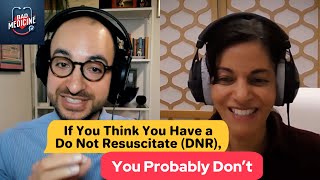
A podcast conversation (hosts Dr. Nicholas Cannello and Anu Simh) explaining advanced care planning, differences between advance directives and DNR/POLST forms, common misconceptions, and practical steps patients should take (e.g., scanning documents into medical charts). The episode emphasizes initiating conversations starting around age 65 and practical tips for ensuring documentation is accessible in emergencies.
Questions this video answers
Starting age 65 (addressed once a year).
POLST form (spelled P-O-L-S-T), described as a pink form commonly placed on the fridge for EMS to find.
Either two witnesses (who observe signature and date, and cannot be the chosen surrogate) or signing in front of a notary.
No — the host states they cannot be the designated surrogate (it's illegal for the treating clinician to be the surrogate).
Chapters
Welcome to Bad Medicine Healing Medicine One episode at a time.
I'm Anu Sim, a board certified functional health coach.
And I'm Dr. Nicholas Cannello, a board certified family medicine physician.
We believe in the importance of lifestyle factors, evidence based medicine and moving beyond symptomatic treatment for true healing.
Our mission is to empower you on your journey to optimal health by demystifying healthcare and guiding you through the vast sea of wellness information.
We help you ask the right questions, become more knowledgeable about medicine and build a better relationship with your healthcare team.
The Bad Medicine podcast is for informational purposes only and should not be considered as professional medical advice. The views expressed are solely those of the hosts and guests. In today's episode, we talk about advanced directives and do not resuscitate. Some of my favorite topics and I was really excited to have this as our first episode.
Yes, it was very informative. I didn't know a lot about it. I learned so much and it's really helped me, my family, especially mom, you know, it's, it's been fantastic and I hope you get as much out of it as I did.
Well, without further ado right to the episode.
So this is like a random question, but if someone is, if your patient is in ER and you know this patient really well and do you hear that that person's an er, do you get some sort of information?
It's come up maybe a handful of times last year or two where I get notifications through the electronic medical record and I read along usually as the as their care progresses and usually they don't hear anything from me because it's the care is good and adequate. But if there's something that I think it's just not sitting right with me, I'll call. Sometimes if they're in the same epic emr, I can actually just message which is super nice. So it can be really seamless. But if they're at a different hospital, then it's a telephone operator page them, wait to hear back, phone tag situation. They've always been very receptive, hopefully because I'm picking the right things to bring up. This actually happened like a week ago. I had a patient where it wasn't clear to me that the advance directive in DNR was that they had access to it.
If they had the er, the hospital.
Patient was already admitted and this patient had very specific wishes. I mean really on both, you know, on who would make decisions and what's the order. But also on the dnr, which we'd had for a Long time. And she wasn't able to be able to relay any of that. So I called, I spoke with the, you know, the team, and we were like, we're going to fax it over right away, but I wanted you to know. Now, here's what it said. It was very specific about withdrawing care after seven days of tube feeding, which is pretty rare, that I'd end up putting that in a dnr.
Wait, that was something that the patient wanted or. It was.
Yeah, we kind of had that discussion like a few years ago.
So DNRs do not resuscitate. And it's a patient who decides that, right? It's within their right. And is that like, do you need, like a power of attorney or do they decide?
I mean, not really. So a patient cannot make themselves dnr. I have to sign off on it. And I think most doctors are like this. We're not just going to sign off on it. If, you know, you pre fill it. We need to have a conversation to make sure you really understand what you're signing up for. And so, yeah, we make. We. We technically put it as the dnr. And then the patient signs and we sign.
I see.
And the DNR form that we use is called a polst form. P O, L, S T. It's not just dnr. It has a question about the aggressiveness of your care once you're dnr. So you could be DNR comfort care, DNR selective care, or DNR full care. You could be DNR and have full care. You would have a intubation, the icu. That's still a DNR because you have not died and been brought back to life, which is the R. The resuscitation. Or you could be dnr and once, you know, you have a fever and you're coughing and short of breath. But if it says comfort care, you know, you don't go to the hospital, you. Unless it's for comfort. So that's also dnr.
Oh, wow. I didn't know that.
And there's a third question, which is on tube feeding. Respectfully, I think this is the least important question. Although in my one case, I just told you it is, it's about would you never want tube feeding under any circumstances? Yes, feed me as long as you need, or trial period of tube feeding. And that was seven days, so you don't have to specify. But we did. She said, oh, I don't want to be. And I said, well, what if it's a pneumonia? I usually say, like, what if I play a Little devil's advocate, whatever they say. So I can challenge their understanding of make sure they get what they're signing up for.
But Nick, this totally depends on the age of the patient too. Right? Let's say you have a patient in their 90s. I mean, this takes on a different avatar completely.
Absolutely. Yeah. You know, I pretty much always try to give my recommendation, but acknowledge that it's their choice. So, I mean, this has come. I've had patients who are older and sicker, and I think they should be DNR because the odds of surviving and thriving after a resuscitation attempt are so low, they're not zero. You know, I tell them that it's not zero, but it's so low that's probably not worth it.
So let's say you have a patient who has not signed a DNR who is older, like maybe late 80s, 90s, they have an event and the ambulance arrives.
The default is always resuscitation. It's always the default. So we have, when we do the DNR visit, we instruct them verbally and in writing. You must put this DNR form, pulse form, P O L, S T, pink on the fridge because that's where the paramedics, firefighters are trained to look for it.
So the takeaway from this is it needs to happen for all of us.
The category is called advanced care planning. So starting age 65, I address it once a year. Just like I review the meds once a year. Once a year I bring this up. Or if they're younger and sicker, your.
Patients give you a dirty look.
Not anymore. No. I gotta normalize it. I'm like, oh, 65. This is once a year. I always go, I always ask. Yeah, And I kind of give it like that. And I'll explain it. Advanced care planning. There's two things. There's a lot of misconceptions about it. One is an advanced directive. This is a legal document, maybe a 15 page legal document that designates who would make medical decisions for you if you were unable to make them for yourself. This also has different names, like power of attorney for health care. Durable power of attorney for health care. A good advance directive has the phone number or phone numbers for the person, has a backup person and their phone numbers. Because been in the situation in the hospital, you call, they're not picking up. So you get full care, you get full everything. If there's no other guidance, you err on the side of everything. So people who are married legally, you would go to the spouse. Now I've always worried. I've never seen this really play out. But how do you prove that? As a hospital team, I think they're just pretty lax, honestly. It's like, oh, I'm the wife. Like, he doesn't want that.
Yeah.
I mean, really, they should probably get a marriage certificate, honestly.
Yeah.
You know, so I just say I don't care if I want to get the advanced directive done. Plus you get to put the backup person, which is kind of critical. Part two is the. Is the dnr. Not everyone needs a dnr. You only need this pink pulse form if you're gonna be dnr. So I actually used to, very long time ago, I used to do them for everybody. If you said, oh, I want everything, and you just say, like, full resuscitation, full care, there's no point to that. That's already the default. You know, why. Why burden someone with a paperwork and confuse them? So if they're dnr, then we would do that. And then I've got a. I've got an entire visit spiel on, like, what it is and what it isn't. I would say most people have at least one misconception about dnr. They think it's about, like pulling the plug if they're really sick. Pulling the plug if they're going to be on machines and there's not much hope. It's actually couldn't be further from the truth. The main time a DNR matters is right when you die. So if you die on the street, die in the emergency room, die in the hospital, that moment, which usually you actually don't know why they just died. You don't know the diagnosis, you don't know the prognosis. You don't really know much. You just know patient bed five just coded and died. And then the DNR is where? Okay, do we try to bring them back? Let's say you bring them back. They get all the tests, they get the scans, they end up as soon as they make it to the icu, that's the time where the dust settles. You say, oh, my gosh, they've had this massive stroke or whatever it may be, there's little to no hope. That's when the person on the advanced directive can come in and pull the plug. So the DNR has no bearing on that decision. In fact, the advance directive always trumps the dnr. Always. So the patient has dnr, but the advance directive person is in the room and says, I want a resuscitation. That person wins. I've seen that. Oh, she changed her mind. We had a conversation the other week. So it's useful in terms of if no one's there and if there's some uncertainty among the person on the advanced directive, like, oh, phew, this conversation was had, and there's a form that takes the burden. A lot of this is taking the burden off of the person.
So let me ask you this. The advance directive, is that something that needs a witness or several witnesses, or is just the doctor and the patient? Or.
So you do two witnesses or a notary and then the witnesses. There's rules about the witnesses. They can't be the person you pick. I've seen that there was only one witness in that case, and there was the person. It was like, it's a little. So I, you know, rejected it and said, you have to redo it. This is invalid. So rules on who can be the witness. The witnesses have to watch you sign and date it. So I've seen many times signature with no date. Now will it be accepted? I mean, this is life and death. I don't want to mess it up. So I say, nope, fix it. Right. We got to fix this lack of a date. So two witnesses, or you sign and date in front of the notary, and that's probably the easier way to do it. Interestingly, you don't need the permission or signature of the person you're picking to be your surrogate medical decision maker.
You don't need their permission.
No.
You could just write their name.
Yeah. Let's say I want one of my medical school classmates to be my person, because I don't want to put that on my life.
Watch out.
Can be completely in the dark.
Well, no, but don't they need to sign?
They don't need to sign.
That is so different from what.
So many misconceptions about this. Yeah, it's like one of the big topics people don't fully appreciate. There's another one, which I also learned from a mistake, which is, it can't be me. So I had a patient who said, you know, Dr. Canal, I trust you, over who was her closest family member. So I think you'd make the right choice for me. So I put you. I mean, in the moment. I was, like, all warm and fuzzy and honored. Thank you so much. And then, as you could probably tell, I got really into this topic, and I eventually realized, like, oh, wait, that's illegal. Like, I can't be your person. Bad medicine. So, yeah, I had to, like, that's bad. I had to tell her I was Like, I'm so sorry I can't be it. And then this actually has come up maybe two more times where people will say, like me. Or they'll say, oh, I really trust my gastroenterologist. You know, I look at them, they're like a friend and I sort of have to say like, this might be dicey. Now what you could always do is designate, you know, person X and just instruct person X. Ask Canelo. I really want it to be Canelo, but he says it's illegal. So ask him. But at least the final decision maker, the spokesperson, final call is made by someone who is not your healthcare team.
Right? That makes a lot of sense.
I mean, once you get past the warm feelings, you're like, oh yeah, we should not, I should not do that.
So as you're talking about this, I'm thinking, Nick, is it bad medicine not Talking to your 65 and up patient about this?
That's a great question.
Because when a patient comes to the doctor, there's so many things like, how do you even put this as a, as an important topic to talk?
You know, that's why the visitors go long and people have to wait. I mean, I, I always do it. I, it doesn't always happen on the first visit. Sometimes I'll, we'll get labs and I'll tack it on to the lab follow up visit. But.
And they may say, did you see something on my labs? Is that.
Yeah, that's happened. That's happened. You try to tell me something. That's right. Yeah, that's happened. Well, the, the reason I bring it up and actually a lot of the expert guidance is that you don't have to bring it up unless they some. I've seen different. I've seen 70, I've seen 75 or based on medical conditions. But my practice is everyone 65. And the reason I do that, well, I started doing that, maybe ignorantly, I take on financially, emotionally, and I think.
You had the right words, very dicey. And it's. And I think a lot of people who have trust, they do. Ask the attorney asks, is that, is that part of the trust? You know, are you adding a DNR and an advanced directive? I think, you know, I mean, so people are a little bit more educated about this. I mean, I don't think this was happening even 15 years ago, but now everyone's.
Yeah, the advanced directives are pretty common now. People will have them. And I say, well, your lawyer never got it to us, so, so, you know, it's like you Might as well not have it because it's not in your chart. It's not going to be accessible to the hospital team when you are walking down the street and go down. So I have them bring it, we scan it and then they keep it. Sometimes they leave it for us. Like we need to give it back to them. We just scan it in. But I will say I've only once, I've done this, like hundreds of these. I've only once seen a DNR from a lawyer and I'm not sure that would hold up. I think there's actually, I forget her name, but she was working on educating lawyers, things about these. Because there's a lot of not understanding these concepts of lawyers where the lawyers are like, yeah, yeah, your dnr. Usually what they're, I think they're referring to is a clause in there that pretty much everyone gets that says, you know, terminal and no hope, don't do any life saving measures. Very different than a dnr.
And that is the only dnr. I think a lot of, lot of us, especially, you know, movies and, you know, you're just kind of exposed to that dnr. But the ones that you mentioned are.
I've only maybe had a few patients where they're in the hospital and the, you know, they die in the hospital and the DNR is so clear, it's on file, it's in the chart and they allow a death. And it's a very, you know, the doctor's note is very straightforward and simple. And twice, one was very memorable. I was thanked for that. Like, thank you so much for having that conversation. Because in the moment, do you, do you want to resuscitate? She just died, you know, I mean, can you imagine? And they said they felt the burden taken off because I had this conversation and I mean, if I have to do hundreds of these and only like one or two, you know, every few years end up playing out, I think, you know, I think that's worth it.
Gosh, as bleak as this sounds, sometimes even talking about death and what a way to start our podcast. But it's important, you know, it is. It's good medicine to have this conversation with your patients and patience to bring it up with your doctors. Right. I mean, as much as we don't like to talk about death, especially in our society, you know, there are certain cultures who prepare for death from the day they were born. It's completely different here. It's like we avoid it. We were, you know, we almost like, oh, we're going to be Here forever, you know.
But, yeah, I think, I mean, in medicine, I guess if I have to point out the bad medicine, it's a lot of bad medicine is really just time crunched medicine or convenience medicine. And I think it's, it is easier, just died, you know, I mean, can you imagine? And they said they felt the burden taken off because I had this conversation.
Yeah.
And I mean, if I have to do hundreds of these and only like one or two, you know, every few years end up playing out, I think, you know, I think that's worth it.
Gosh, as bleak as this sounds, sometimes even talking about death, what a way to start our podcast. But it's important, you know, it is. It's good medicine to have this conversation with your patients and patience to bring it up with your doctors. Right. I mean, as much as we don't like to talk about death, especially in our society, you know, there are certain cultures who prepare for death from the day they were born. It's completely different here. It's like we avoid it. We were, you know, we almost like, oh, we're going to be here forever, you know.
But yeah, I think, I mean, in medicine, I guess if I have to point out the bad medicine, it's a lot of bad medicine is really just time crunched medicine or convenience medicine. And I think it's, it is easier to do the workup, to do the treatment, to follow the guideline, oh, you're iron deficient. We're going to send you for the colonoscopy to make sure you don't have colon cancer. And, but what if the patient's 89 years old and if you actually have the conversation about you could have cancer, would you want to know that? Would you want to treat that?
Yeah.
And in my experience, when you do that, mostly they say no. And, you know, my job then is, you know, now I'm nervous because I've, like, got to document that really well. You know, the patient may not be litigious, but they may have family members who are litigious. And three years later they end up with metastatic colon cancer. At the er, it should be known that this was an accepted risk. And yeah, those conversations are the, the harder ones.
It's harder. And, and like, sometimes it's like, like I have, I had a client had. And she had metastatic lung cancer. And she came for her, for her session and she said, oh, I know, I'm just heading to hospital from here. And I said, why? And she said, oh, I'm just having a mammogram done and a colonoscopy. They just wanted to drool that out. Metastatic. I mean, like, why would you. I didn't get that at all. It was just kind of very frustrating for me to even hear her say that. But I don't know if it's because of the whole healthcare and how it's kind of set up that if you don't do something, that's going to come and bite. Bite you in the end, you know.
So first there's things called quality measures, which is a great topic, where they're trying to encourage good care. And then there's exceptions that you can make so that you don't get dinged. Like, if the patient you know is terminal, you're not. The doctor shouldn't be dinged for not ordering the mammogram. But that is an extra step for the doctor. Gotta make sure that right codes on there. I don't make sure I applied for that exception correctly. So they're disincentivizing this. And again, comes down to what's easier, what's more convenient. And it's like mammogram, colonoscopy. No one's gonna blame me for missing anything. I'm gonna hit all my metrics. I'm not gonna have to write some really long note. You know, I'm not gonna have to argue an exception here. I'm gonna move on to the next patient. I'm gonna get home for dinner.
Who cares if she's going through enough trauma? You know, she's going through enough trauma.
And it's completely wrong.
I think it's interesting, and I think it's useful for people to know. Right. You know exactly what to do. How do you go about. So let's kind of summarize.
You know, one, if you think you're DNR and you don't have a pink form on your fridge, you're probably not dnr. Talk to your doctor. That's the number one misconception. Two, if you have an advance directive with your lawyer. And you think your lawyer got that to me, they did not. That's actually never happened. You need to bring it and have it scanned into the chart, properly labeled, and then you keep it. Thanks for joining us for this episode of Bad Medicine. We hope that today's conversation empowers you to take a more informed role in your health journey.
Remember, your path to optimal health is unique, and integrating medical insights with lifestyle changes can make all the difference.
Don't forget to subscribe to Bad Medicine on your favorite platforms, so you never.
Miss an episode, and we love hearing from you. If you have questions, topics you'd like for us to explore, or stories to share, please reach out to us on Instagram.
Badmedicinepod produced by Nicholas Canelo, Anu Sim and A.C. lamberty edited by Taylor Brooks Music by Nick Canelo, Jake Semperman and AJ Valletta. Special thanks to Elena Savignano and Kyle Simon.
More from Anu



The Bad Medicine of Travel: Why Airplane Food and Jet Lag Are Ruining Your Gut


We’ve been waging war on the microbial 0.1% and carpet-bombing the 99.9% that keeps us alive


Picky kids + mac & cheese: here’s one low-friction idea to expand their palate